

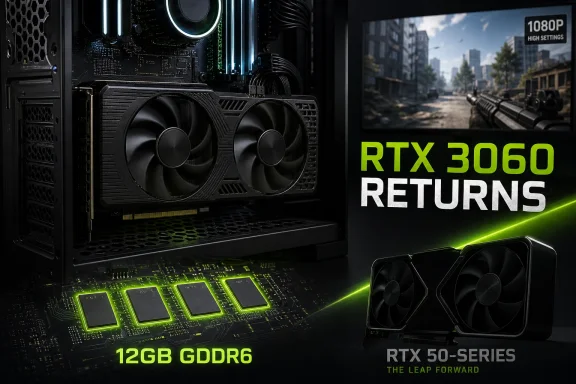
Palit has formally launched the GeForce RTX 3060 Infinity 2 OC, a newly designed dual-fan version of NVIDIA’s five-year-old 12GB Ampere card, giving the RTX 3060 an unexpected second retail life in July 2026. The practical catch is straightforward: this is not a modern GPU wearing an old name. It is the familiar 3,584-CUDA-core GeForce RTX 3060 with a modest boost-clock bump to 1,792 MHz, repackaged for a market where newer cards and memory have become harder to source at sensible prices.
Palit announced the card on July 15, calling it “the return of a classic” and emphasizing its 12GB GDDR6 memory pool, compact all-black cooler, and mainstream positioning. Tom’s Hardware, which first framed Palit’s announcement as a clear official sign of the RTX 3060 revival, reports that Palit will also offer a non-OC Infinity 2 version.
For Windows gamers and system builders, the key question will not be whether the RTX 3060 can still run current games. It can, especially at 1080p. The question is whether the card lands at a price low enough to justify buying 2021-era silicon in a 2026 market.
The Infinity 2 OC is a conventional two-slot, two-fan board with a reinforced, vented backplate. Palit says it is aimed at “smooth 1080p gaming,” and the design appears intended for ordinary ATX and compact desktop cases rather than the oversized, triple-slot class increasingly common at the high end.
Under that shroud is the original RTX 3060 12GB configuration: 3,584 CUDA cores, 12GB of GDDR6 memory, and a 192-bit memory bus. NVIDIA’s own RTX 3060 specification page still lists the reference 12GB model with a 1.78 GHz boost clock, 170W graphics-card power rating, a single eight-pin PCIe power connector, and a recommended 550W system power supply.
That makes the Infinity 2 OC’s 1,792 MHz boost clock notable mostly because it is not very notable. The factory overclock is under 1% above NVIDIA’s 1,777 MHz reference boost specification. Buyers should not expect a meaningful real-world frame-rate difference between this card and a standard-clock RTX 3060 12GB. The important change is board availability, not board performance.
Palit is also promising low-noise operation and a protective backplate intended to resist PCB flex. Those are sensible quality-of-life features for a budget card, but they do not transform the fundamentals: no advanced new media engine, no contemporary architecture gains, and no access to the latest RTX 50-series feature set.
That does not mean more VRAM automatically makes the RTX 3060 the better card. GPU compute performance, memory bandwidth, architecture efficiency, ray-tracing throughput, and upscaling support all still determine whether a title is actually enjoyable at a given setting. A card can avoid a VRAM-related stutter or texture downgrade and still lack the rendering performance needed for higher-quality presets.
Still, the 12GB configuration makes the revived RTX 3060 more defensible than a bare-minimum entry-level product. For a Windows 11 gaming PC driving a 1080p display, particularly an older system with a 550W-class power supply and a single eight-pin GPU lead, it could be a drop-in replacement for cards such as the GTX 1060, GTX 1660, or RTX 2060. The RTX 3060 also retains DirectX 12 Ultimate support, PCIe 4.0, Resizable BAR support, NVIDIA Broadcast, Reflex, and the existing ecosystem of Game Ready and Studio drivers.
That makes it a serviceable compatibility upgrade. It is not a forward-looking performance purchase at any price.
The explanation offered by recent hardware reporting is component economics. RTX 30-series products use older GDDR6 memory and Ampere silicon fabricated on Samsung’s 8nm process, while the RTX 50-series uses newer GDDR7 memory and more advanced manufacturing. In a component environment shaped by demand for AI infrastructure, older designs may be easier or cheaper to bring back into production or to support through remaining supply chains.
That may solve a narrow vendor problem: filling an affordable shelf position when a newer design cannot hit its intended price. It does not erase the generational gap for buyers. TweakTown estimates that NVIDIA’s GeForce RTX 5060 is roughly 50% faster in 1080p gaming than the RTX 3060, a difference too large for the Infinity 2 OC’s token clock increase to address.
The RTX 3060 also belongs to an older feature generation. It supports DLSS and hardware ray tracing, but it does not offer the newer DLSS multi-frame-generation capabilities associated with NVIDIA’s recent architectures. Gamers who prioritize high-refresh 1080p play, heavy ray tracing, or the newest AI-assisted performance features should treat the RTX 3060 as a fallback choice rather than a preferred one.
At a substantial discount to current-generation alternatives, a new 12GB RTX 3060 with a full warranty could make sense for basic 1080p systems, replacement builds, and buyers who care more about avoiding 8GB memory limits than maximizing FPS. It could also appeal to those upgrading older Windows desktops that cannot comfortably accommodate a large GPU or a power-hungry card with newer connector requirements.
At a price close to an RTX 5060, RTX 5060 Ti, or a discounted RTX 40-series card, the proposition collapses quickly. Better performance per watt, stronger ray tracing, newer encoder and display capabilities, and longer practical relevance would outweigh the RTX 3060’s extra memory in most gaming workloads. A well-priced used RTX 40-series card may likewise offer a more balanced upgrade, although buyers then trade a new-product warranty for a potentially faster GPU.
There is another complication for the used market: existing RTX 3060 owners should not assume that a “new” Infinity 2 OC has materially improved resale value for their card. Its launch confirms continued demand for the 12GB model, but the performance is unchanged. This is a supply refresh, not a new performance tier.
Palit’s Infinity 2 OC is therefore best understood as a newly manufactured answer to an old problem: mainstream gamers still need affordable GPUs, and suppliers appear willing to revisit Ampere if current-generation parts cannot meet that demand at the right cost. Until Palit discloses pricing and retailers begin listing the card, the RTX 3060’s comeback remains a hardware-industry curiosity with a potentially practical outcome—not yet a recommendation.
Palit announced the card on July 15, calling it “the return of a classic” and emphasizing its 12GB GDDR6 memory pool, compact all-black cooler, and mainstream positioning. Tom’s Hardware, which first framed Palit’s announcement as a clear official sign of the RTX 3060 revival, reports that Palit will also offer a non-OC Infinity 2 version.
For Windows gamers and system builders, the key question will not be whether the RTX 3060 can still run current games. It can, especially at 1080p. The question is whether the card lands at a price low enough to justify buying 2021-era silicon in a 2026 market.
 A New Board Around Very Old Silicon
The Infinity 2 OC is a conventional two-slot, two-fan board with a reinforced, vented backplate. Palit says it is aimed at “smooth 1080p gaming,” and the design appears intended for ordinary ATX and compact desktop cases rather than the oversized, triple-slot class increasingly common at the high end.Under that shroud is the original RTX 3060 12GB configuration: 3,584 CUDA cores, 12GB of GDDR6 memory, and a 192-bit memory bus. NVIDIA’s own RTX 3060 specification page still lists the reference 12GB model with a 1.78 GHz boost clock, 170W graphics-card power rating, a single eight-pin PCIe power connector, and a recommended 550W system power supply.
That makes the Infinity 2 OC’s 1,792 MHz boost clock notable mostly because it is not very notable. The factory overclock is under 1% above NVIDIA’s 1,777 MHz reference boost specification. Buyers should not expect a meaningful real-world frame-rate difference between this card and a standard-clock RTX 3060 12GB. The important change is board availability, not board performance.
Palit is also promising low-noise operation and a protective backplate intended to resist PCB flex. Those are sensible quality-of-life features for a budget card, but they do not transform the fundamentals: no advanced new media engine, no contemporary architecture gains, and no access to the latest RTX 50-series feature set.
The 12GB Number Still Has Weight
The RTX 3060’s unusual strength has always been memory capacity. Its 12GB frame buffer stands out against several newer mainstream cards that shipped with 8GB configurations, and it can matter in modern games when texture settings, ray tracing, mods, or high-resolution assets push VRAM usage upward.That does not mean more VRAM automatically makes the RTX 3060 the better card. GPU compute performance, memory bandwidth, architecture efficiency, ray-tracing throughput, and upscaling support all still determine whether a title is actually enjoyable at a given setting. A card can avoid a VRAM-related stutter or texture downgrade and still lack the rendering performance needed for higher-quality presets.
Still, the 12GB configuration makes the revived RTX 3060 more defensible than a bare-minimum entry-level product. For a Windows 11 gaming PC driving a 1080p display, particularly an older system with a 550W-class power supply and a single eight-pin GPU lead, it could be a drop-in replacement for cards such as the GTX 1060, GTX 1660, or RTX 2060. The RTX 3060 also retains DirectX 12 Ultimate support, PCIe 4.0, Resizable BAR support, NVIDIA Broadcast, Reflex, and the existing ecosystem of Game Ready and Studio drivers.
That makes it a serviceable compatibility upgrade. It is not a forward-looking performance purchase at any price.
Palit’s Launch Makes a Rumor Into a Supply Story
The wider significance of the Infinity 2 OC is that Palit’s announcement turns scattered reports of revived RTX 3060 inventory into an explicit product launch. According to Tom’s Hardware, Gigabyte and Manli had already begun listing renewed RTX 3060 variants in some markets before Palit’s official reveal.The explanation offered by recent hardware reporting is component economics. RTX 30-series products use older GDDR6 memory and Ampere silicon fabricated on Samsung’s 8nm process, while the RTX 50-series uses newer GDDR7 memory and more advanced manufacturing. In a component environment shaped by demand for AI infrastructure, older designs may be easier or cheaper to bring back into production or to support through remaining supply chains.
That may solve a narrow vendor problem: filling an affordable shelf position when a newer design cannot hit its intended price. It does not erase the generational gap for buyers. TweakTown estimates that NVIDIA’s GeForce RTX 5060 is roughly 50% faster in 1080p gaming than the RTX 3060, a difference too large for the Infinity 2 OC’s token clock increase to address.
The RTX 3060 also belongs to an older feature generation. It supports DLSS and hardware ray tracing, but it does not offer the newer DLSS multi-frame-generation capabilities associated with NVIDIA’s recent architectures. Gamers who prioritize high-refresh 1080p play, heavy ray tracing, or the newest AI-assisted performance features should treat the RTX 3060 as a fallback choice rather than a preferred one.
Price Will Decide Whether the Revival Is Useful
Palit has not announced a price or regional availability for the GeForce RTX 3060 Infinity 2 OC. That omission is the entire story from a buyer’s perspective.At a substantial discount to current-generation alternatives, a new 12GB RTX 3060 with a full warranty could make sense for basic 1080p systems, replacement builds, and buyers who care more about avoiding 8GB memory limits than maximizing FPS. It could also appeal to those upgrading older Windows desktops that cannot comfortably accommodate a large GPU or a power-hungry card with newer connector requirements.
At a price close to an RTX 5060, RTX 5060 Ti, or a discounted RTX 40-series card, the proposition collapses quickly. Better performance per watt, stronger ray tracing, newer encoder and display capabilities, and longer practical relevance would outweigh the RTX 3060’s extra memory in most gaming workloads. A well-priced used RTX 40-series card may likewise offer a more balanced upgrade, although buyers then trade a new-product warranty for a potentially faster GPU.
There is another complication for the used market: existing RTX 3060 owners should not assume that a “new” Infinity 2 OC has materially improved resale value for their card. Its launch confirms continued demand for the 12GB model, but the performance is unchanged. This is a supply refresh, not a new performance tier.
Palit’s Infinity 2 OC is therefore best understood as a newly manufactured answer to an old problem: mainstream gamers still need affordable GPUs, and suppliers appear willing to revisit Ampere if current-generation parts cannot meet that demand at the right cost. Until Palit discloses pricing and retailers begin listing the card, the RTX 3060’s comeback remains a hardware-industry curiosity with a potentially practical outcome—not yet a recommendation.
References
- Primary source: TweakTown
Published: 2026-07-16T04:31:07+00:00
Loading…
www.tweaktown.com - Independent coverage: Tom's Hardware
Published: 2026-07-15T11:59:06+00:00
Loading…
www.tomshardware.com - Related coverage: gamesradar.com
Loading…
www.gamesradar.com - Related coverage: techspot.com
Loading…
www.techspot.com - Related coverage: pcgamer.com
Loading…
www.pcgamer.com