

Pocketpair’s Palworld leaves Early Access on July 10 with version 1.0, a $29.99 full release that preserves existing save files while adding a Sky Island endgame region, rebuilt progression, redesigned bosses, expanded base construction, new equipment, and more new Pals than any previous update. The scale is visible before anyone even logs in: community manager Bucky says the patch notes run to 27 PDF pages and more than 66,000 characters, over twice Steam’s standard 32,000-character post limit. This is not merely a content drop with a ceremonial version number attached; it is Pocketpair’s attempt to turn a viral Early Access phenomenon into a durable platform. The central question is no longer whether the “Pokémon with guns” joke can attract attention, but whether Palworld can outgrow the comparison that made it famous.
Palworld entered Early Access in January 2024 under conditions that would have crushed a more conventional game. It was immediately legible as a mash-up—monster collecting, firearms, automation, base labor, multiplayer survival—and that legibility made it both irresistible and easy to dismiss. Critics could summarize the hook in four words, while millions of players could understand the fantasy without reading a design document.
The problem with a viral premise is that the premise can become a cage. If Palworld remained chiefly the game people streamed because its creatures could carry assault rifles or work assembly lines, its enormous launch would eventually look like a novelty spike rather than the beginning of a franchise. Version 1.0 is Pocketpair’s argument that the joke was only the acquisition strategy.
Windows Central’s preview of the launch trailer emphasizes how much sharper and broader the game now appears, but the more important evidence is structural. Pocketpair has not confined the release to a new zone and a bag of creatures. It has reworked early-to-mid-game progression, redesigned headline boss encounters, altered old regions, expanded building rules, introduced new traversal, and built a fresh endgame focal point above the existing map.
That breadth matters because Early Access games often accumulate content without resolving their underlying shape. New items arrive, maps grow, and systems multiply, but the opening hours still carry old assumptions and the middle of the game still exposes seams left by years of iterative development. Palworld 1.0 appears designed to attack that problem directly by making the journey through the game feel intentional from the start, not merely larger at the end.
Pocketpair’s own language is celebratory but revealing. “We are incredibly proud of how far Palworld has come. Thanks to the amazing support of our players, it has become a success beyond our wildest dreams.” The studio is talking about gratitude, but it is also acknowledging the unusual strategic freedom created by a game that reached 40 million players before its formal retail launch.
Bucky’s public struggle to format the notes is almost too perfect as launch marketing. Steam’s standard 32,000-character post limit is built for substantial updates, and Palworld’s notes reportedly exceed that ceiling by more than twofold. The message to lapsed players is uncomplicated: the game waiting on July 10 is not the same rough, explosively popular build they sampled in early 2024.
The more consequential change is the overhaul of progression. Pocketpair says old Early Access saves remain compatible, but the development team strongly recommends starting over because the early-to-mid-game path has been rebuilt. That is a difficult message to deliver after asking players to spend months collecting creatures, laying out production chains, and constructing elaborate bases.
It is also the honest message. Save compatibility protects player ownership and lowers the risk of updating, but compatibility is not the same thing as experiencing the new design. A veteran character dropped into an established world may preserve inventory, structures, and accomplishments while bypassing the very pacing changes intended to make 1.0 cohere.
This creates two valid launch experiences, neither of which should be treated as the universally correct one. Players attached to a long-running world can keep it, inspect what changed, and move toward the new endgame. Players who want to understand Pocketpair’s finished progression curve should create a fresh world and accept that repetition is the price of seeing the game as it is now designed.
For server operators and friend groups, that choice is not merely personal. A shared world contains negotiated territory, communal production, breeding infrastructure, resource routes, and the social history of a group. Resetting it can renew participation, but it can also erase the reason some players return. The sensible approach is to preserve the old world, then decide whether 1.0 deserves a parallel fresh start rather than treating deletion as a prerequisite.
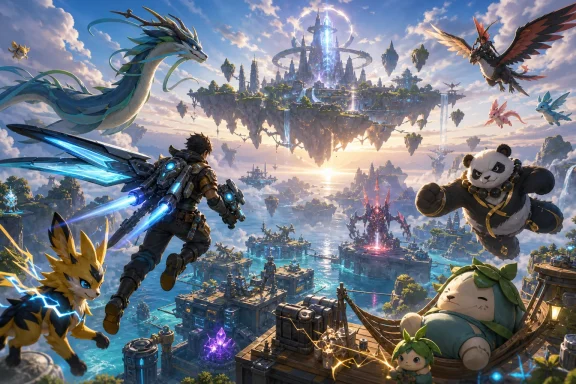
Verticality gives Pocketpair a way to separate this territory from the familiar survival-game rhythm of walking, riding, harvesting, and expanding across connected ground. The Wing pack—described as a jetpack with wings—is built around crossing the gaps of the new region. Traversal therefore becomes part of the biome’s identity rather than a convenience layered over a conventional landscape.
The new Sky Village is equally significant. A friendly inhabited settlement in the clouds can give the zone social texture and a sense that the world exists for reasons beyond resource extraction. Palworld’s strongest emergent stories have often come from player systems colliding; authored settlements and revised story material can provide firmer narrative scaffolding without turning the game into a linear campaign.
Older areas have also been visually and structurally reworked, while new spaces have been stitched into the world. That phrasing suggests Pocketpair understands the danger of attaching a premium-looking expansion to an unchanged foundation. If only the Sky Island looked like the finished game, returning players would feel the quality gap every time they descended.
The Wildlife Sanctuaries offer a smaller example of the same design philosophy. They are now enclosed by glowing shield bubbles, guarded by flying drone-type defenders, and occupied by powerful bosses. A location that previously read largely as a special-purpose resource area is being reframed as an encounter space with a stronger silhouette, clearer danger, and more explicit resistance.
Tower bosses receive an even more direct overhaul, with redesigned encounters, new mechanics, and revised scaling. Bosses are where survival sandboxes reveal whether their combat systems can carry authored pressure; ordinary enemies can be overwhelmed through preparation, but a marquee encounter must test movement, loadouts, creature choice, and player understanding. Rebuilding those fights is the sort of work expected from a 1.0 transition, even if it is less marketable than adding another island.
New roof variants and decorative statues broaden the architectural vocabulary. These additions may sound minor beside a new biome, yet long-lived survival games depend on players who treat construction as the endgame. A new boss can occupy an evening; a more flexible building kit can occupy hundreds of hours and generate the screenshots and videos that keep a community visible.
The redesigned expedition station addresses a different kind of building problem. Pocketpair has reportedly made it sleeker and less visually intrusive, recognizing that utility objects can become mandatory blemishes in carefully composed bases. This is a small but telling quality-of-life decision: the developers are designing for players who care not only whether a machine works, but whether it ruins the room.
The Fish Sword, by contrast, is Palworld refusing to become respectable at the cost of becoming bland. The weapon lets the player wield the literal spine of a fish Pal, echoing the absurdity of using Foxparks as a flamethrower. Alongside unnamed high-tier weapons, it signals that mechanical expansion will still be filtered through the game’s particular taste for cheerful creature design and casually alarming utility.
That tonal confidence matters. A more polished Palworld cannot simply sand away everything that made the Early Access release strange. The finished game must become easier to understand and more satisfying to progress through while preserving the dissonance that made players stop scrolling in the first place.
Ahri and the Crazy Dragon Serpent anchor the Sky Island’s boss mythology. Seekmet, quickly nicknamed “Catgirl Anubis” by the community, demonstrates how readily Palworld designs invite player shorthand. Soul Mora is an unusually fast swimmer that can reportedly be ridden at speed on dry land, turning an aquatic design into a traversal joke with mechanical value.
Lefan is a martial-arts panda positioned as a counterpart to Mossanda, while Venusa takes a Gorgon or Medusa motif and makes it deliberately goofy rather than severe. Tropica is a flightless raptor-bird hybrid with a huge floppy flower, Dupin is a rabbit-jester magician, and Snock brings an electric snail from the official comics into the game itself. These are not creatures drawn from one consistent zoological register; they are hooks aimed at different kinds of attachment.
Hoodle and its permanently exhausted-looking guardian show Pocketpair’s meme instincts at full strength. The Sleepy Pal’s appearance is described as though it desperately wants to go to bed at 6:00 PM, an oddly specific joke that is almost engineered for fan art and social posts. Puff, an electric puppy, and Pikmi, a tiny ghost child built around jump scares, occupy similarly clear emotional lanes.
The roster also includes a beetle-themed Egyptian warrior with arm-whips and a mysterious silhouette at the top of the World Tree. The latter is especially effective because it turns geography into anticipation: players are not merely being promised another creature, but a discovery associated with reaching the symbolic summit of Palworld’s map.
The design test is whether these creatures participate meaningfully in the revised systems. A survival-crafting roster can become a catalog of cosmetic preferences if too many creatures overlap mechanically. Version 1.0 will be judged not only by how many Pals players want to catch, but by whether catching them changes traversal, production, combat planning, or base organization.
The distinction between players and copies sold is essential. GamesRadar correctly notes that Game Pass access means the 40 million figure cannot be treated as 40 million retail sales. Even with that caveat, the number establishes a vast addressable audience of owners, subscribers, lapsed users, and curious players who have already crossed the hardest barrier: they know what Palworld is.
Pocketpair is keeping the retail-launch price at $29.99 rather than using the 1.0 milestone to raise it. Early Access developers often increase prices as content and confidence grow, rewarding early buyers while asking later customers to pay for a more complete product. Palworld is taking the opposite path because scale gives it the luxury of prioritizing reactivation and expansion over extracting more revenue from each new purchase.
That price is therefore not simply generous; it is strategic. A $29.99 launch keeps the friction low for groups trying to recruit another friend, for Game Pass players considering ownership, and for people who watched the original phenomenon from a distance. It also makes the 1.0 update feel like a reason to return rather than a toll gate placed at the end of Early Access.
The studio frames the decision as thanks for support that created “a success beyond our wildest dreams.” That is credible, but gratitude and platform economics can coexist. Pocketpair benefits when the community is large, multiplayer worlds are populated, creators have new material, and every old owner sees the launch as added value rather than an upsell.
Palworld’s 40 million-player milestone also changes the burden of proof. An unknown survival game can survive technical problems as part of Early Access’s implied bargain. A formally launched game with an audience this large will be judged against the expectations created by its own success: stable saves, functioning multiplayer, predictable servers, coherent progression, and rapid handling of launch defects.
But Pocketpair’s recommendation to begin again should not be dismissed as marketing for replayability. If brand-new Pals have been redistributed through the early game and the leveling journey has been rebuilt, an advanced save can conceal the work. The player sees the destination but not the repaired road.
The right choice depends on what a player values. A builder with a beloved waterfront complex may want to load the old world immediately and test floating foundations. A progression-focused group that quit after the initial rush may gain more from a clean start that lets new creature distribution, boss scaling, and pacing changes unfold naturally.
For many communities, the third option is the least dramatic and most informative. Archive the old world, launch a fresh one, and revisit the original after the opening weeks. Storage is cheaper than regret, and a reversible choice is better than turning launch-night enthusiasm into permanent data loss.
Los Angeles is scheduled for 8:30 PM PT on Thursday, followed by New York at 11:30 PM ET. London receives the update at 4:30 AM BST Friday, Tokyo at 12:30 PM JST, and Sydney at 1:30 PM AEST. Players should treat those as scheduled release times rather than a guarantee that every storefront, server, and client will surface the update at precisely the same second.
Last month — Pocketpair reveals version 1.0 at Summer Game Fest, establishing July 10 as the end of the Early Access period.
July 8, 2026 — Pocketpair announces that Palworld has reached 40 million total players across all platforms.
July 9, 2026 — Pocketpair releases the official 1.0 launch trailer; the scheduled rollout begins that evening in Los Angeles and New York.
July 10, 2026 — Palworld officially exits Early Access worldwide as version 1.0.
The sequence is unusually compressed. Pocketpair moved from formal reveal to full launch in roughly a month, then placed the player milestone, trailer, patch-note spectacle, and worldwide release into a tightly managed final week. That approach limits the period in which expectations can drift away from the actual build.
The status must be described carefully. The case remains ongoing; version 1.0 is not a court-certified victory, and a launch trailer is not a legal judgment. According to the newer reporting summarized by Windows Central, however, Pocketpair’s proactive changes to capture and mounting systems have narrowed the dispute’s practical scope to older Early Access builds, with best-case damages for the plaintiffs described as the equivalent of about $30,000.
That reported narrowing changes the business meaning of the case even if it does not erase the case itself. An injunction threatening the current product could shape roadmaps, platform support, marketing, and investment. A dispute focused on historical builds and comparatively limited damages is still expensive and distracting, but it is less capable of holding the current game hostage.
The legal story also exposes why Pocketpair’s mechanics work matters as much as its content volume. Reworking overworld capture and mounting was not simply balance tuning; according to the source coverage, it reduced exposure while preserving the game’s broader identity. The studio’s survival depended on distinguishing between the fantasy players came for and the exact interactions that could be challenged.
Some coverage has treated the reduced damages estimate as proof that Nintendo “lost,” while official statements establish only that litigation was filed and remains contested. The defensible conclusion is narrower: Palworld reaches 1.0 in a substantially stronger operating position than the phrase “Nintendo lawsuit” once implied. Pocketpair can market a full release, preserve saves, sell the game at the same price, and put its most recognizable collection mechanics in front of a global audience without presenting the launch as provisional.
There is an irony here. The lawsuit helped keep Palworld attached to Pokémon in the public imagination at the exact moment Pocketpair needed to establish an independent identity. Version 1.0 cannot end that association by argument; it can only make the comparison less useful by offering systems, places, and player stories that Pokémon does not attempt to provide.
Pocketpair’s actual competitors are every persistent game asking players to return this weekend. Version 1.0 must persuade lapsed owners to reinstall, convince active players to restart or migrate, and give creators enough surprising material to rebuild momentum. A huge historical player count helps, but it also creates a graveyard of people who already decided once that they were finished.
That is why the early-game overhaul may matter more than the Sky Island in the long run. Endgame content rewards the faithful; a reconstructed opening wins back the departed. If the first hours still feel disorganized, grind-heavy, or technically unstable, the 40 million-player announcement will describe the past rather than secure the future.
The $29.99 price, compatible saves, and simultaneous release reduce obvious obstacles. The 66,000-character changelog gives Pocketpair a powerful proof-of-work narrative. What remains cannot be settled by a trailer: performance, multiplayer reliability, pacing, balance, and whether the revised systems create a game that feels finished rather than merely enormous.
 Version 1.0 Is Pocketpair’s Bid to Control the Story
Palworld entered Early Access in January 2024 under conditions that would have crushed a more conventional game. It was immediately legible as a mash-up—monster collecting, firearms, automation, base labor, multiplayer survival—and that legibility made it both irresistible and easy to dismiss. Critics could summarize the hook in four words, while millions of players could understand the fantasy without reading a design document.The problem with a viral premise is that the premise can become a cage. If Palworld remained chiefly the game people streamed because its creatures could carry assault rifles or work assembly lines, its enormous launch would eventually look like a novelty spike rather than the beginning of a franchise. Version 1.0 is Pocketpair’s argument that the joke was only the acquisition strategy.
Windows Central’s preview of the launch trailer emphasizes how much sharper and broader the game now appears, but the more important evidence is structural. Pocketpair has not confined the release to a new zone and a bag of creatures. It has reworked early-to-mid-game progression, redesigned headline boss encounters, altered old regions, expanded building rules, introduced new traversal, and built a fresh endgame focal point above the existing map.
That breadth matters because Early Access games often accumulate content without resolving their underlying shape. New items arrive, maps grow, and systems multiply, but the opening hours still carry old assumptions and the middle of the game still exposes seams left by years of iterative development. Palworld 1.0 appears designed to attack that problem directly by making the journey through the game feel intentional from the start, not merely larger at the end.
Pocketpair’s own language is celebratory but revealing. “We are incredibly proud of how far Palworld has come. Thanks to the amazing support of our players, it has become a success beyond our wildest dreams.” The studio is talking about gratitude, but it is also acknowledging the unusual strategic freedom created by a game that reached 40 million players before its formal retail launch.
A 66,000-Character Changelog Signals More Than Volume
Patch-note length is an imperfect measure of quality. A bloated changelog can reflect meaningful systems work, hundreds of trivial adjustments, or simply an editorial team that documents everything. Yet 27 PDF pages and more than 66,000 characters are still useful evidence that version 1.0 reaches across Palworld rather than decorating one corner of it.Bucky’s public struggle to format the notes is almost too perfect as launch marketing. Steam’s standard 32,000-character post limit is built for substantial updates, and Palworld’s notes reportedly exceed that ceiling by more than twofold. The message to lapsed players is uncomplicated: the game waiting on July 10 is not the same rough, explosively popular build they sampled in early 2024.
The more consequential change is the overhaul of progression. Pocketpair says old Early Access saves remain compatible, but the development team strongly recommends starting over because the early-to-mid-game path has been rebuilt. That is a difficult message to deliver after asking players to spend months collecting creatures, laying out production chains, and constructing elaborate bases.
It is also the honest message. Save compatibility protects player ownership and lowers the risk of updating, but compatibility is not the same thing as experiencing the new design. A veteran character dropped into an established world may preserve inventory, structures, and accomplishments while bypassing the very pacing changes intended to make 1.0 cohere.
This creates two valid launch experiences, neither of which should be treated as the universally correct one. Players attached to a long-running world can keep it, inspect what changed, and move toward the new endgame. Players who want to understand Pocketpair’s finished progression curve should create a fresh world and accept that repetition is the price of seeing the game as it is now designed.
For server operators and friend groups, that choice is not merely personal. A shared world contains negotiated territory, communal production, breeding infrastructure, resource routes, and the social history of a group. Resetting it can renew participation, but it can also erase the reason some players return. The sensible approach is to preserve the old world, then decide whether 1.0 deserves a parallel fresh start rather than treating deletion as a prerequisite.
The Sky Island Gives the Endgame a Destination
The headline environmental addition is the Sky Island biome, a large floating region suspended above the Palpagos archipelago. It functions as the visual center of the launch trailer and, according to the source coverage, as the focal point for endgame exploration. That positioning tells us something important about Pocketpair’s priorities: 1.0 needs a place that feels like a culmination, not simply another landmass on the edge of the map.Verticality gives Pocketpair a way to separate this territory from the familiar survival-game rhythm of walking, riding, harvesting, and expanding across connected ground. The Wing pack—described as a jetpack with wings—is built around crossing the gaps of the new region. Traversal therefore becomes part of the biome’s identity rather than a convenience layered over a conventional landscape.
The new Sky Village is equally significant. A friendly inhabited settlement in the clouds can give the zone social texture and a sense that the world exists for reasons beyond resource extraction. Palworld’s strongest emergent stories have often come from player systems colliding; authored settlements and revised story material can provide firmer narrative scaffolding without turning the game into a linear campaign.
Older areas have also been visually and structurally reworked, while new spaces have been stitched into the world. That phrasing suggests Pocketpair understands the danger of attaching a premium-looking expansion to an unchanged foundation. If only the Sky Island looked like the finished game, returning players would feel the quality gap every time they descended.
The Wildlife Sanctuaries offer a smaller example of the same design philosophy. They are now enclosed by glowing shield bubbles, guarded by flying drone-type defenders, and occupied by powerful bosses. A location that previously read largely as a special-purpose resource area is being reframed as an encounter space with a stronger silhouette, clearer danger, and more explicit resistance.
Tower bosses receive an even more direct overhaul, with redesigned encounters, new mechanics, and revised scaling. Bosses are where survival sandboxes reveal whether their combat systems can carry authored pressure; ordinary enemies can be overwhelmed through preparation, but a marquee encounter must test movement, loadouts, creature choice, and player understanding. Rebuilding those fights is the sort of work expected from a 1.0 transition, even if it is less marketable than adding another island.
Base Building Finally Pushes Past the Shoreline
Palworld’s base system has always been central to its identity because it turns captured creatures into workers, logistics nodes, and sources of chaos. Version 1.0 expands that identity with floating foundations that can extend construction directly over water. The practical effect is more buildable space, but the creative effect is larger: coastlines stop being hard borders and become design opportunities.New roof variants and decorative statues broaden the architectural vocabulary. These additions may sound minor beside a new biome, yet long-lived survival games depend on players who treat construction as the endgame. A new boss can occupy an evening; a more flexible building kit can occupy hundreds of hours and generate the screenshots and videos that keep a community visible.
The redesigned expedition station addresses a different kind of building problem. Pocketpair has reportedly made it sleeker and less visually intrusive, recognizing that utility objects can become mandatory blemishes in carefully composed bases. This is a small but telling quality-of-life decision: the developers are designing for players who care not only whether a machine works, but whether it ruins the room.
The Fish Sword, by contrast, is Palworld refusing to become respectable at the cost of becoming bland. The weapon lets the player wield the literal spine of a fish Pal, echoing the absurdity of using Foxparks as a flamethrower. Alongside unnamed high-tier weapons, it signals that mechanical expansion will still be filtered through the game’s particular taste for cheerful creature design and casually alarming utility.
That tonal confidence matters. A more polished Palworld cannot simply sand away everything that made the Early Access release strange. The finished game must become easier to understand and more satisfying to progress through while preserving the dissonance that made players stop scrolling in the first place.
The New Pals Are a Roster Expansion and a Design Test
Pocketpair is adding more new Pals in this update than in all prior patches combined, according to the launch coverage. Quantity will dominate the immediate discussion, but variety is the more revealing metric. The announced creatures range from tower-boss spectacle to mobility tools, comic relief, combat partners, and community-ready mascots.Ahri and the Crazy Dragon Serpent anchor the Sky Island’s boss mythology. Seekmet, quickly nicknamed “Catgirl Anubis” by the community, demonstrates how readily Palworld designs invite player shorthand. Soul Mora is an unusually fast swimmer that can reportedly be ridden at speed on dry land, turning an aquatic design into a traversal joke with mechanical value.
Lefan is a martial-arts panda positioned as a counterpart to Mossanda, while Venusa takes a Gorgon or Medusa motif and makes it deliberately goofy rather than severe. Tropica is a flightless raptor-bird hybrid with a huge floppy flower, Dupin is a rabbit-jester magician, and Snock brings an electric snail from the official comics into the game itself. These are not creatures drawn from one consistent zoological register; they are hooks aimed at different kinds of attachment.
Hoodle and its permanently exhausted-looking guardian show Pocketpair’s meme instincts at full strength. The Sleepy Pal’s appearance is described as though it desperately wants to go to bed at 6:00 PM, an oddly specific joke that is almost engineered for fan art and social posts. Puff, an electric puppy, and Pikmi, a tiny ghost child built around jump scares, occupy similarly clear emotional lanes.
The roster also includes a beetle-themed Egyptian warrior with arm-whips and a mysterious silhouette at the top of the World Tree. The latter is especially effective because it turns geography into anticipation: players are not merely being promised another creature, but a discovery associated with reaching the symbolic summit of Palworld’s map.
The design test is whether these creatures participate meaningfully in the revised systems. A survival-crafting roster can become a catalog of cosmetic preferences if too many creatures overlap mechanically. Version 1.0 will be judged not only by how many Pals players want to catch, but by whether catching them changes traversal, production, combat planning, or base organization.
Forty Million Players Changes the Economics of Leaving Early Access
Palworld’s launch history gives Pocketpair room to make choices that would be difficult for a smaller Early Access project. More than 7 million players joined through its Xbox Game Pass launch, which Windows Central described as Xbox’s biggest third-party Game Pass debut. Across all platforms, Pocketpair now reports 40 million total players.The distinction between players and copies sold is essential. GamesRadar correctly notes that Game Pass access means the 40 million figure cannot be treated as 40 million retail sales. Even with that caveat, the number establishes a vast addressable audience of owners, subscribers, lapsed users, and curious players who have already crossed the hardest barrier: they know what Palworld is.
Pocketpair is keeping the retail-launch price at $29.99 rather than using the 1.0 milestone to raise it. Early Access developers often increase prices as content and confidence grow, rewarding early buyers while asking later customers to pay for a more complete product. Palworld is taking the opposite path because scale gives it the luxury of prioritizing reactivation and expansion over extracting more revenue from each new purchase.
That price is therefore not simply generous; it is strategic. A $29.99 launch keeps the friction low for groups trying to recruit another friend, for Game Pass players considering ownership, and for people who watched the original phenomenon from a distance. It also makes the 1.0 update feel like a reason to return rather than a toll gate placed at the end of Early Access.
The studio frames the decision as thanks for support that created “a success beyond our wildest dreams.” That is credible, but gratitude and platform economics can coexist. Pocketpair benefits when the community is large, multiplayer worlds are populated, creators have new material, and every old owner sees the launch as added value rather than an upsell.
Palworld’s 40 million-player milestone also changes the burden of proof. An unknown survival game can survive technical problems as part of Early Access’s implied bargain. A formally launched game with an audience this large will be judged against the expectations created by its own success: stable saves, functioning multiplayer, predictable servers, coherent progression, and rapid handling of launch defects.
Keeping Old Saves Is the Right Promise—Starting Fresh May Be the Better Choice
Backward compatibility is one of the most important commitments in the release. Pocketpair confirms that old Early Access save files will continue to work, avoiding the forced wipe that can turn a major update into a community fracture. For players with intricate bases or rare collections, that promise may matter more than any new Pal.But Pocketpair’s recommendation to begin again should not be dismissed as marketing for replayability. If brand-new Pals have been redistributed through the early game and the leveling journey has been rebuilt, an advanced save can conceal the work. The player sees the destination but not the repaired road.
The right choice depends on what a player values. A builder with a beloved waterfront complex may want to load the old world immediately and test floating foundations. A progression-focused group that quit after the initial rush may gain more from a clean start that lets new creature distribution, boss scaling, and pacing changes unfold naturally.
| Launch approach | What it preserves | What it reveals | Main risk |
|---|---|---|---|
| Continue an Early Access save | Existing bases, collections, equipment, and shared history | New endgame content and system changes from an established position | Revised early progression may be skipped or distorted |
| Start a fresh 1.0 world | Nothing beyond player knowledge | The intended early-to-mid-game curve, new Pal distribution, and rebuilt pacing | Time already invested must be repeated |
| Keep both worlds | The original save remains available while a new run begins | A direct comparison between legacy progression and the 1.0 design | Groups may split attention between servers |
Action checklist for admins
- Back up the complete world and player-save data before applying version 1.0.
- Record the current server settings and any non-default configuration before maintenance.
- Check whether mods, management tools, and automation depend on the Early Access build, and disable unverified components for the first launch.
- Decide with the player group whether the main server will migrate, restart, or run old and new worlds in parallel.
- Schedule a maintenance window around the global release and allow extra time for downloading, validation, and first-boot conversion.
- Keep the pre-1.0 backup untouched until the migrated world has been played and verified.
The Global Launch Turns Thursday Night Into Friday Morning
Palworld 1.0 releases simultaneously worldwide, producing different calendar dates across regions. For U.S. players, the practical launch is Thursday night, July 9; Europe, Japan, and Australia receive it on Friday, July 10. The timing favors an immediate weekend surge but also concentrates download demand, multiplayer activity, and bug discovery into the same narrow window.Los Angeles is scheduled for 8:30 PM PT on Thursday, followed by New York at 11:30 PM ET. London receives the update at 4:30 AM BST Friday, Tokyo at 12:30 PM JST, and Sydney at 1:30 PM AEST. Players should treat those as scheduled release times rather than a guarantee that every storefront, server, and client will surface the update at precisely the same second.
Timeline
January 2024 — Palworld launches in Early Access and becomes a viral hit, drawing more than 7 million players through Xbox Game Pass.Last month — Pocketpair reveals version 1.0 at Summer Game Fest, establishing July 10 as the end of the Early Access period.
July 8, 2026 — Pocketpair announces that Palworld has reached 40 million total players across all platforms.
July 9, 2026 — Pocketpair releases the official 1.0 launch trailer; the scheduled rollout begins that evening in Los Angeles and New York.
July 10, 2026 — Palworld officially exits Early Access worldwide as version 1.0.
The sequence is unusually compressed. Pocketpair moved from formal reveal to full launch in roughly a month, then placed the player milestone, trailer, patch-note spectacle, and worldwide release into a tightly managed final week. That approach limits the period in which expectations can drift away from the actual build.
Nintendo’s Lawsuit Still Matters, but It No Longer Defines the Product
Palworld’s journey to 1.0 has unfolded under an ongoing patent lawsuit in Japan involving Nintendo and The Pokémon Company. Pocketpair’s official account of the original action said the plaintiffs sought an injunction and damages, making the legal threat materially more serious than online arguments about whether one creature resembled another. Patent litigation targets mechanics and implementation, not merely the broad cultural accusation that Palworld looked too much like Pokémon.The status must be described carefully. The case remains ongoing; version 1.0 is not a court-certified victory, and a launch trailer is not a legal judgment. According to the newer reporting summarized by Windows Central, however, Pocketpair’s proactive changes to capture and mounting systems have narrowed the dispute’s practical scope to older Early Access builds, with best-case damages for the plaintiffs described as the equivalent of about $30,000.
That reported narrowing changes the business meaning of the case even if it does not erase the case itself. An injunction threatening the current product could shape roadmaps, platform support, marketing, and investment. A dispute focused on historical builds and comparatively limited damages is still expensive and distracting, but it is less capable of holding the current game hostage.
The legal story also exposes why Pocketpair’s mechanics work matters as much as its content volume. Reworking overworld capture and mounting was not simply balance tuning; according to the source coverage, it reduced exposure while preserving the game’s broader identity. The studio’s survival depended on distinguishing between the fantasy players came for and the exact interactions that could be challenged.
Some coverage has treated the reduced damages estimate as proof that Nintendo “lost,” while official statements establish only that litigation was filed and remains contested. The defensible conclusion is narrower: Palworld reaches 1.0 in a substantially stronger operating position than the phrase “Nintendo lawsuit” once implied. Pocketpair can market a full release, preserve saves, sell the game at the same price, and put its most recognizable collection mechanics in front of a global audience without presenting the launch as provisional.
There is an irony here. The lawsuit helped keep Palworld attached to Pokémon in the public imagination at the exact moment Pocketpair needed to establish an independent identity. Version 1.0 cannot end that association by argument; it can only make the comparison less useful by offering systems, places, and player stories that Pokémon does not attempt to provide.
The Real Rival Is Not Pokémon but Player Indifference
The most tempting framing is that Nintendo should be worried because Palworld has survived. That is emotionally satisfying, particularly for players who viewed the legal action as a giant attempting to suppress an upstart, but it oversimplifies the competitive landscape. Palworld does not need to defeat Pokémon to succeed, and Pokémon does not need to become a survival-crafting automation game to answer it.Pocketpair’s actual competitors are every persistent game asking players to return this weekend. Version 1.0 must persuade lapsed owners to reinstall, convince active players to restart or migrate, and give creators enough surprising material to rebuild momentum. A huge historical player count helps, but it also creates a graveyard of people who already decided once that they were finished.
That is why the early-game overhaul may matter more than the Sky Island in the long run. Endgame content rewards the faithful; a reconstructed opening wins back the departed. If the first hours still feel disorganized, grind-heavy, or technically unstable, the 40 million-player announcement will describe the past rather than secure the future.
The $29.99 price, compatible saves, and simultaneous release reduce obvious obstacles. The 66,000-character changelog gives Pocketpair a powerful proof-of-work narrative. What remains cannot be settled by a trailer: performance, multiplayer reliability, pacing, balance, and whether the revised systems create a game that feels finished rather than merely enormous.
What Players Should Carry Into Launch Weekend
The launch is best understood as a reset of expectations, not a reset of ownership. Pocketpair is preserving the worlds players built while asking them to consider the value of beginning again, and it is holding the price steady while delivering its largest update.- Version 1.0 launches worldwide on July 10, with U.S. release times falling late on July 9.
- Existing Early Access saves remain compatible, but a fresh world is the clearest way to experience the rebuilt progression.
- The update’s centerpiece is the Sky Island endgame region, supported by new traversal, a Sky Village, revised bosses, and reworked older areas.
- Base builders gain floating water foundations, more architectural options, and a less intrusive expedition station.
- Pocketpair reports 40 million total players and is keeping the retail price at $29.99.
- The Japanese patent lawsuit remains ongoing, but newer reporting says its practical scope has narrowed to older builds and limited potential damages.
References
- Primary source: Windows Central
Published: 2026-07-09T15:20:33.591602
Loading…
www.windowscentral.com - Related coverage: gamesradar.com
Loading…
www.gamesradar.com - Related coverage: legalclarity.org
Loading…
legalclarity.org - Related coverage: playstation.com
Loading…
www.playstation.com - Related coverage: iipla.org
Loading…
iipla.org - Related coverage: gamedeveloper.com
Loading…
www.gamedeveloper.com