

Paramount Skydance is turning its next return-to-office push into a manager training exercise, and the tone is unmistakable: sell the policy as culture, not just compliance. According to the internal material described by Business Insider, leaders are being coached to answer resistance with empathy, team bonding, and even Microsoft Copilot prompts for activity ideas, while the company simultaneously warns that missed attendance can lead to discipline or dismissal. The move signals that David Ellison’s workplace reset is no longer just about where people sit; it is about how management is expected to enforce a more rigid corporate identity. unt’s “Phase 2” return-to-office rollout lands in a media industry that still has not fully settled on what “normal” work should look like. The company’s New York and Los Angeles staff were already back in the office five days a week earlier in 2026, but this new phase broadens the mandate to employees assigned to U.S. offices outside those two hubs. The timing matters because the company is not merely adjusting logistics; it is codifying a philosophy of management in which in-person presence is treated as a strategic asset.
That strategy refleroader argument that Paramount needs to become a “next gen media and entertainment company” built around tighter collaboration, faster execution, and more visible accountability. Business Insider’s report makes clear that the company is not leaving the message to chance. Managers are being given a toolkit, a script, and a set of escalation paths, suggesting the company understands that the most difficult part of an RTO mandate is not the policy itself but the human friction it creates.
The most revealing part of the story is le. It is the management philosophy behind it. By instructing managers to invite resistance-prone workers out for coffee, lunch, or team-building activities, Paramount is acknowledging that compliance alone does not create cohesion. Yet the same company is also positioning attendance tracking as a discipline issue, which means the culture pitch and the enforcement mechanism are moving in tandem rather than in opposition.
This approach places Paramount at the center of a much broade America. Many employers have grown more assertive about in-person work since the pandemic-era remote boom, but few have tied the policy so directly to manager behavior and AI-assisted internal coaching. That makes this rollout noteworthy not only for Hollywood watchers, but for anyone trying to understand where workplace power is heading in 2026.
Paramount’s current posture did not appear overnight. The company’s post-merger leadership has spent months signaling that cost discipline, operational simplification, and a more centralized culture would define the new era. Earlier reporting showed the company’s first phase required Los Angeles and New York employees at the vice president level and below to either accept in-office work or leave through a voluntary severance path.
That earlier phase was important because it established the template for what is happening now. Rather than framing return-to-office as a soft preference, Paramount made it a structural test of whether employees wanted to remain inside the company’s evolving model. The new phase extends that logic to additional U.S. offices, while leaving some remote workers outside commuting distance with a longer runway before their own in-person expectations begin in 2027.
The company’s messaging also ave of executive skepticism about fully remote work. Across industries, leaders have argued that office presence supports faster collaboration, stronger oversight, and better cultural transmission. Media companies in particular often believe their businesses depend on informal coordination, creative proximity, and rapid decision-making, which makes them especially prone to favor office-first models.
Still, Paramount’s case stands out because of the way it merges policy and persuasion. The toolkit described by Business Insider suggests management is expected to do more than relay instructions. Leaders are being positioned as culture brokers, troubleshooting interpersonal resistance one conversation at a time. That is a notably labor-intensive approach, and it hints at an internal recognition that thorkers for more than a commute.
At the same time, the company has made clear that it does not intend for the policy to remain optional in practice. According to the report, managers will eventually gain access to attendance data, and staff who do not comply can face escalating consequences. That combination of delayed visibility, eventual monitoring, and possible discipline creates a phased enforcement model that is m symbolic.
The toolkit’s logic is obvious enough: if employees feel socially attached to the workplace, they may be less likely to treat office attendance as an arbitrary demand. That is why the document reportedly recommends coffee chats, luncheactivities. In other words, Paramount is trying to make office time feel relational instead of punitive, even while the policy itself becomes more punitive over time.
That dual use is what makes the toolkit interesting from a management standpoint. It is both humane and surveillance-friendly, which is exactly the sort of tension modern workplace policy often tries to conceal. Paramount appears to be betting that if managers can sound empathetic enou more likely to accept a policy that is already nonnegotiable. That is a clever tactic, but not necessarily a popular one.
This matters because enforcement is where most RTO policies run into trouble. A memo is easy. Measuring attendance across multiple offices, roles, and exceptions is much harder. Paramount is trying to solve that problem by first training managers to handle the interpersonal side and then, later, giving them access to attendance data so they canence.
That argument has particular force in a company trying to reinvent itself. A transformation of this scale requires fast cross-functional coordination, and leadership may believe that office proximity makes those interactions easier to achieve. In media, where priorities can shift quickly and creative, technical, and commercial teams all need to align, the case for in-person speed can sound persuasive, at least from the boardroom.
There is also a symbolic dimension here. By making the office the default again, Ellison is drawing a line between the old Paramount and the new one. Many executives have softened their RTO rhetoric over time; Paramount appears to be going in the other direction. That creates a sense of decisiveness, which can be useful during corporate integration, even if it also raises the risk of employee resentment.
That tension explains why the response is often so polarized. Executives see a culture they believe can be strengthened. Employees see a return of control that may not be justified by day-to-day reality. In media companies, where layoffs, restructuring, and content-market volatility already create unease, office mandates can land as another layer of top-down pressure.
The company may believe that being more rigid now will create a cleaner operating model later. That would fit the logic of a turnaround: make the hard calls early, absorb the pain, and build a different culture from the ground up. But in practice, office policy is rarely isolated from broader labor sentiment. If employees view the mandate as symbolic overreach, the company may gain compliance while losing goodwill.
That split is especially sharp for employees who do not live near a Paramount office. The report says some full-time remote workers who are not near any company offices will be expected to return in 2027. That longer timeline acknowledges that commuting is not a simple toggle, but it also extends uncertainty for workers who may feel they are living under a delayed ultimatum.
For managers, the burden is broader than the employee count suggests. They must explain the policy, interpret exceptions, document issues, and maintain team cohesion while answering to leadership. e conflict: the same manager is expected to be both advocate and enforcer, which is one of the least comfortable positions in corporate life.
The emotional divide here should not be underestimated. A return-to-office rule is never just about desks and calendars. It is about whether the company believes proximity creates value, or whether proximity is being used as a proxy for control. Paramount’s language suggests it wants both outcomes, which is ambitious and potentially unstable.
That may sound harmless, but it says a lot about the changing texture of work. AI tools are increasingly being used not just to draft emails or summarize meetings, but to shape interpersonal behavior inside the company. In that sense, Paramount is not merely adopting AI; it is normalizing AI as a management assistant for culture-making itself.
There is a downside, of course. If leaders rely too much on machine-generated social scripts, they may become less authentic in exactly the moments when authenticity matters most. Employees can sense when a manager is speaking from conviction and when they are reading from a corporate playbook. AI can help with structure, but it cannot manufacture trust on demand.
The company also has a chance to refine the employee experience around in-person work rather than merely mandate it. If Paramount invests in better collaboration spaces, stronger team rituals, and genuinely useful office routines, the policy could feel less like a penalty and more like a workplace redesign. That would be the best-case scenario.
A second concern is managerial burnout. The more responsibility managers have for policing attendance, the less time they have for actual leadership. If Paramount wants managers to act as cut cannot also drown them in compliance duties without consequences. The “hall monitor” complaint is not a throwaway line; it is a warning sign.
Finally, there is the broader reputational issue. In a labor market where flexibility remains a powerful retention tool, a strict office mandate can make a company look less modern, not more. Paramount may believe it is sigmployees may interpret it as a shrinking of trust. That gap in interpretation is where policies like this often break down.
The other important question is how quickly the company turns on attendance visibility for managers. Once data becomes available, the policy changes from cultural messaging to measurable compliance enforcement. That is usually the point at which office mandates become most consequential, because managers can no longer rely on impressions or informal relationships.
Source: Business Insider How Paramount wants its managers to talk about David Ellison's new RTO mandate
That strategy refleroader argument that Paramount needs to become a “next gen media and entertainment company” built around tighter collaboration, faster execution, and more visible accountability. Business Insider’s report makes clear that the company is not leaving the message to chance. Managers are being given a toolkit, a script, and a set of escalation paths, suggesting the company understands that the most difficult part of an RTO mandate is not the policy itself but the human friction it creates.
The most revealing part of the story is le. It is the management philosophy behind it. By instructing managers to invite resistance-prone workers out for coffee, lunch, or team-building activities, Paramount is acknowledging that compliance alone does not create cohesion. Yet the same company is also positioning attendance tracking as a discipline issue, which means the culture pitch and the enforcement mechanism are moving in tandem rather than in opposition.
This approach places Paramount at the center of a much broade America. Many employers have grown more assertive about in-person work since the pandemic-era remote boom, but few have tied the policy so directly to manager behavior and AI-assisted internal coaching. That makes this rollout noteworthy not only for Hollywood watchers, but for anyone trying to understand where workplace power is heading in 2026.
 Background
Paramount’s current posture did not appear overnight. The company’s post-merger leadership has spent months signaling that cost discipline, operational simplification, and a more centralized culture would define the new era. Earlier reporting showed the company’s first phase required Los Angeles and New York employees at the vice president level and below to either accept in-office work or leave through a voluntary severance path.That earlier phase was important because it established the template for what is happening now. Rather than framing return-to-office as a soft preference, Paramount made it a structural test of whether employees wanted to remain inside the company’s evolving model. The new phase extends that logic to additional U.S. offices, while leaving some remote workers outside commuting distance with a longer runway before their own in-person expectations begin in 2027.
The company’s messaging also ave of executive skepticism about fully remote work. Across industries, leaders have argued that office presence supports faster collaboration, stronger oversight, and better cultural transmission. Media companies in particular often believe their businesses depend on informal coordination, creative proximity, and rapid decision-making, which makes them especially prone to favor office-first models.
Still, Paramount’s case stands out because of the way it merges policy and persuasion. The toolkit described by Business Insider suggests management is expected to do more than relay instructions. Leaders are being positioned as culture brokers, troubleshooting interpersonal resistance one conversation at a time. That is a notably labor-intensive approach, and it hints at an internal recognition that thorkers for more than a commute.
At the same time, the company has made clear that it does not intend for the policy to remain optional in practice. According to the report, managers will eventually gain access to attendance data, and staff who do not comply can face escalating consequences. That combination of delayed visibility, eventual monitoring, and possible discipline creates a phased enforcement model that is m symbolic.
Why this matters now
The timing of the rollout also tells its own story. Paramount is trying to integrate a major corporate transformation while preserving enough employee stability to keep the business moving. Office policy becomes a lever in that process because it can be used to sort employees, set norms, and signal what kind of organization this will be under Ellison’s leadership. The company’s RTO stance is therefore less a standalone HR choice than a marker of corporate identity.The New Manager Playbook
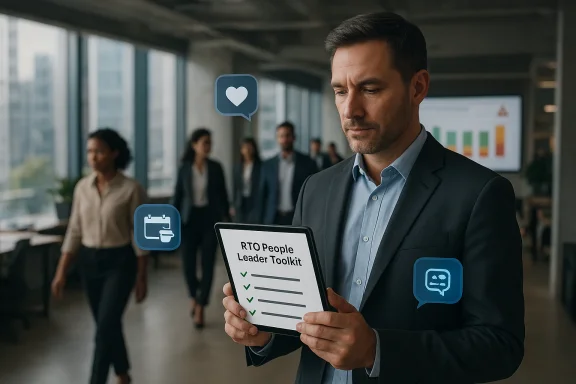
The centerpiece of the Business Insider report is the “RTO People Leader Toolkit.” That document reportedly tells managers how to talk to employees who re, emphasizing supportive language first and discipline later. The phrasing matters because it reframes compliance as a conversation about belonging rather than a blunt decree from above.The toolkit’s logic is obvious enough: if employees feel socially attached to the workplace, they may be less likely to treat office attendance as an arbitrary demand. That is why the document reportedly recommends coffee chats, luncheactivities. In other words, Paramount is trying to make office time feel relational instead of punitive, even while the policy itself becomes more punitive over time.
How the script works
The suggested manager questions are revealing because they are framed as check-ins, not interrogations. Asking how the transition is going or what support someone needs is a classic way to hout immediately escalating conflict. But the same script can also be used to identify noncompliance and build a record of who is not showing up.That dual use is what makes the toolkit interesting from a management standpoint. It is both humane and surveillance-friendly, which is exactly the sort of tension modern workplace policy often tries to conceal. Paramount appears to be betting that if managers can sound empathetic enou more likely to accept a policy that is already nonnegotiable. That is a clever tactic, but not necessarily a popular one.
- Managers are told to frame RTO as a support issue first.
- Team bonding is presented as a tool for reducing resistance.
- Questions about attendance doubls.
- Enforcement is deferred, not eliminated.
- Culture language masks a harder disciplinary framework.
The AI angle is not trivial
The Copilot reference is not just a quirky footnote. It demonstrates that internal AI tools are increasingly being normalized as management aids, not only as productivity tools for individual contributors. That broadens the role of generative AI in the enterprise, especially when the task is something as soft and subjective as easing labor relations. The irony is hard to miss: the machine is being asked to help human leaders sound more human.Enforcement and Discipline
The clearest signal in the reporting is that Paramount wants the policy to be binding, not aspirational. The company reportedly told managers that they will be responsible for ensuring team members meet the full-time in-office requirement, and that failures can lead to discipline up to and including dismissal. That language makes the new mandate fundamentally different frpolicy with gentle nudges.This matters because enforcement is where most RTO policies run into trouble. A memo is easy. Measuring attendance across multiple offices, roles, and exceptions is much harder. Paramount is trying to solve that problem by first training managers to handle the interpersonal side and then, later, giving them access to attendance data so they canence.
The hall monitor problem
One manager reportedly described the responsibility as daunting, saying they did not want to become a “hall monitor” on top of existing work. That reaction captures the practical challenge of any compliance-heavy workplace policy. When leaders become attendance enforcers, they often spend less time coaching, planning, and developing people—the tasks that are supposed to make office time worthwhile in the first p especially pronounced in creative and media organizations, where leadership credibility often depends on judgment rather than surveillance. If managers are reduced to checking who has swiped in, their role shifts from mentor to monitor. That can erode trust quickly, even if the company believes it is simply tightening standards.- Attendance dministrative drag.
- Managers may be caught between team loyalty and corporate policy.
- Enforcement can damage morale if it feels inconsistent.
- Discipline policies tend to work best when exceptions are clear.
- Data access changes the power balance between managers and employees.
Why Paramount Is Pushing So Hard
Paramount’s rorward: in-person work, it says, helps create stronger relationships, better trust, and a greater sense of community. Those claims are not unique, but they are central to how executives justify office mandates. The company is effectively arguing that distributed work weakens organizational cohesion at a time when it needs every advantage.That argument has particular force in a company trying to reinvent itself. A transformation of this scale requires fast cross-functional coordination, and leadership may believe that office proximity makes those interactions easier to achieve. In media, where priorities can shift quickly and creative, technical, and commercial teams all need to align, the case for in-person speed can sound persuasive, at least from the boardroom.
The strategic bet
The strategic bet is that a stronger office culture will produce a stronger operating culture. If employees communicate more often, leaders may hope for fewer silos, quicker decisions, and more visible accountability. That is a plausible theory, but it is still a theory, and its success depends on whether the in-office experience actually improves the work rather than simply relocating it.There is also a symbolic dimension here. By making the office the default again, Ellison is drawing a line between the old Paramount and the new one. Many executives have softened their RTO rhetoric over time; Paramount appears to be going in the other direction. That creates a sense of decisiveness, which can be useful during corporate integration, even if it also raises the risk of employee resentment.
- The policy reinforces leadership authority.
- It aims to reduce ambiguity around performance expectations.
- It gives managers a clearer basis for accountability conversations.
- It signals that culture will be built around physical presence.
- It supports a broader cost-and-control narrative across the company.
The Media Industry Context
Paramount is not alone in pushing more aggressively for in-person work, but the media sector makes these choices look especially charged. Creative organizations have always valued spontaneous collaboration, yet they also employ large numbers of people in roles that can be done remotely with little loss in output. That makes media RTO decisions feel less like objective necessity and more like leadership preference.That tension explains why the response is often so polarized. Executives see a culture they believe can be strengthened. Employees see a return of control that may not be justified by day-to-day reality. In media companies, where layoffs, restructuring, and content-market volatility already create unease, office mandates can land as another layer of top-down pressure.
Competitor behavior matters
Paramount’s rivals have generally been more tolerant of hybrid work, even if they have not embraced remote-first extremes. That creates an important comparison point: if competitors can preserve flexibility while still producing content and revenue, Paramount’s stricter approach must prove its value in measurable ways. Otherwise, the company risks appearing more authoritarian than effective.The company may believe that being more rigid now will create a cleaner operating model later. That would fit the logic of a turnaround: make the hard calls early, absorb the pain, and build a different culture from the ground up. But in practice, office policy is rarely isolated from broader labor sentiment. If employees view the mandate as symbolic overreach, the company may gain compliance while losing goodwill.
- Media firms rely heavily on informal coordination.
- Hybrid work remains common across many competitors.
- Creative teams are harder to manage through pure surveillance.
- Workplace culture often tracks broader leadership style.
- RTO policies can become a proxy for trust in management.
Enterprise vs. Employee Reality
For the enterprise, the mandate is about control, predictability, and alignment. For employees, it is about commuting, autonomy, and whether management trusts them. Thoseely overlap perfectly, and Paramount’s toolkit suggests leadership knows that the employee side cannot be ignored. Yet the final structure of the policy still favors the company’s need for visible order over individual flexibility.That split is especially sharp for employees who do not live near a Paramount office. The report says some full-time remote workers who are not near any company offices will be expected to return in 2027. That longer timeline acknowledges that commuting is not a simple toggle, but it also extends uncertainty for workers who may feel they are living under a delayed ultimatum.
Different groups, different stakes
Employees assigned to New York and Los Angeles already experienced the first wave of change, so the latest phase may feel like a continuation rather than a surprise. Employees elsewhere, by cs proof that hybrid flexibility is shrinking companywide. The difference matters because morale tends to deteriorate fastest when workers believe a policy is expanding beyond its original scope.For managers, the burden is broader than the employee count suggests. They must explain the policy, interpret exceptions, document issues, and maintain team cohesion while answering to leadership. e conflict: the same manager is expected to be both advocate and enforcer, which is one of the least comfortable positions in corporate life.
What employees are likely to hear
Even if leadership frames the policy in terms of culture, many workers will hear something simpler: show up or risk consequences. That may be acceptable to some ethose who already prefer office work. But for others, especially high performers who proved they can deliver from home, the message may feel like a downgrade in trust.The emotional divide here should not be underestimated. A return-to-office rule is never just about desks and calendars. It is about whether the company believes proximity creates value, or whether proximity is being used as a proxy for control. Paramount’s language suggests it wants both outcomes, which is ambitious and potentially unstable.
- Enterprise leaders want consistency and visibility.
- Employees want flexibility and earned autonomy.
- Managers sit in the middle and absorb conflict.
- Remote workers face the greatest uncertainty.
- Hybrid expectations tend to erodeomes stricter.
The Copilot Detail and the Future of AI at Work
The suggestion that managers ask Microsoft Copilot for team-building ideas is one of the most modern details in the report, but it is also one of the most revealing. It shows how quickly generative AI has moved from a productivity novelty to an organizational crutch. If a manager cannot immediately think of a lunch, a coffee, or a bonding activity, the machine can fill the gap.That may sound harmless, but it says a lot about the changing texture of work. AI tools are increasingly being used not just to draft emails or summarize meetings, but to shape interpersonal behavior inside the company. In that sense, Paramount is not merely adopting AI; it is normalizing AI as a management assistant for culture-making itself.
Why that matters beyond Paramount
This is a useful preview of where enterprise AI may head next. The obvious use case is efficiency, but the deeper use case is decision support and behavioral scaffolding. If AI can help managers navigate sensitive conversations, companies will lean on it heavily, especially when they want standardizatie HR staff.There is a downside, of course. If leaders rely too much on machine-generated social scripts, they may become less authentic in exactly the moments when authenticity matters most. Employees can sense when a manager is speaking from conviction and when they are reading from a corporate playbook. AI can help with structure, but it cannot manufacture trust on demand.
- Copilot is being positioned as a management helper, not just a worker tool.
- AI may make internal communication more standardized.
- Overuse of AI can flatten emotional credibility.
- Tools that help enforce policy can also intensify employee skepticism.
- The enterprise AI market is expanding into softer HR workflows.
Strengths and Opportunities
Paramount’s RTO rollout is not without logic. If the company truly believes closer collaboration will improve execution, then a clearer office policy could help align teams during a period of major corporate change. The real opportunity is whether the company can turn physical presence into faster decisions, stronger accountability, and a more coherent operating rhythm.- A unified policy reduces ambiguity across offices.
- Managers have a clearer framework for difficult conversations.
- In-person work may improve cross-functional coordination.
- The rollout reinforces a more disciplined corporate culture.
- The company can use office presence to support integration.
- AI-assisted management tools may reduce the burden of routine coaching.
- The policy could help distinguish top performers who adapt quickly.
The company also has a chance to refine the employee experience around in-person work rather than merely mandate it. If Paramount invests in better collaboration spaces, stronger team rituals, and genuinely useful office routines, the policy could feel less like a penalty and more like a workplace redesign. That would be the best-case scenario.
Risks and Concerns
The downside is that the policy could easily be remembered as a discipline-first mandate wrapped in culture language. When employees hear about coffee chats and then read about dismissal for noncompliance, they may conclude that the softer language is just a veil for harder control. That perception can be hard to reverse once it takes hold.- Employee morale may suffer if the policy feels one-sided.
- Managers could become compliance police rather than team builders.
- Attendance tracking may create operational overhead.
- Remote workers may feel increasingly excluded from company culture.
- Thr resignations or quiet disengagement.
- AI-assisted advice may feel impersonal or performative.
- Enforcement inconsistencies could create legal or HR headaches.
A second concern is managerial burnout. The more responsibility managers have for policing attendance, the less time they have for actual leadership. If Paramount wants managers to act as cut cannot also drown them in compliance duties without consequences. The “hall monitor” complaint is not a throwaway line; it is a warning sign.
Finally, there is the broader reputational issue. In a labor market where flexibility remains a powerful retention tool, a strict office mandate can make a company look less modern, not more. Paramount may believe it is sigmployees may interpret it as a shrinking of trust. That gap in interpretation is where policies like this often break down.
Looking Ahead
The next few months will show whether Paramount’s Phase 2 rollout is a one-time policy shift or the opening move in a more comprehensive workplace reset. The biggest question is not whether managers can repeat the right talking points. It is whether the company can make office time genuinely useful enough that employees stop seeing it as a demand imposed from above.The other important question is how quickly the company turns on attendance visibility for managers. Once data becomes available, the policy changes from cultural messaging to measurable compliance enforcement. That is usually the point at which office mandates become most consequential, because managers can no longer rely on impressions or informal relationships.
What to watch
- Whether other Paramount divisions receive different carve-outs or exemptions.
- How quickly managers gain access to attendance data.
- Whether the company reports more attrition after Phase 2 begins.
- Whether employees near distant offices comply more readily than remote workers.
- Whether the policy affects productivity, collaboration, or morale in measurable ways.
Source: Business Insider How Paramount wants its managers to talk about David Ellison's new RTO mandate
