

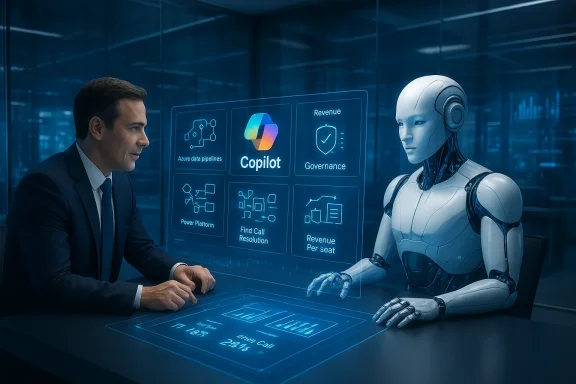
Jen Harris’s message on the AI Agent & Copilot Podcast is simple and urgent: partners must stop treating AI like a toy and start building the partner of the future — one that combines Microsoft Copilot, Azure, Power Platform, data, and governance into outcome-driven solutions that actually reduce work and increase value.
The AI era has shifted the partner landscape from platform brokerage to outcome delivery. In a recent episode of the AI Agent & Copilot Podcast hosted by John Siefert, Jen Harris, CEO of Technology Management Concepts (TMC), laid out a candid roadmap for Microsoft partners confronting this shift. Harris’s discussion touched on TMC’s strategic acquisition of The TM Group (TMG), the mindset required for meaningful AI adoption, and the practical role partners must play as organizations move from experimentation to operationalization with AI agents and Copilot.
This conversation is framed by an industry moment where Microsoft Copilot, agentic AI, and cloud-first data foundations are converging. Events such as the AI Agent & Copilot Summit NA — an AI-first conference focused on Copilot, agents, and enterprise outcomes — are accelerating community learning, and partners are racing to productize skills into repeatable offers. Harris argues that survival and leadership depend on building capabilities that meet customers where they are and guide them to where they need to be.
Her comments were grounded in TMC’s own strategic moves — notably the acquisition of TMG — which she framed as a way to deepen ERP and industry capabilities while scaling modern AI and automation services without losing the boutique, accountable model customers prefer.
If you plan to attend or follow the summit conversations, come prepared with:
But partners should be clear-eyed: success requires gritty work — data plumbing, governance, lifecycle management, and real behavior change across organizations. Agents will take the repetitive and reactive work first; that will be disruptive but also liberating if partners can re-skill people into higher-value roles.
The partner of the future is not the biggest; it is the most adaptable. It combines domain expertise, modern data ops, Copilot and agent architecture, and above all, a willingness to lead customers through deliberate, measurable transformation. Partners that move swiftly to operationalize AI, measure value, and govern responsibly will be the ones who don’t just survive — they’ll set the agenda.
Conclusion
The podcast with Jen Harris is less about hype and more about a disciplined, human-centered path to scale AI in enterprise settings. For Microsoft partners, the choice is not whether to engage with Copilot and agents — it’s how deliberately, responsibly, and quickly they will turn those technologies into repeatable business outcomes. Those who treat AI as a long-term capability, not a short-lived experiment, will define the partner ecosystem in the years to come.
Source: Cloud Wars AI Agent & Copilot Podcast: TMC CEO Jen Harris on Building the Partner of the Future
 Background
The AI era has shifted the partner landscape from platform brokerage to outcome delivery. In a recent episode of the AI Agent & Copilot Podcast hosted by John Siefert, Jen Harris, CEO of Technology Management Concepts (TMC), laid out a candid roadmap for Microsoft partners confronting this shift. Harris’s discussion touched on TMC’s strategic acquisition of The TM Group (TMG), the mindset required for meaningful AI adoption, and the practical role partners must play as organizations move from experimentation to operationalization with AI agents and Copilot.This conversation is framed by an industry moment where Microsoft Copilot, agentic AI, and cloud-first data foundations are converging. Events such as the AI Agent & Copilot Summit NA — an AI-first conference focused on Copilot, agents, and enterprise outcomes — are accelerating community learning, and partners are racing to productize skills into repeatable offers. Harris argues that survival and leadership depend on building capabilities that meet customers where they are and guide them to where they need to be.
Overview: What Harris said and why it matters
In plain terms, Harris delivered three interlocking assertions:- AI adoption needs commitment, not half measures. Early failures are normal; organizations must persist through imperfect first results to obtain real returns.
- Customers want solutions, not stacks. The era of selling disconnected tools is over; buyers expect partners to integrate Copilot, Azure services, Power Platform, and governance into working outcomes.
- The greatest barrier is mindset, not technology. Fear of job displacement, risk aversion, and short-term thinking undermine adoption more than technical limitations do.
Her comments were grounded in TMC’s own strategic moves — notably the acquisition of TMG — which she framed as a way to deepen ERP and industry capabilities while scaling modern AI and automation services without losing the boutique, accountable model customers prefer.
Why this podcast should matter to Microsoft partners
- AI agents and Copilot are not feature upgrades — they are a new category of business automation that executes tasks, orchestrates systems, and interacts with people on behalf of organizations. Partners that continue to sell point solutions will be marginalized.
- Microsoft’s ecosystem (Power Platform, Azure, Dynamics 365, Copilot Studio, Microsoft Fabric) gives partners a powerful set of primitives. The real differentiator becomes the partner’s ability to combine those primitives into repeatable, verticalized outcomes.
- Events like the AI Agent & Copilot Summit are maturing the community conversation from hype to execution. Partners who learn from peer case studies, governance patterns, and operational playbooks will accelerate their path to revenue.
Key takeaways from the conversation
AI requires commitment, not cautious dabbling
Harris’s blunt observation — “You fail first at new things” — is an antidote to pilot-itis. Short-term experiments with no executive sponsorship, no measurement plan, and no operational ownership rarely survive. Real adoption needs:- Executive sponsorship and business KPIs tied to AI initiatives.
- Continuous measurement and iteration cycles.
- A budget and timeline that account for early failure and learning.
Solutions beat technology stacks
Buyers are done assembling toolkits themselves. They want partners who will:- Map outcomes (e.g., reduce days-to-close, increase first-call resolution) to specific agent architectures and Copilot integrations.
- Combine Power Platform automation, Azure AI services, data pipelines, and application changes into a single deliverable.
- Own productized IP (accelerators, connectors, governance templates) that reduce time-to-value.
Mindset is the real bottleneck
Harris repeatedly returned to the human factor: perception, fear, and the social contract at work. Phrases like “It’s not quite here yet” often mean “we don’t want to be disrupted.” Successful adoption requires partners to lead conversations that reframe AI as a workload reducer and opportunity creator:- Ask business leaders “What would you do if people were less busy?” rather than “How can we replace people?”
- Show immediate, small wins that free time for higher-value work.
- Demonstrate how governance and responsibility remain human-led.
Reactive roles are disappearing — pivot to proactive value
Agents promise to automate repetitive tasks — triage, routing, data entry, status checks — and to do them 24/7 at scale. That means:- Operational specialists who excel at reactive work must re-skill toward orchestration, strategy, and exception handling.
- Partners have a commercial opening to offer managed services, reskilling programs, and human+agent operating models.
Human connection still matters
Amid automation, Harris emphasized the persistent value of human trust. AI scales intelligence, but human relationships, trust, and shared understanding still come from people. Partners that double down on advisory services, workshops, and in-person relationship-building will retain an edge.Critical analysis: strengths and limitations of Harris’s approach
Strengths — what’s realistic and valuable
- Practical orientation: Harris focuses on outcomes and governance rather than chasing bleeding-edge features. That matches what enterprise customers ask for.
- Acquisition strategy: Buying complementary capability (TMC + TMG) to strengthen ERP depth and industry domain is a proven way to accelerate capacity without building everything internally.
- People-first framing: Reframing AI as a workload reducer helps reduce employee resistance and positions the partner as a strategic advisor.
Risks and blind spots — what partners must watch
- Underestimating data work: Turning agents from experiments into reliable production systems hinges on data quality, pipelines, and labels. The podcast rightly highlighted governance, but partners often underprice the data engineering effort required to make Copilots consistently reliable.
- Agent sprawl and governance complexity: As organizations deploy multiple agents, agent sprawl can create shadow AI, compliance gaps, and security exposures. Partners must help customers with visibility, lifecycle management, and policy enforcement from day one.
- Over-reliance on vendor roadmaps: Microsoft and hyperscalers move quickly. Partners that bet their business models on currently available features without modularity or portability risk disruption if vendor APIs or pricing change.
- Talent and culture friction: Even with clear ROI, re-skilling existing staff and hiring new talent (AI engineers, data engineers, MLOps) is costly and time-consuming. Partners must have realistic transition plans and financial models to absorb the ramp.
The strategic playbook: How partners should act now
Below is a practical, prioritized roadmap partners can use to become the partner of the future. Each step is actionable and designed to be modular for firms of different sizes.- Diagnose and prioritize outcomes
- Start with one high-value, high-frequency process (e.g., service dispatch, order-to-cash exception handling, claims triage).
- Define business metrics (time saved, error reduction, margin improvement).
- Secure an executive sponsor and commit a 6–12 month runway for iterative delivery.
- Build a minimal data foundation
- Inventory the data sources required for the target outcome.
- Implement a data pipeline with clear ownership, retention, and quality metrics.
- Ensure role-based access control and separation of duties are designed from the start.
- Design human+agent workflows
- Map who does what: which tasks the agent performs, when humans intervene, and how escalation works.
- Define clear SLAs and audit trails for agent actions.
- Create KPIs for agent accuracy, latency, and user satisfaction.
- Productize and accelerate delivery
- Convert learnings into accelerators (pre-built connectors, templates, prompts, governance checklists).
- Package these as outcome-based offers (e.g., “Copilot-enabled Order Triage: 90-day pilot to reduce exceptions by X%”).
- Price for outcomes where possible (shared savings, per-transaction fees).
- Organize governance and security
- Institute agent discovery and an inventory process to avoid shadow agents.
- Enforce model and data governance: provenance, versioning, testing, and rollback procedures.
- Implement continuous monitoring for drift, hallucinations, and privacy leaks.
- Reskill and re-role talent
- Create learning paths: prompt engineering basics, MLOps fundamentals, data stewardship, and human-centered design for AI.
- Offer internal apprenticeships and rotate staff through customer engagements.
- Build a culture that rewards experimentation, measurement, and learning from failure.
- Measure, iterate, and scale
- Collect leading indicators and business outcomes.
- Use a cadence of sprints and retrospectives to refine agent behavior and integration.
- Once validated, replicate across similar functions and verticals.
Governance, security, and compliance: non-negotiables
As Harris emphasized, trust is central. Partners must embed governance and security into every stage:- Identity and access: Agents must operate under least-privilege principles and have segregated service identities with auditable actions.
- Data handling: Sensitive data must be classified and protected; ensure that model inputs/outputs are sanitized and logged.
- Model lifecycle: From staging to production, apply model evaluation, adversarial testing, and rollback plans.
- Third-party models: If using third-party or foundation models, verify licensing, data usage terms, and ability to explain outputs.
- Continuous risk assessment: Monitor for hallucinations, data leakage, and compliance breaches in production agents.
M&A and consolidation: why TMC’s acquisition of TMG is emblematic
Harris framed TMC’s acquisition of TMG as a deliberate step to accelerate capability rather than an opportunistic play for scale. This mirrors a broader trend across the partner ecosystem:- Vertical depth matters. As AI adoption becomes domain-specific, partners with industry knowledge and ERP expertise (e.g., finance, manufacturing, healthcare) will command higher premium engagements.
- Speed to market through acquisition beats build-in-house for many firms. Buying complementary skills, IP, or customer relationships compresses time-to-revenue.
- Boutique scale + governance = buyer preference. Harris’s pitch of preserving a “boutique, accountable model” while adding modern capabilities resonates with customers who fear being lost in a megaconsultant.
Measuring success: KPIs that matter
Traditional project KPIs (on-time, on-budget) are insufficient in the AI era. Harris’s emphasis on outcomes implies the following metrics:- Business outcome KPIs: time-to-resolution, days-to-close, FCR (first call resolution), revenue per seat, margin uplift.
- Operational KPIs: agent uptime, mean time-to-detect issues, percentage of cases fully automated vs. human-assisted.
- Trust KPIs: rate of human overrides, audit completeness, privacy incidents per million transactions.
- Adoption KPIs: users actively using the Copilot/agent, feature engagement, reduction in manual steps.
What Microsoft partners must unlearn
Harris’s insistence on mindset change implies several unlearning moments for partners:- Stop selling features and start selling outcomes. Clients care about solved problems, not checked boxes.
- Stop treating pilots as “proof of life.” A pilot without clear success criteria and a scale plan is a cost center.
- Stop assuming technical parity wins engagements. Domain expertise, service design, and change management are the differentiators.
Preparing for the AI Agent & Copilot Summit and the broader community phase
The AI Agent & Copilot Summit is shaping up as the ecosystem’s operational forum: masterclasses on Copilot Studio, Azure AI Foundry, and agent governance will help partners move from concept to production.If you plan to attend or follow the summit conversations, come prepared with:
- Concrete problems and datasets you want to solve.
- ROI models for the outcomes you plan to deliver.
- A list of governance questions and operational constraints (data residency, regulatory requirements).
- A plan to share failures and learning — the community advances faster when practitioners are candid.
Final assessment: opportunity is real, but execution is everything
Jen Harris’s call to arms is a practical, grounded plea for partners to stop treating AI as an add-on and start treating it like a new class of IT and service productization. The strengths of her approach include a relentless focus on outcomes, an honest view of human resistance, and a pragmatic growth path via talent and M&A.But partners should be clear-eyed: success requires gritty work — data plumbing, governance, lifecycle management, and real behavior change across organizations. Agents will take the repetitive and reactive work first; that will be disruptive but also liberating if partners can re-skill people into higher-value roles.
The partner of the future is not the biggest; it is the most adaptable. It combines domain expertise, modern data ops, Copilot and agent architecture, and above all, a willingness to lead customers through deliberate, measurable transformation. Partners that move swiftly to operationalize AI, measure value, and govern responsibly will be the ones who don’t just survive — they’ll set the agenda.
Conclusion
The podcast with Jen Harris is less about hype and more about a disciplined, human-centered path to scale AI in enterprise settings. For Microsoft partners, the choice is not whether to engage with Copilot and agents — it’s how deliberately, responsibly, and quickly they will turn those technologies into repeatable business outcomes. Those who treat AI as a long-term capability, not a short-lived experiment, will define the partner ecosystem in the years to come.
Source: Cloud Wars AI Agent & Copilot Podcast: TMC CEO Jen Harris on Building the Partner of the Future
