

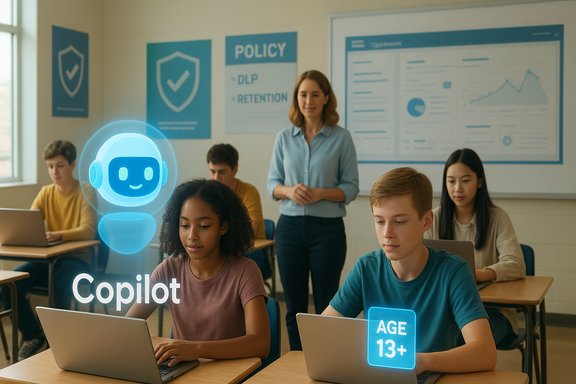
Pasco County Schools plans to unlock supervised, limited student access to Microsoft Copilot for high‑school accounts on December 1, moving from teacher‑only pilots to a phased classroom rollout that ties access to managed district accounts, age gating (13+), and teacher discretion over assignment‑level use.
Pasco’s decision reflects a broader shift in K–12 districts away from blanket bans on consumer chatbots toward managed, tenant‑grounded deployments that pair technical controls with pedagogical guardrails. The district says the approach is deliberately iterative: teachers and staff have run pilots, the administration will enable limited student features on managed accounts, and policy will be updated continuously as features, contracts, and classroom implications evolve.
The district’s draft guidance emphasizes a simple pedagogical principle: “AI should help you learn — not do the work for you.” Students will be asked to document AI‑assisted work, and teachers will remain the arbiters of whether Copilot may be used for any graded assignment.
That said, meaningful protection depends on the details. The real guardrails are not marketing claims but written procurement commitments, accurately configured identity controls, robust DLP/retention settings, measured assessment redesign, funded teacher PD, and transparent public reporting on usage and equity outcomes. Where those pieces are missing or underfunded, the rollout risks inequitable benefits, assessment drift, and contractual surprises. Pasco’s declared posture—start slow, learn fast, revise constantly—is the right one, but the district must follow through with measurable transparency and contractual rigor to turn the promise of AI‑augmented instruction into durable classroom gains.
Source: suncoastnews.com Pasco schools outline AI rules before unlocking program for students
 Background
Pasco’s decision reflects a broader shift in K–12 districts away from blanket bans on consumer chatbots toward managed, tenant‑grounded deployments that pair technical controls with pedagogical guardrails. The district says the approach is deliberately iterative: teachers and staff have run pilots, the administration will enable limited student features on managed accounts, and policy will be updated continuously as features, contracts, and classroom implications evolve.The district’s draft guidance emphasizes a simple pedagogical principle: “AI should help you learn — not do the work for you.” Students will be asked to document AI‑assisted work, and teachers will remain the arbiters of whether Copilot may be used for any graded assignment.
What Pasco is actually unlocking: scope and timeline
Who and when
- Target users: high school students, with access restricted to accounts marked as age 13 or older.
- Activation date announced: December 1 for the initial student enablement following teacher pilots.
- Access model: managed district accounts only — consumer Microsoft accounts are not part of the rollout.
What features will be available
The district is enabling a conservative, classroom‑first set of Copilot capabilities intended for:- Teacher productivity: lesson scaffolds, multiple reading‑level conversions, rubric drafting.
- Low‑stakes student practice: flashcards, formative quizzes, step‑by‑step explanations, brainstorming and editing support.
Why Microsoft Copilot? The practical IT case
Pasco’s choice of Copilot is rooted in operational and procurement practicality. When a district already runs Microsoft 365 tenancy and Entra (formerly Azure AD), Copilot can be provisioned inside the institutional tenant, enabling:- Centralized identity and role management so student access can be age‑gated and account types enforced.
- Application of Data Loss Prevention (DLP), retention policies, and sensitivity labeling via Microsoft Purview (or equivalent) at the tenant level.
- Administrative telemetry, audit logs, and export rights that help IT and compliance teams investigate incidents.
Technical controls and identity gating
Age gating via Entra/Azure attributes
Microsoft’s education guidance allows administrators to gate certain Copilot features by setting an age attribute in Entra ID; Pasco intends to use that mechanism to limit student‑facing Copilot capabilities to accounts marked 13+. Accurate identity provisioning is critical: misclassified accounts or unmanaged consumer sign‑ups undermine the gating strategy.Managed accounts, DLP, and retention controls
Managed tenant accounts let IT apply:- DLP rules to prevent sensitive PII from leaving school systems.
- Sensitivity labels and retention policies to control how conversation logs and artifacts are stored.
- Exportable telemetry for audits and investigations.
Pedagogy and assessment: redesigning how we grade
A core tension driving Pasco’s cautious posture is assessment integrity. Generative models can produce polished essays or code that mask the student’s reasoning. Detection tools are imperfect; the sustainable strategy is assessment redesign, not a cat‑and‑mouse game. Pasco’s draft guidance and recommended classroom practices include:- Requiring prompt‑and‑output logs and a short student reflection for any work where Copilot contributed to a grade.
- Reserving Copilot for formative tasks (practice quizzes, brainstorming, revision support) unless process evidence is demonstrable.
- Using staged submissions, oral defenses, and in‑class demonstrations for summative assessments to ensure authenticity.
Teacher professional development and operational workflow
Success hinges on teacher readiness. Pasco plans short, hands‑on PD modules and instructional champions to model concrete workflows:- Prompt literacy: designing effective prompts and spotting hallucinations.
- Rubric redesign: explicit scoring for revision, source verification, and reflection.
- Remediation and integrity workflows: transparent, pedagogically focused remediation rather than punitive first responses.
Privacy, procurement, and legal risks
Contract language matters
Vendor claims about not using institutional inputs to train public models are only meaningful if reflected in signed contracts and the correct SKU is purchased. Pasco’s guidance explicitly calls for procurement clauses that:- Include non‑training guarantees for student prompts and uploaded files, where possible.
- Define retention schedules and deletion procedures for conversation logs and generated artifacts.
- Provide audit and export rights so the district can verify compliance.
FERPA and student data
Tools that record or retain student work may implicate FERPA if those artifacts are treated as education records. Districts must be explicit about who can access prompt logs and generated content, how long these artifacts are kept, and how deletion/export requests are handled. Pasco’s materials highlight the need to treat vendor assurances as a starting point for legally binding contract language.Equity, access, and the digital divide
AI’s instructional benefits depend on device parity and reliable internet. Without explicit equity planning, a Copilot rollout risks amplifying existing gaps:- Students with better devices or home broadband will naturally access more practice and richer interactions.
- Pasco is advised to include device parity programs, scheduled lab time, and alternative assignments for opt‑outs to avoid widening achievement gaps.
Operational checklist: IT, procurement and school leaders
Pasco’s draft guidance includes a practical checklist that other districts would be wise to follow:- Confirm account provisioning: ensure every student is on a managed institutional account and that ageGroup attributes in Entra/Azure are correctly set.
- Map SKUs and contract terms: verify which Copilot SKU was purchased and whether non‑training, retention, and audit clauses are included.
- Configure DLP, sensitivity labels, and retention policies in Purview (or equivalent) before broad rollout.
- Disable or limit risky features by class (web browsing, unchecked code generation) where necessary.
- Fund rapid PD sprints and identify teacher champions to model practice.
Measurable success: what Pasco should publish
To build trust and inform decisions about scaling, the district should publish short‑cycle evaluation metrics after the pilot period:- Usage analytics: counts of unique users, features used, session durations by course and demographic group.
- Instructional outcomes: teacher‑reported time savings on prep, changes in formative completion rates, and qualitative teacher/student feedback.
- Integrity incidents: number, type, remediation steps, and outcomes.
- Equity indicators: device parity, home connectivity, and opt‑out counts.
Strengths of Pasco’s plan
- Pragmatic, incremental approach: teacher pilots followed by cautious student enablement reduces the chance of wholesale policy failure.
- Tenant‑grounded deployment: leveraging managed Microsoft 365 tenancy gives Pasco technical levers (DLP, logging, age gating) not available with consumer chatbots.
- Pedagogical emphasis: the district frames Copilot as a scaffold and ties access to teacher workflows and assessment redesign, turning potential misuse into teachable moments.
Major risks and what remains uncertain
- Contractual ambiguity: vendor marketing claims about non‑training are only reliable when spelled out in signed contracts and SKU terms—these are not public by default and must be validated. Treat vendor statements as provisional until procurement documents are produced.
- Feature volatility: Copilot features, administrative defaults, and vendor policies can change quickly; Pasco’s policy will need a standing review group to respond to sudden changes.
- Assessment drift and academic integrity: detection tools are imperfect; the durable fix is pedagogy redesign, which is labor‑intensive and requires ongoing PD.
- Equity gaps: without explicit device and connectivity mitigation, benefits may accrue unevenly.
Practical recommendations for district stakeholders
- For district leaders: Publish a living AI policy with a clear review cadence, opt‑out procedures, and a summary of contractual privacy protections (or a pledge to provide contract highlights where legally possible). Fund PD and teacher champions to scale consistent practice.
- For IT & procurement: Verify purchased SKUs, negotiate explicit non‑training and retention clauses, configure Entra age attributes correctly, and enable DLP/retention policies before enabling student access.
- For teachers: Start with low‑stakes uses, require prompt logs and reflections for graded work, and redesign rubrics to value process and verification.
- For parents: Ask whether the student account is a managed institutional account, request clarity on data retention and deletion, and request plain‑language descriptions of how AI will be used in classrooms.
What to watch in the first semester
- Published metrics: Did Pasco publish the usage, equity, and integrity statistics it promised?
- Contract transparency: Are highlights of the Microsoft agreement (non‑training, retention, audit rights) available on request or summarized publicly?
- PD outcomes: Have teachers reported meaningful reductions in prep time, and have those time‑savings been reinvested into student contact?
- Incident handling: How were integrity incidents remediated—was pedagogy emphasized over punishment?
Conclusion
Pasco County Schools’ move to unlock Microsoft Copilot for high‑school students on December 1 is a consequential, pragmatic step that mirrors a growing national trend: shift from prohibition to managed adoption of generative AI in K–12. The district’s phased plan—teacher pilots, tenant‑grounded accounts, age gating, teacher control over classroom use, and an explicit pledge to treat policy as “living”—aligns with operational best practices that reduce some of the most immediate technological and legal exposures.That said, meaningful protection depends on the details. The real guardrails are not marketing claims but written procurement commitments, accurately configured identity controls, robust DLP/retention settings, measured assessment redesign, funded teacher PD, and transparent public reporting on usage and equity outcomes. Where those pieces are missing or underfunded, the rollout risks inequitable benefits, assessment drift, and contractual surprises. Pasco’s declared posture—start slow, learn fast, revise constantly—is the right one, but the district must follow through with measurable transparency and contractual rigor to turn the promise of AI‑augmented instruction into durable classroom gains.
Source: suncoastnews.com Pasco schools outline AI rules before unlocking program for students
