

Strategic preparation remains the decisive factor in passing IT certification exams in 2026, as cloud, cybersecurity, networking, and project-management credentials increasingly test practical judgment rather than rote recall across global exam programs. That is the useful truth inside a familiar career-advice story: certification still matters, but the old shortcut culture around it is becoming less reliable. For Windows admins, cloud engineers, and security practitioners, the exam is now less a trivia contest than a proxy for whether you can operate in messy production environments. The winners will be candidates who treat certification as a structured engineering project, not a weekend cram session.
The modern IT certification market is no longer just a ladder for junior technicians trying to prove they know subnetting or Active Directory. It has become a parallel credentialing system for the cloud era, where hiring managers need some way to compare candidates who may have learned through bootcamps, vendor labs, home labs, military service, managed service provider work, or pure production scars.
That explains why names like AWS Certified Solutions Architect, Microsoft Azure certifications, Cisco CCNA, CompTIA Security+, Google Cloud certifications, and CISSP keep appearing in career guidance. They are not interchangeable badges, and they are not magic keys. But they are recognizable signals in a hiring market where “I know cloud” can mean anything from deploying a static website to designing an enterprise landing zone with identity, logging, cost controls, and incident response baked in.
The important shift is that certification exams have become more explicit about skills measured. Microsoft Learn study guides, AWS exam guides, CompTIA objectives, Cisco blueprints, and ISC2 outlines are no longer ornamental PDFs that candidates glance at after buying a course. They are the contract between the vendor and the candidate, and they increasingly describe work-like outcomes rather than textbook chapters.
That is why the advice to start with the exam blueprint is not merely sensible. It is foundational. If you ignore the blueprint, you are not studying harder; you are studying blind.
Microsoft’s certification ecosystem is a good example. Its exams are tied tightly to role-based expectations, and those expectations move as Azure, Microsoft 365, Entra, Defender, Intune, Power Platform, and Windows management tooling evolve. A study guide may include a change log, retirement warning, or revised skills list, and those details are not administrative trivia. They are the difference between preparing for the exam you will sit and preparing for an exam that no longer exists.
AWS does the same through exam guides that spell out domains and task statements. CompTIA publishes exam objectives by version, such as Security+ SY0-701, and candidates using older SY0-601 material in 2026 risk absorbing outdated emphasis. ISC2’s CISSP outline remains broader and more managerial, but it too is structured by weighted domains that tell candidates where the exam thinks professional competence lives.
The common thread is simple: the official objectives are not optional. They should be the first document opened, the last document reviewed, and the framework against which every course, lab, book, and practice test is judged.
That is especially visible in cloud and security exams. A cloud candidate may be asked not only what a service does, but which service fits a specific set of constraints: cost, resilience, latency, compliance, identity, logging, and operational overhead. A security candidate may be asked to interpret symptoms, prioritize mitigations, or understand how governance and technical controls interact.
This is where “hands-on experience” stops being a cliché and becomes a study requirement. Building a small Azure environment, breaking and repairing a virtual network, testing conditional access behavior, reading logs in Microsoft Defender, configuring a lab firewall, or deploying workloads with least privilege teaches patterns that a video course cannot fully supply.
For WindowsForum readers, this matters because so much modern Windows administration now sits at the intersection of endpoint management, identity, cloud policy, and security operations. The admin who once lived in Group Policy alone now needs to understand Intune, Entra ID, device compliance, Defender telemetry, PowerShell automation, and hybrid identity behaviors. Certifications that look “cloud” on the surface often test assumptions that show up every day in Windows shops.
A better plan looks boring because most successful plans do. It starts with the exam guide, turns objectives into a checklist, blocks regular study time, and reserves space for review. The schedule should be realistic enough to survive work incidents, family demands, patch cycles, and the inevitable evening when a “quick lab” becomes a three-hour troubleshooting session.
The common recommendation of one to two focused hours per day is not sacred, but it is directionally right. The point is consistency. Frequent contact with the material allows candidates to connect concepts across domains: identity and networking, monitoring and cost, encryption and key management, incident response and governance.
Cramming can still get a reasonably experienced professional across the line for a familiar exam. But for candidates moving into new domains — a Windows admin pursuing Azure architecture, a help desk technician pursuing Security+, a network engineer pursuing cloud networking — the cram model is a trap. It produces recognition without recall and confidence without transfer.
But practice exams are also the part of certification culture most easily corrupted. There is a difference between legitimate practice questions and brain-dump material that reproduces or claims to reproduce live exam content. The former helps a candidate understand. The latter trains a candidate to cheat, memorize, and fail later when the job demands the skill the exam was supposed to validate.
This distinction matters because the internet is saturated with “guaranteed pass” language, suspiciously precise question banks, and sites that blur the line between practice and dumps. A candidate who relies on those materials may pass a test and still be exposed in an interview, a production incident, or a peer review. Worse, they may violate exam policies and put the credential itself at risk.
The healthiest use of practice exams is diagnostic. Missed questions should send the learner back to the official objectives, documentation, labs, and notes. The goal is not to recognize a question stem. The goal is to explain why the right answer is right, why the distractors are wrong, and how the decision would play out in a real environment.
But in fast-moving platforms, documentation has a special role: it is often the first place reality changes. Microsoft Learn, AWS documentation, Cisco learning resources, CompTIA objectives, and ISC2 exam outlines should be treated as primary sources. Third-party material can teach, simplify, and contextualize, but it should not overrule the vendor’s current exam guide.
This is particularly important for Microsoft certification candidates. Azure services can evolve substantially between the release of a course and the date a candidate takes the exam. A portal blade may move. A service may be renamed. A feature may shift from preview to general availability. An exam may be revised or retired.
That does not mean candidates should read documentation cover to cover as if preparing for a doctoral defense. It means they should use official documentation to verify claims, resolve ambiguity, and update older study material. If a course says one thing and the current study guide says another, the study guide wins.
A help desk technician may want CISSP because it sounds prestigious, but Security+, Network+, Microsoft fundamentals, or an endpoint administration path may produce better short-term returns. A Windows admin may be tempted by every Azure credential, but the right first move might be identity, endpoint management, or administrator-level Azure skills rather than architect-level design. A developer may not need a broad operations certification if the real career path is cloud-native application development.
This is not gatekeeping. It is sequencing. Certifications work best when they sit one or two steps ahead of current experience, not ten steps ahead of reality. The exam should stretch the candidate, but it should also connect to work they can plausibly perform, lab, discuss, and retain.
For employers, alignment matters too. A team that funds random badges should not be surprised when certification spending fails to change capability. A better approach is to map credentials to business needs: cloud migration, Zero Trust rollout, endpoint modernization, SOC maturity, network refresh, compliance obligations, or project delivery. Then the certification becomes part of workforce planning rather than a perk.
This collapse is especially visible around Microsoft environments. Entra ID, Intune, Defender, Azure Policy, Conditional Access, Windows Autopilot, and Microsoft 365 administration are not separate islands in the way old product families once appeared. A decision in one layer affects the others, and exams increasingly reflect that interconnectedness.
That makes lab work more valuable than ever. Reading about Conditional Access is one thing; watching a policy block a sign-in because a device is noncompliant is another. Reading about role-based access control is useful; accidentally granting too much permission in a lab and then fixing it teaches the lesson with sharper edges.
The same principle applies outside Microsoft. AWS IAM, Google Cloud IAM, Cisco segmentation, Kubernetes access controls, and security monitoring all reward candidates who can reason across systems. The exam may be vendor-branded, but the underlying skill is architectural thinking.
Candidates should be wary of any provider that treats the official exam as a puzzle to be gamed rather than a competency to be developed. That does not mean every commercial practice platform is suspect. Many are useful. But the marketing language matters: if a product promises guaranteed success, emphasizes memorized questions, or downplays labs and objectives, it is selling anxiety relief more than professional development.
There is also a subtler trust problem. Certifications can create false confidence in employers that a newly certified professional is immediately production-ready. A credential should open a conversation, not end one. It should say, “This person has met a defined benchmark,” not “This person can own the architecture unsupervised.”
The best organizations understand this. They pair certification with mentoring, lab environments, internal runbooks, shadowing, post-incident reviews, and real operational responsibility. The certificate becomes a checkpoint in a learning system, not the system itself.
Still, the long-term career value comes from the skill acquired while preparing, not the badge alone. A candidate who studies Security+ properly gains a vocabulary for risk, controls, threats, architecture, and operations. A candidate who studies CCNA properly gains a mental model of networks that remains useful even when the interface changes. A candidate who studies Azure administration properly learns how identity, compute, networking, storage, monitoring, and governance fit together.
This is why the “pass on the first attempt” framing is both motivating and slightly dangerous. Passing matters, especially when exam fees are expensive and employer reimbursement depends on success. But an obsession with first-attempt success can push candidates toward shortcuts that weaken the real benefit.
The better target is first-attempt readiness. That means the candidate can sit the exam with evidence: objectives checked, labs completed, weak domains reviewed, practice scores stable, and documentation consulted. Confidence should be earned before it is felt.
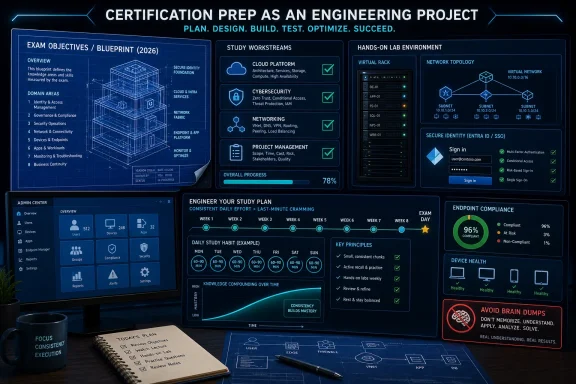
The exam blueprint is the requirements document. The study plan is the project schedule. Labs are the test environment. Practice exams are monitoring. Weak domains are defects. Updated vendor documentation is change control. The final review is the go/no-go meeting.
This analogy is useful because it reframes certification from a school exercise into professional work. The candidate is not merely “studying.” The candidate is managing a learning project with scope, risk, resources, and a deadline.
It also makes failure less mysterious. If a candidate fails after ignoring the blueprint, skipping labs, using outdated material, and taking one practice test the night before, the problem is not intelligence. It is process. A better process will not guarantee success, but it dramatically improves the odds.
Newly certified professionals should immediately apply the material. That might mean building a lab project, volunteering for a migration task, documenting a security control, improving a backup process, reviewing IAM permissions, helping with endpoint compliance, or presenting lessons learned to a team. The sooner the knowledge is used, the less likely it is to decay.
This is especially important because many certifications expire or require continuing education. The renewal model is often criticized as a revenue stream, sometimes fairly. But the underlying premise is sound: technology changes too quickly for a credential to be treated as permanent proof.
The best candidates therefore see certification as a cadence, not a trophy. Learn, validate, apply, update. That rhythm fits the reality of modern IT better than the old model of collecting badges every few years and hoping the acronyms carry the career.
 The Certification Boom Has Outgrown the Certificate Frame
The modern IT certification market is no longer just a ladder for junior technicians trying to prove they know subnetting or Active Directory. It has become a parallel credentialing system for the cloud era, where hiring managers need some way to compare candidates who may have learned through bootcamps, vendor labs, home labs, military service, managed service provider work, or pure production scars.That explains why names like AWS Certified Solutions Architect, Microsoft Azure certifications, Cisco CCNA, CompTIA Security+, Google Cloud certifications, and CISSP keep appearing in career guidance. They are not interchangeable badges, and they are not magic keys. But they are recognizable signals in a hiring market where “I know cloud” can mean anything from deploying a static website to designing an enterprise landing zone with identity, logging, cost controls, and incident response baked in.
The important shift is that certification exams have become more explicit about skills measured. Microsoft Learn study guides, AWS exam guides, CompTIA objectives, Cisco blueprints, and ISC2 outlines are no longer ornamental PDFs that candidates glance at after buying a course. They are the contract between the vendor and the candidate, and they increasingly describe work-like outcomes rather than textbook chapters.
That is why the advice to start with the exam blueprint is not merely sensible. It is foundational. If you ignore the blueprint, you are not studying harder; you are studying blind.
Vendor Blueprints Are the New Syllabus, and They Change Faster Than Careers Do
A generation ago, an administrator could buy a certification book, keep it on the shelf for years, and assume most of the core material would remain relevant. That world is gone. Cloud services change names, security defaults shift, licensing models mutate, and management portals are redesigned with little regard for the learner who memorized screenshots.Microsoft’s certification ecosystem is a good example. Its exams are tied tightly to role-based expectations, and those expectations move as Azure, Microsoft 365, Entra, Defender, Intune, Power Platform, and Windows management tooling evolve. A study guide may include a change log, retirement warning, or revised skills list, and those details are not administrative trivia. They are the difference between preparing for the exam you will sit and preparing for an exam that no longer exists.
AWS does the same through exam guides that spell out domains and task statements. CompTIA publishes exam objectives by version, such as Security+ SY0-701, and candidates using older SY0-601 material in 2026 risk absorbing outdated emphasis. ISC2’s CISSP outline remains broader and more managerial, but it too is structured by weighted domains that tell candidates where the exam thinks professional competence lives.
The common thread is simple: the official objectives are not optional. They should be the first document opened, the last document reviewed, and the framework against which every course, lab, book, and practice test is judged.
The Exam Is Not the Job, but the Job Is Invading the Exam
The most consequential change in certification testing is the move away from simple memorization. Multiple-choice questions still exist, of course, and some exams remain more theoretical than their marketing suggests. But the trend is unmistakable: vendors want candidates to reason through scenarios.That is especially visible in cloud and security exams. A cloud candidate may be asked not only what a service does, but which service fits a specific set of constraints: cost, resilience, latency, compliance, identity, logging, and operational overhead. A security candidate may be asked to interpret symptoms, prioritize mitigations, or understand how governance and technical controls interact.
This is where “hands-on experience” stops being a cliché and becomes a study requirement. Building a small Azure environment, breaking and repairing a virtual network, testing conditional access behavior, reading logs in Microsoft Defender, configuring a lab firewall, or deploying workloads with least privilege teaches patterns that a video course cannot fully supply.
For WindowsForum readers, this matters because so much modern Windows administration now sits at the intersection of endpoint management, identity, cloud policy, and security operations. The admin who once lived in Group Policy alone now needs to understand Intune, Entra ID, device compliance, Defender telemetry, PowerShell automation, and hybrid identity behaviors. Certifications that look “cloud” on the surface often test assumptions that show up every day in Windows shops.
Study Plans Fail When They Imitate Panic
The Malaysian Reserve piece correctly emphasizes structured study, but the deeper point is that exams punish volatility. Candidates who binge-study for three nights and then disappear for two weeks are not building durable memory or operational confidence. They are producing the illusion of progress.A better plan looks boring because most successful plans do. It starts with the exam guide, turns objectives into a checklist, blocks regular study time, and reserves space for review. The schedule should be realistic enough to survive work incidents, family demands, patch cycles, and the inevitable evening when a “quick lab” becomes a three-hour troubleshooting session.
The common recommendation of one to two focused hours per day is not sacred, but it is directionally right. The point is consistency. Frequent contact with the material allows candidates to connect concepts across domains: identity and networking, monitoring and cost, encryption and key management, incident response and governance.
Cramming can still get a reasonably experienced professional across the line for a familiar exam. But for candidates moving into new domains — a Windows admin pursuing Azure architecture, a help desk technician pursuing Security+, a network engineer pursuing cloud networking — the cram model is a trap. It produces recognition without recall and confidence without transfer.
Practice Exams Are Useful Until They Become a Dependency
Practice exams deserve their popularity. They teach time management, reveal weak domains, and help candidates understand how vendors phrase questions. They also lower anxiety by making the exam format feel less alien.But practice exams are also the part of certification culture most easily corrupted. There is a difference between legitimate practice questions and brain-dump material that reproduces or claims to reproduce live exam content. The former helps a candidate understand. The latter trains a candidate to cheat, memorize, and fail later when the job demands the skill the exam was supposed to validate.
This distinction matters because the internet is saturated with “guaranteed pass” language, suspiciously precise question banks, and sites that blur the line between practice and dumps. A candidate who relies on those materials may pass a test and still be exposed in an interview, a production incident, or a peer review. Worse, they may violate exam policies and put the credential itself at risk.
The healthiest use of practice exams is diagnostic. Missed questions should send the learner back to the official objectives, documentation, labs, and notes. The goal is not to recognize a question stem. The goal is to explain why the right answer is right, why the distractors are wrong, and how the decision would play out in a real environment.
Documentation Beats Courseware When the Product Has Moved On
Training courses are valuable, especially for beginners who need structure. Books are valuable, especially when they explain fundamentals in a coherent order. Video tutorials are valuable, especially when they demonstrate workflows that are hard to visualize from documentation alone.But in fast-moving platforms, documentation has a special role: it is often the first place reality changes. Microsoft Learn, AWS documentation, Cisco learning resources, CompTIA objectives, and ISC2 exam outlines should be treated as primary sources. Third-party material can teach, simplify, and contextualize, but it should not overrule the vendor’s current exam guide.
This is particularly important for Microsoft certification candidates. Azure services can evolve substantially between the release of a course and the date a candidate takes the exam. A portal blade may move. A service may be renamed. A feature may shift from preview to general availability. An exam may be revised or retired.
That does not mean candidates should read documentation cover to cover as if preparing for a doctoral defense. It means they should use official documentation to verify claims, resolve ambiguity, and update older study material. If a course says one thing and the current study guide says another, the study guide wins.
Career Alignment Is the Step Candidates Skip Because It Requires Honesty
“Choose a certification that aligns with your goals” sounds like harmless career-center language. In reality, it is one of the hardest parts of the process because it forces candidates to distinguish between aspiration, market pressure, and actual next steps.A help desk technician may want CISSP because it sounds prestigious, but Security+, Network+, Microsoft fundamentals, or an endpoint administration path may produce better short-term returns. A Windows admin may be tempted by every Azure credential, but the right first move might be identity, endpoint management, or administrator-level Azure skills rather than architect-level design. A developer may not need a broad operations certification if the real career path is cloud-native application development.
This is not gatekeeping. It is sequencing. Certifications work best when they sit one or two steps ahead of current experience, not ten steps ahead of reality. The exam should stretch the candidate, but it should also connect to work they can plausibly perform, lab, discuss, and retain.
For employers, alignment matters too. A team that funds random badges should not be surprised when certification spending fails to change capability. A better approach is to map credentials to business needs: cloud migration, Zero Trust rollout, endpoint modernization, SOC maturity, network refresh, compliance obligations, or project delivery. Then the certification becomes part of workforce planning rather than a perk.
For Windows Pros, the Cloud Exam Is Now an Identity Exam
One reason certification preparation feels harder is that domain boundaries have collapsed. A Windows administrator studying Azure cannot avoid identity. A security analyst cannot avoid cloud logging. A network engineer cannot avoid policy-based access. A developer cannot avoid secrets, deployment pipelines, and observability.This collapse is especially visible around Microsoft environments. Entra ID, Intune, Defender, Azure Policy, Conditional Access, Windows Autopilot, and Microsoft 365 administration are not separate islands in the way old product families once appeared. A decision in one layer affects the others, and exams increasingly reflect that interconnectedness.
That makes lab work more valuable than ever. Reading about Conditional Access is one thing; watching a policy block a sign-in because a device is noncompliant is another. Reading about role-based access control is useful; accidentally granting too much permission in a lab and then fixing it teaches the lesson with sharper edges.
The same principle applies outside Microsoft. AWS IAM, Google Cloud IAM, Cisco segmentation, Kubernetes access controls, and security monitoring all reward candidates who can reason across systems. The exam may be vendor-branded, but the underlying skill is architectural thinking.
The Certification Economy Has a Trust Problem
The uncomfortable part of the certification story is that the market contains both legitimate education and aggressive credential monetization. Every popular exam attracts bootcamps, question banks, resellers, influencers, affiliate sites, and “pass fast” products. Some are excellent. Some are thin wrappers around public documentation. Some are ethically dubious.Candidates should be wary of any provider that treats the official exam as a puzzle to be gamed rather than a competency to be developed. That does not mean every commercial practice platform is suspect. Many are useful. But the marketing language matters: if a product promises guaranteed success, emphasizes memorized questions, or downplays labs and objectives, it is selling anxiety relief more than professional development.
There is also a subtler trust problem. Certifications can create false confidence in employers that a newly certified professional is immediately production-ready. A credential should open a conversation, not end one. It should say, “This person has met a defined benchmark,” not “This person can own the architecture unsupervised.”
The best organizations understand this. They pair certification with mentoring, lab environments, internal runbooks, shadowing, post-incident reviews, and real operational responsibility. The certificate becomes a checkpoint in a learning system, not the system itself.
Employers Want Signals, but Teams Need Skills
The hiring value of certifications is real, but it is uneven. Some roles treat a certification as a filter. Others treat it as a tie-breaker. Regulated, government, defense, and large enterprise environments may care about specific credentials because frameworks, contracts, or internal policies name them explicitly.Still, the long-term career value comes from the skill acquired while preparing, not the badge alone. A candidate who studies Security+ properly gains a vocabulary for risk, controls, threats, architecture, and operations. A candidate who studies CCNA properly gains a mental model of networks that remains useful even when the interface changes. A candidate who studies Azure administration properly learns how identity, compute, networking, storage, monitoring, and governance fit together.
This is why the “pass on the first attempt” framing is both motivating and slightly dangerous. Passing matters, especially when exam fees are expensive and employer reimbursement depends on success. But an obsession with first-attempt success can push candidates toward shortcuts that weaken the real benefit.
The better target is first-attempt readiness. That means the candidate can sit the exam with evidence: objectives checked, labs completed, weak domains reviewed, practice scores stable, and documentation consulted. Confidence should be earned before it is felt.
The Candidates Who Win Treat Prep Like Change Management
IT professionals already know how to plan complex work. They gather requirements, identify dependencies, estimate effort, test in nonproduction, document changes, monitor results, and roll back when needed. Certification preparation should borrow the same habits.The exam blueprint is the requirements document. The study plan is the project schedule. Labs are the test environment. Practice exams are monitoring. Weak domains are defects. Updated vendor documentation is change control. The final review is the go/no-go meeting.
This analogy is useful because it reframes certification from a school exercise into professional work. The candidate is not merely “studying.” The candidate is managing a learning project with scope, risk, resources, and a deadline.
It also makes failure less mysterious. If a candidate fails after ignoring the blueprint, skipping labs, using outdated material, and taking one practice test the night before, the problem is not intelligence. It is process. A better process will not guarantee success, but it dramatically improves the odds.
The Real Exam Starts After the Score Report
A passing score is gratifying, but it is not the end of the credential’s value. The months after certification are when the learning either hardens into competence or evaporates into résumé decoration.Newly certified professionals should immediately apply the material. That might mean building a lab project, volunteering for a migration task, documenting a security control, improving a backup process, reviewing IAM permissions, helping with endpoint compliance, or presenting lessons learned to a team. The sooner the knowledge is used, the less likely it is to decay.
This is especially important because many certifications expire or require continuing education. The renewal model is often criticized as a revenue stream, sometimes fairly. But the underlying premise is sound: technology changes too quickly for a credential to be treated as permanent proof.
The best candidates therefore see certification as a cadence, not a trophy. Learn, validate, apply, update. That rhythm fits the reality of modern IT better than the old model of collecting badges every few years and hoping the acronyms carry the career.
The Passing Strategy That Survives the 2026 Exam Landscape
The practical lesson from the certification arms race is not that candidates need more resources. It is that they need a better filter for the resources they already have. One official guide, one strong course, one documentation habit, one lab routine, and one ethical practice-exam source can outperform a dozen half-used playlists and recycled PDFs.- Candidates should choose certifications that map directly to the role they want next, not merely the credential that sounds most impressive.
- Candidates should treat official exam objectives as the controlling document and check every paid or free resource against the current exam version.
- Candidates should build hands-on labs whenever the exam covers operational technologies, especially in cloud, networking, endpoint management, and security.
- Candidates should use practice exams to diagnose weak areas and improve timing, not to memorize question patterns.
- Candidates should avoid outdated material, brain dumps, and “guaranteed pass” shortcuts that undermine both exam integrity and workplace readiness.
- Candidates should apply newly learned skills quickly after passing so the credential becomes part of professional capability rather than a static résumé line.
References
- Primary source: The Malaysian Reserve
Published: 2026-06-08T12:30:08.977500
Strategic preparation remains key to passing IT certification exams
AS DIGITAL transformation accelerates across industries, professional IT certifications continue to play an increasingly important role in helping technology professionals strengthen their credentials, expand their expertise and remain competitive in a rapidly evolving job market. themalaysianreserve.com
- Related coverage: isc2.org
Review the ISC2 CISSP Certification Exam Outline
What's on the CISSP exam? The CISSP Exam Outline provides a comprehensive review of the domains and subdomains on which candidates will be evaluated.www.isc2.org
- Related coverage: docs.aws.amazon.com
AWS Certified Solutions Architect - Associate (SAA-C03) - AWS Certified Solutions Architect - Associate
Information about the AWS Certified Solutions Architect - Associate examdocs.aws.amazon.com
