

Pax8 said on June 9, 2026, that it will add inforcer to the Pax8 Marketplace this summer, giving managed service providers a new Microsoft 365 security, governance, and Copilot-readiness platform to package for small and midsize business customers. The announcement is not just another vendor listing in a crowded channel catalog. It is a sign that Microsoft 365 administration is being pulled out of the break-fix era and turned into an ongoing managed discipline. For MSPs, the pitch is simple: AI adoption is making sloppy tenant configuration harder to ignore.
The Pax8-inforcer deal lands at a moment when the Microsoft cloud has become both the default productivity platform for SMBs and the place where many of their worst security assumptions now live. Email, Teams, SharePoint, OneDrive, Entra ID, Intune, Purview, Defender, and Copilot are no longer separate conversations for most customers. They are one operational surface, and the MSP is increasingly expected to understand all of it.
That expectation is the real product Pax8 is trying to package. Inforcer’s value proposition is not that it introduces a magical new security primitive into Microsoft 365. It is that it gives MSPs a more repeatable way to assess tenants, apply baseline configurations, detect drift, and show evidence that policies remain in place over time.
That matters because Microsoft 365 is powerful precisely where it is also dangerous. A tenant can look functional while still carrying years of legacy sharing permissions, inconsistent identity controls, unmanaged devices, weak conditional access, stale admin roles, and user data scattered across Teams and SharePoint. Copilot does not create that mess, but it can make the mess more visible and more consequential.
The channel framing is also deliberate. Pax8 is not targeting the Fortune 500 security architecture team with this announcement. It is aiming at the MSP that supports dozens or hundreds of smaller customers and needs a service model that does not collapse under the weight of bespoke scripting, spreadsheet audits, and one-off hardening projects.
Microsoft 365 Copilot works inside the customer’s existing permissions model. That is the point, and it is also the warning label. If users can already access poorly governed content, an AI assistant can make that access easier to exploit, easier to misunderstand, and harder for administrators to explain after the fact.
Pax8’s own messaging leans into this change. The company cites research saying 62 percent of SMBs are using AI, while 18.5 percent are using it extensively across multiple business functions. It also says 84 percent of SMBs would trust an outside technology adviser to help implement AI. Those numbers explain why a marketplace distributor wants to give MSPs something more concrete than a slide deck about transformation.
The practical problem is that many SMBs want the productivity promise before they have done the governance work. They want Copilot, AI-assisted workflows, meeting summaries, document discovery, and sales or support automation. They are less excited about identity hygiene, data lifecycle policies, sensitivity labels, DLP rules, device compliance, and access reviews.
That gap is where MSPs can make money, but only if they can operationalize the work. A Copilot readiness assessment sold once is a consulting engagement. A continuously monitored Microsoft 365 governance service is recurring revenue. Pax8 is betting that inforcer can help partners make that transition.
That model breaks when AI governance becomes part of the monthly conversation. Customers will not accept “we think it was configured correctly last quarter” as an answer when executives are asking whether sensitive files can surface in Copilot or whether employees are feeding company data into unsanctioned tools. MSPs need current visibility, not just historical project notes.
Inforcer’s software is built around that problem. Its platform is designed to automate configuration, monitor compliance in real time, and identify policy drift across customer tenants. It also includes Copilot readiness assessments, deployment governance, and monitoring of AI usage patterns.
The interesting word there is drift. In Microsoft 365, configuration is not a one-time event. Admins change policies, users create teams, departments invite guests, licenses are added, devices age out of compliance, and Microsoft itself continues shipping new controls. A tenant that was acceptably hardened in January may not look the same in June.
For MSPs, drift detection is not just a technical feature. It is a business model feature. It turns governance into something that can be reported, remediated, and billed on a recurring basis.
The company says it works with more than 47,000 IT partners and that 800,000 SMBs use its platform. Those figures are central to the logic of the inforcer deal. A tool aimed at single-tenant enterprise security teams would not necessarily need Pax8. A tool that helps MSPs standardize security and governance across many SMB tenants benefits from distribution through a marketplace already embedded in partner workflows.
This is also why the announcement leans heavily on service packaging. Pax8 and inforcer are not simply describing a product that checks configuration settings. They are describing a route for MSPs to build offerings around Microsoft 365 hardening, compliance monitoring, Copilot readiness, managed AI, and ongoing governance.
That is a subtle but important shift. The old channel motion was often license resale plus implementation. The newer motion is license resale plus managed outcomes. AI accelerates that shift because customers can understand the risk more easily: if the AI can find everything, then the business needs to know what “everything” includes.
The issue is not that Microsoft lacks controls. The issue is that Microsoft 365 has become a vast administrative estate, and SMBs rarely have the internal staff to govern it well. Even MSPs can struggle when each customer tenant has different licensing, different maturity, different exceptions, and different historical baggage.
That is why third-party MSP platforms keep finding room around Microsoft’s edges. They do not need to replace Microsoft’s controls. They need to make those controls deployable, auditable, and commercially repeatable across many customers.
This is a familiar channel pattern. Microsoft builds the platform; partners build the operating model around it. Inforcer’s bet is that MSPs need a layer that turns Microsoft 365 governance from an expert-only craft into a standardized service line.
There is a risk, of course, that “standardized” becomes another word for shallow. Security baselines are useful, but they are not a substitute for understanding the customer’s business, data, regulatory exposure, and user behavior. The MSPs that succeed with tools like inforcer will be the ones that use automation to raise the floor, not to pretend the ceiling no longer matters.
The company’s recent Copilot Manager push also shows where it sees demand moving. MSPs do not just want to prepare tenants for AI rollout; they want to monitor adoption, identify usage patterns, surface licensing opportunities, and detect unsanctioned AI behavior. That makes AI governance both a security service and a commercial analytics service.
But MSPs are a skeptical audience, and rightly so. They have seen plenty of vendors arrive with promises of automation, only to discover that every deployment still requires hours of manual tuning. They have also seen platforms that generate attractive reports but do not reduce operational burden.
The test for inforcer inside Pax8 will be whether it genuinely helps partners deliver services faster and more consistently. If the platform shortens assessment cycles, reduces configuration variance, catches drift, and produces customer-facing evidence MSPs can use in quarterly business reviews, it will have a strong case. If it becomes another portal technicians must check, the enthusiasm will fade.
AI complicates it again. Now the MSP has to explain not only whether a customer is protected from phishing or ransomware, but whether the customer understands how AI tools interact with data. That means governance has to move closer to the center of the managed services offer.
This is where Pax8’s phrase “managed intelligence” becomes more than marketing, though it is certainly marketing too. The idea is that AI adoption is not a deployment milestone but an operating state. Once employees start using AI assistants, the business needs ongoing visibility into who is using them, what data they can reach, where policy exceptions exist, and whether controls are drifting.
For WindowsForum readers, the Microsoft angle is obvious. Most SMBs are not building their AI governance posture from scratch in a neutral cloud. They are doing it inside Microsoft 365 because that is where their email, documents, identities, meetings, and devices already live.
The result is a new kind of channel dependency. Customers may buy Copilot from Microsoft, but they will rely on MSPs to make the surrounding environment sane. Pax8 wants to be the marketplace where those MSPs buy the tooling to do it.
That context does not invalidate the inforcer deal. If anything, it underlines the point that governance failures are rarely abstract. A single operational mistake can create disclosure obligations, customer anxiety, partner frustration, and reputational damage.
For Pax8, adding Microsoft 365 governance tooling is therefore both a market move and a trust move. The company is telling partners that it understands the operational burden they face as customers demand secure AI adoption. But partners will also judge Pax8 by its own operational discipline, not just by the products it lists.
That is the bargain at the heart of cloud marketplaces. MSPs consolidate purchasing, billing, and workflows because the marketplace saves time and creates leverage. In return, the marketplace becomes a critical dependency. The more security-sensitive the services become, the more that dependency matters.
Customers do not need to understand every Entra, Intune, Purview, SharePoint, and Teams setting. They do need to understand that AI readiness depends on identity, access, data governance, device trust, and continuous review. The MSP’s job is to translate that into a service that is understandable without becoming misleading.
Inforcer’s appeal is that it can help make those services measurable. A customer-facing report that shows policy drift, remediation progress, readiness posture, and usage patterns is easier to sell than a vague promise that the tenant is “secure.” Evidence matters, especially when SMB executives are trying to justify AI spending.
Still, there is no tool that can turn bad service design into good governance. MSPs will need to decide which baselines they enforce, which exceptions they allow, how they document risk acceptance, and how often they revisit customer policy. Automation can make that process scalable, but it cannot make the hard choices disappear.
Copilot changes the audience. Executives who once ignored SharePoint permissions now ask whether AI can find confidential documents. Compliance teams that once saw Microsoft 365 as a productivity platform now see it as an information governance environment. Finance leaders want to know whether Copilot licenses are being used enough to justify their cost.
That shift gives MSPs an opening to move up the value chain. Instead of being the people who add users and reset passwords, they can become advisers on AI adoption, governance, and operational risk. But the move upmarket requires better tooling, better reporting, and better process discipline.
Pax8’s inforcer announcement should be read through that lens. It is not revolutionary technology in isolation. It is an attempt to give MSPs a channel-ready platform for a conversation customers are already beginning to have.
The difficulty is that confidence cannot be faked for long. A polished readiness score means little if it is not backed by actual configuration changes, continuous monitoring, and honest discussion of residual risk. The same is true for AI usage dashboards that emphasize adoption while downplaying data exposure.
The best MSPs will use platforms like inforcer to make uncomfortable conversations easier. They will show customers where controls are weak, where policy exceptions exist, and where Copilot rollout should wait. That may slow some deployments, but it will also prevent the kind of AI adoption that looks impressive in a board meeting and reckless during an incident review.
That is where Pax8’s marketplace strategy has a practical edge. If partners can buy, deploy, bill, and support governance tooling through a familiar channel, the barrier to building these services drops. The question is whether enough MSPs will invest in the process maturity required to make the tooling meaningful.
That means defining baseline standards for Microsoft 365 tenants before AI enters the conversation. It means identifying which customers are likely Copilot candidates, which ones need remediation first, and which ones lack the licensing or governance maturity to proceed safely. It also means training account managers to talk about AI governance without drowning customers in Microsoft acronyms.
The pricing and packaging challenge may be just as important as the technical one. SMBs often resist open-ended consulting, but they understand tiered managed services. MSPs that can bundle assessment, remediation, monitoring, quarterly reporting, and Copilot governance into understandable packages will have an advantage.
The danger is overpromising. No MSP should sell “safe AI” as if a platform can guarantee it. A more credible offer is continuous governance: reducing misconfiguration, surfacing drift, improving visibility, and helping the customer make informed decisions as Microsoft’s AI stack evolves.
For partners, the immediate action is less glamorous than the AI branding suggests. They need to inventory tenant maturity, normalize baselines, understand licensing implications, and prepare customer-facing reporting. The MSP that can do those things repeatedly will be better positioned than the one that treats Copilot as another add-on license.
The deal also suggests that marketplaces will keep absorbing more of the MSP operational stack. Procurement and billing were the first layer. Security, governance, and AI management are the next. That creates efficiency, but it also concentrates dependency on a smaller number of channel platforms.
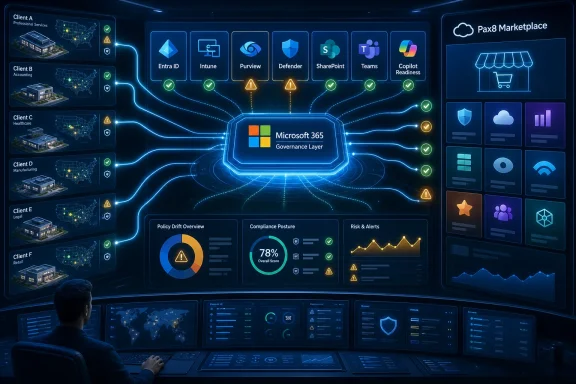 Pax8 Is Selling a Control Layer, Not Just Another Tool
The Pax8-inforcer deal lands at a moment when the Microsoft cloud has become both the default productivity platform for SMBs and the place where many of their worst security assumptions now live. Email, Teams, SharePoint, OneDrive, Entra ID, Intune, Purview, Defender, and Copilot are no longer separate conversations for most customers. They are one operational surface, and the MSP is increasingly expected to understand all of it.That expectation is the real product Pax8 is trying to package. Inforcer’s value proposition is not that it introduces a magical new security primitive into Microsoft 365. It is that it gives MSPs a more repeatable way to assess tenants, apply baseline configurations, detect drift, and show evidence that policies remain in place over time.
That matters because Microsoft 365 is powerful precisely where it is also dangerous. A tenant can look functional while still carrying years of legacy sharing permissions, inconsistent identity controls, unmanaged devices, weak conditional access, stale admin roles, and user data scattered across Teams and SharePoint. Copilot does not create that mess, but it can make the mess more visible and more consequential.
The channel framing is also deliberate. Pax8 is not targeting the Fortune 500 security architecture team with this announcement. It is aiming at the MSP that supports dozens or hundreds of smaller customers and needs a service model that does not collapse under the weight of bespoke scripting, spreadsheet audits, and one-off hardening projects.
The Copilot Boom Has Turned Configuration Debt Into Business Risk
The generative AI wave has changed how Microsoft 365 security is discussed. A few years ago, a tenant with loose SharePoint permissions or inconsistent data classification might have been treated as a cleanup project to handle when budget allowed. Now those same weaknesses are part of the customer’s AI readiness story.Microsoft 365 Copilot works inside the customer’s existing permissions model. That is the point, and it is also the warning label. If users can already access poorly governed content, an AI assistant can make that access easier to exploit, easier to misunderstand, and harder for administrators to explain after the fact.
Pax8’s own messaging leans into this change. The company cites research saying 62 percent of SMBs are using AI, while 18.5 percent are using it extensively across multiple business functions. It also says 84 percent of SMBs would trust an outside technology adviser to help implement AI. Those numbers explain why a marketplace distributor wants to give MSPs something more concrete than a slide deck about transformation.
The practical problem is that many SMBs want the productivity promise before they have done the governance work. They want Copilot, AI-assisted workflows, meeting summaries, document discovery, and sales or support automation. They are less excited about identity hygiene, data lifecycle policies, sensitivity labels, DLP rules, device compliance, and access reviews.
That gap is where MSPs can make money, but only if they can operationalize the work. A Copilot readiness assessment sold once is a consulting engagement. A continuously monitored Microsoft 365 governance service is recurring revenue. Pax8 is betting that inforcer can help partners make that transition.
The MSP Model Is Being Rewritten Around Repeatability
Managed service providers have always sold standardization in theory. In practice, many inherited whatever the customer already had: old tenants, old licensing, unmanaged guest access, half-finished migrations, abandoned admin accounts, and security settings configured by whichever technician happened to be available on the day.That model breaks when AI governance becomes part of the monthly conversation. Customers will not accept “we think it was configured correctly last quarter” as an answer when executives are asking whether sensitive files can surface in Copilot or whether employees are feeding company data into unsanctioned tools. MSPs need current visibility, not just historical project notes.
Inforcer’s software is built around that problem. Its platform is designed to automate configuration, monitor compliance in real time, and identify policy drift across customer tenants. It also includes Copilot readiness assessments, deployment governance, and monitoring of AI usage patterns.
The interesting word there is drift. In Microsoft 365, configuration is not a one-time event. Admins change policies, users create teams, departments invite guests, licenses are added, devices age out of compliance, and Microsoft itself continues shipping new controls. A tenant that was acceptably hardened in January may not look the same in June.
For MSPs, drift detection is not just a technical feature. It is a business model feature. It turns governance into something that can be reported, remediated, and billed on a recurring basis.
Pax8 Wants the Marketplace to Become the MSP Operating System
Pax8 has spent years positioning itself as more than a distributor. Its marketplace model is designed to make software procurement, billing, provisioning, and partner enablement feel like a single channel operating layer. Adding inforcer fits that pattern because Microsoft 365 security is one of the few areas where nearly every MSP customer has exposure and nearly every MSP has service revenue to chase.The company says it works with more than 47,000 IT partners and that 800,000 SMBs use its platform. Those figures are central to the logic of the inforcer deal. A tool aimed at single-tenant enterprise security teams would not necessarily need Pax8. A tool that helps MSPs standardize security and governance across many SMB tenants benefits from distribution through a marketplace already embedded in partner workflows.
This is also why the announcement leans heavily on service packaging. Pax8 and inforcer are not simply describing a product that checks configuration settings. They are describing a route for MSPs to build offerings around Microsoft 365 hardening, compliance monitoring, Copilot readiness, managed AI, and ongoing governance.
That is a subtle but important shift. The old channel motion was often license resale plus implementation. The newer motion is license resale plus managed outcomes. AI accelerates that shift because customers can understand the risk more easily: if the AI can find everything, then the business needs to know what “everything” includes.
Microsoft’s Stack Is Rich, But SMBs Still Need Translators
Microsoft already offers many of the security, identity, compliance, device management, and AI governance controls that MSPs need. Entra ID, Intune, Defender, Purview, SharePoint administration, Teams governance, and the Microsoft 365 admin center all contain pieces of the puzzle. Microsoft’s own Copilot Control System and security messaging emphasize governance, compliance, data protection, and risk mitigation around AI adoption.The issue is not that Microsoft lacks controls. The issue is that Microsoft 365 has become a vast administrative estate, and SMBs rarely have the internal staff to govern it well. Even MSPs can struggle when each customer tenant has different licensing, different maturity, different exceptions, and different historical baggage.
That is why third-party MSP platforms keep finding room around Microsoft’s edges. They do not need to replace Microsoft’s controls. They need to make those controls deployable, auditable, and commercially repeatable across many customers.
This is a familiar channel pattern. Microsoft builds the platform; partners build the operating model around it. Inforcer’s bet is that MSPs need a layer that turns Microsoft 365 governance from an expert-only craft into a standardized service line.
There is a risk, of course, that “standardized” becomes another word for shallow. Security baselines are useful, but they are not a substitute for understanding the customer’s business, data, regulatory exposure, and user behavior. The MSPs that succeed with tools like inforcer will be the ones that use automation to raise the floor, not to pretend the ceiling no longer matters.
Inforcer Arrives With Momentum, but the Channel Will Demand Proof
Inforcer launched in 2023 and says it now works with more than 1,200 MSP partners across North America, Europe, the Middle East, Africa, and Asia-Pacific. The company also says it has been adding more than 100 MSPs per month. That growth rate helps explain why Pax8 would want the platform in its marketplace now, before the Copilot-readiness market becomes even more crowded.The company’s recent Copilot Manager push also shows where it sees demand moving. MSPs do not just want to prepare tenants for AI rollout; they want to monitor adoption, identify usage patterns, surface licensing opportunities, and detect unsanctioned AI behavior. That makes AI governance both a security service and a commercial analytics service.
But MSPs are a skeptical audience, and rightly so. They have seen plenty of vendors arrive with promises of automation, only to discover that every deployment still requires hours of manual tuning. They have also seen platforms that generate attractive reports but do not reduce operational burden.
The test for inforcer inside Pax8 will be whether it genuinely helps partners deliver services faster and more consistently. If the platform shortens assessment cycles, reduces configuration variance, catches drift, and produces customer-facing evidence MSPs can use in quarterly business reviews, it will have a strong case. If it becomes another portal technicians must check, the enthusiasm will fade.
AI Governance Is Becoming the New Security Bundle
The managed security bundle used to be fairly easy to describe. It included endpoint protection, email security, backup, patch management, MFA, maybe a password manager, and some form of monitoring. Microsoft 365 complicated that bundle by moving identity, collaboration, data, and device posture into the same subscription conversation.AI complicates it again. Now the MSP has to explain not only whether a customer is protected from phishing or ransomware, but whether the customer understands how AI tools interact with data. That means governance has to move closer to the center of the managed services offer.
This is where Pax8’s phrase “managed intelligence” becomes more than marketing, though it is certainly marketing too. The idea is that AI adoption is not a deployment milestone but an operating state. Once employees start using AI assistants, the business needs ongoing visibility into who is using them, what data they can reach, where policy exceptions exist, and whether controls are drifting.
For WindowsForum readers, the Microsoft angle is obvious. Most SMBs are not building their AI governance posture from scratch in a neutral cloud. They are doing it inside Microsoft 365 because that is where their email, documents, identities, meetings, and devices already live.
The result is a new kind of channel dependency. Customers may buy Copilot from Microsoft, but they will rely on MSPs to make the surrounding environment sane. Pax8 wants to be the marketplace where those MSPs buy the tooling to do it.
The Security Story Cuts Both Ways for Pax8
There is an awkward backdrop to any Pax8 security announcement in 2026. Earlier this year, the company faced reports that a mistakenly sent spreadsheet exposed limited internal business information tied to around 1,800 MSP partners, mainly in the UK. The incident was described as a human error rather than a system compromise, but it still landed in the channel with force because MSPs are unusually sensitive to vendor trust.That context does not invalidate the inforcer deal. If anything, it underlines the point that governance failures are rarely abstract. A single operational mistake can create disclosure obligations, customer anxiety, partner frustration, and reputational damage.
For Pax8, adding Microsoft 365 governance tooling is therefore both a market move and a trust move. The company is telling partners that it understands the operational burden they face as customers demand secure AI adoption. But partners will also judge Pax8 by its own operational discipline, not just by the products it lists.
That is the bargain at the heart of cloud marketplaces. MSPs consolidate purchasing, billing, and workflows because the marketplace saves time and creates leverage. In return, the marketplace becomes a critical dependency. The more security-sensitive the services become, the more that dependency matters.
The Winners Will Package Governance Without Hiding Complexity
The temptation for MSPs will be to turn Copilot readiness into a simple SKU: assessment, report, remediation, deployment. That will sell, at least for a while. But the better opportunity is to treat Copilot readiness as the visible edge of a deeper Microsoft 365 maturity program.Customers do not need to understand every Entra, Intune, Purview, SharePoint, and Teams setting. They do need to understand that AI readiness depends on identity, access, data governance, device trust, and continuous review. The MSP’s job is to translate that into a service that is understandable without becoming misleading.
Inforcer’s appeal is that it can help make those services measurable. A customer-facing report that shows policy drift, remediation progress, readiness posture, and usage patterns is easier to sell than a vague promise that the tenant is “secure.” Evidence matters, especially when SMB executives are trying to justify AI spending.
Still, there is no tool that can turn bad service design into good governance. MSPs will need to decide which baselines they enforce, which exceptions they allow, how they document risk acceptance, and how often they revisit customer policy. Automation can make that process scalable, but it cannot make the hard choices disappear.
Microsoft 365 Administration Is Becoming a Boardroom Conversation
For years, Microsoft 365 administration was often treated as back-office plumbing. The tenant had to work, email had to flow, Teams had to connect people, and users had to access documents. Security came in layers, sometimes mature, sometimes improvised.Copilot changes the audience. Executives who once ignored SharePoint permissions now ask whether AI can find confidential documents. Compliance teams that once saw Microsoft 365 as a productivity platform now see it as an information governance environment. Finance leaders want to know whether Copilot licenses are being used enough to justify their cost.
That shift gives MSPs an opening to move up the value chain. Instead of being the people who add users and reset passwords, they can become advisers on AI adoption, governance, and operational risk. But the move upmarket requires better tooling, better reporting, and better process discipline.
Pax8’s inforcer announcement should be read through that lens. It is not revolutionary technology in isolation. It is an attempt to give MSPs a channel-ready platform for a conversation customers are already beginning to have.
The Real Sale Is Confidence, Not Compliance
Compliance is part of the pitch, but confidence is the product customers actually buy. SMB leaders want to know that adopting AI will not expose hidden data problems, embarrass the company, or create a governance burden they cannot manage. MSPs want to know they can deliver that assurance without turning every customer into a custom consulting project.The difficulty is that confidence cannot be faked for long. A polished readiness score means little if it is not backed by actual configuration changes, continuous monitoring, and honest discussion of residual risk. The same is true for AI usage dashboards that emphasize adoption while downplaying data exposure.
The best MSPs will use platforms like inforcer to make uncomfortable conversations easier. They will show customers where controls are weak, where policy exceptions exist, and where Copilot rollout should wait. That may slow some deployments, but it will also prevent the kind of AI adoption that looks impressive in a board meeting and reckless during an incident review.
That is where Pax8’s marketplace strategy has a practical edge. If partners can buy, deploy, bill, and support governance tooling through a familiar channel, the barrier to building these services drops. The question is whether enough MSPs will invest in the process maturity required to make the tooling meaningful.
The Summer Listing Gives MSPs a Narrow Window to Prepare
By the time inforcer becomes available through the Pax8 Marketplace this summer, many MSPs will already be fielding customer questions about Copilot, AI policy, and Microsoft 365 security posture. Waiting for the listing before designing the service would be a mistake. The product can support the motion, but the MSP still needs to decide what it is selling.That means defining baseline standards for Microsoft 365 tenants before AI enters the conversation. It means identifying which customers are likely Copilot candidates, which ones need remediation first, and which ones lack the licensing or governance maturity to proceed safely. It also means training account managers to talk about AI governance without drowning customers in Microsoft acronyms.
The pricing and packaging challenge may be just as important as the technical one. SMBs often resist open-ended consulting, but they understand tiered managed services. MSPs that can bundle assessment, remediation, monitoring, quarterly reporting, and Copilot governance into understandable packages will have an advantage.
The danger is overpromising. No MSP should sell “safe AI” as if a platform can guarantee it. A more credible offer is continuous governance: reducing misconfiguration, surfacing drift, improving visibility, and helping the customer make informed decisions as Microsoft’s AI stack evolves.
The Pax8-Inforcer Deal Shows Where the Channel Is Heading
The most concrete lesson from the announcement is that Microsoft 365 security is no longer separable from Microsoft 365 AI adoption. The second is that MSPs are being pushed toward standardized service delivery whether they like it or not. Pax8 and inforcer are not creating that pressure; they are responding to it.For partners, the immediate action is less glamorous than the AI branding suggests. They need to inventory tenant maturity, normalize baselines, understand licensing implications, and prepare customer-facing reporting. The MSP that can do those things repeatedly will be better positioned than the one that treats Copilot as another add-on license.
The deal also suggests that marketplaces will keep absorbing more of the MSP operational stack. Procurement and billing were the first layer. Security, governance, and AI management are the next. That creates efficiency, but it also concentrates dependency on a smaller number of channel platforms.
What Pax8 Partners Should Have Ready Before Inforcer Lands
The announcement gives MSPs enough detail to start planning, even before marketplace availability arrives. The important move is to define the service motion now, rather than waiting for tooling to dictate it.- MSPs should treat Copilot readiness as an ongoing Microsoft 365 governance service, not as a one-time assessment wrapped around an AI license sale.
- Partners should identify the baseline controls they expect across identity, device management, data governance, collaboration settings, and administrative access before they attempt to standardize customer tenants.
- Customer conversations should connect AI adoption to practical risks such as overshared files, unmanaged guests, stale permissions, weak conditional access, and poor visibility into shadow AI usage.
- Inforcer’s value will depend on whether it reduces manual work, catches policy drift, and produces evidence that customers can understand during business reviews.
- Pax8’s marketplace role may make adoption easier, but MSPs still need service design, technician training, and clear risk language to turn the platform into recurring revenue.
References
- Primary source: SecurityBrief UK
Published: Thu, 11 Jun 2026 08:00:00 GMT
Loading…
securitybrief.co.uk - Related coverage: globenewswire.com
Loading…
www.globenewswire.com - Related coverage: inforcer.com
Microsoft 365 Copilot Readiness Assessments | inforcer
Quickly assess Microsoft 365 Copilot readiness across customer tenants. Understand AI maturity and identify key areas to address before rolling out Copilot. www.inforcer.com
- Official source: microsoft.com
Loading…
www.microsoft.com - Related coverage: windowsforum.com

Pax8 Adds inforcer: Microsoft 365 Copilot Readiness as Repeatable MSP Service | Windows Forum
Pax8 said on June 9, 2026, that it will add inforcer to the Pax8 Marketplace this summer, giving managed service providers a new route to buy and deploy...windowsforum.com - Related coverage: pax8.com
Loading…
www.pax8.com
- Related coverage: techradar.com

Pax8 accidentally exposes partner data - 1,800 MSPs have customer info and licensing details exposed | TechRadar
A Pax8 employee apparently sent an email with the wrong attachmentwww.techradar.com - Official source: microsoftpartners.microsoft.com
Security Copilot
microsoftpartners.microsoft.com - Related coverage: itpro.com
Loading…
www.itpro.com - Related coverage: pax8nebula.com
- Related coverage: fusioncomputing.ca
Microsoft 365 Copilot Readiness Checklist for Mid-Sized Canadian Companies
PDF documentfusioncomputing.ca
- Related coverage: compass365.com
Loading…
compass365.com
