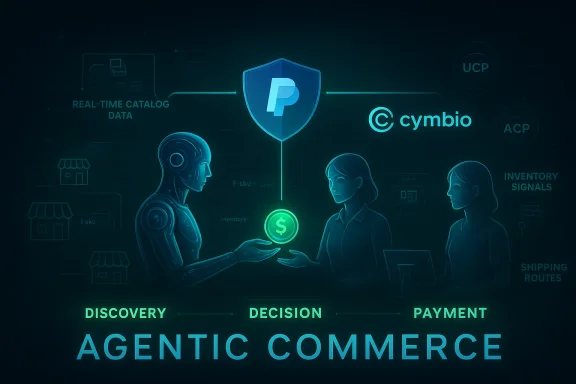
PayPal Bets on Cymbio to Build Agentic Commerce Infrastructure

  • Thread Author
PayPal’s purchase of Cymbio is not a neat defensive tweak — it’s an explicit pivot from “payment button” to an attempt at becoming a plumbing and distribution node inside a fundamentally different commerce stack built for AI agents, and the clock on preserving PayPal’s independence in an agent‑first shopping world is short and measurable.

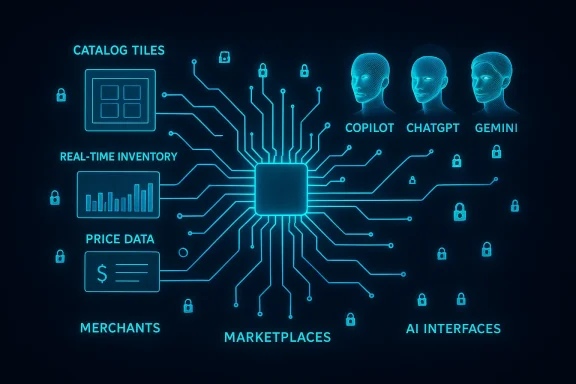
Neon AI hub linking catalogs, real-time inventory, and price data across marketplaces.Background / Overview​

The facts are simple and worth stating up front: PayPal announced it has agreed to acquire Cymbio — a multi‑channel commerce orchestration platform that makes merchant product catalogs discoverable and routable across marketplaces and AI shopping surfaces — with an expected close in the first half of 2026. PayPal’s corporate release confirms the agreement but explicitly says deal terms were not disclosed.
Market commentary — and the analysis circulating in industry feeds — has placed that missing price tag in an estimated band of roughly $150 million to $200 million. That estimate has been repeated in commentary pieces and aggregations, but it is not a figure PayPal has confirmed in publas industry color rather than a corporate admission. I review what the acquisition actually buys PayPal, why it matters, and whether the company has the runway to make the shift from “payments rails” to agentic commerce infrastructure.

Why this matters now: the architecture of Agentic Commerce​

AI agents are compressing the traditional e‑commerce funnel. Discovery, comparison, personalization, checkout authorization and even basic fulfilment orchestration can be performed by an agent acting on a user’s behalf. Several interlocking developments make that more than a thought exercise:
  • Open standards and protocol efforts are proliferating to let agents, merchants and payment providers interoperate without bespoke integrations. Two of the most visible efforts are the Agentic Commerce Protocol (ACP), spearheaded by OpenAI and Stripe, and Shopify’s Universal Commerce Protocol (UCP) — co‑developed with Google in Shopify’s announcement. These protocols aim to standardize how agents see catalogs, confirm intent, and pass actionable order details.
  • Card networks and payments incumbents are building their own agent‑aware frameworks to preserve trust, tokenization, and fraud controls in this new flow. Mastercard, Visa and others have released programs and papers around authenticated agentic transactions and agent tokens — signaling they intend to be active rule‑makers, not passive pipes.
  • Merchant orchestration platforms that normalize product metadata, inventory and order routing — the very capabilities Cymbio provides — become the enablers for AI agents to reliably recommend and commit to purchases without human intervention. Agents require machine‑readable, accurate, and real‑time product and fulfilment data; that is Cymbio’s core product.
All of this translates to a simple structural reality: payments will cease to be the final mile and instead become an embedded node inside discovery and order workflows. Whoever controls those workflows — or who is embedded as a trusted node inside them — captures pricing power, data feedback loops, and ultimately the merchant relationship.

What Cymbio gives PayPal — the product case​

Cymbio’s platform is built for discovery and operational reliability across channels. Practically, PayPal buys:
  • Catalog normalization and Store Sync: canonical, machine‑readable product records with GTIN/SKU mapping, variants, rich media and shipping metadata so agents can extract precise, non‑hallucinated product options.
  • Real‑time inventory and price synchronization: critical for agents to avoid recommending out‑of‑stock items and for keeping fulfilment promises accurate.
  • Order routing and orchestration: translating an accepted agent order into the merchant’s OMS/ERP/fulfilment flows while preserving merchant‑of‑record status.
  • Channel breadth: pre‑existing integrations across marketplaces, retailers and social commerce channels that reduce onboarding friction when adding AI surfaces like Copilot, Perplexity, ChatGPT, or Google Gemini.
In short: Cymbio is middleware that makes a merchant’s catalog and operational systems agent‑ready. For PayPal, owning that middleware shortens the path to making “Store Sync” a one‑step merchant product combined with PayPal’s payment, risk and buyer protection stack.

The numbers that frame the problem​

To measure PayPal’s runway, context matters. PayPal reported processing roughly $1.68–$1.7 trillion in total payment volume (TPV) for 2024 and has historically had large monthly active accounts within its branded checkout footprints — PayPal’s filings and proxy materials list 142 million monthly branded checkout active accounts as a key metric. Those are real scale advantages — but scale alone is not destiny in a protocol‑driven transition.
Stripe, their principal competitor in the agentic execution layer, processed roughly $1.4 trillion in payment volume in 2024 and has been explicit about designing tools — shared payment tokens and the ACP — to be the execution primitives for agent‑initiated commerce. That makes Stripe both a direct payments competitor and a platform play targeting the agent execution surface.
Market sizing is large and widely cited: McKinsey estimates the U.S. B2C agentic opportunity could approach $900 billion–$1 trillion by 2030 (and $3–$5 trillion globally in some scenarios), while Morgan Stanley models a U.S. agentic commerce range of roughly $190 billion to $385 billion by 2030 (10%–20% of online retail in their scenarios). Those are not conservative forecasts; they are the reason incumbents are racing to define protocols and product primitives now.

Protocols and platforms: who controls which layer?​

The current competitive topology looks like this:
  • Routing / discovery layer (UCP / Shopify + Google)
    Shopify announced the Universal Commerce Protocol (UCP), co‑developed with Google, with a clear intent: make merchant catalogs and checkout primitives available to agentic surfaces at scale via a single integration. The goal here is to make the integration problem one‑and‑done for merchants and avoid bespoke agent integrations merchant‑by‑merchant. UCP is designed to be a neutral routing plane where any payment provider can participate.
  • Agent execution / checkout layer (ACP / OpenAI + Stripe)
    OpenAI and Stripe’s Agentic Commerce Protocol (ACP) focuses on how agents can securely initiate and confirm purchases inside conversational interfaces using shared payment tokens and structured APIs (Stripe’s Instant Checkout in ChatGPT is a concrete example). ACP is about execution — making it safe for an agent to hold a scoped token and ask the merchant to capture payment when the agent has authorization.
  • Payments networks and token rules (Visa, Mastercard, Agent Pay)
    Card networks are designing agent‑aware tokens and acceptance frameworks to preserve the security, dispute and settlement models that underpin consumer confidence. They want a seat at the governance table because whoever sets the rules for authentication, agent identity, and dispute remediation will capture significant control points.
  • Embedded merchant middleware (PayPal + Cymbio)
    PayPal is building a vertically integrated play: provide the Store Sync (catalog + routing) and Agent‑Ready payment primitives so merchants can be discoverable and settle via PayPal without having to stitch multiple vendors together. That gives PayPal the choice of being an enabler inside open protocols or being a favored execution node for the merchants that adopt Store Sync.
This is a multi‑player market with overlapping incentives. UCP may want to be a neutral highway; ACP wants to standardize execution semantics for agents; card networks want governance control; payments platforms want to be the default wallet and execution layer.

Head‑to‑head: PayPal + Cymbio vs Stripe + ACP vs UCP/Shopify​

Compare the value propositions at a high level:
  • PayPal + Cymbio: merchant onboarding, catalog normalization, order routing, tokenized checkout and buyer protections all in one package. Strength: one vendor for discovery→checkout→fulfilment orchestration. Weakness: must persuade merchants that PayPal’s combined bundle is preferable to a multi‑protocol world where they retain payment choice.
  • Stripe + OpenAI (ACP + Instant Checkout): execution first. Stripe and OpenAI make it easy for conversational surfaces to issue shared payment tokens and let merchants accept agentic orders via ACP. Strength: Stripe’s developer APIs and merchant adoption are already broad; ACP is designed to be payment‑provider agnostic but Stripe’s primitives may become de facto defaults. Weakness: merchants still need normalized catalogs and routing solutions to feed agents in the discovery phase.
  • Shopify + Google (UCP): protocol and routing at scale. Strength: merchants on Shopify can reach multiple agents with a single integration; Google’s reach into search and Gemini gives UCP immediate distribution. Weakness: UCP intentionally treats payments as a multi‑provider choice — which may slow the capture of payments economics but preserves broad adoption incentives.
No single player yet controls all layers end‑to‑end. The near‑term winners will be those that minimize friction for merchants while capturing the most valuable feedback loops (conversion signals, repeat purchase behavior, fulfilment reliability) and preserving optionality for merchants who resist platform lock‑in.

Strategic analysis: how much time does PayPal realistically have?​

Short answer: less than many investors expect. Longer answer: PayPal’s runway is a function of five quantifiable vectors:
  • Merchant adoption velocity of Store Sync (how quickly Cymbio‑powered Store Sync enrolls merchants).
  • Depth of integrations into agent surfaces (Copilot, ChatGPT/Instant Checkout, Gemini, Perplexity and others).
  • Protocol standardization and governance outcomes (does UCP/ACP win, or do networks set stricter agent auth rules?).
  • Competitor traction — particularly Stripe’s developer momentum and Shopify+Google distribution.
  • Regulatory and network rule changes that might privilege card networks or require stronger agent authentication paths.
If merchants rapidly adopt open standards (UCP/ACP) and choose payment agnosticism, PayPal’s competitive advantage shifts from default checkout to differentiation by product features and pricing. If, instead, PayPal can use Cymbio to make Store Sync the simplest path to reach every major agent, the company can convert merchant onboarding efficiency into long‑term volume. Both outcomes are plausible; the decisive metric will be time to scale — measured in quarters, not years.

Risks, trade‑offs and blind spots​

  • Price / value mismatch on acquisition: public filings show PayPal disclosed the acquisition but not price. Market estimates exist; they are unverified. The lack of transparency matters because investor appetite hinges on whether this is an inexpensive strategic tuck‑in or an expensive salvage play. Treat price commentary with skepticism until regulatory filings surface.
  • Protocol fragmentation risk: multiple competing protocols (ACP, UCP, AP2/AP protocols from Google, card network schemes) increase integration complexity and could result in slower merchant adoption if interoperability rules are unsettled. Fragmentation benefits large vertically integrated players who can internalize the stack and hurts mid‑market merchants.
  • Operational complexity and merchant trust: embedding deeper into merchant operations (inventory, fulfilment routing) increases PayPal’s operational surface area and liability. Mistakes in order routing, inventory mismatches, or agent hallucination leading to mistaken orders create disputes and reputational risk. PayPal will need robust SLAs and dispute tools.
  • Regulatory and governance uncertainty: card networks and regulators are already exploring agentic frameworks; payments rules, consumer protections and KYC/AML expectations could harden in ways that favor incumbent banks or network‑centric solutions. Being early carries benefits, but being regulated into a defensive posture is an equally real threat.
  • Crypto exclusion — a potential missed wedge: current protocol conversations emphasize traditional rails (cards, wallets) and stablecoins are largely absent from the dominant specs. Crypto firms can still design rails adapted for instant, programmable settlement, but timing is critical. If mainstream protocols harden without crypto integration, on‑ramps become more expensive later.

Recommended playbook for PayPal (and for banks / fintechs watching the clock)​

For PayPal to convert this acquisition from a defensive necessity into sustained advantage, it should:
  • Prioritize merchant onboarding speed over closed revenue capture. Frictionless adoption of Store Sync matters more than capturing the first dollar.
  • Make Store Sync and Agent‑Ready payments protocol‑agnostic by supporting both ACP and UCP, while offering superior operational guarantees and SLAs. That preserves merchant choice and reduces the chance of being sidestepped by a standard.
  • Invest beyond tokenization: build dispute resolution, provenance tracking, and auditable agent intent records — these will be table stakes for buyer protections.
  • Open a clear, public roadmap for Cymbio integration and migration paths for PayPal’s existing merchant base (concrete timelines, expected merchant onboarding rates, and measured success metrics). Transparency reduces investor and merchant uncertainty.
  • Work actively with card networks and regulators to shape agent governance in ways that protect consumers but preserve merchant economics.
For banks and crypto firms: pick one of two strategies — either become the default settlement layer for agentic rails (fast, programmable settlement and a clear API story), or partner early with a dominant protocol consortium so you retain a governance seat. Missing the first two windows risks permanent relegation to backend clearing.

A short scorecard: who’s likely to win what​

  • Who will likely own discovery/routing? Shopify + Google (UCP) has the distribution advantage with merchants already on Shopify and Google’s search/Gemini reach.
  • Who will likely own checkout execution? Stripe + OpenAI (ACP + Instant Checkout) is set up to own the exd developer mindshare, especially in the conversational surfaces (ChatGPT/Instant Checkout).
  • Who will own merchant orchestration? PayPal + Cymbio is attempting to own this by offering a full merchant package that makes catalogs agent‑ready and routes orders reliably; success depends on merchant migration speed and product quality.
  • Who will own governance and settled trust? Card networks and regulators — unless protocols produce mature governance quickly — will continue to shape the legal/regulatory contours of agentic transactions.

What to watch next (concrete, short‑term signals)​

  • Merchant enrollment rates in Store Sync (PayPal should publish adoption milestones).
  • ACP / UCP technical specs and the list of certified participants — watch who signs on as a payments provider and as a distribution partner.
  • Card network rule publications and pilot rollouts (Agent Pay, tokenization changes, dispute frameworks).
  • Regulatory guidance on agent‑initiated payments — any consumer protection edicts or KYC expectations that materially increase compliance costs.

Conclusion — how much time does PayPal have?​

Time is measurable here: if the next 12–24 months see rapid merchant standardization on UCP/ACP and broader adoption of Stripe/OpenAI instant checkout primitives across major conversational surfaces, PayPal’s opportunity to become the indispensable payment node shrinks dramatically. Conversely, if PayPal can demonstrate rapid Cymbio‑powered merchant onboarding and deliver demonstrable conversion lift for brands that use Store Sync, it can convert PayPal’s existing payments scale and buyer protections into a durable advantage.
Put another way: PayPal is no longer playing to preserve a mature checkout moat — it’s in a race to be embedded into the front‑end of shopping itself. The outcome depends on execution speed, protocol politics, and the willingness of merchants to adopt one integration that promises omnichannel reach into agentic surfaces. Those are variables measured in quarters. The firm with the clearest path to onboarding millions of merchants to a single, open, reliable agentic integration will control the largest slices of the near‑term agentic commerce value chain.
This deal moves PayPal from the rails onto the road; whether PayPal can keep driving or gets boxed into a toll station depends on the next few strategic turns.

Source: 富途牛牛 How much time is left for PayPal when AI takes over the 'shopping journey'?
 

PayPal’s purchase of Cymbio is not a quiet product bet — it’s a public, high‑stakes move to buy its way into the plumbing of a new shopping era where AI agents don’t merely recommend products but discover, decide, and pay on behalf of people.

Futuristic AI agents facilitate real-time commerce and payments in a neon cyber-scene.Background / Overview​

The modern e‑commerce funnel — search, browse, cart, checkout — is being compressed into conversational and agentic flows where discovery and payment are stitched together by standards, tokens, and authenticated agents. Major platform and payments players have responded with competing technical approaches: Google and Shopify pushing a Universal Commerce Protocol (UCP) to standardize routing and discovery; OpenAI and Stripe shipping an Agentic Commerce Protocol (ACP) and Instant Checkout to enable agent‑initiated payments inside chat; and card networks and incumbents building agent authentication and tokenization layers (Visa Trusted Agent, Mastercard Agent Pay). These moves are fast, coordinated, and explicitly oriented to make agents first‑class storefronts.
PayPal’s Cymbio deal — announced January 22, 2026 and described by PayPal as an acquisition that will accelerate merchant discoverability across AI platforms — folds a decade of feed management, catalog normalization and dropship orchestration into PayPal’s “Store Sync” and agentic commerce product stack. PayPal’s statement says deal terms were not disclosed; media market reports widely peg the transaction at roughly $150–$200 million. Treat the price as a market estimate, not a confirmed fact.

Why Cymbio matters: the operational plumbing of agentic commerce​

The problem agents need solved​

AI agents cannot meaningfully buy on behalf of users unless product, price, inventory, and fulfillment information is canonical, machine‑readable, and reliably up to date. That’s why a layer that does schema mapping, feed syndication, real‑time inventory parity, and order routing is essential.
Cymbio’s core capabilities—catalog ingestion and canonicalization, inventory synchronization, dropship routing and order orchestration—are exactly the operational elements agents require to turn recommendations into fulfilled orders. Embedded agents demand:
  • Reliable SKU-level data and canonical identifiers
  • Real‑time availaead‑time signals
  • Deterministic order routing into merchant OMS/WMS/3PL stacks
  • Clear merchant‑of‑record legal flows and reconciliation
Cymbio’s stack makes merchants “agent‑discoverable” without building bespoke integrations for every agent or marketplace. That’s the product thesis PayPal bought into.

Where PayPal’s existing assets line up​

PayPal brings several hard assets to this problem:
  • A global payments vault and tokenization footprint with high trust in buyer protections.
  • Large merchant reach and multiple checkout surfaces (branded checkout, Braintree, Venmo).
  • Fraud and dispute infrastructure that already operates at scale.
If PayPal can reliably inject Cymbio’s operational layer in front of its payments/fraud stack, it converts its payment moat into an embedded commerce moat — the difference between being a last‑step button and becoming an execution node in an agentic workflow. The company’s own filings and investor materials highlight large TPV and active accounts that create distribution leverage; PayPal reported $1.68 trillion TPV for 2024 and 434 million active accounts (metrics PayPal discloses in its SEC filings). The company has also publicly positioned agentic commerce as a strategic priority.

The three architectural camps and their playbooks​

1) UCP: Google + Shopify — control the routing and discovery layer​

  • Goal: build a neutral, open protocol for agents to route product queries and surface merchant catalogs across large discovery endpoints.
  • Advantage: Google’s search/Gemini reach + Shopify’s merchant distribution (millions of stores) create a powerful distribution wedge.
  • Strategic posture: make routing free and widely adopted to lock in network effects around discoverability and then monetize other layers (ads, featured placements, or commerce primitives).
Shopify announced UCP and positions it as an open standard co‑developed with Google to let merchants “sell directly in AI Mode” across many agent surfaces; the aim is to avoid a proliferation of bespoke connectors. If UCP becomes the default routing layer, merchants benefit from “one integration, many agents.”

2) ACP + Instant Checkout: OpenAI + Stripe — own agent execution and wallet primitives​

  • Goal: make it trivially easy for agents to ask users to pay, confirm with a shared token, and let the agent pass a payment token to the merchant for settlement.
  • Advantage: Stripe’s payments API mindshare and OpenAI’s ChatGPT distribution together can convert conversational intent to payment with minimal merchant friction.
  • Strategic posture: be the default action execution layer — the wallet + payment and risk stack agents call when they want to do commerce.
Stripe and OpenAI released the Agentic Commerce Protocol and Instant Checkout inside ChatGPT. ACP defines a Shared Payment Token primitive and order‑event flow that lets agents initiate and confirm payments under delegated authorization. If agents routinely use ACP, Stripe gains an execution advantage analogous to its historical role as the developer‑first payments API.

3) PayPal + Cymbio — own merchant orchestration and merchant experience​

  • Goal: make merchants agent‑ready at scale (catalog + orchestration) and position payments as an embedded, protocol‑agnostic capability invoked within agent flows.
  • Advantage: PayPal’s existing merchant relationships + Cymbio’s operational connectors creking millions of merchants discoverable by agents.
  • Strategic posture: become the merchant‑orchestration node and a favored payment node for agent flows by delivering measurable conversion lifts for brands.
PayPal’s Store Sync + Agent Ready primitives (announced in late 2025) are the portal for Cymbio’s capabilities to scale across PayPal’s merchant base. The risk for PayPal is time and adoption: merchants must migrate to the combined stack before competing protocols solidify.

The protocol wars: what’s at stake​

This is not a simple “who takes the checkout fee” fight. The real control points are:
  • Discovery and routing (who decides which products agents can see).
  • Execution and authorization (how an agent gets permission and payment tokens).
  • Fulfillment orchestration and merchant relationship (who ensures orders are fulfilled and who owns post‑purchase data).
  • Governance and dispute frameworks (how liability, reversals, KYC/KYA and fraud are managed when an agent initiates action).
Each layer produces different revenue pools and regulatory leverage. Whoever controls discovery shapes demand; whoever controls tokens and execution shapes settlement and fees; and whoever governs agent behavior wins trust and regulatory advocacy.
Key public moves:
  • Google + Shopify’s UCP aims to standardize routing and make discovery ubiquitous.
  • OpenAI + Stripe’s ACP makes agent‑initiated payments easier inside ChatGPT and other agent surfaces.
  • Card networks introduced agentic tokenization and “trusted agent” frameworks (Mastercard’s Agent Pay, Visa’s Trusted Agent Protocol) to keep network rules and settlement central. These efforts tie new agent patterns back into legacy rails, preserving the existing financial plumbing while layering new attestation and token primitives.

Verifying the big claims (what’s solid and what’s speculative)​

  • PayPal acquisition of Cymbio: PayPal announced an agreement to acquire Cymbio on January 22, 2026; PayPal’s press release did not disclose financial terms. Independent media outlets reported market estimates between $150–$200 million — credible but unofficial. Treat the price as an informed market estimate, not a company disclosure.
  • Stripe / OpenAI ACP and Instant Checkout: this is confirmed public product activity; Stripe’s announcement and OpenAI integration were published in September 2025 and are productized inside ChatGPT’s checkout flows. This is not rumor; it’s an active, shipping pattern.
  • Shopify + Google UCP: Shopify has publicly described UCP as a new open standard co‑developed with Google and is rolling agentic storefront capabilities. This is an explicit programmatic push to standardize the discovery/routing layer.
  • McKinsey / Morgan Stanley / Bain market forecasts: multiple research firms have published agentic commerce market sizing with overlapping but not identical ranges. McKinsey’s public work cites up to $1 trillion in U.S. B2C retail orchestration by 2030 (and $3–$5 trillion globally); Morgan Stanley’s research projects $190–$385 billion in U.S. agentic e‑commerce by 2030 (10–20% of online retail). Bain and other consultancies produce similar, slightly different ranges. These forecasts are credible, but they are scenario models that assume high agent adoption and merchant readiness — not guaranteed outcomes.
  • Consumer adoption statistics: survey numbers vary widely by vendor and definition. Some industry trackers and vendor briefs report figures in the high teens to low forties for “used AI to discover or buy” metrics (examples: Salsify, Adobe, proprietary Morgan Stanley AlphaWise figures). A figure of “23% of U.S. consumers have made a purchase using AI by November 2025” appears in several industry summaries, but the primary source for that exact percentage is not always published publicly; different surveys use different definitions (purchase via an AI agent vs. purchase after using AI for discovery). Treat single‑survey claims as early‑stage signals; lean onshow trend direction rather than a single exact percentage.

Strategic implications: winners, losers, and the small print​

For PayPal — the upside​

  • Rapid merchant onboarding via Cymbio could make PayPal the simplest path for brands to become agent‑visible, preserving the company’s role as the go‑to payment and buyer‑protection provider.
  • PayPal can bundle merchant orchestration, order orchestration, risk controls and settlement — creating new revenue lines beyond fees at checkout.
  • PayPal’s buyer‑protection and dispute processes are credible assets that matter when agents operate autonomously.

For PayPal — the risks and execution gaps​

  • Merchant adoption is a people and product problem: integrating Cymbio into millions of merchants and demonstrating measurable conversion lift is complex and multi‑quarter work. If UCP / ACP adoption surges faster, PayPal risks becoming “one payment provider among many” rather than the merchant’s orchestration choice. Industry trackers suggest the window to lock in merchant behavior is measured in quarters.
  • Data governance and contract terms will be scrutinized: merchants will demand clarity on data portability, fees, and control if PayPal controls the catalog sync path. Any hint of extractive contract terms could slow adoption.
  • Regulatory and disputes complexity grows when agents act — PayPal must scale KYA (know‑your‑agent) and dispute frameworks for agent‑initiated actions in ways that satisfy both consumer protection regulators and merchant economics.

For Stripe and OpenAI — the advantage​

  • Stripe’s developer mindshare and OpenAI’s conversational surface create a killer combo: merchants that adopt ACP/Instant Checkout get immediate access to a high‑intent discovery surface inside ChatGPT and other agentic UIs.
  • If Stripe’s Shared Payment Token pattern becomes the de facto execution primitive, Stripe can capture both payment flow fees and optional value add services (fraud, tax, fulfillment event streaming).

For Banks and Card Networks — the survival playbook​

  • Card networks (Visa, Mastercard) are not passive: they are adding tokenization and “agent” attestations to ensure transactions remain governed by network rules and settlement logic. That’s strategically important for banks that want to preserve clearing and settlement economics.
  • Banks should prioritize:
  • Embedding agent attestation and programmable spend into issuer product catalogs.
  • Working with protocol consortia to ensure issuer rights and merchant protections.
  • Offering fast settlement and value‑added compliance tooling for agentic flows.

For crypto and stablecoins — a narrow window of opportunity​

  • Current public protocol stacks (UCP, ACP, AP2) and pilots are payment‑rail agnostic, but much early activity has relied on card rails and tokenization primitives. Crypto proponents point out that programmable money and real‑time settlement are natural fits for agentic flows — but they face a time pressure firms can deliver a native settlement rail with simple developer UX and integrate into early agent protocols before merchant integrations consolidate, they can leapfrog into settlement roles. Otherwise, crypto risks being an optional experiment rather than a core rail. Industry signals show limited crypto inclusion in most early ACP/UCP pilots.

Practical short‑term signals to watch (concrete metrics)​

  • Merchant enrollment speed in PayPal’s Store Sync / Cymbio post‑close (public adoption milestones and merchant case studies).
  • ACP and UCP certification lists and which payment providers they accept by default.
  • Card‑network rule publications and pilot rollouts for agent tokens (Visa Trusted Agent, Mastercard Agent Pay dates and issuer participation).
  • Consumer pilot conversion lifts: does agent discovery → agent checkout measurably improve conversion vs. standard channels?
  • Regulatory guidance or formal rule changes around agent‑initiated payments and KYA (Know Your Agent) requirements.
These are actionable, short‑term indicators that will determine who captures market share in the next 12–24 months.

What merchants should do now (practical checklist)​

  • Instrument product data for agents: canonical SKUs, machine‑readable attributes, inventory parity hooks.
  • Build or buy a single feed/integration that supports ACP and UCP-style endpoints — one integration for multiple agents wins.
  • Revisit commercial terms: ensure MAP, pricing, and returns logic are agent‑compatible.
  • Insist on data portability and audit trails for agent‑initiated orders.
  • Pilot with multiple agent platforms to measure conversion, cost and chargeback patterns.
Merchants who delay will be commoditized by agents that prefer clean, programmatic, agent‑ready catalogs.

Governance, consumer protections and unanswered questions​

Agentic commerce introduces new regulatory and consumer‑protection complexities:
  • Who bears liability when an agent makes an unauthorized or erroneous purchase?
  • How are refunds and chargebacks adjudicated when the agent, merchant, and payment provider are distinct legal actors?
  • What are the privacy and provenance expectations for agents that use sensitive personal signals (health, finance, calendar) to purchase?
Industry consortia and card networks are racing to define these guardrails, but regulation will follow practice. Firms should assume regulators will demand auditable intent trails, robust KYA, and stronger dispute frameworks for agent‑initiated commerce. If those systems aren’t in place, merchants and platforms could face reputational and legal risk fast. ://www.mckinsey.com/capabilities/quantumblack/our-insights/the-agentic-commerce-opportunity-how-ai-agents-are-ushering-in-a-new-era-for-consumers-and-merchants)

Final assessment: how much time does PayPal have?​

PayPal has real advantages — scale, buyer protections, merchant relationships and now Cymbio’s operational layer — but the clock is short. The next 12–24 months will likely decide whether PayPal becomes an embedded orchestration node or simply another supported payment provider on ACP/UCP rails.
  • If PayPal can rapidly onboard millions of merchants to Cymbio‑powered Store Sync, prove conversion lifts, and maintain favorable merchant economics, it converts payments scale into a durable commerce platform advantage.
  • If Shopify+Google’s UCP and Stripe+OpenAI’s ACP gain rapid adoption, then the routing and execution layers will standardize around players whose protocols are already embedded in agents and developer tooling — constraining PayPal to a commoditized payment role unless it becomes the preferred merchant orchestration vendor.
Put bluntly: PayPal’s window to be a system builder rather than a toll collector looks to be measured in quarters, not years. Execution speed, transparent merchant economics, and active participation in protocol governance will determine whether PayPal remains at the table.

Conclusion​

Agentic commerce is not a future hypothesis anymore — it’s an active product rollout across the major commerce stacks. PayPal’s Cymbio acquisition moves the company onto the road toward agentic infrastructure, but it does not alone guarantee a leading seat. The debate is now less about if agents will buy and more about who will define the standards, issue the tokens, and own the merchant relationships that shape discovery, execution, and settlement.
For PayPal, Cymbio is an entrance fee: expensive, necessary, and strategically sensible. But entrance fees don’t buy victory — execution does. Over the next few quarters, the market will watch adoption curves, merchant economics, protocol sign‑ups and proof points for conversion and trust. Those signals will tell us if PayPal has bought itself a durable role in the agentic future — or simply parceled itself into the payments lane on someone else’s AI highway.

Source: BlockBeats When AI Takes Over the 'Shopping Journey,' How Much Time Does PayPal Have Left?
 

Back
Top