

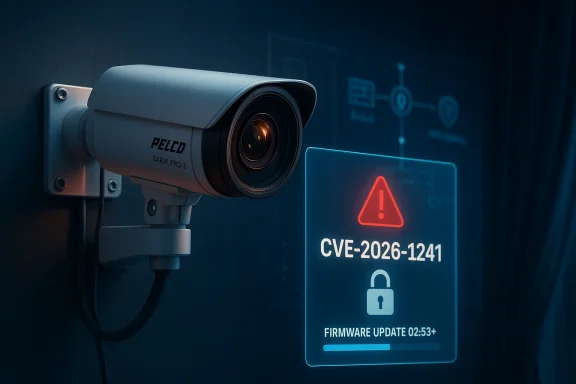
Pelco’s Sarix Professional 3 Series cameras have a serious authentication-bypass weakness that, according to the advisory published this week, allows unauthenticated access to functionality normally gated behind the device’s web-management interface — including the ability to view live video streams — unless devices are updated to the vendor‑recommended firmware. This vulnerability is tracked as CVE‑2026‑1241, carries a CVSS v3.1 base score of 7.5 (High), and has been flagged by federal incident responders as a notable risk to commercial, government, healthcare, energy, transportation, and other critical‑infrastructure environments. cope
Pelco’s Sarix Professional 3 Series is a widely deployed family of fixed IP cameras — including the IMP 3, IXP 3, IBP 3 and IWP 3 lines — used in commercial and government surveillance deployments worldwide. The product family is documented on the vendor site and supported with firmware and manuals through Pelco’s support channels. These cameras are feature‑rich: advanced imaging, analytics, multiple encodings (H.264/H.265), and support for standard VMS integrations, which makes them attractive targets when a management‑interface weakness is discovered.
The advisory identifies affected firmware versions as any Sarix Professional 3 Series device running version 02.52 or earlier, and it recommends updating to 02.53 or later as the remediation. The vulnerability class is described as Authentication Bypass Using an Alternate Path or Channel (CWE‑288) — in practice, that means the camera’s web management interface fails to enfor certain endpoints or flows, enabling an attacker to reach privileged functionality without providing valid credentials.
Important verification note: the advisory text explicitly recommends updating to firmware 02.53 or later. I attempted to locate a public Pelco firmware release note that names 02.53 and the specific fix details on Pelco’s public support pages, but a distinct vendor advisory or a labelled release‑notes page referencing version 02.53 was not clearly discoverable at time of writing. Pelco’s support portal and firmware repository are the canonical sources for firmware downloads and release notices; administrators should confirm the presence of firmware 02.53 (or later) for their exact camera model with Pelco support or their authorized reseller before applying updates. Pelco’s product support portal documents firmware distribution and support processes.
Finally, the Sarix product family has a history of web interface and firmware vulnerabilities (several CVEs dating from 2018 were publicly documented), which reinforces the observation that complex IP cameras remain attractive targets and that firmware updates are the typical remediation path. Historical CVE records for Pelco Sarix devices and their remediation timelines can be found in public vulnerability databases and vendor advisories.
The advisory recommends updating to firmware 02.53 or later; operators should verify:
For security teams this means changing the operational mindset: treat cameras as endpoints with an associated patch, inventory, logging, and lifecycle policy rather than permanently trusted sensors. That shift pays off: segmentation, strict access controls, and regular firmware maintenance dramatically reduce the risk window for issues like CVE‑2026‑1241.
This advisory is an urgent call to action for security teams that operate or manage camera fleets: combine rapid patching with network segmentation and robust logging to reduce the window of exploitation and protect privacy, safety, and operational continuity.
Source: CISA Pelco, Inc. Sarix Pro 3 Series IP Cameras | CISA
Pelco’s Sarix Professional 3 Series is a widely deployed family of fixed IP cameras — including the IMP 3, IXP 3, IBP 3 and IWP 3 lines — used in commercial and government surveillance deployments worldwide. The product family is documented on the vendor site and supported with firmware and manuals through Pelco’s support channels. These cameras are feature‑rich: advanced imaging, analytics, multiple encodings (H.264/H.265), and support for standard VMS integrations, which makes them attractive targets when a management‑interface weakness is discovered.
The advisory identifies affected firmware versions as any Sarix Professional 3 Series device running version 02.52 or earlier, and it recommends updating to 02.53 or later as the remediation. The vulnerability class is described as Authentication Bypass Using an Alternate Path or Channel (CWE‑288) — in practice, that means the camera’s web management interface fails to enfor certain endpoints or flows, enabling an attacker to reach privileged functionality without providing valid credentials.
 What the vulnerability allows — technical summary
- The root issue is an access‑control enforcement failure in the device’s web management/API. Because authentication checks are incomplete or bypassable for some endpoints, attackers that can reach the camera’s management port can invoke functionality that should be restricted.
- The most immediate impact reported is unauthorized viewing of live video streams, but the weakness can also expose configuration pages and sensitive device data that increase operational exposure.
- The advisory rates confidentiality impact as high and specifies that integrity and availability impacts for this flaw were either not applicable or not elevated in the published scoring; however, downstream operational risks (pritory exposure, and the possibility of misuse of captured video) are significant for many deployments.
- View live or recorded video without authorization.
- Change camera configuration (streaming profiles, storage, network).
- Harvest credentials or API tokens stored on or accessible through the device.
- Create or enable backdoor access paths (e.g., enabling services, altering firmware update checks).
- Use the camera as a foothold to pivot into corporate or OT networks if the camera sits on a segment with greater trust.
Verification and sources
This article is based on the recent advisory material that describes CVE‑2026‑1241 and the list of affected Sarix Pro 3 Series versions. For additional product context I reviewed Pelco’s product and support pages (Sarix Professional/Pro 3 Series documentation and firmware/manuals) to validate product names, common deployment characteristics, and where firmware updates are usually distributed.Important verification note: the advisory text explicitly recommends updating to firmware 02.53 or later. I attempted to locate a public Pelco firmware release note that names 02.53 and the specific fix details on Pelco’s public support pages, but a distinct vendor advisory or a labelled release‑notes page referencing version 02.53 was not clearly discoverable at time of writing. Pelco’s support portal and firmware repository are the canonical sources for firmware downloads and release notices; administrators should confirm the presence of firmware 02.53 (or later) for their exact camera model with Pelco support or their authorized reseller before applying updates. Pelco’s product support portal documents firmware distribution and support processes.
Finally, the Sarix product family has a history of web interface and firmware vulnerabilities (several CVEs dating from 2018 were publicly documented), which reinforces the observation that complex IP cameras remain attractive targets and that firmware updates are the typical remediation path. Historical CVE records for Pelco Sarix devices and their remediation timelines can be found in public vulnerability databases and vendor advisories.
Why this matters: risk analysis
Privacy and regulatory exposure
Surveillance cameras capture personally identifiable information and often operate in spaces subject to privacy regulation. Unauthorized viewing of streams can produce immediate privacy violations. For healthcare, government, education, and transportation deployments, the presence of open camera streams can have legal and compliance consequences.Operational safety and business‑impact risks
Even if an attacker only watches video, the intelligence gained can support physical security breaches, timing of intrusions, or reconnaissance for follow‑on attacks. If the vulnerability lets an attacker change camera network configuration or enable remote access services, the device could be used to exfiltrate data, enable persistent access, or deliver additional payloads.Critical‑infrastructure and stions
CISA classified this advisory as relevant to multiple critical‑infrastructure sectors and noted global deployment of the affected devices. Cameras in those sectors are often part of networks that interact with control systems, building‑management systems, or secure physical‑access solutions — meaning a compromise could have cascading effects.Exploitation likelihood
The advisory reports no known public exploitation of CVE‑2026‑1241 at the time of publication, but that absence is not a guarantee. Authentication bypasses are straightforward to exploit when a target is reachable, and camera management interfaces are sometimes directly exposed or reachable from poorly segmented networks. The presence of historical Sarix vulnerabilities and widespread camera deployments increases the likelihood that automated scans or opportunistic attackers will probe for similar weaknesses.Immediate actions for operators (what to do now)
The advisory and industry best practices converge on a short set of immediate steps. Prioritize them in this order:- Inventory and identify:
- Locate every Sarix Professional 3 Series device on your network (IMP 3, IXP 3, IBP 3, IWP 3).
- Record current firmware versions and management IP addresses.
- Isolate and reduce exposure:
- Ensure camera management interfaces are not reachable from the public internet.
- If remote management is required, restrict access by IP allow‑lists and place devices behind secure jump hosts or a management VPN.
- Move camera management traffic to a segmented management VLAN with limited access.
- Patching:
- Apply vendor firmware updates to 02.53 or later as soon as you can confirm the correct vendor image for your exact model and hardware revision.
- When patching, follow vendor instructions: back up device configuration, schedule maintenance windows, and test firmware on a small subset before mass rollout.
- Monitor and detect:
- Enable and forward camera syslog and web‑server logs to a centralized SIEM. Search for anomalous GET/POST patterns against management endpoints and unknown user agents.
- Look for unexpected configuration changes, reboots, or downloads initiated via the device web UI.
- Post‑patch validation:
- After applying updates, validaposed endpoints now require authentication.
- Rotate any credentials that might have been stored or cached on the device or VMS (service accounts, API tokens).
- Report suspicious activity:
- If you observe signs of compromise, preserve logs and follow your incident‑response plan; consider contacting CISA or appropriate national authorities as recommended by your internal policies.
Recommended technical mitigations and controls (beyond patching)
- Network segmentation: place cameras on a dedicated, isolated VLAN and deny lateral traffic to sensitive systems. Use access control lists (ACLs) to restrict communication to only permitted VMS servers and management hosts.
- Strong device management hygiene: enforce unique, strong passwords; disable unused services; and use centralized certificate management where supported.
- Harden remote access: if remote management is required, require multi‑factor authentication on the gateway, use bastion hosts, and avoid exposing the camera’s web ports directly.
- Device lifecycle policies: maintain a current inventory of models, hardware revisions, and firmware levels; schedule regular firmware reviews and patching cycles.
- Logging and telemetry: centralize logs and use behavioral detection rules for unusual patterns (e.g., repeated unauthenticated GETs to management endpoints or unusual query strings).
- Least privilege integration: configure VMS integrations and operator accounts using separate, minimal‑privilege accounts rather than shared admin-level credentials.
- Supply‑chain and procurement controls: insist vendors publish clear CVE mappings and release notes, and require secure update mechanisms (signed firmware, secure rollbacks).
Detection guidance — indicators to hunt for
- Web server request logs from the camera that show requests to management endpoints without a valid session cookie or basic auth header.
- Unexpected HTTP(S) GET or POST to XML or CGI endpoints commonly used by camera web interfaces.
- Outbound connections from cameras to unknown IP addresses or domains (possible exfiltration or callback).
- Sudden changes to streaming endpoints, or creation of new RTSP/RTMP streams not authorized by the VMS.
- Repeated failed or successful anonymous access attempts followed by configuration changes.
Incident response playbook — short checklist
- Quarantine affected devices (remove from network or restrict routes).
- Collect evidence: device logs, VMS logs, DHCP/DNS history, and network captures.
- Validate whether the device was used to access other network resources.
- Rotate passwords and tokens associated with the camera and VMS.
- Reimage or reflash device firmware from a verified vendor image if compromise is suspected.
- Notify stakeholders and regulators as required by policy or law.
Why vendor communication and coordinated disclosure matter
Embedded and IoT devices (including IP cameras) often have long operational lifetimes and produce many product variants. That complexity makes accurate, model‑specific release notes and signed firmware images essential for secure patching.The advisory recommends updating to firmware 02.53 or later; operators should verify:
- That 02.53 exists for their exact model and hardware revision.
- Whether Pelco’s firmware release notes describe the fix for CVE‑2026‑1241.
- Whether the firmware image is signed and whether the device validates the signature during updates.
Bigger picture: cameras as persistent risk hotspots
This advisory is the latest reminder that networked cameras are not “simple” appliances. They often run complex stacks — web servers, APIs, analytics, and third‑party libraries — and historically have been the source of many vulnerabilities in the wild. The Pelco Sarix family previously had multiple disclosed vulnerabilities that required firmware-level remediation; the community must treat camera fleets like any other critical software inventory that requires ongoing vulnerability management and segmentation.For security teams this means changing the operational mindset: treat cameras as endpoints with an associated patch, inventory, logging, and lifecycle policy rather than permanently trusted sensors. That shift pays off: segmentation, strict access controls, and regular firmware maintenance dramatically reduce the risk window for issues like CVE‑2026‑1241.
Strengths and limits of the advisory and mitigation guidance
Strengths:- The advisory clearly identifies affected product models and firmware cutoff (<= 02.52).
- It assigns a CVSS score (7.5) that helps prioritize remediation.
- The advisory offers a concrete remediation (update to 02.53 or later) and practical mitigations (segmentation, restricted remote access).
- At the time of publication, vendor confirmation of the specific firmware release notes for 02.53 was not easily discoverable in public documentation. Operators should verify the vendor image before updating.
- The advisory indicates no known public exploitation at publication, but exploitation of similar camera web interface flaws in the past has occurred rapidly once proof‑of‑concepts or scanning signatures become available.
- Because the advisory’s technical details are framed at a high level (authentication enforcement failure), defenders must assume a broad attack surface and prioritize defense‑in‑depth rather than relying only on a single control.
Recommendations for security managers and integrators
- Treat this as a patch‑and‑segmentation priority for any Sarix Pro 3 Series devices exposed to untrusted networks.
- Implement a tested firmware‑update SOP: image verification, config backups, staged rollouts, post‑patch validation.
- Require vendors to provide signed, model‑specific firmware images and release notes that reference CVE IDs when publishing security fixes.
- Include IP cameras in vulnerability‑scanning and inventory tools, and validate that discovery scans do not inadvertently expose management interfaces.
- Incorporate camera‑specific telemetry into the enterprise detection program (centralized logging, rule sets for web UI anomalies).
- For high‑risk environments (healthcare, government, energy, transportation) — plan for emergency maintenance windows to apply critical security updates quickly and validate network segmentation controls.
Final assessment
CVE‑2026‑1241 is a high‑impact, high‑visibility vulnerability affecting a widely deployed family of Pelco Sarix Professional 3 Series cameras. The vector — an authentication bypass in the management interface — is the type of weakness attackers reliably exploit to gain unauthorized access to video feeds and to establish footholds. Operators should assume that any camera reachable from an untrusted network is at risk and should immediately:- Inventory and isolate affected units,
- Confirm and apply the vendor‑supplied firmware update (02.53 or later) for the precise camera model and hardware revision,
- Harden network and access controls while monitoring for indicators of abuse.
This advisory is an urgent call to action for security teams that operate or manage camera fleets: combine rapid patching with network segmentation and robust logging to reduce the window of exploitation and protect privacy, safety, and operational continuity.
Source: CISA Pelco, Inc. Sarix Pro 3 Series IP Cameras | CISA
