

Penguin Solutions’ late-June 2026 move into several Russell growth benchmarks, its removal from corresponding value indices, its upgraded ClusterWareAI software, and its invitation-only NVIDIA AI Factory Specialized Partner designation together mark a sharper market reframing of PENG as an AI infrastructure growth story rather than a legacy hardware value name. That reframing matters, but it is not the same thing as de-risking the business. The new narrative gives Penguin a cleaner story to tell investors: it wants to be a full-stack operator of AI factories, not merely a seller of memory, compute systems, or project-based high-performance computing gear. The unresolved question is whether that story can produce durable, software-and-services-like revenue instead of another cycle of lumpy infrastructure demand wrapped in better branding.
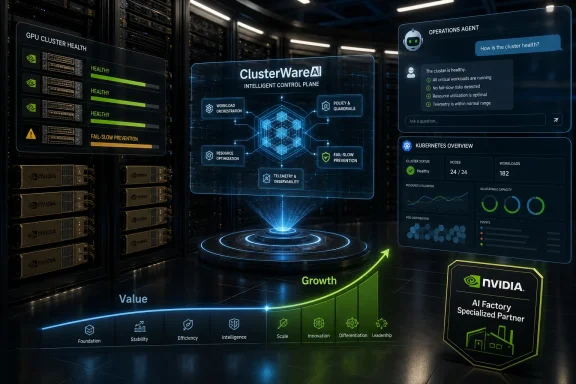
As reported by Simply Wall St and supported by Penguin Solutions’ own late-June announcements, the company’s Russell reclassification arrived almost simultaneously with two product-and-partner signals that are more consequential than the index mechanics themselves. Penguin announced an expanded ClusterWareAI AI Factory Platform Operating System release on June 25, adding a conversational Operations Agent, automated remediation for Kubernetes-based inference workloads, and deeper GPU health visibility. Days earlier, the company said it had become an NVIDIA AI Factory Specialized Partner, a designation it described as invitation-only within the NVIDIA Partner Network.
That pairing is what gives the week its weight. An index provider can move a stock from value to growth because the market has already changed its view of the company. A platform release and an NVIDIA-aligned partner credential, by contrast, are management’s attempt to make that change operationally real.
Russell growth and value indices are not editorial judgments in the way investors sometimes imagine them to be. They are rules-based classifications, driven by factors such as valuation, expected growth, and recent performance. Still, when a company leaves value benchmarks and enters growth benchmarks, the move often captures a change in market perception that has already been underway.
For Penguin Solutions, that perception shift is unusually clean. The company is no longer being discussed primarily as a cyclical hardware supplier or a memory-adjacent enterprise infrastructure business. It is being judged against the much more ambitious category of AI infrastructure providers trying to turn GPU clusters, data-center orchestration, monitoring, and managed services into a repeatable platform.
Simply Wall St framed the June 2026 Russell move as Penguin being added to the Russell 2000, 2500, 3000, and Microcap Growth indices while being removed from corresponding value benchmarks. That is not a thesis by itself, but it changes the audience. Growth funds, quantitative strategies, and investors screening for AI infrastructure exposure now have a more natural reason to encounter the stock.
The danger is that index inclusion can be mistaken for business validation. It can improve visibility, liquidity, and forced ownership from benchmark-tracking funds, but it does not guarantee revenue quality. A stock can graduate into a growth index because expectations have risen faster than the company’s ability to make those expectations less volatile.
That is the useful tension in PENG now. The Russell shift tells us the market is increasingly willing to price Penguin as an AI growth company. The operating results still have to prove that Penguin can behave like one.
Penguin says the AI Factory Specialized Partner designation recognizes solution providers with demonstrated competency in deploying NVIDIA-based training and inference infrastructure. That matters because the AI factory concept is no longer just a glossy phrase from conference keynotes. It describes a real operational problem: how to turn racks of expensive accelerators into a managed, observable, resilient environment capable of supporting model training, inference, and increasingly agentic AI workloads.
For long-term investors, the designation could help Penguin in three ways. It gives customers a signal that Penguin is not merely reselling components. It places the company closer to NVIDIA’s preferred ecosystem for enterprise AI deployments. It also strengthens Penguin’s claim that its software, services, memory, and compute capabilities belong in one integrated platform.
But the badge is not a moat in the way proprietary silicon, hyperscale cloud capacity, or a dominant software layer can be. NVIDIA has many partners, and large customers will continue to evaluate vendors on delivery, price, service quality, integration depth, and support. The partner status opens doors; it does not lock them behind Penguin.
That distinction matters because AI infrastructure is becoming crowded with companies that can credibly say they are NVIDIA-aligned. Dell, Supermicro, HPE, Lenovo, cloud providers, colocation specialists, and specialized integrators all want a slice of the AI factory buildout. Penguin’s challenge is not to prove that the market exists. It is to prove that its role in that market can generate attractive economics over time.
Penguin describes ClusterWareAI as an operating system for AI factories, a hardware-agnostic control plane intended to unify deployment, observability, automation, governance, and performance optimization. The June 25 release added an AI Factory Operations Agent that lets administrators query GPU cluster performance in natural language. It also expanded automated GPU remediation for Kubernetes-based inference workloads and improved health monitoring to detect degraded components before they harm application performance.
Those details are easy to dismiss as vendor boilerplate, but they map directly onto the real pain of AI infrastructure at scale. GPU clusters do not fail only in dramatic, obvious ways. They also develop fail-slow conditions, where hardware continues to operate but performs poorly enough to waste expensive capacity, distort workload scheduling, and quietly degrade service levels.
In traditional enterprise IT, an underperforming node is annoying. In an AI factory built around costly accelerators, it is a capital-efficiency problem. If Penguin can help customers keep GPUs healthier, better utilized, and easier to manage, ClusterWareAI becomes more than a management console. It becomes part of the return-on-investment argument for AI infrastructure itself.
The conversational Operations Agent is also worth watching, though with some skepticism. Every enterprise software vendor now wants to add a natural-language assistant to its product, and many of these agents will end up as demos rather than daily operational tools. Penguin’s version will matter if it compresses troubleshooting time, lowers the expertise required to run large clusters, and helps administrators move from reactive firefighting to proactive management.
That shift is favorable to Penguin’s story. Training clusters can look like one-off engineering projects. Production inference environments demand long-running operations, health monitoring, automation, governance, remediation, and service-level thinking. Those are precisely the areas where Penguin wants ClusterWareAI and its managed services to sit.
The June ClusterWareAI release explicitly targets Kubernetes-based inference environments, which is significant because Kubernetes remains the orchestration substrate many enterprises already understand. By extending automated remediation into those environments, Penguin is trying to connect AI infrastructure with the operating model customers use for modern applications. That is a smart place to compete.
It also reflects a broader market truth: AI spending is moving from experimentation toward production pressure. Once companies run customer-facing or employee-facing AI workloads at scale, GPU utilization, uptime, latency, and predictable cost become board-level concerns. Penguin’s pitch is that AI factories need a control plane, not just a pile of accelerators.
Still, investors should be careful not to assume every AI infrastructure vendor becomes a software company simply because it names a control plane. Software-like economics require pricing power, repeatability, renewals, attach rates, and customer dependency. The product direction is promising; the revenue mix will tell us whether the promise is translating into a better business.
Simply Wall St’s narrative recap points directly at this contradiction. To own Penguin, investors need to believe the company can turn its AI factory platform into a steadier, more software-and-services-weighted business. At the same time, Advanced Computing revenue remains vulnerable to concentration and project timing.
That concentration risk is not solved by joining a Russell growth benchmark. It is not solved by receiving an NVIDIA partner designation. It is not even solved by launching a better software layer, unless that software layer changes the cadence and composition of revenue.
This is the hardest part of the narrative for long-term investors. A company can be strategically well positioned and still be financially volatile. In AI infrastructure, demand can be real, customers can be serious, and deployments can be technically impressive, yet quarterly results can swing because a few large projects move from one period to another.
The market may tolerate that volatility while AI enthusiasm is high. It may even reward it if bookings, backlog, and customer wins suggest larger deployments ahead. But if the growth story becomes dependent on a small number of big contracts, investors will eventually ask whether Penguin is building a platform business or simply becoming a more fashionable project integrator.
That is a privilege and a burden. Growth investors are patient with losses or uneven profits when they believe a company is scaling a repeatable model. They are less forgiving when a growth story depends on difficult-to-forecast hardware cycles, customer concentration, or one-time deployments.
Simply Wall St’s model, as provided in the source material, projected Penguin reaching about $2.2 billion in revenue and $199.1 million in earnings by 2029. That path would require roughly 17.8% annual revenue growth and a significant earnings increase from the current base cited by the analysis. The same write-up also noted a valuation estimate implying meaningful downside to the then-current price, while acknowledging that more optimistic analysts had far higher earnings expectations.
The spread between those views is the story. If Penguin becomes a higher-margin AI infrastructure platform with software, monitoring, remediation, managed services, and recurring customer relationships, the bullish forecasts become easier to understand. If it remains primarily a hardware-and-services project business with AI upside, the market’s growth framing may outrun the fundamentals.
Investors should therefore focus less on the headline partnership language and more on evidence of recurrence. Are customers expanding after initial deployments? Is ClusterWareAI attached to a larger percentage of deals? Are services becoming more durable? Are gross margins improving? Is revenue becoming less dependent on a handful of large customers or programs?
But reliance on NVIDIA’s ecosystem also creates strategic dependency. Penguin’s differentiation has to live in integration, operations, software, services, customer relationships, and execution. It does not control the core accelerator roadmap. It does not set GPU supply dynamics. It does not own the broadest enterprise distribution channels in the way some larger infrastructure vendors do.
This is not a fatal weakness. In fact, many successful infrastructure companies are built around making dominant platforms usable, reliable, and productive for customers. The question is whether Penguin can become indispensable enough in that layer to avoid being squeezed by larger OEMs above it and lower-cost integrators below it.
The AI factory market is still young enough that operational expertise can matter as much as procurement scale. Customers that are new to large GPU clusters may value Penguin’s experience in high-performance computing and cluster operations. Enterprises that need help turning hardware into usable capacity may prefer a specialist over a general-purpose vendor.
Over time, however, specialization has to become defensibility. Penguin’s software must become sticky. Its services must create trust. Its architecture work must reduce deployment risk. Its support must prove valuable when clusters misbehave at 2 a.m. That is where the NVIDIA badge can help open conversations, but Penguin’s own execution has to close and renew them.
A conversational interface for cluster diagnostics sounds like a convenience feature. In practice, if done well, it could be a way to encode institutional expertise into the operating environment. Administrators could ask why utilization dropped, which nodes are underperforming, where fail-slow symptoms are emerging, or whether a Kubernetes inference pool is being constrained by hardware health.
That kind of assistant will only matter if it is grounded in real telemetry and connected to remediation workflows. A chatbot that summarizes dashboard data is not enough. A useful operations agent needs to help teams move from symptom to cause to action with fewer specialists in the loop.
Penguin’s press release language suggests that this is the intended direction: AI-assisted workflows, root-cause analysis, and automated remediation. The challenge is that enterprise buyers have become skeptical of agent branding. They will test whether the system reduces downtime, improves utilization, and saves staff hours.
For WindowsForum’s sysadmin and IT pro audience, this is the familiar arc of infrastructure automation. The promise is never simply that software can tell you something. The promise is that software can reduce the number of fragile, manual, expert-only steps required to keep expensive systems running.
Penguin is emphasizing hardware-level visibility, real-time cluster health, and proactive detection of degradation. That is not glamorous, but it is exactly where AI infrastructure becomes an operations business. The buyer who signs off on a GPU deployment eventually wants to know whether the fleet is producing useful work at the expected rate.
The fail-slow problem is especially important. Traditional monitoring often focuses on failed components, but degraded components can be more insidious. They keep jobs running poorly, reduce throughput, and make application performance inconsistent. In inference, that can mean higher latency, worse user experience, and inefficient scaling.
If Penguin can demonstrate that ClusterWareAI improves GPU utilization or reduces downtime, it gains a stronger value proposition than “we help deploy AI clusters.” It can say it protects the customer’s AI capital investment. That is the kind of claim that can support recurring software and services revenue if customers believe the evidence.
This is also where Penguin’s historical experience in high-performance computing may matter. AI infrastructure may be marketed with new language, but many of its operational problems resemble older supercomputing and cluster-management challenges. The difference is that the customer base is broader, the business pressure is higher, and the tolerance for waste is lower.
That frame is useful. It lets Penguin describe itself as the company that brings software, infrastructure, memory, services, and partner ecosystems together so customers can deploy and operate AI at scale. It also aligns the company with one of the most powerful capital-spending cycles in technology.
But cleaner narratives can hide messier businesses. Investors should resist the temptation to treat the NVIDIA designation, the Russell shift, and the ClusterWareAI release as three separate bullish confirmations of the same fact. They are related, but they do different kinds of work.
The Russell move reflects market classification. The NVIDIA status improves ecosystem credibility. The ClusterWareAI release strengthens the product case. None of those alone proves that Penguin’s revenue will become more predictable, margins will expand, or customer concentration will decline.
The narrative has improved because the pieces fit together better than they did before. The investment case has not become simpler because the burden of proof has increased. Growth stories are allowed to dream, but they are also expected to scale.
If Penguin can show that ClusterWareAI is attached to AI factory deployments as a durable software layer, the market may begin to underwrite a better multiple. If managed services expand alongside deployments, the company may be able to smooth some of the lumpiness that has historically made project-based infrastructure businesses difficult to value. If OriginAI, ComputeAI, MemoryAI, and ClusterWareAI become a coherent portfolio rather than a collection of branded offerings, the platform claim becomes more credible.
On the other hand, if revenue growth remains dominated by a small number of large builds, investors may eventually discount the AI factory narrative. High growth with poor visibility can still be valuable, but it rarely receives the same valuation as repeatable platform growth. The distinction matters most when sentiment turns.
The AI infrastructure market is likely to keep growing, but it will not grow in a straight line for every supplier. GPU supply, customer budgets, deployment bottlenecks, power constraints, data-center capacity, and model economics can all change the pace of projects. Penguin’s software-and-services push is partly a response to that uncertainty.
The better Penguin becomes at operating infrastructure after the sale, the less dependent it may be on any single wave of hardware demand. That is the optimistic thesis. The market’s job over the next several quarters will be to determine whether the company is making that transition fast enough to justify the new growth framing.
That direction is toward a company trying to own more of the AI infrastructure lifecycle. Penguin does not want to be valued merely on the shipment of systems. It wants to be valued on its ability to deploy, monitor, remediate, optimize, and manage AI factories over time.
That is a better business if it works. It could be more durable, more differentiated, and more aligned with the operational reality of enterprise AI. It could also support a valuation that looks less like a cyclical infrastructure supplier and more like a specialized AI platform company.
But the market will not grant that status forever on narrative alone. Penguin needs to show that customers are buying the full stack, that software is becoming more central, that services recur, and that NVIDIA alignment translates into wins rather than just recognition. The stock’s new benchmark identity may invite a growth lens, but the income statement will decide whether it deserves one.
As reported by Simply Wall St and supported by Penguin Solutions’ own late-June announcements, the company’s Russell reclassification arrived almost simultaneously with two product-and-partner signals that are more consequential than the index mechanics themselves. Penguin announced an expanded ClusterWareAI AI Factory Platform Operating System release on June 25, adding a conversational Operations Agent, automated remediation for Kubernetes-based inference workloads, and deeper GPU health visibility. Days earlier, the company said it had become an NVIDIA AI Factory Specialized Partner, a designation it described as invitation-only within the NVIDIA Partner Network.
That pairing is what gives the week its weight. An index provider can move a stock from value to growth because the market has already changed its view of the company. A platform release and an NVIDIA-aligned partner credential, by contrast, are management’s attempt to make that change operationally real.
 The Russell Move Names a Story the Market Was Already Starting to Tell
Russell growth and value indices are not editorial judgments in the way investors sometimes imagine them to be. They are rules-based classifications, driven by factors such as valuation, expected growth, and recent performance. Still, when a company leaves value benchmarks and enters growth benchmarks, the move often captures a change in market perception that has already been underway.For Penguin Solutions, that perception shift is unusually clean. The company is no longer being discussed primarily as a cyclical hardware supplier or a memory-adjacent enterprise infrastructure business. It is being judged against the much more ambitious category of AI infrastructure providers trying to turn GPU clusters, data-center orchestration, monitoring, and managed services into a repeatable platform.
Simply Wall St framed the June 2026 Russell move as Penguin being added to the Russell 2000, 2500, 3000, and Microcap Growth indices while being removed from corresponding value benchmarks. That is not a thesis by itself, but it changes the audience. Growth funds, quantitative strategies, and investors screening for AI infrastructure exposure now have a more natural reason to encounter the stock.
The danger is that index inclusion can be mistaken for business validation. It can improve visibility, liquidity, and forced ownership from benchmark-tracking funds, but it does not guarantee revenue quality. A stock can graduate into a growth index because expectations have risen faster than the company’s ability to make those expectations less volatile.
That is the useful tension in PENG now. The Russell shift tells us the market is increasingly willing to price Penguin as an AI growth company. The operating results still have to prove that Penguin can behave like one.
NVIDIA’s Badge Is More Than Marketing, but Less Than a Moat
Penguin’s NVIDIA AI Factory Specialized Partner status is the more important development because NVIDIA has become the gravity well around which modern AI infrastructure ecosystems orbit. Enterprises, sovereign AI programs, neocloud providers, and hyperscalers are not merely buying GPUs. They are buying validated architectures, integration expertise, deployment speed, uptime assurances, and a way to make scarce accelerated compute behave like a production utility.Penguin says the AI Factory Specialized Partner designation recognizes solution providers with demonstrated competency in deploying NVIDIA-based training and inference infrastructure. That matters because the AI factory concept is no longer just a glossy phrase from conference keynotes. It describes a real operational problem: how to turn racks of expensive accelerators into a managed, observable, resilient environment capable of supporting model training, inference, and increasingly agentic AI workloads.
For long-term investors, the designation could help Penguin in three ways. It gives customers a signal that Penguin is not merely reselling components. It places the company closer to NVIDIA’s preferred ecosystem for enterprise AI deployments. It also strengthens Penguin’s claim that its software, services, memory, and compute capabilities belong in one integrated platform.
But the badge is not a moat in the way proprietary silicon, hyperscale cloud capacity, or a dominant software layer can be. NVIDIA has many partners, and large customers will continue to evaluate vendors on delivery, price, service quality, integration depth, and support. The partner status opens doors; it does not lock them behind Penguin.
That distinction matters because AI infrastructure is becoming crowded with companies that can credibly say they are NVIDIA-aligned. Dell, Supermicro, HPE, Lenovo, cloud providers, colocation specialists, and specialized integrators all want a slice of the AI factory buildout. Penguin’s challenge is not to prove that the market exists. It is to prove that its role in that market can generate attractive economics over time.
ClusterWareAI Is the Part of the Story Investors Should Actually Watch
The upgraded ClusterWareAI release is more than a feature update because it points to where Penguin’s investment case has to go. Hardware deployments can be large, impressive, and revenue-generating, but they are often project-driven. Software that controls, monitors, remediates, and optimizes those deployments has a better chance of creating recurring value.Penguin describes ClusterWareAI as an operating system for AI factories, a hardware-agnostic control plane intended to unify deployment, observability, automation, governance, and performance optimization. The June 25 release added an AI Factory Operations Agent that lets administrators query GPU cluster performance in natural language. It also expanded automated GPU remediation for Kubernetes-based inference workloads and improved health monitoring to detect degraded components before they harm application performance.
Those details are easy to dismiss as vendor boilerplate, but they map directly onto the real pain of AI infrastructure at scale. GPU clusters do not fail only in dramatic, obvious ways. They also develop fail-slow conditions, where hardware continues to operate but performs poorly enough to waste expensive capacity, distort workload scheduling, and quietly degrade service levels.
In traditional enterprise IT, an underperforming node is annoying. In an AI factory built around costly accelerators, it is a capital-efficiency problem. If Penguin can help customers keep GPUs healthier, better utilized, and easier to manage, ClusterWareAI becomes more than a management console. It becomes part of the return-on-investment argument for AI infrastructure itself.
The conversational Operations Agent is also worth watching, though with some skepticism. Every enterprise software vendor now wants to add a natural-language assistant to its product, and many of these agents will end up as demos rather than daily operational tools. Penguin’s version will matter if it compresses troubleshooting time, lowers the expertise required to run large clusters, and helps administrators move from reactive firefighting to proactive management.
The AI Factory Narrative Depends on Inference, Not Just Buildouts
The first wave of AI infrastructure enthusiasm was driven by training clusters and the race to acquire accelerated compute. The next phase is more operationally demanding. Enterprises want inference capacity that can run reliably, economically, and close enough to production systems to support business-critical workloads.That shift is favorable to Penguin’s story. Training clusters can look like one-off engineering projects. Production inference environments demand long-running operations, health monitoring, automation, governance, remediation, and service-level thinking. Those are precisely the areas where Penguin wants ClusterWareAI and its managed services to sit.
The June ClusterWareAI release explicitly targets Kubernetes-based inference environments, which is significant because Kubernetes remains the orchestration substrate many enterprises already understand. By extending automated remediation into those environments, Penguin is trying to connect AI infrastructure with the operating model customers use for modern applications. That is a smart place to compete.
It also reflects a broader market truth: AI spending is moving from experimentation toward production pressure. Once companies run customer-facing or employee-facing AI workloads at scale, GPU utilization, uptime, latency, and predictable cost become board-level concerns. Penguin’s pitch is that AI factories need a control plane, not just a pile of accelerators.
Still, investors should be careful not to assume every AI infrastructure vendor becomes a software company simply because it names a control plane. Software-like economics require pricing power, repeatability, renewals, attach rates, and customer dependency. The product direction is promising; the revenue mix will tell us whether the promise is translating into a better business.
The Old Penguin Has Not Disappeared Inside the New One
The strongest bullish version of the Penguin story is that the company is evolving into a full-stack AI infrastructure provider with differentiated software, memory expertise, validated compute architectures, and services. The skeptical version is that Penguin remains exposed to large, uneven projects whose timing can make revenue and margins hard to forecast. Both views can be true at the same time.Simply Wall St’s narrative recap points directly at this contradiction. To own Penguin, investors need to believe the company can turn its AI factory platform into a steadier, more software-and-services-weighted business. At the same time, Advanced Computing revenue remains vulnerable to concentration and project timing.
That concentration risk is not solved by joining a Russell growth benchmark. It is not solved by receiving an NVIDIA partner designation. It is not even solved by launching a better software layer, unless that software layer changes the cadence and composition of revenue.
This is the hardest part of the narrative for long-term investors. A company can be strategically well positioned and still be financially volatile. In AI infrastructure, demand can be real, customers can be serious, and deployments can be technically impressive, yet quarterly results can swing because a few large projects move from one period to another.
The market may tolerate that volatility while AI enthusiasm is high. It may even reward it if bookings, backlog, and customer wins suggest larger deployments ahead. But if the growth story becomes dependent on a small number of big contracts, investors will eventually ask whether Penguin is building a platform business or simply becoming a more fashionable project integrator.
A Growth Multiple Requires Proof of Recurrence
The Russell reclassification matters because it can influence how investors frame valuation. Value investors often ask what a company is worth relative to current earnings, assets, cash flow, and cyclicality. Growth investors are more willing to pay for future revenue expansion, margin improvement, and category leadership. Penguin is now being pulled more visibly into the second conversation.That is a privilege and a burden. Growth investors are patient with losses or uneven profits when they believe a company is scaling a repeatable model. They are less forgiving when a growth story depends on difficult-to-forecast hardware cycles, customer concentration, or one-time deployments.
Simply Wall St’s model, as provided in the source material, projected Penguin reaching about $2.2 billion in revenue and $199.1 million in earnings by 2029. That path would require roughly 17.8% annual revenue growth and a significant earnings increase from the current base cited by the analysis. The same write-up also noted a valuation estimate implying meaningful downside to the then-current price, while acknowledging that more optimistic analysts had far higher earnings expectations.
The spread between those views is the story. If Penguin becomes a higher-margin AI infrastructure platform with software, monitoring, remediation, managed services, and recurring customer relationships, the bullish forecasts become easier to understand. If it remains primarily a hardware-and-services project business with AI upside, the market’s growth framing may outrun the fundamentals.
Investors should therefore focus less on the headline partnership language and more on evidence of recurrence. Are customers expanding after initial deployments? Is ClusterWareAI attached to a larger percentage of deals? Are services becoming more durable? Are gross margins improving? Is revenue becoming less dependent on a handful of large customers or programs?
NVIDIA Alignment Cuts Both Ways
NVIDIA alignment is a powerful advantage in 2026 because NVIDIA remains the central supplier and ecosystem architect for much of the AI infrastructure market. Customers building AI factories want validated NVIDIA-based solutions, and vendors that can credibly deploy, manage, and optimize those environments benefit from that demand. Penguin’s partner status gives it a stronger claim to be one of those vendors.But reliance on NVIDIA’s ecosystem also creates strategic dependency. Penguin’s differentiation has to live in integration, operations, software, services, customer relationships, and execution. It does not control the core accelerator roadmap. It does not set GPU supply dynamics. It does not own the broadest enterprise distribution channels in the way some larger infrastructure vendors do.
This is not a fatal weakness. In fact, many successful infrastructure companies are built around making dominant platforms usable, reliable, and productive for customers. The question is whether Penguin can become indispensable enough in that layer to avoid being squeezed by larger OEMs above it and lower-cost integrators below it.
The AI factory market is still young enough that operational expertise can matter as much as procurement scale. Customers that are new to large GPU clusters may value Penguin’s experience in high-performance computing and cluster operations. Enterprises that need help turning hardware into usable capacity may prefer a specialist over a general-purpose vendor.
Over time, however, specialization has to become defensibility. Penguin’s software must become sticky. Its services must create trust. Its architecture work must reduce deployment risk. Its support must prove valuable when clusters misbehave at 2 a.m. That is where the NVIDIA badge can help open conversations, but Penguin’s own execution has to close and renew them.
The Operations Agent Is a Small Window Into a Bigger Labor Problem
The most interesting feature in the ClusterWareAI update may be the Operations Agent, not because chat interfaces are novel, but because AI infrastructure operations are becoming a labor bottleneck. Running large GPU environments requires knowledge across hardware, networking, storage, schedulers, containers, drivers, firmware, telemetry, and application behavior. The talent pool for that work is not expanding as quickly as the installed base of AI systems.A conversational interface for cluster diagnostics sounds like a convenience feature. In practice, if done well, it could be a way to encode institutional expertise into the operating environment. Administrators could ask why utilization dropped, which nodes are underperforming, where fail-slow symptoms are emerging, or whether a Kubernetes inference pool is being constrained by hardware health.
That kind of assistant will only matter if it is grounded in real telemetry and connected to remediation workflows. A chatbot that summarizes dashboard data is not enough. A useful operations agent needs to help teams move from symptom to cause to action with fewer specialists in the loop.
Penguin’s press release language suggests that this is the intended direction: AI-assisted workflows, root-cause analysis, and automated remediation. The challenge is that enterprise buyers have become skeptical of agent branding. They will test whether the system reduces downtime, improves utilization, and saves staff hours.
For WindowsForum’s sysadmin and IT pro audience, this is the familiar arc of infrastructure automation. The promise is never simply that software can tell you something. The promise is that software can reduce the number of fragile, manual, expert-only steps required to keep expensive systems running.
GPU Health Monitoring Is Where the Economics Get Real
The expanded GPU health monitoring in ClusterWareAI deserves more attention than the buzzier AI agent because it hits the financial core of AI infrastructure. GPUs are expensive, scarce, power-hungry, and central to the economics of training and inference. A cluster that looks available but performs inconsistently can quietly destroy utilization assumptions.Penguin is emphasizing hardware-level visibility, real-time cluster health, and proactive detection of degradation. That is not glamorous, but it is exactly where AI infrastructure becomes an operations business. The buyer who signs off on a GPU deployment eventually wants to know whether the fleet is producing useful work at the expected rate.
The fail-slow problem is especially important. Traditional monitoring often focuses on failed components, but degraded components can be more insidious. They keep jobs running poorly, reduce throughput, and make application performance inconsistent. In inference, that can mean higher latency, worse user experience, and inefficient scaling.
If Penguin can demonstrate that ClusterWareAI improves GPU utilization or reduces downtime, it gains a stronger value proposition than “we help deploy AI clusters.” It can say it protects the customer’s AI capital investment. That is the kind of claim that can support recurring software and services revenue if customers believe the evidence.
This is also where Penguin’s historical experience in high-performance computing may matter. AI infrastructure may be marketed with new language, but many of its operational problems resemble older supercomputing and cluster-management challenges. The difference is that the customer base is broader, the business pressure is higher, and the tolerance for waste is lower.
The Investor Narrative Is Now Cleaner, but Not Simpler
Before the AI factory push, Penguin’s story could look scattered to generalist investors. Memory, compute systems, services, high-performance computing, and specialized infrastructure do not always combine into an easy elevator pitch. The AI factory label gives the company a unifying frame.That frame is useful. It lets Penguin describe itself as the company that brings software, infrastructure, memory, services, and partner ecosystems together so customers can deploy and operate AI at scale. It also aligns the company with one of the most powerful capital-spending cycles in technology.
But cleaner narratives can hide messier businesses. Investors should resist the temptation to treat the NVIDIA designation, the Russell shift, and the ClusterWareAI release as three separate bullish confirmations of the same fact. They are related, but they do different kinds of work.
The Russell move reflects market classification. The NVIDIA status improves ecosystem credibility. The ClusterWareAI release strengthens the product case. None of those alone proves that Penguin’s revenue will become more predictable, margins will expand, or customer concentration will decline.
The narrative has improved because the pieces fit together better than they did before. The investment case has not become simpler because the burden of proof has increased. Growth stories are allowed to dream, but they are also expected to scale.
The Numbers Will Have to Catch the Narrative
The most important future Penguin disclosures will not be the ones with the most AI adjectives. They will be the ones that show whether the company is changing the shape of its revenue. Investors should watch backlog, customer concentration, software attach rates, recurring services, gross margin trends, and the timing of large Advanced Computing projects.If Penguin can show that ClusterWareAI is attached to AI factory deployments as a durable software layer, the market may begin to underwrite a better multiple. If managed services expand alongside deployments, the company may be able to smooth some of the lumpiness that has historically made project-based infrastructure businesses difficult to value. If OriginAI, ComputeAI, MemoryAI, and ClusterWareAI become a coherent portfolio rather than a collection of branded offerings, the platform claim becomes more credible.
On the other hand, if revenue growth remains dominated by a small number of large builds, investors may eventually discount the AI factory narrative. High growth with poor visibility can still be valuable, but it rarely receives the same valuation as repeatable platform growth. The distinction matters most when sentiment turns.
The AI infrastructure market is likely to keep growing, but it will not grow in a straight line for every supplier. GPU supply, customer budgets, deployment bottlenecks, power constraints, data-center capacity, and model economics can all change the pace of projects. Penguin’s software-and-services push is partly a response to that uncertainty.
The better Penguin becomes at operating infrastructure after the sale, the less dependent it may be on any single wave of hardware demand. That is the optimistic thesis. The market’s job over the next several quarters will be to determine whether the company is making that transition fast enough to justify the new growth framing.
The Reclassification Only Matters If Penguin Changes the Revenue Mix
The late-June news cycle gives investors a more coherent way to think about PENG, but it should not be mistaken for a completed transformation. The Russell move may bring growth-oriented holders. The NVIDIA badge may help with enterprise credibility. The ClusterWareAI update may strengthen Penguin’s operational value proposition. The combination is meaningful precisely because it points in the same direction.That direction is toward a company trying to own more of the AI infrastructure lifecycle. Penguin does not want to be valued merely on the shipment of systems. It wants to be valued on its ability to deploy, monitor, remediate, optimize, and manage AI factories over time.
That is a better business if it works. It could be more durable, more differentiated, and more aligned with the operational reality of enterprise AI. It could also support a valuation that looks less like a cyclical infrastructure supplier and more like a specialized AI platform company.
But the market will not grant that status forever on narrative alone. Penguin needs to show that customers are buying the full stack, that software is becoming more central, that services recur, and that NVIDIA alignment translates into wins rather than just recognition. The stock’s new benchmark identity may invite a growth lens, but the income statement will decide whether it deserves one.
The AI Factory Label Finally Gives PENG a Coherent Test
Penguin’s latest announcements do not make the stock automatically cheap or expensive. They make the test clearer.- Penguin’s Russell growth reclassification reflects a market that is increasingly viewing the company through an AI infrastructure lens rather than a traditional value framework.
- The NVIDIA AI Factory Specialized Partner designation improves Penguin’s credibility with customers looking for validated NVIDIA-based training and inference deployments.
- The ClusterWareAI update matters because operations, remediation, and GPU health monitoring are where AI infrastructure becomes a recurring management problem rather than a one-time buildout.
- The biggest risk remains revenue lumpiness from large, concentrated Advanced Computing projects, and none of the June announcements eliminates that risk by itself.
- The long-term bull case depends on Penguin converting AI factory deployments into software, services, and managed infrastructure relationships that are more predictable than hardware projects.
- Investors should watch evidence of revenue mix shift, customer expansion, margin improvement, and recurring attach rates more closely than headline partner labels.
References
- Primary source: simplywall.st
Published: 2026-07-04T14:40:16.662987
Loading…
simplywall.st - Related coverage: ir.penguinsolutions.com
Loading…
ir.penguinsolutions.com - Related coverage: businesswire.com
Loading…
www.businesswire.com - Related coverage: penguinsolutions.com
Loading…
www.penguinsolutions.com - Related coverage: marketchameleon.com
Loading…
marketchameleon.com - Related coverage: streetinsider.com
Loading…
www.streetinsider.com
- Related coverage: ca.investing.com
Loading…
ca.investing.com - Related coverage: investing.com
Loading…
www.investing.com - Related coverage: nasdaq.com
Loading…
www.nasdaq.com - Related coverage: ng.investing.com
Loading…
ng.investing.com - Related coverage: lseg.com
Loading…
www.lseg.com - Related coverage: newsroom.ibm.com
IBM Announces Expanded Collaboration with NVIDIA to Advance AI for the Enterprise
PDF documentnewsroom.ibm.com
- Related coverage: s204.q4cdn.com
Loading…
s204.q4cdn.com - Related coverage: homesteadadvisers.com
Loading…
www.homesteadadvisers.com