

The Pentagon’s decision to label Anthropic a “supply-chain risk to national security” was not triggered by a discovered vulnerability in Claude, foreign ownership, or evidence of compromised software. It followed a contract dispute over whether the U.S. military could use Anthropic’s AI for “all lawful purposes” without the company preserving two explicit guardrails: no mass surveillance of Americans and no fully autonomous weapons.
As Anthropic detailed in a March statement from CEO Dario Amodei, the company had already agreed to support a broad range of defense and intelligence work. The breaking point was contractual language. Anthropic wanted its restrictions retained in writing; the Pentagon wanted unrestricted discretion over lawful military uses. When negotiations failed, the administration moved from threatening to terminate the relationship to invoking a procurement tool normally associated with hostile or compromised suppliers.
That distinction matters. Calling a technology provider a supply-chain risk is not the same as simply declining to renew a contract. The label turns a commercial disagreement into a security finding, with consequences that can reach defense contractors, systems integrators, cloud partners, and agencies relying on the provider’s models.
Anthropic’s position was not that Claude could not support military work. Its government-focused models had already been used in national-security environments, including classified deployments through partner platforms. The company’s public account said it was prepared to support intelligence analysis, planning, logistics, cybersecurity, and other defense applications.
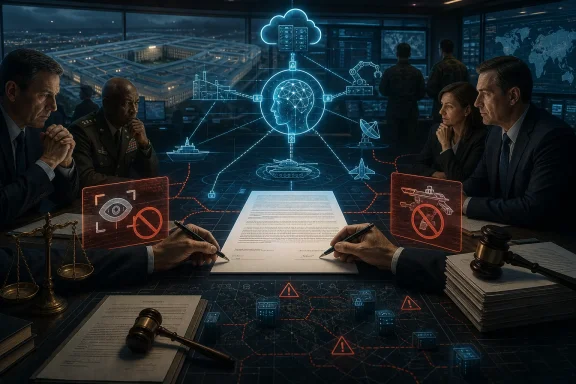
Its red lines were narrower, but consequential. Anthropic would not remove prohibitions covering mass domestic surveillance and systems that could select or engage targets without meaningful human control. The Pentagon’s response, reported by Axios and later confirmed in public statements, was that military users needed access for all uses permitted under U.S. law.
This is where the argument became larger than a model’s terms of service. The Defense Department saw a private supplier’s policy layer as an unacceptable limitation on command authority. Anthropic saw those terms as a necessary backstop precisely because the law may permit activities a model developer considers too risky or too harmful to enable.
In practical IT terms, the conflict resembled a vendor insisting on a non-negotiable acceptable-use control inside a critical platform, while the customer demanded administrator-level authority over every legally permitted configuration. Neither side was debating whether the platform could perform the task. They were debating who gets the final say over the task.
The Pentagon’s formal action followed public pressure from the administration in late February and early March. Anthropic said it received a letter confirming the designation on March 4, 2026; reporting from Reuters, the Associated Press, and Defense News described the policy as becoming effective immediately. The administration also directed a broader federal phaseout of Anthropic technology.
The government’s rationale was straightforward even if its legal theory was contentious: a supplier that can deny the military access to a capability needed for lawful operations creates an unacceptable dependency risk. Pentagon officials argued that vendors cannot insert themselves into the chain of command by imposing operational limits after their products become embedded in defense workflows.
That is a recognizable procurement concern. A military organization does not want a contractor to remotely alter mission-critical capabilities, revoke access in a crisis, or dictate operational policy. But Anthropic’s critics and supporters differed sharply over whether that concern justified branding a domestic AI developer as a national-security supply-chain threat rather than simply ending the business relationship.
The label also carried a much broader practical threat than the loss of a direct contract. Defense contractors could be required to certify that they were not using Anthropic models in covered defense work. For organizations that use Claude through a cloud service, an internal knowledge tool, a coding assistant, or an embedded third-party platform, the hard problem is discovering where that model is actually present.
Anthropic argued that the Pentagon’s formal letter was narrower. According to Amodei, it applied principally to Claude’s use in direct connection with Defense Department contracts, rather than to all commercial use of Anthropic products by companies that also happened to work with the Pentagon.
That did not eliminate the disruption. A narrow rule is still difficult to operationalize in a defense industrial base built around shared cloud tenants, common developer tools, centralized identity, and mixed-use corporate environments. A contractor may be able to segment a Claude-powered workflow from a defense program on paper, but it needs technical evidence that the separation holds in practice.
For Windows administrators and security teams, the story is less about whether employees can open a Claude chat window and more about software inventory. Organizations affected by the designation would need to map direct API usage, cloud-hosted models, AI features embedded in SaaS products, developer extensions, automation pipelines, and data flows. They would also need to determine whether a covered use touches government-furnished devices, classified networks, controlled unclassified information, or a contract-specific environment.
A procurement restriction becomes a security architecture project very quickly.
On March 26, Judge Rita Lin of the U.S. District Court for the Northern District of California granted Anthropic a preliminary injunction against key government actions. The Associated Press reported that Lin found the government’s theory difficult to reconcile with the statute and described the record as indicating possible First Amendment retaliation.
But the litigation did not produce a clean, final reset. Reporting by Breaking Defense and Reuters showed that the administration relied on separate statutory authorities, including a government-wide framework distinct from the Pentagon-specific authority challenged in California. In April, the D.C. Circuit declined, at least temporarily, to block the separate government-wide action while the case proceeded.
The result is a fragmented legal and operational picture. One court ruling restrained part of the Pentagon’s effort, while another pathway for the designation remained contested. Contractors should not mistake an injunction headline for an automatic restoration of previous procurement rules; they need to follow the terms of their contracts, agency guidance, and any applicable implementation memoranda.
That will push the Pentagon toward architectures that reduce reliance on any single model vendor. Expect more interest in model portability, multi-vendor gateways, isolated deployment environments, audit logging, and workflows designed to swap one model for another without rebuilding the entire system. The demand is not merely for better AI; it is for replaceable AI infrastructure that preserves government control even if a supplier exits, changes its policies, or loses eligibility.
For AI companies, the counterpressure is equally clear. Government business may require more than a specialized product, security authorization, and a favorable price. It may require accepting that lawful use, rather than vendor-defined ethical limits, is the governing standard.
That is the real spark behind the designation. Anthropic did not lose Pentagon favor because Claude stopped working. It was labeled a risk because Anthropic insisted that some technically possible, potentially lawful uses of Claude should remain contractually off limits—and the Pentagon decided that constraint itself was the risk.
As Anthropic detailed in a March statement from CEO Dario Amodei, the company had already agreed to support a broad range of defense and intelligence work. The breaking point was contractual language. Anthropic wanted its restrictions retained in writing; the Pentagon wanted unrestricted discretion over lawful military uses. When negotiations failed, the administration moved from threatening to terminate the relationship to invoking a procurement tool normally associated with hostile or compromised suppliers.
That distinction matters. Calling a technology provider a supply-chain risk is not the same as simply declining to renew a contract. The label turns a commercial disagreement into a security finding, with consequences that can reach defense contractors, systems integrators, cloud partners, and agencies relying on the provider’s models.
 The Dispute Was About Control of Claude’s Use
Anthropic’s position was not that Claude could not support military work. Its government-focused models had already been used in national-security environments, including classified deployments through partner platforms. The company’s public account said it was prepared to support intelligence analysis, planning, logistics, cybersecurity, and other defense applications.Its red lines were narrower, but consequential. Anthropic would not remove prohibitions covering mass domestic surveillance and systems that could select or engage targets without meaningful human control. The Pentagon’s response, reported by Axios and later confirmed in public statements, was that military users needed access for all uses permitted under U.S. law.
This is where the argument became larger than a model’s terms of service. The Defense Department saw a private supplier’s policy layer as an unacceptable limitation on command authority. Anthropic saw those terms as a necessary backstop precisely because the law may permit activities a model developer considers too risky or too harmful to enable.
In practical IT terms, the conflict resembled a vendor insisting on a non-negotiable acceptable-use control inside a critical platform, while the customer demanded administrator-level authority over every legally permitted configuration. Neither side was debating whether the platform could perform the task. They were debating who gets the final say over the task.
Why “Supply-Chain Risk” Was an Extraordinary Escalation
The designation was extraordinary because supply-chain authorities are generally intended to address technology that could create national-security exposure through sabotage, malicious functionality, foreign control, or other forms of compromise. Anthropic is a U.S. AI company supplying a product the Pentagon had actively sought to deploy.The Pentagon’s formal action followed public pressure from the administration in late February and early March. Anthropic said it received a letter confirming the designation on March 4, 2026; reporting from Reuters, the Associated Press, and Defense News described the policy as becoming effective immediately. The administration also directed a broader federal phaseout of Anthropic technology.
The government’s rationale was straightforward even if its legal theory was contentious: a supplier that can deny the military access to a capability needed for lawful operations creates an unacceptable dependency risk. Pentagon officials argued that vendors cannot insert themselves into the chain of command by imposing operational limits after their products become embedded in defense workflows.
That is a recognizable procurement concern. A military organization does not want a contractor to remotely alter mission-critical capabilities, revoke access in a crisis, or dictate operational policy. But Anthropic’s critics and supporters differed sharply over whether that concern justified branding a domestic AI developer as a national-security supply-chain threat rather than simply ending the business relationship.
The label also carried a much broader practical threat than the loss of a direct contract. Defense contractors could be required to certify that they were not using Anthropic models in covered defense work. For organizations that use Claude through a cloud service, an internal knowledge tool, a coding assistant, or an embedded third-party platform, the hard problem is discovering where that model is actually present.
The Narrow Scope Was Important — and Still Disruptive
Initial public rhetoric suggested a sweeping commercial blacklist: companies doing any business with the military might have to cut off Anthropic entirely. That interpretation raised immediate concerns for Amazon, Microsoft, systems integrators, and enterprise software vendors serving both civilian and defense customers.Anthropic argued that the Pentagon’s formal letter was narrower. According to Amodei, it applied principally to Claude’s use in direct connection with Defense Department contracts, rather than to all commercial use of Anthropic products by companies that also happened to work with the Pentagon.
That did not eliminate the disruption. A narrow rule is still difficult to operationalize in a defense industrial base built around shared cloud tenants, common developer tools, centralized identity, and mixed-use corporate environments. A contractor may be able to segment a Claude-powered workflow from a defense program on paper, but it needs technical evidence that the separation holds in practice.
For Windows administrators and security teams, the story is less about whether employees can open a Claude chat window and more about software inventory. Organizations affected by the designation would need to map direct API usage, cloud-hosted models, AI features embedded in SaaS products, developer extensions, automation pipelines, and data flows. They would also need to determine whether a covered use touches government-furnished devices, classified networks, controlled unclassified information, or a contract-specific environment.
A procurement restriction becomes a security architecture project very quickly.
The Courts Found a Serious Legal Problem
Anthropic filed suit on March 9, arguing that the designation exceeded the government’s authority and amounted to retaliation for the company’s protected policy position. The company’s legal argument centered in part on the statutory requirement to use the least restrictive means necessary to address a supply-chain threat.On March 26, Judge Rita Lin of the U.S. District Court for the Northern District of California granted Anthropic a preliminary injunction against key government actions. The Associated Press reported that Lin found the government’s theory difficult to reconcile with the statute and described the record as indicating possible First Amendment retaliation.
But the litigation did not produce a clean, final reset. Reporting by Breaking Defense and Reuters showed that the administration relied on separate statutory authorities, including a government-wide framework distinct from the Pentagon-specific authority challenged in California. In April, the D.C. Circuit declined, at least temporarily, to block the separate government-wide action while the case proceeded.
The result is a fragmented legal and operational picture. One court ruling restrained part of the Pentagon’s effort, while another pathway for the designation remained contested. Contractors should not mistake an injunction headline for an automatic restoration of previous procurement rules; they need to follow the terms of their contracts, agency guidance, and any applicable implementation memoranda.
The Precedent Is Bigger Than Anthropic
The Anthropic fight exposes a structural problem in defense AI: the military wants advanced commercial models, but frontier-model providers increasingly treat deployment rules as part of the product. A model’s safety policy, access controls, system prompts, monitoring, and acceptable-use terms are no longer peripheral legal language. They are operational constraints.That will push the Pentagon toward architectures that reduce reliance on any single model vendor. Expect more interest in model portability, multi-vendor gateways, isolated deployment environments, audit logging, and workflows designed to swap one model for another without rebuilding the entire system. The demand is not merely for better AI; it is for replaceable AI infrastructure that preserves government control even if a supplier exits, changes its policies, or loses eligibility.
For AI companies, the counterpressure is equally clear. Government business may require more than a specialized product, security authorization, and a favorable price. It may require accepting that lawful use, rather than vendor-defined ethical limits, is the governing standard.
That is the real spark behind the designation. Anthropic did not lose Pentagon favor because Claude stopped working. It was labeled a risk because Anthropic insisted that some technically possible, potentially lawful uses of Claude should remain contractually off limits—and the Pentagon decided that constraint itself was the risk.
References
- Primary source: Kavout | AI
Published: 2026-07-18T09:50:21.819528
What Sparked the Pentagon's Unprecedented "Supply-Chain Risk" Label for Anthropic
The Pentagon labeled Anthropic a "supply-chain risk" due to disagreements on AI use. This impacts Anthropic's valuation and partnerships. The conflict highlights evolving AI ethics and geopolitical concerns.www.kavout.com
- Related coverage: techcrunch.com
Anthropic to challenge DOD's supply chain label in court | TechCrunch
Anthropic CEO Dario Amodei said he plans to challenge the Department of Defense's designation of the AI firm as a supply-chain risk. He claims most Anthropic customers are unaffected by the label.techcrunch.com - Related coverage: thehackernews.com
Pentagon Designates Anthropic Supply Chain Risk Over AI Military Dispute
Pentagon labels Anthropic a supply chain risk after dispute over mass surveillance and autonomous weapons use.thehackernews.com
- Related coverage: kvia.com
Anthropic says the Pentagon’s supply chain risk label will have less business impact than feared - KVIA
By Hadas Gold, CNN (CNN) — Anthropic on Thursday said a Pentagon designation of the AI company as a “supply chain risk to America’s national security” won’t impact their business partners as heavily as Defense Secretary Pete Hegseth implied last week. Hegseth had announced in a post on X...kvia.com
- Related coverage: nbcchicago.com
- Related coverage: investing.com
Pentagon designates Anthropic a supply chain risk By Reuters
Pentagon designates Anthropic a supply chain riskwww.investing.com
