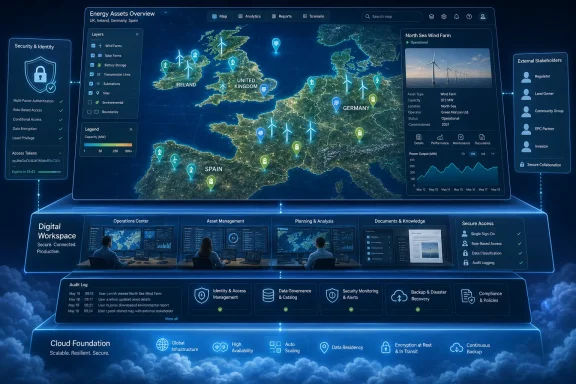
Perigus Energy has selected Cegal’s Cetegra, deployed on Microsoft Azure, as the foundation for a European onshore renewables GIS platform serving wind, solar and battery storage operations across the United Kingdom, Ireland, Germany and Spain. The deal is not large enough to redraw the cloud market, but it is telling enough to matter. A platform built with subsurface and energy workloads in mind is being pulled into the operational machinery of onshore renewables, where geography, permissions, assets, contractors and grid constraints are now as strategic as turbines and panels. The real story is not that another energy company moved an application estate to Azure; it is that renewables operators are starting to look like infrastructure software companies with land banks attached.
GIS has always mattered in energy, but in onshore renewables it has often been treated as a planning tool rather than a central operating system. Developers used maps to assess land, wind resource, solar irradiation, grid proximity, environmental constraints and planning boundaries. Once projects moved into construction and operation, the center of gravity often shifted toward asset management, SCADA, finance systems and document repositories.
That boundary is becoming harder to maintain. A modern onshore renewables business is a distributed portfolio of leases, easements, substations, access roads, ecological conditions, grid applications, planning commitments, battery sites and repowering options. The map is no longer a static representation of the business. It is increasingly the interface through which the business understands itself.
Perigus Energy’s adoption of Cetegra therefore lands at an interesting moment. The company is newly formed from Copenhagen Infrastructure Partners’ acquisition of Ørsted’s European onshore business, but it inherits real assets, real projects and real operational obligations. That combination — new corporate structure, established operational footprint — is precisely the sort of transition where GIS either becomes a coherent platform or fragments into a collection of inherited tools, shared drives and local workarounds.
Cegal’s pitch for Cetegra is that energy companies need a secure, vendor-neutral, cloud-based workspace for applications and data. In oil, gas and subsurface-heavy environments, that argument is familiar. In onshore renewables, it has a sharper edge: the industry is scaling fast enough that yesterday’s departmental GIS stack can become tomorrow’s operational bottleneck.
Carve-outs are deceptively technical events. The press release language tends to emphasize continuity, governance and collaboration, but the practical reality is messier. Applications have to be separated or rehomed. Identity and access models have to be rebuilt. Data ownership and retention need to be clarified. External stakeholders still need access, and internal teams still need to deliver projects while the organizational scaffolding changes around them.
That is why the GIS decision matters. A distributed renewables business cannot afford for its core spatial data and applications to become trapped in a transition project. Developers, engineers, environmental teams, construction managers, commercial staff and external partners all depend on geospatial context. If the GIS platform stumbles, the consequences show up not as an IT outage in the abstract but as slower project development, weaker asset visibility and more friction between teams.
Perigus appears to have chosen Cetegra because it needed speed without building physical infrastructure, and because prior experience inside the organization gave confidence that the platform could handle energy-sector workflows. That is a pragmatic decision, not a romantic one. In a carve-out, the best platform is often the one that can be stood up quickly, governed centrally and made boring enough that the business can get back to work.
Azure brings the expected cloud virtues: scalability, managed infrastructure, security services, identity integration and resilience. Those are not glamorous features, but they are exactly the features that matter when a company is trying to support geographically dispersed users without buying, housing and maintaining its own hardware. The renewables sector may be physically rooted in land, weather and grid connections, but its IT architecture is increasingly borderless.
The more interesting point is governance. A cloud-first IT strategy is not simply a preference for renting compute. It is a governance model that assumes applications, identities, data controls, security policies and operational telemetry should live in a managed environment where change can be controlled and audited. For a company operating across the UK, Ireland, Germany and Spain, that matters.
Cetegra on Azure gives Perigus a way to centralize access to GIS applications while maintaining enterprise control over who can see and do what. That is especially important in energy, where project data can include commercially sensitive land positions, grid connection information, environmental constraints and planning material. A GIS platform is not just a productivity layer. It is a repository of strategic intelligence.
Oil and gas operators learned long ago that high-performance workspaces, specialized applications and large technical datasets are difficult to manage with generic desktop IT. Subsurface interpretation, seismic workflows and reservoir modeling demanded centralized, controlled environments because the data was heavy, the software was specialized and collaboration was expensive when everyone worked locally. Cetegra emerged in that world.
Onshore renewables is different, but not as different as it once looked. The datasets are not seismic cubes, but the operational complexity is real. Developers and operators manage spatial layers, planning constraints, asset locations, cable routes, grid interfaces, land agreements, ecological surveys and construction logistics. Solar, wind and battery storage projects may not require the same compute profile as subsurface modeling, but they do require consistent access to trusted spatial data.
The move into renewables also reflects a broader convergence inside energy IT. The old division between “traditional energy” software and “clean energy” software is weakening. Renewable operators do not get a pass on security, data governance or performance simply because their assets are greener. If anything, the fragmented and geographically distributed nature of onshore renewables makes the case for disciplined platforms stronger.
A renewables operator may use different GIS tools, engineering packages, document management systems, asset platforms and cloud services depending on country, project phase and inherited practice. A carve-out from Ørsted’s European onshore business only heightens that complexity. The goal is not to pretend one vendor will replace everything. The goal is to provide a secure workspace where different tools and datasets can be reached consistently.
Vendor neutrality also gives Perigus room to evolve. A newly independent business does not yet know every future operational requirement. It may standardize some applications, retire others, add analytics layers, change external access patterns or integrate new asset management workflows. A platform that is too tightly tied to one application stack can become a constraint just when the organization needs flexibility.
This is one reason the decision is better understood as platform modernization than application hosting. Hosting asks where software runs. Modernization asks how the business will govern, secure, scale and adapt the environment over time. Perigus is not merely putting GIS in the cloud; it is trying to make GIS survivable through corporate change and useful across a multi-country renewables portfolio.
In a slower world, an organization might design a dedicated environment, procure hardware, configure networks, negotiate hosting, validate performance and gradually migrate workloads. In a transition from a previous corporate parent, that luxury often does not exist. The business needs continuity, but it also needs separation. Users expect systems to work, while the IT team is rebuilding the foundations underneath them.
Azure and Cetegra together offer a way to avoid turning infrastructure into the critical path. Managed cloud services reduce the upfront burden. A pre-existing energy-focused workspace reduces the need to invent an access and application-delivery model from scratch. The promise is not that cloud makes complexity vanish; it is that cloud shifts more of the complexity into repeatable patterns.
That matters for WindowsForum readers because it is the same argument many enterprises have been making about line-of-business applications for years. The workload may be GIS for European renewables, but the underlying pattern is familiar: a business event creates urgency, inherited systems become liabilities, and the fastest credible path is a managed cloud environment with centralized identity, security and operations.
Renewables development involves a long chain of participants. Internal development teams work with landowners, grid specialists, planners, ecological consultants, construction partners, investors and regulators. Many of those parties need some view into project or asset information. Very few should have unlimited access.
A secure digital workspace is attractive because it can narrow the gap between usability and control. Users get a consistent environment for applications and data. Administrators get a more coherent access model. The company gets a better chance of enforcing governance across markets rather than relying on local habits.
This is especially important when dealing with GIS. Spatial data has a way of becoming a shadow system because maps are useful to almost everyone. Exports, screenshots, shapefiles and local copies can proliferate if the official platform is slow or difficult to access. A performant, cloud-hosted workspace is partly about convenience, but convenience has security consequences. If the governed system is the easiest system to use, fewer people will route around it.
That shift changes the job of enterprise IT. Supporting a GIS estate is no longer only about installing clients, patching machines and mapping drives. It is about delivering a secure workspace that can serve internal and external users across locations, while keeping performance acceptable for data-heavy workflows. Windows remains the access point, but not necessarily the center of gravity.
Microsoft benefits from this model because Azure becomes the substrate for specialized industry platforms. Cegal benefits because it can sell energy-specific functionality and operational know-how without asking customers to bet on a greenfield infrastructure build. Customers such as Perigus benefit if the arrangement gives them faster deployment, fewer physical infrastructure constraints and a cleaner governance story.
The risk, as always, is abstraction without accountability. When an application stack spans a specialist platform, a hyperscale cloud and enterprise identity services, troubleshooting can become a multi-party exercise. Performance issues, access failures and integration gaps may not respect vendor boundaries. The success of deployments like this depends not only on the architecture but on how well the parties operate it after the launch announcement fades.
That maturation follows the money. Copenhagen Infrastructure Partners’ acquisition of Ørsted’s European onshore business created a standalone company with operational assets, projects under construction and a development pipeline. Institutional capital expects repeatability. Repeatability requires systems. A company cannot scale a multi-country renewables portfolio indefinitely on heroics, spreadsheets and local toolchains.
GIS sits near the center of that scaling challenge because onshore renewables is profoundly spatial. Where a project is located determines its permitting risk, grid economics, community impact, construction complexity and long-term operating conditions. As portfolios grow, the ability to compare and govern spatial information across markets becomes a competitive capability.
That is why Cetegra’s first onshore renewables adoption matters even if it is not a household-name technology story. It shows a specialist energy IT platform crossing into a segment where operational sophistication is rising. The clean energy transition is often discussed in terms of generation capacity and financing, but the software layer is becoming just as consequential.
Perigus avoids the overhead of investing in and maintaining physical infrastructure, which is a real advantage during a corporate transition. It gains scalability and a more predictable operational model. It can support geographically dispersed teams through a consistent workspace. Those benefits are exactly why cloud platforms have become the default answer for many new enterprise environments.
But cloud-first also requires discipline. Identity design matters. Data residency and regulatory expectations need to be understood across jurisdictions. External stakeholder access must be controlled without becoming unusable. Cost management cannot be an afterthought, especially when performance can be scaled to match demand. In cloud environments, waste is not always visible as idle hardware in a rack; it may appear as a bill that slowly normalizes bad architecture.
The Perigus case reads as though those issues were part of the selection criteria rather than discovered later. The source material stresses enterprise governance, secure access and predictable operations. That is the right vocabulary. In 2026, the serious cloud question is no longer whether a workload can move; it is whether the organization can govern the workload once it gets there.
The company is careful to position Cetegra as broader than a GIS host. It describes a secure environment for applications and data, a high-performance digital workspace and a platform capable of supporting wider energy applications. That positioning matters because a renewables operator’s GIS platform can become the first step toward a more comprehensive operational data environment.
Perigus may have selected Cetegra for GIS, but the architecture leaves open the possibility of adjacent workflows. Asset data, project documentation, engineering tools, analytics and collaboration spaces all orbit the same operational reality. Once a secure workspace is established and trusted, platform expansion becomes easier to imagine.
There is a commercial danger here too. Energy customers are wary of platforms that begin as enablers and become lock-in machines. Cegal’s vendor-neutral language is therefore not just descriptive; it is defensive. If Cetegra is to grow in renewables, it must convince operators that it simplifies heterogeneous environments rather than replacing one set of constraints with another.
A platform decision like this buys time for the business to stabilize. It lets teams continue working across geographies. It gives IT a controlled environment rather than a patchwork of emergency arrangements. It allows the company to defer some longer-term standardization questions without leaving users stranded.
That is not a criticism. Good enterprise architecture often works by sequencing uncertainty. Perigus does not need to solve every future application and data question on day one. It needs a platform that keeps the GIS function reliable now while preserving options later. Cetegra on Azure appears designed to do exactly that.
The broader lesson is that modernization is often less dramatic than vendors pretend. It is not always a sweeping transformation or a wholesale reinvention. Sometimes it is the practical act of creating a secure, scalable place for critical work to happen while the business around it changes.
That combination is common far beyond energy. Manufacturing, construction, logistics, utilities and public infrastructure organizations all face versions of the same challenge. Specialized applications that once lived close to local teams now need to be delivered securely across distributed organizations. The old compromise — local performance at the expense of central governance — is becoming less acceptable.
The Perigus case also shows why industry-specific cloud platforms continue to have a role despite the breadth of hyperscaler services. Azure can provide the infrastructure, identity hooks, security tooling and scale. It does not automatically provide an energy-aware workspace model, application packaging, workflow expectations or domain-specific operational practice. That is where a specialist such as Cegal claims its value.
For WindowsForum’s audience, the takeaway is not that every GIS workload belongs on Cetegra or Azure. The takeaway is that the center of enterprise application delivery is moving toward managed, policy-driven workspaces where the physical endpoint matters less than the governed session. Windows devices still matter, but they are increasingly clients into a controlled cloud environment rather than self-contained islands of capability.
That matters because new companies formed from asset acquisitions often face a fork in the road. They can preserve inherited complexity until it becomes cultural sediment, or they can use the transition moment to impose a cleaner operating model. The latter is harder upfront, but it is usually cheaper than trying to unwind fragmentation later.
There is also a competitive dimension. European onshore renewables is not a sleepy market. Developers and operators are competing for land, grid access, planning approvals, capital efficiency and execution speed. Better GIS does not guarantee better projects, but poor GIS can absolutely slow them down.
A secure and scalable GIS platform is therefore a modest but meaningful part of Perigus’s operating thesis. It supports the kind of company CIP presumably wants Perigus to become: a repeatable, multi-market renewables platform rather than a loose bundle of inherited assets.
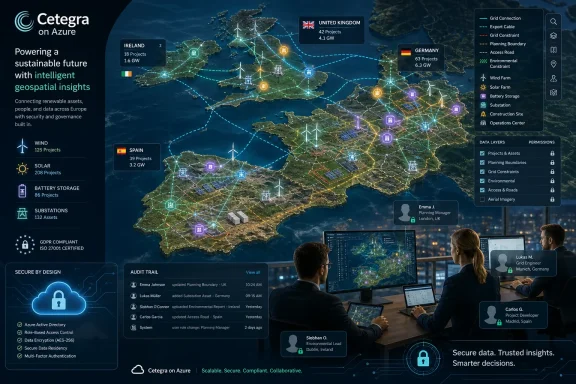 The Map Has Become Part of the Machine
GIS has always mattered in energy, but in onshore renewables it has often been treated as a planning tool rather than a central operating system. Developers used maps to assess land, wind resource, solar irradiation, grid proximity, environmental constraints and planning boundaries. Once projects moved into construction and operation, the center of gravity often shifted toward asset management, SCADA, finance systems and document repositories.That boundary is becoming harder to maintain. A modern onshore renewables business is a distributed portfolio of leases, easements, substations, access roads, ecological conditions, grid applications, planning commitments, battery sites and repowering options. The map is no longer a static representation of the business. It is increasingly the interface through which the business understands itself.
Perigus Energy’s adoption of Cetegra therefore lands at an interesting moment. The company is newly formed from Copenhagen Infrastructure Partners’ acquisition of Ørsted’s European onshore business, but it inherits real assets, real projects and real operational obligations. That combination — new corporate structure, established operational footprint — is precisely the sort of transition where GIS either becomes a coherent platform or fragments into a collection of inherited tools, shared drives and local workarounds.
Cegal’s pitch for Cetegra is that energy companies need a secure, vendor-neutral, cloud-based workspace for applications and data. In oil, gas and subsurface-heavy environments, that argument is familiar. In onshore renewables, it has a sharper edge: the industry is scaling fast enough that yesterday’s departmental GIS stack can become tomorrow’s operational bottleneck.
Perigus Starts Life With an Integration Problem
Perigus is not a startup in the conventional sense. It is a new name wrapped around an existing European onshore renewables business, with operations and projects across several jurisdictions. That gives it the advantages of continuity — experienced teams, existing assets, development pipelines — but also the obligations of a carved-out enterprise.Carve-outs are deceptively technical events. The press release language tends to emphasize continuity, governance and collaboration, but the practical reality is messier. Applications have to be separated or rehomed. Identity and access models have to be rebuilt. Data ownership and retention need to be clarified. External stakeholders still need access, and internal teams still need to deliver projects while the organizational scaffolding changes around them.
That is why the GIS decision matters. A distributed renewables business cannot afford for its core spatial data and applications to become trapped in a transition project. Developers, engineers, environmental teams, construction managers, commercial staff and external partners all depend on geospatial context. If the GIS platform stumbles, the consequences show up not as an IT outage in the abstract but as slower project development, weaker asset visibility and more friction between teams.
Perigus appears to have chosen Cetegra because it needed speed without building physical infrastructure, and because prior experience inside the organization gave confidence that the platform could handle energy-sector workflows. That is a pragmatic decision, not a romantic one. In a carve-out, the best platform is often the one that can be stood up quickly, governed centrally and made boring enough that the business can get back to work.
Azure Is the Quiet Power Broker
Microsoft Azure’s role in this story is easy to understate because it is not the branded application. Cetegra is the platform Perigus selected; Azure is the cloud environment underneath it. But for IT teams, the distinction between application and operating environment is increasingly academic.Azure brings the expected cloud virtues: scalability, managed infrastructure, security services, identity integration and resilience. Those are not glamorous features, but they are exactly the features that matter when a company is trying to support geographically dispersed users without buying, housing and maintaining its own hardware. The renewables sector may be physically rooted in land, weather and grid connections, but its IT architecture is increasingly borderless.
The more interesting point is governance. A cloud-first IT strategy is not simply a preference for renting compute. It is a governance model that assumes applications, identities, data controls, security policies and operational telemetry should live in a managed environment where change can be controlled and audited. For a company operating across the UK, Ireland, Germany and Spain, that matters.
Cetegra on Azure gives Perigus a way to centralize access to GIS applications while maintaining enterprise control over who can see and do what. That is especially important in energy, where project data can include commercially sensitive land positions, grid connection information, environmental constraints and planning material. A GIS platform is not just a productivity layer. It is a repository of strategic intelligence.
Renewables Inherits the Subsurface Playbook
Cegal says Cetegra is widely used in subsurface and the wider energy industry, and that Perigus marks its first adoption within onshore renewables. That detail is more than a marketing milestone. It suggests the renewables sector is beginning to borrow technology patterns from older, more data-intensive parts of energy.Oil and gas operators learned long ago that high-performance workspaces, specialized applications and large technical datasets are difficult to manage with generic desktop IT. Subsurface interpretation, seismic workflows and reservoir modeling demanded centralized, controlled environments because the data was heavy, the software was specialized and collaboration was expensive when everyone worked locally. Cetegra emerged in that world.
Onshore renewables is different, but not as different as it once looked. The datasets are not seismic cubes, but the operational complexity is real. Developers and operators manage spatial layers, planning constraints, asset locations, cable routes, grid interfaces, land agreements, ecological surveys and construction logistics. Solar, wind and battery storage projects may not require the same compute profile as subsurface modeling, but they do require consistent access to trusted spatial data.
The move into renewables also reflects a broader convergence inside energy IT. The old division between “traditional energy” software and “clean energy” software is weakening. Renewable operators do not get a pass on security, data governance or performance simply because their assets are greener. If anything, the fragmented and geographically distributed nature of onshore renewables makes the case for disciplined platforms stronger.
The Vendor-Neutral Claim Is Doing Real Work
Cegal describes Cetegra as vendor-neutral, and that phrase can sound like a brochure cliché. In this case, it is central to the logic of the deployment. Energy companies rarely live inside a single software ecosystem, and GIS is particularly prone to mixed estates.A renewables operator may use different GIS tools, engineering packages, document management systems, asset platforms and cloud services depending on country, project phase and inherited practice. A carve-out from Ørsted’s European onshore business only heightens that complexity. The goal is not to pretend one vendor will replace everything. The goal is to provide a secure workspace where different tools and datasets can be reached consistently.
Vendor neutrality also gives Perigus room to evolve. A newly independent business does not yet know every future operational requirement. It may standardize some applications, retire others, add analytics layers, change external access patterns or integrate new asset management workflows. A platform that is too tightly tied to one application stack can become a constraint just when the organization needs flexibility.
This is one reason the decision is better understood as platform modernization than application hosting. Hosting asks where software runs. Modernization asks how the business will govern, secure, scale and adapt the environment over time. Perigus is not merely putting GIS in the cloud; it is trying to make GIS survivable through corporate change and useful across a multi-country renewables portfolio.
The Deadline Explains the Architecture
The source material emphasizes that Perigus needed to move quickly. That is not incidental. Tight deadlines are one of the strongest arguments for cloud-native platforms because they compress the room available for bespoke infrastructure projects.In a slower world, an organization might design a dedicated environment, procure hardware, configure networks, negotiate hosting, validate performance and gradually migrate workloads. In a transition from a previous corporate parent, that luxury often does not exist. The business needs continuity, but it also needs separation. Users expect systems to work, while the IT team is rebuilding the foundations underneath them.
Azure and Cetegra together offer a way to avoid turning infrastructure into the critical path. Managed cloud services reduce the upfront burden. A pre-existing energy-focused workspace reduces the need to invent an access and application-delivery model from scratch. The promise is not that cloud makes complexity vanish; it is that cloud shifts more of the complexity into repeatable patterns.
That matters for WindowsForum readers because it is the same argument many enterprises have been making about line-of-business applications for years. The workload may be GIS for European renewables, but the underlying pattern is familiar: a business event creates urgency, inherited systems become liabilities, and the fastest credible path is a managed cloud environment with centralized identity, security and operations.
Security Is the Condition of Collaboration
The press release repeatedly invokes secure access, governance and collaboration. That triad is easy to skim past, but it captures the central tension in modern infrastructure businesses. Teams need to collaborate more broadly, but the data they collaborate on is more sensitive than ever.Renewables development involves a long chain of participants. Internal development teams work with landowners, grid specialists, planners, ecological consultants, construction partners, investors and regulators. Many of those parties need some view into project or asset information. Very few should have unlimited access.
A secure digital workspace is attractive because it can narrow the gap between usability and control. Users get a consistent environment for applications and data. Administrators get a more coherent access model. The company gets a better chance of enforcing governance across markets rather than relying on local habits.
This is especially important when dealing with GIS. Spatial data has a way of becoming a shadow system because maps are useful to almost everyone. Exports, screenshots, shapefiles and local copies can proliferate if the official platform is slow or difficult to access. A performant, cloud-hosted workspace is partly about convenience, but convenience has security consequences. If the governed system is the easiest system to use, fewer people will route around it.
The Windows Angle Is Bigger Than the Desktop
For many Windows users, GIS still conjures images of heavy desktop applications, remote desktops, file shares and specialized workstations. Those assumptions are not obsolete, but they are being abstracted. The user may still be sitting at a Windows device, but the application experience is increasingly mediated by cloud workspaces, identity policies, conditional access and managed infrastructure.That shift changes the job of enterprise IT. Supporting a GIS estate is no longer only about installing clients, patching machines and mapping drives. It is about delivering a secure workspace that can serve internal and external users across locations, while keeping performance acceptable for data-heavy workflows. Windows remains the access point, but not necessarily the center of gravity.
Microsoft benefits from this model because Azure becomes the substrate for specialized industry platforms. Cegal benefits because it can sell energy-specific functionality and operational know-how without asking customers to bet on a greenfield infrastructure build. Customers such as Perigus benefit if the arrangement gives them faster deployment, fewer physical infrastructure constraints and a cleaner governance story.
The risk, as always, is abstraction without accountability. When an application stack spans a specialist platform, a hyperscale cloud and enterprise identity services, troubleshooting can become a multi-party exercise. Performance issues, access failures and integration gaps may not respect vendor boundaries. The success of deployments like this depends not only on the architecture but on how well the parties operate it after the launch announcement fades.
Onshore Renewables Is Becoming an Enterprise Software Market
The most important implication of the Perigus deployment is that onshore renewables is maturing into a serious enterprise software market. The industry is not just buying turbines, panels and batteries. It is buying platforms to coordinate development pipelines, asset operations, stakeholder collaboration and data governance.That maturation follows the money. Copenhagen Infrastructure Partners’ acquisition of Ørsted’s European onshore business created a standalone company with operational assets, projects under construction and a development pipeline. Institutional capital expects repeatability. Repeatability requires systems. A company cannot scale a multi-country renewables portfolio indefinitely on heroics, spreadsheets and local toolchains.
GIS sits near the center of that scaling challenge because onshore renewables is profoundly spatial. Where a project is located determines its permitting risk, grid economics, community impact, construction complexity and long-term operating conditions. As portfolios grow, the ability to compare and govern spatial information across markets becomes a competitive capability.
That is why Cetegra’s first onshore renewables adoption matters even if it is not a household-name technology story. It shows a specialist energy IT platform crossing into a segment where operational sophistication is rising. The clean energy transition is often discussed in terms of generation capacity and financing, but the software layer is becoming just as consequential.
Cloud-First Does Not Mean Cloud-Simple
There is a temptation to read any Azure-based deployment as another proof point for cloud inevitability. That is too easy. Cloud-first strategies solve some problems and relocate others.Perigus avoids the overhead of investing in and maintaining physical infrastructure, which is a real advantage during a corporate transition. It gains scalability and a more predictable operational model. It can support geographically dispersed teams through a consistent workspace. Those benefits are exactly why cloud platforms have become the default answer for many new enterprise environments.
But cloud-first also requires discipline. Identity design matters. Data residency and regulatory expectations need to be understood across jurisdictions. External stakeholder access must be controlled without becoming unusable. Cost management cannot be an afterthought, especially when performance can be scaled to match demand. In cloud environments, waste is not always visible as idle hardware in a rack; it may appear as a bill that slowly normalizes bad architecture.
The Perigus case reads as though those issues were part of the selection criteria rather than discovered later. The source material stresses enterprise governance, secure access and predictable operations. That is the right vocabulary. In 2026, the serious cloud question is no longer whether a workload can move; it is whether the organization can govern the workload once it gets there.
Cegal Gets a Beachhead in a Better Growth Story
For Cegal, the strategic value is obvious. Subsurface and traditional energy workloads remain important, but renewables is where much of the growth narrative sits. Extending Cetegra into onshore renewables gives the company a reference point in a market that is likely to need more disciplined digital platforms as portfolios expand.The company is careful to position Cetegra as broader than a GIS host. It describes a secure environment for applications and data, a high-performance digital workspace and a platform capable of supporting wider energy applications. That positioning matters because a renewables operator’s GIS platform can become the first step toward a more comprehensive operational data environment.
Perigus may have selected Cetegra for GIS, but the architecture leaves open the possibility of adjacent workflows. Asset data, project documentation, engineering tools, analytics and collaboration spaces all orbit the same operational reality. Once a secure workspace is established and trusted, platform expansion becomes easier to imagine.
There is a commercial danger here too. Energy customers are wary of platforms that begin as enablers and become lock-in machines. Cegal’s vendor-neutral language is therefore not just descriptive; it is defensive. If Cetegra is to grow in renewables, it must convince operators that it simplifies heterogeneous environments rather than replacing one set of constraints with another.
Perigus Buys Time, and That May Be the Point
The immediate outcome for Perigus is straightforward: a secure, scalable GIS platform that could be deployed quickly and support continuity through a critical transition. That is valuable, but the deeper benefit may be time. During a carve-out, time is the scarce commodity.A platform decision like this buys time for the business to stabilize. It lets teams continue working across geographies. It gives IT a controlled environment rather than a patchwork of emergency arrangements. It allows the company to defer some longer-term standardization questions without leaving users stranded.
That is not a criticism. Good enterprise architecture often works by sequencing uncertainty. Perigus does not need to solve every future application and data question on day one. It needs a platform that keeps the GIS function reliable now while preserving options later. Cetegra on Azure appears designed to do exactly that.
The broader lesson is that modernization is often less dramatic than vendors pretend. It is not always a sweeping transformation or a wholesale reinvention. Sometimes it is the practical act of creating a secure, scalable place for critical work to happen while the business around it changes.
The Practical Signal for IT Teams Is Hiding in the Geography
For IT administrators and architects, the Perigus deployment is worth watching because it compresses several familiar enterprise problems into one case. There is a multi-country operating model. There is a business transition from a previous owner. There are specialist applications. There are internal and external collaborators. There is a cloud-first mandate, but also a need for governance.That combination is common far beyond energy. Manufacturing, construction, logistics, utilities and public infrastructure organizations all face versions of the same challenge. Specialized applications that once lived close to local teams now need to be delivered securely across distributed organizations. The old compromise — local performance at the expense of central governance — is becoming less acceptable.
The Perigus case also shows why industry-specific cloud platforms continue to have a role despite the breadth of hyperscaler services. Azure can provide the infrastructure, identity hooks, security tooling and scale. It does not automatically provide an energy-aware workspace model, application packaging, workflow expectations or domain-specific operational practice. That is where a specialist such as Cegal claims its value.
For WindowsForum’s audience, the takeaway is not that every GIS workload belongs on Cetegra or Azure. The takeaway is that the center of enterprise application delivery is moving toward managed, policy-driven workspaces where the physical endpoint matters less than the governed session. Windows devices still matter, but they are increasingly clients into a controlled cloud environment rather than self-contained islands of capability.
The Cetegra Move Tells Perigus What Kind of Company It Wants to Be
Perigus is presenting itself as a renewables operator with a cloud-first IT strategy, and the Cetegra decision makes that strategy concrete. This is not merely an infrastructure preference. It signals a desire to run the company with centralized governance, scalable access and platform consistency from the beginning of its independent life.That matters because new companies formed from asset acquisitions often face a fork in the road. They can preserve inherited complexity until it becomes cultural sediment, or they can use the transition moment to impose a cleaner operating model. The latter is harder upfront, but it is usually cheaper than trying to unwind fragmentation later.
There is also a competitive dimension. European onshore renewables is not a sleepy market. Developers and operators are competing for land, grid access, planning approvals, capital efficiency and execution speed. Better GIS does not guarantee better projects, but poor GIS can absolutely slow them down.
A secure and scalable GIS platform is therefore a modest but meaningful part of Perigus’s operating thesis. It supports the kind of company CIP presumably wants Perigus to become: a repeatable, multi-market renewables platform rather than a loose bundle of inherited assets.
The First Renewables Cetegra Deployment Is a Small Deal With a Large Shadow
The concrete facts are limited, but they point in a clear direction. Perigus needed continuity and governance during a fast organizational transition, and Cegal used Cetegra on Azure to provide a cloud-native GIS foundation for European onshore operations.- Perigus Energy is using Cetegra as the core platform for GIS applications across its European onshore renewables business.
- The deployment marks Cetegra’s first stated adoption in onshore renewables after broader use in subsurface and energy-sector environments.
- Microsoft Azure provides the dedicated cloud environment, managed infrastructure and security foundation beneath the Cetegra workspace.
- The project reflects the operational demands of a newly formed company inheriting assets, teams and projects from Ørsted’s European onshore business.
- The most important benefit is not cloud migration in isolation, but the creation of a governed workspace for distributed teams and sensitive spatial data.
- The move suggests that onshore renewables operators increasingly need enterprise-grade application delivery and data governance, not just project development tools.
References
- Primary source: Aberdeen & Grampian Chamber of Commerce
Published: 2026-06-17T09:30:17.383362
Perigus Energy selects Cegal’s Cetegra on Microsoft Azure to support its European onshore GIS platform
Perigus Energy, a leading player in the renewables market, has integrated Cegal’s Cetegra as the foundation for its GIS platform supporting its European onshore business.www.agcc.co.uk - Related coverage: ca-cib.com
Crédit Agricole CIB closes €1.4bn financing for CIP’s Ørsted onshore acquisition | Crédit Agricole CIB
Our Bank successfully supported Copenhagen Infrastructure Partners (CIP) in their acquisition of Ørsted's European onshore platform, through their flagship fund CI V.www.ca-cib.com - Related coverage: accura.dk
Copenhagen Infrastructure Partners acquires Ørsted's European onshore business - Accura
Copenhagen Infrastructure Partners acquires Ørsted's European onshore businessaccura.dk - Related coverage: onestopesg.com
Copenhagen Infrastructure Partners Launches Perigus Energy With 826 MW European Onshore Renewables Portfolio
Copenhagen Infrastructure Partners has completed the acquisition of Ørsted's European onshore renewable energy business and launched it as a new standalone onestopesg.com
- Related coverage: blackridgeresearch.com
Copenhagen Infrastructure Partners Completes Ørsted Onshore Acquisition
Copenhagen Infrastructure Partners acquires Ørsted's onshore renewables business, launching Perigus Energy across Ireland, Germany, UK and Spain with 826MWwww.blackridgeresearch.com
- Related coverage: harianbasis.co
CIP Acquires Orsted European Onshore Assets for 1.69 Billion Dollars
Copenhagen Infrastructure Partners completes the acquisition of Orsted's European onshore renewable business, launching the new firm Perigus Energy.www.harianbasis.co
- Related coverage: powersystems.technology
CIP Launches Perigus Energy After Acquiring Ørsted Onshore Renewables Portfolio - Power Systems Technology
Danish infrastructure investor Copenhagen Infrastructure Partners (CIP) has completed the acquisition of Ørsted’s European onshore wind and solar business, www.powersystems.technology
- Related coverage: finance.yahoo.com
CIP acquires Ørsted’s onshore business in Europe
CIP completed the purchase through its fifth flagship fund, CI V.finance.yahoo.com - Related coverage: cegal.com
Cetegra | Cegal
Discover Cegal Cetegra, the leading cloud platform for the energy industry, revolutionizing collaboration and data management. www.cegal.com
- Related coverage: esgpost.com
- Related coverage: reglobal.org
CIP launches Perigus post Ørsted deal - REGlobal - Big Moves
REGlobal features analysis of key trends and major developments, interviews with top managers and officials, opinion of leading experts and a rich knowledge centre. It covers a wide range of issues and topics including but not limited to markets, technology, policy and finance. The primary focus...reglobal.org - Related coverage: cdn.orsted.com
- Related coverage: modernpowersystems.com
- Related coverage: copenhagen-energy.com
- Related coverage: azure.github.io