

On June 15, 2026, Frost & Sullivan released a white paper on AI infrastructure orchestration that names Phancy Group’s Rise vGPU a Tier 1 leading platform and ranks Phancy ModelHub first overall in an enterprise model-management evaluation. The announcement is not just another vendor trophy for the AI cabinet. It is a signal that the center of gravity in AI infrastructure is moving away from raw accelerator bragging rights and toward the much less glamorous discipline of making mixed fleets of chips behave like one dependable computing system.
That matters because the AI buildout has entered its uncomfortable middle phase. Enterprises have bought GPUs, rented GPUs, begged for GPUs, and in China’s case increasingly mixed domestic NPUs and GPUs into clusters shaped as much by supply chains and policy as by benchmark charts. The next constraint is no longer only “how many chips can I get?” but “how much usable work can I extract from the chips I already have?”
For most of the generative AI boom, infrastructure marketing has been dominated by the language of silicon. Every vendor wanted to talk about tensor cores, memory bandwidth, interconnects, accelerator roadmaps, and the supposedly decisive advantage of one chip family over another. That conversation is not over, but it is becoming less sufficient.
The Frost & Sullivan white paper, as summarized in the announcement, frames the shift bluntly: AI infrastructure competitiveness is moving from “single-chip performance” to “cluster-scale system coordination.” That is the right diagnosis. Modern AI workloads are not served by a heroic chip sitting alone in a rack; they are served by a stack of schedulers, runtimes, drivers, model registries, network fabrics, storage layers, observability systems, and policy engines that either work together or quietly destroy utilization.
The problem is especially acute in heterogeneous environments. A clean, homogenous NVIDIA estate is hard enough to operate at high utilization. A mixed estate that includes NVIDIA, Huawei Ascend, Cambricon, Hygon, and other accelerators introduces a nastier problem: different software stacks, different performance profiles, different memory constraints, and different operational assumptions.
That is where Phancy is trying to plant its flag. Rise vGPU is being positioned as a software-defined control plane for mixed AI compute, while ModelHub extends the pitch upward into model onboarding, deployment, optimization, inference service management, and version governance. In plain English, Phancy is arguing that the winning AI platform is not merely the one with access to scarce hardware, but the one that can turn messy hardware into predictable service capacity.
Those figures should be read carefully. Vendor-supplied utilization claims always deserve scrutiny, because “utilization” can mean different things depending on whether one measures allocated capacity, active compute, memory pressure, job throughput, or business-level inference output. But even if the exact numbers vary from one environment to another, the basic point is hard to dispute: expensive AI hardware is often idle, stranded, or inefficiently partitioned.
This is not a small accounting problem. A GPU cluster with poor utilization is a capital sink. Enterprises can spend millions building AI capacity only to discover that workloads are blocked by scheduling conflicts, memory fragmentation, driver incompatibilities, model-placement failures, or teams hoarding full accelerators for jobs that need only a slice.
The Rise vGPU pitch attacks precisely that waste. By offering sub-GPU partitioning and memory slicing at MB-level granularity, Phancy is promising to turn large accelerators into divisible, schedulable pools. That is the same broad idea that has powered virtualization in traditional enterprise computing for decades: stop treating physical devices as sacred units, and start treating them as pools of capacity governed by software.
The difference is that GPU virtualization for AI is much harder than CPU virtualization was in its mature server era. AI jobs can be memory-hungry, latency-sensitive, topology-dependent, and intolerant of noisy neighbors. Training jobs, fine-tuning runs, batch inference, and real-time inference do not stress a cluster in the same way. A scheduler that improves average utilization but degrades critical inference latency is not an enterprise platform; it is a science project with a billing dashboard.
In a market where organizations may need to deploy across NVIDIA accelerators, domestic GPUs, NPUs, and specialized AI chips, heterogeneity is not a temporary inconvenience. It is the operating model. The fantasy of standardizing everything on one accelerator family is less realistic when hardware availability, compliance expectations, and strategic autonomy all point in different directions.
That makes orchestration a national-scale infrastructure problem as much as a data-center engineering problem. If each chip family requires its own deployment workflow, model adaptation path, monitoring system, and operations team, the cost of AI adoption rises sharply. Worse, every fragmented stack becomes a reason for business units to delay deployment or retreat into small pilots.
Phancy’s message is therefore well calibrated for its home market. Rise vGPU promises unified onboarding and management across more than ten GPU and NPU vendors. ModelHub promises model-and-chip compatibility, execution stability, and coordinated model-GPU scheduling. Together, the products are being presented as a bridge between China’s multi-chip reality and enterprise expectations for cloud-like reliability.
That does not make Phancy’s claims automatically proven in every environment. It does make the company’s strategy legible. The opportunity is not to beat NVIDIA at NVIDIA’s own game of end-to-end silicon and software dominance. It is to become the translation layer for customers who cannot, or will not, live inside a single-vendor accelerator universe.
AI infrastructure is now reaching the same stage of maturity. The first wave was hardware acquisition. The second wave is utilization, governance, and service delivery. The third wave, if the enterprise cloud playbook holds, will be chargeback, policy automation, compliance evidence, and developer self-service.
That is why the announcement’s less glamorous claims may matter more than the headline award. Monitoring, metering, and cost allocation are not the phrases that light up a launch event, but they are the features that determine whether a CIO can run AI infrastructure as a shared enterprise service rather than a politically contested pile of scarce machines.
If Phancy can make GPU resources “operable digital assets,” as the announcement puts it, the implications are practical. A central AI infrastructure team can allocate capacity by priority. Finance can understand which business units are consuming expensive compute. Compliance teams can audit production inference workloads. Engineering teams can request capacity without negotiating manually for entire accelerators.
That is the boring work that makes technology adoption durable. Enterprises do not merely need AI accelerators; they need AI infrastructure that can survive budgeting cycles, audits, outages, staff turnover, and the inevitable moment when a pilot becomes a production dependency.
Inference is becoming a production workload in the most literal sense. Customer-support bots, coding assistants, document analysis tools, fraud systems, search features, and agentic workflows increasingly depend on model responses arriving within usable latency windows. A delayed batch job may be annoying. A degraded inference service embedded in customer operations can become an outage.
This is where GPU oversubscription becomes dangerous if handled poorly. The same technique that improves utilization can also introduce contention. Multiple tenants sharing slices of accelerator capacity may compete for memory, bandwidth, scheduler attention, or runtime resources. Without careful isolation and workload awareness, a platform can win the spreadsheet and lose the service-level agreement.
Phancy’s emphasis on deterministic execution is therefore strategically smart. It acknowledges that enterprises will not accept a simple trade of higher utilization for unpredictable service quality. The challenge is to prove that the system can make fine-grained sharing safe, observable, and enforceable under real production pressure.
The burden of proof will not be met by a white paper alone. It will be met by reference deployments, failure-mode transparency, independent benchmarking, and the everyday testimony of operations teams. In AI infrastructure, the most important customer question is not whether a platform performs well in the happy path. It is what happens when the cluster is full, the model is large, the traffic spike is real, and the executive dashboard is red.
That set of criteria points to a real pain in enterprise AI: models are not portable in the frictionless way many business leaders imagine. A model that runs acceptably in one environment may require adaptation, optimization, quantization, runtime changes, driver support, memory tuning, or deployment redesign to run effectively somewhere else. The more heterogeneous the hardware estate, the more complex this becomes.
A model-management platform that understands the underlying compute environment can reduce that friction. Instead of treating model deployment and GPU scheduling as separate domains, Phancy is pitching a closed loop: onboard the model, match it to suitable hardware, optimize execution, serve inference, track versions, and govern the lifecycle. That is a more complete enterprise story than simply selling a vGPU layer.
This also reflects where the AI platform market is heading. The infrastructure layer and the model layer are converging because cost, performance, and reliability depend on decisions made across both. A model registry that does not understand hardware may be blind to deployment economics. A GPU scheduler that does not understand model behavior may place workloads poorly. A governance system that cannot connect model versions to execution environments may struggle to explain failures.
In that sense, ModelHub is not just an add-on. It is Phancy’s attempt to move from infrastructure utility to AI operating layer. If Rise vGPU controls the scarce resource, ModelHub controls what enterprises actually do with it.
The announcement says Frost & Sullivan defined Tier 1 criteria around heterogeneous support, fine-grained control, and production-grade execution. It says Rise vGPU meets those standards. It says ModelHub achieved the highest overall score. Those are meaningful claims, but they are also presented through a corporate news release whose issuer is responsible for the content.
That does not make the claims false. It does mean IT buyers should ask the next round of questions. What workloads were tested? What competing platforms were included? Were results measured in synthetic benchmarks, customer deployments, or vendor submissions? How was utilization defined? What were the latency tradeoffs under oversubscription? How did the platform behave across different accelerator types?
This is not cynicism. It is procurement hygiene. The AI infrastructure market is filled with products that promise abstraction, portability, governance, and utilization gains. Some will deliver. Some will work only within narrow constraints. Some will turn out to be wrappers around open-source components with ambitious roadmaps and uneven enterprise support.
Phancy’s advantage, if the white paper’s framing is accurate, is that it is attacking a real and growing problem. The risk for buyers is assuming that a category win eliminates the need for environment-specific validation. AI infrastructure is too workload-dependent for that. The right question is not “Is Rise vGPU Tier 1?” but “Does Rise vGPU make our particular mix of chips, models, teams, policies, and latency targets easier to operate?”
That distinction matters. The next generation of Windows enterprise experiences will depend heavily on back-end AI systems, whether those are internal copilots, document intelligence tools, code assistants, security analytics, or vertical business applications. The endpoint may be Windows, but the expensive and operationally fragile layer lives in the data center or cloud.
Sysadmins and IT architects should therefore pay attention to orchestration platforms even if they never touch Rise vGPU directly. The same forces shaping Phancy’s market are shaping AI adoption everywhere: scarce accelerators, mixed environments, security boundaries, model sprawl, chargeback pressure, and the uncomfortable realization that AI pilots are easy while AI operations are not.
There is also a lesson for Microsoft-centric environments. Azure, Windows Server, Hyper-V, Kubernetes, and enterprise identity systems have conditioned IT teams to expect abstraction, policy, and centralized management. AI infrastructure is now being pulled toward that same operating model. The firms that win will be those that make accelerators behave less like exotic research hardware and more like governed enterprise capacity.
The Windows ecosystem has always benefited when messy hardware differences are hidden behind stable software contracts. That is the broader story here. Whether the hardware is a printer, a storage array, a GPU, or an NPU, enterprise adoption accelerates when administrators can manage it predictably and developers can consume it without becoming hardware specialists.
That is why the control plane matters. Whoever controls placement, partitioning, scheduling, observability, policy, and model lifecycle has enormous influence over the economics of AI. The control plane decides whether an expensive accelerator serves one underutilized workload or many carefully isolated ones. It decides whether a model lands on the right chip or burns time and money on a poor match. It decides whether a failed deployment is diagnosable or merely mysterious.
In the classic cloud market, the control plane became the product. Compute, storage, and networking were necessary, but the real stickiness came from identity, APIs, automation, monitoring, billing, and managed services. AI infrastructure is heading toward a similar pattern, except the underlying resources are more expensive, the workloads are less predictable, and the operational stakes are rising faster.
This is where Phancy’s full-stack positioning is rational. Rise vGPU alone could be seen as infrastructure optimization. ModelHub alone could be seen as model governance. Together, they create a stronger claim: Phancy wants to manage the path from heterogeneous accelerator to deployed AI service. That is the layer where customers may be willing to pay if the platform reduces waste and operational risk.
The question is how defensible that layer becomes. Hyperscalers are building their own AI infrastructure abstractions. Chip vendors are extending their software stacks upward. Kubernetes-native projects continue to evolve. Open-source schedulers and GPU-sharing frameworks are advancing. Enterprise software vendors are bundling AI deployment features into existing platforms. Phancy’s opening is strongest where customers need neutral orchestration across mixed Chinese and global accelerator ecosystems, but competition for the AI control plane will be fierce.
Enterprises now need to ask whether a platform can absorb new chip vendors without creating operational silos. They need to know whether expensive accelerators can be safely shared across teams and workloads. They need predictable SLAs for inference services that may become customer-facing. They need cost allocation that finance can understand and audit trails that governance teams can defend.
They also need to plan for model churn. The model that looks strategic today may be replaced, distilled, fine-tuned, regulated, or retired within months. A platform that treats model deployment as a one-time packaging exercise will not keep up. Enterprises need model lifecycle systems that connect versions, dependencies, hardware placement, performance, security, and business ownership.
This is why the Phancy announcement lands at an interesting moment. The AI market is shifting from experimental abundance to operational scarcity. Budgets are still large, but scrutiny is rising. Boards and CFOs want evidence that AI spending produces durable capability rather than impressive demos. Utilization, governance, and reliability are becoming boardroom issues by way of the data center.
That trend favors vendors that can speak both infrastructure and business language. Rise vGPU’s claims about utilization and slicing speak to engineering teams. ModelHub’s governance and lifecycle story speaks to platform teams. Cost allocation and metering speak to finance. SLA assurance speaks to operations. A coherent platform needs all of those audiences to believe the same story.
That matters because the AI buildout has entered its uncomfortable middle phase. Enterprises have bought GPUs, rented GPUs, begged for GPUs, and in China’s case increasingly mixed domestic NPUs and GPUs into clusters shaped as much by supply chains and policy as by benchmark charts. The next constraint is no longer only “how many chips can I get?” but “how much usable work can I extract from the chips I already have?”
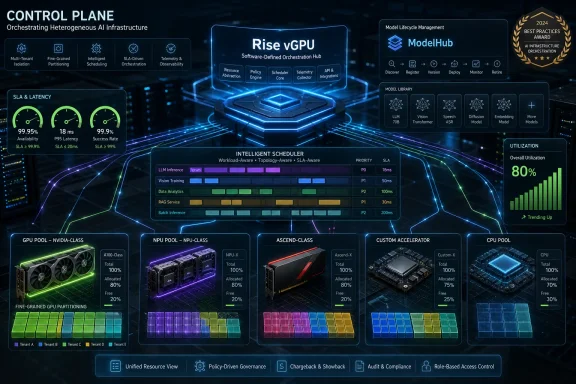 The AI Hardware Race Is Becoming an Orchestration Race
For most of the generative AI boom, infrastructure marketing has been dominated by the language of silicon. Every vendor wanted to talk about tensor cores, memory bandwidth, interconnects, accelerator roadmaps, and the supposedly decisive advantage of one chip family over another. That conversation is not over, but it is becoming less sufficient.The Frost & Sullivan white paper, as summarized in the announcement, frames the shift bluntly: AI infrastructure competitiveness is moving from “single-chip performance” to “cluster-scale system coordination.” That is the right diagnosis. Modern AI workloads are not served by a heroic chip sitting alone in a rack; they are served by a stack of schedulers, runtimes, drivers, model registries, network fabrics, storage layers, observability systems, and policy engines that either work together or quietly destroy utilization.
The problem is especially acute in heterogeneous environments. A clean, homogenous NVIDIA estate is hard enough to operate at high utilization. A mixed estate that includes NVIDIA, Huawei Ascend, Cambricon, Hygon, and other accelerators introduces a nastier problem: different software stacks, different performance profiles, different memory constraints, and different operational assumptions.
That is where Phancy is trying to plant its flag. Rise vGPU is being positioned as a software-defined control plane for mixed AI compute, while ModelHub extends the pitch upward into model onboarding, deployment, optimization, inference service management, and version governance. In plain English, Phancy is arguing that the winning AI platform is not merely the one with access to scarce hardware, but the one that can turn messy hardware into predictable service capacity.
Phancy’s Award Is Also a Warning About GPU Waste
The most provocative number in the announcement is not the Tier 1 label. It is the claim that industry GPU utilization is generally below 30 percent, while Rise vGPU can push utilization into the 70 to 90 percent range through oversubscription and time-space multiplexing.Those figures should be read carefully. Vendor-supplied utilization claims always deserve scrutiny, because “utilization” can mean different things depending on whether one measures allocated capacity, active compute, memory pressure, job throughput, or business-level inference output. But even if the exact numbers vary from one environment to another, the basic point is hard to dispute: expensive AI hardware is often idle, stranded, or inefficiently partitioned.
This is not a small accounting problem. A GPU cluster with poor utilization is a capital sink. Enterprises can spend millions building AI capacity only to discover that workloads are blocked by scheduling conflicts, memory fragmentation, driver incompatibilities, model-placement failures, or teams hoarding full accelerators for jobs that need only a slice.
The Rise vGPU pitch attacks precisely that waste. By offering sub-GPU partitioning and memory slicing at MB-level granularity, Phancy is promising to turn large accelerators into divisible, schedulable pools. That is the same broad idea that has powered virtualization in traditional enterprise computing for decades: stop treating physical devices as sacred units, and start treating them as pools of capacity governed by software.
The difference is that GPU virtualization for AI is much harder than CPU virtualization was in its mature server era. AI jobs can be memory-hungry, latency-sensitive, topology-dependent, and intolerant of noisy neighbors. Training jobs, fine-tuning runs, batch inference, and real-time inference do not stress a cluster in the same way. A scheduler that improves average utilization but degrades critical inference latency is not an enterprise platform; it is a science project with a billing dashboard.
The China Context Makes Heterogeneity a Feature, Not a Bug
The announcement repeatedly grounds the Frost & Sullivan white paper in China’s AI infrastructure reality. That is not incidental. China’s AI ecosystem has been pushed toward multi-chip coexistence by a combination of domestic innovation, supply-chain constraints, export controls, procurement policy, and the sheer scale of enterprise AI demand.In a market where organizations may need to deploy across NVIDIA accelerators, domestic GPUs, NPUs, and specialized AI chips, heterogeneity is not a temporary inconvenience. It is the operating model. The fantasy of standardizing everything on one accelerator family is less realistic when hardware availability, compliance expectations, and strategic autonomy all point in different directions.
That makes orchestration a national-scale infrastructure problem as much as a data-center engineering problem. If each chip family requires its own deployment workflow, model adaptation path, monitoring system, and operations team, the cost of AI adoption rises sharply. Worse, every fragmented stack becomes a reason for business units to delay deployment or retreat into small pilots.
Phancy’s message is therefore well calibrated for its home market. Rise vGPU promises unified onboarding and management across more than ten GPU and NPU vendors. ModelHub promises model-and-chip compatibility, execution stability, and coordinated model-GPU scheduling. Together, the products are being presented as a bridge between China’s multi-chip reality and enterprise expectations for cloud-like reliability.
That does not make Phancy’s claims automatically proven in every environment. It does make the company’s strategy legible. The opportunity is not to beat NVIDIA at NVIDIA’s own game of end-to-end silicon and software dominance. It is to become the translation layer for customers who cannot, or will not, live inside a single-vendor accelerator universe.
Virtualization Is the Old Enterprise Trick AI Suddenly Needs
There is something almost cyclical about the Rise vGPU story. Enterprise IT has seen this movie before. Physical servers were once deployed as dedicated machines for specific applications, then virtualization turned them into elastic pools. Storage went through a similar abstraction wave. Networking followed with software-defined overlays, policy controllers, and increasingly programmable fabrics.AI infrastructure is now reaching the same stage of maturity. The first wave was hardware acquisition. The second wave is utilization, governance, and service delivery. The third wave, if the enterprise cloud playbook holds, will be chargeback, policy automation, compliance evidence, and developer self-service.
That is why the announcement’s less glamorous claims may matter more than the headline award. Monitoring, metering, and cost allocation are not the phrases that light up a launch event, but they are the features that determine whether a CIO can run AI infrastructure as a shared enterprise service rather than a politically contested pile of scarce machines.
If Phancy can make GPU resources “operable digital assets,” as the announcement puts it, the implications are practical. A central AI infrastructure team can allocate capacity by priority. Finance can understand which business units are consuming expensive compute. Compliance teams can audit production inference workloads. Engineering teams can request capacity without negotiating manually for entire accelerators.
That is the boring work that makes technology adoption durable. Enterprises do not merely need AI accelerators; they need AI infrastructure that can survive budgeting cycles, audits, outages, staff turnover, and the inevitable moment when a pilot becomes a production dependency.
SLA Claims Are Where the Marketing Meets the Pager
The announcement says Rise vGPU includes a Deterministic Execution Layer designed to deliver committed and auditable SLA guarantees for critical inference workloads. That phrase deserves attention because it sits at the boundary between infrastructure marketing and operational reality.Inference is becoming a production workload in the most literal sense. Customer-support bots, coding assistants, document analysis tools, fraud systems, search features, and agentic workflows increasingly depend on model responses arriving within usable latency windows. A delayed batch job may be annoying. A degraded inference service embedded in customer operations can become an outage.
This is where GPU oversubscription becomes dangerous if handled poorly. The same technique that improves utilization can also introduce contention. Multiple tenants sharing slices of accelerator capacity may compete for memory, bandwidth, scheduler attention, or runtime resources. Without careful isolation and workload awareness, a platform can win the spreadsheet and lose the service-level agreement.
Phancy’s emphasis on deterministic execution is therefore strategically smart. It acknowledges that enterprises will not accept a simple trade of higher utilization for unpredictable service quality. The challenge is to prove that the system can make fine-grained sharing safe, observable, and enforceable under real production pressure.
The burden of proof will not be met by a white paper alone. It will be met by reference deployments, failure-mode transparency, independent benchmarking, and the everyday testimony of operations teams. In AI infrastructure, the most important customer question is not whether a platform performs well in the happy path. It is what happens when the cluster is full, the model is large, the traffic spike is real, and the executive dashboard is red.
ModelHub Shows Why Compute Alone Is Not Enough
The ModelHub portion of the announcement is easy to treat as a secondary win, but it may be the more revealing part of Phancy’s strategy. Frost & Sullivan’s reported evaluation gives ModelHub the highest overall score in enterprise-grade model management, with strong marks in model-and-chip compatibility, execution stability, performance, and model-GPU coordination.That set of criteria points to a real pain in enterprise AI: models are not portable in the frictionless way many business leaders imagine. A model that runs acceptably in one environment may require adaptation, optimization, quantization, runtime changes, driver support, memory tuning, or deployment redesign to run effectively somewhere else. The more heterogeneous the hardware estate, the more complex this becomes.
A model-management platform that understands the underlying compute environment can reduce that friction. Instead of treating model deployment and GPU scheduling as separate domains, Phancy is pitching a closed loop: onboard the model, match it to suitable hardware, optimize execution, serve inference, track versions, and govern the lifecycle. That is a more complete enterprise story than simply selling a vGPU layer.
This also reflects where the AI platform market is heading. The infrastructure layer and the model layer are converging because cost, performance, and reliability depend on decisions made across both. A model registry that does not understand hardware may be blind to deployment economics. A GPU scheduler that does not understand model behavior may place workloads poorly. A governance system that cannot connect model versions to execution environments may struggle to explain failures.
In that sense, ModelHub is not just an add-on. It is Phancy’s attempt to move from infrastructure utility to AI operating layer. If Rise vGPU controls the scarce resource, ModelHub controls what enterprises actually do with it.
The White Paper Endorsement Is Useful, But It Is Not the Same as Proof
Frost & Sullivan endorsements carry weight in enterprise markets, especially when buyers need third-party language to validate vendor shortlists. But readers should distinguish between three things: a consulting-firm assessment, a vendor-distributed announcement, and independently reproducible technical evidence.The announcement says Frost & Sullivan defined Tier 1 criteria around heterogeneous support, fine-grained control, and production-grade execution. It says Rise vGPU meets those standards. It says ModelHub achieved the highest overall score. Those are meaningful claims, but they are also presented through a corporate news release whose issuer is responsible for the content.
That does not make the claims false. It does mean IT buyers should ask the next round of questions. What workloads were tested? What competing platforms were included? Were results measured in synthetic benchmarks, customer deployments, or vendor submissions? How was utilization defined? What were the latency tradeoffs under oversubscription? How did the platform behave across different accelerator types?
This is not cynicism. It is procurement hygiene. The AI infrastructure market is filled with products that promise abstraction, portability, governance, and utilization gains. Some will deliver. Some will work only within narrow constraints. Some will turn out to be wrappers around open-source components with ambitious roadmaps and uneven enterprise support.
Phancy’s advantage, if the white paper’s framing is accurate, is that it is attacking a real and growing problem. The risk for buyers is assuming that a category win eliminates the need for environment-specific validation. AI infrastructure is too workload-dependent for that. The right question is not “Is Rise vGPU Tier 1?” but “Does Rise vGPU make our particular mix of chips, models, teams, policies, and latency targets easier to operate?”
Windows Shops Should Read This as a Data-Center Story, Not a Desktop Story
For WindowsForum readers, the immediate temptation may be to ask where Windows fits. Rise vGPU and ModelHub are not consumer Windows features, and this announcement is not about gaming GPUs, desktop virtualization, or Windows 11 AI PCs. Its relevance is upstream: it concerns the infrastructure that increasingly powers enterprise AI services consumed from Windows endpoints.That distinction matters. The next generation of Windows enterprise experiences will depend heavily on back-end AI systems, whether those are internal copilots, document intelligence tools, code assistants, security analytics, or vertical business applications. The endpoint may be Windows, but the expensive and operationally fragile layer lives in the data center or cloud.
Sysadmins and IT architects should therefore pay attention to orchestration platforms even if they never touch Rise vGPU directly. The same forces shaping Phancy’s market are shaping AI adoption everywhere: scarce accelerators, mixed environments, security boundaries, model sprawl, chargeback pressure, and the uncomfortable realization that AI pilots are easy while AI operations are not.
There is also a lesson for Microsoft-centric environments. Azure, Windows Server, Hyper-V, Kubernetes, and enterprise identity systems have conditioned IT teams to expect abstraction, policy, and centralized management. AI infrastructure is now being pulled toward that same operating model. The firms that win will be those that make accelerators behave less like exotic research hardware and more like governed enterprise capacity.
The Windows ecosystem has always benefited when messy hardware differences are hidden behind stable software contracts. That is the broader story here. Whether the hardware is a printer, a storage array, a GPU, or an NPU, enterprise adoption accelerates when administrators can manage it predictably and developers can consume it without becoming hardware specialists.
The Real Competition Is the Control Plane
Phancy’s “Token Factory” language is promotional, but it captures a serious economic idea. Inference is becoming an industrial process. Enterprises increasingly care about cost per token, latency per request, throughput per watt, and the ability to match model quality to business value without wasting premium compute.That is why the control plane matters. Whoever controls placement, partitioning, scheduling, observability, policy, and model lifecycle has enormous influence over the economics of AI. The control plane decides whether an expensive accelerator serves one underutilized workload or many carefully isolated ones. It decides whether a model lands on the right chip or burns time and money on a poor match. It decides whether a failed deployment is diagnosable or merely mysterious.
In the classic cloud market, the control plane became the product. Compute, storage, and networking were necessary, but the real stickiness came from identity, APIs, automation, monitoring, billing, and managed services. AI infrastructure is heading toward a similar pattern, except the underlying resources are more expensive, the workloads are less predictable, and the operational stakes are rising faster.
This is where Phancy’s full-stack positioning is rational. Rise vGPU alone could be seen as infrastructure optimization. ModelHub alone could be seen as model governance. Together, they create a stronger claim: Phancy wants to manage the path from heterogeneous accelerator to deployed AI service. That is the layer where customers may be willing to pay if the platform reduces waste and operational risk.
The question is how defensible that layer becomes. Hyperscalers are building their own AI infrastructure abstractions. Chip vendors are extending their software stacks upward. Kubernetes-native projects continue to evolve. Open-source schedulers and GPU-sharing frameworks are advancing. Enterprise software vendors are bundling AI deployment features into existing platforms. Phancy’s opening is strongest where customers need neutral orchestration across mixed Chinese and global accelerator ecosystems, but competition for the AI control plane will be fierce.
The Enterprise Buyer’s Checklist Is Changing
A few years ago, AI infrastructure procurement could be reduced, crudely, to accelerator access and cloud budget. Today that is not enough. The white paper’s emphasis on heterogeneous support, fine-grained control, and production-grade execution reflects a more mature buyer mindset.Enterprises now need to ask whether a platform can absorb new chip vendors without creating operational silos. They need to know whether expensive accelerators can be safely shared across teams and workloads. They need predictable SLAs for inference services that may become customer-facing. They need cost allocation that finance can understand and audit trails that governance teams can defend.
They also need to plan for model churn. The model that looks strategic today may be replaced, distilled, fine-tuned, regulated, or retired within months. A platform that treats model deployment as a one-time packaging exercise will not keep up. Enterprises need model lifecycle systems that connect versions, dependencies, hardware placement, performance, security, and business ownership.
This is why the Phancy announcement lands at an interesting moment. The AI market is shifting from experimental abundance to operational scarcity. Budgets are still large, but scrutiny is rising. Boards and CFOs want evidence that AI spending produces durable capability rather than impressive demos. Utilization, governance, and reliability are becoming boardroom issues by way of the data center.
That trend favors vendors that can speak both infrastructure and business language. Rise vGPU’s claims about utilization and slicing speak to engineering teams. ModelHub’s governance and lifecycle story speaks to platform teams. Cost allocation and metering speak to finance. SLA assurance speaks to operations. A coherent platform needs all of those audiences to believe the same story.
Phancy’s Tier 1 Moment Narrows the Next Set of Questions
The Frost & Sullivan recognition gives Phancy a strong talking point, but the practical meaning will be decided in deployments rather than announcements. The most concrete implications are not abstract; they are the questions enterprise AI teams should now bring to every infrastructure discussion.- Enterprises running mixed GPU and NPU fleets should treat orchestration as a first-order design requirement, not as an afterthought bolted onto hardware procurement.
- Utilization claims should be evaluated against real workloads, with attention to latency, isolation, memory behavior, and failure modes under contention.
- Model management and compute scheduling should be assessed together, because model placement decisions increasingly determine cost, performance, and reliability.
- Platforms promising fine-grained GPU sharing must prove that they can protect critical inference services from noisy-neighbor effects.
- Third-party recognition is useful for market validation, but production pilots remain essential because AI infrastructure performance is highly workload-specific.
- Windows and Microsoft-centric IT teams should view this as part of the broader enterprise shift toward AI back ends that require cloud-style governance, even when users experience them through familiar desktop tools.
References
- Primary source: Bisinfotech
Published: 2026-06-17T06:30:12.658751
Frost & Sullivan names Phancy Rise vGPU Tier 1 platform
Frost & Sullivan white paper ranks Phancy's Rise vGPU as Tier 1 and ModelHub highest in enterprise model management. www.bisinfotech.com
- Related coverage: alvinology.com
- Related coverage: frost.com
Frost & Sullivan Highlights Cooling as a Strategic Imperative in the AI Era in New Data Centre Whitepaper
New analysis explores how advanced cooling architectures, liquid cooling technologies, and thermal management strategies are reshaping next-generation digital infrastructure London, UK — 7 May 2026 — Frost & Sullivan’s latest whitepaper, Strategic Cooling for the AI Era: How Data Centre...www.frost.com - Related coverage: hub.frost.com
- Related coverage: assets.ctfassets.net
- Related coverage: en.phancy.ai
