

Phoenix Semiconductor, an Austin chip-resurrection startup, has won a Phase II Small Business Innovation Research contract from the U.S. Defense Logistics Agency to recreate obsolete microelectronic components for aging defense systems, including a 1970s-era logic chip tied to carrier launch-and-recovery infrastructure. The award is not just another defense supply-chain footnote. It is a reminder that national security still depends on parts designed before the PC era, and that “modernization” often begins by making the old thing work exactly as before.
The pitch is almost anti-Silicon Valley: do not redesign the system, do not rewrite the software, do not force a platform-level certification cycle unless absolutely necessary. Instead, reproduce the behavior of vanished chips closely enough that military hardware can keep operating without learning anything new. In a defense world obsessed with artificial intelligence, hypersonics, and autonomous systems, Phoenix is betting that some of the most valuable engineering work is disciplined technological impersonation.
The Pentagon’s semiconductor headache is usually described in future-tense language: secure fabs, trusted foundries, advanced packaging, export controls, and the geopolitical risk of depending on offshore manufacturing. Those are real problems. But Phoenix’s contract points to a less glamorous crisis already inside the inventory: chips that disappeared from commercial production decades ago but remain embedded in systems expected to serve for decades more.
That mismatch is structural. Military platforms can remain in service for 30, 40, or 50 years, while commercial semiconductor lifecycles are often measured in single-digit years. A chipmaker stops producing a part because the market moved on, a fabrication process was retired, or a product line no longer makes economic sense. The Navy, Air Force, or Army may still have a perfectly functional system whose weakest link is now a few pieces of silicon no one makes.
The result is not merely inconvenience. When a component becomes unavailable, program offices face a grim menu: scour brokers for old stock, qualify substitutes, redesign boards, rewrite firmware, re-certify assemblies, or cannibalize parts from other systems. Each option carries risk. Some increase counterfeit exposure, some extend depot timelines, and some turn a cheap part shortage into a multimillion-dollar engineering event.
Phoenix Semiconductor is positioning itself in the narrow space between nostalgia and necessity. Its job is not to make a better chip in the normal consumer-electronics sense. Its job is to make a chip that behaves so much like the old one that the surrounding system never notices the difference.
According to the reported contract details, the 82S100 replacement is tied to the Catapult Assisted Take-Off but Arrested Recovery system used aboard Nimitz-class carriers. That phrasing matters. Carrier aviation is not an abstract back-office workload; it is a choreography of energy, timing, safety margins, maintenance routines, and certification regimes. A component shortage in that environment can become a readiness problem long before it becomes a dramatic failure.
The chip itself is not glamorous. A bipolar field-programmable logic array is the kind of device engineers used to encode logic before cheap, dense programmable logic became ubiquitous. But in legacy systems, boring parts are often the most dangerous parts to lose. They sit at the intersection of electrical assumptions, timing assumptions, board layouts, test procedures, and decades of accumulated operational confidence.
Replacing that kind of part is not as simple as finding a modern FPGA and writing equivalent logic. The external system may depend on voltage levels, propagation delays, loading characteristics, package dimensions, thermal behavior, and even oddities of the original silicon. In old defense electronics, “close enough” is not an engineering philosophy. It is a risk register.
That is the elegant version. The hard version is that every one of those words hides a trap. A modern substitute may be faster, but faster can be wrong if the original circuit depended on slower timing. A modern part may use less power, but lower power draw can alter assumptions in power monitoring or analog-adjacent behavior. A new package may have the same pinout but behave differently under vibration, heat, or electrical stress.
Phoenix says its earlier Phase I work demonstrated cycle-accurate replacement chips tested in a live commercial system without requiring hardware or software changes. That is the claim that makes the Phase II award interesting. If the company can repeatedly reproduce old digital behavior in certifiable, domestically controlled components, it could offer defense program offices a route around one of the most expensive forms of obsolescence.
The company’s approach reportedly does not require new silicon fabrication or original wafers. That point deserves attention because it separates Phoenix’s model from the usual assumption that semiconductor recovery means restarting an old process node. If Phoenix can emulate, reconstruct, or otherwise reproduce legacy part behavior without resurrecting the original manufacturing line, the economics may change substantially.
The risk, of course, is that defense electronics are full of exceptions. A method that works beautifully for one logic device may require fresh validation for every target part and every system context. But even a partial solution is valuable in a world where the alternative is often a platform redesign triggered by a chip that once cost a few dollars.
This is where the Phoenix contract becomes more than a chip story. Obsolescence is often treated as maintenance housekeeping until it collides with operational availability. A part goes out of production, a last-time buy is missed or exhausted, a depot repair queue grows, and a system that should be repairable becomes a candidate for expensive engineering intervention.
For administrators and IT pros, the pattern is familiar even if the stakes differ. Enterprises keep old servers, controllers, industrial PCs, and embedded Windows systems alive because the application they run is tied to a production line, laboratory instrument, medical device, or compliance regime. The business case for replacement is never just “buy a new box.” It includes validation, downtime, training, interfaces, licenses, data migration, and the terrifying sentence: “We are not sure what else depends on it.”
Defense platforms magnify that problem. A carrier, aircraft, radar, missile system, or logistics platform is not a replaceable desktop. It is a certified ecosystem. Once a subsystem changes, documentation changes. Tests change. Maintenance procedures change. Sometimes training changes. In the military world, redesign is not a single engineering task; it is a bureaucratic, operational, and safety process.
That is why a drop-in chip has strategic weight out of proportion to its size. The value is not just the price of silicon avoided. It is the avoidance of cascading change.
Obsolete electronics create a gray market. When official supply disappears, buyers may turn to brokers, salvaged parts, old inventory, or uncertain provenance. That opens the door to counterfeits, damaged components, misrepresented lots, and parts that pass basic inspection but fail under operational stress. In national-security systems, availability risk and integrity risk merge quickly.
A domestic, validated replacement path would not eliminate those risks, but it could reduce dependence on uncertain sourcing. That is particularly important for parts that are too old to benefit from modern secure supply-chain practices yet too important to casually redesign away. In that sense, Phoenix is not merely filling a warehouse bin. It is offering a way to reassert control over a class of components that has drifted outside the normal commercial support envelope.
The WindowsForum audience will recognize the software analogue. Unsupported operating systems linger because the supported replacement breaks something mission-critical. Administrators then build compensating controls: network segmentation, application allowlisting, virtual patching, backup discipline, and strict change windows. Phoenix’s hardware proposition is a cousin to that logic: if you cannot immediately modernize the whole system, reduce the risk of keeping it alive.
There is an uncomfortable lesson here for anyone who equates security with constant replacement. Sometimes replacement is the riskier path. If the system is critical, deeply integrated, and expensive to certify, a stable, validated substitute component may be safer than a rushed modernization project that changes too many variables at once.
But defense does not run only on leading-edge silicon. It also runs on analog parts, power devices, radiation-tolerant components, microcontrollers, programmable logic, memory, and obscure chips built on older processes. Many of those parts are not attractive to commercial manufacturers chasing volume and margin. Yet they can be essential to platforms that are still funded, deployed, and expected to work.
Phoenix’s contract fits a broader turn toward sustainment as a strategic capability. A military that cannot maintain what it already owns is not automatically strengthened by buying more advanced systems. The inventory has to be repairable. The depots need parts. The supply chain needs visibility. And program managers need options short of redesigning half a subsystem because a single package vanished from distribution.
That is not a romantic argument for freezing technology. Some systems genuinely need replacement. Some legacy hardware is too brittle, insecure, or expensive to justify heroic sustainment. But the choice is rarely clean. The military often has to modernize selectively while keeping older equipment available through a long transition.
The phrase “legacy” can mislead here. In consumer technology, legacy often means obsolete in the everyday sense: something superseded, unsupported, and ready for recycling. In defense, legacy may mean operational, certified, maintained, and still central to mission planning. A legacy chip can be old without being optional.
This is especially true in platforms where downtime is scheduled years in advance and physical access is limited. Carrier maintenance availability is not a casual calendar entry. If a fix requires pulling equipment, altering assemblies, and retesting integrated systems, the cost is operational as well as financial. The Navy cannot manage readiness as if it were swapping a motherboard in a lab.
Phoenix’s proposition is therefore conservative in the productive sense. It tries to preserve the certified boundary. The replacement part does its work inside the footprint of the old part, allowing the larger system to remain stable. If that approach passes validation, the government buys time, avoids disruption, and reduces the number of engineering changes competing for scarce attention.
The danger is complacency. Drop-in replacements can become a way to defer necessary modernization indefinitely. That is not unique to defense; it is how banks end up with ancient core systems and factories end up with unsupported controllers. Sustainment becomes unhealthy when it is used to avoid strategy.
But used well, this kind of component recovery is a bridge. It keeps critical systems available while modernization is planned deliberately instead of triggered by a parts shortage. That distinction matters.
A semiconductor part that disappears from the market can strand equipment far outside defense. A factory controller, imaging device, oil-and-gas system, avionics unit, or rail subsystem may rely on a board designed when component availability looked stable. Decades later, the original vendor may be gone, the firmware source may be incomplete, and the replacement module may require recertifying an entire process.
That reality complicates the usual technology-industry bias toward refresh cycles. In many environments, old hardware persists not because owners are careless, but because the cost of change is non-linear. Replacing a control board can mean revalidating a production line. Updating an embedded OS can mean recertifying a medical device. Swapping a logic chip can mean proving that timing-sensitive behavior did not change in a safety-critical path.
Phoenix’s reported method, if it scales beyond a handful of components, speaks to a market that is bigger than the Pentagon. It suggests a future in which component resurrection becomes a managed service category: identify at-risk parts, reconstruct behavior, validate substitutes, and maintain trusted supply for long-life equipment. That is not as flashy as designing the next accelerator, but it may be just as important for the systems people actually depend on.
There is also an environmental angle, though it should not be overstated. Extending the life of high-value equipment can reduce waste and avoid unnecessary replacement. But prolonging systems without addressing security, efficiency, and maintainability can also lock organizations into fragile architectures. The virtue is not old hardware for its own sake. The virtue is controlled continuity.
The same trade-off appears in hardware sustainment. Compatibility is not merely convenience. It is infrastructure. When an organization designs procedures, training, procurement, maintenance, and safety cases around a system, the ability to preserve behavior becomes economically valuable.
That is why “just replace it” is so often bad advice from people outside the operational chain. In a home PC context, a clean install may be annoying but manageable. In a factory, ship, hospital, utility, or defense platform, the same mindset can be reckless. Systems are not isolated objects; they are dependencies with metal around them.
Phoenix’s work is a hardware expression of the compatibility bargain. The replacement component is valuable precisely because it does not demand attention from everything around it. It disappears into the existing architecture. In modern technology culture, invisibility is underrated.
This does not mean every legacy dependency should be preserved. Windows administrators know the pain of ancient line-of-business applications, unsigned drivers, unsupported operating systems, and hardware whose only documentation is a binder in a locked cabinet. Compatibility can become a trap. But when the alternative is mission disruption, disciplined compatibility is not sentimentality. It is risk management.
That sounds modest until one considers the constraints. The replacement must satisfy technical behavior, procurement rules, validation expectations, supply-chain scrutiny, and the unforgiving physics of old boards. It must be new enough to source and support, yet old enough in behavior to be accepted by legacy systems. It must modernize the supply chain without modernizing the interface.
This is a subtle form of engineering discipline. It resists the temptation to improve the surrounding system, because every improvement can become a new failure mode. It treats the original component not as an inferior ancestor but as a specification encoded in silicon.
There is a lesson here for software as well. The industry frequently underestimates the value of stable interfaces and overestimates the customer appetite for forced migration. Every deprecated API, abandoned driver model, unsupported authentication flow, or broken management script creates a tiny version of the same problem. Multiply that across enterprises, and compatibility debt becomes operational drag.
Phoenix’s work will not solve all of that. But it provides a useful metaphor: sometimes the best upgrade is the one that preserves the contract.
Still, funded bets reveal priorities. The Defense Logistics Agency is not chasing this because retro chips are charming. It is chasing it because the sustainment system needs options. The FY2025 defense-policy environment has emphasized microelectronics obsolescence mitigation, supply-chain risk management, and domestic manufacturing capacity. Phoenix’s project sits neatly inside that agenda.
The involvement of Naval Air Systems Command on the carrier-related chip also gives the work a concrete operational edge. This is not merely a laboratory curiosity about old programmable logic. It is attached to a platform class that remains central to U.S. naval power. The Nimitz-class carriers are aging, but they are not irrelevant. Their sustainment demands will remain large even as the Ford class matures.
The likely near-term outcome is not dramatic. If Phoenix succeeds, a few specific obsolete chips get validated replacements. Program offices gain a path around certain shortages. The supply chain becomes less brittle in targeted places. That is incremental work.
But many strategic improvements are incremental until they suddenly matter. A ship deploys because repairs were completed. A depot clears a backlog. A counterfeit-prone sourcing path closes. A redesign is postponed until it can be done properly. Those are not press-conference achievements, but they are the mechanics of readiness.
The Pentagon’s chip problem is not simply that the future arrives too fast; it is that the past remains deployed. Phoenix Semiconductor’s Phase II award is a small but telling attempt to reconcile those timelines by making vanished components available again without forcing critical systems through avoidable redesign. If the approach works, the lesson for defense, industry, and enterprise IT will be the same: modernization is not always a leap forward, and sometimes the most consequential technology is the part that lets everything else keep running while the next move is planned.
The pitch is almost anti-Silicon Valley: do not redesign the system, do not rewrite the software, do not force a platform-level certification cycle unless absolutely necessary. Instead, reproduce the behavior of vanished chips closely enough that military hardware can keep operating without learning anything new. In a defense world obsessed with artificial intelligence, hypersonics, and autonomous systems, Phoenix is betting that some of the most valuable engineering work is disciplined technological impersonation.
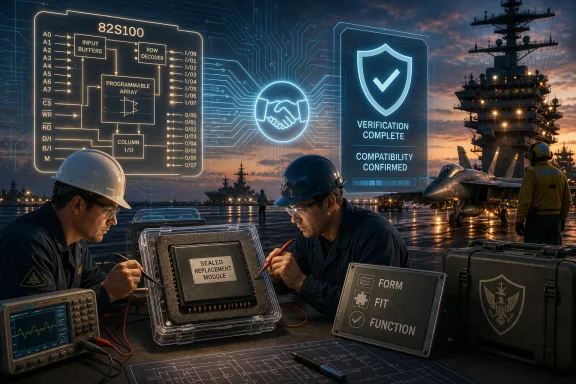 The Pentagon’s New Problem Is Not Always New Technology
The Pentagon’s semiconductor headache is usually described in future-tense language: secure fabs, trusted foundries, advanced packaging, export controls, and the geopolitical risk of depending on offshore manufacturing. Those are real problems. But Phoenix’s contract points to a less glamorous crisis already inside the inventory: chips that disappeared from commercial production decades ago but remain embedded in systems expected to serve for decades more.That mismatch is structural. Military platforms can remain in service for 30, 40, or 50 years, while commercial semiconductor lifecycles are often measured in single-digit years. A chipmaker stops producing a part because the market moved on, a fabrication process was retired, or a product line no longer makes economic sense. The Navy, Air Force, or Army may still have a perfectly functional system whose weakest link is now a few pieces of silicon no one makes.
The result is not merely inconvenience. When a component becomes unavailable, program offices face a grim menu: scour brokers for old stock, qualify substitutes, redesign boards, rewrite firmware, re-certify assemblies, or cannibalize parts from other systems. Each option carries risk. Some increase counterfeit exposure, some extend depot timelines, and some turn a cheap part shortage into a multimillion-dollar engineering event.
Phoenix Semiconductor is positioning itself in the narrow space between nostalgia and necessity. Its job is not to make a better chip in the normal consumer-electronics sense. Its job is to make a chip that behaves so much like the old one that the surrounding system never notices the difference.
A 1975 Logic Chip Becomes a Carrier Readiness Issue
The headline component in the new work is the Signetics 82S100 Bipolar Field-Programmable Logic Array, a chip introduced in 1975 and discontinued in the late 1980s. In ordinary commercial computing history, that part belongs to the era of minicomputers, arcade boards, and early digital control logic. In defense logistics, it is still relevant because systems built around such parts can outlive the companies, fabs, and catalogs that created them.According to the reported contract details, the 82S100 replacement is tied to the Catapult Assisted Take-Off but Arrested Recovery system used aboard Nimitz-class carriers. That phrasing matters. Carrier aviation is not an abstract back-office workload; it is a choreography of energy, timing, safety margins, maintenance routines, and certification regimes. A component shortage in that environment can become a readiness problem long before it becomes a dramatic failure.
The chip itself is not glamorous. A bipolar field-programmable logic array is the kind of device engineers used to encode logic before cheap, dense programmable logic became ubiquitous. But in legacy systems, boring parts are often the most dangerous parts to lose. They sit at the intersection of electrical assumptions, timing assumptions, board layouts, test procedures, and decades of accumulated operational confidence.
Replacing that kind of part is not as simple as finding a modern FPGA and writing equivalent logic. The external system may depend on voltage levels, propagation delays, loading characteristics, package dimensions, thermal behavior, and even oddities of the original silicon. In old defense electronics, “close enough” is not an engineering philosophy. It is a risk register.
Drop-In Replacement Is the Hardest Easy Idea in Hardware
The phrase form, fit, and function sounds bureaucratic, but it captures the entire wager. The replacement must physically fit where the old component fits, electrically interface as the old component interfaces, and function as the old component functions. If it succeeds, the system treats the new part as if the supply chain never broke.That is the elegant version. The hard version is that every one of those words hides a trap. A modern substitute may be faster, but faster can be wrong if the original circuit depended on slower timing. A modern part may use less power, but lower power draw can alter assumptions in power monitoring or analog-adjacent behavior. A new package may have the same pinout but behave differently under vibration, heat, or electrical stress.
Phoenix says its earlier Phase I work demonstrated cycle-accurate replacement chips tested in a live commercial system without requiring hardware or software changes. That is the claim that makes the Phase II award interesting. If the company can repeatedly reproduce old digital behavior in certifiable, domestically controlled components, it could offer defense program offices a route around one of the most expensive forms of obsolescence.
The company’s approach reportedly does not require new silicon fabrication or original wafers. That point deserves attention because it separates Phoenix’s model from the usual assumption that semiconductor recovery means restarting an old process node. If Phoenix can emulate, reconstruct, or otherwise reproduce legacy part behavior without resurrecting the original manufacturing line, the economics may change substantially.
The risk, of course, is that defense electronics are full of exceptions. A method that works beautifully for one logic device may require fresh validation for every target part and every system context. But even a partial solution is valuable in a world where the alternative is often a platform redesign triggered by a chip that once cost a few dollars.
Obsolescence Is a Budget Line With a Readiness Shadow
The Department of Defense has long described diminishing manufacturing sources and material shortages as a recurring burden, not a rare surprise. The numbers attached to the problem are large: redesign and replacement efforts can run into millions over several years for a single instance, and broader mitigation costs across the defense enterprise reach into the billions annually. The exact cost of any given shortage depends on the platform, certification burden, operational urgency, and available stock, but the direction is not in dispute.This is where the Phoenix contract becomes more than a chip story. Obsolescence is often treated as maintenance housekeeping until it collides with operational availability. A part goes out of production, a last-time buy is missed or exhausted, a depot repair queue grows, and a system that should be repairable becomes a candidate for expensive engineering intervention.
For administrators and IT pros, the pattern is familiar even if the stakes differ. Enterprises keep old servers, controllers, industrial PCs, and embedded Windows systems alive because the application they run is tied to a production line, laboratory instrument, medical device, or compliance regime. The business case for replacement is never just “buy a new box.” It includes validation, downtime, training, interfaces, licenses, data migration, and the terrifying sentence: “We are not sure what else depends on it.”
Defense platforms magnify that problem. A carrier, aircraft, radar, missile system, or logistics platform is not a replaceable desktop. It is a certified ecosystem. Once a subsystem changes, documentation changes. Tests change. Maintenance procedures change. Sometimes training changes. In the military world, redesign is not a single engineering task; it is a bureaucratic, operational, and safety process.
That is why a drop-in chip has strategic weight out of proportion to its size. The value is not just the price of silicon avoided. It is the avoidance of cascading change.
The Old Chip Is Also a Cybersecurity Story
At first glance, recreating a 1970s logic chip sounds orthogonal to cybersecurity. There is no cloud endpoint, no patch Tuesday, no browser exploit, no ransomware operator. But supply-chain security begins with knowing what is in the system and trusting where replacement parts come from.Obsolete electronics create a gray market. When official supply disappears, buyers may turn to brokers, salvaged parts, old inventory, or uncertain provenance. That opens the door to counterfeits, damaged components, misrepresented lots, and parts that pass basic inspection but fail under operational stress. In national-security systems, availability risk and integrity risk merge quickly.
A domestic, validated replacement path would not eliminate those risks, but it could reduce dependence on uncertain sourcing. That is particularly important for parts that are too old to benefit from modern secure supply-chain practices yet too important to casually redesign away. In that sense, Phoenix is not merely filling a warehouse bin. It is offering a way to reassert control over a class of components that has drifted outside the normal commercial support envelope.
The WindowsForum audience will recognize the software analogue. Unsupported operating systems linger because the supported replacement breaks something mission-critical. Administrators then build compensating controls: network segmentation, application allowlisting, virtual patching, backup discipline, and strict change windows. Phoenix’s hardware proposition is a cousin to that logic: if you cannot immediately modernize the whole system, reduce the risk of keeping it alive.
There is an uncomfortable lesson here for anyone who equates security with constant replacement. Sometimes replacement is the riskier path. If the system is critical, deeply integrated, and expensive to certify, a stable, validated substitute component may be safer than a rushed modernization project that changes too many variables at once.
The Defense Industrial Base Rediscovers Maintenance as Strategy
For years, the public conversation about semiconductors has been dominated by leading-edge capacity. That emphasis is understandable. Advanced chips matter for AI, high-performance computing, sensors, electronic warfare, and next-generation weapons. The CHIPS-era political vocabulary has made nodes, fabs, and reshoring part of mainstream policy debate.But defense does not run only on leading-edge silicon. It also runs on analog parts, power devices, radiation-tolerant components, microcontrollers, programmable logic, memory, and obscure chips built on older processes. Many of those parts are not attractive to commercial manufacturers chasing volume and margin. Yet they can be essential to platforms that are still funded, deployed, and expected to work.
Phoenix’s contract fits a broader turn toward sustainment as a strategic capability. A military that cannot maintain what it already owns is not automatically strengthened by buying more advanced systems. The inventory has to be repairable. The depots need parts. The supply chain needs visibility. And program managers need options short of redesigning half a subsystem because a single package vanished from distribution.
That is not a romantic argument for freezing technology. Some systems genuinely need replacement. Some legacy hardware is too brittle, insecure, or expensive to justify heroic sustainment. But the choice is rarely clean. The military often has to modernize selectively while keeping older equipment available through a long transition.
The phrase “legacy” can mislead here. In consumer technology, legacy often means obsolete in the everyday sense: something superseded, unsupported, and ready for recycling. In defense, legacy may mean operational, certified, maintained, and still central to mission planning. A legacy chip can be old without being optional.
Certification Makes the Slow Path Rational
One reason drop-in replacement is so attractive is that certification pressure punishes unnecessary novelty. A modern redesigned board might be more elegant, more efficient, and easier to source. But if it requires extensive system testing, shipyard time, software changes, documentation updates, and safety reviews, its real cost may dwarf the component problem it solves.This is especially true in platforms where downtime is scheduled years in advance and physical access is limited. Carrier maintenance availability is not a casual calendar entry. If a fix requires pulling equipment, altering assemblies, and retesting integrated systems, the cost is operational as well as financial. The Navy cannot manage readiness as if it were swapping a motherboard in a lab.
Phoenix’s proposition is therefore conservative in the productive sense. It tries to preserve the certified boundary. The replacement part does its work inside the footprint of the old part, allowing the larger system to remain stable. If that approach passes validation, the government buys time, avoids disruption, and reduces the number of engineering changes competing for scarce attention.
The danger is complacency. Drop-in replacements can become a way to defer necessary modernization indefinitely. That is not unique to defense; it is how banks end up with ancient core systems and factories end up with unsupported controllers. Sustainment becomes unhealthy when it is used to avoid strategy.
But used well, this kind of component recovery is a bridge. It keeps critical systems available while modernization is planned deliberately instead of triggered by a parts shortage. That distinction matters.
The Commercial World Should Be Paying Attention
The military may be the most visible customer for this kind of work, but it is not the only one. Industrial automation, energy, transportation, medical equipment, aerospace, and scientific instrumentation all face the same lifecycle mismatch. The machine lasts. The chip does not.A semiconductor part that disappears from the market can strand equipment far outside defense. A factory controller, imaging device, oil-and-gas system, avionics unit, or rail subsystem may rely on a board designed when component availability looked stable. Decades later, the original vendor may be gone, the firmware source may be incomplete, and the replacement module may require recertifying an entire process.
That reality complicates the usual technology-industry bias toward refresh cycles. In many environments, old hardware persists not because owners are careless, but because the cost of change is non-linear. Replacing a control board can mean revalidating a production line. Updating an embedded OS can mean recertifying a medical device. Swapping a logic chip can mean proving that timing-sensitive behavior did not change in a safety-critical path.
Phoenix’s reported method, if it scales beyond a handful of components, speaks to a market that is bigger than the Pentagon. It suggests a future in which component resurrection becomes a managed service category: identify at-risk parts, reconstruct behavior, validate substitutes, and maintain trusted supply for long-life equipment. That is not as flashy as designing the next accelerator, but it may be just as important for the systems people actually depend on.
There is also an environmental angle, though it should not be overstated. Extending the life of high-value equipment can reduce waste and avoid unnecessary replacement. But prolonging systems without addressing security, efficiency, and maintainability can also lock organizations into fragile architectures. The virtue is not old hardware for its own sake. The virtue is controlled continuity.
The Windows Lesson Is That Compatibility Has Always Been Infrastructure
Windows users understand backward compatibility better than most technology communities. Microsoft’s desktop dominance was built in large part on the promise that old applications, drivers, peripherals, and workflows would not be casually abandoned. That promise created complexity, but it also created trust.The same trade-off appears in hardware sustainment. Compatibility is not merely convenience. It is infrastructure. When an organization designs procedures, training, procurement, maintenance, and safety cases around a system, the ability to preserve behavior becomes economically valuable.
That is why “just replace it” is so often bad advice from people outside the operational chain. In a home PC context, a clean install may be annoying but manageable. In a factory, ship, hospital, utility, or defense platform, the same mindset can be reckless. Systems are not isolated objects; they are dependencies with metal around them.
Phoenix’s work is a hardware expression of the compatibility bargain. The replacement component is valuable precisely because it does not demand attention from everything around it. It disappears into the existing architecture. In modern technology culture, invisibility is underrated.
This does not mean every legacy dependency should be preserved. Windows administrators know the pain of ancient line-of-business applications, unsigned drivers, unsupported operating systems, and hardware whose only documentation is a binder in a locked cabinet. Compatibility can become a trap. But when the alternative is mission disruption, disciplined compatibility is not sentimentality. It is risk management.
The Real Innovation Is Knowing When Not to Innovate
The most interesting part of the Phoenix story is that it challenges the industry’s default definition of innovation. In consumer markets, innovation usually means new capability: faster, smaller, cheaper, smarter, more connected. In sustainment engineering, innovation can mean reproducing old capability with enough fidelity that nothing else has to change.That sounds modest until one considers the constraints. The replacement must satisfy technical behavior, procurement rules, validation expectations, supply-chain scrutiny, and the unforgiving physics of old boards. It must be new enough to source and support, yet old enough in behavior to be accepted by legacy systems. It must modernize the supply chain without modernizing the interface.
This is a subtle form of engineering discipline. It resists the temptation to improve the surrounding system, because every improvement can become a new failure mode. It treats the original component not as an inferior ancestor but as a specification encoded in silicon.
There is a lesson here for software as well. The industry frequently underestimates the value of stable interfaces and overestimates the customer appetite for forced migration. Every deprecated API, abandoned driver model, unsupported authentication flow, or broken management script creates a tiny version of the same problem. Multiply that across enterprises, and compatibility debt becomes operational drag.
Phoenix’s work will not solve all of that. But it provides a useful metaphor: sometimes the best upgrade is the one that preserves the contract.
A Small Contract Points to a Larger Procurement Shift
The Phase II SBIR mechanism matters because it is designed to move small businesses from feasibility toward prototype development. It is not the same as a full production contract, and it should not be treated as proof that Phoenix has solved defense microelectronics obsolescence at scale. It is a funded bet.Still, funded bets reveal priorities. The Defense Logistics Agency is not chasing this because retro chips are charming. It is chasing it because the sustainment system needs options. The FY2025 defense-policy environment has emphasized microelectronics obsolescence mitigation, supply-chain risk management, and domestic manufacturing capacity. Phoenix’s project sits neatly inside that agenda.
The involvement of Naval Air Systems Command on the carrier-related chip also gives the work a concrete operational edge. This is not merely a laboratory curiosity about old programmable logic. It is attached to a platform class that remains central to U.S. naval power. The Nimitz-class carriers are aging, but they are not irrelevant. Their sustainment demands will remain large even as the Ford class matures.
The likely near-term outcome is not dramatic. If Phoenix succeeds, a few specific obsolete chips get validated replacements. Program offices gain a path around certain shortages. The supply chain becomes less brittle in targeted places. That is incremental work.
But many strategic improvements are incremental until they suddenly matter. A ship deploys because repairs were completed. A depot clears a backlog. A counterfeit-prone sourcing path closes. A redesign is postponed until it can be done properly. Those are not press-conference achievements, but they are the mechanics of readiness.
The Carrier Chip Story Leaves IT With Five Practical Signals
The Phoenix award is about defense hardware, but its implications travel well beyond the flight deck. For anyone responsible for long-lived systems, the story is a warning against treating component availability, software compatibility, and supply-chain trust as separate problems.- Organizations should maintain inventories of critical components and dependencies before shortages turn routine maintenance into emergency redesign.
- Drop-in replacements can reduce risk only when their behavior is validated against the real system, not merely against a datasheet.
- Legacy platforms need modernization plans that distinguish between parts worth preserving and architectures that have become unsafe to extend.
- Trusted sourcing matters most when official production has ended and gray-market alternatives begin to look tempting.
- Compatibility should be treated as an operational asset, not as a sentimental attachment to old technology.
The Pentagon’s chip problem is not simply that the future arrives too fast; it is that the past remains deployed. Phoenix Semiconductor’s Phase II award is a small but telling attempt to reconcile those timelines by making vanished components available again without forcing critical systems through avoidable redesign. If the approach works, the lesson for defense, industry, and enterprise IT will be the same: modernization is not always a leap forward, and sometimes the most consequential technology is the part that lets everything else keep running while the next move is planned.
References
- Primary source: Interesting Engineering
Published: Fri, 19 Jun 2026 16:39:00 GMT
Pentagon tap semiconductor firm to fix aging carrier defense systems
Phoenix Semiconductor wins a DLA Phase II SBIR contract to build drop-in replacements for obsolete defense microchips used in critical systems.interestingengineering.com - Related coverage: spectrum.ieee.org
Phoenix Links IoT Chips to Save High‑Value Legacy Systems
Phoenix targets the high-mix, low-volume demand for obsolete chips in critical systemsspectrum.ieee.org - Related coverage: darpa.mil
SBIR/STTR topics | DARPA
www.darpa.mil
- Related coverage: highergov.com

Photonic-electronic Panels Integration (PEPI)
On 4/16/26 Defense Advanced Research Projects Agency issued SBIR / STTR Topic DPA26BZ01-NV002 for Photonic-electronic Panels Integration (PEPI) due 6/3/26
www.highergov.com
- Related coverage: semiconductorsinsight.com
Phoenix Semiconductor's Big Feat - Bags Investment from Lockheed Martin - Semiconductors Insight
Phoenix Semiconductor, supported by Lockheed Martin’s investment, innovatively addresses legacy semiconductor challenges by recreating obsolete chips without new silicon or original wafers. This process is crucial for industries like defense and aerospace, ensuring operational reliability. The...semiconductorsinsight.com - Related coverage: 0e190a550a8c4c8c4b93-fcd009c875a5577fd4fe2f5b7e3bf4eb.ssl.cf2.rackcdn.com
EINPresswire 820474258 phoenix semiconductor secures 5 5 million from j2 ventures and rtx ventures announces formation of board of directors 1
PDF document0e190a550a8c4c8c4b93-fcd009c875a5577fd4fe2f5b7e3bf4eb.ssl.cf2.rackcdn.com
- Related coverage: emergingtechnologiesinstitute.org
- Related coverage: scribd.com
- Related coverage: pdf.marketpublishers.com
Global Aircraft Carrier Market Size study, by Type (Conventional Powered, Nuclear-Powered), Configuration (Catapult-Assisted Take-Off but Arrested Recovery (CATOBAR), Short Take-Off but Arrested Recovery (STOBAR), Short Take-Off but Vertical Recovery
Global Aircraft Carrier Market Size study, by Type (Conventional Powered, Nuclear-Powered), Configuration (Catapult-Assisted Take-Off but Arrested Recovery (CATOBAR), Short Take-Off but Arrested Recovery (STOBAR), Short Take-Off but Vertical Recovery (STOVL)) and Regional Forecasts 2021-2027pdf.marketpublishers.com
- Related coverage: armement.defense.gouv.fr
