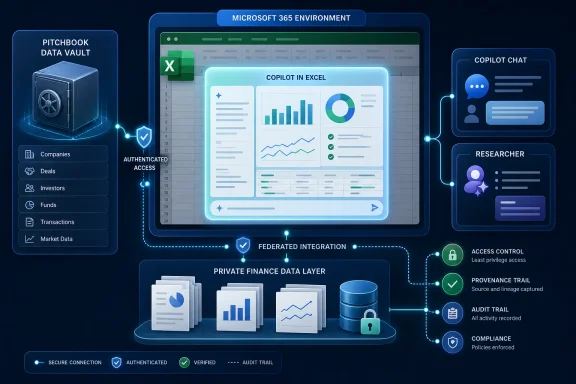
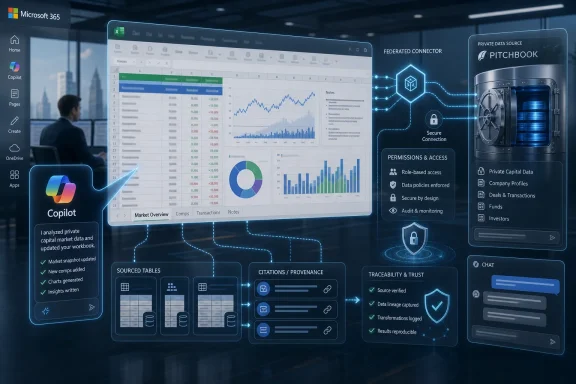
PitchBook announced on June 25, 2026, in Seattle that it is adding a federated Microsoft 365 Copilot connector that brings its private capital market data into Microsoft 365 Copilot, Copilot Chat, Researcher, and Copilot in Excel for licensed enterprise users. The move is not just another AI partnership press release; it is a bet that financial work will be won inside the productivity apps where models, memos, and pitch decks already live. Microsoft gets another high-value data provider to make Copilot feel less generic. PitchBook gets to defend its data moat by turning Excel from an export destination into an AI-native workspace.
For years, the private markets workflow has had a familiar rhythm: log into a specialized data platform, search for companies or funds, export a table, clean it up in Excel, write a memo in Word, and package the result in PowerPoint. That workflow was inefficient, but it preserved a clear boundary between the source system and the productivity layer. PitchBook’s new connector deliberately blurs that boundary.
The company says licensed users of both PitchBook and Microsoft 365 Copilot can interact with PitchBook intelligence directly from Microsoft’s apps using natural language. In practical terms, that means a corporate development analyst could ask for acquisition targets, a venture investor could screen comparable companies, or a banker could begin shaping a diligence workbook without first navigating the PitchBook interface as a separate stop.
That is the real significance of Copilot in Excel. Excel is not merely another surface for Microsoft’s AI assistant; it is where financial professionals reconcile narrative with numbers. If PitchBook data can be queried, shaped, and traced from inside a workbook, the spreadsheet becomes less of a static container and more of a live analytical front end.
The pitch is seductive because it attacks the most stubborn problem in white-collar AI adoption: context. General-purpose models can write polished prose and generate plausible formulas, but deal work depends on specialized, licensed, frequently updated datasets. PitchBook is arguing that the safest path to useful AI is not asking a model to know everything, but giving it controlled access to a dataset that professionals already pay to trust.
That is why connectors matter. Microsoft 365 Copilot connectors are designed to bring third-party content into the Copilot experience so that answers can be grounded in enterprise-approved sources rather than improvised from a model’s training data. The newer federated connector model is especially important because it can retrieve data at query time, reducing the need to copy entire repositories into Microsoft’s index before users can ask questions.
For Microsoft, PitchBook is the kind of partner that makes Copilot look less like a chat box and more like infrastructure. Private capital data is expensive, time-sensitive, and professionally consequential. If Copilot can become the interface through which people ask questions of that data, Microsoft strengthens its claim that AI belongs inside the productivity suite rather than in a growing sprawl of standalone assistants.
That does not mean Microsoft owns the value. In fact, the partnership reveals a dependency: Copilot becomes more useful when trusted data providers participate. The assistant is the interface, but the credibility comes from the source.
PitchBook says the integration can help users build target lists, run diligence workflows, and screen investments using company profiles, deal histories, fund data, and analyst research. That is a much more concrete promise than “AI insights” in the abstract. It places the connector directly in the daily grind of analysts and associates who live in rows, columns, filters, and footnotes.
The obvious benefit is speed. A user who can ask Copilot in Excel to pull a set of private companies by sector, geography, funding history, or investor profile may save the repetitive work of searching, exporting, and formatting. The less obvious benefit is consistency. If the same governed connector is used across chat, research, Excel, and presentation workflows, organizations may reduce the ad hoc copy-paste chains that often introduce stale or misattributed data.
But this is also where the risk concentrates. Excel has a long history of turning small mistakes into expensive decisions because spreadsheets feel authoritative even when their logic is fragile. Adding AI to the workbook raises the stakes: a generated table must be not only formatted correctly, but sourced correctly, permissioned correctly, and interpreted correctly.
The company’s framing is therefore data-first rather than model-first. PitchBook is not claiming that a chatbot has suddenly learned private markets. It is claiming that its own curated dataset can make AI tools useful because the model has something reliable to retrieve, summarize, and structure.
That distinction matters. Much of the first wave of enterprise AI hype treated the model as the product. The second wave is increasingly about grounding: connecting models to systems of record, enforcing permissions, and producing answers that can be traced back to authorized sources. PitchBook’s connector belongs squarely in that second wave.
Still, “trusted” should not be read as “infallible.” Private market data is messy by nature. Deal terms may be undisclosed, valuations may be estimated, company status may lag reality, and analyst research still requires interpretation. The integration may reduce friction, but it does not remove the need for professional judgment.
The importance of those assurances is hard to overstate. Private equity, venture capital, investment banking, corporate development, and legal advisory work all involve sensitive information. A target screen may be confidential. A diligence memo may reveal strategy. A workbook may contain assumptions that should never become training data or leak into another user’s response.
The federated approach is attractive because it suggests a more controlled pattern of access. Rather than dumping everything into a general model context or encouraging users to upload spreadsheets into consumer-grade AI tools, the connector can work within enterprise authentication and governance boundaries. That is the theory, and it is the theory Microsoft has been pushing across the Copilot ecosystem.
The implementation details will determine whether that theory survives contact with enterprise IT. Administrators will want to know how permissions are evaluated, how prompts and responses are logged, what data leaves the tenant, how retention works, and whether connector activity can be audited with the same rigor as other Microsoft 365 activity. The buyers who most need PitchBook data are also the buyers least willing to accept vague AI assurances.
PitchBook has already been building AI experiences inside its own platform, including PitchBook Navigator and proprietary tools such as its VC Exit Predictor. The Microsoft integration extends that strategy outward. Instead of forcing every AI interaction to happen inside PitchBook’s own product, the company is meeting users in Microsoft 365, where much of the final work product is created.
That is a pragmatic move. Analysts do not get promoted for having a beautifully organized software workflow; they get judged by the quality and speed of the memo, model, deck, or investment committee packet. If AI can compress the distance between data discovery and deliverable creation, it becomes much harder for firms to resist.
It also changes the competitive battlefield. Financial data providers are no longer competing only on coverage, freshness, and interface design. They are competing on how cleanly their data can be used by AI systems, how well their permissions translate into agentic workflows, and how confidently users can trace an answer back to source material.
This is why the licensing requirement matters. The connector is for licensed users of both Microsoft 365 Copilot and PitchBook. It is not a free private markets oracle added to Office. It is a premium bridge between two paid ecosystems, aimed at firms that already see both productivity software and financial data as operating costs.
That dual-license model reinforces the direction of enterprise AI economics. The base AI assistant may become broadly available, but the valuable versions are increasingly defined by the data and tools attached to them. A generic Copilot prompt can draft a market overview. A Copilot prompt grounded in PitchBook can potentially assemble a target universe, compare deal histories, and cite the underlying records a professional actually trusts.
For PitchBook, that is defensive as much as expansionary. If users begin to expect all research to start in a chat interface, specialized platforms risk being hidden behind the assistant. By creating its own Copilot agent and controlled connector, PitchBook ensures its brand and data provenance remain visible inside the new workflow.
A good analyst still has to decide which filters matter, whether a comparable company is actually comparable, whether a funding history signals momentum or desperation, and whether a market map reflects strategic reality. The connector does not answer those questions by itself. It changes how quickly the analyst can get to them.
That distinction will matter inside firms. If management treats the integration as a headcount-reduction machine, it will encourage shallow automation and overconfidence. If teams treat it as a way to reduce mechanical work and improve review cycles, it could make analysis both faster and more transparent.
The best version of this workflow is not a black box that spits out an investment thesis. It is a workbook or memo where the analyst can see the data trail, challenge the assumptions, and revise the output. In finance, AI earns trust less by sounding smart than by making its work inspectable.
The enterprise rollout version is less glamorous. It involves license assignment, connector enablement, identity mapping, user training, audit requirements, and policy decisions about who is allowed to query what. It also requires deciding whether AI-generated outputs can be used in client materials without additional review.
For WindowsForum’s IT pro audience, this is the practical heart of the story. Microsoft’s AI ecosystem is becoming a control plane for third-party business data. That makes the Microsoft 365 admin center, identity policies, data-loss prevention posture, and audit logs more central to workflows that used to be governed inside specialized SaaS platforms.
The risk is not simply that Copilot gives a wrong answer. The risk is that a correct answer appears in the wrong place, reaches the wrong user, or is reused without its original context. As connectors proliferate, administrators will need to think of Copilot less as an application feature and more as a cross-system access layer.
With a PitchBook connector, the workbook may become a place where licensed external data, internal assumptions, generated analysis, and presentation-ready text converge. That is powerful, but it complicates records management. A model built from live market intelligence may need a clearer audit trail than a traditional spreadsheet assembled by hand.
Financial firms, law firms, and corporate development teams will also have to decide how to label AI-assisted work. If a memo summarizes PitchBook analyst research through Copilot, reviewers need to know whether the summary is faithful, whether omissions matter, and whether the underlying data is current. The word “traceable” in PitchBook’s announcement is therefore not a marketing flourish; it is a requirement for professional use.
This is where Microsoft’s platform advantage and burden meet. By bringing more work into Microsoft 365, the company can offer familiar governance controls. But it also inherits user expectations that those controls will work consistently across native files, third-party data, agents, and generated outputs.
If an analyst starts in PitchBook, Microsoft is a downstream productivity layer. If the analyst starts in Copilot, PitchBook becomes one of several data sources available through the assistant. Both companies can win from the partnership, but the balance of power depends on habit formation.
Microsoft wants Copilot to become the universal entry point for work. PitchBook wants to ensure that, when the question involves private markets, its data is the trusted answer. The connector is the compromise: Copilot gets the workflow, PitchBook gets the authority.
That compromise may become common across enterprise software. Specialized vendors will not disappear, but their interfaces may become less central for routine queries. The winners will be the vendors whose data, permissions, and metadata are clean enough to survive being used by agents outside their own walls.
If every generated table must be manually reconstructed to verify it, the productivity gain shrinks. If the connector can reliably produce structured, traceable outputs that analysts can inspect and refine, it becomes much more than a convenience feature. It becomes a new operating pattern for private market research.
The most likely near-term outcome is uneven but meaningful adoption. Power users in finance and corporate development will experiment quickly because they already understand both the value and limitations of PitchBook data. More conservative organizations will wait for governance proof, admin guidance, and internal playbooks.
That is not a failure of the technology. It is how serious enterprise tools enter serious workflows. The more consequential the decision, the more important it is that the AI system be boringly reliable rather than theatrically impressive.
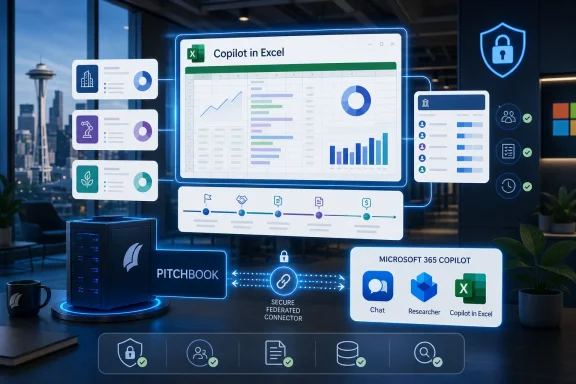 PitchBook Is Moving the Terminal Into the Spreadsheet
For years, the private markets workflow has had a familiar rhythm: log into a specialized data platform, search for companies or funds, export a table, clean it up in Excel, write a memo in Word, and package the result in PowerPoint. That workflow was inefficient, but it preserved a clear boundary between the source system and the productivity layer. PitchBook’s new connector deliberately blurs that boundary.The company says licensed users of both PitchBook and Microsoft 365 Copilot can interact with PitchBook intelligence directly from Microsoft’s apps using natural language. In practical terms, that means a corporate development analyst could ask for acquisition targets, a venture investor could screen comparable companies, or a banker could begin shaping a diligence workbook without first navigating the PitchBook interface as a separate stop.
That is the real significance of Copilot in Excel. Excel is not merely another surface for Microsoft’s AI assistant; it is where financial professionals reconcile narrative with numbers. If PitchBook data can be queried, shaped, and traced from inside a workbook, the spreadsheet becomes less of a static container and more of a live analytical front end.
The pitch is seductive because it attacks the most stubborn problem in white-collar AI adoption: context. General-purpose models can write polished prose and generate plausible formulas, but deal work depends on specialized, licensed, frequently updated datasets. PitchBook is arguing that the safest path to useful AI is not asking a model to know everything, but giving it controlled access to a dataset that professionals already pay to trust.
Microsoft’s Copilot Strategy Depends on Other People’s Data
Microsoft has spent the last several years selling Copilot as the AI layer for work, but the value of that layer depends heavily on what it can see. Email, meetings, documents, and Teams chats are useful, yet they are rarely enough for specialized decisions. A merger model, a fund screen, or a market map needs external data that lives beyond the Microsoft Graph.That is why connectors matter. Microsoft 365 Copilot connectors are designed to bring third-party content into the Copilot experience so that answers can be grounded in enterprise-approved sources rather than improvised from a model’s training data. The newer federated connector model is especially important because it can retrieve data at query time, reducing the need to copy entire repositories into Microsoft’s index before users can ask questions.
For Microsoft, PitchBook is the kind of partner that makes Copilot look less like a chat box and more like infrastructure. Private capital data is expensive, time-sensitive, and professionally consequential. If Copilot can become the interface through which people ask questions of that data, Microsoft strengthens its claim that AI belongs inside the productivity suite rather than in a growing sprawl of standalone assistants.
That does not mean Microsoft owns the value. In fact, the partnership reveals a dependency: Copilot becomes more useful when trusted data providers participate. The assistant is the interface, but the credibility comes from the source.
The Excel Integration Is the Sharp End of the Announcement
The press release mentions Microsoft 365 Copilot, Copilot Chat, Researcher, and the PitchBook Copilot agent, but Excel is the surface that matters most. Finance teams do not simply consume answers; they build artifacts. They need target lists, comparable-company tables, fund performance views, deal histories, assumptions, and defensible outputs that can survive review.PitchBook says the integration can help users build target lists, run diligence workflows, and screen investments using company profiles, deal histories, fund data, and analyst research. That is a much more concrete promise than “AI insights” in the abstract. It places the connector directly in the daily grind of analysts and associates who live in rows, columns, filters, and footnotes.
The obvious benefit is speed. A user who can ask Copilot in Excel to pull a set of private companies by sector, geography, funding history, or investor profile may save the repetitive work of searching, exporting, and formatting. The less obvious benefit is consistency. If the same governed connector is used across chat, research, Excel, and presentation workflows, organizations may reduce the ad hoc copy-paste chains that often introduce stale or misattributed data.
But this is also where the risk concentrates. Excel has a long history of turning small mistakes into expensive decisions because spreadsheets feel authoritative even when their logic is fragile. Adding AI to the workbook raises the stakes: a generated table must be not only formatted correctly, but sourced correctly, permissioned correctly, and interpreted correctly.
“Trusted Data” Is Doing a Lot of Work
PitchBook leans hard on the language of trusted, human-verified private market intelligence, and for good reason. In financial services, AI’s biggest weakness is not prose quality; it is confidence without accountability. A beautifully written but unsupported answer is not an insight. It is a liability.The company’s framing is therefore data-first rather than model-first. PitchBook is not claiming that a chatbot has suddenly learned private markets. It is claiming that its own curated dataset can make AI tools useful because the model has something reliable to retrieve, summarize, and structure.
That distinction matters. Much of the first wave of enterprise AI hype treated the model as the product. The second wave is increasingly about grounding: connecting models to systems of record, enforcing permissions, and producing answers that can be traced back to authorized sources. PitchBook’s connector belongs squarely in that second wave.
Still, “trusted” should not be read as “infallible.” Private market data is messy by nature. Deal terms may be undisclosed, valuations may be estimated, company status may lag reality, and analyst research still requires interpretation. The integration may reduce friction, but it does not remove the need for professional judgment.
Security Is the Sales Pitch and the Gatekeeper
PitchBook says the integrations are built with a commitment to data privacy, with client data remaining siloed and under user control. The company also says its AI technologies do not learn from or retain proprietary client data. That language is aimed at exactly the audience most likely to slow down adoption: compliance teams, legal departments, and information security leaders.The importance of those assurances is hard to overstate. Private equity, venture capital, investment banking, corporate development, and legal advisory work all involve sensitive information. A target screen may be confidential. A diligence memo may reveal strategy. A workbook may contain assumptions that should never become training data or leak into another user’s response.
The federated approach is attractive because it suggests a more controlled pattern of access. Rather than dumping everything into a general model context or encouraging users to upload spreadsheets into consumer-grade AI tools, the connector can work within enterprise authentication and governance boundaries. That is the theory, and it is the theory Microsoft has been pushing across the Copilot ecosystem.
The implementation details will determine whether that theory survives contact with enterprise IT. Administrators will want to know how permissions are evaluated, how prompts and responses are logged, what data leaves the tenant, how retention works, and whether connector activity can be audited with the same rigor as other Microsoft 365 activity. The buyers who most need PitchBook data are also the buyers least willing to accept vague AI assurances.
The Deal Workflow Is Being Reassembled Around Agents
PitchBook’s announcement sits inside a broader shift in how financial software vendors are positioning themselves. The old model was database plus dashboard. The new model is database plus agent, with the dashboard increasingly treated as only one interface among many.PitchBook has already been building AI experiences inside its own platform, including PitchBook Navigator and proprietary tools such as its VC Exit Predictor. The Microsoft integration extends that strategy outward. Instead of forcing every AI interaction to happen inside PitchBook’s own product, the company is meeting users in Microsoft 365, where much of the final work product is created.
That is a pragmatic move. Analysts do not get promoted for having a beautifully organized software workflow; they get judged by the quality and speed of the memo, model, deck, or investment committee packet. If AI can compress the distance between data discovery and deliverable creation, it becomes much harder for firms to resist.
It also changes the competitive battlefield. Financial data providers are no longer competing only on coverage, freshness, and interface design. They are competing on how cleanly their data can be used by AI systems, how well their permissions translate into agentic workflows, and how confidently users can trace an answer back to source material.
Copilot Gains Prestige, but PitchBook Keeps the Scarcity
The partnership benefits Microsoft, but it does not make Microsoft the source of truth for private markets. That distinction is important. Copilot is the conversation layer; PitchBook remains the scarce asset.This is why the licensing requirement matters. The connector is for licensed users of both Microsoft 365 Copilot and PitchBook. It is not a free private markets oracle added to Office. It is a premium bridge between two paid ecosystems, aimed at firms that already see both productivity software and financial data as operating costs.
That dual-license model reinforces the direction of enterprise AI economics. The base AI assistant may become broadly available, but the valuable versions are increasingly defined by the data and tools attached to them. A generic Copilot prompt can draft a market overview. A Copilot prompt grounded in PitchBook can potentially assemble a target universe, compare deal histories, and cite the underlying records a professional actually trusts.
For PitchBook, that is defensive as much as expansionary. If users begin to expect all research to start in a chat interface, specialized platforms risk being hidden behind the assistant. By creating its own Copilot agent and controlled connector, PitchBook ensures its brand and data provenance remain visible inside the new workflow.
The Human Analyst Is Not Removed; the Low-Value Loop Is Attacked
The most credible reading of this announcement is not that AI will replace the analyst. It is that AI will attack the loop of finding, exporting, reformatting, summarizing, and repackaging data. That loop consumes enormous time while adding relatively little professional judgment.A good analyst still has to decide which filters matter, whether a comparable company is actually comparable, whether a funding history signals momentum or desperation, and whether a market map reflects strategic reality. The connector does not answer those questions by itself. It changes how quickly the analyst can get to them.
That distinction will matter inside firms. If management treats the integration as a headcount-reduction machine, it will encourage shallow automation and overconfidence. If teams treat it as a way to reduce mechanical work and improve review cycles, it could make analysis both faster and more transparent.
The best version of this workflow is not a black box that spits out an investment thesis. It is a workbook or memo where the analyst can see the data trail, challenge the assumptions, and revise the output. In finance, AI earns trust less by sounding smart than by making its work inspectable.
Enterprise IT Will Care Less About the Demo Than the Controls
The demo version of this integration is easy to imagine. A user opens Excel, asks Copilot for a list of late-stage cybersecurity companies in North America with recent funding activity, and receives a structured table backed by PitchBook data. A few prompts later, the user has a draft diligence outline and a PowerPoint-ready summary.The enterprise rollout version is less glamorous. It involves license assignment, connector enablement, identity mapping, user training, audit requirements, and policy decisions about who is allowed to query what. It also requires deciding whether AI-generated outputs can be used in client materials without additional review.
For WindowsForum’s IT pro audience, this is the practical heart of the story. Microsoft’s AI ecosystem is becoming a control plane for third-party business data. That makes the Microsoft 365 admin center, identity policies, data-loss prevention posture, and audit logs more central to workflows that used to be governed inside specialized SaaS platforms.
The risk is not simply that Copilot gives a wrong answer. The risk is that a correct answer appears in the wrong place, reaches the wrong user, or is reused without its original context. As connectors proliferate, administrators will need to think of Copilot less as an application feature and more as a cross-system access layer.
The AI Spreadsheet Is Becoming a Regulated Workspace
Excel has always been the unofficial database of business, which is both its genius and its curse. It lets experts move faster than formal systems, but it also creates governance headaches. AI inside Excel magnifies both tendencies.With a PitchBook connector, the workbook may become a place where licensed external data, internal assumptions, generated analysis, and presentation-ready text converge. That is powerful, but it complicates records management. A model built from live market intelligence may need a clearer audit trail than a traditional spreadsheet assembled by hand.
Financial firms, law firms, and corporate development teams will also have to decide how to label AI-assisted work. If a memo summarizes PitchBook analyst research through Copilot, reviewers need to know whether the summary is faithful, whether omissions matter, and whether the underlying data is current. The word “traceable” in PitchBook’s announcement is therefore not a marketing flourish; it is a requirement for professional use.
This is where Microsoft’s platform advantage and burden meet. By bringing more work into Microsoft 365, the company can offer familiar governance controls. But it also inherits user expectations that those controls will work consistently across native files, third-party data, agents, and generated outputs.
The Real Competition Is for the First Prompt
The deeper strategic fight is not over whether PitchBook has better data than another provider or whether Copilot has the best language model. It is over where the user begins. The first prompt is becoming the new homepage.If an analyst starts in PitchBook, Microsoft is a downstream productivity layer. If the analyst starts in Copilot, PitchBook becomes one of several data sources available through the assistant. Both companies can win from the partnership, but the balance of power depends on habit formation.
Microsoft wants Copilot to become the universal entry point for work. PitchBook wants to ensure that, when the question involves private markets, its data is the trusted answer. The connector is the compromise: Copilot gets the workflow, PitchBook gets the authority.
That compromise may become common across enterprise software. Specialized vendors will not disappear, but their interfaces may become less central for routine queries. The winners will be the vendors whose data, permissions, and metadata are clean enough to survive being used by agents outside their own walls.
The Press Release Promises Speed; The Market Will Test Discipline
PitchBook and Microsoft both frame the integration around speed, clarity, and confidence. Those are the right words for buyers, but they describe outcomes rather than guarantees. The market will judge the product on whether it reduces busywork without introducing new review burdens.If every generated table must be manually reconstructed to verify it, the productivity gain shrinks. If the connector can reliably produce structured, traceable outputs that analysts can inspect and refine, it becomes much more than a convenience feature. It becomes a new operating pattern for private market research.
The most likely near-term outcome is uneven but meaningful adoption. Power users in finance and corporate development will experiment quickly because they already understand both the value and limitations of PitchBook data. More conservative organizations will wait for governance proof, admin guidance, and internal playbooks.
That is not a failure of the technology. It is how serious enterprise tools enter serious workflows. The more consequential the decision, the more important it is that the AI system be boringly reliable rather than theatrically impressive.
The Spreadsheet Just Became the Front Door to Private Markets
PitchBook’s Microsoft 365 Copilot integration is best understood as a workflow land grab, not a chatbot feature. It puts premium private market intelligence closer to the documents, models, and presentations where investment work becomes institutional memory.- PitchBook’s new federated connector brings its private capital market data into Microsoft 365 Copilot experiences for users licensed for both platforms.
- Copilot in Excel is the most consequential surface because it connects AI-assisted research directly to the financial modeling environment professionals already use.
- The integration’s value depends on grounding, traceability, and permission controls rather than on generic language-model fluency.
- Microsoft benefits by making Copilot more useful for specialized professional workflows, while PitchBook preserves the scarcity and provenance of its data.
- Enterprise IT teams should evaluate the connector as a cross-system access layer, not merely as an Office add-in.
- The productivity upside is real, but high-stakes financial analysis will still require human review, source checking, and disciplined governance.
References
- Primary source: The National Law Review
Published: Thu, 25 Jun 2026 14:40:06 GMT
PitchBook Expands Premium AI Integrations with Microsoft 365 Copilot and Copilot in Excel
New integrations bring trusted private market intelligence directly into Microsoft 365 and Excel workflowsnatlawreview.com
- Official source: developer.microsoft.com
Microsoft 365 Copilot Connectors | Connect external data sources
Connect content from external data services into Microsoft Graph to power experiences such as Microsoft 365 Copilot, Copilot Search, and Microsoft Search.developer.microsoft.com - Official source: support.microsoft.com
Understand Copilot connectors | Microsoft Support
Understand Copilot connectorssupport.microsoft.com - Official source: learn.microsoft.com
Microsoft 365 Copilot connectors documentation - Microsoft 365 Copilot connectors | Microsoft Learn
Connect to data beyond Microsoft 365 to enhance Microsoft 365 Copilot, Copilot Search, and Microsoft Search experiences.learn.microsoft.com - Official source: techcommunity.microsoft.com
Federated Copilot connectors - bringing real-time enterprise data within Microsoft 365 Copilot | Microsoft Community Hub
Announcing federated Copilot connectors. Bring real-time data within Copilot via connectors from partners like Moody's, HubSpot, LSEG (London Stock Exchange... techcommunity.microsoft.com
- Related coverage: marketscreener.com
- Related coverage: prnewswire.com
Daloopa expands financial data access with new MCP connector for Microsoft 365 Copilot integration, bringing trusted financial data directly into AI workflows
/PRNewswire/ -- Daloopa, the essential data infrastructure for AI and agentic workflows in financial services, today announced a new Model Context Protocol... www.prnewswire.com
- Official source: news.microsoft.com
- Related coverage: globenewswire.com
Reflexivity Brings Real-Time Portfolio Intelligence to
Reflexivity’s institutional-grade investment intelligence is now accessible directly within Microsoft 365 Copilot via https://reflexivity.com/copilot. ...www.globenewswire.com - Related coverage: windowscentral.com
New Copilot keyboard shortcuts are coming to Microsoft 365 | Windows Central
A new floating icon and Alt + C shortcut are replacing old entry points in Microsoft 365 apps.www.windowscentral.com - Related coverage: techradar.com
Microsoft makes Copilot Cowork open to everyone, and wants to help you tackle even the trickiest work tasks | TechRadar
Copilot Cowork gets an upgrade as it opens to all userswww.techradar.com - Related coverage: pcgamer.com
Microsoft launches Copilot AI function in Excel, but warns not to use it in 'any task requiring accuracy or reproducibility' | PC Gamer
You can have Copilot generate your formulas in Excel now, but it doesn't sound ready for prime time.www.pcgamer.com - Official source: cdn-dynmedia-1.microsoft.com
- Official source: microsoft.com
</rdf:Alt> </dc:title> <dc:description> <rdf:Alt> <rdf:li xml:lang="x-default"/> </rdf:Alt> </dc:description> <dc:creator> <rdf:Seq> <rdf:li>Lukas V
</rdf:Alt> </dc:description> <dc:creator> <rdf:Seq> <rdf:li>Lukas Velushwww.microsoft.com
- Related coverage: m365maps.com
- Related coverage: press.spglobal.com
S&P Global Launches AI-Ready Commodities Data Integrated With Microsoft 365 Copilot - Apr 21, 2025
PDF documentpress.spglobal.com
- Official source: download.microsoft.com
- Related coverage: m-files.com