

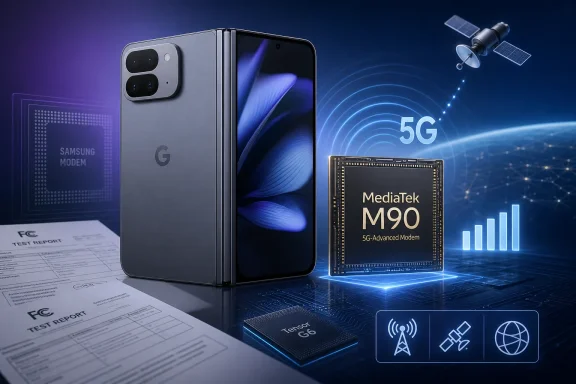
Google’s Pixel 11 lineup is reportedly set to drop another major Samsung component: the cellular modem. Android Authority found a reference to MediaTek’s TA-SAR v2 algorithm in FCC radio-exposure testing paperwork for what appears to be the Pixel 11 Pro Fold, reinforcing earlier reports that Google’s Tensor G6 chip will use a MediaTek M90 modem rather than a Samsung Exynos part.
The finding is not a full specification sheet, and Google has not confirmed the modem or the Pixel 11 hardware publicly. Still, it is meaningful evidence because SAR testing directly involves the phone’s radio hardware. Android Authority’s read is straightforward: Samsung would not be expected to use MediaTek’s RF algorithms in an Exynos modem.
Every Tensor generation through the Pixel 10’s Tensor G5 used Samsung modem technology. Google had already ended Samsung Foundry’s role in manufacturing its flagship Tensor chips with the Pixel 10 series in 2025, moving the G5 to TSMC’s 3nm process. Google said at the time that TSMC’s process enabled more transistors and better power efficiency.
The reported Pixel 11 change would therefore separate two of Tensor’s most visible foundations from Samsung: chip fabrication and cellular connectivity.
Leaks have consistently tied Tensor G6 to TSMC’s 2nm process and the MediaTek M90. Neither point is confirmed, but the FCC filing makes the modem claim more credible than a typical pre-release specification leak. Samsung may remain a supplier of displays, memory, storage, or camera components, but it would no longer be central to the Tensor platform’s manufacturing and modem design.
MediaTek says the M90 supports peak downlink speeds up to 12Gbps, 5G dual-SIM dual-active operation, and integrated satellite connectivity. Those are platform capabilities, not a guarantee that every Pixel 11 model, carrier, or regional variant will expose them. Real-world performance will depend on Google’s implementation, carrier bands, firmware, and local network conditions.
The Pixel 11 launch is expected on August 12, according to Google event materials reported by Android Authority. That leaves little time before the company will need to explain whether Tensor G6’s move to a MediaTek modem brings practical improvements in battery life and cellular reliability.
For Windows users and IT buyers, there is nothing to deploy or change now; wait for retail hardware and independent radio testing before treating the modem change as an upgrade.
The finding is not a full specification sheet, and Google has not confirmed the modem or the Pixel 11 hardware publicly. Still, it is meaningful evidence because SAR testing directly involves the phone’s radio hardware. Android Authority’s read is straightforward: Samsung would not be expected to use MediaTek’s RF algorithms in an Exynos modem.
 A further break from the original Tensor supply chain
Every Tensor generation through the Pixel 10’s Tensor G5 used Samsung modem technology. Google had already ended Samsung Foundry’s role in manufacturing its flagship Tensor chips with the Pixel 10 series in 2025, moving the G5 to TSMC’s 3nm process. Google said at the time that TSMC’s process enabled more transistors and better power efficiency.The reported Pixel 11 change would therefore separate two of Tensor’s most visible foundations from Samsung: chip fabrication and cellular connectivity.
Leaks have consistently tied Tensor G6 to TSMC’s 2nm process and the MediaTek M90. Neither point is confirmed, but the FCC filing makes the modem claim more credible than a typical pre-release specification leak. Samsung may remain a supplier of displays, memory, storage, or camera components, but it would no longer be central to the Tensor platform’s manufacturing and modem design.
Why the modem matters
For users, a modem swap could matter more than benchmark scores. Cellular power draw, weak-signal behavior, call reliability, handoff performance, and heat are all influenced heavily by the modem and its integration with the rest of the chip.MediaTek says the M90 supports peak downlink speeds up to 12Gbps, 5G dual-SIM dual-active operation, and integrated satellite connectivity. Those are platform capabilities, not a guarantee that every Pixel 11 model, carrier, or regional variant will expose them. Real-world performance will depend on Google’s implementation, carrier bands, firmware, and local network conditions.
The Pixel 11 launch is expected on August 12, according to Google event materials reported by Android Authority. That leaves little time before the company will need to explain whether Tensor G6’s move to a MediaTek modem brings practical improvements in battery life and cellular reliability.
For Windows users and IT buyers, there is nothing to deploy or change now; wait for retail hardware and independent radio testing before treating the modem change as an upgrade.
References
- Primary source: SamMobile
Published: 2026-07-16T07:31:16+00:00
Google moves even further away from Samsung for Pixel 11's hardware needs - SamMobile
Google has reportedly stopped using Samsung's Exynos 5G modems in its phones, starting with the Pixel 11 series. www.sammobile.com
- Related coverage: androidauthority.com
I've used Pixel phones for years. Why the upcoming Pixel 11 has me seriously worried
The Pixel 11 series looks set to double down on Google's software-first strategy, but weaker hardware upgrades could leave us wanting more.www.androidauthority.com - Related coverage: androidcentral.com
Pixel 11 Pro Fold FCC filing hints at Google's biggest modem upgrade yet | Android Central
The filing suggests Google is done with Samsung modems.www.androidcentral.com - Related coverage: blog.google
Pixel 10 introduces new chip, Tensor G5
Learn more about Tensor G5, the latest Silicon for Pixel 10 phones.blog.google - Related coverage: android.com
Discover the new Google Pixel 10 phones, Pixel Watch 4 and Pixel Buds Pro 2 | Android
Explore new AI features, the Pixel Watch 4 and Pixel Buds Pro 2www.android.com - Official source: store.google.com
