
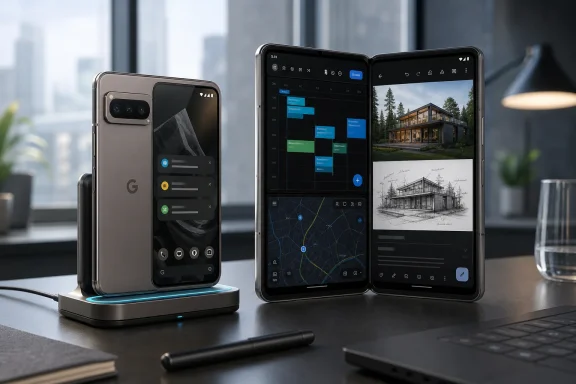
 Google’s Foldable Ambition Is Starting to Look Less Experimental
The original Pixel Fold felt like Google testing whether it could bring the Pixel idea into a tablet-shaped phone without losing the things that made Pixels appealing. The later Pro Fold generations pushed the device closer to the mainstream foldable template: large inner screen, useful cover display, premium camera bar, and a price that assumed buyers were already convinced.
The Pixel 11 Pro Fold leaks suggest Google is now past the proof-of-concept phase. The rumored specs point to a product that is being tuned rather than rescued. That matters, because foldables have spent years being sold as the future while behaving like expensive compromises in the present.
Google’s challenge is not simply to match Samsung, Honor, OnePlus, or Vivo on hinge engineering and display brightness. It has to convince users that a folding Pixel is not just a Pixel phone with a tablet mode attached. It has to feel like the natural home for Android’s multitasking, AI features, camera processing, and long-term software support.
That is why the rumored Pixel 11 Pro Fold is interesting even if the hardware changes sound incremental. A brighter display, a more efficient Tensor G6, slimmer bezels, and improved sensors would not transform the category by themselves. But they would suggest Google is addressing the exact places where foldables still feel fragile, heavy, or awkwardly first-generation.
The Launch Window Tells Us Google Wants the Fold in the Main Pixel Story
The rumored August or September 2026 launch timing matters because it keeps the foldable inside the main Pixel hardware narrative. Google has spent the past few years turning late summer into its phone season, using the Made by Google event to frame Pixel as a coherent family rather than a collection of one-off experiments.
That family positioning is important for the Fold. A foldable that launches separately can look like a niche device for enthusiasts. A foldable that appears beside the Pixel 11, Pixel 11 Pro, and Pixel 11 Pro XL looks like the top branch of the same tree.
The risk is that this also forces uncomfortable comparisons. If the Pixel 11 Pro Fold costs dramatically more than the slab Pro models while sharing similar software, similar chip branding, and some camera limitations imposed by its thinner body, Google will have to make the form factor itself feel worth the premium. Foldables do not get to hide behind novelty anymore.
India pricing rumors between ₹1,59,999 and ₹1,81,999 put the phone squarely in luxury territory. That is not just “flagship pricing” in the casual sense; it is laptop money, workstation monitor money, or a full device refresh budget for many buyers. In markets where Android dominates but premium foldables remain aspirational, Google’s pricing will be part of the product story, not a footnote.
The Pixel 10 Pro Fold’s roughly ₹1,72,999 India price gives the rumored range a plausible anchor. If Google stays near that number, it is effectively saying the Pro Fold is not an experiment subsidized for adoption. It is a premium product that must stand on its own.
Tensor G6 Is the Spec That Carries the Most Pressure
The rumored Tensor G6 upgrade is the most important leak because every recent Pixel conversation eventually becomes a Tensor conversation. Google’s chips have never been sold as benchmark monsters. They are pitched as ambient computing silicon: tuned for photography, speech, translation, security, and on-device AI rather than raw gaming performance.
That argument is more defensible on a regular phone than on a foldable. A foldable invites heavier use. Buyers open the inner display for multitasking, split-screen apps, browsing, document review, remote desktop sessions, photo editing, and the sort of work that quickly exposes heat, modem efficiency, and sustained performance limits.
If Tensor G6 is built on a more efficient process node and uses revised ARM cores as leaks suggest, the practical question is not whether it tops synthetic charts. The question is whether it lets the Pixel 11 Pro Fold behave like a large-screen productivity device without throttling, draining too quickly, or warming up during ordinary multitasking.
That is especially relevant for WindowsForum readers who live across ecosystems. A foldable Android phone is no longer just a personal device. For many admins, consultants, and power users, it becomes a pocket terminal for Microsoft 365, Teams, Remote Desktop, Azure dashboards, password vaults, SSH clients, authenticator apps, ticket queues, and browser-based management consoles.
A better Tensor chip would matter if it makes those workflows feel boringly reliable. Nobody wants a $1,700-class foldable that is brilliant at computational photography but merely adequate when juggling a Teams call, a spreadsheet, a browser, and a remote session. Google’s silicon story must mature from “clever Pixel features” into “dependable high-end platform.”
The Display Rumors Point to the Real Foldable Battleground
The leaked display numbers are eye-catching: an inner foldable panel around 8 inches, a cover OLED around 6.4 inches, refresh rates up to 120Hz or possibly 144Hz, and peak brightness reportedly in the 3,000-nit range. Even allowing for marketing-friendly brightness figures that apply only in specific conditions, the direction is clear. Foldables are no longer competing only on whether they open; they are competing on whether both screens feel like proper flagship screens.
The cover display is particularly important. Early foldables often treated the outer screen as a convenience panel, useful for quick tasks but not something you would want to live on. That made the entire device feel conditional: great when open, compromised when closed.
A 6.4-inch outer OLED would keep the Pixel Fold line closer to a normal phone experience. That is essential because foldable users do not unfold their devices every time they reply to a message, approve a sign-in, scan a boarding pass, or check a notification. The outer display has to be good enough that the phone is not constantly asking for ceremony.
The inner 8-inch screen, meanwhile, is where Google needs Android to earn its keep. Large Android displays have improved, but the ecosystem still varies wildly. Google’s own apps generally scale well, Microsoft’s productivity apps are far better than they once were, and browsers are increasingly capable, but many apps still treat big screens as stretched phone canvases.
This is where Google has a structural advantage and a structural burden. It controls Android, Pixel software, and a growing layer of AI-assisted interaction. If any Android vendor can nudge developers, polish multitasking, and make a folding phone feel less like a hacked-together tablet, it should be Google. If Google cannot do it, the broader Android foldable argument becomes harder to sustain.
Qi2 Could Be the Small Feature That Changes Daily Use
Wireless charging rarely gets the spotlight in foldable coverage, but the rumored Qi2 support deserves attention. A magnetic charging standard sounds mundane until you have used a large, expensive phone that must be placed just so on a charger at night. Foldables make alignment fussier because their camera bumps, weight distribution, and unfolded geometry can interfere with accessories.
Qi2 support would bring the Pixel foldable closer to the accessory ecosystem iPhone users have enjoyed through MagSafe-style charging. That is not just about chargers. It is about stands, car mounts, desk docks, power banks, and the small rituals that make a device easier to live with.
For a foldable, those accessories matter more than usual. A Pixel 11 Pro Fold on a magnetic stand could become a bedside screen, a travel media display, a video-call device, or a lightweight dashboard for work alerts. The hardware form factor gains value when it can sit securely in more places.
Google’s Pixelsnap branding on the previous generation already signaled that Google understands the appeal. If the Pixel 11 Pro Fold keeps or improves that approach, it would be one of those changes that looks minor on a spec sheet but affects daily satisfaction. Premium phones are often judged by their annoyances, not their peak capabilities.
The Camera System Looks Like a Pixel Compromise, Not a Pixel Surrender
The rumored rear camera setup — a 48MP main sensor, a 10.8MP telephoto with 5x optical zoom, and a 10.5MP ultrawide — sounds familiar in the way foldable cameras often do. The numbers suggest Google may again be balancing optical ambition against the brutal geometry of a folding chassis.
Foldables do not have the same internal freedom as slab phones. Hinges, dual batteries, thin halves, display layers, and durability structures all compete for space. That is why even expensive foldables can lag behind conventional flagships in camera hardware, especially on sensor size and periscope complexity.
Google’s advantage has always been computational photography. A Pixel can often produce better images than its hardware would suggest because Google has spent years refining HDR, Night Sight, portrait processing, skin tones, zoom fusion, and motion handling. That software advantage is real, but it is not magic.
The Pixel 11 Pro Fold therefore has to walk a narrow line. If its camera hardware is merely respectable, Google’s processing can make it feel excellent for most users. But if the gap between the Fold and the slab Pixel 11 Pro models becomes too visible, the buyer is again forced to accept that the most expensive Pixel may not be the best camera Pixel.
The rumored 10MP selfie cameras on both inner and outer displays also fit the category pattern. They are likely good enough for video calls, face unlock workflows if supported, and casual images, but not the headline. On a foldable, the more interesting camera trick is using the rear cameras with the cover screen as a viewfinder. Google should lean into that because it turns the form factor into a photographic advantage rather than an engineering tax.
Familiar Design Is Either Confidence or Caution
Leaked renders reportedly show a device that looks broadly similar to last year’s foldable, with slimmer bezels and refinements rather than a total redesign. That will disappoint anyone hoping for a dramatic new silhouette. It may also be exactly the right move.
Foldables are still mechanically risky compared with slab phones. Hinges, creases, flexible glass layers, dust resistance, water resistance, and drop durability all remain under scrutiny. A company that changes too much too quickly can create new failure points just as it solves old ones.
A familiar design can signal that Google is iterating around a platform it trusts. If the hinge improves, bezels shrink, weight distribution gets better, and the device becomes slightly thinner without sacrificing durability, that is meaningful progress. The foldable market has matured enough that refinement is not automatically boring.
But caution has a cost. Samsung has spent years teaching buyers what a book-style foldable looks like. Chinese OEMs have pushed thinness and charging speed aggressively. Apple is widely expected to enter the foldable conversation sooner or later, and if it does, the category’s design language may reset overnight.
Google cannot afford to look timid. If the Pixel 11 Pro Fold resembles its predecessor too closely, the company will need to prove that the real changes are in usability, battery life, thermal behavior, software polish, and camera consistency. Otherwise, the device risks being perceived as a spec refresh attached to an even larger invoice.
The Battery Figure Sounds Sensible, but Charging Still Looks Conservative
A rumored battery capacity around 5,015 to 5,050mAh would be sensible for a large foldable. It is not a shocking figure, but it is in the zone where efficiency becomes more important than raw capacity. With two bright displays and a power-hungry multitasking use case, the Pixel 11 Pro Fold cannot rely on battery size alone.
The more controversial number is 30W wired charging. In the broader Android world, that is conservative. Some competitors have trained users to expect dramatically faster top-ups, especially outside the United States. Google has historically been cautious on charging speed, prioritizing battery health, thermals, and standards over headline wattage.
That philosophy is defensible, but only if the phone lasts long enough that users rarely care. A foldable that costs this much should not force people into battery management habits by late afternoon. If Tensor G6 efficiency is real, 30W charging may be acceptable. If efficiency disappoints, it will become one of the easiest specs for critics to attack.
Wireless charging at 15W or more through Qi2 would soften the issue. Many premium-phone users do not need the fastest cable charging if the device comfortably charges on desks, nightstands, and car mounts throughout the day. But that assumes the wireless ecosystem works cleanly and does not require proprietary compromises.
Google should be careful here. The foldable buyer may be an enthusiast, but that does not mean they tolerate friction. In fact, they often notice it first.
The India Price Leak Reveals the Foldable’s Real Audience
The rumored India price range is a reminder that foldables remain elite devices, not mass-market flagships. Even at the low end of the leak, the Pixel 11 Pro Fold would be priced far beyond what most buyers consider reasonable for a phone. At the high end, it becomes a status device, a productivity device, and a luxury gadget all at once.
That creates a marketing problem. Google’s Pixel brand has often leaned on intelligence, camera quality, and helpfulness rather than pure extravagance. A foldable at nearly ₹1.8 lakh has to communicate something more forceful: this is the best Pixel experience, not just the most expensive one.
India is also a tough market for Pixel. Google has made progress, but it is competing against brands with stronger retail presence, aggressive bank offers, faster charging, and broader service networks. For a foldable, after-sales confidence matters enormously. A cracked display, hinge problem, or repair delay is far more intimidating on a device this costly.
The price also narrows the audience. Early adopters, Pixel loyalists, executives, creators, and high-income professionals may consider it. Mainstream Android buyers will likely wait for discounts, exchange offers, or proof that the hardware holds up after months of real use.
That is not necessarily a failure. Foldables are still halo products. They exist partly to show what a company can do. But halo products only work if the glow reaches the rest of the lineup.
The Software Story Must Be Bigger Than AI Wallpaper
Pixel launches increasingly revolve around AI, and the Pixel 11 Pro Fold will almost certainly follow that pattern. The danger is that Google treats AI as a layer of demos rather than a reason the foldable should exist. A folding screen does not become essential because it can generate text, summarize a page, or edit a photo. It becomes essential when the software understands the shape of the device.
The best foldable software features are contextual. A video call should naturally use the hinge angle. A translation session should make sense across two displays. A document review should let the user compare, annotate, and message without juggling windows like a circus act. A camera preview should exploit the outer screen without burying the feature in menus.
This is where Google’s AI ambitions could become genuinely useful. Imagine call summaries that sit beside notes during a Teams meeting, Gemini assistance that reads a document on one half of the screen while drafting a response on the other, or photo editing tools that use the larger display without feeling like a web app squeezed into Android chrome.
But Google also has to earn trust. AI features that require cloud processing, change names every year, or arrive with regional restrictions can make expensive hardware feel dependent on shifting service policies. For enterprise and security-minded users, on-device capability, admin controls, data handling, and long-term support matter as much as demo-stage cleverness.
A foldable Pixel should be Google’s best argument that Android can be a serious productivity platform in your pocket. If the software pitch is only “more AI,” it will undersell the hardware.
The Competition Will Not Wait for Google to Perfect the Pixel
The Pixel 11 Pro Fold will not arrive into a quiet market. Samsung’s Galaxy Z Fold line remains the default Android foldable in many regions. Chinese competitors continue to push thinner bodies, larger batteries, faster charging, and impressive camera hardware. Apple’s rumored foldable ambitions hover over the category even before a product is official.
That makes Google’s position unusual. It is not the foldable volume leader. It is not the hardware-spec maximalist. It is not the company with the deepest premium retail network in every market. Its strongest argument is integration: Android, Pixel software, Google services, computational photography, and long support in one device.
That can be enough, but only if the device feels cohesive. A foldable is unforgiving because every weakness is multiplied by price. A merely average modem is more annoying when the phone costs this much. A mediocre app layout is more obvious on an 8-inch screen. A warm chassis is harder to ignore when you are holding it open like a small tablet.
The Windows comparison is useful here. Premium 2-in-1 PCs did not win because they had hinges. They won when the hinge, display, pen, keyboard, battery, and software made sense together. Foldables face the same test in phone form.
Google’s task is not to produce the most extreme foldable. It is to produce the most Pixel foldable. That means the phone has to feel intelligent, reliable, camera-first, secure, and quietly useful. The leaks suggest Google understands the assignment, but they do not yet prove it has completed it.
The Leaks Point to an Upgrade Built for Believers
The Pixel 11 Pro Fold leaks are exciting because they show momentum, not because they promise revolution. A better chip, brighter screens, Qi2 support, camera refinements, and design polish would all make Google’s foldable more credible. None of those changes alone would make it an easy purchase.
That is the tension at the heart of this device. Foldables are now mature enough that buyers expect polish, but still expensive enough that they demand wonder. Google appears to be building a phone for people who already believe the foldable future is coming and want the Pixel version of it.
For Pixel loyalists, that may be enough. They will care about Tensor G6 efficiency, Pixel camera tuning, Google’s software features, and the practical joy of opening a phone into a small tablet. For skeptics, the same leaks will sound like a cautious refresh at a luxury price.
The official launch will have to settle several questions that leaks cannot. Weight, hinge feel, crease visibility, repair terms, thermal behavior, modem performance, battery endurance, and real camera output will matter more than any single rumored number. These are the things that decide whether a foldable becomes someone’s daily driver or an expensive weekend toy.
The Spec Sheet Is Only Half the Bet This Time
The most concrete picture from the leaks is not of a radical new device, but of Google trying to make the Fold less exotic and more dependable. That is a sensible strategy for 2026, because the category’s biggest obstacle is no longer awareness. It is confidence.
- The Pixel 11 Pro Fold is expected to launch with the broader Pixel 11 family in August or September 2026.
- The rumored India price range places it firmly in the ultra-premium tier, close to the Pixel 10 Pro Fold’s launch pricing.
- The leaked display setup suggests Google is prioritizing both a usable phone-like cover screen and a large 8-inch inner workspace.
- Tensor G6 is likely to define the device’s reputation more than any camera or display number, because foldables expose sustained-performance and efficiency weaknesses quickly.
- Qi2 support could make the Fold easier to live with day to day, especially for desk, car, and travel charging setups.
- The biggest unknowns remain durability, thermals, real battery life, repair experience, and whether Google’s software makes the folding screen feel necessary rather than merely impressive.
If Google gets the Pixel 11 Pro Fold right, it will not be because it wins every spec comparison. It will be because the company finally makes the foldable Pixel feel inevitable: a premium Android device whose larger screen, camera system, AI features, and daily ergonomics work together well enough that the hinge stops being the headline. The leaks suggest Google is moving in that direction, but at this price, “promising” will not be enough; the next Fold has to make the case that the future of the Pixel is not just smarter, but larger, sturdier, and worth unfolding.
