

Deepdesk’s new “travel‑friendly” AI layer promises to break a key barrier in scalable CX automation: giving an AI assistant the ability to move across disparate customer‑experience systems, retrieve live context, and return agent‑ready insights without forcing enterprises to rip and replace their existing stacks. This announcement — framed around a platform‑agnostic AI architecture and strengthened by Deepdesk’s 2024 acquisition by AnywhereNow and recent Microsoft hackathon recognition — stakes a claim that sensible automation can be both portable and practical for real contact centres.
In February 2024 Deepdesk was acquired by Anywhere365 (now trading as AnywhereNow), a move positioned as bolstering the buyer’s AI and omnichannel contact‑centre capabilities by folding Deepdesk’s assistant technology into its Dialogue Cloud and agent tooling. The acquisition was announced publicly and reinforced in company materials as an effort to deliver AI‑assisted, Microsoft‑friendly CX at scale. Since then, Deepdesk’s AI assistant approach has received industry attention: at a recent Microsoft Copilot hackathon Deepdesk was credited as the top‑scoring CX vendor in the event’s “Ready to Scale” category for agent solutions built with Copilot primitives, demonstrating both technical competence and a commercial mindset for rapid deployment. That recognition has been used to underline Deepdesk’s portability claim — that its AI can run on top of, rather than inside, existing CX platforms. This article examines what platform‑agnostic AI means in practice, the engineering patterns behind “travel‑friendly” assistants, the benefits and operational risks for CX teams, and the procurement and governance questions IT leaders should ask before buying in.
That implies two concrete design requirements:
For vendors, the new battleground is composability and connector ecosystems. Whoever can cheaply and reliably maintain connectors for the most common CX systems — and demonstrate strong governance — will find receptive buyers. This is likely why Deepdesk’s portability message resonated at the Copilot hackathon: it addresses a real procurement pain point.
At the same time, deeper integration with a dominant provider like Microsoft carries strategic trade‑offs: it reduces some commercial friction today but can concentrate future choices and costs around one cloud and its pricing, telemetry, and contractual constraints. Buying teams must balance near‑term adoption ease with long‑term strategic flexibility.
Platform‑agnostic AI — implemented as an orchestration layer that preserves context and connects to multiple back ends — is a sensible and pragmatic route for many CX organizations. Deepdesk’s approach, backed by AnywhereNow and validated in a Microsoft Copilot hackathon, is a credible commercial proposition for enterprises that want AI assistance without a wholesale system redesign. That said, success depends on rigorous engineering of connectors and retrieval pipelines, disciplined governance, and realistic expectations about the maintenance burden.
Source: CX Today Deepdesk Introduces Its Travel-Friendly AI Approach For Complex Automation
 Background
In February 2024 Deepdesk was acquired by Anywhere365 (now trading as AnywhereNow), a move positioned as bolstering the buyer’s AI and omnichannel contact‑centre capabilities by folding Deepdesk’s assistant technology into its Dialogue Cloud and agent tooling. The acquisition was announced publicly and reinforced in company materials as an effort to deliver AI‑assisted, Microsoft‑friendly CX at scale. Since then, Deepdesk’s AI assistant approach has received industry attention: at a recent Microsoft Copilot hackathon Deepdesk was credited as the top‑scoring CX vendor in the event’s “Ready to Scale” category for agent solutions built with Copilot primitives, demonstrating both technical competence and a commercial mindset for rapid deployment. That recognition has been used to underline Deepdesk’s portability claim — that its AI can run on top of, rather than inside, existing CX platforms. This article examines what platform‑agnostic AI means in practice, the engineering patterns behind “travel‑friendly” assistants, the benefits and operational risks for CX teams, and the procurement and governance questions IT leaders should ask before buying in.Overview: What “platform‑agnostic AI” actually promises
“Platform‑agnostic AI” is a marketing phrase that describes one specific technical goal: decoupling AI decisioning and orchestration from the underlying CX infrastructure so the same assistant logic can operate across multiple vendor systems without a full rebuild.That implies two concrete design requirements:
- Connector‑first architecture — the assistant must have standardized connectors or adapters to read and write data across different telephony, CRM, and knowledge platforms (for example: Genesys, Salesforce, Microsoft Dynamics, or proprietary systems).
- State and context portability — the AI must preserve session context and knowledge when moving between systems, or present a single, consistent context surface to the agent UI even when underlying systems differ.
Why this matters now
- Many enterprises run multiple CX systems across regions, product lines, or acquisitions. Rebuilding everything to use a vendor’s native AI is impractical and costly.
- Microsoft’s Copilot and Azure AI momentum has made enterprises more comfortable with AI features if they can be introduced without full platform migration. Vendors that can “layer” Copilot capabilities onto existing stacks gain an adoption advantage.
The architecture beneath the promise
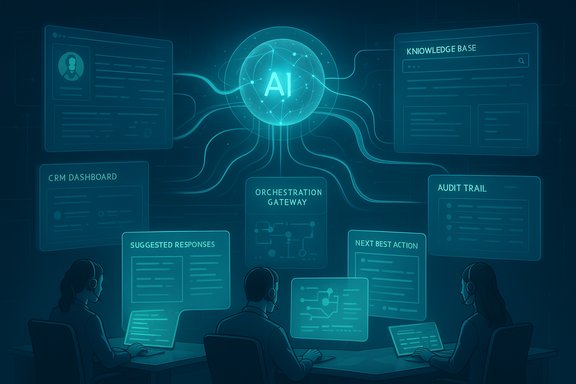
A platform‑agnostic assistant is not a single monolith; it’s an orchestration of components, each performing a well‑defined role. The typical architecture that delivers the “travel‑friendly” behavior includes:- Universal API gateway / orchestration layer
This mediates between external systems and the AI logic. It standardizes authentication, rates data requests, and exposes unified endpoints for the assistant. The gateway is the piece that “moves” — it translates platform‑specific events into canonical signals the AI understands. - Connectors and adapters
Lightweight, replaceable modules implement platform‑specific logic (CRM queries, telephony metadata, knowledge‑base reads). Connectors should be composable so new systems can be onboarded without changing AI logic. - Retrieval‑augmented generation (RAG) pipeline
For grounded responses the assistant combines vector retrieval (from indexed knowledge stores) with on‑demand calls to live systems (orders, accounts, tickets). Effective RAG design is critical to avoid hallucinations and to provide traceable evidence for automated suggestions. - Session and context store
A persistent — but controlled — context layer preserves conversational state across platform transitions. It tracks what the AI has read and what the agent has confirmed, enabling continuous context even when the caller’s records are split across multiple systems. - Human‑in‑the‑loop orchestration and governance
UI workflows, approvals, and audit trails ensure recommended actions require human confirmation for high‑risk tasks. This is essential where automated actions touch billing, refunds, or regulatory workflows.
Tangible benefits for CX operations
When the architecture is implemented properly, platform‑agnostic AI yields measurable benefits:- Reduced time‑to‑value: deploy AI assistance without redesigning the contact centre.
- Faster agent onboarding: consistent assistance across channels and platforms reduces cognitive load.
- Lower cost‑to‑serve: automation of research, drafting replies, and workflow execution reduces handle time.
- Retained tech‑stack control: enterprises avoid vendor lock‑in by preserving existing CRM, telephony, or bespoke systems.
- Gradual migration path: organizations can adopt AI steadily, upgrading systems at their own pace while retaining AI investment.
How Deepdesk leverages Microsoft technologies (and why that matters)
AnywhereNow’s acquisition of Deepdesk formalized a close alignment with Microsoft ecosystems, and that shows in product materials and public statements. The company advertises Deepdesk Agent Assist as “Copilot‑ready” and notes use of Azure OpenAI in agent assist workflows to reduce handle time and improve agent guidance. This creates three advantages:- Familiar trust model: Many enterprises already accept Microsoft governance, compliance, and security processes — using Copilot/Azure AI as a backend makes security conversations easier.
- Rich connector surface: Microsoft Graph and Dynamics 365 primitives provide robust access to calendar, email, and CRM data where customers use the Microsoft stack.
- Accelerated development: Copilot Studio and other Microsoft agent frameworks provide low‑code ways to build and test agent behaviour quickly.
Validation: industry recognition and real‑world signals
Two independent indicators lend credibility to Deepdesk’s approach:- The acquisition by Anywhere365 / AnywhereNow in February 2024 — a public transaction that folded Deepdesk into a larger omnichannel vendor and signalled a priority on agent AI.
- Recognition at a Microsoft Copilot hackathon where Deepdesk placed in the “Ready to Scale” category and was the top‑scoring CX vendor — a practical proof point that the team can build working Copilot agents rapidly and in a way that impressed Microsoft’s architects. Multiple industry outlets reported this outcome.
The hard problems: where platform‑agnostic AI struggles
The concept is elegant, but implementation is hard. Key technical and operational risks to watch include:- Data fragmentation and incomplete visibility
If an enterprise partitions customer data across systems and fails to expose the right connectors, the AI will see gaps. That creates inconsistent responses and increases the risk of hallucination. Deepdesk itself acknowledges that orchestrating data flows between systems is the central challenge. - Latency and real‑time constraints
Pulling context from multiple back ends in real time can introduce latency that undermines agent workflows. Designing caching layers and prefetch strategies is essential to meet the tight SLAs expected in live contact‑centre conversations. - Governance, security and compliance complexity
Giving an assistant broad read/write capability increases the attack surface. Enterprises must decide what the assistant can do autonomously and what actions require human approval. Entrusting data access to an AI layer requires rigorous tenant‑level controls, audited logs, and close alignment with privacy/regulatory obligations. - Hidden vendor coupling and future migration costs
While the approach reduces immediate lock‑in by not replacing the whole stack, heavy use of a particular model provider (for example, deep integration with Microsoft Graph or Copilot prompts) can still create migration friction and cost in the long run. - Operational drift and model governance
As connectors and systems evolve, the AI must continue to understand schema changes, retired fields, and differing data semantics. Maintenance is not trivial — connectors, prompt templates, and retrieval indices will need ongoing engineering.
Practical implementation checklist for IT and CX leaders
To adopt a travel‑friendly, platform‑agnostic AI safely, teams should follow a pragmatic roadmap:- Map data sources and define the ground truth
- Inventory every system that stores customer context (CRM, billing, order management, knowledge base). Require connectors or read-only export feeds for each.
- Define risk zones and human‑in‑the‑loop gates
- Decide in advance which actions require agent confirmation (refunds, legal commitments) and which can be suggested automatically. Build UI confirmation flows and audit logs.
- Start small with high‑value use cases
- Pilot the assistant for targeted tasks (account lookup, knowledge retrieval, suggested responses) before automating multi‑system transactions.
- Insist on explainability and provenance
- Require that each AI suggestion include the sources and retrieval trace (document ID, CRM ticket number) to enable rapid verification and troubleshooting.
- Contract for portability and exportability
- Ensure conversation logs, knowledge artifacts, and automation flows can be exported in interoperable formats if the vendor relationship changes.
Commercial considerations: procurement and vendor selection
When evaluating vendors that claim platform‑agnostic capabilities, procurement teams should insist on three demonstrations:- A live demo showing the assistant orchestrating across at least two different CX systems in real time.
- Evidence of security and compliance: tenant separation, encryption, retention policy controls, and audit trails.
- A clear total cost of ownership model that includes consumption for model usage (Copilot/Azure AI charges, if used), connector maintenance, and expected engineering costs for upgrades.
Competitive and market implications
Platform‑agnostic AI layers introduce a useful middle ground in the CX market: vendors can either attempt to lock customers into end‑to‑end suites with embedded AI, or they can offer horizontal AI orchestration that works across stacks. The latter gives enterprises flexibility and preserves system investments.For vendors, the new battleground is composability and connector ecosystems. Whoever can cheaply and reliably maintain connectors for the most common CX systems — and demonstrate strong governance — will find receptive buyers. This is likely why Deepdesk’s portability message resonated at the Copilot hackathon: it addresses a real procurement pain point.
At the same time, deeper integration with a dominant provider like Microsoft carries strategic trade‑offs: it reduces some commercial friction today but can concentrate future choices and costs around one cloud and its pricing, telemetry, and contractual constraints. Buying teams must balance near‑term adoption ease with long‑term strategic flexibility.
Strengths, caveats and a final assessment
Strengths- Pragmatism: The travel‑friendly approach is pragmatic for the many enterprises that cannot or will not modernize their entire CX stack in a single project.
- Speed: If the vendor’s connectors and RAG pipelines are well engineered, the time from pilot to production can be significantly shorter than full platform migration.
- Hybrid human + AI model: The design that treats the AI as a co‑pilot rather than a replacement mitigates operational risk and preserves agent judgement.
- Data completeness is non‑negotiable: The AI can only be as useful as the data it can access; partial access yields partial outcomes.
- Operational maintenance: Connectors, prompt templates, and retrieval indices are ongoing responsibilities that require funding and engineering discipline.
- Hidden coupling risks: Deep integration with Copilot or any single model provider reduces friction but creates vendor exposure that must be contractually understood.
Platform‑agnostic AI — implemented as an orchestration layer that preserves context and connects to multiple back ends — is a sensible and pragmatic route for many CX organizations. Deepdesk’s approach, backed by AnywhereNow and validated in a Microsoft Copilot hackathon, is a credible commercial proposition for enterprises that want AI assistance without a wholesale system redesign. That said, success depends on rigorous engineering of connectors and retrieval pipelines, disciplined governance, and realistic expectations about the maintenance burden.
Closing: what to watch next
Adopters should watch four short‑term signals to validate vendor claims in production:- Evidence of low-latency, cross‑system retrieval in live agent sessions.
- Transparent audit trails and exportable logs for conversation and action provenance.
- Clear billing and consumption models for Copilot/Azure usage versus alternative inference providers.
- Independent customer case studies that show measurable reductions in handle time or cost‑to‑serve.
Source: CX Today Deepdesk Introduces Its Travel-Friendly AI Approach For Complex Automation
