

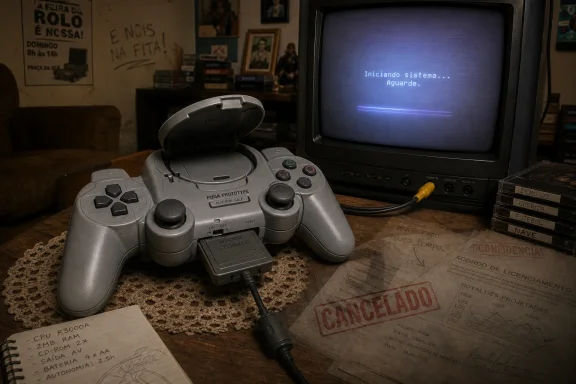
Sony’s canceled PlayStation PUGA was a prototype plug-and-play controller, recently resurfaced through developer Brian “Biscuit” Watson’s Retro Collective appearance, that reportedly put PlayStation 1 hardware inside a DualShock-style pad for Brazil before royalty negotiations killed it. The machine sounds like a collector’s fever dream, but the more interesting story is not that Sony could miniaturize old hardware. It is that the company had already understood, years before the retro-console boom, that nostalgia could be packaged as a low-cost appliance. The PUGA failed because software rights proved less compressible than silicon.
The PlayStation PUGA story arrived this week through Watson’s public recollection, then spread through GamesRadar, Insider Gaming, Time Extension, and Tom’s Hardware. The core claim is simple enough to be instantly memorable: Sony once had a DualShock-like controller that did not merely control a PlayStation, but effectively was one.
That makes it tempting to treat PUGA as another delightful museum oddity, the sort of unreleased hardware that exists to make retro fans ask where the surviving units are. But the design points to something more deliberate. This was not just engineering whimsy; it was an attempt to turn the original PlayStation into a mass-market, low-friction, region-specific product after the conventional console model had run into local market realities.
Watson’s account places the project in Brazil, where high import barriers and gray-market console availability shaped the economics of games hardware. In that context, a controller-console hybrid was not a gimmick. It was a way to avoid shipping a full living-room box into a market where the full living-room box was already burdened by cost, regulation, and distribution friction.
That is why the PUGA feels oddly modern. Strip away the gray plastic and composite video lead, and the strategy resembles today’s dedicated streaming sticks, plug-and-play retro boxes, and subscription-first hardware: reduce the device, predefine the experience, and make the customer’s first session happen before they have time to think about setup.
Those details matter because they move the project away from fantasy and into product planning. This was not an abstract Sony patent sketch or a studio joke pulled from a drawer. The accounts describe a working prototype, a target market, a power strategy, a video output path, and a planned software bundle.
The use of a DualShock-like shell was clever precisely because it hid the complexity. A conventional console asks the buyer to accept a hierarchy of objects: box, controller, disc, memory card, cables, television. The PUGA collapsed that hierarchy into the one object players already understood by touch.
That design also solved an emotional problem. For a family buying an inexpensive retro device, especially in a market where official consoles were expensive or hard to obtain, the controller was the brand. The PlayStation shape, the familiar button layout, and the gray plastic vocabulary could do the work that a console chassis normally did on a retail shelf.
Yet this minimalism came with a tradeoff. Once Sony removed the disc drive and bundled a fixed set of games, it stopped selling a platform in the traditional sense and started selling a curated software product. That changed the economics from hardware distribution to rights aggregation, and that is where the project appears to have broken.
PUGA was different in spirit. It did not simply shrink the console; it erased the console as a separate object. The hardware became subordinate to the controller, and the controller became the whole product.
That difference is not cosmetic. The PlayStation Classic asked buyers to display a tiny monument to the original PlayStation beneath the television. PUGA asked them to forget that a console box was necessary at all.
In hindsight, the PUGA concept looks closer to the dedicated plug-and-play TV games that filled toy aisles and electronics shelves in the 2000s than to Sony’s later mini-console. Those devices often packaged classic arcade or console titles into a joystick or gamepad with TV cables attached. Sony’s twist was that it could bring the legitimacy of the PlayStation brand and the weight of the PS1 library to a category usually associated with cheaper licensed curios.
That would have been a very different kind of retro PlayStation product. It could have been sold as accessible hardware for a specific region, not as a collector’s desk ornament for global nostalgia shoppers. It could also have kept the PS1 alive in a market where the barrier was not affection for the brand, but the practical cost of entering the ecosystem.
A battery-powered controller-console makes far more sense through that lens. If the goal was simply to impress retro collectors, Sony could have built a small box. If the goal was to get PlayStation games into homes where a traditional console was expensive or inconvenient, then the all-in-one controller suddenly becomes practical.
Four AA batteries sound quaint in 2026, but they were also a distribution technology. Batteries are everywhere. Composite televisions were everywhere. A self-contained controller with a cable to the TV could travel through retail and household environments that did not look like the tidy entertainment-center setup imagined by console marketing departments.
The project also suggests Sony was thinking about regional hardware in a more flexible way than the standard console cycle usually allows. The canonical PlayStation business model depends on global platforms, software licensing, and accessory ecosystems. PUGA instead seems to have been a localized appliance built around a preselected catalog.
That is a more radical thought than it first appears. Console makers typically protect platform uniformity because developers, publishers, retailers, and marketing teams all depend on it. PUGA would have been a PlayStation product, but not quite a PlayStation platform in the ordinary sense. It would have been a PlayStation experience sold as a sealed package.
GamesRadar quoted Watson saying Sony licensing could not settle royalty terms for the games. Time Extension and Insider Gaming likewise framed the cancellation around royalty disputes, not a failure to make the controller-console run. Tom’s Hardware added the striking claim that the economics involved tiny per-unit amounts, with publishers reportedly unhappy about royalty terms around 10 cents per unit sold.
That number is small enough to sound absurd and large enough to wreck a low-margin product. A cheap device with 10 games has no room for every rights holder to behave as if it is negotiating a full-price boxed release. But from the publisher side, a bundled classic game is still intellectual property, still brand value, and still a precedent for future negotiations.
This is the cruel math of retro gaming. The older the hardware gets, the cheaper it becomes to emulate, miniaturize, or repackage. But the software does not automatically depreciate in the same way. Rights can become more fragmented, not less. Music, trademarks, expired likeness agreements, defunct publishers, regional distribution contracts, and internal licensing policy can all become harder to manage as time passes.
PUGA appears to have hit that wall early. Sony could make a controller that behaved like a PlayStation. It could not make all the legal and commercial claims around PlayStation software behave like a single piece of hardware.
A bad library would have made the controller feel like a toy. A strong library would have required either valuable first-party titles, major third-party games, or both. That is precisely where royalty negotiations become existential.
Sony’s own catalog could provide some cover, but the original PlayStation’s cultural power came from a much wider coalition. Final Fantasy, Resident Evil, Tekken, Metal Gear Solid, Tomb Raider, Crash Bandicoot, Gran Turismo, Ridge Racer, Wipeout, Tony Hawk, and dozens more defined the platform through a mix of first-party, second-party, and third-party relationships. A Brazil-focused plug-and-play PlayStation would have needed games people actually recognized.
The problem is that recognition costs money. Publishers know when their software is doing more than filling space. If the device’s appeal depends on a famous game, the rights holder has leverage, even if the hardware maker is trying to build an affordable regional product.
This is why “just include ten classics” is never just that. The list becomes the product. The product becomes a bundle of negotiations. The negotiations become a fight over whether old software is cheap filler, premium nostalgia, or strategic market entry.
Microsoft’s Game Pass, Sony’s PlayStation Plus catalogs, Nintendo’s Switch Online retro libraries, and countless publisher collections all orbit that tension. The format changes, but the question remains: when a platform repackages old games as access, who captures the value?
PUGA’s alleged 10-cents-per-unit dispute sounds small because it belongs to a physical product. But it is conceptually close to today’s per-user, per-download, per-engagement, or flat-fee licensing debates. Once software becomes part of a bundle, the publisher must decide whether the bundle expands the market or cannibalizes individual sales.
For a platform holder, the bundle is the point. It lowers friction and makes the device, service, or subscription feel abundant. For a publisher, the bundle can feel like a discount bin with better branding.
That is why PUGA’s cancellation is not merely an old Sony anecdote. It is an early case study in the collision between hardware simplification and software monetization. The easier the device becomes for the customer, the harder the rights stack becomes behind the scenes.
The NES Classic and SNES Classic became cultural moments because they converted memory into a simple box. Sega, Konami, SNK, Atari licensees, Capcom licensees, Evercade, Analogue, and others have all explored different versions of the same appetite. Even unofficial handhelds and emulation devices thrive because they promise the thing PUGA gestured toward: the old library, minus the old mess.
Sony’s PlayStation Classic, by contrast, landed with a thud in part because the execution felt compromised. Its game selection was debated, its emulation was criticized, and its nostalgic objecthood could not fully compensate for the sense that Sony had arrived late and cautiously. PUGA, had it shipped in its intended era and market, would have been judged under different expectations.
It might not have been perfect. Composite video, batteries, limited storage, and a fixed library would have imposed real constraints. But as a region-specific product designed around affordability and access, it could have occupied a category Sony later struggled to define globally.
The PUGA also would have carried a powerful story. “A PlayStation inside a controller” is the sort of phrase marketing departments spend fortunes trying to manufacture. In this case, the phrase appears to have been literally true enough to sell the concept in a single sentence.
But the more valuable historical question is how far the project went inside Sony. Was this a serious product plan with manufacturing partners and a launch window, or a promising prototype that never survived internal commercial review? How many games were being negotiated, and which publishers resisted? Did Sony Brazil have a deeper role in shaping the device?
Watson’s account gives the story its spark, but it also leaves room for careful follow-up. Sony has not publicly issued a detailed statement about PUGA. Without internal documents, licensing memos, bill-of-material estimates, or partner testimony, the public version remains a credible but incomplete reconstruction.
That incompleteness does not make the story unimportant. It makes it typical of hardware history. Many of the industry’s most revealing projects exist in the space between shipping products and private experiments, where company strategy can be glimpsed before it is sanitized into a press release.
For WindowsForum readers used to the archaeology of Microsoft prototypes, canceled Windows builds, and weird OEM reference designs, PUGA should feel familiar. The unreleased device often explains the released strategy better than the shipping product does. It shows what a company thought might be possible before market reality forced the official version into a safer shape.
For IT pros and platform watchers, the device is a reminder that the most elegant technical architecture can still be defeated by commercial dependencies. In enterprise software, cloud marketplaces, streaming media, and games alike, the stack is never just compute, storage, and interface. It is also contracts, royalties, support obligations, compliance constraints, and partner incentives.
The consumer sees the object. The company sees the margin model. The partner sees the precedent.
That is what makes PUGA so instructive. It was not ahead of its time because it hid a console in a controller. It was ahead of its time because it exposed the problem every access-based entertainment product now faces: users want simplicity, but rights holders monetize complexity.
 Sony’s Strangest PlayStation Was a Business Model in Controller Form
The PlayStation PUGA story arrived this week through Watson’s public recollection, then spread through GamesRadar, Insider Gaming, Time Extension, and Tom’s Hardware. The core claim is simple enough to be instantly memorable: Sony once had a DualShock-like controller that did not merely control a PlayStation, but effectively was one.That makes it tempting to treat PUGA as another delightful museum oddity, the sort of unreleased hardware that exists to make retro fans ask where the surviving units are. But the design points to something more deliberate. This was not just engineering whimsy; it was an attempt to turn the original PlayStation into a mass-market, low-friction, region-specific product after the conventional console model had run into local market realities.
Watson’s account places the project in Brazil, where high import barriers and gray-market console availability shaped the economics of games hardware. In that context, a controller-console hybrid was not a gimmick. It was a way to avoid shipping a full living-room box into a market where the full living-room box was already burdened by cost, regulation, and distribution friction.
That is why the PUGA feels oddly modern. Strip away the gray plastic and composite video lead, and the strategy resembles today’s dedicated streaming sticks, plug-and-play retro boxes, and subscription-first hardware: reduce the device, predefine the experience, and make the customer’s first session happen before they have time to think about setup.
The Controller Was the Console Because the Console Was the Problem
According to Watson, the PUGA looked like a PlayStation controller but contained enough hardware to run PS1 games on its own. Time Extension reported that the prototype he discussed used a TI OMAP 3530 system-on-chip with an ARM CPU, ran from four AA batteries, and connected to a television over composite video. GamesRadar described a memory-card-style storage arrangement and a molded video cable, while Tom’s Hardware reported that the device was intended to carry about 4GB of storage for roughly 10 games.Those details matter because they move the project away from fantasy and into product planning. This was not an abstract Sony patent sketch or a studio joke pulled from a drawer. The accounts describe a working prototype, a target market, a power strategy, a video output path, and a planned software bundle.
The use of a DualShock-like shell was clever precisely because it hid the complexity. A conventional console asks the buyer to accept a hierarchy of objects: box, controller, disc, memory card, cables, television. The PUGA collapsed that hierarchy into the one object players already understood by touch.
That design also solved an emotional problem. For a family buying an inexpensive retro device, especially in a market where official consoles were expensive or hard to obtain, the controller was the brand. The PlayStation shape, the familiar button layout, and the gray plastic vocabulary could do the work that a console chassis normally did on a retail shelf.
Yet this minimalism came with a tradeoff. Once Sony removed the disc drive and bundled a fixed set of games, it stopped selling a platform in the traditional sense and started selling a curated software product. That changed the economics from hardware distribution to rights aggregation, and that is where the project appears to have broken.
The PlayStation Classic Was Late to an Idea PUGA Already Understood
Sony eventually did release a nostalgia box: the PlayStation Classic in 2018. That product was a miniature console with a fixed library, HDMI output, and two replica controllers. It was familiar, cautious, and recognizably part of the late-2010s mini-console wave after Nintendo had proved the model with its NES and SNES Classic systems.PUGA was different in spirit. It did not simply shrink the console; it erased the console as a separate object. The hardware became subordinate to the controller, and the controller became the whole product.
That difference is not cosmetic. The PlayStation Classic asked buyers to display a tiny monument to the original PlayStation beneath the television. PUGA asked them to forget that a console box was necessary at all.
In hindsight, the PUGA concept looks closer to the dedicated plug-and-play TV games that filled toy aisles and electronics shelves in the 2000s than to Sony’s later mini-console. Those devices often packaged classic arcade or console titles into a joystick or gamepad with TV cables attached. Sony’s twist was that it could bring the legitimacy of the PlayStation brand and the weight of the PS1 library to a category usually associated with cheaper licensed curios.
That would have been a very different kind of retro PlayStation product. It could have been sold as accessible hardware for a specific region, not as a collector’s desk ornament for global nostalgia shoppers. It could also have kept the PS1 alive in a market where the barrier was not affection for the brand, but the practical cost of entering the ecosystem.
Brazil Was Not a Footnote; It Was the Point
Several reports based on Watson’s talk emphasize that the PUGA was aimed at Brazil, and that point should not be treated as trivia. Brazil has long been one of the most complicated and resilient video game markets in the world: enthusiastic players, strong demand, high hardware costs, and a history of parallel imports and local manufacturing strategies.A battery-powered controller-console makes far more sense through that lens. If the goal was simply to impress retro collectors, Sony could have built a small box. If the goal was to get PlayStation games into homes where a traditional console was expensive or inconvenient, then the all-in-one controller suddenly becomes practical.
Four AA batteries sound quaint in 2026, but they were also a distribution technology. Batteries are everywhere. Composite televisions were everywhere. A self-contained controller with a cable to the TV could travel through retail and household environments that did not look like the tidy entertainment-center setup imagined by console marketing departments.
The project also suggests Sony was thinking about regional hardware in a more flexible way than the standard console cycle usually allows. The canonical PlayStation business model depends on global platforms, software licensing, and accessory ecosystems. PUGA instead seems to have been a localized appliance built around a preselected catalog.
That is a more radical thought than it first appears. Console makers typically protect platform uniformity because developers, publishers, retailers, and marketing teams all depend on it. PUGA would have been a PlayStation product, but not quite a PlayStation platform in the ordinary sense. It would have been a PlayStation experience sold as a sealed package.
The Engineering Was Smaller Than the Rights Problem
The most revealing part of Watson’s account is his claim that the prototype worked. In the mythology of canceled hardware, devices usually die because the battery life was impossible, the cost was too high, the performance was poor, or the industrial design could not survive mass production. PUGA, according to the reporting around Watson’s talk, died for a more familiar but less romantic reason: licensing.GamesRadar quoted Watson saying Sony licensing could not settle royalty terms for the games. Time Extension and Insider Gaming likewise framed the cancellation around royalty disputes, not a failure to make the controller-console run. Tom’s Hardware added the striking claim that the economics involved tiny per-unit amounts, with publishers reportedly unhappy about royalty terms around 10 cents per unit sold.
That number is small enough to sound absurd and large enough to wreck a low-margin product. A cheap device with 10 games has no room for every rights holder to behave as if it is negotiating a full-price boxed release. But from the publisher side, a bundled classic game is still intellectual property, still brand value, and still a precedent for future negotiations.
This is the cruel math of retro gaming. The older the hardware gets, the cheaper it becomes to emulate, miniaturize, or repackage. But the software does not automatically depreciate in the same way. Rights can become more fragmented, not less. Music, trademarks, expired likeness agreements, defunct publishers, regional distribution contracts, and internal licensing policy can all become harder to manage as time passes.
PUGA appears to have hit that wall early. Sony could make a controller that behaved like a PlayStation. It could not make all the legal and commercial claims around PlayStation software behave like a single piece of hardware.
The Device Exposed the Limits of “Just Put Ten Games on It”
Every retro product looks easy until someone has to choose the games. A fixed library must do several jobs at once: represent the console’s identity, justify the purchase, satisfy licensors, avoid technical trouble, and hit a price. The PUGA was particularly exposed because the hardware concept depended on a small, compelling bundle.A bad library would have made the controller feel like a toy. A strong library would have required either valuable first-party titles, major third-party games, or both. That is precisely where royalty negotiations become existential.
Sony’s own catalog could provide some cover, but the original PlayStation’s cultural power came from a much wider coalition. Final Fantasy, Resident Evil, Tekken, Metal Gear Solid, Tomb Raider, Crash Bandicoot, Gran Turismo, Ridge Racer, Wipeout, Tony Hawk, and dozens more defined the platform through a mix of first-party, second-party, and third-party relationships. A Brazil-focused plug-and-play PlayStation would have needed games people actually recognized.
The problem is that recognition costs money. Publishers know when their software is doing more than filling space. If the device’s appeal depends on a famous game, the rights holder has leverage, even if the hardware maker is trying to build an affordable regional product.
This is why “just include ten classics” is never just that. The list becomes the product. The product becomes a bundle of negotiations. The negotiations become a fight over whether old software is cheap filler, premium nostalgia, or strategic market entry.
PUGA Was a Preview of the Subscription Age’s Hardest Argument
The PUGA never shipped, but the argument underneath it never went away. Today, platform holders routinely ask publishers to put older games into subscription services, cloud catalogs, compilations, and limited-time promotional libraries. The same tension returns every time: the platform wants breadth and affordability; the rights holder wants compensation that reflects perceived value.Microsoft’s Game Pass, Sony’s PlayStation Plus catalogs, Nintendo’s Switch Online retro libraries, and countless publisher collections all orbit that tension. The format changes, but the question remains: when a platform repackages old games as access, who captures the value?
PUGA’s alleged 10-cents-per-unit dispute sounds small because it belongs to a physical product. But it is conceptually close to today’s per-user, per-download, per-engagement, or flat-fee licensing debates. Once software becomes part of a bundle, the publisher must decide whether the bundle expands the market or cannibalizes individual sales.
For a platform holder, the bundle is the point. It lowers friction and makes the device, service, or subscription feel abundant. For a publisher, the bundle can feel like a discount bin with better branding.
That is why PUGA’s cancellation is not merely an old Sony anecdote. It is an early case study in the collision between hardware simplification and software monetization. The easier the device becomes for the customer, the harder the rights stack becomes behind the scenes.
The Retro Market Rewards the Product Sony Did Not Ship
The irony is that the market later proved PUGA’s basic instinct correct. Players do buy dedicated nostalgia hardware. They do respond to low-friction access. They do accept curated libraries when the industrial design is charming and the price feels right.The NES Classic and SNES Classic became cultural moments because they converted memory into a simple box. Sega, Konami, SNK, Atari licensees, Capcom licensees, Evercade, Analogue, and others have all explored different versions of the same appetite. Even unofficial handhelds and emulation devices thrive because they promise the thing PUGA gestured toward: the old library, minus the old mess.
Sony’s PlayStation Classic, by contrast, landed with a thud in part because the execution felt compromised. Its game selection was debated, its emulation was criticized, and its nostalgic objecthood could not fully compensate for the sense that Sony had arrived late and cautiously. PUGA, had it shipped in its intended era and market, would have been judged under different expectations.
It might not have been perfect. Composite video, batteries, limited storage, and a fixed library would have imposed real constraints. But as a region-specific product designed around affordability and access, it could have occupied a category Sony later struggled to define globally.
The PUGA also would have carried a powerful story. “A PlayStation inside a controller” is the sort of phrase marketing departments spend fortunes trying to manufacture. In this case, the phrase appears to have been literally true enough to sell the concept in a single sentence.
Collectors Want the Artifact, But Historians Should Watch the Process
The immediate fan reaction is predictable: people want photos, teardown details, footage, and ideally a working surviving unit. That curiosity is legitimate. Prototype hardware is tangible history, and the PUGA’s form factor makes it more interesting than yet another dev kit or debug console.But the more valuable historical question is how far the project went inside Sony. Was this a serious product plan with manufacturing partners and a launch window, or a promising prototype that never survived internal commercial review? How many games were being negotiated, and which publishers resisted? Did Sony Brazil have a deeper role in shaping the device?
Watson’s account gives the story its spark, but it also leaves room for careful follow-up. Sony has not publicly issued a detailed statement about PUGA. Without internal documents, licensing memos, bill-of-material estimates, or partner testimony, the public version remains a credible but incomplete reconstruction.
That incompleteness does not make the story unimportant. It makes it typical of hardware history. Many of the industry’s most revealing projects exist in the space between shipping products and private experiments, where company strategy can be glimpsed before it is sanitized into a press release.
For WindowsForum readers used to the archaeology of Microsoft prototypes, canceled Windows builds, and weird OEM reference designs, PUGA should feel familiar. The unreleased device often explains the released strategy better than the shipping product does. It shows what a company thought might be possible before market reality forced the official version into a safer shape.
Sony’s Tiny Controller Leaves a Large Paper Trail of Lessons
The PUGA story is small in one sense: a canceled controller-console for one market, remembered years later by a developer in a public talk. But the lessons are broad because they cut across hardware, licensing, regional strategy, and the modern obsession with frictionless access.For IT pros and platform watchers, the device is a reminder that the most elegant technical architecture can still be defeated by commercial dependencies. In enterprise software, cloud marketplaces, streaming media, and games alike, the stack is never just compute, storage, and interface. It is also contracts, royalties, support obligations, compliance constraints, and partner incentives.
The consumer sees the object. The company sees the margin model. The partner sees the precedent.
That is what makes PUGA so instructive. It was not ahead of its time because it hid a console in a controller. It was ahead of its time because it exposed the problem every access-based entertainment product now faces: users want simplicity, but rights holders monetize complexity.
The Controller That Almost Escaped the Console War
The concrete picture that emerges from Watson’s account and subsequent reporting is surprisingly coherent: a PlayStation-branded controller-console, battery-powered, aimed at Brazil, designed for about ten games, and reportedly canceled over royalty terms rather than technical failure. The unresolved parts are just as important as the known ones, because they separate documented recollection from mythology.- The PlayStation PUGA was reportedly a Sony prototype that put PS1-capable hardware into a DualShock-style controller rather than requiring a separate console box.
- Brian “Biscuit” Watson surfaced the story through The Retro Collective, and outlets including GamesRadar, Insider Gaming, Time Extension, and Tom’s Hardware amplified the account.
- The device was reportedly intended for Brazil, where import restrictions and console pricing made a locally viable, low-cost PlayStation product attractive.
- The prototype was described as battery-powered, composite-video capable, and built around a small fixed library rather than physical PlayStation discs.
- The cancellation appears to have centered on royalty negotiations for bundled games, showing that software rights were the hard part even when the hardware worked.
- Sony has not publicly filled in the remaining gaps, so the PUGA should be treated as a credible prototype story rather than a fully documented canceled launch.
References
- Primary source: kobaran.com
Published: 2026-07-05T04:10:13.913900
PlayStation PUGA: The Canceled Sony Controller That Hid an Entire PS1 Inside
Sony's history is packed with prototypes that never made it past internal testing, but few sound as ambitious as the PlayStation PUGA. This shelved project...www.kobaran.com - Related coverage: tomshardware.com
Sony crammed an entire PS1 into a DualShock controller that connects to your TV, but killed the project — PlayStation Puga offered game studios a mere 10 cents per unit sold | Tom's Hardware
It's like a PSP without a screen.www.tomshardware.com - Related coverage: timeextension.com
- Related coverage: insider-gaming.com
Sony’s Canceled DualShock Had an Entire PlayStation Inside - Insider Gaming
A new report reveals that there was almost a DualShock controller with a built-in PlayStation. Here are more details.insider-gaming.com - Related coverage: gamesradar.com
Sony created a battery-powered PS1 and shoved it inside a DualShock controller, but "couldn't get their act together about the royalty terms" | GamesRadar+
Legendary game developer Brian 'Biscuit' Watson says he worked on a PS1 plug-and-play console built into a DualShock controller, but it was ultimately canceled.www.gamesradar.com - Related coverage: levelup.com
Inside the PlayStation PUGA: The DualShock That Packed a Full PS1 and Why Sony Pulled the Plug. | LEVEL UP
The PlayStation PUGA was a prototype developed by Sony that integrated a PlayStation 1 into a DualShock controller, allowing users to play games by connecting the device directly to a TV. Despite its potential as a portable and cost-effective gaming solution, it was never released due to...www.levelup.com
- Related coverage: techeblog.com
Sony's PlayStation PUGA Prototype Crammed a PS1 Inside a DualShock Controller and They Almost Brought It to Market - TechEBlog
Brian Watson has worked in games for more than four decades. He started at DMA Design on classics like Lemmings and later spent time at Sony...www.techeblog.com - Related coverage: spite.cz
Místo konzole jen ovladač: Objevil se doposud neviděný PlayStation Puga | Spite.cz
Přetěte si novinku Místo konzole jen ovladač: Objevil se doposud neviděný PlayStation Puga a dozvíte se k tomu vše ✔️ Autorem je Jakub Hergesell spite.cz
- Related coverage: tech.yahoo.com
Sony crammed an entire PS1 into a DualShock controller that connects to your TV, but killed the project — P...
Sony successfully built a PlayStation 1 console that fit inside a controller but had to cancel the project after game studios were unhappy with the royalties they would make from the project.tech.yahoo.com - Related coverage: abit.ee
Sony Developed a DualShock Controller With a Built-In Original PlayStation, But Cancelled It
The PlayStation Puga prototype — a DualShock controller with a built-in original PlayStation for the Brazilian market — was cancelled over licensing issues.abit.ee
- Related coverage: pixelsseo.com
"I Almost Left Sony": The Secret Unreleased PlayStation Controller With A Built-In PS1 That Sony Killed
I Almost Left Sony Over That One Meet The Unreleased PlayStation Pad With A PS1 Inside is a statement that has completely captivated the retro gamingpixelsseo.com - Related coverage: museumofplay.org
- Related coverage: datassette.s3.us-west-004.backblazeb2.com
Final badge 1
A front on angled shot of Sony Playstation with controller, shot on a white reflective surface in the studio with studio lighting.datassette.s3.us-west-004.backblazeb2.com