

Pokémon Go was not experiencing a company-confirmed platform-wide outage on Saturday afternoon, despite player complaints flagged around 12:46 p.m. by @status_is_down. IsDown, Entireweb Status, Outage.report, and Niantic’s own channels showed no active widespread incident at the time of their latest checks. The evidence instead pointed to scattered failures affecting particular players, features, devices, accounts, networks, or locations. No company-confirmed platform-wide outage was visible as of Saturday afternoon; scattered player reports remained.
Before assuming the servers are down, check the phone itself. On iPhone, open Settings > Pokémon GO > Location, choose While Using the App—or Always, if desired—and turn Precise Location on. On Android, open Settings > Apps > Pokémon GO > Permissions > Location and select Allow only while using the app. Then test the game once on Wi-Fi and once on cellular data. Camera permission is not required for normal play; it is relevant only when using AR features.
The immediate alarm came from @status_is_down, which asked followers around 12:46 p.m. Saturday whether they were also encountering problems with Pokémon Go. As IBTimes Australia reported, the post captured enough player frustration to raise the obvious question, but it did not establish the scale, geography, duration, or cause of the disruption.
That evidentiary gap matters. Social-media posts are often the first visible indication of a genuine online-service failure, but a post asking whether a service is down is a starting point for investigation, not proof that a platform-wide outage exists.
The independent monitoring data was largely reassuring. IsDown reported no ongoing official outage and said it had received only a handful of Pokémon Go reports during the prior 24 hours, a volume it regarded as consistent with the game’s normal baseline rather than an abnormal spike.
Entireweb Status separately described Pokémon Go as “operating normally.” Its finding combined automated scanning with crowdsourced reports. Those inputs can provide a useful high-level view: automated checks may show whether monitored endpoints are responding, while human reports may expose player-facing problems that a simple availability check would miss.
Outage.report reached much the same conclusion through a somewhat different monitoring model. The service, which watches social-media activity alongside direct server pings, found no significant outage during the previous 24 hours and said report volume remained typical for that time of day.
Those systems are not infallible, and they do not observe every transaction inside a complicated mobile game. Their agreement nevertheless weakens the claim that Pokémon Go was suffering a broad, continuing outage. It does not invalidate the experiences of players whose apps, accounts, event access, or individual features were failing.
The trackers answer a limited but important question: whether their available signals show an unusual, broad interruption. They cannot guarantee that every login, battle, gift, spawn, purchase, ticket, or event interaction is functioning correctly.
No company-confirmed platform-wide outage was visible as of Saturday afternoon; scattered player reports remained.
A player may therefore load the game successfully while being unable to use the Battle League. Another may see the map but encounter fewer wild Pokémon than expected. A third may catch normally but fail when attempting to process a ticket or complete an interaction with a friend.
That general pattern is consistent with the complaints appearing on IsTheServiceDown. Players there reportedly described Battle League problems, trouble completing in-game gifting, event-ticket registration failures, and reduced wild Pokémon spawns in certain areas.
Those reports do not identify one proven cause. Battle League trouble may involve the game or the quality of a player’s connection. Gifting failures may be limited to a particular interaction or account. Ticket-registration trouble may concern an event entitlement rather than general availability. Spawn complaints may be local, location-related, event-related, or caused by a game defect that broad status checks cannot see.
The diversity of complaints therefore cuts both ways. It may reflect one or more narrow service problems, but it may also combine unrelated bugs, local connectivity failures, account-specific conditions, device issues, and misunderstandings of expected game behavior.
This is the central limitation of crowdsourced outage reporting. Human reports are good at revealing that people are experiencing pain, but they do not automatically classify the source of that pain.
When a player says Pokémon Go is down, that can mean the login screen will not advance, the avatar is standing in the wrong place, a raid has frozen, the Battle League is lagging, no creatures are appearing, or a paid entitlement has not registered. Each can be a legitimate problem, but none alone establishes a platform-wide outage.
Availability is not the same as complete functionality. A game may remain reachable while one feature, account, region, or transaction fails. Saturday’s evidence supports that narrower reading: no company-confirmed broad outage, but scattered player reports that still deserved investigation.
That creates several possible failure points without proving that each named feature runs on a wholly separate backend. If home Wi-Fi is unstable, a cellular connection is congested, location permission is disabled, or the app becomes stuck after moving between networks, the visible result may be an empty map, stalled loading screen, inaccurate position, or failed interaction.
Authentication problems are similarly difficult to classify from the symptom alone. A sign-in failure may involve the game, the connection, a linked login provider, an expired session, or an account-specific issue. Without corroborating reports or an official acknowledgment, the error screen by itself cannot establish which layer failed.
Location permission deserves special attention because it is fundamental to normal gameplay. On iPhone, players should open Settings > Pokémon GO > Location, choose While Using the App or Always, and enable Precise Location. On Android, players should open Settings > Apps > Pokémon GO > Permissions > Location and choose Allow only while using the app. Menu wording can vary slightly by Android manufacturer.
Camera access is different. It supports AR features, but players should not be told that camera permission is necessary for ordinary map-based play, catching without AR, gifting, or Battle League access.
Network transitions can also produce confusing symptoms. Players routinely move between Wi-Fi and cellular service while walking, entering buildings, or gathering in busy areas. If the app stops responding during that transition, restarting it and testing each connection separately can reveal whether the problem follows one network.
The concise lesson is that a reachable game can still contain a broken or inaccessible function, while a local phone or network failure can resemble a server outage. That is why the live evidence and a short sequence of controlled tests are more useful than arguing over whether the game is simply “up” or “down.”
Even so, event participation can make individual failures more urgent. A player who cannot register a ticket, reach an event feature, receive expected spawns, or complete a time-limited task may lose value even when most other players can sign in normally.
Crowded locations can add another variable. Many devices may be competing for mobile capacity in the same area, and strong signal bars do not necessarily guarantee responsive data service. A player should therefore compare cellular data with a trusted Wi-Fi connection where practical before concluding that Niantic’s entire platform is unavailable.
The reverse limitation also matters: a narrow feature failure may affect players in several places without generating enough overall reports to look like a broad outage. Ticket registration, gifting, and Battle League usage represent only portions of total player activity. A problem limited to one of them may be serious for the affected group while remaining difficult for a general availability tracker to classify.
Reduced-spawn complaints are especially hard to interpret. If they cluster in one area, possibilities include inaccurate location data, local or event content behavior, delayed game data, or another limited defect. A high-level monitor that sees successful connections may not detect that kind of gameplay problem.
The practical conclusion is not that status dashboards are useless. Their “operational” labels answer a narrower question: whether their signals indicate a broad service interruption. They do not promise that every event mechanic, geographic area, account entitlement, or competitive session is functioning correctly.
If a tracker declared an outage every time one person submitted a report, almost every large platform would appear permanently unavailable. The useful signal comes from a meaningful departure from normal reporting patterns, failed technical checks, geographic clustering, or confirmation from the operator.
IsDown’s Saturday finding matters in that context. It saw only a handful of reports during the prior 24 hours and treated that volume as part of Pokémon Go’s normal baseline.
Entireweb Status’s combination of automated checks and crowdsourced information provides another perspective. Automated systems may establish reachability, while player reports describe practical usability. Neither signal, on its own, proves that every operation is healthy.
Outage.report adds social activity and direct pings. Those inputs can reveal a larger disturbance, but they still may not expose a defect limited to one feature, region, account group, or type of transaction.
No single dashboard should be treated as an oracle. The stronger conclusion comes from comparing several sources and stating only what their evidence supports. On Saturday afternoon, the monitors remained calm, the observed report volume was not classified as abnormal, and Niantic had not confirmed a corresponding platform-wide incident.
That does not justify saying that every player was fine. It supports the more precise conclusion required here: No company-confirmed platform-wide outage was visible as of Saturday afternoon; scattered player reports remained.
A company may need time to collect reports, reproduce a failure, identify its scope, and decide whether public communication is warranted. A limited problem involving a region, account cohort, ticket type, or game feature may also be handled through support or a known-issues entry rather than a platform-wide outage announcement.
The wording therefore matters. “No company-confirmed outage” means exactly that: Niantic had not confirmed a broad incident at the time checked. It does not mean Niantic had positively verified every reported function or rejected every player complaint.
For an affected player, the distinction can feel academic. If a paid ticket will not register while an event clock continues running, a normal-looking tracker offers little consolation.
For community moderators, news outlets, and support teams, however, precise language prevents two opposite mistakes. Declaring “the servers are down” can exaggerate a limited problem, while declaring “everything is fine” can dismiss a real feature, account, or location-specific failure.
The responsible formulation remains: No company-confirmed platform-wide outage was visible as of Saturday afternoon; scattered player reports remained.
That episode helped establish a lasting reflex: when Pokémon Go behaves strangely, many players immediately suspect another large server failure. The comparison is understandable, but the facts available for Saturday do not show a repeat of that broad launch-era interruption.
The 2016 history should also be stated carefully. The supplied evidence supports the release, expansion to more than two dozen countries, and a multi-hour outage. It does not establish a specific technical cause, a contemporaneous Niantic explanation, or a direct measure showing that today’s infrastructure is more resilient.
Saturday’s diagnosis must therefore stand on current observations rather than architectural assumptions or launch-era comparisons. The available monitors did not identify a significant ongoing outage, Niantic had not confirmed one, and scattered players continued to describe real problems.
Saturday, around 12:46 p.m. — @status_is_down flagged player reports and asked whether others were having trouble.
Saturday afternoon — IsDown, Entireweb Status, and Outage.report showed no significant ongoing outage, while Niantic had issued no acknowledgment tied to the reported problem.
Saturday-afternoon verdict — No company-confirmed platform-wide outage was visible; scattered player reports remained.
Restarting Pokémon Go is a sensible early step because it clears a stalled app session without changing account data or reinstalling the game. If the app became stuck during a temporary interruption or network transition, a clean restart may restore access.
The next comparison should be Wi-Fi versus cellular data. If the game works over one connection but not the other, the result points toward a network-specific condition rather than a universal Pokémon Go outage. That test does not identify the exact technical cause, but it immediately narrows the investigation.
Permissions should then be checked deliberately. Location access and precise location data are essential to normal play. Camera access is only relevant to AR features and should not be presented as a requirement for the game’s ordinary non-AR functions.
Cross-account or cross-device testing is valuable when available. If the same account fails on two devices and two networks, an account or server-side issue becomes more plausible. If another account works on the original device and network, that also helps isolate the fault. These tests are indicators, not absolute proof, because several conditions may overlap.
Feature testing can be equally revealing. If the map loads and ordinary catches work but gifting fails, describe the problem as a repeatable gifting failure rather than saying the entire game is down. The same principle applies to Battle League, ticket registration, purchases, event access, and unexpected spawn behavior.
Reinstallation should come later, not first. It consumes time and data, may require another sign-in, and can erase some evidence of the original state. Before reinstalling, record the error message, take screenshots, note the time, and identify exactly what succeeded and failed.
More detailed component and regional information could help players distinguish broad availability from a narrow failure. It could also reassure affected users that a specific issue is being investigated without incorrectly labeling the entire platform as offline.
Third-party trackers provide useful outside signals, but their classifications depend on what they can observe. IsDown incorporates official information and user reports, Entireweb combines automated and crowdsourced signals, and Outage.report monitors social activity alongside direct pings. None has access to every piece of Niantic’s internal application telemetry.
Players are therefore left to combine several kinds of evidence: official communications, tracker activity, reports from other users, and controlled tests on their own devices. That process is imperfect, but it produces a more accurate result than relying on one social post or one green dashboard.
The absence of a company-confirmed outage should reassure players that there is no established platform-wide incident. It should not be used to dismiss a reproducible Battle League, gifting, ticket, purchase, event, or spawn problem.
A future genuine outage may begin with the same scattered reports seen here. The distinction will emerge only when reports form a broader pattern, monitoring services detect abnormal activity, or Niantic confirms an incident. Until then, the evidence should not be stretched beyond what it shows.
Verdict: Pokémon Go was not confirmed down broadly; check your connection and permissions first, but document repeatable Battle League, gifting, ticket, or spawn failures for support.
Before assuming the servers are down, check the phone itself. On iPhone, open Settings > Pokémon GO > Location, choose While Using the App—or Always, if desired—and turn Precise Location on. On Android, open Settings > Apps > Pokémon GO > Permissions > Location and select Allow only while using the app. Then test the game once on Wi-Fi and once on cellular data. Camera permission is not required for normal play; it is relevant only when using AR features.
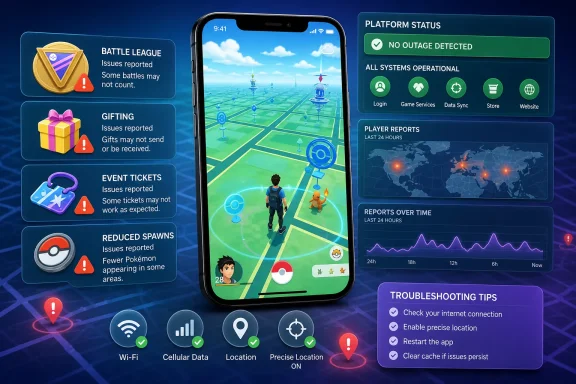 A Social-Media Alarm Met a Wall of Normal Telemetry
The immediate alarm came from @status_is_down, which asked followers around 12:46 p.m. Saturday whether they were also encountering problems with Pokémon Go. As IBTimes Australia reported, the post captured enough player frustration to raise the obvious question, but it did not establish the scale, geography, duration, or cause of the disruption.That evidentiary gap matters. Social-media posts are often the first visible indication of a genuine online-service failure, but a post asking whether a service is down is a starting point for investigation, not proof that a platform-wide outage exists.
The independent monitoring data was largely reassuring. IsDown reported no ongoing official outage and said it had received only a handful of Pokémon Go reports during the prior 24 hours, a volume it regarded as consistent with the game’s normal baseline rather than an abnormal spike.
Entireweb Status separately described Pokémon Go as “operating normally.” Its finding combined automated scanning with crowdsourced reports. Those inputs can provide a useful high-level view: automated checks may show whether monitored endpoints are responding, while human reports may expose player-facing problems that a simple availability check would miss.
Outage.report reached much the same conclusion through a somewhat different monitoring model. The service, which watches social-media activity alongside direct server pings, found no significant outage during the previous 24 hours and said report volume remained typical for that time of day.
Those systems are not infallible, and they do not observe every transaction inside a complicated mobile game. Their agreement nevertheless weakens the claim that Pokémon Go was suffering a broad, continuing outage. It does not invalidate the experiences of players whose apps, accounts, event access, or individual features were failing.
| Monitoring source | Inputs described | Latest finding | What the finding supports |
|---|---|---|---|
| IsDown | Official status information and crowdsourced reports | No ongoing official outage; only a handful of reports in the prior 24 hours | Report volume remained within the service’s normal baseline |
| Entireweb Status | Automated scanning and crowdsourced reports | “Operating normally” | No evidence there of a major continuing disruption |
| Outage.report | Social-media activity and direct server pings | No significant outage in the prior 24 hours | Activity was typical for the time of day |
| Niantic channels | Company support and official status communications | No Saturday-afternoon acknowledgment tied to the reported issue | No company-confirmed platform-wide incident was visible |
No company-confirmed platform-wide outage was visible as of Saturday afternoon; scattered player reports remained.
“It Works for Me” Is Not a Refutation
Online-service failures rarely divide cleanly into “everything works” and “everything is down.” Pokémon Go is particularly resistant to that binary because players can encounter trouble at different points: signing in, loading the map, obtaining accurate location data, seeing expected spawns, entering a battle, exchanging a gift, or registering event access.A player may therefore load the game successfully while being unable to use the Battle League. Another may see the map but encounter fewer wild Pokémon than expected. A third may catch normally but fail when attempting to process a ticket or complete an interaction with a friend.
That general pattern is consistent with the complaints appearing on IsTheServiceDown. Players there reportedly described Battle League problems, trouble completing in-game gifting, event-ticket registration failures, and reduced wild Pokémon spawns in certain areas.
Those reports do not identify one proven cause. Battle League trouble may involve the game or the quality of a player’s connection. Gifting failures may be limited to a particular interaction or account. Ticket-registration trouble may concern an event entitlement rather than general availability. Spawn complaints may be local, location-related, event-related, or caused by a game defect that broad status checks cannot see.
The diversity of complaints therefore cuts both ways. It may reflect one or more narrow service problems, but it may also combine unrelated bugs, local connectivity failures, account-specific conditions, device issues, and misunderstandings of expected game behavior.
This is the central limitation of crowdsourced outage reporting. Human reports are good at revealing that people are experiencing pain, but they do not automatically classify the source of that pain.
When a player says Pokémon Go is down, that can mean the login screen will not advance, the avatar is standing in the wrong place, a raid has frozen, the Battle League is lagging, no creatures are appearing, or a paid entitlement has not registered. Each can be a legitimate problem, but none alone establishes a platform-wide outage.
Availability is not the same as complete functionality. A game may remain reachable while one feature, account, region, or transaction fails. Saturday’s evidence supports that narrower reading: no company-confirmed broad outage, but scattered player reports that still deserved investigation.
Why Partial Failures Can Look Like a Global Outage
Pokémon Go, released in 2016 and developed by Niantic in collaboration with Nintendo and The Pokémon Company, depends on more than the app alone. Normal play involves a working account session, an internet connection, location information, compatible device behavior, and game systems that return the appropriate map and gameplay data.That creates several possible failure points without proving that each named feature runs on a wholly separate backend. If home Wi-Fi is unstable, a cellular connection is congested, location permission is disabled, or the app becomes stuck after moving between networks, the visible result may be an empty map, stalled loading screen, inaccurate position, or failed interaction.
Authentication problems are similarly difficult to classify from the symptom alone. A sign-in failure may involve the game, the connection, a linked login provider, an expired session, or an account-specific issue. Without corroborating reports or an official acknowledgment, the error screen by itself cannot establish which layer failed.
Location permission deserves special attention because it is fundamental to normal gameplay. On iPhone, players should open Settings > Pokémon GO > Location, choose While Using the App or Always, and enable Precise Location. On Android, players should open Settings > Apps > Pokémon GO > Permissions > Location and choose Allow only while using the app. Menu wording can vary slightly by Android manufacturer.
Camera access is different. It supports AR features, but players should not be told that camera permission is necessary for ordinary map-based play, catching without AR, gifting, or Battle League access.
Network transitions can also produce confusing symptoms. Players routinely move between Wi-Fi and cellular service while walking, entering buildings, or gathering in busy areas. If the app stops responding during that transition, restarting it and testing each connection separately can reveal whether the problem follows one network.
The concise lesson is that a reachable game can still contain a broken or inaccessible function, while a local phone or network failure can resemble a server outage. That is why the live evidence and a short sequence of controlled tests are more useful than arguing over whether the game is simply “up” or “down.”
Event Activity Can Amplify Local Complaints
The reports appeared during the broader Pokémon Go Fest 2026 series, which included Copenhagen. The available facts do not establish that multiple city gatherings were active that Saturday, so the event calendar should not be used as proof of either a global outage or simultaneous problems across several locations.Even so, event participation can make individual failures more urgent. A player who cannot register a ticket, reach an event feature, receive expected spawns, or complete a time-limited task may lose value even when most other players can sign in normally.
Crowded locations can add another variable. Many devices may be competing for mobile capacity in the same area, and strong signal bars do not necessarily guarantee responsive data service. A player should therefore compare cellular data with a trusted Wi-Fi connection where practical before concluding that Niantic’s entire platform is unavailable.
The reverse limitation also matters: a narrow feature failure may affect players in several places without generating enough overall reports to look like a broad outage. Ticket registration, gifting, and Battle League usage represent only portions of total player activity. A problem limited to one of them may be serious for the affected group while remaining difficult for a general availability tracker to classify.
Reduced-spawn complaints are especially hard to interpret. If they cluster in one area, possibilities include inaccurate location data, local or event content behavior, delayed game data, or another limited defect. A high-level monitor that sees successful connections may not detect that kind of gameplay problem.
The practical conclusion is not that status dashboards are useless. Their “operational” labels answer a narrower question: whether their signals indicate a broad service interruption. They do not promise that every event mechanic, geographic area, account entitlement, or competitive session is functioning correctly.
Trackers Measure Abnormality, Not Perfection
Every popular online service generates a background level of complaints. Users lose connectivity, forget credentials, experience device problems, encounter bugs, or report behavior that does not affect the wider population.If a tracker declared an outage every time one person submitted a report, almost every large platform would appear permanently unavailable. The useful signal comes from a meaningful departure from normal reporting patterns, failed technical checks, geographic clustering, or confirmation from the operator.
IsDown’s Saturday finding matters in that context. It saw only a handful of reports during the prior 24 hours and treated that volume as part of Pokémon Go’s normal baseline.
Entireweb Status’s combination of automated checks and crowdsourced information provides another perspective. Automated systems may establish reachability, while player reports describe practical usability. Neither signal, on its own, proves that every operation is healthy.
Outage.report adds social activity and direct pings. Those inputs can reveal a larger disturbance, but they still may not expose a defect limited to one feature, region, account group, or type of transaction.
No single dashboard should be treated as an oracle. The stronger conclusion comes from comparing several sources and stating only what their evidence supports. On Saturday afternoon, the monitors remained calm, the observed report volume was not classified as abnormal, and Niantic had not confirmed a corresponding platform-wide incident.
That does not justify saying that every player was fine. It supports the more precise conclusion required here: No company-confirmed platform-wide outage was visible as of Saturday afternoon; scattered player reports remained.
Silence From Niantic Is Evidence, but Not a Verdict
Niantic’s official channels had not acknowledged an active incident connected to Saturday’s reports by the afternoon. That absence aligns with the independent trackers, but it cannot prove that no defect existed.A company may need time to collect reports, reproduce a failure, identify its scope, and decide whether public communication is warranted. A limited problem involving a region, account cohort, ticket type, or game feature may also be handled through support or a known-issues entry rather than a platform-wide outage announcement.
The wording therefore matters. “No company-confirmed outage” means exactly that: Niantic had not confirmed a broad incident at the time checked. It does not mean Niantic had positively verified every reported function or rejected every player complaint.
For an affected player, the distinction can feel academic. If a paid ticket will not register while an event clock continues running, a normal-looking tracker offers little consolation.
For community moderators, news outlets, and support teams, however, precise language prevents two opposite mistakes. Declaring “the servers are down” can exaggerate a limited problem, while declaring “everything is fine” can dismiss a real feature, account, or location-specific failure.
The responsible formulation remains: No company-confirmed platform-wide outage was visible as of Saturday afternoon; scattered player reports remained.
The 2016 Outage Still Shapes New Scares
Pokémon Go’s launch-era instability remains embedded in public memory. After the game’s 2016 release and its expansion into more than two dozen countries, players experienced a multi-hour outage.That episode helped establish a lasting reflex: when Pokémon Go behaves strangely, many players immediately suspect another large server failure. The comparison is understandable, but the facts available for Saturday do not show a repeat of that broad launch-era interruption.
The 2016 history should also be stated carefully. The supplied evidence supports the release, expansion to more than two dozen countries, and a multi-hour outage. It does not establish a specific technical cause, a contemporaneous Niantic explanation, or a direct measure showing that today’s infrastructure is more resilient.
Saturday’s diagnosis must therefore stand on current observations rather than architectural assumptions or launch-era comparisons. The available monitors did not identify a significant ongoing outage, Niantic had not confirmed one, and scattered players continued to describe real problems.
Timeline
2016 — Pokémon Go launched, expanded into more than two dozen countries, and experienced a multi-hour outage.Saturday, around 12:46 p.m. — @status_is_down flagged player reports and asked whether others were having trouble.
Saturday afternoon — IsDown, Entireweb Status, and Outage.report showed no significant ongoing outage, while Niantic had issued no acknowledgment tied to the reported problem.
Saturday-afternoon verdict — No company-confirmed platform-wide outage was visible; scattered player reports remained.
Troubleshooting Should Narrow the Fault
When no broad outage is visible, troubleshooting should be a controlled isolation process. The objective is to determine whether the failure follows the app session, network, permission setting, account, device, location, or specific game feature.Restarting Pokémon Go is a sensible early step because it clears a stalled app session without changing account data or reinstalling the game. If the app became stuck during a temporary interruption or network transition, a clean restart may restore access.
The next comparison should be Wi-Fi versus cellular data. If the game works over one connection but not the other, the result points toward a network-specific condition rather than a universal Pokémon Go outage. That test does not identify the exact technical cause, but it immediately narrows the investigation.
Permissions should then be checked deliberately. Location access and precise location data are essential to normal play. Camera access is only relevant to AR features and should not be presented as a requirement for the game’s ordinary non-AR functions.
Cross-account or cross-device testing is valuable when available. If the same account fails on two devices and two networks, an account or server-side issue becomes more plausible. If another account works on the original device and network, that also helps isolate the fault. These tests are indicators, not absolute proof, because several conditions may overlap.
Feature testing can be equally revealing. If the map loads and ordinary catches work but gifting fails, describe the problem as a repeatable gifting failure rather than saying the entire game is down. The same principle applies to Battle League, ticket registration, purchases, event access, and unexpected spawn behavior.
Reinstallation should come later, not first. It consumes time and data, may require another sign-in, and can erase some evidence of the original state. Before reinstalling, record the error message, take screenshots, note the time, and identify exactly what succeeded and failed.
What to Do Now
Follow these actions in order:- Check Niantic Help and its known-issues information. Look for an acknowledged problem matching the exact feature or error you are seeing.
- Restart Pokémon Go. Fully close the app, reopen it, and repeat the failed action once.
- Switch between Wi-Fi and cellular data. Test the same action on each connection so you can determine whether the failure follows one network.
- Verify location permission. On iPhone, use Settings > Pokémon GO > Location > While Using the App or Always, with Precise Location on. On Android, use Settings > Apps > Pokémon GO > Permissions > Location > Allow only while using the app.
- Test a different account or device if one is available. Note whether the problem follows the account, the phone, or both.
- Capture the error and time. Save a screenshot or screen recording, copy the exact error wording, and record the approximate time, connection type, device, location, and failed feature.
- Contact support for ticket, purchase, event, or repeatable feature failures. Provide the captured evidence, especially when paid access, limited-time rewards, Battle League results, gifting, or event spawns are involved.
Better Status Information Would Reduce Confusion
Saturday’s episode illustrates a limitation of simple status indicators. One green label cannot explain whether login works while Battle League is degraded, whether general gameplay is available while a ticket fails, or whether a problem is limited to a particular region or account group.More detailed component and regional information could help players distinguish broad availability from a narrow failure. It could also reassure affected users that a specific issue is being investigated without incorrectly labeling the entire platform as offline.
Third-party trackers provide useful outside signals, but their classifications depend on what they can observe. IsDown incorporates official information and user reports, Entireweb combines automated and crowdsourced signals, and Outage.report monitors social activity alongside direct pings. None has access to every piece of Niantic’s internal application telemetry.
Players are therefore left to combine several kinds of evidence: official communications, tracker activity, reports from other users, and controlled tests on their own devices. That process is imperfect, but it produces a more accurate result than relying on one social post or one green dashboard.
The absence of a company-confirmed outage should reassure players that there is no established platform-wide incident. It should not be used to dismiss a reproducible Battle League, gifting, ticket, purchase, event, or spawn problem.
What Saturday’s Evidence Actually Supports
The defensible conclusion is narrower than either side of the usual social-media argument. The game was neither confirmed down for everyone nor proven flawless for every player.- @status_is_down flagged complaints around 12:46 p.m. Saturday, but the scale and cause remained unclear.
- IsDown saw only a handful of reports in the prior 24 hours and classified the volume as normal.
- Entireweb Status described Pokémon Go as “operating normally.”
- Outage.report found no significant outage and no abnormal report volume for the time of day.
- Players still reported Battle League, gifting, ticket-registration, and wild-spawn problems.
- Niantic had not acknowledged an active platform-wide incident connected to those reports by Saturday afternoon.
- A lack of broad confirmation does not rule out local, account-specific, device-specific, network-specific, or feature-specific failures.
A future genuine outage may begin with the same scattered reports seen here. The distinction will emerge only when reports form a broader pattern, monitoring services detect abnormal activity, or Niantic confirms an incident. Until then, the evidence should not be stretched beyond what it shows.
Verdict: Pokémon Go was not confirmed down broadly; check your connection and permissions first, but document repeatable Battle League, gifting, ticket, or spawn failures for support.
References
- Primary source: International Business Times Australia
Published: 2026-07-11T17:42:08.303864
Loading…
www.ibtimes.com.au - Related coverage: outage.report
Loading…
outage.report - Related coverage: niantic.helpshift.com
Loading…
niantic.helpshift.com - Related coverage: isdown.app
Loading…
isdown.app - Related coverage: downhunter.com
Loading…
www.downhunter.com - Related coverage: phys.org
Loading…
phys.org
- Related coverage: trepo.tuni.fi
Loading…
trepo.tuni.fi - Related coverage: researchprofiles.csumb.edu
Loading…
researchprofiles.csumb.edu - Related coverage: money.cnn.com
Loading…
money.cnn.com - Related coverage: theguardian.com
Loading…
www.theguardian.com - Related coverage: axios.com
Loading…
www.axios.com