

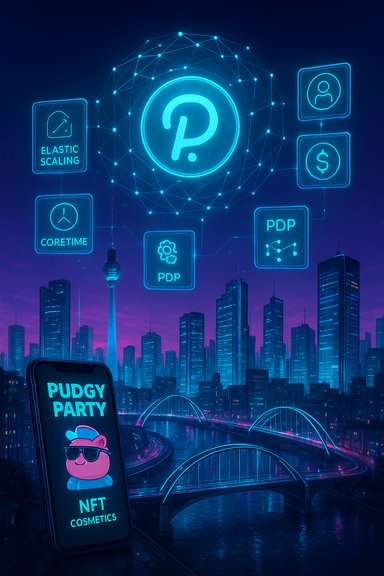
The Web3 Summit in Berlin closed with a flurry of technical milestones and provocative economic proposals that together signal a decisive pivot for Polkadot: move DOT from a passive staking instrument into the active fuel of an on‑chain economy, while simultaneously delivering the production primitives (elastic scaling, one‑click rollups, and cross‑chain liquidity rails) needed to make that shift practical. What happened in Berlin is equal parts engineering progress and a policy debate—Gavin Wood floated radical changes to staking and supply mechanics, teams presented near‑ready production features (Elastic Scaling, PDP, NOMT), and real‑world integrations and app launches (notably the global Pudgy Party mobile launch and Coins.ph’s Asset Hub integration) began to show how the new narrative could translate into users and payments. These developments were widely reported by ecosystem outlets and summarized in the Polkadot weekly coverage.
Background / Overview
Polkadot’s architecture is undergoing two complementary shifts: a technical transition toward a product‑friendly, on‑demand compute model (often called Polkadot 2.0 or JAM) and an economic conversation about how token incentives should support that technical vision. The tech changes—Agile Coretime, Elastic Scaling, PDP’s one‑click rollup deployment, and cross‑chain vToken mechanics—seek to make parachains and rollups cheap, fast, and easy to run. The economic conversation asks a pointed question: if DOT is to power on‑chain services (renting coretime, paying for compute, collateralizing services), should it remain locked in staking at current scale, or should policy push more DOT into DeFi and product activity? The tension between security budgets, treasury income, and on‑chain utility frames the debate.Gavin Wood’s “Thought Bombs”: Supply, Staking and Identity
Short‑term economic experiments: halving, hard caps and reduced staking incentives
At the heart of the headlines was Gavin Wood’s public discussion about dramatically reducing staking incentives to free up DOT for on‑chain use. Reported figures suggested a hypothetical reduction in the relay chain’s annual security cost from roughly $500 million down to about $90 million—an 82% cut that, in PolkaWorld’s modeling, could release hundreds of millions of DOT back into liquid markets and DeFi. These figures and the proposal framework were outlined publicly and then amplified across ecosystem commentary. Readers should treat the numeric headline as a reported thought‑experiment rather than an enacted governance change. Gavin also proposed highly symbolic monetary policy options—most notably fixing DOT’s total supply at π × 10⁹ (≈3.14 billion DOT) and embedding that cap into the JAM genesis bootstrap parameters, with a suggested halve every two years disinflation schedule as a constitutional‑style rule. The intent: remove opportunistic supply changes from routine governance and make monetary policy predictable. This approach was framed as an option for JAM bootstrap, not an immediate relay chain referendum; it therefore remains subject to community debate and formal governance processes.Mid‑term security re‑architecture: Proof of Personhood and identity-driven security
Beyond tokenomics, Gavin and others discussed moving parts of security from capital‑intensive staking toward identity primitives—Proof of Personhood (PoP) plus an individuality layer that would allow identity‑driven participation in consensus and security. The broad idea is to lower the reliance on capital for security, enabling a security model that can be partially powered by authenticated human identities. This is an ambitious, structural change that would require deep protocol work, robust privacy protections, and careful anti‑Sybil design. The proposal is best viewed as a research and roadmap direction rather than an immediate protocol replacement.A native stablecoin and capital circulation
Another major theme was the push for a native stablecoin rail inside Polkadot—intended to create a closed capital cycle: DOT → rent coretime → on‑chain services → revenue → DOT flows back. Proponents argue that a native, compliant stablecoin payment system will materially improve payment UX for remittances, payroll and commerce, and serve as the revenue foundation for public goods and treasury replenishment. These proposals were announced as ecosystem priorities and have practical, product‑level backers.Technical Progress — From Research to Production
Elastic Scaling, PDP and Coretime markets
One of the clearest production wins in Berlin was the demonstration that Polkadot’s scaling primitives are close to deployable. Elastic Scaling (dynamic core rental), coupled with Coretime markets, allows rollups and parachains to rent extra compute on demand—an AWS‑like model for chain compute. This reduces the need for expensive, permanent parachain leases and unlocks pay‑as‑you‑grow business models for games, consumer apps, and high‑frequency DeFi. The Polkadot Deployment Portal (PDP) has matured into a one‑click deployment flow with templates, auto‑renewal, and runtime diffing that makes rollup launches fast and repeatable. Beta testing reached 100% success for the June testing cohort. These are not theoretical features anymore; they are testing and deployment features that materially lower developer friction.Consensus and block mechanics: NOMT and BastiBlocks
Performance experiments discussed by the Polkadot Technical Fellowship include the NOMT consensus engine upgrade (promising up to 10x performance gains in certain modes) and a 500ms block production experiment—BastiBlocks—which decouples block production speed from core count. These efforts target low latency and finality for gaming and high‑frequency financial applications and indicate an explicit prioritization of UX‑sensitive performance. The Fellowship also outlined ambitious stress‑testing targets (hundreds of thousands TPS in lab conditions) using multi‑core setups. While impressive, the path to safe, live deployment requires staged testing, attacker modeling, and governance approval.Dual contract architecture: PVM + EVM
To improve developer experience, Polkadot Hub is moving toward supporting dual contract architecture—PVM (a RISC‑V‑style Polkadot Virtual Machine) plus EVM. This means Solidity contracts could be deployed either as PVM‑native bytecode or EVM bytecode, giving teams choice and allowing existing Solidity tooling to operate while enabling PVM‑level optimizations. This duality is a pragmatic, developer‑friendly approach that could accelerate migration of EVM teams into a Polkadot rollup landscape.Adoption Signals: Real Products, Payments and Games
Pudgy Party: a mainstream Web3 mobile launch
On August 29, 2025, Pudgy Party—the mobile game built with Mythical Games and Pudgy Penguins—launched globally, bringing a high‑profile, mass‑market Web3 title to mobile stores. The launch combined soft onboarding (automatic wallet creation), tradable cosmetic NFTs, and seasonal live events—hallmarks of a play‑first Web3 game experience. Early coverage reported strong download growth and chart placements, making the launch a concrete validation that the Polkadot stack (Mythos chain + PDP + Elastic Scaling) can host mainstream mobile titles. Confirmed press material and industry coverage document the August 29 launch. Why this matters: games are UX‑driven and require high concurrency, deterministic latency, and easy onboarding—precisely the problem set Polkadot’s new primitives aim to solve. If Pudgy Party keeps retention and on‑chain item flows healthy, it becomes the first repeatable playbook for other studios.Coins.ph integrates Asset Hub: stablecoins for remittances
Coins.ph, the Philippines’ leading crypto payments platform, has formally integrated Polkadot Asset Hub, enabling faster, lower‑cost USDT/USDC transfers for millions of Filipinos. Coins.ph’s announcement and multiple regional outlets document the integration and the product benefits: reduced fees, faster settlement, and an immediate payments UX improvement for cross‑border family remittances—one of the highest‑value use cases in Southeast Asia. This is a practical validation of the “stablecoin rails” thesis.Cross‑chain liquidity: Bifrost and vDOT flows
Liquid staking derivatives and XCM flows are already important on Polkadot. Bifrost’s runtime updates (Runtime 20000) introduced vDOT cross‑chain transfers to Asset Hub and delegated voting primitives (DVT), enabling users to keep staking exposure while mobilizing liquidity into DeFi. Bifrost’s own monthly reports and ecosystem dashboards show rising vDOT liquidity and structural support for cross‑chain bridges—evidence that DOT liquidity can be operationalized without forcing users to choose between governance and DeFi participation. Independent reporting and Bifrost’s blog detail these runtime upgrades and vDOT growth metrics.What the Economic Modeling Really Says — Five Effects and One Cost
PolkaWorld’s modeling (publicly circulated in the Berlin coverage) projects that freeing 345 million staked DOT back into liquid markets could push Polkadot‑focused TVL north of $3 billion, placing Polkadot top‑10 in global TVL rankings. The model highlights five potential effects:- More capital attention on DOT as a tradable, productive asset.
- Attraction of DEX, lending and stablecoin projects that need liquid DOT as collateral.
- Increased on‑chain utility for DOT (payments, rent, collateral).
- A higher ecosystem valuation and improved fundraising dynamics.
- A narrative rewrite away from “no‑one‑uses‑DOT” to “DOT powers services.”
Important caveat: the $500M and $90M figures are reported modeling estimates rather than enacted parameters. These are high‑level, conceptual numbers intended to provoke a governance debate and require detailed, formal modeling and staged referenda to validate security, slashing economics, and treasury resiliency before any change goes live. Independent confirmation of the precise math is limited; readers should treat those headline totals as community modeling, not policy facts.
Governance, Grants and the Treasury: Hardening Public Funding
Responding to the prospect of much lower treasury inflows, ecosystem stewards (PolkaWorld and other community DVs) have proposed tighter OpenGov principles: prioritize indispensable public goods, prefer retroactive funding for SDK/tooling (i.e., fund what has demonstrable adoption), and cap hourly salaries (suggested rates: $100/hr for development, $30/hr for maintenance). The intent is to increase funding efficiency and make every treasury dollar count in a potential low‑budget future. These are pragmatic austerity measures designed to protect core infrastructure spending during a fiscal transition—but they are politically sensitive and represent a new rigor that will reshape grant expectations.Risks, Unknowns and Practical Mitigations
1) Security vs capital efficiency
Reducing staking rewards lowers nominal “security costs,” but it also lowers the on‑chain economic cost an attacker must overcome to economically harm the network. Any move that reduces staking-based economic weight requires careful attacker‑cost modeling, potential hybrid security mixes (stake + identity), and staged deployment with conservative thresholds. A rushed policy change could weaken the network if not accompanied by alternative security primitives and robust economic simulations.2) Treasury starvation and public goods
A large drop in inflation‑funded treasury income will force hard triage: which projects get funded, what counts as “indispensable,” and how to maintain core common‑goods like client maintenance and bridging. Retroactive funding can help, but it favors established players with existing users and can bias against early‑stage infrastructure discovery. The risk is underinvestment in long‑lead infrastructure.3) Governance friction and social coordination
Constitutional changes—like embedding supply caps into JAM genesis—shift power from routine referenda to protocol upgrades and forks. That raises governance legitimacy questions and makes upgrades heavier. Broad community buy‑in, transparent editorial boards, and inclusive transition planning will be essential.4) Concentration on a few “killer apps”
Heavy reliance on a handful of mainstream dapps (Pudgy Party, Coins.ph payments) to validate the new narrative creates concentration risk. If these apps fail to retain users or fail at monetization, the whole experiment could stall. The antidote is a diversified launch pipeline: games, DeFi, payments, enterprise rails and consumer apps.5) Data, oracle and bridge risks with mass liquidity flows
Large amounts of newly liquid DOT flowing into DeFi increases exposure to bridge risk, oracle manipulation, and correlated slashing events. Builders must prioritize robust bridge architectures, audited oracles, and conservative risk parameters for vTokens and leveraged products. Bifrost’s vDOT primitives and delegated voting experiments are useful experiments, but they require time and integration testing at scale.Practical Guidance: What Builders, Validators and Stakers Should Do Now
- Builders: design products assuming variable coretime and rent markets. Optimize for elastic scaling and build recovery plans that handle rapid changes in chain economics. Use PDP templates and conduct stress tests in staging.
- Validators/Infrastructure operators: prepare for a scenario with lower staking inflows—diversify revenue (infrastructure contracts, subservices, collator/validation services for parachains), and harden opsec and contingency SLAs. Monitor OpenGov referenda closely.
- Treasury proposers and DAOs: increase emphasis on measurable adoption metrics. Retroactive funding readiness (ship, show users, then petition) will score higher in a leaner treasury era. Demonstrate retention and revenue attachment, not just TVL or vanity metrics.
Why This Matters for the Broader Blockchain Landscape
Polkadot’s conversation in Berlin is useful for the whole industry because it confronts a central tension: how to move from speculative token narratives to product economics while preserving security, decentralization, and funding for public goods. The experiments under discussion—elastic compute markets, identity primitives for security, native stablecoin rails, and a more disciplined treasury—represent a full‑stack attempt to make blockchains useful. If successful, Polkadot could set an operational template: rent compute → power apps → capture revenue on‑chain → reinvest. That’s a different growth model than the airdrop‑centric cycles that dominated prior waves.Final Assessment and What to Watch Next
Polkadot left Berlin with a credible technical path to enable mainstream apps and an aggressive set of economic thought‑experiments that aim to convert DOT from a largely passive staking asset into an active, productive token. The immediate wins are engineering deliverables—PDP’s one‑click flows, Elastic Scaling readiness, and runtime/vToken upgrades—that materially lower developer friction and enable games and payment rails to operate at scale. The more controversial pieces—dramatic staking incentive cuts, constitutional supply caps, and identity‑driven security—are strategic debates that demand rigorous modeling, staged governance, and conservative rollout plans before any protocol change can be considered safe.What to monitor in the coming months:
- Formal governance referenda and detailed simulation papers on any proposed staking or supply changes.
- PDP production deployments and first wave of consumer dapps (metrics: retention, on‑chain item flows, downtime, latency).
- Treasury inflows and how grant selection criteria evolve under a tighter budget regime.
- Cross‑chain liquidity telemetry (vDOT and XCM flows) and bridge security audits.
- Adoption outcomes from practical integrations like Coins.ph and commercial launch performance for Pudgy Party.
Source: Bitget Polkadot Weekly Report | Web3 Summit successfully concluded in Berlin! Pudgy Party is expected to launch on Polkadot on August 29! | Bitget News
