

PostCSS versions prior to 8.4.31 contain a subtle but consequential parsing bug (tracked as CVE-2023-44270) that can let attacker-supplied CSS hide live rules and properties inside what appears to be a comment — a behavior that undermines linters and other tools that rely on PostCSS to safely parse untrusted CSS. This defect is not an exotic privilege escalation or kernel bug, but it is exactly the kind of parser confusion that modern automated build and security pipelines depend on not to exist: when PostCSS mishandles line breaks and comment boundaries, content that looks inert to humans can be resurrected as active CSS in the PostCSS output.
PostCSS is one of the most widely used CSS processing engines in the Node ecosystem. It exposes a tokenizer and AST that plugins (style processors, lint rules, bundlers, and transformation tools) use to inspect, modify, and generate CSS programmatically. Because linters, CI pipelines, and server-side sanitizers commonly use PostCSS to parse incoming or third‑party stylesheets, any parser-level bug can cascade into an application-level bypass. The CVE in question specifically impacts scenarios where PostCSS is used to parse external, untrusted CSS — for example, user uploads, third‑party themes, or embedded widgets.
The flaw was disclosed in late September 2023 and patched in PostCSS 8.4.31. Public vulnerability trackers and vendor advisories catalog the issue and its remediation; the consensus view in the community labels the bug as moderate risk (CVSS ~5.3) because the attack surface is specific — it requires an application to parse untrusted CSS with an affected PostCSS version — but the consequences for automated defenses can be meaningful.
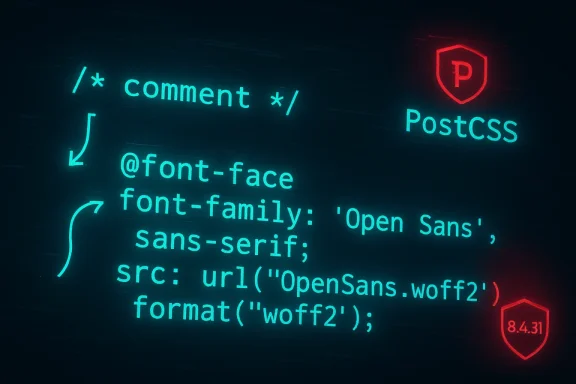
Security trackers reproduce the minimal illustrating example as
That said, it’s important to recognize that the presence of a fixed version does not automatically eliminate risk: packaged distributions and downstream products may lag, and some environments may embed older versions as transitive dependencies. Debian and other OS package trackers reported the CVE and associated packaging updates; those backports and packaging rollouts can take additional time in some distributions.
Source: MSRC Security Update Guide - Microsoft Security Response Center
 Background / Overview
PostCSS is one of the most widely used CSS processing engines in the Node ecosystem. It exposes a tokenizer and AST that plugins (style processors, lint rules, bundlers, and transformation tools) use to inspect, modify, and generate CSS programmatically. Because linters, CI pipelines, and server-side sanitizers commonly use PostCSS to parse incoming or third‑party stylesheets, any parser-level bug can cascade into an application-level bypass. The CVE in question specifically impacts scenarios where PostCSS is used to parse external, untrusted CSS — for example, user uploads, third‑party themes, or embedded widgets.The flaw was disclosed in late September 2023 and patched in PostCSS 8.4.31. Public vulnerability trackers and vendor advisories catalog the issue and its remediation; the consensus view in the community labels the bug as moderate risk (CVSS ~5.3) because the attack surface is specific — it requires an application to parse untrusted CSS with an affected PostCSS version — but the consequences for automated defenses can be meaningful.
How the bug works: parser confusion via line returns and comment boundaries
The tokenizer is the weak link
At the heart of the defect is how PostCSS’s tokenizer handled carriage‑return/line‑feed sequences and comment delimiters. In normal CSS, content enclosed between / and / is ignored by the user agent and should be invisible to downstream tools. The bug arises when carefully crafted character sequences (notably carriage returns, represented as\r) create a scenario where parts of a comment are recognized by PostCSS as syntactic elements rather than inert text.Security trackers reproduce the minimal illustrating example as
@font-face{ font:(\r/*);} — an innocuous-looking sequence that triggers the tokenizer to treat content inside what appears to be a comment as active nodes in the parsed output. After PostCSS completes parsing and transforms the AST back to CSS, previously-commented fragments can show up as active rules or declarations.Why linters and sanitizers fail
Most linters and sanitizers operate under the assumption that comments are non‑executable and therefore safe to ignore when enforcing policies. If a malicious actor can hide a@import, background:url(...), position: absolute, or other sensitive property inside a comment — and PostCSS later elevates that content to a real rule — then the linter may never see the offensive node. Tools that depend on PostCSS for canonicalization or normalization will thus produce a sanitized-looking output that nevertheless contains “phantom” rules. This is not a parser bug in the abstract: it is a bypass for systems that trust PostCSS’s output as authoritative.Real-world impact and attack scenarios
- Linters and policy enforcers: A web platform that rejects uploads containing
position:absoluteor blocks@importstatements but relies on PostCSS < 8.4.31 for parsing could be tricked into accepting CSS where those banned constructs are present in the final output. Attackers can therefore evade content policies intended to prevent layout manipulation or remote resource inclusion. - Build pipelines and bundled artifacts: When PostCSS is embedded in a build or transformation pipeline (for example, a theme builder that parses third‑party CSS), an attacker-supplied stylesheet could cause unexpected nodes to appear in the compiled CSS that later gets served to users or shipped to customers. The vulnerability is particularly dangerous in automated CI/CD workflows where code reviews won’t inspect every generated CSS file manually.
- Downstream software and appliance exposures: Vendors who bundle PostCSS inside larger applications — whether an enterprise workflow product or an on-prem appliance — may ship vulnerable copies inside release archives. IBM’s security bulletins, for instance, flagged specific IBM products that incidentally depended on vulnerable PostCSS packages. This illustrates the supply-chain reach of a parser bug: not every affected product is a web linter; some are enterprise services that embed JS packages for UI processing.
- Potential for chained attacks (edge cases): While the bug by itself does not enable remote code execution in the node process, it can be a pivot in chained attacks. For example, injection of
@importorbackground:url()instructions could be used in combination with other vulnerabilities (e.g., second‑order injection in a rendering pipeline) to expand an attacker’s foothold. Treat these scenarios as realistic in complex, multi-component systems.
Technical analysis: what to look for in inputs and outputs
- The canonical trigger patterns often involve carriage‑return (
\r) and carefully placed comment delimiters. Several public writeups, advisories, and the NVD description highlight@font-face{ font:(\r/*);}as a demonstration. Attackers who understand the tokenizer can craft more elaborate sequences that are visually indistinguishable from benign comments. - Key symptom: input CSS that visually contains only comments but whose processed output contains extra rules or declarations. If you can reproduce this locally by running PostCSS on a suspicious file and the output includes nodes absent from the raw input (but visually inside comments), you have a practical reproduction of the vulnerability class.
- Hardening observation: different CSS parsers have different robustness to corner cases. Relying on a single parser’s behavior as an enforcement primitive is brittle — particularly for user-supplied content. Cross-parse suspicious uploads with multiple parsers or use parser-agnostic sanitization to reduce reliance on the assumptions of any one library.
What was fixed and how the maintainers responded
The PostCSS project released a fix in version 8.4.31 that corrects the tokenizer behavior (the release and the commit that introduced the fix are referenced by advisories and the OSV/GHSA entries). The change tightens the handling of carriage-return sequences and comment boundaries so that data inside/[I] ... [/I]/ cannot be promoted into nodes in the final AST output. The fix was applied promptly following public disclosure, and the advisory metadata (GitHub advisory / OSV / NVD) marks 8.4.31 as the remedial version.That said, it’s important to recognize that the presence of a fixed version does not automatically eliminate risk: packaged distributions and downstream products may lag, and some environments may embed older versions as transitive dependencies. Debian and other OS package trackers reported the CVE and associated packaging updates; those backports and packaging rollouts can take additional time in some distributions.
Detection: how to know if you are affected
- Dependency tree checks
- Run
npm ls postcssor the equivalent in your package manager to find direct and transitive uses of PostCSS. If any package resolves to a version older than8.4.31, treat it as potentially vulnerable. Useyarn why postcssorpnpm why postcssfor other package managers. - Lockfile and SBOM inspection
- Inspect
package-lock.json,yarn.lock, or your SBOM for occurrences ofpostcss@<8.4.31. Replace or update packages that pin vulnerable versions. Automated SBOM scanners can flag known CVEs reported against package versions. - SCA tooling and vulnerability databases
- Run
npm audit, Snyk, or your organization’s SCA solution to surface CVE-2023-44270 instances. These tools use feeds (NVD, GHSA, OSV) that contain the advisory mapping. Snyk and other vulnerability databases list the issue and the fix version. - Behavioral tests
- For systems that must accept untrusted CSS, create a small test harness: feed a crafted example (e.g.,
@font-face{ font:(\r/*);}with additional comment-wrapped rules) into your PostCSS pipeline in a staging environment and examine the output for elevated nodes. This practical test will detect misbehavior even when static dependency checks are inconclusive.
Remediation and mitigation: step‑by‑step
- Upgrade PostCSS
- The first and primary action is to upgrade direct PostCSS installs to 8.4.31 or later. For a Node project:
npm install [email][email protected][/email] --save(or use your preferred package manager and lockfile update command).- Patch transitive dependencies
- Many projects consume PostCSS indirectly (stylelint, autoprefixer, CSS-in-JS tools, theme engines). If your dependency tree contains older PostCSS versions only via transitive dependencies, update the parent package or submit an upstream issue/PR asking the maintainer to upgrade. You can also use temporary overrides (for example, npm’s
overridesor Yarn’sresolutions) where appropriate to force a patched PostCSS across the tree — but do so with caution and test thoroughly. - Block or sanitize untrusted CSS inputs
- If upgrading is not immediately possible, implement pre-parsing sanitization as a stopgap:
- Normalize line endings (convert
\r\nand\rto\n) before parsing to remove the specific\rpatterns implicated in the CVE. Caveat: this can alter legitimate inputs and should be tested. - Strip comment blocks entirely before parsing (e.g., a conservative approach that removes
/[I]...[/I]/) — this reduces functionality but is safer for high‑risk contexts. - Reject files with suspicious sequences (excessive nested delimiters, weird control characters).
- Note: many trackers state there is no perfect workaround that fully matches an upgrade. Apply these mitigations judiciously and prioritize upgrading.
- Harden build and CI pipelines
- Add SCA checks to CI to prevent builds that still include vulnerable versions from propagating to production artifacts.
- Add automated tests that run a small corpus of crafted comment-injection samples through your pipeline to detect regressions.
- Monitor vendor and distro advisories
- If you consume vendor-supplied packages (for example, an enterprise appliance or closed-source theme engine), track vendor security bulletins for backported fixes. Vendors such as IBM published advisories calling out the affected PostCSS packages in their shipped products.
Defensive recommendations for developers and platform operators
- Treat parser output as "untrusted-transformed" data. Even when a library returns a normalized AST or reserialized CSS, regard that output as needing the same scrutiny as raw input if it originated from untrusted sources.
- Apply least-privilege in content handling. If a subsystem only needs to analyze CSS for a narrow set of allowed properties, prefer simpler checks over full parsing: token-level scanning or whitelist-based regexes (careful: regexes can be brittle) may reduce attack surface for that specific function.
- Use layered controls. Combine client-side CSP and server-side content validation. If malicious CSS could cause remote resource loads, a strict CSP that disallows
img-src/font-src/style-srcfrom arbitrary hosts will reduce the impact. - Update the full toolchain, not just direct dependencies. A known vulnerability in an upstream library only stops being a risk when every product and distribution that ships it is patched or otherwise constrained. Monitor package feeds, Linux distribution security trackers, and your internal SBOMs. Debian and other distributions posted bug reports and tracking issues that show how long it can take for fixes to propagate across ecosystems.
Critical assessment: strengths of the response — and remaining risks
Strengths- The PostCSS team released a targeted fix and the advisory ecosystem quickly cataloged the issue (NVD, GHSA/OSV, package advisories). This ensures that mainstream SCA tools can flag affected projects and that developers have an explicit upgrade target (8.4.31).
- The problem is well-scoped: it affects parsing of untrusted CSS and is not a generic remote code execution in PostCSS itself. For many projects that only process trusted internal CSS, the practical risk is reduced.
- Transitive and vendor-supplied exposures remain the largest residual risk. Organizations that rely on third-party vendor bundles, or that have long-lived production images, may carry vulnerable PostCSS copies long after the upstream fix — a point highlighted by distribution bug trackers and vendor advisories. Patching at scale remains an operational challenge.
- Detection by simple automation is imperfect. Static scanning of a lockfile finds version numbers, but runtime bundling or code that dynamically imports patched vs. unpatched copies can complicate a clean inventory. Behavioral tests (feeding crafted inputs and observing output) are a necessary, practical complement.
- No full workaround guaranteed. Many repositories and advisories warn that there is no perfect workaround beyond upgrading; mitigations such as normalizing line endings reduce risk but have tradeoffs and must be validated.
Practical checklist for teams (prioritized)
- Inventory
- Run
npm ls postcss(or equivalent) across all active repositories and identify uses ofpostcss@<8.4.31. Record both direct and transitive occurrences. - Patch
- For direct dependencies, upgrade to
[email][email protected][/email]or later and run full test suites. - For transitive dependencies, update parent packages or apply package manager overrides where safe; coordinate with upstream maintainers for permanent fixes.
- Harden inputs
- In systems that accept untrusted CSS, add pre-parse normalization (line endings) and/or comment-stripping guards for the narrow window while patches are deployed. Use these only as temporary mitigations.
- Automate detection
- Integrate SCA checks (Snyk, npm audit, OSV feeds) into CI to block deployments that would use vulnerable versions. Add a small unit test that parses crafted comment-injection samples through pipelines.
- Monitor
- Keep an eye on advisories for related libraries that embed PostCSS (e.g., stylelint, theme engines) and vendor bulletins for appliances and enterprise products that bundle Node packages.
Final thoughts
CVE‑2023‑44270 is a textbook example of how a seemingly minor tokenizer quirk can undermine larger security assumptions. The vulnerability’s mechanics are narrow — a comment-parsing edge case influenced by carriage-return behavior — yet its consequences are amplified when the parser is positioned as the arbiter of what is "safe" or "allowed." The lesson for developers and security teams is enduring: treat parser outputs with skepticism, maintain rapid patching and SBOM discipline, and design systems so that a single library’s parsing behavior does not become the sole gatekeeper for security policies. PostCSS published the corrective release (8.4.31), and the community’s vulnerability feeds now point to that remediation; apply it, validate your pipelines, and consider behavioral testing for any component that parses untrusted content.Source: MSRC Security Update Guide - Microsoft Security Response Center
