

Microsoft’s latest PowerShell mea culpa is more than a routine postmortem; it is a signal that the company now sees release engineering as a product feature, not just a back-office discipline. After a delayed PowerShell 7.6 LTS launch, the PowerShell team has publicly walked through what went wrong, why the schedule slipped into March 2026, and what it plans to change so the next cycle does not wobble in the same way. That matters because PowerShell sits at the center of Windows automation, enterprise administration, and cross-platform scripting, which means a packaging delay is never just about packages. It affects rollout planning, validation calendars, and trust in Microsoft’s ability to ship a dependable tool chain. (devblogs.microsoft.com)
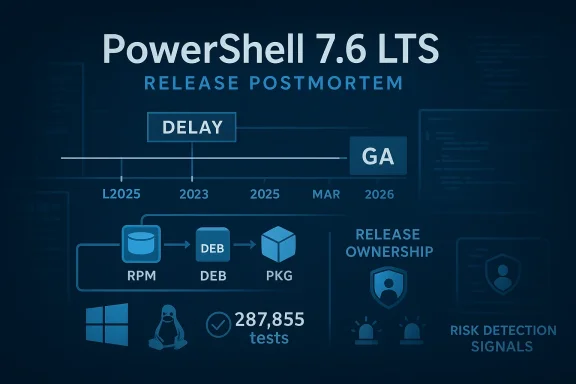
PowerShell has always occupied a strange and important place inside Microsoft’s ecosystem. It is a native Windows tool, but it is also a cross-platform command shell and automation framework that now has to behave consistently across Windows, Linux, and macOS. That dual identity is what makes the product powerful, but it is also what makes the release process fragile. Every change has to be tested in far more combinations than a typical Windows utility, and Microsoft says 7.6 involved 29 packages, 8 package formats, 4 architectures, 8 operating systems, and 287,855 tests per release. (devblogs.microsoft.com)
The company’s public explanation also reflects a broader shift in how Microsoft communicates about quality. Instead of only highlighting features, the PowerShell team is now discussing release ownership, preview cadence, packaging complexity, and detection gaps. That is notable because release delays in infrastructure software are usually hidden behind generic “fix in progress” language. Here, Microsoft is effectively admitting that the process itself needed to be rebuilt, and that the problem was not a single bug but a chain of operational weaknesses. (devblogs.microsoft.com)
The timing is also important. On March 18, 2026, Microsoft announced PowerShell 7.6 GA, describing it as the recommended production version and emphasizing reliability improvements, module updates, tab completion fixes, and alignment with .NET 10 LTS. Then, on April 1, 2026, the team published a separate release postmortem and investments article that explained why the release missed its original target. That sequencing tells you a lot: the product is now out the door, but Microsoft still wanted to explain the delay and show that the lessons are being folded back into the engineering process. (devblogs.microsoft.com)
For Windows users, the story also lands against a larger backdrop. Microsoft has recently been talking more openly about improving Windows itself, including quality, performance, and reliability across the platform. PowerShell is not Windows 11, but it is one of the most widely used native tools on Windows, especially in enterprise environments where administrators rely on it to automate deployment, maintenance, patching, and troubleshooting. So when Microsoft says it is fixing the way PowerShell ships, it is also reinforcing the credibility of the broader Windows stack. That is the real subtext of this announcement. (devblogs.microsoft.com)
Microsoft’s own numbers are designed to make that complexity visible. A release cycle involving multiple versions, multiple OSes, multiple architectures, and multiple package formats is not just a test matrix; it is an operational dependency graph. When the team says it ran 287,855 tests across the release, it is making a case that even a small tooling regression can cascade into schedule risk. The lesson is not simply “testing is hard.” The lesson is that release engineering has become a software product in its own right. (devblogs.microsoft.com)
That sequence matters because it shows the delay was cumulative. There was no single catastrophic failure that could be fixed with one patch. Instead, Microsoft encountered a series of interlocking issues that each consumed time, and by the time the team had a stable replacement workflow, the release calendar had already been pushed deep into the year. In other words, this was a schedule problem caused by technical risk compounding with process risk. (devblogs.microsoft.com)
The company’s admission here is important because it frames preview software as part of the quality system, not a marketing exercise. If the preview train runs irregularly, then the release train loses one of its best safety nets. In practice, that means more bugs are found in the expensive phase, after branch coordination, packaging, and compliance work have already hardened around the target release. (devblogs.microsoft.com)
The team also says it is changing the way it detects trouble. One of the key gaps, according to the postmortem, was a lack of early signals that the packaging changes would affect the release timeline. That means Microsoft is not only trying to make the tooling better; it is trying to make the warning system better too. Those are different problems, and both need to be solved if the company wants more dependable releases. (devblogs.microsoft.com)
For Windows enthusiasts, the practical significance lies in the reliability of everyday scripting. PowerShell is used for everything from basic file handling to provisioning, remote management, and automation of repetitive support work. A more disciplined release pipeline should reduce the chance that package or platform regressions interfere with those tasks. That will not make PowerShell glamorous, but it will make it more dependable. (devblogs.microsoft.com)
That is why the new focus on predictability is not a cosmetic improvement. It is part of the value proposition of LTS itself. If Microsoft cannot keep the ship date steady, the market starts to discount the promise of the support window. That would be a real problem for a tool whose credibility rests on being the dependable layer beneath critical scripts and admin pipelines. (devblogs.microsoft.com)
The significance of Microsoft’s release discipline is that it helps PowerShell defend its niche. The product’s selling point has always been that it is deeply integrated, richly structured, and designed for real administration rather than ad hoc text munging. But that advantage only matters if the release train feels dependable. If Microsoft demonstrates that it can improve predictability, it strengthens PowerShell’s credibility against more established scripting habits. (devblogs.microsoft.com)
Another concern is that platform complexity will keep rising. PowerShell has to serve Windows users, Linux users, and macOS users while staying aligned with .NET and multiple packaging ecosystems. That makes every release inherently more fragile than it was in the old Windows-only era. Microsoft can reduce risk, but it cannot eliminate the structural complexity that comes with being everywhere at once. (devblogs.microsoft.com)
The broader Windows implication is just as important. Microsoft has been talking more openly about refining the quality of Windows and the tools around it, and PowerShell is a natural place to show that philosophy in practice. A more predictable PowerShell release cadence would help both developers and administrators, and it would reinforce the idea that Microsoft is serious about the plumbing, not just the front-end polish. (devblogs.microsoft.com)
Source: Neowin After Windows 11, Microsoft addressing "key" issues on one of its most powerful native tools
 Overview
PowerShell has always occupied a strange and important place inside Microsoft’s ecosystem. It is a native Windows tool, but it is also a cross-platform command shell and automation framework that now has to behave consistently across Windows, Linux, and macOS. That dual identity is what makes the product powerful, but it is also what makes the release process fragile. Every change has to be tested in far more combinations than a typical Windows utility, and Microsoft says 7.6 involved 29 packages, 8 package formats, 4 architectures, 8 operating systems, and 287,855 tests per release. (devblogs.microsoft.com)The company’s public explanation also reflects a broader shift in how Microsoft communicates about quality. Instead of only highlighting features, the PowerShell team is now discussing release ownership, preview cadence, packaging complexity, and detection gaps. That is notable because release delays in infrastructure software are usually hidden behind generic “fix in progress” language. Here, Microsoft is effectively admitting that the process itself needed to be rebuilt, and that the problem was not a single bug but a chain of operational weaknesses. (devblogs.microsoft.com)
The timing is also important. On March 18, 2026, Microsoft announced PowerShell 7.6 GA, describing it as the recommended production version and emphasizing reliability improvements, module updates, tab completion fixes, and alignment with .NET 10 LTS. Then, on April 1, 2026, the team published a separate release postmortem and investments article that explained why the release missed its original target. That sequencing tells you a lot: the product is now out the door, but Microsoft still wanted to explain the delay and show that the lessons are being folded back into the engineering process. (devblogs.microsoft.com)
For Windows users, the story also lands against a larger backdrop. Microsoft has recently been talking more openly about improving Windows itself, including quality, performance, and reliability across the platform. PowerShell is not Windows 11, but it is one of the most widely used native tools on Windows, especially in enterprise environments where administrators rely on it to automate deployment, maintenance, patching, and troubleshooting. So when Microsoft says it is fixing the way PowerShell ships, it is also reinforcing the credibility of the broader Windows stack. That is the real subtext of this announcement. (devblogs.microsoft.com)
Why this PowerShell delay matters
The obvious reading of the postmortem is that Microsoft missed a release window. The more important reading is that the company is acknowledging how much modern PowerShell depends on packaging discipline, not just language or engine work. For an admin tooling product, the installer and distribution layer are not incidental. They are the mechanism by which trust is delivered, and if that layer becomes unstable, enterprise teams feel it long before casual users do. (devblogs.microsoft.com)Microsoft’s own numbers are designed to make that complexity visible. A release cycle involving multiple versions, multiple OSes, multiple architectures, and multiple package formats is not just a test matrix; it is an operational dependency graph. When the team says it ran 287,855 tests across the release, it is making a case that even a small tooling regression can cascade into schedule risk. The lesson is not simply “testing is hard.” The lesson is that release engineering has become a software product in its own right. (devblogs.microsoft.com)
Enterprise implications
Enterprises do not care whether a delay was caused by a flaky build script, a compliance requirement, or a holiday freeze. They care that their planning assumptions changed. If a PowerShell LTS release slips, then automation teams may hold back script validation, delay image refreshes, or postpone adoption of new features that are tied to a stable support window. That is why the company’s promise to improve predictability matters almost as much as the release itself. (devblogs.microsoft.com)- Release timing affects validation calendars.
- Packaging consistency affects deployment confidence.
- LTS stability affects whether teams standardize or wait.
- Preview cadence affects how early problems surface.
- Ownership clarity affects how quickly blockers are resolved.
Consumer implications
Most home users never think about package formats, but they do feel the downstream effects. A more reliable release pipeline usually means fewer broken installers, fewer edge-case bugs, and fewer confusing version mismatches across channels. Even if the average Windows enthusiast only opens PowerShell occasionally, a healthier servicing pipeline can improve the everyday experience by making the tool less temperamental and more consistent. That is the quiet consumer win here. (devblogs.microsoft.com)What went wrong in the 7.6 cycle
Microsoft’s postmortem lays out a surprisingly detailed timeline. In October 2025, packaging-related changes introduced a bug in preview 7.6-preview.5 that broke Alpine builds because the new build method for the Microsoft.PowerShell.Native library was not compatible with Alpine. In November 2025, compliance requirements forced further tooling changes for non-Windows package generation. In December 2025, the holiday freeze and limited personnel reduced the team’s ability to move quickly. Then, in January 2026, a compatibility issue involving glibc 2.28 for RHEL 8 surfaced, and the packaging changes proved deeper than expected. By March 2026, the work stabilized enough for release. (devblogs.microsoft.com)That sequence matters because it shows the delay was cumulative. There was no single catastrophic failure that could be fixed with one patch. Instead, Microsoft encountered a series of interlocking issues that each consumed time, and by the time the team had a stable replacement workflow, the release calendar had already been pushed deep into the year. In other words, this was a schedule problem caused by technical risk compounding with process risk. (devblogs.microsoft.com)
Packaging as a hidden dependency
The most interesting line in the postmortem is the one about replacing the packaging workflow entirely. Microsoft says the compliance requirement could not be addressed with incremental changes, so the team had to rebuild the workflow for RPM, DEB, and PKG packages. That is the kind of change that sounds mundane until you remember that all the public-facing binaries depend on it. If the factory breaks, the product cannot be shipped, even if the code itself is ready. (devblogs.microsoft.com)- Alpine builds failed after a build-system change.
- Non-Windows tooling had to be reworked for compliance.
- RHEL 8 required different
glibcsupport than newer RHEL systems. - Holiday freezes reduced flexibility during recovery.
- Backporting across active branches added coordination overhead.
Validation slowed when previews slowed
Microsoft also says reduced preview cadence made issues harder to catch early. That is an uncomfortable but familiar reality in developer tools. Preview builds are not just about offering new features to enthusiasts; they are a form of distributed testing that gives the engineering team earlier signal before the final cut. When preview cadence slips, risk gets discovered later, when changes are more expensive to unwind. (devblogs.microsoft.com)The company’s admission here is important because it frames preview software as part of the quality system, not a marketing exercise. If the preview train runs irregularly, then the release train loses one of its best safety nets. In practice, that means more bugs are found in the expensive phase, after branch coordination, packaging, and compliance work have already hardened around the target release. (devblogs.microsoft.com)
The lesson Microsoft says it learned
Microsoft’s response is the part most worth paying attention to. Rather than trying to patch around the packaging mess, the team shifted to a broader stabilization effort and rebuilt the workflow as a prerequisite for shipping. That is an important strategic decision, because it tells you the company now sees packaging infrastructure as something that needs modernization, not merely maintenance. (devblogs.microsoft.com)The team also says it is changing the way it detects trouble. One of the key gaps, according to the postmortem, was a lack of early signals that the packaging changes would affect the release timeline. That means Microsoft is not only trying to make the tooling better; it is trying to make the warning system better too. Those are different problems, and both need to be solved if the company wants more dependable releases. (devblogs.microsoft.com)
Process changes, not just code changes
Microsoft lists several concrete improvements: clear release ownership, improved tracking, a consistent preview cadence, reduced packaging complexity, more automation, and clearer communication signals through the PowerShell repository. Those are not flashy promises, but they are the right ones. Mature platform software usually improves through boring discipline, not dramatic reinvention. (devblogs.microsoft.com)- Release owners will have explicit responsibility.
- Tracking systems should expose blockers earlier.
- Preview builds should arrive on a steadier schedule.
- Packaging systems should be simplified where possible.
- Automation should reduce manual bottlenecks.
- Community-facing communication should surface risk sooner.
Reliability over speed
The postmortem makes one value judgment repeatedly: the team chose reliability over speed. That sounds obvious, but it is actually a strategic stance. In a world where many software vendors rush out updates and patch later, Microsoft is signaling that for PowerShell LTS, correctness and cross-platform consistency come first. That is especially sensible for enterprise software, where an unreliable release is worse than a delayed one. Fast is useful; trustworthy is better. (devblogs.microsoft.com)Why this matters for Windows users
PowerShell may be cross-platform now, but it still carries the weight of Windows expectations. If Windows has a reputation problem around quality, then the tools embedded in its ecosystem cannot look careless. The PowerShell postmortem therefore doubles as a quiet reassurance: Microsoft is trying to clean up not only the operating system experience, but the utility layer that millions of admins use to keep systems running. (devblogs.microsoft.com)For Windows enthusiasts, the practical significance lies in the reliability of everyday scripting. PowerShell is used for everything from basic file handling to provisioning, remote management, and automation of repetitive support work. A more disciplined release pipeline should reduce the chance that package or platform regressions interfere with those tasks. That will not make PowerShell glamorous, but it will make it more dependable. (devblogs.microsoft.com)
The enterprise vs. consumer split
Enterprise administrators will feel the biggest impact because they live on the edge of release planning. They need stable LTS versions, predictable previews, and enough notice to test changes before rollout. Home users, on the other hand, mostly benefit indirectly through better quality and fewer regressions in the tools included with or commonly installed on Windows. (devblogs.microsoft.com)- Enterprises care about support windows and validation.
- Consumers care more about simplicity and fewer failures.
- DevOps teams care about package consistency across platforms.
- Power users care about command completion and shell reliability.
- IT pros care about automation stability under pressure.
Why LTS makes the problem bigger
Long-term support releases have a special burden because they become the default anchor point for production environments. Microsoft explicitly says PowerShell 7.6 is the recommended version for production automation. Once a release takes on that role, delay is not just inconvenient; it affects whether organizations can adopt the version they are supposed to trust. (devblogs.microsoft.com)That is why the new focus on predictability is not a cosmetic improvement. It is part of the value proposition of LTS itself. If Microsoft cannot keep the ship date steady, the market starts to discount the promise of the support window. That would be a real problem for a tool whose credibility rests on being the dependable layer beneath critical scripts and admin pipelines. (devblogs.microsoft.com)
Competitive implications
PowerShell does not compete like a consumer app, but it still faces pressure from adjacent ecosystems. On Windows, it competes with simpler admin tools, third-party automation platforms, and the tendency of teams to standardize on whatever scripting stack feels least risky. Across platforms, it also exists in the shadow of Bash, Python, and infrastructure-as-code systems that developers may prefer for cross-platform automation. (devblogs.microsoft.com)The significance of Microsoft’s release discipline is that it helps PowerShell defend its niche. The product’s selling point has always been that it is deeply integrated, richly structured, and designed for real administration rather than ad hoc text munging. But that advantage only matters if the release train feels dependable. If Microsoft demonstrates that it can improve predictability, it strengthens PowerShell’s credibility against more established scripting habits. (devblogs.microsoft.com)
Why rivals should care
Competing tools do not need to beat PowerShell on every feature. They just need to be easier to trust or easier to standardize. That is why the packaging delays matter strategically. They create an opening for alternatives to look more stable, even if they are less powerful. Microsoft’s willingness to publicly fix that perception is therefore a defensive move as much as an internal improvement. (devblogs.microsoft.com)- Reliability is part of the competitive story.
- Cross-platform support raises user expectations.
- LTS releases are judged on predictability.
- Packaging bugs can undermine brand trust.
- Process transparency can preserve developer goodwill.
The broader Microsoft pattern
The move mirrors a larger pattern across Microsoft: the company is increasingly willing to talk about quality, reliability, and engineering process in public. That is smart, because the era of “ship it and fix it later” is less forgiving for enterprise platforms than for consumer apps. PowerShell’s postmortem shows Microsoft trying to behave like a mature platform vendor that knows release confidence is part of the product. (devblogs.microsoft.com)Strengths and Opportunities
The best thing about Microsoft’s response is that it is specific. The company did not stop at vague promises; it identified the release-cadence failure, the packaging bottleneck, and the ownership gaps that allowed the delay to stretch. That creates a roadmap for improvement, and it gives users a way to judge whether the next cycle is actually better. Specificity is the first sign of seriousness. (devblogs.microsoft.com)- Clearer release ownership should reduce handoff confusion.
- Better tracking should surface blockers earlier.
- More automation should cut manual release friction.
- Simplified packaging should reduce future regressions.
- Regular preview cadence should improve validation quality.
- Cross-platform consistency should improve trust in LTS builds.
- Public communication through the repository should help the community plan ahead.
A chance to rebuild confidence
For administrators, nothing builds confidence like a release that arrives when expected and behaves the way the documentation says it should. Microsoft now has a chance to prove that its postmortem was not just a PR reset. If the next few PowerShell updates land on time, with consistent previews and fewer packaging surprises, the company can restore some of the trust it spent during the 7.6 delay. (devblogs.microsoft.com)Risks and Concerns
The biggest risk is that the root causes are deeper than the current fixes. If the release pipeline still depends too heavily on manual steps, tribal knowledge, or tightly coupled packaging logic, then a similar delay could return under a different form. Microsoft is talking about automation and simplified packaging, but those improvements only matter if they are executed thoroughly and sustained across future cycles. (devblogs.microsoft.com)Another concern is that platform complexity will keep rising. PowerShell has to serve Windows users, Linux users, and macOS users while staying aligned with .NET and multiple packaging ecosystems. That makes every release inherently more fragile than it was in the old Windows-only era. Microsoft can reduce risk, but it cannot eliminate the structural complexity that comes with being everywhere at once. (devblogs.microsoft.com)
Operational and reputational risk
The reputational risk is subtle but real. If PowerShell keeps missing target windows, users may start treating Microsoft’s release dates as aspirational rather than dependable. For infrastructure software, that is dangerous because trust erodes slowly and then suddenly. Once customers start building schedule slack around uncertainty, the product loses one of its biggest advantages. (devblogs.microsoft.com)- Late-cycle changes are inherently hard to absorb.
- Manual publishing steps create avoidable bottlenecks.
- Holiday freezes can magnify upstream delays.
- Preview gaps can hide risk until it is expensive.
- Compliance changes can force nontrivial tooling rewrites.
- Cross-platform packaging remains a structural challenge.
The hidden user impact
Finally, there is a user-experience risk that should not be ignored. Packaging issues are invisible until they surface as missing binaries, inconsistent installers, or broken platform support. Users rarely see the engineering debate, only the symptom. That means Microsoft’s internal improvements must translate into visible reliability, or else the entire exercise will feel abstract. (devblogs.microsoft.com)Looking Ahead
What happens next will reveal whether Microsoft’s response is cosmetic or structural. The company now has a chance to prove that release ownership, preview regularity, and packaging automation are more than slide-deck language. If the next PowerShell cycle is smoother, the postmortem will look like a turning point. If not, it will read like a warning that came too late. (devblogs.microsoft.com)The broader Windows implication is just as important. Microsoft has been talking more openly about refining the quality of Windows and the tools around it, and PowerShell is a natural place to show that philosophy in practice. A more predictable PowerShell release cadence would help both developers and administrators, and it would reinforce the idea that Microsoft is serious about the plumbing, not just the front-end polish. (devblogs.microsoft.com)
What to watch
- Whether preview builds arrive on a steadier cadence.
- Whether release ownership is visibly clearer in future cycles.
- Whether packaging changes are simplified instead of reworked in crisis mode.
- Whether communication about blockers appears earlier in the repository.
- Whether future LTS releases land closer to their planned schedule.
Source: Neowin After Windows 11, Microsoft addressing "key" issues on one of its most powerful native tools
Last edited:
