

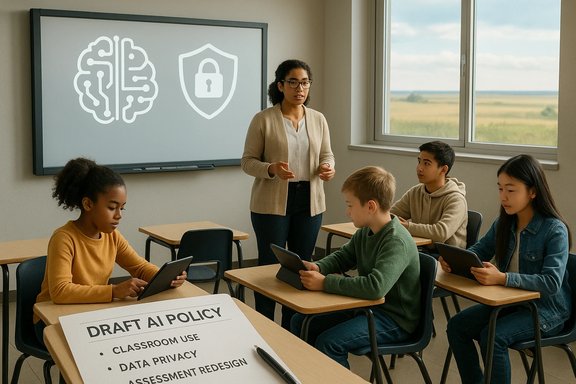
Prairie South School Division’s modest, pragmatic pivot toward classroom AI — framed by superintendent of school operations Dustin Swanson as “AI as a tool, not a threat” — captures the posture many North American districts are taking: cautious pilots, a living policy under development, and a tight focus on protecting student learning and privacy while building staff competence. The division has introduced a draft AI policy to staff, is prioritizing data‑privacy safeguards and professional development, and is explicitly wrestling with the tradeoffs between student agency, accountability and responsibility as AI becomes part of everyday learning workflows.
Prairie South’s announcement follows a pattern now familiar in K–12 systems: generative AI tools (ChatGPT, Microsoft Copilot, Google Gemini and their education‑focused siblings) are widely available and students are already using them, but formal guidance — especially at the provincial level in some jurisdictions — lags district practice. Prairie South’s leadership framed AI as a support for pedagogy — a drafting, differentiation and administrative aid — while flagging the usual concerns: academic integrity, hallucinations, equity of access and where student data might be stored or used by vendors.
Two big, verifiable trends give context to that local posture. First, global education assessment is already moving to account for AI and media literacy: the OECD’s PISA 2029 cycle explicitly includes a Media & Artificial Intelligence Literacy (MAIL) domain, intended to assess students’ ability to interact with and critically evaluate digital and AI‑mediated content. This is not speculative policy — it is a planned innovation with framework drafts and timelines set by the OECD. Second, the scale of everyday AI use is large enough to matter for schools. Multiple market and journalism reports converge on the conclusion that more than a billion people now interact regularly with standalone AI platforms or services; while exact counts vary by methodology, the direction is clear — generative and assistive AI tools are mainstream. That ubiquity is why school systems cannot treat AI as a curiosity to be banned indefinitely. The “tool, not threat” framing reflects this reality while preserving the core educational mission.
Key facts reported from the presentation include:
Note: the above summary is drawn from reporting presented to trustees and local media; some specifics (for example, procurement decisions and exact contractual protections) were described at a high level but were not accompanied by public contract documents and therefore should be treated as preliminary until formal procurement records are available.
However, several gaps and risks remain:
The next 12–18 months will be decisive: whether Prairie South negotiates robust contractual protections, invests in practical teacher development, and redesigns assessment to foreground process will determine whether AI supplements learning or inadvertently undercuts it. School systems that succeed will be those that treat AI adoption as a governance and pedagogy problem — not merely an IT procurement exercise — and that publish measurable outcomes to keep the community informed and accountable.
Source: DiscoverMooseJaw Prairie South outlines approach to AI in schools
 Background
Prairie South’s announcement follows a pattern now familiar in K–12 systems: generative AI tools (ChatGPT, Microsoft Copilot, Google Gemini and their education‑focused siblings) are widely available and students are already using them, but formal guidance — especially at the provincial level in some jurisdictions — lags district practice. Prairie South’s leadership framed AI as a support for pedagogy — a drafting, differentiation and administrative aid — while flagging the usual concerns: academic integrity, hallucinations, equity of access and where student data might be stored or used by vendors.Two big, verifiable trends give context to that local posture. First, global education assessment is already moving to account for AI and media literacy: the OECD’s PISA 2029 cycle explicitly includes a Media & Artificial Intelligence Literacy (MAIL) domain, intended to assess students’ ability to interact with and critically evaluate digital and AI‑mediated content. This is not speculative policy — it is a planned innovation with framework drafts and timelines set by the OECD. Second, the scale of everyday AI use is large enough to matter for schools. Multiple market and journalism reports converge on the conclusion that more than a billion people now interact regularly with standalone AI platforms or services; while exact counts vary by methodology, the direction is clear — generative and assistive AI tools are mainstream. That ubiquity is why school systems cannot treat AI as a curiosity to be banned indefinitely. The “tool, not threat” framing reflects this reality while preserving the core educational mission.
Overview: What Prairie South told trustees
At a recent board meeting superintendent Dustin Swanson summarized Prairie South’s approach: treat AI as an instructional and operational tool, not a replacement for teachers or critical thinking; pilot conservatively; and build a policy that clarifies acceptable use, privacy protections and staff training.Key facts reported from the presentation include:
- Prairie South has prepared a draft AI policy and introduced it to staff last August as an initial guidance document.
- The division recognizes benefits — rapid summarization, differentiation (adjusting text complexity), administrative efficiency, and personalized practice — but equally acknowledges risks — cheating, over‑reliance, bias and privacy exposure.
- Leadership has attended national summits and is tracking provincial developments; Prairie South expects provincial association work to inform local policy.
- Priorities going forward are policy refinement, stronger data privacy protocols and expanded staff AI competency.
Note: the above summary is drawn from reporting presented to trustees and local media; some specifics (for example, procurement decisions and exact contractual protections) were described at a high level but were not accompanied by public contract documents and therefore should be treated as preliminary until formal procurement records are available.
Why Prairie South’s posture is familiar — and defensible
AI as a pedagogical amplifier
Districts that move beyond bans and toward managed adoption are doing so for concrete reasons:- AI can save teacher time on routine tasks — drafting rubrics, preparing differentiated reading levels, generating formative quizzes — freeing time for small‑group instruction and higher‑value interactions. Several implementation playbooks and district pilots report measurable time savings when teachers use AI as a drafting co‑pilot.
- AI can personalize practice at scale, creating formative items and revision plans tailored to student needs, which supports mastery learning when paired with teacher review.
- Preparing students to operate in an AI‑infused workplace is itself an educational outcome. Building AI literacy — how models work, how to verify outputs, how to document usage — is increasingly framed as part of digital citizenship and workforce readiness. The OECD’s inclusion of AI literacy in PISA 2029 institutionalizes that idea at the international assessment level.
Managed adoption over blanket bans
The operational argument for managed, tenant‑based solutions (for example, education SKUs of major vendors) is pragmatic: when a district already uses a vendor suite for identity and storage, adding an embedded assistant lets IT apply the existing controls — account management, Data Loss Prevention (DLP), retention rules and tenant isolation — instead of allowing unmanaged consumer accounts that are harder to control. But that convenience alone is not a privacy guarantee; contractual non‑training clauses and clear retention/export rights must be negotiated and verified.The benefits Prairie South highlighted — unpacked
Prairie South’s presentation named several practical classroom and operational advantages. Here’s a breakdown of each and what evidence or practice says about them:- Rapid content generation and summarization. AI can quickly draft lesson scaffolds, summaries and prompts. Teachers can use this as a starting point and then adapt for curricular alignment. District pilots across North America show teacher time savings on these tasks, provided outputs are human‑verified.
- Differentiation and accessibility. Generative tools can rewrite texts at different reading levels, translate, or provide alternate formats for students with language or learning needs. When used with teacher oversight, this increases access and inclusion for diverse learners.
- Administrative efficiency and data summarization. From meeting notes to parent letters, AI can automate routine writing and pattern analysis, again reclaiming time for instruction. Practical deployments emphasize teacher/instructional oversight to ensure tone, accuracy and privacy compliance.
- Support for assessment design. AI can help generate formative items and offer ideas for staged assessments that surface process rather than just product. This is a key pedagogical lever to retain rigor while integrating AI.
Risks and trade‑offs — what Prairie South must manage
Prairie South’s list of challenges is a near‑catalog of the sector’s concerns. Each requires targeted mitigations.- Academic integrity and deskilling. Generative models produce polished outputs that can mask lack of student reasoning. The durable response is assessment redesign: staged drafts, oral defenses, portfolios and required process artifacts (prompt logs, reflections). Relying solely on detection tools is a brittle strategy; detection produces false positives and negatives and can be gamed.
- Hallucinations and accuracy. Models sometimes fabricate facts or produce convincing but incorrect claims. Both teachers and students need routines to verify outputs against authoritative sources; AI outputs should be treated as drafts not final authority.
- Data privacy and contractual ambiguity. Vendor marketing claims (for example, that inputs from education accounts are not used to train public models) are meaningful only if reflected in signed contracts and the specific SKU purchased. Districts should require explicit non‑training clauses, defined retention and deletion policies, and audit/export rights. Without those, school data — including student prompts and uploaded files — can be at risk.
- Equity and access. If AI benefits are accessible only via premium features, better devices or reliable home broadband, adoption can widen gaps. Districts must plan device parity, on‑site lab time and opt‑out alternatives to prevent unfair advantages.
- Teacher capacity and sustainability. One‑off vendor demos are insufficient. Effective adoption requires ongoing professional development, communities of practice, and protected time for teachers to redesign rubrics and assessments. Evidence suggests short practical PD combined with teacher champions yields better and more lasting results.
Procurement and privacy — practical guardrails
Prairie South named data privacy as a priority. Operationalizing that requires concrete clauses and technical controls:- Contractual non‑training guarantees: Insist that the vendor explicitly not use school prompts, uploaded files or student content to train public models. Verify the clause applies to the selected SKU and region. Marketing language is insufficient by itself.
- Retention and deletion semantics: Contracts should define how conversation logs are retained and how the district can export and delete them. Administrative export and audit rights are essential for investigations.
- Identity and account management: Provision AI access only through managed district accounts and enforce age gating (for features dependent on age limits such as 13+ settings). Ensure Entra/Azure or the equivalent identity service is configured correctly so student accounts cannot inadvertently access consumer features.
- Technical controls: Deploy DLP, sensitivity labels and retention policies. Log telemetry in a way that can be exported for audits. Limit PII and exam content from being pasted into any model, and provide explicit student guidance about what may not be shared.
Assessment redesign: the single most consequential lever
If AI simply makes it easier to produce a final product, learning is at risk. The strongest systems replenish rigor by redesigning how they assess.- From product to process. Score reasoning, source verification, iterative drafts and revision work. Use rubrics that value critique of AI output and the authenticity of a student’s contribution.
- Staged submissions and oral defenses. Require timestamped drafts, reflections and occasional in‑class demonstrations or vivas for high‑stakes work. This reduces the incentive to outsource the process entirely to AI.
- Prompt logging and reflection. Make students submit the prompts they used and a short reflection on how they used AI, what they verified and how they edited the output. This creates teachable moments about responsible use.
- Low‑stakes practice vs. summative caution. Allow AI for formative practice (flashcards, study guides) but be conservative for summative work unless process evidence is rigorous and required.
Staff competency — build teacher confidence, not fear
Prairie South’s plan to expand staff competency is critical. Research and field reports converge on what effective teacher PD looks like:- Short, practical modules on prompt craft, hallucination detection, and tool limits.
- Pedagogical workshops on assessment redesign and rubric rewriting.
- Teacher champions and communities of practice to share prompt libraries and exemplar assignments.
- Protected redesign time and measurable completion targets tied to classroom implementation.
How Prairie South compares: other provinces and districts
Prairie South’s approach is conservative and iterative, mirroring what other Canadian and international jurisdictions are doing — but some regions have moved faster in publishing district frameworks or guidance.- In Saskatchewan the landscape is mixed: boards are reported to be grappling with AI and formal province‑level guidance has been limited, prompting districts to act locally while watching provincial developments. That limited provincial guidance underlines why Prairie South’s local draft policy is an important first step.
- British Columbia has multiple districts and consortia actively producing guidance and resources (Vancouver School Board working groups, Abbotsford’s resources). Several BC districts are running teacher‑centered pilots and publishing frameworks for staff and families. These local initiatives demonstrate the patchwork approach: boards fill gaps where provincial direction lags.
- Ontario has signalled policy attention at the provincial level by naming AI as a Professional Activity Day topic in 2025–26, encouraging boards to produce local policies and PD. Some Ontario boards (for example, those in Renfrew County and Ottawa Catholic) published local frameworks and practical classroom guidance faster than a single centralized mandate could dictate.
Verifying the big claims — what is confirmed and what remains estimates
- The OECD’s PISA 2029 plan to include an innovative Media & Artificial Intelligence Literacy domain is an official programmatic decision; framework drafts and a timetable are published by the OECD. That means AI literacy is being assessed at international scale.
- The statement that “more than a billion people globally use some form of AI” is supported by multiple market summaries and journalistic analyses; however, the precise headcount is an aggregation across platforms, regions and methodologies. It is reasonable to treat the figure as a strong market signal rather than a precise census number. Readers should understand it as an informed estimate that underscores AI’s ubiquity.
- Local operational claims about Prairie South’s draft policy, the timing of staff briefings, and Swanson’s board statements are drawn from trustee meeting reporting; procurement and contract details (for example, whether non‑training clauses have been negotiated) were not publicly disclosed at the time of reporting and therefore remain unverified until the division publishes contract documentation. Those areas should be treated as open items.
Practical roadmap: a clear, pragmatic checklist for Prairie South (and similar divisions)
- Finalize and publish a living AI policy that includes:
- Clear permitted/forbidden classroom uses.
- Parental opt‑out procedures and plain‑language family communications.
- A schedule for policy review and updates.
- Centralize procurement, and require these contractual protections:
- Explicit non‑training clauses for student data where possible.
- Defined retention and deletion procedures for conversation logs and uploaded files.
- Audit and export rights for telemetry and logs.
- Institute technical controls before broad student access:
- Managed district accounts only; enforce age gating where features require 13+.
- Configure DLP, sensitivity labels and retention in your tenant controls.
- Log and archive prompt histories tied to assignments where appropriate.
- Redesign assessment systems:
- Move high‑stakes assessment toward staged submissions, oral defenses and portfolios.
- Require prompt logs + short reflective statements for work where AI contributed.
- Build staff capacity:
- Deploy short PD modules on prompt design, verification and assessment redesign.
- Fund teacher champions and communities of practice with protected time.
- Measure PD completion and classroom implementation, not just attendance.
- Equity and access:
- Audit device parity and connectivity; fund loaner devices and in‑school lab time.
- Provide low‑bandwidth or offline alternatives where necessary.
- Pilot, evaluate, iterate:
- Start with small teacher‑led pilots, collect short‑cycle metrics (time saved, equity metrics, integrity incidents).
- Report outcomes publicly to build community trust and inform scale decisions.
Critical appraisal — strengths, gaps and the risks of complacency
Prairie South’s approach has several strengths: it treats AI as a pedagogical tool, it is building an initial policy rather than improvising classroom rules, and it prioritizes privacy and staff competency. That posture reduces the risk of knee‑jerk bans that push students to unmanaged consumer tools and relinquishes the teaching moment.However, several gaps and risks remain:
- Procurement specificity. Saying “we’ll protect student data” is not a guarantee; the details live in signed contracts and the specific SKU purchased. District leaders must not accept vendor assurances without contractual confirmation and legal review.
- Assessment workload. Requiring staged submissions and prompt logging is pedagogically smart but increases teacher workload. Prairie South should plan for workload tradeoffs — invest time‑savings gains from AI into the teacher time needed to verify and grade process artifacts.
- Measurement and transparency. Promises of time saved and learning gains must be measured and published. Short‑cycle metrics (who uses AI, for what, and with what outcomes) will be crucial to justify scale. Districts that publish these metrics build trust and practical accountability.
- Community engagement. Parents and guardians need clear, plain‑language explanations about what AI will be used for, how student data is handled, and how to opt out. Transparency is a leading indicator of community trust; it requires communication resources and deliberate planning.
Conclusion
Prairie South’s early, measured approach — drafting policy, centering teacher agency, and prioritizing privacy and PD — is aligned with the pragmatic, evidence‑driven path many districts are now taking. The division is balancing the clear pedagogical gains of AI (differentiation, accessibility, teacher productivity) against the well‑documented hazards (academic integrity, hallucinations, contractual privacy uncertainty and equity gaps).The next 12–18 months will be decisive: whether Prairie South negotiates robust contractual protections, invests in practical teacher development, and redesigns assessment to foreground process will determine whether AI supplements learning or inadvertently undercuts it. School systems that succeed will be those that treat AI adoption as a governance and pedagogy problem — not merely an IT procurement exercise — and that publish measurable outcomes to keep the community informed and accountable.
Source: DiscoverMooseJaw Prairie South outlines approach to AI in schools
