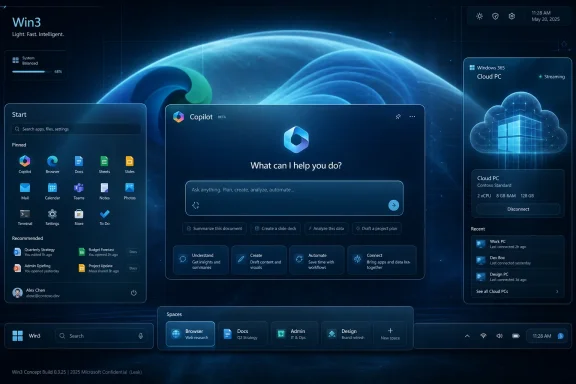
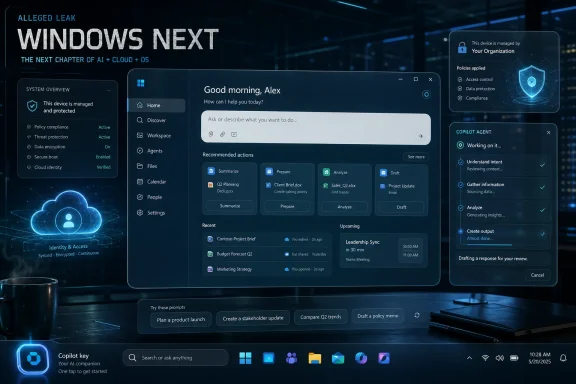
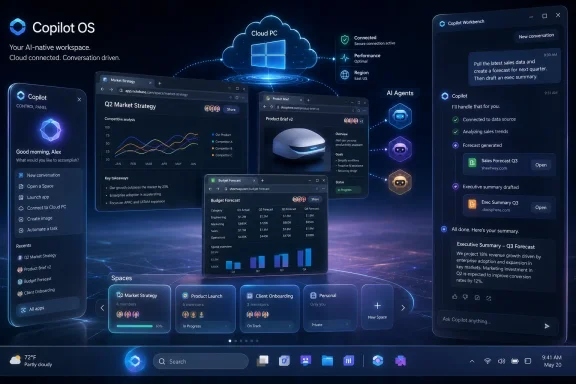
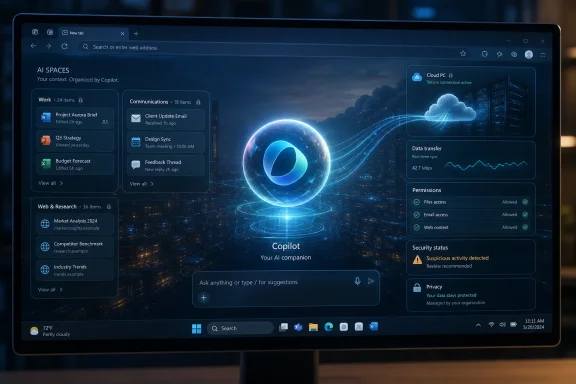
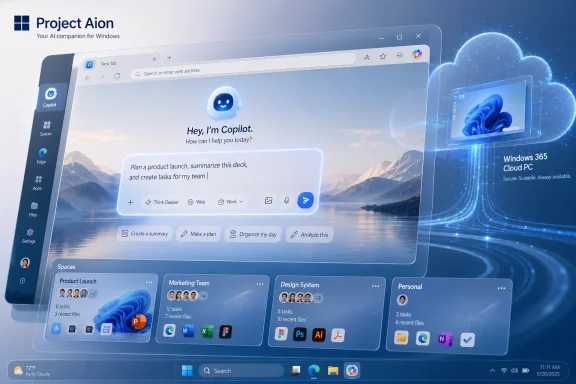
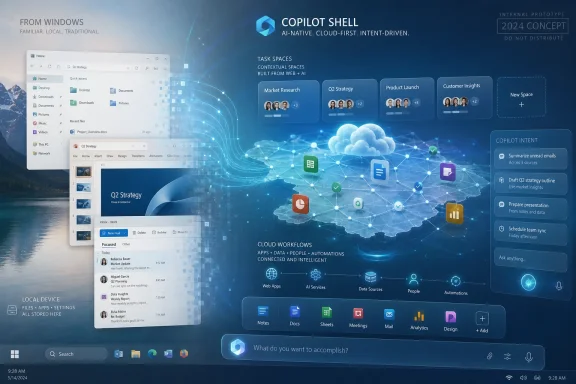
That is a radical idea, but not a surprising one. Aion looks less like a one-off fever dream than a concentrated version of Microsoft’s last several years of Windows strategy: Copilot+ PCs, Recall, Click to Do, semantic search, Windows 365, Microsoft 365 Graph, and a developer platform increasingly pitched as an AI runtime. The leak matters because it shows the quiet part in interface form. Microsoft is not merely adding AI to Windows; it has been exploring what Windows looks like when AI is the thing Windows is for.
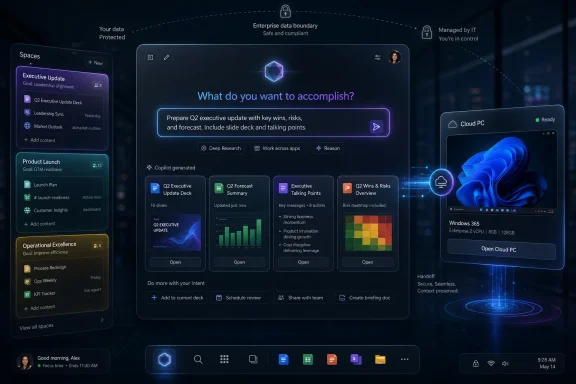 Aion Turns the Start Menu Into a Negotiation With the Machine
The most provocative detail in the leaked demonstration is the apparent demotion of the Start menu. In ordinary Windows, Start is a launcher, a search surface, a pin board, and a relic of desktop computing’s app-first bargain. You decide whether the next unit of work is Word, Outlook, Teams, Edge, File Explorer, or a line-of-business application, and Windows mostly helps you get there.
Aion appears to invert that relationship. The central box is described as an Omnibox, and the model behind it is reportedly called Sydney, the original codename associated with Bing Chat. Instead of asking the user to choose an app, the system asks the user to describe an intent.
That sounds like the oldest promise in computing, dressed in 2020s language. Natural-language launchers have existed for decades, and every generation rediscovers the dream that users should not need to know where things live. What makes Aion more interesting is that the leaked concept is not just a text box pasted on top of Windows. It appears to be an operating environment where the text box decides which domain of knowledge is appropriate, whether that is consumer web information or enterprise data protected by Microsoft 365 boundaries.
This is where the demo becomes less about user-interface theater and more about Microsoft’s institutional advantage. Apple can make the local device feel coherent. Google can make the web feel native. Microsoft can make the boundary between your employer’s identity system, your documents, your calendar, your Teams chats, your Cloud PC, and your browser session feel like a single managed surface. Aion’s Start replacement is not merely a launcher. It is a policy-aware router for work.
The Browser Was Always the Escape Hatch From Windows’ Past
The leaked material reportedly describes Aion as web-based and running on a modified version of Microsoft Edge. That detail will set off alarms for anyone who remembers Microsoft’s long history of bundling browsers into operating systems, but the more immediate reason is architectural. If Microsoft wants a lightweight, AI-readable, cloud-connected shell, Chromium is a convenient substrate.
A browser shell gives Microsoft a way around the messiest part of Windows: the accumulated weight of four decades of compatibility. Win32 is Windows’ moat and its millstone. It is the reason enterprises still depend on Windows, and also the reason Microsoft cannot simply refactor the PC into a clean, agentic appliance without breaking the world.
Aion’s reported design neatly dodges that contradiction. It does not try to make every old Windows application native to the new shell. It treats the web as the default computing surface and punts heavy legacy work to Windows 365 through a handoff flow. If a file or workflow needs a traditional desktop application, the system can remote into a Cloud PC with context already loaded.
That is a very Microsoft answer. Rather than kill Windows compatibility, it virtualizes it. Rather than force Win32 into a new UX model, it keeps the old Windows environment available as a service.
This also explains why Aion seems optimized for enterprise more than consumers. A consumer PC still has to run games, device utilities, creative apps, oddball installers, printer software, and every local thing people expect to own. An enterprise endpoint, especially one aimed at frontline, kiosk, contractor, or managed productivity scenarios, can be much more constrained. For those users, the browser already is most of the computer, and Windows 365 is an acceptable answer when it is not.
Spaces Are Microsoft’s Bet That Apps Are the Wrong Unit of Work
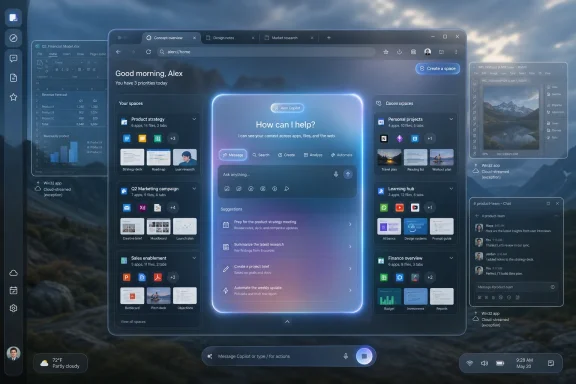
The leaked video’s “Spaces” concept may be the most consequential idea in the whole package. According to the reports, Aion groups work around goals rather than applications, with an engine reportedly called Silverstone assembling the relevant pages, documents, chats, and tasks into context-aware workspaces. That may sound like a productivity consultant’s slide deck, but it gets at a real failure of modern desktop computing.
The app-centric model is tidy for software vendors and chaotic for users. A budget review might involve Excel, Teams, Outlook, SharePoint, a browser tab with an internal dashboard, a PDF, a meeting transcript, and three half-remembered chat threads. Windows sees those things as separate windows and processes. The user sees them as one problem.
Aion’s apparent answer is to make the problem the container. If the system can infer that a set of documents, messages, pages, and pending actions belong to the same goal, it can reassemble work in a way that resembles human memory more than a file system. That is a big claim, and it is exactly the kind of claim Microsoft has been circling with Recall and semantic search.
The distinction is that Recall, as shipped and documented, is anchored in local snapshots and local analysis on Copilot+ PCs. Aion’s reported approach is different because Edge can inspect the document object model of web content directly. Instead of understanding a web page as pixels on a screen, the system can understand its structure, fields, links, text, and interactive elements.
That is more powerful. It is also more invasive if handled badly. A system that understands the DOM of every work page can produce more useful automations than a screenshot index, but it also raises sharper questions about consent, data boundaries, logging, administrator visibility, and the separation between user intent and automated action.
The Windows Recall Backlash Haunts Every AI Shell Demo
Aion reportedly predates or overlaps with Microsoft’s most turbulent AI-on-Windows period. In 2024, Microsoft introduced Recall for Copilot+ PCs and was quickly forced to revisit its security and privacy posture after widespread criticism. By 2025 and 2026, the company’s official documentation emphasized local processing, encryption, Windows Hello requirements, management controls, and the fact that Recall is disabled or removed by default on managed devices.
That chronology matters because Aion’s leaked interface exists in the shadow of that backlash. Any system that promises to understand everything you are doing across workspaces will be judged through the Recall lens, even if its architecture is different. Users and administrators have learned to ask the obvious questions first: what is captured, where is it stored, who can search it, what leaves the device, and which policy can turn it off?
The leaked Aion concept appears enterprise-aware in ways that suggest Microsoft anticipated some of those questions. Routing prompts between work and consumer Copilot experiences is not a cosmetic feature. It is an attempt to preserve compliance boundaries inside an interface that otherwise invites the user to blur them.
But the hardest problem is not routing a prompt. It is establishing trust in a system that wants to become the memory and action layer of the PC. The more useful the assistant becomes, the more context it needs. The more context it receives, the more it looks like surveillance unless users and administrators can understand, constrain, and audit it.
That is the bargain Microsoft has to make legible. “AI can see your workspace” is not an acceptable enterprise message. “AI can operate within a governed, local, identity-scoped, auditable workspace” is closer, but only if the product actually behaves that way.
Aion Looks Canceled Because Windows Can Absorb Its Best Ideas
The safest reading of the leak is that Aion was an internal exploration rather than a product roadmap. The video appears old, the UI is unfinished, and the concept depends on a level of organizational commitment that Microsoft has not publicly announced. The project is likely canceled or on the back burner, and Windows Central’s reporting similarly frames it as an exploration whose shipping future is unclear.
That does not make it irrelevant. Microsoft often kills shells and keeps their organs. Windows Core OS, Windows 10X, Polaris, Andromeda, and other internal projects left behind ideas that later resurfaced in pieces: containerization, simplified update models, modern shell components, cloud recovery, web-first app assumptions, and new device categories.
Aion could follow the same path. The full Copilot OS may never arrive, but its assumptions can seep into Windows 11 and whatever succeeds it. The Start menu can become more conversational. Search can become more semantic. Workspaces can become more task-aware. Edge can become more deeply integrated with Copilot. Windows 365 handoff can become smoother. Agents can operate in constrained environments rather than across the whole desktop.
That is probably the more realistic future. Microsoft does not need to ship “Copilot OS” to make Windows feel more like Aion. It only needs to keep moving the center of gravity away from files and apps and toward context, identity, and tasks.
The Enterprise Pitch Is Stronger Than the Consumer Pitch
Aion’s reported design makes far more sense inside a managed organization than on a family laptop. In a company, the data sources are known, the identity layer is Microsoft Entra, the productivity suite is often Microsoft 365, and the browser is increasingly the universal client. Administrators can define policy, procurement can standardize devices, and security teams can demand auditability.
For consumers, the story is messier. People use multiple clouds, multiple browsers, multiple identities, local apps, games, creative tools, and hardware peripherals that do not fit neatly into a web-first Copilot shell. They also tend to be less forgiving when an operating system feels like it is making decisions on their behalf.
That is why Aion’s Windows 365 handoff is so revealing. A Cloud PC is not a consumer-first answer to compatibility. It is an enterprise answer to endpoint simplification. If the local shell is lightweight and the heavy desktop is streamed when needed, IT gets easier device replacement, cleaner recovery, tighter data control, and potentially less local risk.
But there is a cost. Cloud PC dependence means network dependence. It means licensing complexity. It means latency matters. It also means Microsoft’s platform becomes not just the OS on the endpoint but the infrastructure behind the endpoint. For some IT departments, that is a feature. For others, it is exactly the kind of vendor consolidation they have spent years trying to avoid.
Edge as the Shell Would Reopen Old Wounds
Microsoft’s choice of Edge as the apparent Aion substrate is technically logical and politically combustible. Windows users have spent years complaining about Edge prompts, default-browser friction, web widgets, Bing integration, and Microsoft’s tendency to route system experiences through its own services. A Copilot OS built on Edge would not calm those suspicions.
To be fair, a browser-based shell does not have to be anticompetitive. ChromeOS has proven that a web-first computer can be simple, secure, and commercially successful. Edge gives Microsoft a standards-based rendering engine, cross-platform web compatibility, identity integration, and a place where Copilot already lives.
The problem is that Windows is not ChromeOS. Windows carries the expectations of an open desktop platform. Users expect to choose their browser, their search engine, their local apps, their shell utilities, and their workflow conventions. When Microsoft moves core experiences into Edge, critics see not architectural modernization but platform steering.
Aion would intensify that fight because the browser would no longer be an app inside Windows. It would be the environment through which work is understood. In that model, browser choice is no longer a preference. It becomes a question of who controls the context layer of the PC.
The AI-Generated UI Is More Important Than the AI-Generated Icon
One of the flashier details in the leak is that Aion reportedly generates custom icons for chat windows or task entries. That is cute, but it is not the real story. The more important claim is that the UI itself can dynamically form around the task.
Traditional operating systems are full of fixed surfaces: windows, menus, buttons, panels, settings pages, file pickers, share sheets. AI systems encourage a different model, where controls appear when the system believes they are needed. In the leaked example, asking to send a summary reportedly produces an interactive email control inside the chat, allowing the user to review and send without opening a dedicated mail app.
That is the interface version of agentic computing. The assistant is not merely answering. It is assembling a transaction. It knows the context, drafts the output, presents the control, and waits for approval.
Done well, this could remove enormous friction from routine office work. Done poorly, it becomes Clippy with admin rights. The difference lies in precision, reversibility, transparency, and user control. People will tolerate automation that is narrow, visible, and easy to undo. They will revolt against automation that is confident, opaque, and wrong.
Microsoft knows this, which is why the company’s current Windows AI messaging leans heavily on local models, APIs, security architecture, and developer controls. The Aion leak shows the destination; the public platform work shows the scaffolding Microsoft thinks it needs before asking users to trust that destination.
Windows 11 Is Becoming the Compromise Product
The public version of Microsoft’s strategy is not Aion. It is Windows 11 with AI features layered in: Copilot+ PC experiences, Recall, Click to Do, improved search, AI APIs, local models, and deeper developer tooling. That approach is slower, less elegant, and more compatible with reality.
It also gives Microsoft room to retreat. If a feature sparks backlash, it can be delayed, reworked, disabled by policy, or limited to specific hardware. If an AI model is not ready, it can be updated independently. If developers do not adopt an API, Windows remains Windows.
A dedicated Copilot OS has much less margin for error. If the core metaphor fails, the whole environment feels wrong. If the AI routing is unreliable, the shell is unreliable. If web-first workflows do not cover enough user needs, the product feels like a thin client pretending to be a PC.
That is why the likely future is hybrid. Windows remains the compatibility platform. Edge and Microsoft 365 become richer context surfaces. Copilot becomes more persistent. Windows 365 absorbs legacy workloads in selected enterprise scenarios. The AI shell arrives not as a new operating system but as a series of features that make the old one gradually harder to recognize.
The Leak Reveals the Shape of Microsoft’s Next Argument
The Aion leak is not proof that Microsoft is about to replace Windows 11 with a Copilot-only web shell. It is evidence that Microsoft has been seriously experimenting with a different answer to the question of what a PC is. That answer is less about local ownership and more about managed context.
The conventional PC says the user owns a machine full of apps and files. The Aion-style PC says the user enters a governed workspace where an assistant brokers tasks across web content, enterprise data, and remote Windows capacity. Those are not the same philosophy.
For IT pros, the second model has obvious appeal. It could simplify provisioning, reduce local data exposure, make context portable, and turn Windows 365 into a just-in-time compatibility layer. It could also deepen dependence on Microsoft’s cloud, identity, browser, and AI stack in ways that deserve scrutiny.
For enthusiasts, Aion is a warning and a preview. The warning is that Microsoft’s idea of the PC may be drifting further from the tweakable, app-rich, locally controlled machine that defined Windows culture. The preview is that some of these ideas, especially goal-based workspaces and context-aware actions, could be genuinely useful if implemented without coercion.
A Copilot OS That May Never Ship Still Changes the Windows Roadmap
The concrete lesson from Aion is not that a new OS is imminent. It is that Microsoft’s design center has moved. The company is increasingly designing Windows around what AI can infer, retrieve, summarize, and do.
- Microsoft appears to have explored a Copilot-first operating environment called Aion that replaces much of the traditional Windows shell with an Edge-based, AI-centered workspace.
- The leaked design reportedly routes prompts between enterprise and consumer Copilot contexts, underscoring that the concept was aimed most naturally at managed work scenarios.
- Aion’s web-first architecture would not run classic Win32 apps locally, instead leaning on Windows 365 handoff for heavier desktop workloads.
- The Spaces concept points to a future where Windows organizes work by goals and context rather than by applications, files, and browser tabs.
- The project may never ship as shown, but its ideas align closely with Microsoft’s public push toward Copilot+ PCs, Windows AI APIs, Recall, Click to Do, semantic search, and cloud-backed Windows experiences.
- The biggest unresolved issue is trust: users and administrators will need clear controls over what AI can see, remember, route, and act upon.
Aion is best understood as a prototype of Microsoft’s ambition rather than a product waiting for a release date. The company may decide that a Copilot OS is too disruptive, too politically risky, or simply too narrow for the Windows installed base, but the leak makes one thing difficult to deny: Microsoft is testing futures in which the PC is no longer organized around the app icon. Whether that future arrives as a separate shell, a managed enterprise endpoint, or a slow transformation of Windows 11, the next fight over Windows will be about who controls context — the user, the administrator, the browser, or the assistant that wants to sit above them all.
Update: New report ties Aion leak to Microsoft’s current agentic Windows work (July 4, 2026)
TechGenyz now argues that the leaked Aion video is less a preview of a future Windows shell than a two-year-old prototype whose ideas have already reappeared in Microsoft’s current AI platform work. The report says the clip should be read as a “time capsule” from before Microsoft publicly detailed its newer agentic Windows direction.
The key new claim is that Aion’s concepts may overlap with Microsoft’s announced Project Solara, described as an agentic OS experience that can generate just-in-time interface elements on demand, and with Aion 1.0, a 14-billion-parameter on-device reasoning model Microsoft announced at Build 2026. The report also points to MXC, Microsoft’s OS-level sandbox for AI agents, as a more concrete shipping-path answer to some of the same problems the prototype tried to solve.
That reframes the leak slightly. Rather than suggesting Microsoft is preparing to ship an Edge-based Copilot shell that replaces the Windows desktop, the newer interpretation is that Microsoft has already broken the concept apart: local models, agent sandboxes, Edge-based automation, Windows 365, and Copilot surfaces are moving forward separately.
For IT pros, the practical takeaway is that the extreme Aion shell may never arrive, but the architecture beneath it is not theoretical. Microsoft appears to be pursuing the safer version: agentic features layered into Windows with local execution, sandboxing, and policy controls, instead of a wholesale replacement for the Windows desktop.