

Microsoft unveiled Project Solara at Build 2026 as an early chip-to-cloud platform for agent-first devices, developed with silicon partners including Qualcomm and MediaTek, and designed to move AI assistants beyond apps, PCs, and phones into enterprise-ready dedicated hardware. The announcement is less a product launch than a declaration of intent: Microsoft wants the next user interface to be an agent, not a Start menu, dock, browser tab, or app grid. That is a radical claim from the company that made the operating system the most valuable real estate in personal computing. It is also a bet that Windows’ next act may depend on accepting that Windows is no longer always the center of the screen.
Project Solara arrives with the usual Microsoft language about platforms, ecosystems, and enterprise readiness, but the important part is simpler: Microsoft is preparing for a world where the computer is less a device you operate and more a network of agents you authorize. The company is not saying that apps vanish tomorrow, or that Windows becomes irrelevant overnight. It is saying that the point of interaction shifts upward, from the app and operating system to the agent that coordinates them.
That is why Satya Nadella’s framing matters. Microsoft’s chief executive has spent the last several years describing AI as a platform shift rather than a feature wave, and Solara is the hardware-and-runtime expression of that argument. If Copilot was Microsoft’s attempt to inject AI into existing products, Solara is the attempt to imagine devices that do not begin with existing products at all.
For Windows users, that distinction is easy to miss. We have seen plenty of AI branding layered onto familiar software: Copilot in Windows, Copilot in Edge, Copilot in Office, Copilot in Teams, Copilot in the taskbar, and Copilot in places where many users would rather not see it. Solara is different because it asks what happens when the agent is not a sidebar attached to an app, but the primary reason the device exists.
That is both the promise and the danger. A well-designed agent-first device could collapse a dozen small workflows into a natural conversation, a glanceable card, or a one-tap action. A poorly designed one becomes another surveillance-shaped gadget that listens more than it helps and adds a cloud dependency to tasks that used to be local, visible, and under the user’s control.
That idea is not entirely new. Smartphones already distribute work across local silicon, cloud services, notifications, identity systems, and app backends. Windows 365 already turns the PC into a client for a cloud-hosted desktop. What Solara does is make that distribution explicit and then design the interaction model around it.
Microsoft calls the operating system “liminal,” which is the kind of word that tends to appear when a platform vendor wants to sound philosophical while still retaining control of the stack. But the meaning is important. The OS is not disappearing; it is becoming a boundary layer between the user, the device, the cloud, and the agent runtime.
That boundary layer is where the practical questions begin. Who decides which computation happens on the device and which happens in the cloud? What data is stored locally, what is sent to Azure, and what is exposed to third-party agents? What happens when the network is poor, a policy blocks access, or a user needs to audit what the agent did?
Those are not edge cases for enterprise IT. They are the product.
Microsoft no longer has the luxury of insisting that every new form factor begins with Windows. Watches, badges, desk companions, point-of-sale devices, medical equipment, and purpose-built industrial hardware do not need the full Windows desktop. They need manageability, identity, security controls, connectivity, reliable silicon support, and a runtime that can surface the right experience at the right moment.
AOSP gives Microsoft a flexible embedded and mobile base without asking the company to reopen the old war over phone operating systems. The strategic layer is not the kernel or app store. It is Entra ID, Intune, Microsoft 365 Copilot, Work IQ, Azure, agent orchestration, and the management hooks that make a new device acceptable inside a regulated business.
This is classic modern Microsoft. The company is willing to concede the low-level platform if it can own the identity, management, productivity, and cloud layers above it. Windows remains essential on the PC, but Solara suggests Microsoft sees the next wave of agent hardware as too broad, too specialized, and too context-dependent to force through one desktop operating system.
For enthusiasts, that may feel like a demotion. For administrators, it may feel like pragmatism. If a Solara badge can be enrolled, authenticated, wiped, governed, and audited like any other managed endpoint, the underlying OS matters less than the operational model.
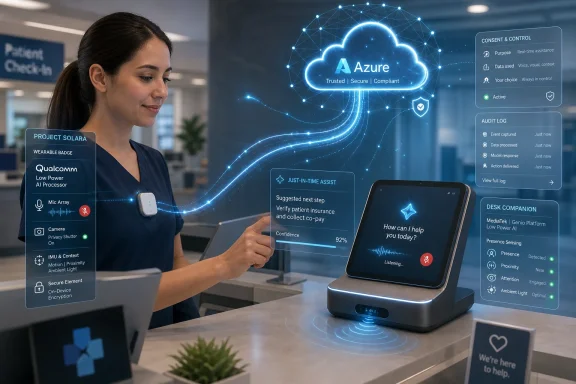
The portable reference design Microsoft discussed is a badge-like device. It has a touchscreen, biometric authentication, wireless connectivity including 5G, microphone and speaker hardware, a camera, and Qualcomm wearable silicon. The intended users are not hobbyists installing preview builds on spare machines; they are nurses, frontline workers, retail staff, information workers, and others who might benefit from an agent that is physically present throughout the workday.
That form factor makes the Solara pitch much easier to understand. A hospital nurse does not need a full desktop environment while moving between rooms. A retail manager does not need to unlock a laptop to ask what inventory needs attention. A field worker may need a device that can capture a voice note, summarize a conversation, surface a task, or hand off context to a larger system.
MediaTek, meanwhile, is attached to the stationary desk concept. That device is closer to a companion terminal: touchscreen, facial authentication, microphone controls, presence sensing, USB-C, wireless connectivity, and the ability to act as a companion to a Windows PC or even a Windows 365 client when connected to a display. In that scenario, Solara is not competing with the PC so much as orbiting it.
This split reveals Microsoft’s ambitions. Solara is not one gadget. It is a reference architecture for many agent-first endpoints, some worn, some mounted, some desk-bound, some perhaps invisible inside existing equipment. The PC becomes one participant in a wider agent fabric, not the sole stage on which computing happens.
Agents promise to reverse the flow. Instead of opening a calendar, email client, CRM, document editor, and chat thread, the user states an intent: prepare me for this meeting, summarize what changed, follow up with the team, create the report, book the trip, surface the urgent items. The agent then pulls from tools, data, and services behind the scenes.
This is the vision Microsoft has been building toward with Microsoft 365 Copilot, Copilot Studio, declarative agents, custom agents, and the Microsoft 365 Agents SDK. Solara extends the same idea into hardware. If the agent is the new unit of interaction, Microsoft wants devices designed around agents rather than apps retrofitted with chat boxes.
The hard part is that apps are not merely interface clutter. They are also boundaries. An app shows the user where they are, what data they are touching, what command they are invoking, and what system is responsible when something goes wrong. Agents blur those boundaries by design.
That is why the anti-app argument cannot stand alone. Microsoft must prove that agents can be not only more convenient than apps, but also more inspectable, governable, reversible, and secure. Otherwise the app grid may look old-fashioned, but it will still be the safer abstraction.
This is the piece that could make specialized agent devices economically plausible. Historically, new hardware categories struggle because they need software support before users buy them, but developers do not invest until there are users. Microsoft’s argument is that agents can reduce this cold-start problem by generating or adapting enough interface on demand to make smaller device categories useful.
That is a big claim. Responsive design made websites fit different screens, but it did not eliminate the need for design. Voice assistants made simple commands possible, but they did not replace rich applications. Generative UI could become powerful, but it also risks becoming inconsistent, unpredictable, and difficult to test.
Enterprise buyers will not tolerate an agent interface that changes so much that training, compliance, and support become impossible. Workers need consistency, especially in high-stakes settings like healthcare, retail operations, finance, and field service. A UI that is created on the fly still has to obey policy, preserve accessibility, expose consent, and make errors recoverable.
Microsoft appears to understand that the fully generative end state is not here yet. The company is positioning Solara somewhere between rigid responsive UI and unconstrained AI-generated screens. That middle ground is sensible. It is also where most of the engineering work will live.
Microsoft is emphasizing enterprise controls, biometric authentication, physical mic mute buttons, recording indicators, privacy switches, Entra ID integration, and Intune management. Those details matter because agent-first devices cannot rely on vague assurances about trust. If a badge can record a hallway conversation or a desk device can listen for a wake word, users need visible, hardware-level signals about what is happening.
The harder privacy problem is not only whether the device is listening. It is whether the agent is learning patterns from the user’s schedule, messages, conversations, location, priorities, and work relationships. The more useful the agent becomes, the more context it needs. The more context it has, the more dangerous a breach, misconfiguration, or overbroad policy becomes.
This is where Microsoft’s enterprise heritage helps and hurts. On one hand, the company understands identity, device management, compliance, retention, and auditability better than most consumer AI startups. On the other hand, Microsoft’s business customers are often employers, not individual workers. A device that makes management comfortable can still make employees uneasy.
Solara’s success may depend on whether Microsoft can make user control more than a slide-deck phrase. A physical mute switch is good. Clear recording indicators are good. But users will also need understandable logs, permission boundaries, data minimization, and a way to know when an agent acted, what it accessed, and why.
The desk concept makes that explicit. It can pair with a Windows PC, share state, hand off tasks, and serve as a Windows 365 client when attached to an external display. That means Solara could become a bridge between local Windows, cloud Windows, Microsoft 365, and agent-first hardware.
For administrators, this could be attractive. A managed Solara desk device might give workers quick access to Copilot, meetings, summaries, and task triage without requiring them to keep another full PC awake, patched, and exposed. For shared desks, frontline stations, or constrained environments, an agent-first companion could be easier to deploy than a traditional endpoint.
For Windows enthusiasts, the symbolism is more complicated. The PC used to be the universal device: if software mattered, it came to Windows. Solara suggests that Microsoft now sees some future computing experiences as too ambient, mobile, or task-specific for the PC model. The Windows desktop remains powerful, but it is no longer the default answer to every computing question.
That is not necessarily bad for Windows. A world of specialized devices still needs developer tools, identity, cloud services, security policy, and integration with the systems where real work gets done. If Microsoft can make Windows the command center and Solara devices the peripheral nervous system, the ecosystem expands rather than shrinks.
But that is a delicate balance. If agents become the main interface and cloud services become the main runtime, Windows risks becoming less visible. Microsoft has lived through that before, when the smartphone moved everyday computing away from the PC. Solara is partly an attempt not to miss the next shift in the same way.
This is how platform shifts often begin. The vendor shows a device that is not quite a product, a runtime that is not quite mature, and a developer story that is partly present tense and partly future tense. The goal is to get partners building before the market exists.
The risk is that developers have heard this kind of story before. Every major platform vendor has promised that a new abstraction would let software run everywhere with minimal rework. Sometimes it works well enough to change the industry. Often it works just enough to create demos, then collapses under the weight of real user expectations, performance limits, security demands, and edge cases.
Solara’s developer proposition will depend on whether agents can become portable in a meaningful way. If a Microsoft 365 agent can surface on a badge, desk device, PC, Teams chat, phone, and Windows 365 session while preserving identity, permissions, context, and UI coherence, developers have a reason to care. If each form factor still requires substantial custom work, Solara becomes another device program rather than a platform.
The most important developer question is not how to draw buttons on a tiny screen. It is how to define what an agent is allowed to do across systems. Permissions, tool invocation, handoffs, data grounding, memory, and audit trails will matter more than visual polish. The future Microsoft is describing is not app development with a smaller screen; it is workflow delegation with consequences.
A badge that can capture action items during a shift handoff, surface urgent operational tasks, or help a clinician document an interaction might justify itself if it saves minutes at scale. A desk companion that filters priority work, starts secure Copilot sessions, and hands off to Windows 365 might make sense in managed office environments. These are not science-fiction use cases; they are the tedious seams where work currently leaks time.
But enterprise pilots are also unforgiving. Devices must survive shared use, bad Wi-Fi, policy conflicts, battery complaints, accidental recordings, union concerns, accessibility requirements, support tickets, and skeptical workers who have already lived through too many productivity transformations. If Solara is merely impressive in a keynote, it will not survive the first deployment review.
The private pilot phase will also reveal whether agent-first hardware solves real problems or simply relocates them. If workers still need to verify everything in the original app, the agent becomes a notification layer. If the agent acts without enough confirmation, it becomes a liability. If the device captures too much context, it becomes a governance problem.
That is why Solara should be judged less by the elegance of the reference devices and more by the boring administrative surfaces around them. Enrollment, policy, logging, consent, update cadence, lifecycle management, and incident response will decide whether IT departments treat these devices as serious endpoints or experimental toys.
The contrast will be revealing. Apple tends to begin with consumer devices, polished interfaces, and tight hardware-software integration. Microsoft is beginning with enterprise workflows, cloud identity, manageability, and partner reference designs. Both companies are chasing the same broad transition, but from opposite cultural directions.
Apple’s advantage is trust in personal devices and control over hardware. Microsoft’s advantage is the workplace graph: email, calendars, files, chats, meetings, documents, identity, device policy, cloud infrastructure, and developer tools. An agent that understands work may be more valuable inside Microsoft’s ecosystem than inside any single piece of hardware.
But Apple also has a privacy narrative that Microsoft will have to answer. If Apple can run more agentic processing on-device while Microsoft’s model leans heavily on cloud orchestration, the comparison will be uncomfortable, especially for consumers. In enterprise, Microsoft can argue that cloud governance and compliance matter more than purely local computation. In public perception, the argument is harder.
This is the next platform race taking shape. It will not look exactly like Windows versus Mac, iOS versus Android, or Teams versus Slack. It will be a race to decide which company’s agent understands the user, which one is allowed to act, which one developers extend, and which one administrators trust.
Microsoft knows this, which is why Solara is being framed as early, conceptual, and enterprise-piloted rather than a mass-market replacement for the PC. Still, the ambition depends on a steep improvement curve. An agent-first device only works if the agent can be trusted to interpret intent, invoke tools, respect permissions, and recover from errors.
The reliability problem is different from the old app bug problem. When an app fails, the user often sees the failure in the interface. When an agent fails, the error may be hidden inside a chain of reasoning, retrieval, tool calls, policy checks, and generated output. That makes debugging harder for users and administrators alike.
There is also a responsibility problem. If an agent schedules the wrong meeting, sends the wrong summary, records the wrong conversation, or surfaces the wrong priority, who owns the mistake? The user who approved it? The developer who built the agent? Microsoft’s platform? The employer that deployed the device?
These questions do not make Solara impossible. They make it immature. The agent-first future requires not only better models, but better control planes. It needs clear approval thresholds, transaction logs, permission scopes, simulation modes, rollback mechanisms, and ways for humans to remain meaningfully in charge without babysitting every step.
But the real platform is trust. Not trust as a marketing noun, but trust as a system property: authentication, authorization, transparency, auditability, privacy, reliability, and user control. Without those, an always-present agent is not a digital partner. It is a managed microphone with ambitions.
Microsoft’s advantage is that it can embed Solara into systems enterprises already use. Intune can manage the device. Entra ID can authenticate the user. Microsoft 365 can provide work context. Azure can host and scale agent services. Windows 365 can extend the desktop when needed. That stack is hard for startups to replicate.
The disadvantage is that every layer also increases lock-in concerns. An enterprise that adopts Solara may not merely be buying devices; it may be deepening dependency on Microsoft’s identity, productivity, cloud, and AI stack. For many organizations, that is acceptable because they are already there. For others, it will be a reason to wait.
This is why Microsoft’s promise of multiple agents and bring-your-own-agent extensibility matters. If Solara becomes a Microsoft-only Copilot appliance category, its reach will be limited. If it becomes a governed runtime where third-party and internal agents can operate coherently, it has a much stronger claim to being a platform.
 Microsoft Is Trying to Move the Center of Gravity Before Someone Else Does
Project Solara arrives with the usual Microsoft language about platforms, ecosystems, and enterprise readiness, but the important part is simpler: Microsoft is preparing for a world where the computer is less a device you operate and more a network of agents you authorize. The company is not saying that apps vanish tomorrow, or that Windows becomes irrelevant overnight. It is saying that the point of interaction shifts upward, from the app and operating system to the agent that coordinates them.That is why Satya Nadella’s framing matters. Microsoft’s chief executive has spent the last several years describing AI as a platform shift rather than a feature wave, and Solara is the hardware-and-runtime expression of that argument. If Copilot was Microsoft’s attempt to inject AI into existing products, Solara is the attempt to imagine devices that do not begin with existing products at all.
For Windows users, that distinction is easy to miss. We have seen plenty of AI branding layered onto familiar software: Copilot in Windows, Copilot in Edge, Copilot in Office, Copilot in Teams, Copilot in the taskbar, and Copilot in places where many users would rather not see it. Solara is different because it asks what happens when the agent is not a sidebar attached to an app, but the primary reason the device exists.
That is both the promise and the danger. A well-designed agent-first device could collapse a dozen small workflows into a natural conversation, a glanceable card, or a one-tap action. A poorly designed one becomes another surveillance-shaped gadget that listens more than it helps and adds a cloud dependency to tasks that used to be local, visible, and under the user’s control.
The Operating System Becomes a Liminal Layer
Microsoft’s own description of Solara is striking because it avoids treating the operating system as the hero. The company describes the platform as chip-to-cloud, with intelligence distributed between local hardware and Azure-backed services. In plain English, the device is no longer the whole computer; it is a local access point into a larger agentic system.That idea is not entirely new. Smartphones already distribute work across local silicon, cloud services, notifications, identity systems, and app backends. Windows 365 already turns the PC into a client for a cloud-hosted desktop. What Solara does is make that distribution explicit and then design the interaction model around it.
Microsoft calls the operating system “liminal,” which is the kind of word that tends to appear when a platform vendor wants to sound philosophical while still retaining control of the stack. But the meaning is important. The OS is not disappearing; it is becoming a boundary layer between the user, the device, the cloud, and the agent runtime.
That boundary layer is where the practical questions begin. Who decides which computation happens on the device and which happens in the cloud? What data is stored locally, what is sent to Azure, and what is exposed to third-party agents? What happens when the network is poor, a policy blocks access, or a user needs to audit what the agent did?
Those are not edge cases for enterprise IT. They are the product.
Android Underneath, Microsoft on Top
One of the more telling details is that Solara is built around Microsoft’s Device Ecosystem Platform, an enterprise-grade operating system based on the Android Open Source Project rather than Windows. That will raise eyebrows in any Windows community, but it should not surprise anyone who has watched Microsoft’s hardware strategy since the Windows Phone collapse.Microsoft no longer has the luxury of insisting that every new form factor begins with Windows. Watches, badges, desk companions, point-of-sale devices, medical equipment, and purpose-built industrial hardware do not need the full Windows desktop. They need manageability, identity, security controls, connectivity, reliable silicon support, and a runtime that can surface the right experience at the right moment.
AOSP gives Microsoft a flexible embedded and mobile base without asking the company to reopen the old war over phone operating systems. The strategic layer is not the kernel or app store. It is Entra ID, Intune, Microsoft 365 Copilot, Work IQ, Azure, agent orchestration, and the management hooks that make a new device acceptable inside a regulated business.
This is classic modern Microsoft. The company is willing to concede the low-level platform if it can own the identity, management, productivity, and cloud layers above it. Windows remains essential on the PC, but Solara suggests Microsoft sees the next wave of agent hardware as too broad, too specialized, and too context-dependent to force through one desktop operating system.
For enthusiasts, that may feel like a demotion. For administrators, it may feel like pragmatism. If a Solara badge can be enrolled, authenticated, wiped, governed, and audited like any other managed endpoint, the underlying OS matters less than the operational model.
Qualcomm Supplies the Mobility Story, MediaTek Supplies the Room
Qualcomm’s role in the announcement is not incidental. Microsoft has spent years trying to make Arm-based Windows PCs more compelling, and Qualcomm has become central to the Copilot+ PC narrative. With Solara, Qualcomm brings a different kind of credibility: low-power, always-connected, sensor-rich devices that need to be useful without behaving like miniature laptops.The portable reference design Microsoft discussed is a badge-like device. It has a touchscreen, biometric authentication, wireless connectivity including 5G, microphone and speaker hardware, a camera, and Qualcomm wearable silicon. The intended users are not hobbyists installing preview builds on spare machines; they are nurses, frontline workers, retail staff, information workers, and others who might benefit from an agent that is physically present throughout the workday.
That form factor makes the Solara pitch much easier to understand. A hospital nurse does not need a full desktop environment while moving between rooms. A retail manager does not need to unlock a laptop to ask what inventory needs attention. A field worker may need a device that can capture a voice note, summarize a conversation, surface a task, or hand off context to a larger system.
MediaTek, meanwhile, is attached to the stationary desk concept. That device is closer to a companion terminal: touchscreen, facial authentication, microphone controls, presence sensing, USB-C, wireless connectivity, and the ability to act as a companion to a Windows PC or even a Windows 365 client when connected to a display. In that scenario, Solara is not competing with the PC so much as orbiting it.
This split reveals Microsoft’s ambitions. Solara is not one gadget. It is a reference architecture for many agent-first endpoints, some worn, some mounted, some desk-bound, some perhaps invisible inside existing equipment. The PC becomes one participant in a wider agent fabric, not the sole stage on which computing happens.
The Agent-First Pitch Is Really an Anti-App Pitch
Microsoft’s strongest argument for Solara is that apps are a poor fit for many real-world workflows. Apps require users to know where to go, which interface to open, which field to fill, which command to remember, and how to carry context from one system to another. That model works beautifully for power users and structured tasks, but it is clumsy for messy, cross-application work.Agents promise to reverse the flow. Instead of opening a calendar, email client, CRM, document editor, and chat thread, the user states an intent: prepare me for this meeting, summarize what changed, follow up with the team, create the report, book the trip, surface the urgent items. The agent then pulls from tools, data, and services behind the scenes.
This is the vision Microsoft has been building toward with Microsoft 365 Copilot, Copilot Studio, declarative agents, custom agents, and the Microsoft 365 Agents SDK. Solara extends the same idea into hardware. If the agent is the new unit of interaction, Microsoft wants devices designed around agents rather than apps retrofitted with chat boxes.
The hard part is that apps are not merely interface clutter. They are also boundaries. An app shows the user where they are, what data they are touching, what command they are invoking, and what system is responsible when something goes wrong. Agents blur those boundaries by design.
That is why the anti-app argument cannot stand alone. Microsoft must prove that agents can be not only more convenient than apps, but also more inspectable, governable, reversible, and secure. Otherwise the app grid may look old-fashioned, but it will still be the safer abstraction.
Just-in-Time UI Is the Most Ambitious and Most Fragile Piece
One of Solara’s most interesting ideas is just-in-time UI, Microsoft’s term for interfaces that adapt to the device, screen, task, and interaction mode without requiring developers to build a bespoke app for every form factor. In today’s terms, that might mean adaptive cards, structured content, and known layouts. In the longer term, it points toward dynamic or partially generated interfaces.This is the piece that could make specialized agent devices economically plausible. Historically, new hardware categories struggle because they need software support before users buy them, but developers do not invest until there are users. Microsoft’s argument is that agents can reduce this cold-start problem by generating or adapting enough interface on demand to make smaller device categories useful.
That is a big claim. Responsive design made websites fit different screens, but it did not eliminate the need for design. Voice assistants made simple commands possible, but they did not replace rich applications. Generative UI could become powerful, but it also risks becoming inconsistent, unpredictable, and difficult to test.
Enterprise buyers will not tolerate an agent interface that changes so much that training, compliance, and support become impossible. Workers need consistency, especially in high-stakes settings like healthcare, retail operations, finance, and field service. A UI that is created on the fly still has to obey policy, preserve accessibility, expose consent, and make errors recoverable.
Microsoft appears to understand that the fully generative end state is not here yet. The company is positioning Solara somewhere between rigid responsive UI and unconstrained AI-generated screens. That middle ground is sensible. It is also where most of the engineering work will live.
The Privacy Story Has to Be Physical, Not Just Contractual
Solara devices are built around microphones, cameras, presence sensors, authentication systems, and cloud-connected agents. That combination can be genuinely useful. It can also be creepy in the way only workplace technology can be creepy: always around, nominally optional, but practically hard to avoid.Microsoft is emphasizing enterprise controls, biometric authentication, physical mic mute buttons, recording indicators, privacy switches, Entra ID integration, and Intune management. Those details matter because agent-first devices cannot rely on vague assurances about trust. If a badge can record a hallway conversation or a desk device can listen for a wake word, users need visible, hardware-level signals about what is happening.
The harder privacy problem is not only whether the device is listening. It is whether the agent is learning patterns from the user’s schedule, messages, conversations, location, priorities, and work relationships. The more useful the agent becomes, the more context it needs. The more context it has, the more dangerous a breach, misconfiguration, or overbroad policy becomes.
This is where Microsoft’s enterprise heritage helps and hurts. On one hand, the company understands identity, device management, compliance, retention, and auditability better than most consumer AI startups. On the other hand, Microsoft’s business customers are often employers, not individual workers. A device that makes management comfortable can still make employees uneasy.
Solara’s success may depend on whether Microsoft can make user control more than a slide-deck phrase. A physical mute switch is good. Clear recording indicators are good. But users will also need understandable logs, permission boundaries, data minimization, and a way to know when an agent acted, what it accessed, and why.
This Is a Windows Story Even When Windows Is Not the OS
Project Solara is not a Windows product in the conventional sense, but it is absolutely a Windows story. Microsoft is redefining what counts as the edge of the Windows ecosystem. The PC still matters, but the workflows around the PC are becoming more distributed.The desk concept makes that explicit. It can pair with a Windows PC, share state, hand off tasks, and serve as a Windows 365 client when attached to an external display. That means Solara could become a bridge between local Windows, cloud Windows, Microsoft 365, and agent-first hardware.
For administrators, this could be attractive. A managed Solara desk device might give workers quick access to Copilot, meetings, summaries, and task triage without requiring them to keep another full PC awake, patched, and exposed. For shared desks, frontline stations, or constrained environments, an agent-first companion could be easier to deploy than a traditional endpoint.
For Windows enthusiasts, the symbolism is more complicated. The PC used to be the universal device: if software mattered, it came to Windows. Solara suggests that Microsoft now sees some future computing experiences as too ambient, mobile, or task-specific for the PC model. The Windows desktop remains powerful, but it is no longer the default answer to every computing question.
That is not necessarily bad for Windows. A world of specialized devices still needs developer tools, identity, cloud services, security policy, and integration with the systems where real work gets done. If Microsoft can make Windows the command center and Solara devices the peripheral nervous system, the ecosystem expands rather than shrinks.
But that is a delicate balance. If agents become the main interface and cloud services become the main runtime, Windows risks becoming less visible. Microsoft has lived through that before, when the smartphone moved everyday computing away from the PC. Solara is partly an attempt not to miss the next shift in the same way.
Developers Are Being Asked to Build for a Platform That Is Still Mostly a Thesis
Microsoft is telling developers that if they are building agents today with Microsoft 365, Copilot Studio, Azure, the Microsoft 365 Agents SDK, or related frameworks, they are already preparing for Solara. That is a useful message, because the hardware ecosystem is not yet real enough for developers to target in the traditional sense. There are concepts, pilots, reference designs, and a direction of travel.This is how platform shifts often begin. The vendor shows a device that is not quite a product, a runtime that is not quite mature, and a developer story that is partly present tense and partly future tense. The goal is to get partners building before the market exists.
The risk is that developers have heard this kind of story before. Every major platform vendor has promised that a new abstraction would let software run everywhere with minimal rework. Sometimes it works well enough to change the industry. Often it works just enough to create demos, then collapses under the weight of real user expectations, performance limits, security demands, and edge cases.
Solara’s developer proposition will depend on whether agents can become portable in a meaningful way. If a Microsoft 365 agent can surface on a badge, desk device, PC, Teams chat, phone, and Windows 365 session while preserving identity, permissions, context, and UI coherence, developers have a reason to care. If each form factor still requires substantial custom work, Solara becomes another device program rather than a platform.
The most important developer question is not how to draw buttons on a tiny screen. It is how to define what an agent is allowed to do across systems. Permissions, tool invocation, handoffs, data grounding, memory, and audit trails will matter more than visual polish. The future Microsoft is describing is not app development with a smaller screen; it is workflow delegation with consequences.
Enterprise Pilots Are the Right Place to Start, and the Hardest Place to Hide
Microsoft says it plans private pilots with large organizations across industries including retail, healthcare, weather, and consumer services. That is the right move. Consumer AI gadgets have struggled because they often ask individuals to buy a new device for a vague promise. Enterprises, by contrast, have specific workflows, measurable pain points, and budgets for devices that save time or reduce friction.A badge that can capture action items during a shift handoff, surface urgent operational tasks, or help a clinician document an interaction might justify itself if it saves minutes at scale. A desk companion that filters priority work, starts secure Copilot sessions, and hands off to Windows 365 might make sense in managed office environments. These are not science-fiction use cases; they are the tedious seams where work currently leaks time.
But enterprise pilots are also unforgiving. Devices must survive shared use, bad Wi-Fi, policy conflicts, battery complaints, accidental recordings, union concerns, accessibility requirements, support tickets, and skeptical workers who have already lived through too many productivity transformations. If Solara is merely impressive in a keynote, it will not survive the first deployment review.
The private pilot phase will also reveal whether agent-first hardware solves real problems or simply relocates them. If workers still need to verify everything in the original app, the agent becomes a notification layer. If the agent acts without enough confirmation, it becomes a liability. If the device captures too much context, it becomes a governance problem.
That is why Solara should be judged less by the elegance of the reference devices and more by the boring administrative surfaces around them. Enrollment, policy, logging, consent, update cadence, lifecycle management, and incident response will decide whether IT departments treat these devices as serious endpoints or experimental toys.
Apple’s Shadow Makes the Timing Louder
The timing of the announcement is hard to ignore. Apple’s developer conference follows shortly after Microsoft’s Build window, and the industry is waiting to see how Apple reframes Siri, on-device intelligence, and agent-like automation across its ecosystem. Microsoft and Qualcomm are effectively planting a flag before Apple tells its own story.The contrast will be revealing. Apple tends to begin with consumer devices, polished interfaces, and tight hardware-software integration. Microsoft is beginning with enterprise workflows, cloud identity, manageability, and partner reference designs. Both companies are chasing the same broad transition, but from opposite cultural directions.
Apple’s advantage is trust in personal devices and control over hardware. Microsoft’s advantage is the workplace graph: email, calendars, files, chats, meetings, documents, identity, device policy, cloud infrastructure, and developer tools. An agent that understands work may be more valuable inside Microsoft’s ecosystem than inside any single piece of hardware.
But Apple also has a privacy narrative that Microsoft will have to answer. If Apple can run more agentic processing on-device while Microsoft’s model leans heavily on cloud orchestration, the comparison will be uncomfortable, especially for consumers. In enterprise, Microsoft can argue that cloud governance and compliance matter more than purely local computation. In public perception, the argument is harder.
This is the next platform race taking shape. It will not look exactly like Windows versus Mac, iOS versus Android, or Teams versus Slack. It will be a race to decide which company’s agent understands the user, which one is allowed to act, which one developers extend, and which one administrators trust.
The AI Agent Era Still Has a Reliability Debt
The most obvious objection to Solara is also the most important: today’s AI agents are not yet reliable enough to become the main interface for serious computing. They can summarize, draft, classify, retrieve, and automate. They can also hallucinate, misunderstand context, overreach, fail silently, and produce answers that sound more certain than they are.Microsoft knows this, which is why Solara is being framed as early, conceptual, and enterprise-piloted rather than a mass-market replacement for the PC. Still, the ambition depends on a steep improvement curve. An agent-first device only works if the agent can be trusted to interpret intent, invoke tools, respect permissions, and recover from errors.
The reliability problem is different from the old app bug problem. When an app fails, the user often sees the failure in the interface. When an agent fails, the error may be hidden inside a chain of reasoning, retrieval, tool calls, policy checks, and generated output. That makes debugging harder for users and administrators alike.
There is also a responsibility problem. If an agent schedules the wrong meeting, sends the wrong summary, records the wrong conversation, or surfaces the wrong priority, who owns the mistake? The user who approved it? The developer who built the agent? Microsoft’s platform? The employer that deployed the device?
These questions do not make Solara impossible. They make it immature. The agent-first future requires not only better models, but better control planes. It needs clear approval thresholds, transaction logs, permission scopes, simulation modes, rollback mechanisms, and ways for humans to remain meaningfully in charge without babysitting every step.
The Real Platform Is Trust, Not Silicon
The phrase chip-to-cloud makes Solara sound like a hardware story, and silicon matters. Efficient local inference, always-on sensing, battery life, secure enclaves, connectivity, and thermal constraints will shape what these devices can do. Qualcomm and MediaTek are not decoration; they are necessary for making agent-first devices practical outside a laptop shell.But the real platform is trust. Not trust as a marketing noun, but trust as a system property: authentication, authorization, transparency, auditability, privacy, reliability, and user control. Without those, an always-present agent is not a digital partner. It is a managed microphone with ambitions.
Microsoft’s advantage is that it can embed Solara into systems enterprises already use. Intune can manage the device. Entra ID can authenticate the user. Microsoft 365 can provide work context. Azure can host and scale agent services. Windows 365 can extend the desktop when needed. That stack is hard for startups to replicate.
The disadvantage is that every layer also increases lock-in concerns. An enterprise that adopts Solara may not merely be buying devices; it may be deepening dependency on Microsoft’s identity, productivity, cloud, and AI stack. For many organizations, that is acceptable because they are already there. For others, it will be a reason to wait.
This is why Microsoft’s promise of multiple agents and bring-your-own-agent extensibility matters. If Solara becomes a Microsoft-only Copilot appliance category, its reach will be limited. If it becomes a governed runtime where third-party and internal agents can operate coherently, it has a much stronger claim to being a platform.
The Solara Bet Comes Down to These Enterprise Realities
Project Solara is early enough that skepticism is not only fair, but necessary. The announcement sketches a plausible future, not a finished market. The useful way to read it is as a map of where Microsoft wants developers, hardware partners, and IT departments to start placing their bets.- Microsoft is positioning agents as the next interaction layer above apps and operating systems, rather than merely as features inside existing products.
- Project Solara is aimed first at specialized enterprise devices, including portable badge-like hardware and stationary desk companions, not at replacing consumer PCs overnight.
- The platform’s practical foundation is Microsoft’s cloud, identity, management, and productivity stack, with AOSP-based device software underneath rather than traditional Windows.
- Qualcomm and MediaTek give Microsoft credible silicon paths for low-power, connected, sensor-rich devices across mobile, wearable, desk, and embedded scenarios.
- The hardest problems are not demos or form factors, but privacy, consent, reliability, auditability, and whether agents can act across workflows without becoming opaque automation.
- Windows remains central to Microsoft’s ecosystem, but Solara shows that Microsoft is preparing for a future in which the most important computing surface may not always look like a PC.
References
- Primary source: secnews.gr
Published: 2026-06-03T09:42:12.635017
Microsoft Project Solara: Moving from OS and Apps to AI Agents
Microsoft announces Project Solara, a "chip-to-cloud" platform that will form the basis for the next generation of AI agents.www.secnews.gr - Related coverage: qualcomm.com
Project Solara: The Shift to Agent-First Computing | Qualcomm
Learn how Qualcomm and Microsoft are driving the shift to agent-first computing with Project Solara, a new chip-to-cloud platform for seamless AI experiences.www.qualcomm.com - Related coverage: 9to5mac.com
Microsoft CEO: We’re moving from OS and apps to agents instead - 9to5Mac
Microsoft CEO Satya Nadella shared an interesting quote today on the company’s vision for an AI agent-first computing future.9to5mac.com - Official source: commandline.microsoft.com
Composing a new platform for agent-first devices - Command Line
New interaction technology enables new types of computers. Learn more about Microsoft’s Project Solara.commandline.microsoft.com - Related coverage: techtimes.com
Microsoft Unveils Project Solara: AI Agents to Replace Platforms, OS via Chip-to-Cloud Tech
Microsoft’s massive plans for AI agents have been unveiled during Build 2026, including the new Project Solara.www.techtimes.com - Related coverage: arstechnica.com
Microsoft's Project Solara is an Android OS designed for agents instead of apps - Ars Technica
Microsoft missed the boat on apps, so get ready for agents.arstechnica.com
- Related coverage: business-standard.com
Microsoft bets on AI agents, not apps, and dynamic UI with Project Solara
Microsoft Project Solara: Project Solara rethinks computing with AI agents replacing apps, dynamic interfaces adapting in real time, and hardware designed around tasks instead of traditional software workflowswww.business-standard.com - Related coverage: gigazine.net
Microsoft has announced 'Project Solara,' a new platform for AI agent-dedicated devices, creating an agent-centric system using an Android-based OS rather than Windows. - GIGAZINE
At its developer event, ' Microsoft Build 2026, ' held in San Francisco, USA on June 2, 2026, Microsoft announced ' Project Solara, ' a new device platform that operates primarily with AI agents. Microsoft positions Project Solara not merely as an OS, but as a 'chip-to-cloud' platform spanning...gigazine.net - Related coverage: engadget.com
Microsoft Announces Project Solara, Its Take On An AI Agent Platform
The company demoed Solara on an Echo Show-style smart display and a smart key badge.www.engadget.com - Official source: news.microsoft.com
- Related coverage: s204.q4cdn.com
Qualcomm Collaborates with Microsoft to Accelerate Cloud Services on 10nm Qualcomm Centriq 2400 Platform
PDF documents204.q4cdn.com
