

Microsoft used Build 2026 in San Francisco to preview Project Solara, a chip-to-cloud platform for agent-first enterprise devices that runs on an Android Open Source Project foundation rather than Windows. The company is not reviving Windows Phone, and it is not announcing a consumer handset. It is doing something more revealing: treating Android-derived plumbing, Azure identity, Copilot agents, and purpose-built hardware as the ingredients for Microsoft’s next mobile play. The result is a strategy that says the future of Microsoft mobility may not be a phone at all, but a managed endpoint for AI.
The most important thing about Project Solara is not that it looks mobile. It is that Microsoft no longer appears interested in winning mobility by recreating the smartphone stack.
That is a hard-earned conclusion. Windows Phone was elegant, disciplined, and doomed by the same gravitational force that has crushed almost every third mobile ecosystem: apps. The Nokia acquisition gave Microsoft hardware scale but not developer gravity. Surface Duo tried to smuggle Microsoft’s productivity worldview into Android hardware, but the device never became a mainstream category.
Project Solara reads like a company that has internalized those failures. It does not ask developers to port their apps to a Microsoft mobile operating system. It does not ask consumers to choose a Microsoft phone instead of an iPhone or Galaxy. It asks a different question: if AI agents become the thing users actually interact with, how much of the traditional mobile platform still matters?
That is the wager underneath the Build demo. Microsoft is not saying Windows has no role in the future of computing. It is saying that the next class of useful computers may be too small, too specialized, too embedded, or too task-specific to justify Windows at all.
But Solara is not Android in the consumer sense. It is not about Google Play, familiar app grids, launcher customization, or the vast software culture that makes Android Android. AOSP here is closer to industrial substrate: an operating base that Microsoft can manage, harden, update, and wrap in its own cloud identity and agent experience.
That distinction is why the “Microsoft ditches Windows for Android” framing is true but incomplete. Microsoft is not choosing Android because it wants to become another Android OEM. It is choosing AOSP because the low-level economics of mobile hardware have already been solved there.
Windows remains Microsoft’s center of gravity on PCs. But in smart displays, workplace badges, room systems, kiosks, point-of-sale devices, and wearables, Windows is often too much operating system for too narrow a job. Solara effectively concedes that the Microsoft platform can win without the Windows kernel being present.
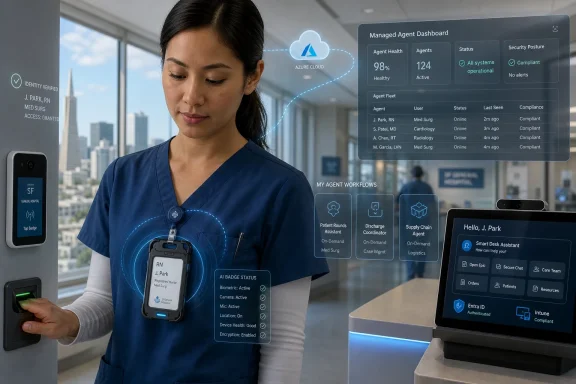
That tension is the point. Microsoft’s demo framed the badge in a healthcare setting, where a worker could receive tasks, scan information, authenticate with biometrics, and invoke AI assistance by voice. In that environment, a phone is often too personal, too distracting, too app-heavy, or too hard to secure around shared workflows.
A badge, by contrast, is already part of the uniform. It belongs to the workplace before it belongs to the worker. That makes it a clever Trojan horse for enterprise AI: Microsoft can introduce a new computing surface without asking an employee to carry another conventional device.
The choice of healthcare is also not accidental. Hospitals and clinics are full of information-dense, time-sensitive workflows where the computer is often in the wrong place. A nurse, technician, or clinician may need hands-free access, identity-aware task routing, and quick data capture more than they need a full desktop or phone. Solara’s badge prototype is Microsoft’s argument that the right computer may be the one hanging from your neck.
Microsoft has already spent years turning meeting rooms and shared workspaces into managed computing environments through Teams Rooms, Intune, Entra ID, and certified device programs. Solara extends that logic into the agent era. Instead of treating a room display as merely a video endpoint, Microsoft wants it to become a local face for cloud-hosted agents.
This is where the phrase chip-to-cloud earns its keep. The chip matters because latency, sensors, local interaction, and trusted hardware matter. The cloud matters because agents need state, permissions, organizational data, orchestration, and model access that no tiny badge or desk puck can fully contain.
In other words, Solara’s hardware is not meant to be powerful in the old PC sense. It is meant to be present, authenticated, manageable, and close to the task.
That is a real strategic advantage. The modern app ecosystem is mature, saturated, and hostile to new entrants. By contrast, the agent ecosystem is still being defined. Microsoft would much rather compete at the layer of identity, management, productivity data, and AI orchestration than at the layer of mobile app downloads.
But this trade has a cost. The app model, for all its clutter, gives users a visible map of what software is installed and what it roughly does. Agents blur those boundaries. They act across services, summarize data, initiate workflows, and make suggestions in contexts where the interface may be a tiny screen or a voice prompt.
That creates a different trust problem. With Solara, the question is not “does this device have the app I need?” It is “what exactly can this agent see, decide, remember, and do on my behalf?” For enterprise IT, that is both a governance opportunity and a governance headache.
A badge that scans, authenticates, and relays tasks may feel dystopian in a consumer context. In a hospital, factory, warehouse, retail floor, or field-service environment, it can be pitched as a productivity tool. The same hardware that would look awkward at a coffee shop can look natural on a shift.
This is also where Microsoft’s stack is strongest. Entra ID gives the company identity leverage. Intune gives it device management leverage. Azure gives it cloud and data leverage. Copilot gives it a branded AI front end. Windows may be absent from the device, but Microsoft’s enterprise control plane is everywhere around it.
That control plane is the actual product. Hardware makers may build the badge, the desk display, the wearable, or whatever comes next. Microsoft wants to define the requirements, the management model, the agent shell, and the developer target.
Solara is a spiritual successor to that ambition, but with a more pragmatic base. Instead of shrinking Windows down until it fits, Microsoft is starting from an AOSP platform that already speaks the language of mobile silicon. Instead of assuming the desktop metaphor should follow users everywhere, Microsoft is assuming agents will adapt the interface to the job.
That is a significant philosophical shift. Earlier Microsoft mobile efforts often carried Windows’ assumptions into smaller devices. Solara carries Microsoft’s cloud and management assumptions into devices that may not feel like Windows at all.
This is why Solara matters to WindowsForum readers even if it never boots a Windows shell. The center of Microsoft gravity is moving from “Windows as the interface” to “Microsoft as the managed intelligence layer.” Windows remains critical, but it is no longer the only surface where Microsoft expects work to happen.
AI agents need access points. Some of those access points will be PCs and phones. Others will be ambient, wearable, or embedded. If the agent is the user’s continuity layer, then the device can become more disposable, more specialized, and more context-aware.
That is the dream. The nightmare is a drawer full of half-useful AI gadgets that duplicate phone features while adding new privacy risks. The post-smartphone device graveyard is crowded: smart glasses, AI pins, assistant speakers, watches that overpromised, and workplace gadgets that never escaped pilot purgatory.
Microsoft’s enterprise-first strategy protects it from some of that consumer skepticism. A retail chain or hospital network does not need a Solara badge to be fashionable. It needs it to reduce friction, save time, document work, and satisfy compliance. If it cannot do those things, no amount of agent rhetoric will save it.
That sounds liberating until one considers the design burden. A task that works on a desktop Copilot pane may need to become a glanceable card on a badge, a spoken confirmation through an earbud, a visual overlay in smartglasses, or a shared prompt on a desk display. The same agent may need to behave differently depending on whether the user is alone, in a meeting, in a patient room, on a shop floor, or driving a forklift.
This is where Microsoft’s platform work will either shine or collapse. If Solara gives developers a coherent way to declare capabilities, permissions, context, and UI adaptation, it could become a serious enterprise target. If every device requires bespoke behavior and custom integration, Solara will become another expensive pilot platform with impressive demos and limited deployment.
The phrase agent-first can conceal a lot of implementation pain. Agents still need data access, APIs, audit logs, fallback paths, error handling, identity boundaries, and human override. The smaller and more ambient the device, the less room there is for ambiguity.
That could be powerful. It could also be a security team’s migraine. The badge prototype alone raises questions about recording controls, data retention, physical loss, remote wipe, biometric handling, network segmentation, and what happens when an agent misreads a situation. In regulated industries, the difference between assistance and unauthorized disclosure can be one badly designed workflow.
Microsoft’s advantage is that it knows how to sell governance. It can wrap Solara in Intune policies, Entra conditional access, hardware attestation, compliance dashboards, and procurement language that reassures CIOs. That does not eliminate risk, but it makes the risk legible to the people who buy enterprise technology.
The harder problem is social. Workers may not welcome AI-enabled badges if they feel like surveillance tools. Customers and patients may not know when they are being scanned, summarized, or assisted by an agent. The technical architecture can be secure and still fail the trust test.
The real shift is that Microsoft is now willing to let Windows sit out categories where it is not the natural fit. That is healthier than trying to force every device into the Windows lineage. It also reflects the Satya Nadella-era Microsoft that prioritizes services, cloud, identity, and developer reach over operating system purity.
For Windows users, this may feel strange. Microsoft spent decades training the industry to associate its platform power with the Windows desktop. Solara says that in the next phase, the platform may be the agent, the identity graph, the management layer, and the cloud state — while the local OS fades into the background.
That does not make Windows irrelevant. It makes Windows one endpoint among many in a Microsoft-controlled workflow. The PC remains the place where complex work is composed. Solara devices may become the places where fragments of that work are captured, delegated, confirmed, or acted upon.
Qualcomm and MediaTek involvement gives Solara credibility on the silicon side. Enterprise pilots with recognizable customers would give it credibility on the deployment side. But credibility is not adoption.
The hardware must be boringly good. Battery life must match shifts, not demos. Cameras must work in bad lighting. Voice input must survive noisy floors. Displays must be readable. Devices must be rugged, cleanable, replaceable, and cheap enough to deploy at scale. An AI badge that costs too much or breaks too often will be remembered as another futuristic curiosity.
Microsoft also has to resist the urge to overgeneralize. The best Solara devices may be deeply specific: a clinical badge, a retail task screen, a factory inspection wearable, a field-service assistant. The more Microsoft tries to sell one universal “next computer,” the more it risks repeating the old platform fantasy that one interface can conquer every context.
 Microsoft Has Stopped Trying to Make the Phone the Prize
The most important thing about Project Solara is not that it looks mobile. It is that Microsoft no longer appears interested in winning mobility by recreating the smartphone stack.That is a hard-earned conclusion. Windows Phone was elegant, disciplined, and doomed by the same gravitational force that has crushed almost every third mobile ecosystem: apps. The Nokia acquisition gave Microsoft hardware scale but not developer gravity. Surface Duo tried to smuggle Microsoft’s productivity worldview into Android hardware, but the device never became a mainstream category.
Project Solara reads like a company that has internalized those failures. It does not ask developers to port their apps to a Microsoft mobile operating system. It does not ask consumers to choose a Microsoft phone instead of an iPhone or Galaxy. It asks a different question: if AI agents become the thing users actually interact with, how much of the traditional mobile platform still matters?
That is the wager underneath the Build demo. Microsoft is not saying Windows has no role in the future of computing. It is saying that the next class of useful computers may be too small, too specialized, too embedded, or too task-specific to justify Windows at all.
Android Is the Admission Price, Not the Destination
The Android angle is both obvious and easy to overstate. Project Solara relies on Microsoft Device Ecosystem Platform, or MDEP, an enterprise-grade platform built on AOSP. That matters because AOSP gives Microsoft and hardware partners a mature base for ARM devices, touchscreens, radios, sensors, cameras, audio, and power management without asking them to rebuild the entire mobile stack from scratch.But Solara is not Android in the consumer sense. It is not about Google Play, familiar app grids, launcher customization, or the vast software culture that makes Android Android. AOSP here is closer to industrial substrate: an operating base that Microsoft can manage, harden, update, and wrap in its own cloud identity and agent experience.
That distinction is why the “Microsoft ditches Windows for Android” framing is true but incomplete. Microsoft is not choosing Android because it wants to become another Android OEM. It is choosing AOSP because the low-level economics of mobile hardware have already been solved there.
Windows remains Microsoft’s center of gravity on PCs. But in smart displays, workplace badges, room systems, kiosks, point-of-sale devices, and wearables, Windows is often too much operating system for too narrow a job. Solara effectively concedes that the Microsoft platform can win without the Windows kernel being present.
The ID Badge Is a Phone Wearing a Corporate Costume
The most provocative Solara prototype is the wearable badge. On paper, it sounds suspiciously like a small smartphone: touchscreen, fingerprint sensor, camera, microphones, speakers, Wi-Fi, 5G, and a Qualcomm processor. The form factor says “enterprise credential.” The parts list says “mobile computer.”That tension is the point. Microsoft’s demo framed the badge in a healthcare setting, where a worker could receive tasks, scan information, authenticate with biometrics, and invoke AI assistance by voice. In that environment, a phone is often too personal, too distracting, too app-heavy, or too hard to secure around shared workflows.
A badge, by contrast, is already part of the uniform. It belongs to the workplace before it belongs to the worker. That makes it a clever Trojan horse for enterprise AI: Microsoft can introduce a new computing surface without asking an employee to carry another conventional device.
The choice of healthcare is also not accidental. Hospitals and clinics are full of information-dense, time-sensitive workflows where the computer is often in the wrong place. A nurse, technician, or clinician may need hands-free access, identity-aware task routing, and quick data capture more than they need a full desktop or phone. Solara’s badge prototype is Microsoft’s argument that the right computer may be the one hanging from your neck.
The Desk Device Shows Microsoft Wants Agents to Have Rooms, Not Just Screens
The second prototype, a MediaTek-powered smart display, is less dramatic but just as important. It places Solara in the familiar territory of desk companions, meeting room controllers, and Echo Show-like appliances. That makes the platform feel less like a one-off wearable experiment and more like a general-purpose layer for specialized endpoints.Microsoft has already spent years turning meeting rooms and shared workspaces into managed computing environments through Teams Rooms, Intune, Entra ID, and certified device programs. Solara extends that logic into the agent era. Instead of treating a room display as merely a video endpoint, Microsoft wants it to become a local face for cloud-hosted agents.
This is where the phrase chip-to-cloud earns its keep. The chip matters because latency, sensors, local interaction, and trusted hardware matter. The cloud matters because agents need state, permissions, organizational data, orchestration, and model access that no tiny badge or desk puck can fully contain.
In other words, Solara’s hardware is not meant to be powerful in the old PC sense. It is meant to be present, authenticated, manageable, and close to the task.
The App Store Problem Gets Replaced by the Agent Trust Problem
Microsoft’s most elegant move with Solara is that it sidesteps the app-store deficit that killed Windows Phone. If the primary interaction model is an agent shell that summons task-specific capabilities on demand, then the device does not need a billion apps. It needs reliable agents, secure connectors, useful interfaces, and permission models that users and administrators can understand.That is a real strategic advantage. The modern app ecosystem is mature, saturated, and hostile to new entrants. By contrast, the agent ecosystem is still being defined. Microsoft would much rather compete at the layer of identity, management, productivity data, and AI orchestration than at the layer of mobile app downloads.
But this trade has a cost. The app model, for all its clutter, gives users a visible map of what software is installed and what it roughly does. Agents blur those boundaries. They act across services, summarize data, initiate workflows, and make suggestions in contexts where the interface may be a tiny screen or a voice prompt.
That creates a different trust problem. With Solara, the question is not “does this device have the app I need?” It is “what exactly can this agent see, decide, remember, and do on my behalf?” For enterprise IT, that is both a governance opportunity and a governance headache.
Enterprise Is the Only Plausible Starting Point
Microsoft is wise to start Solara with businesses rather than consumers. Enterprises already buy specialized devices. They already manage fleets. They already accept tradeoffs that consumers reject, provided the device improves workflow, compliance, or labor efficiency.A badge that scans, authenticates, and relays tasks may feel dystopian in a consumer context. In a hospital, factory, warehouse, retail floor, or field-service environment, it can be pitched as a productivity tool. The same hardware that would look awkward at a coffee shop can look natural on a shift.
This is also where Microsoft’s stack is strongest. Entra ID gives the company identity leverage. Intune gives it device management leverage. Azure gives it cloud and data leverage. Copilot gives it a branded AI front end. Windows may be absent from the device, but Microsoft’s enterprise control plane is everywhere around it.
That control plane is the actual product. Hardware makers may build the badge, the desk display, the wearable, or whatever comes next. Microsoft wants to define the requirements, the management model, the agent shell, and the developer target.
The Return of Windows CE, Without Saying Windows CE
There is an old Microsoft pattern hiding inside this new AI vocabulary. For decades, the company has wanted a role in the computing devices that are not quite PCs: handhelds, terminals, embedded systems, industrial controllers, room devices, automotive dashboards, and ruggedized mobile gear. Windows CE, Windows Embedded, Windows Mobile, and Windows IoT all tried to make Microsoft relevant beyond the desktop.Solara is a spiritual successor to that ambition, but with a more pragmatic base. Instead of shrinking Windows down until it fits, Microsoft is starting from an AOSP platform that already speaks the language of mobile silicon. Instead of assuming the desktop metaphor should follow users everywhere, Microsoft is assuming agents will adapt the interface to the job.
That is a significant philosophical shift. Earlier Microsoft mobile efforts often carried Windows’ assumptions into smaller devices. Solara carries Microsoft’s cloud and management assumptions into devices that may not feel like Windows at all.
This is why Solara matters to WindowsForum readers even if it never boots a Windows shell. The center of Microsoft gravity is moving from “Windows as the interface” to “Microsoft as the managed intelligence layer.” Windows remains critical, but it is no longer the only surface where Microsoft expects work to happen.
Wearables Are the Real Prize, Even If Microsoft Is Being Careful
Microsoft’s promotional material hints at a broader universe: smartwatches, rings, earbuds, smartglasses, and other small devices. The company has not announced a consumer product line, and it would be foolish to pretend Solara smartglasses are around the corner. But the outlines are clear enough.AI agents need access points. Some of those access points will be PCs and phones. Others will be ambient, wearable, or embedded. If the agent is the user’s continuity layer, then the device can become more disposable, more specialized, and more context-aware.
That is the dream. The nightmare is a drawer full of half-useful AI gadgets that duplicate phone features while adding new privacy risks. The post-smartphone device graveyard is crowded: smart glasses, AI pins, assistant speakers, watches that overpromised, and workplace gadgets that never escaped pilot purgatory.
Microsoft’s enterprise-first strategy protects it from some of that consumer skepticism. A retail chain or hospital network does not need a Solara badge to be fashionable. It needs it to reduce friction, save time, document work, and satisfy compliance. If it cannot do those things, no amount of agent rhetoric will save it.
Developers Are Being Asked to Build for Places, Not Just Platforms
For developers, the Solara pitch is subtle but important. Microsoft is not merely asking them to build another Copilot extension. It is asking them to imagine agents that can appear across form factors with radically different input and output constraints.That sounds liberating until one considers the design burden. A task that works on a desktop Copilot pane may need to become a glanceable card on a badge, a spoken confirmation through an earbud, a visual overlay in smartglasses, or a shared prompt on a desk display. The same agent may need to behave differently depending on whether the user is alone, in a meeting, in a patient room, on a shop floor, or driving a forklift.
This is where Microsoft’s platform work will either shine or collapse. If Solara gives developers a coherent way to declare capabilities, permissions, context, and UI adaptation, it could become a serious enterprise target. If every device requires bespoke behavior and custom integration, Solara will become another expensive pilot platform with impressive demos and limited deployment.
The phrase agent-first can conceal a lot of implementation pain. Agents still need data access, APIs, audit logs, fallback paths, error handling, identity boundaries, and human override. The smaller and more ambient the device, the less room there is for ambiguity.
Security Is the Selling Point and the Attack Surface
Microsoft is presenting Solara as enterprise-grade, and it has to. A device with a camera, microphones, biometric authentication, 5G, workplace identity, and AI access is not merely another endpoint. It is a roving sensor attached to corporate permissions.That could be powerful. It could also be a security team’s migraine. The badge prototype alone raises questions about recording controls, data retention, physical loss, remote wipe, biometric handling, network segmentation, and what happens when an agent misreads a situation. In regulated industries, the difference between assistance and unauthorized disclosure can be one badly designed workflow.
Microsoft’s advantage is that it knows how to sell governance. It can wrap Solara in Intune policies, Entra conditional access, hardware attestation, compliance dashboards, and procurement language that reassures CIOs. That does not eliminate risk, but it makes the risk legible to the people who buy enterprise technology.
The harder problem is social. Workers may not welcome AI-enabled badges if they feel like surveillance tools. Customers and patients may not know when they are being scanned, summarized, or assisted by an agent. The technical architecture can be secure and still fail the trust test.
This Is Not a Windows Failure Story
It is tempting to frame Solara as another defeat for Windows in mobile. That misses the bigger story. Windows did not lose the badge market, the smart ring market, or the AI desk companion market, because those markets do not yet exist in a mature form.The real shift is that Microsoft is now willing to let Windows sit out categories where it is not the natural fit. That is healthier than trying to force every device into the Windows lineage. It also reflects the Satya Nadella-era Microsoft that prioritizes services, cloud, identity, and developer reach over operating system purity.
For Windows users, this may feel strange. Microsoft spent decades training the industry to associate its platform power with the Windows desktop. Solara says that in the next phase, the platform may be the agent, the identity graph, the management layer, and the cloud state — while the local OS fades into the background.
That does not make Windows irrelevant. It makes Windows one endpoint among many in a Microsoft-controlled workflow. The PC remains the place where complex work is composed. Solara devices may become the places where fragments of that work are captured, delegated, confirmed, or acted upon.
The Hardware Partners Will Decide Whether Solara Is a Platform or a Demo
Microsoft says it is showing reference designs, not necessarily shipping its own Solara hardware. That is the right posture, but it also introduces the usual platform chicken-and-egg problem. A platform becomes real when partners ship devices, customers deploy them, and developers have enough incentive to support them.Qualcomm and MediaTek involvement gives Solara credibility on the silicon side. Enterprise pilots with recognizable customers would give it credibility on the deployment side. But credibility is not adoption.
The hardware must be boringly good. Battery life must match shifts, not demos. Cameras must work in bad lighting. Voice input must survive noisy floors. Displays must be readable. Devices must be rugged, cleanable, replaceable, and cheap enough to deploy at scale. An AI badge that costs too much or breaks too often will be remembered as another futuristic curiosity.
Microsoft also has to resist the urge to overgeneralize. The best Solara devices may be deeply specific: a clinical badge, a retail task screen, a factory inspection wearable, a field-service assistant. The more Microsoft tries to sell one universal “next computer,” the more it risks repeating the old platform fantasy that one interface can conquer every context.
The Badge Is Small, but the Bet Is Enormous
Project Solara is best understood as a test of whether Microsoft can turn AI agents into an enterprise device ecosystem before Apple, Google, Samsung, Meta, or a new hardware startup defines the category. The near-term story is not consumer disruption. It is whether businesses will accept a new class of managed, sensor-rich, agent-centered endpoints.- Project Solara is a Microsoft chip-to-cloud platform for agent-first devices, not a Windows Phone revival.
- Microsoft is using an AOSP-based foundation through MDEP because mobile and embedded hardware already run well on that stack.
- The first public concepts — a wearable badge and a desk display — are aimed at enterprise workflows rather than consumers.
- The platform’s success depends less on flashy AI demos than on identity, management, security, battery life, and useful task integration.
- Solara could eventually reach consumer-adjacent wearables, but Microsoft is sensibly beginning where it has the strongest leverage: managed business environments.
References
- Primary source: Android Police
Published: 2026-06-08T10:15:09.798225
Microsoft's new mobile effort ditches Windows for Android, and it's not a phone
You already know Microsoft's stuffed it full of AI www.androidpolice.com
- Related coverage: windowscentral.com
Microsoft outlines its vision for “the next computer” with Project Solara, an agentic platform that exists liminally in your pocket and on your desk | Windows Central
After Windows Phone, Microsoft is eager to get ahead of the next paradigm shift in computing, and it's betting big on an agentic hardware and software future.www.windowscentral.com - Related coverage: t3.com
Microsoft's the latest tech firm to herald the death of apps – even Windows could take a back seat | T3
The bell tolls for apps as tech CEOs see a drastically different future for deviceswww.t3.com - Related coverage: tomsguide.com
Biggest Microsoft Build 2026 announcements — agentic AI, RTX Spark Dev Box, GitHub Copilot app, new MAI models, and more | Tom's Guide
All the big news from Microsoft's AI-focused eventwww.tomsguide.com - Related coverage: tomshardware.com
Microsoft unveils Project Solara AI, a chip-to-cloud platform built to power a new generation of 'agent-first' enterprise devices — hardware designed to run AI agents instead of traditional apps | Tom's Hardware
Microsoft ditches Windows to build OS on Androidwww.tomshardware.com - Official source: commandline.microsoft.com
Composing a new platform for agent-first devices - Command Line
New interaction technology enables new types of computers. Learn more about Microsoft’s Project Solara.commandline.microsoft.com
- Related coverage: techmymoney.com
Microsoft Project Solara Is Built for Agent-First Devices
Microsoft Project Solara is a Build 2026 platform for agent-first devices, starting with enterprise desk and badge concepts. techmymoney.com
- Related coverage: gigazine.net
Microsoft has announced 'Project Solara,' a new platform for AI agent-dedicated devices, creating an agent-centric system using an Android-based OS rather than Windows. - GIGAZINE
At its developer event, ' Microsoft Build 2026, ' held in San Francisco, USA on June 2, 2026, Microsoft announced ' Project Solara, ' a new device platform that operates primarily with AI agents. Microsoft positions Project Solara not merely as an OS, but as a 'chip-to-cloud' platform spanning...gigazine.net - Related coverage: thurrott.com
Build 2026: Microsoft Project Solara Envisions a Future of Agent-First Devices - Thurrott.com
During the Build 2026 keynote, Microsoft technical fellow Stevie Bathiche introduced Project Solara, a new software platform for agent-first hardware.www.thurrott.com - Related coverage: livemint.com
Meet Project Solara: Microsoft unveils Android powered OS for running agentic AI | Mint
Microsoft introduced ‘Project Solara’, a new OS based on Android for AI agent-driven experiences. The company also unveiled two concept devices that could power the OS.www.livemint.com - Related coverage: technews.tw
微軟啟動「AI 代理優先」平台專案,聯發科、高通操刀概念產品 | TechNews 科技新報
在一年一度 Build 2026 開發者大會上,微軟揭曉對於未來 AI 所抱持的願景,推出專為「代理程式優先」(agent-first)新時代打造的全新裝置生態系統平台,它的核心理念不再侷限於單一硬體外型,而是創造一個能將 AI Agent 延伸至各種裝置的作業系統,讓運算能力和 AI Agent ...technews.tw - Related coverage: foundation.us
Project Solara: Microsoft's Agent-First OS | Foundation AI
Microsoft's Project Solara puts an OS and concept devices behind agent-first computing. The tell: it's built for many specialized agents, not one assistant. foundation.us
- Related coverage: thenextweb.com
Microsoft unveils Project Solara: an OS for agent-first devices
Microsoft's Project Solara is a new platform for devices that run AI agents instead of apps. Two concept designs, a badge and desk device, are piloting with Best Buy, CVS, Levi's, and Target.thenextweb.com - Related coverage: techrepublic.com
Microsoft Project Solara Brings AI Agents to Enterprise Devices - TechRepublic
Microsoft Project Solara previews agent-first enterprise devices built on MDEP, with badge and desk concepts that raise IT questions around identity, privacy, and management.www.techrepublic.com
- Official source: news.microsoft.com
Microsoft Build Live
The home for real-time coverage of the news as it is announced from Microsoft Build, June 2-3, 2026.news.microsoft.com - Related coverage: techtimes.com
Microsoft Unveils Project Solara: AI Agents to Replace Platforms, OS via Chip-to-Cloud Tech
Microsoft’s massive plans for AI agents have been unveiled during Build 2026, including the new Project Solara.www.techtimes.com - Related coverage: dspace.networks.imdea.org
- Official source: cdn.techcommunity.microsoft.com
