

Microsoft used Build 2026 in San Francisco on June 2 to preview Project Solara, an Android-based, Microsoft-managed device platform for enterprise hardware designed to run AI agents as the primary interface instead of conventional Windows applications. That single sentence contains the product announcement, but not the actual story. The real story is that Microsoft is testing whether the next wave of workplace computing belongs less to the PC than to specialized, managed endpoints that listen, watch, summarize, authenticate, and act. If Solara succeeds, Windows may not disappear; it may become the administrative center of a much stranger device universe.
For decades, Microsoft’s platform strategy was almost laughably easy to summarize: Windows ran the apps, Office created the work, and servers or cloud services kept everything stitched together. Even when the company embraced the web, mobile devices, and Azure, Windows remained the symbolic center of gravity. Project Solara is different because it imagines a Microsoft device that does not begin with the Start menu, the desktop, or even the familiar notion of launching software.
The phrase Microsoft wants developers to absorb is agent-first. That is not merely a branding update for chatbots. An agent-first device is supposed to infer intent, surface context, call services, and perform work without asking the user to open Outlook, Excel, Teams, Edge, or a bespoke line-of-business app first.
That is why Solara matters even though it is not a shipping product. Microsoft is not saying that users should replace their PCs with badges and desk companions next quarter. It is saying that the application may no longer be the unit of computing that matters most.
The company has been making this argument in software for years through Copilot, GitHub Copilot, Microsoft 365 Copilot, Windows AI features, and Azure’s model infrastructure. Solara brings the argument into hardware. Once the agent becomes the interface, the hardware can become smaller, more specialized, and more ambient.
That choice is also revealing. Microsoft is not trying to make a tiny Windows PC with a new shell. It is trying to create a managed enterprise endpoint that inherits the control plane IT departments already expect: patching, over-the-air updates, device integrity checks, Microsoft Defender integration, Intune management, and Entra ID sign-in.
For administrators, that is the difference between a science project and something that might eventually pass a procurement review. Novel hardware is easy to demo and hard to operate. The boring machinery of enrollment, compliance, update cadence, identity, and revocation is where most experimental devices go to die.
Microsoft appears to understand that. Solara’s bet is not simply that agents will become useful enough to deserve their own devices. It is that companies will only tolerate those devices if they can be managed like corporate assets rather than treated like consumer gadgets with enterprise stickers on the box.
There is a subtle concession here, too. Windows is powerful, flexible, and deeply entrenched, but it is not always the right substrate for an always-on badge or desk object. Microsoft’s willingness to use an Android-derived stack is an admission that the future of Microsoft-managed computing may be more heterogeneous than the Windows era trained us to expect.
Neither device should be mistaken for the next Surface. Microsoft has not announced general availability, pricing, regional rollout plans, or a catalog of commercial models. Industry coverage has correctly compared the hardware to concept cars: useful for showing design intent, dangerous if mistaken for next year’s fleet vehicle.
That does not make the concepts meaningless. Concept hardware gives Microsoft something software cannot: a way to demonstrate how agents might behave when they are not trapped inside a chat pane. A desk device that can surface Outlook events or Excel data is not revolutionary by itself. The more important claim is that a device could assemble an interface dynamically around a task rather than requiring the user to navigate a fixed app hierarchy.
The wearable example is more fraught. A badge with sensors, identity, connectivity, and agent access points directly at frontline work, retail, logistics, healthcare, and field operations. Those are environments where the traditional PC is often awkward, where phones are sometimes restricted, and where managers are constantly tempted by devices that promise real-time coordination.
That same category also invites surveillance anxiety. An always-available workplace agent can be sold as a productivity assistant and experienced as a monitoring tool. Microsoft can build privacy switches and management controls, but social trust will matter as much as silicon.
Identity is how Microsoft makes agents legible to the enterprise. It is how a company decides what an agent can access, which data it can use, what it can change, where its actions are logged, and who is accountable when something goes wrong. Without identity, agents are demos. With identity, they become principals in a security model.
This is where Microsoft has an obvious advantage over smaller AI hardware startups. The company already owns a large portion of the enterprise identity, endpoint management, productivity, developer, and security stack. Solara plugs into that institutional reality rather than trying to bypass it.
But the identity model also raises harder questions. If an agent acts on behalf of a worker, is it bound by that worker’s permissions at every moment? Can it retain context across devices? What happens when a user changes roles, leaves the company, or loses access to a sensitive project? Can a business audit the agent’s reasoning path, or only its final API calls?
Enterprise IT will not accept “the model decided” as a control framework. Microsoft’s agent push therefore depends less on magical autonomy than on mundane enforceability. The agent has to be capable enough to justify its existence and constrained enough to survive a security review.
The model announcements matter because agent-first devices cannot rely on interface novelty alone. A badge or desk companion becomes irritating very quickly if the agent is slow, forgetful, brittle, or unable to operate across real work data. Microsoft needs models that can reason, code, transcribe, summarize, and coordinate while fitting into cloud and edge deployment patterns.
Still, the MAI models should not be read as a clean declaration of independence from OpenAI or any other model partner. Microsoft’s AI strategy has increasingly looked like a portfolio strategy: first-party models where it wants control, partner models where they are useful, open models where developers demand flexibility, and Azure infrastructure underneath as the commercial clearinghouse.
That is why Solara is better understood as part of a full-stack positioning exercise. Microsoft wants to offer the model, the agent framework, the developer tooling, the device platform, the management layer, and the identity fabric. It does not need every customer to use every Microsoft component. It needs the default answer to enterprise AI deployment to feel like Microsoft territory.
For Windows users, that may feel both familiar and alien. Familiar, because Microsoft has always tried to make its platform the safest default for business computing. Alien, because the platform is no longer necessarily Windows in the traditional sense.
The modern workplace already looks like this. A knowledge worker may use a Windows laptop, a phone, Teams Rooms hardware, a security key, a headset, a cloud desktop, and browser-based services in the same day. A frontline worker may use handheld scanners, shared tablets, kiosks, badge systems, and shift-management tools. The single-computer model has been eroding for years.
Solara’s thesis is that agents can make that fragmentation useful instead of merely messy. If the same identity, policy, and contextual intelligence can move across a family of devices, then each device can specialize. The desk companion does not need to be a general-purpose PC. The badge does not need to pretend it is a phone. The Windows laptop can remain the place where complex work happens, while smaller devices catch intent and context around it.
That is the optimistic version. The pessimistic version is that users end up with yet another layer of half-integrated hardware, notification surfaces, compliance prompts, and AI suggestions. Microsoft’s history contains plenty of both outcomes.
The difference will come down to whether Solara devices solve specific workplace problems rather than merely dramatizing Microsoft’s AI vision. A retail associate who can ask a badge for inventory, policy, and customer-order context without leaving the floor is a plausible use case. A desk ornament that repeats what Outlook already told you is not.
Traditional applications package interface, logic, workflow, and brand into a bounded experience. Agentic systems tend to dissolve those boundaries. A user may never open the app whose API an agent calls. A generated interface may expose only the piece of functionality required for a particular moment. The developer’s work becomes part of a larger orchestration fabric.
That could be liberating for some software teams. Internal enterprise apps are often clumsy because they force workers through rigid forms and workflows that exist more for database cleanliness than human efficiency. An agent that can mediate those workflows could make legacy systems feel less hostile.
It could also be threatening. If the agent becomes the user’s primary interface, the owner of the agent runtime gains leverage over the owners of individual apps. Microsoft knows this dynamic well. Platform companies do not eliminate software ecosystems; they reorder them.
For independent software vendors, the key question is whether Microsoft’s agent frameworks create new distribution or new dependency. If Solara-like devices become another front end for Microsoft 365 and Azure services, developers will have to decide whether integration is opportunity, obligation, or both.
That matters because agent-first hardware may be more compelling away from the traditional PC than directly beside it. Office workers already have large screens, keyboards, browsers, and Teams. They may benefit from agents, but they do not necessarily need a new physical object to reach them. Frontline workers often have the opposite problem: the work is physical, mobile, time-sensitive, and poorly served by conventional software.
If Solara finds product-market fit, it may do so through narrow deployments rather than broad consumer excitement. A pharmacy workflow device, a retail floor assistant, a meeting-room coordination hub, or a field-service badge could justify itself in ways a general-purpose AI gadget cannot. Enterprise hardware often succeeds by being boring, rugged, manageable, and tied to a measurable workflow.
That is also why Microsoft’s lack of pricing and availability is not a footnote. Hardware economics shape deployment. Battery life, replacement cycles, breakage rates, cellular costs, privacy training, union concerns, accessibility requirements, and help-desk load will all influence whether these devices remain prototypes or become standard equipment.
The pilots will test the least glamorous parts of the idea. Can the devices stay updated? Can workers trust them? Can IT disable them cleanly? Can the agents avoid hallucinating in operational contexts? Can managers prove that the devices save time without turning employees into sensor platforms?
The old software risk model was already difficult. Malicious documents, browser exploits, credential theft, vulnerable drivers, misconfigured cloud permissions, and supply-chain attacks gave administrators plenty to worry about. Agentic computing adds a new layer: software that can interpret ambiguous instructions, call tools, chain actions, and potentially move faster than a human operator.
A sandbox is Microsoft’s way of saying the company understands that AI cannot simply be sprinkled into the OS with administrator-level trust. But sandboxes are only as useful as the boundaries they enforce and the defaults that developers accept. If the business value of agents depends on broad access, the security model will face constant pressure to widen.
Solara intensifies that pressure because its whole premise is context. A device that is always on and always context-aware needs sensor access, identity access, cloud access, and workflow access. Each one is defensible in isolation. Together, they create an endpoint class that security teams will need to model carefully.
For Windows administrators, the immediate lesson is not to panic about Solara devices appearing on the network tomorrow. It is to prepare for a management future in which AI agents become auditable actors, not just features inside applications. Conditional access, least privilege, device compliance, data-loss prevention, logging, and incident response will all need to understand what an agent did, not merely which user account was active.
Solara evokes several Microsoft pasts at once. It has the managed-device pragmatism of Teams Rooms and enterprise mobility. It has the ambient-computing ambition of Cortana-era Microsoft, minus the consumer assistant naivety. It has the platform-extension logic of Windows, but without requiring Windows as the kernel. It has the hardware curiosity of Surface, though Microsoft is wisely presenting reference designs rather than declaring a new consumer category.
The comparison to failed AI gadgets is unavoidable. Recent attempts to create standalone AI devices have struggled with unclear use cases, weak performance, privacy concerns, and the brutal convenience of the smartphone. Microsoft is trying to avoid that trap by aiming Solara at enterprises rather than consumers, and by anchoring the devices in managed workflows rather than lifestyle futurism.
That is a sensible strategy, but not a guarantee. Enterprises can be conservative for good reasons. They may experiment enthusiastically and deploy slowly. They may love the software story and reject the hardware. They may decide that phones, PCs, and existing Teams devices are good enough.
The most credible version of Solara is not a universal new computer. It is a family of specialized endpoints for places where the PC and phone are awkward, where agents have controlled access to valuable data, and where the management story is strong enough to overcome the weirdness of the form factor.
That is an attractive story for users tired of switching among windows, tabs, and dashboards. It is also attractive for Microsoft, which can sit between intent and execution. The more work flows through agents, the more valuable the orchestration layer becomes.
But there is a cost to making software feel invisible. Invisible systems can become harder to understand, harder to debug, and harder to challenge. When a worker opens an app and enters data, the path is at least visible. When an agent summarizes, decides, and acts across systems, the organization needs new forms of transparency.
This is where Microsoft’s enterprise instincts may help. Consumer AI products often optimize for delight first and auditability later. Microsoft’s core customers will demand auditability early. That does not make the problem easy, but it makes the negotiation explicit.
For the Windows ecosystem, the next few years may be less about whether Windows gets displaced and more about whether Windows becomes one node in a broader Microsoft agent fabric. The PC remains powerful because it is general-purpose. Solara’s devices are interesting because they are not.
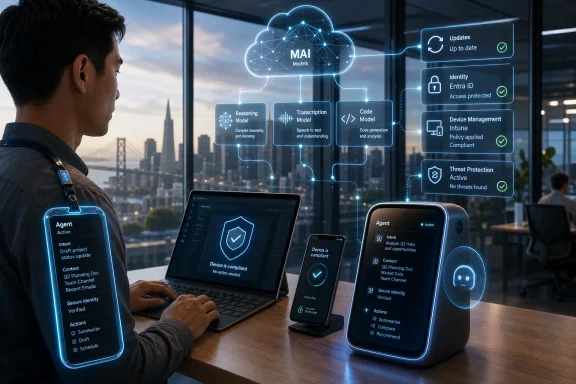 Microsoft Moves the App Model Off Center Stage
For decades, Microsoft’s platform strategy was almost laughably easy to summarize: Windows ran the apps, Office created the work, and servers or cloud services kept everything stitched together. Even when the company embraced the web, mobile devices, and Azure, Windows remained the symbolic center of gravity. Project Solara is different because it imagines a Microsoft device that does not begin with the Start menu, the desktop, or even the familiar notion of launching software.The phrase Microsoft wants developers to absorb is agent-first. That is not merely a branding update for chatbots. An agent-first device is supposed to infer intent, surface context, call services, and perform work without asking the user to open Outlook, Excel, Teams, Edge, or a bespoke line-of-business app first.
That is why Solara matters even though it is not a shipping product. Microsoft is not saying that users should replace their PCs with badges and desk companions next quarter. It is saying that the application may no longer be the unit of computing that matters most.
The company has been making this argument in software for years through Copilot, GitHub Copilot, Microsoft 365 Copilot, Windows AI features, and Azure’s model infrastructure. Solara brings the argument into hardware. Once the agent becomes the interface, the hardware can become smaller, more specialized, and more ambient.
The Most Interesting Part Is That It Is Not Windows
The obvious question for WindowsForum readers is why Microsoft would build its futuristic device platform on the Microsoft Device Ecosystem Platform rather than Windows. The answer is practical, not sentimental. MDEP is Android-based, already aligned with managed device categories such as Teams Rooms hardware, and better suited to low-power, appliance-like endpoints than a full Windows installation.That choice is also revealing. Microsoft is not trying to make a tiny Windows PC with a new shell. It is trying to create a managed enterprise endpoint that inherits the control plane IT departments already expect: patching, over-the-air updates, device integrity checks, Microsoft Defender integration, Intune management, and Entra ID sign-in.
For administrators, that is the difference between a science project and something that might eventually pass a procurement review. Novel hardware is easy to demo and hard to operate. The boring machinery of enrollment, compliance, update cadence, identity, and revocation is where most experimental devices go to die.
Microsoft appears to understand that. Solara’s bet is not simply that agents will become useful enough to deserve their own devices. It is that companies will only tolerate those devices if they can be managed like corporate assets rather than treated like consumer gadgets with enterprise stickers on the box.
There is a subtle concession here, too. Windows is powerful, flexible, and deeply entrenched, but it is not always the right substrate for an always-on badge or desk object. Microsoft’s willingness to use an Android-derived stack is an admission that the future of Microsoft-managed computing may be more heterogeneous than the Windows era trained us to expect.
Solara Looks Like a Concept Car Because It Is One
The two reference devices Microsoft showed are best understood as provocations. One is a badge-style wearable built on Qualcomm silicon, aimed at mobile workers who need hands-free or glanceable agent interaction. The other is a desk companion using a MediaTek IoT system-on-chip, designed to remain always available and context-aware beside a worker’s main machine.Neither device should be mistaken for the next Surface. Microsoft has not announced general availability, pricing, regional rollout plans, or a catalog of commercial models. Industry coverage has correctly compared the hardware to concept cars: useful for showing design intent, dangerous if mistaken for next year’s fleet vehicle.
That does not make the concepts meaningless. Concept hardware gives Microsoft something software cannot: a way to demonstrate how agents might behave when they are not trapped inside a chat pane. A desk device that can surface Outlook events or Excel data is not revolutionary by itself. The more important claim is that a device could assemble an interface dynamically around a task rather than requiring the user to navigate a fixed app hierarchy.
The wearable example is more fraught. A badge with sensors, identity, connectivity, and agent access points directly at frontline work, retail, logistics, healthcare, and field operations. Those are environments where the traditional PC is often awkward, where phones are sometimes restricted, and where managers are constantly tempted by devices that promise real-time coordination.
That same category also invites surveillance anxiety. An always-available workplace agent can be sold as a productivity assistant and experienced as a monitoring tool. Microsoft can build privacy switches and management controls, but social trust will matter as much as silicon.
Microsoft Is Recasting Identity as the Agent Safety Rail
Satya Nadella’s Build framing put the governance problem in unusually plain terms: agents need identities. That line is more important than the usual keynote flourish about the digital stack being reimagined around AI. If agents can take action across enterprise workflows, they cannot remain vague software helpers floating somewhere between a user session and a cloud service.Identity is how Microsoft makes agents legible to the enterprise. It is how a company decides what an agent can access, which data it can use, what it can change, where its actions are logged, and who is accountable when something goes wrong. Without identity, agents are demos. With identity, they become principals in a security model.
This is where Microsoft has an obvious advantage over smaller AI hardware startups. The company already owns a large portion of the enterprise identity, endpoint management, productivity, developer, and security stack. Solara plugs into that institutional reality rather than trying to bypass it.
But the identity model also raises harder questions. If an agent acts on behalf of a worker, is it bound by that worker’s permissions at every moment? Can it retain context across devices? What happens when a user changes roles, leaves the company, or loses access to a sensitive project? Can a business audit the agent’s reasoning path, or only its final API calls?
Enterprise IT will not accept “the model decided” as a control framework. Microsoft’s agent push therefore depends less on magical autonomy than on mundane enforceability. The agent has to be capable enough to justify its existence and constrained enough to survive a security review.
The MAI Models Are the Engine Room, Not the Whole Ship
Solara arrived alongside Microsoft’s broader Build 2026 AI stack, including a self-developed MAI model family reportedly trained from scratch. The lineup includes MAI-Thinking-1 for reasoning, MAI-Code-1-Flash for coding, MAI-Image 2.5 for image generation, and MAI-Transcribe 1.5 for multilingual speech transcription. The flagship reasoning model is described as using a sparse Mixture-of-Experts design with about 35 billion active parameters and a 256,000-token context window in private preview through Microsoft Foundry.The model announcements matter because agent-first devices cannot rely on interface novelty alone. A badge or desk companion becomes irritating very quickly if the agent is slow, forgetful, brittle, or unable to operate across real work data. Microsoft needs models that can reason, code, transcribe, summarize, and coordinate while fitting into cloud and edge deployment patterns.
Still, the MAI models should not be read as a clean declaration of independence from OpenAI or any other model partner. Microsoft’s AI strategy has increasingly looked like a portfolio strategy: first-party models where it wants control, partner models where they are useful, open models where developers demand flexibility, and Azure infrastructure underneath as the commercial clearinghouse.
That is why Solara is better understood as part of a full-stack positioning exercise. Microsoft wants to offer the model, the agent framework, the developer tooling, the device platform, the management layer, and the identity fabric. It does not need every customer to use every Microsoft component. It needs the default answer to enterprise AI deployment to feel like Microsoft territory.
For Windows users, that may feel both familiar and alien. Familiar, because Microsoft has always tried to make its platform the safest default for business computing. Alien, because the platform is no longer necessarily Windows in the traditional sense.
The PC Is Not Being Replaced So Much as Surrounded
The lazy version of the Solara story is that Microsoft is preparing for the death of apps. The slightly less lazy version is that Microsoft is preparing for the death of Windows. Neither quite fits the evidence. Solara points instead to a world where the PC remains important but loses its monopoly over serious work interaction.The modern workplace already looks like this. A knowledge worker may use a Windows laptop, a phone, Teams Rooms hardware, a security key, a headset, a cloud desktop, and browser-based services in the same day. A frontline worker may use handheld scanners, shared tablets, kiosks, badge systems, and shift-management tools. The single-computer model has been eroding for years.
Solara’s thesis is that agents can make that fragmentation useful instead of merely messy. If the same identity, policy, and contextual intelligence can move across a family of devices, then each device can specialize. The desk companion does not need to be a general-purpose PC. The badge does not need to pretend it is a phone. The Windows laptop can remain the place where complex work happens, while smaller devices catch intent and context around it.
That is the optimistic version. The pessimistic version is that users end up with yet another layer of half-integrated hardware, notification surfaces, compliance prompts, and AI suggestions. Microsoft’s history contains plenty of both outcomes.
The difference will come down to whether Solara devices solve specific workplace problems rather than merely dramatizing Microsoft’s AI vision. A retail associate who can ask a badge for inventory, policy, and customer-order context without leaving the floor is a plausible use case. A desk ornament that repeats what Outlook already told you is not.
Developers Are Being Asked to Build for a Moving Target
The Build audience was not only customers and analysts. It was developers, and Microsoft’s message to them was both enticing and difficult: stop thinking only in apps, start thinking in agents, tools, permissions, context, and generated interfaces. That is a major shift in software architecture and a major shift in business incentives.Traditional applications package interface, logic, workflow, and brand into a bounded experience. Agentic systems tend to dissolve those boundaries. A user may never open the app whose API an agent calls. A generated interface may expose only the piece of functionality required for a particular moment. The developer’s work becomes part of a larger orchestration fabric.
That could be liberating for some software teams. Internal enterprise apps are often clumsy because they force workers through rigid forms and workflows that exist more for database cleanliness than human efficiency. An agent that can mediate those workflows could make legacy systems feel less hostile.
It could also be threatening. If the agent becomes the user’s primary interface, the owner of the agent runtime gains leverage over the owners of individual apps. Microsoft knows this dynamic well. Platform companies do not eliminate software ecosystems; they reorder them.
For independent software vendors, the key question is whether Microsoft’s agent frameworks create new distribution or new dependency. If Solara-like devices become another front end for Microsoft 365 and Azure services, developers will have to decide whether integration is opportunity, obligation, or both.
Enterprise Pilots Will Decide Whether the Vision Survives Contact With Work
The named pilot partners — including AccuWeather, Best Buy, CVS Health, Levi’s, and Target — are a useful clue about Microsoft’s intended proving ground. These are not only desk-job scenarios. They point to retail, healthcare, forecasting, operations, customer service, and frontline coordination.That matters because agent-first hardware may be more compelling away from the traditional PC than directly beside it. Office workers already have large screens, keyboards, browsers, and Teams. They may benefit from agents, but they do not necessarily need a new physical object to reach them. Frontline workers often have the opposite problem: the work is physical, mobile, time-sensitive, and poorly served by conventional software.
If Solara finds product-market fit, it may do so through narrow deployments rather than broad consumer excitement. A pharmacy workflow device, a retail floor assistant, a meeting-room coordination hub, or a field-service badge could justify itself in ways a general-purpose AI gadget cannot. Enterprise hardware often succeeds by being boring, rugged, manageable, and tied to a measurable workflow.
That is also why Microsoft’s lack of pricing and availability is not a footnote. Hardware economics shape deployment. Battery life, replacement cycles, breakage rates, cellular costs, privacy training, union concerns, accessibility requirements, and help-desk load will all influence whether these devices remain prototypes or become standard equipment.
The pilots will test the least glamorous parts of the idea. Can the devices stay updated? Can workers trust them? Can IT disable them cleanly? Can the agents avoid hallucinating in operational contexts? Can managers prove that the devices save time without turning employees into sensor platforms?
The Security Sandbox Is the Other Half of the Story
The Solara announcement sat beside Microsoft’s broader Build narrative about AI security, including a Windows system-level AI security sandbox called MXC. Even if Solara itself runs on MDEP, the security theme is inseparable from the agent theme. Agents that can observe context and take action create a larger blast radius than passive apps.The old software risk model was already difficult. Malicious documents, browser exploits, credential theft, vulnerable drivers, misconfigured cloud permissions, and supply-chain attacks gave administrators plenty to worry about. Agentic computing adds a new layer: software that can interpret ambiguous instructions, call tools, chain actions, and potentially move faster than a human operator.
A sandbox is Microsoft’s way of saying the company understands that AI cannot simply be sprinkled into the OS with administrator-level trust. But sandboxes are only as useful as the boundaries they enforce and the defaults that developers accept. If the business value of agents depends on broad access, the security model will face constant pressure to widen.
Solara intensifies that pressure because its whole premise is context. A device that is always on and always context-aware needs sensor access, identity access, cloud access, and workflow access. Each one is defensible in isolation. Together, they create an endpoint class that security teams will need to model carefully.
For Windows administrators, the immediate lesson is not to panic about Solara devices appearing on the network tomorrow. It is to prepare for a management future in which AI agents become auditable actors, not just features inside applications. Conditional access, least privilege, device compliance, data-loss prevention, logging, and incident response will all need to understand what an agent did, not merely which user account was active.
Microsoft Has Been Here Before, but the Stakes Are Different
Microsoft has a long history of showing ambitious future-of-computing concepts before the market is ready. Some become real businesses. Some become developer conference fossils. The company’s advantage is persistence; its weakness is that persistence can look like inevitability before customers have actually agreed.Solara evokes several Microsoft pasts at once. It has the managed-device pragmatism of Teams Rooms and enterprise mobility. It has the ambient-computing ambition of Cortana-era Microsoft, minus the consumer assistant naivety. It has the platform-extension logic of Windows, but without requiring Windows as the kernel. It has the hardware curiosity of Surface, though Microsoft is wisely presenting reference designs rather than declaring a new consumer category.
The comparison to failed AI gadgets is unavoidable. Recent attempts to create standalone AI devices have struggled with unclear use cases, weak performance, privacy concerns, and the brutal convenience of the smartphone. Microsoft is trying to avoid that trap by aiming Solara at enterprises rather than consumers, and by anchoring the devices in managed workflows rather than lifestyle futurism.
That is a sensible strategy, but not a guarantee. Enterprises can be conservative for good reasons. They may experiment enthusiastically and deploy slowly. They may love the software story and reject the hardware. They may decide that phones, PCs, and existing Teams devices are good enough.
The most credible version of Solara is not a universal new computer. It is a family of specialized endpoints for places where the PC and phone are awkward, where agents have controlled access to valuable data, and where the management story is strong enough to overcome the weirdness of the form factor.
The App Era Will End Gradually, Then Administratively
If Microsoft is right, the app does not vanish in a dramatic platform war. It fades into infrastructure. Users ask for outcomes, agents assemble the necessary tools, and interfaces appear only when needed. The software still exists, but its front door is no longer the icon.That is an attractive story for users tired of switching among windows, tabs, and dashboards. It is also attractive for Microsoft, which can sit between intent and execution. The more work flows through agents, the more valuable the orchestration layer becomes.
But there is a cost to making software feel invisible. Invisible systems can become harder to understand, harder to debug, and harder to challenge. When a worker opens an app and enters data, the path is at least visible. When an agent summarizes, decides, and acts across systems, the organization needs new forms of transparency.
This is where Microsoft’s enterprise instincts may help. Consumer AI products often optimize for delight first and auditability later. Microsoft’s core customers will demand auditability early. That does not make the problem easy, but it makes the negotiation explicit.
For the Windows ecosystem, the next few years may be less about whether Windows gets displaced and more about whether Windows becomes one node in a broader Microsoft agent fabric. The PC remains powerful because it is general-purpose. Solara’s devices are interesting because they are not.
The Solara Bet Comes Down to Workflows, Not Wonder
Project Solara should be judged neither as vaporware nor as destiny. It is an early platform preview with credible enterprise plumbing, speculative hardware, and a strategic thesis that fits where Microsoft has been pushing the industry. The useful way to read it is as a map of Microsoft’s assumptions.- Microsoft believes agents are becoming important enough to deserve their own device platform rather than merely another panel inside existing apps.
- Microsoft is willing to use an Android-based managed platform when Windows is too heavy or too general-purpose for the job.
- Microsoft sees identity, policy, device integrity, and endpoint management as the difference between enterprise AI and uncontrolled automation.
- Microsoft’s first serious Solara tests will likely live in frontline and operational environments where PCs are inconvenient and workflow context is valuable.
- Microsoft has not yet answered the commercial questions that decide real deployments, including pricing, availability, lifecycle support, and regional rollout.
- Windows users should see Solara less as a replacement for the PC and more as a signal that Microsoft wants the PC surrounded by AI-aware managed devices.
References
- Primary source: TechJuice
Published: 2026-06-15T11:35:06.696986
Microsoft Wants Devices That Run AI Agents Instead of Apps
Microsoft's Project Solara at Build 2026 is a chip-to-cloud platform for AI agent hardware with two concept devices and MAI-Thinking-1 model.www.techjuice.pk
- Related coverage: windowscentral.com
6 biggest Microsoft Build announcements: How they'll reshape Windows 11 and set up the next generation of AI devices | Windows Central
Microsoft just spent a week laying out the future of your desktop and laid the groundwork for AI devices.www.windowscentral.com - Related coverage: tomshardware.com
Microsoft unveils Project Solara AI, a chip-to-cloud platform built to power a new generation of 'agent-first' enterprise devices — hardware designed to run AI agents instead of traditional apps | Tom's Hardware
Microsoft ditches Windows to build OS on Androidwww.tomshardware.com - Official source: learn.microsoft.com
- Official source: commandline.microsoft.com
Composing a new platform for agent-first devices - Command Line
New interaction technology enables new types of computers. Learn more about Microsoft’s Project Solara.commandline.microsoft.com - Related coverage: techrepublic.com
Microsoft Project Solara Brings AI Agents to Enterprise Devices - TechRepublic
Microsoft Project Solara previews agent-first enterprise devices built on MDEP, with badge and desk concepts that raise IT questions around identity, privacy, and management.www.techrepublic.com
- Related coverage: geekwire.com
Inside Microsoft’s Project Solara: A new platform for devices that run AI agents instead of apps – GeekWire
A team inside Microsoft has been quietly building a platform for devices that run AI agents instead of apps, based on Android instead of Windows. The first two concept devices, a desktop hub and a wearable badge, are headed to pilots with some big-name businesses.www.geekwire.com - Related coverage: gigazine.net
Microsoft has announced 'Project Solara,' a new platform for AI agent-dedicated devices, creating an agent-centric system using an Android-based OS rather than Windows. - GIGAZINE
At its developer event, ' Microsoft Build 2026, ' held in San Francisco, USA on June 2, 2026, Microsoft announced ' Project Solara, ' a new device platform that operates primarily with AI agents. Microsoft positions Project Solara not merely as an OS, but as a 'chip-to-cloud' platform spanning...gigazine.net - Official source: news.microsoft.com
Microsoft Build Live
The home for real-time coverage of the news as it is announced from Microsoft Build, June 2-3, 2026.news.microsoft.com - Related coverage: arstechnica.com
Microsoft's Project Solara is an Android OS designed for agents instead of apps - Ars Technica
Microsoft missed the boat on apps, so get ready for agents.arstechnica.com - Related coverage: business-standard.com
Windows to AI models and Solara: Everything Microsoft announced at Build | Tech News - Business Standard
At Build 2026, Microsoft outlined a shift across Windows, AI models, hardware and quantum computing, positioning AI agents and on-device intelligence at the centre of its future roadmapwww.business-standard.com
- Related coverage: techradar.com
Is this 'the next computer'? Microsoft’s Project Solara looks to break AI out of the PC and into the real world | TechRadar
Project Solara wants to power “the next computer”www.techradar.com - Related coverage: tomsguide.com
Biggest Microsoft Build 2026 announcements — agentic AI, RTX Spark Dev Box, GitHub Copilot app, new MAI models, and more | Tom's Guide
All the big news from Microsoft's AI-focused eventwww.tomsguide.com - Related coverage: axios.com
Axios C-Suite: 3 new AI developments for the week of June 6
We might have seen physical AI's GPT moment.www.axios.com
- Related coverage: zeronoise.ai
