

Microsoft used the Game Developers Conference stage to do something deliberate: it framed the next Xbox not as a single-generation hardware refresh but as a platform pivot that formally stitches console and Windows PC into a single engineering and product story — codenamed Project Helix — built around a custom AMD system‑on‑chip (SoC), new machine‑learning assisted graphics tech, and deeper Windows integration. ([blogs.windows.com]s.com/windowsexperience/2026/03/11/gdc-2026-next-generation-of-xbox-designed-to-play-console-and-pc-games/)
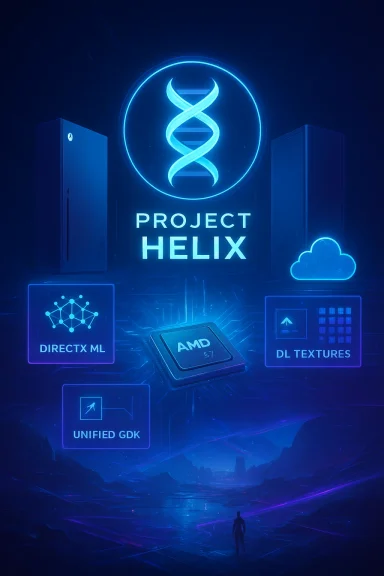
Project Helix is the clearest public signal so far that Microsoft intends to treat Xbox as a cross‑device platform rather than a standalone closed hardware cycle. That message was reinforced across Microsoft’s GDC 2026 sessions and follow‑up posts: Xbox engineering presented a roadmap that ties three major pieces together — custom silicon co‑engineered with AMD, a developer path that leans on a unified Game Development Kit (GDK) and DirectX/ML tooling, and a user experience strategy that brings a console‑style “Xbox Mode” to Windows 11.
This is not incremental messaging. Microsoft is telling developers and platform partners that future Xbox games and the ways players consume them will increasingly assume a single, Windows‑rooted target: the console hardware, Windows PCs (via Xbox Mode), andshare much of the same stack. That idea drives the engineering choices on the table — from shader and asset delivery to dedicated neural pipelines — and it also explains the carefully staged timeline Microsoft shared at GDC.
Why AMD? Because Microsoft is explicitly building for a future where GPU compute, specialized neural hardware, and fast storage interplay in real time. A custom SoC lets Microsoft and AMD tune memory subsystems, on‑chip accelerators, and the interconnect in ways that off‑the‑shelf PC parts cannot, which in turn lowers the engineering complexity for the platform and the studios that will target it.
Xbox Mode will matter because it softens the product boundary between console and PC: same UI affordances, controller‑first navigation, and the promise of tighter startup and shader delivery performance mean that games built with Microsoft’s GDK can expect a predictable Windows launching posture that looks and feels like a console.
Why this matters:
This matters to consumers in two ways: continuity of library (no forced repurchase of many titles) and the ability to apply modern ML assists (upscaling, frame generation, visual enhancements) to older games — potentially refreshing older assets without developer source changes.
The commercial payoff depends on three things converging successfully: (1) Microsoft’s ability to deliver reliable hardware and timelines to partners; (2) AMD’s implementation of the custom SoC and its NPU/graphics balance; and (3) developer adoption of ML‑centric pipelines without unacceptable cost or overhead.
However, the program’s success hinges on execution across multiple, tightly coupled fronts: silicon delivery from AMD; robust, documented tooling from Microsoft; and real‑world validation on hardware via the 2027 alpha kits. All three are non‑trivial. For developers, the path is to engage early with the GDK and to start experimenting with ML‑assisted pipelines. For consumers, the immediate practical change is Xbox Mode on Windows 11 in April 2026 — a software preview of Microsoft’s broader vision — while retail Helix hardware remains a 2027+ story that will require patience.
Microsoft’s message at GDC was ambitious and coherent: make Windows and Xbox feel like a single, developer‑friendly ecosystem and use ML + custom silicon to make high‑fidelity experiences more efficient and widely available. That is an attractive thesis. The next 18 months (alpha hardware, toolchain maturation, and early studio ports) will decide whether Project Helix is the start of a genuine platform shift — or a well‑publicized, technically interesting detour that still struggles with the old problems of market pricing, hardware variance, and developer bandwidth.
Project Helix is not a single product announcement: it’s a platform roadmap that ties together custom AMD silicon, an ML‑driven rendering stack (FSR Diamond / “FSR Next”), neural texture compression, and a Windows‑first user experience that will be visible to consumers this April through Xbox Mode. The core engineering choices — unified GDK, DirectX/ML, and Advanced Shader Delivery — speak to a future where the distinction between “console” and “PC” is increasingly about the user’s posture, not the underlying technology. Whether it becomes the industry’s standard model will depend on Microsoft’s follow‑through with developer kits in 2027, AMD’s silicon delivery, and how quickly studios adapt to the ML‑centric toolkit announced at GDC.
In short: Project Helix is an ambitious, credible plan — technically compelling and strategically sensible — but it remains a work in progress. The alpha hardware arriving in 2027 will be the clearest test yet of whether Microsoft can turn a unified vision into repeatable, cross‑platform game experiences that delight players and simplify developers’ lives.
Source: Geeky Gadgets Microsoft Xbox Project Helix Dev Kits Arriving 2027 for Custom AMD Chip
 Background / Overview
Project Helix is the clearest public signal so far that Microsoft intends to treat Xbox as a cross‑device platform rather than a standalone closed hardware cycle. That message was reinforced across Microsoft’s GDC 2026 sessions and follow‑up posts: Xbox engineering presented a roadmap that ties three major pieces together — custom silicon co‑engineered with AMD, a developer path that leans on a unified Game Development Kit (GDK) and DirectX/ML tooling, and a user experience strategy that brings a console‑style “Xbox Mode” to Windows 11.This is not incremental messaging. Microsoft is telling developers and platform partners that future Xbox games and the ways players consume them will increasingly assume a single, Windows‑rooted target: the console hardware, Windows PCs (via Xbox Mode), andshare much of the same stack. That idea drives the engineering choices on the table — from shader and asset delivery to dedicated neural pipelines — and it also explains the carefully staged timeline Microsoft shared at GDC.
What Microsoft Announced at GDC: The Quick List
- Project Helix is confirmed as the next‑generation Xbox platform, built around a custom AMD SoC and co‑designed with next‑generation DirectX features.
- Microsoft will roll a rebranded, controller‑first Xbox Mode into Windows 11 starting in April 2026 in select markets.
- Alpha developer kits (early hardware) for Project Helix will begin shipping to studios in 2027; a public consumer release window was described by Microsoft as later, with industry reporting placing a likely window in late 2027 into 2028.
- The platform emphasizes advanced ray/path tracing, ML‑driven frame generation and upscaling, and neural texture compression to reduce memory and streaming costs. AMD’s next‑gen FidelityFX generation (branded in recent press as FSR Diamond or generically as “FSR Next”) is a core piece of that stack.
- Backward compatibility and Xbox Play Anywhere expansion remain strategic priorities; Microsoft says it will preserve four generations of Xbox games and is expanding cross‑platform buy‑once play across hundreds — widely reported as a library exceeding 1,500 Play Anywhere‑enabled titles.
Hardware: The Custom AMD SoC and Why It Matters
A silicon partnership at scale
Microsoft confirmed that the next Xbox will use a custom AMD system‑on‑chip, continuing the long partnership between the two companies but taking it deeper: the chip is described as co‑designed for next‑generation DirectX and an NPU‑aware graphics pipeline. Independent reporting from several outlets that attended GDC confirms AMD’s involvement and repeated Microsoft language about co‑engineering the SoC for machine‑learning assisted rendering tasks.Why AMD? Because Microsoft is explicitly building for a future where GPU compute, specialized neural hardware, and fast storage interplay in real time. A custom SoC lets Microsoft and AMD tune memory subsystems, on‑chip accelerators, and the interconnect in ways that off‑the‑shelf PC parts cannot, which in turn lowers the engineering complexity for the platform and the studios that will target it.
Ray tracing, path tracing, and an “order‑of‑magnitude” uplift
Speakers emphasized significant gains in ray‑tracing and path‑tracing capability, driven by the SoC’s GPU and dedicated ML blocks. That language — used directly on stage and in follow‑ups — speaks to a generation of consoles that will use ML not only for upscaling but for real‑time denoising, ray regeneration, and even multi‑frame synthesis to boost perceived frame rates without requiring proportionally larger raster budgets. Several outlets picked up on Microsoft’s “order‑of‑magnitude” characterization of ray‑tracing uplift, which should be read as aspirational guidance for developers rather than a single, quantifiable metric.On‑package memory and streaming expectations
Microsoft’s talks also signaled a posture about asset streaming that mirrors modern PC engine thinking: tighter DirectStorage integration, neural texture compression, and compressed shader delivery are meant to reduce memory pressure and dramatically shorten load and streaming stalls. In practice, this is an architecture built for consoles that have to behave more like PCs when running huge, open worlds or PC‑grade simulation workloads. Several technology write‑ups explicitly call out DirectStorage + zstd and neural texture compression as part of the planned delivery chain.Graphics and ML: FSR Diamond, Neural Texture Compression, and “Neural Rendering”
FSR Diamond: AMD’s next generation upscaling
AMD framed the next generation of its FidelityFX family as a major component of Helix’s visual strategy. Public reporting from AMD partners and press attendees used the name FSR Diamond (previously referred to in rumors as “FSR Next”), describing a suite of ML‑driven features including multi‑frame generation, neural upscaling, and what AMD and Microsoft call ray regeneration for ray/path‑traced content. FSR Diamond is positioned to use on‑die NPU resources for tasks beyond simple spatial upscaling — it’s intended as a full neural rendering assist.- Key FSR Diamond capabilities called out:
- ML multi‑frame generation to synthesize intermediate frames for smoother animation.
- Neural upscaling that uses learned models to improve perceived resolution without huge raster cost.
- ML‑assisted ray regeneration/denoising to make path tracing feasible at higher frame rates.
Neural texture compression
Another core claim from Microsoft’s GDC material is neural texture compression: applying ML models to compress, decode, or reconstruct textures at runtime such that VRAM and storage throughput requirements drop while visual fidelity remains close to—or in some cases better than—traditional block compression. This is a material change in how runtime assets can be stored and streamed and is central to Microsoft’s pitch that Helix can deliver PC‑grade visuals cost‑efficiently. Multiple outlets and attendee writeups repeated this as a central capability, and AMD and Microsoft both emphasized ML pipelines that operate across geometry, materials, and texture delivery.What this means for developers (and why it’s different)
- Tools will need to support ML model delivery alongside shaders and textures.
- Asset pipelines will include model training, verification, and runtime validation steps.
- Shader and shader‑cache delivery (Advanced Shader Delivery) becomes more critical: fewer stalls, faster start times, consistent performance across diverse hardware is the end goal.
Software and Platform: Xbox Mode, GDK, and a Windows‑Centric Console
Xbox Mode for Windows 11 — console posture on your PC
Microsoft will roll out a rebranded, full‑screen, controller‑first Xbox Mode to Windows 11 devices starting in April 2026 in select markets. Xbox Mode is the successor to the Full Screen Experience that shipped on handheld hardware; the new rollout expands the experience to laptops, desktops, and tablets, and crucially links that UI to deeper store and shader delivery integration. Microsoft framed Xbox Mode as a way to “turn any Windows 11 device into a living‑room console” while preserving the benefits and openness of Windows. Multiple Microsoft posts and major outlets covered the April rollout announcement.Xbox Mode will matter because it softens the product boundary between console and PC: same UI affordances, controller‑first navigation, and the promise of tighter startup and shader delivery performance mean that games built with Microsoft’s GDK can expect a predictable Windows launching posture that looks and feels like a console.
Unified Game Development Kit and DirectX/ML
Microsoft is pushing a unified GDK and broader DirectX/ML toolset designed to let studios build once and target Helix, Xbox Series consoles, Windows PC, and cloud endpoints with fewer platform‑specific changes. Developer sessions at GDC emphasized:- Shared runtime libraries and APIs for file IO, storage streaming, and shader models.
- DirectX/ML features that expose NPU capabilities for frame generation, denoising, and texture reconstruction.
- Advanced Shader Delivery to reduce shader compile stalls and enable near‑instant startup across hardware variants.
Developer Timeline: Dev Kits, Public Release, and What to Expect
Alpha dev kits in 2027 — what Microsoft actually committed to
Microsoft told developers that alpha hardware for Project Helix will begin shipping to studios in 2027, not immediately. That timeline was stated on stage and has been reported consistently. The implication is clear: Helix is on a multi‑year cadence where deep developer validation precedes any consumer launch.Why this matters:
- Alpha dev kits let studios test the SoC, ML pipelines, and storage subsystems in real content — not just in tech demos.
- Shipping alpha hardware in 2027 means that games targeting Helix exclusively are unlikely before late 2027 or 2028 unless Microsoft accelerates the public roadmap.
- Microsoft can iterate hardware and tooling during the alpha/developer phases, which reduces launch time risk but also delays consumer availability.
What studios should do now
- Prioritize learning the unified GDK and DirectX/ML samples Microsoft released at GDC.
- Start evaluating the potential for neural‑assisted flows (texture compression, multi‑frame generation) within existing pipelines.
- Expect to receive alpha hardware in 2027 — budget for support time and an iterative QA cycle to validate ML models on real hardware.
Backward Compatibility, Play Anywhere, and the Game Lineup
Backward compatibility remains core to the narrative
Microsoft reiterated that backward compatibility across four generations remains a strategic priority; the company framed it as part of Xbox’s 25th anniversary and a pre libraries across future hardware. Historically, Microsoft has been the industry leader on backward compatibility, and the Project Helix messaging doubles down on that posture. Journalistic coverage and Microsoft summaries from GDC repeated the “four generations” claim.This matters to consumers in two ways: continuity of library (no forced repurchase of many titles) and the ability to apply modern ML assists (upscaling, frame generation, visual enhancements) to older games — potentially refreshing older assets without developer source changes.
Xbox Play Anywhere expansion and cross‑purchase promises
Multiple reports from the GDC sessions noted that the Xbox Play Anywhere initiative will expand, with Microsoft and partners indicating the program now encompasses a catalog that press reports describe as over 1,500 titles. Play Anywhere lets players buy once and play on both Xbox and Windows devices (and in many cases, the cloud), which aligns neatly with Microsoft’s cross‑device Helix vision. While Microsoft did not publish a granular, itemized list during the conference, that aggregate catalog figure was repeated widely in coverage. Readers should treat the 1,500+ number as Microsoft’s stated headline for the program rather than a forensic inventory until Microsoft publishes a definitive catalog.Games: franchise returns and new IP
Microsoft used the platform announcement to tease continuations of key franchises (notably Halo and Gears of War) alongside new IP and indie support. That combination is strategic: flagship franchises anchor sales and brand identity, while a broad indie pipeline exploits the Play Anywhere/GDK story to fill out launch windows across devices. Expect Microsoft to lean on its first‑party studios to showcase Helix features when developer kits mature.Critical Analysis: Strengths, Risks, and the Path Forward
Strengths — an engineer’s wishlist that matches platform thinking
- Unified engineering reduces duplication. A GDK that genuinely allows one build to reach console, PC, and cloud reduces platform friction and lowers the cost of cross‑platform releases.
- Silicon + ML co‑design is future‑proofing. Putting neural pipelines on the SoC and baking ML upscaling and texture streaming into the runtime anticipates where AAA rendering is moving: CPU/GPU balances will shift toward more learned approximations and synthesis.
- Xbox Mode normalizes console ergonomics on Windows. For consumers, a consistent UI and controller‑first posture removes a psychological barrier between “PC” and “console,” making Microsoft’s broad ecosystem feel less fragmented.
Risks and practical challenges
- Tooling and runtime complexity. Shipping a system that expects studios to deliver trained neural models and maintain asset pipelines with model training introduces a steep learning curve. Smaller teams may struggle more than large studios.
- Run‑time determinism and quality control. Neural reconstruction and compression can vary by scene content; ensuring consistent visual fidelity and avoiding artifacts across many titles will require rigorous tooling, profiling, and fallback mechanisms.
- Timing uncertainty. Microsoft’s 2027 alpha kit window is concrete; a consumer launch window is not. That creates planning challenges for publishers making exclusivity and marketing bets. Numerous outlets and analysts have already flagged that 2027 for dev kits doesn’t imply a 2027 retail launch.
- Ecosystem fragmentation risk. The power to “turn any Windows 11 PC into a console” via Xbox Mode is attractive, but Windows PCs vary wildly in thermal, driver, and NPU capability. Microsoft needs to prevent user frustration when an advertised Helix‑grade experience slips because a particular PC lacks NPU acceleration or sufficient storage throughput.
Commercial and strategic perspective
This is a defensive and offensive play for Microsoft at once. Defensively, the company protects its first‑party library and Game Pass value by making titles more portable, thereby discouraging platform lock‑in elsewhere. Offensively, Microsoft is trying to make Windows a first‑class console endpoint, which enlarges the addressable market for Xbox franchises and Game Pass subscriptions.The commercial payoff depends on three things converging successfully: (1) Microsoft’s ability to deliver reliable hardware and timelines to partners; (2) AMD’s implementation of the custom SoC and its NPU/graphics balance; and (3) developer adoption of ML‑centric pipelines without unacceptable cost or overhead.
Practical Takeaways for Developers and Enthusiasts
For developers
- Start learning the unified GDK and DirectX/ML samples released at GDC. Microsoft’s developer resources are the primary source of truth for how Helix features map to APIs.
- Build a roadmap for asset pipelines that incorporates ML testing and validation. Neural texture compression and model delivery pipelines will be testers’ and QA teams’ new battlegrounds.
- If targeting exclusive Helix functionality, budget for iterative hardware validation in 2027 alpha kits — don’t assume immediate consumer availability.
For enthusiasts and buyers
- Don’t treat the 2027 alpha kit window as a retail launch date; Microsoft’s public commitment was to developers first. Consumers should expect the earliest mass‑market availability sometime after studios complete Helix‑targeted development and Microsoft declares a retail schedule.
- Xbox Mode rolling out to Windows 11 in April 2026 will let many players experience a console‑like shell on existing hardware — a low‑risk way to try Microsoft’s vision before new hardware ships.
- Backward compatibility remains a real advantage for Xbox buyers; Microsoft repeated commitments to preserving games from four generations and expanding Play Anywhere purchases. However, specific title availability and legal opt‑ins will still create holes in that promise. Treat compatibility as a strong expectation, not an absolute guarantee. (windowscentral.com)
Where the Open Questions Still Live
- How aggressive will Microsoft be about requiring NPU features for new Helix‑native titles? If ML features become mandatory for top‑tier releases, older or cheaper PCs without NPU support could be sidelined.
- How will Microsoft price Helix hardware variants (if multiple SKUs appear) in a market where PC enthusiasts already carry expensive GPUs? Analysts have speculated about four‑figure prices for the highest‑end models, but Microsoft did not discuss retail price points at GDC. Treat price projections as speculative until Microsoft or retail partners confirm. ([play3.de](Xbox Project Helix: Die Zukunft des Gamings? Microsoft nennt erste Details zur neuen Plattform will Microsoft be about the specific capabilities of the SoC (NPU FLOPS, memory bandwidth, on‑package cache sizes)? Engineers and press will press for those details during the alpha cycle; until we see published silicon whitepapers or official AMD micro‑architecture disclosures, many performance claims remain high‑level.
Final Assessment: Why Project Helix Is More Than Hype — But Not a Done Deal
Project Helix is a clear strategic pivot: Microsoft wants the next Xbox to be a platform that unifies console simplicity and Windows openness, accelerated by custom silicon and ML‑first rendering. That combination can reduce development friction and open new creative avenues for developers, while delivering better perceived performance to players using intelligent upscaling and frame synthesis.However, the program’s success hinges on execution across multiple, tightly coupled fronts: silicon delivery from AMD; robust, documented tooling from Microsoft; and real‑world validation on hardware via the 2027 alpha kits. All three are non‑trivial. For developers, the path is to engage early with the GDK and to start experimenting with ML‑assisted pipelines. For consumers, the immediate practical change is Xbox Mode on Windows 11 in April 2026 — a software preview of Microsoft’s broader vision — while retail Helix hardware remains a 2027+ story that will require patience.
Microsoft’s message at GDC was ambitious and coherent: make Windows and Xbox feel like a single, developer‑friendly ecosystem and use ML + custom silicon to make high‑fidelity experiences more efficient and widely available. That is an attractive thesis. The next 18 months (alpha hardware, toolchain maturation, and early studio ports) will decide whether Project Helix is the start of a genuine platform shift — or a well‑publicized, technically interesting detour that still struggles with the old problems of market pricing, hardware variance, and developer bandwidth.
Project Helix is not a single product announcement: it’s a platform roadmap that ties together custom AMD silicon, an ML‑driven rendering stack (FSR Diamond / “FSR Next”), neural texture compression, and a Windows‑first user experience that will be visible to consumers this April through Xbox Mode. The core engineering choices — unified GDK, DirectX/ML, and Advanced Shader Delivery — speak to a future where the distinction between “console” and “PC” is increasingly about the user’s posture, not the underlying technology. Whether it becomes the industry’s standard model will depend on Microsoft’s follow‑through with developer kits in 2027, AMD’s silicon delivery, and how quickly studios adapt to the ML‑centric toolkit announced at GDC.
In short: Project Helix is an ambitious, credible plan — technically compelling and strategically sensible — but it remains a work in progress. The alpha hardware arriving in 2027 will be the clearest test yet of whether Microsoft can turn a unified vision into repeatable, cross‑platform game experiences that delight players and simplify developers’ lives.
Source: Geeky Gadgets Microsoft Xbox Project Helix Dev Kits Arriving 2027 for Custom AMD Chip
