

Microsoft’s Project Helix confirmation landed like a fuse: a short, carefully worded post from Xbox leadership that says the next-generation Xbox will “lead in performance and play your Xbox and PC games,” and—if you trace the engineering breadcrumbs—this is the culmination of a strategy Microsoft has been assembling for nearly a decade. The Helix reveal is less a sudden pivot and more the public naming of a long-running technical and product convergence that began with OneCore and accelerated through the Xbox Series era’s Velocity Architecture and DirectStorage work. ://kotaku.com/sources-smaller-xbox-one-coming-this-year-more-powerf-1778634446)
Microsoft began intentionally collapsing Windows and Xbox engineering stacks years ago. The OneCore effort—Microsoft’s push to build a single modular kernel and shared platform that could run across phones, PCs, HoloLens and the Xbox One—was publicly visible by 2015 and created the technical foundation for deeper cross-pollination. That shared runtime made it possible to standardize subsystems, APIs, and developer tooling across PC and console.
From a product standpoint, Microsoft already started pushing the cross-device story in consumer-facing ways: Xbox Play Anywhere, simultaneous PC/Xbox releases for key first-party titles, and Game Pass as a cross-device subscription model. Those moves were not accidental experiments—they were early manifestations of a larger engineering thesis that a Windows-rooted ecosystem could deliver a single developer target for both living‑room and PC play. Journalists who investigated internal planning cycles found references to an umbrella strategy—named internally in reporti—as early as 2016, when Kotaku described Microsoft’s intent to converge Xbox and Windows engineering and to pursue a more iterative, PC‑like hardware cadence.
DirectStorage—originally conceived as part of that Xbox Velocity vision—was subsequently brought to Windows. Its promise on PC is to enable GPU-assisted, highly parallel I/O paths so the CPU is not the bottleneck for feeding textures and level data into GPU memory. Over the last several years Microsoft refined DirectStorage on Windows 11, producing developer libraries and drivers that reduce load times and enable more ambitious streaming systems on PC. Those iterative improvements are directly relevant if Microsoft intends to ship a Windows‑rooted console: the software and developer interfaces already exist and have been hardened in a Windows environment.
Asha Sharma, in her public post announcing the codename, stated: “Project Helix will lead in performance and play your Xbox and PC games,” and the Xbox account shared a brief teaser. That short message contains both a product claim (performance leadership) and a strategic framing (support for PC and Xbox games)—and it sent the industry scrambling to reconcile what “play your PC games” will mean in practice: native Windows access? Supported PC storefronts? Compatibility with existing PC peripherals and drivers? Early coverage and developer commentary are already working through those implications.
This has three immediate strategic consequences for Helix:
But there are practical friction points:
For gamers and developers, the promise is seductive: one hardware target, console polish, and access to expansive PC libraries and tooling. For platform owners and regulators, the concern is familiar: how Microsoft balances openness, exclusivity, and business value. Whether Helix becomes the moment Microsoft heals the console/PC divide—or simply creates a new, higher‑end rung in its device family—will come down to three things: the OS model shipped, the storefront and certification policies Microsoft enforces, and the price Microsoft chooses to ask gamers to pay.
Those are not product details you can gloss over in a teaser. Expect the coming weeks—starting at the Game Developers Conference—to be decisive. The Helix codename is now public; the rest of the story arrives in the technical docs, SDKs, and the hardware specifications Microsoft provides next.
Conclusion
Project Helix is the crystallization of a nearly decade‑long engineering strategy: unify Windows and Xbox at an OS and tooling level, push storage and I/O innovations from console into PC and back again, and leverage an expanding content library to deliver new consumer propositions. That makes Helix intellectually and technically plausible today—but it does not make it simple. If Microsoft can ship a compelling hardware and OS package with reasonable pricing, clear storefront rules, and developer-friendly tools, Project Helix could reshape how consoles and PCs coexist. If Microsoft stumbles on any of those elements, Helix risks becoming an expensive experiment that complicates the very convergence it promises to solve. The next phase—detailed specs, SDK documentation, and partner policy—will show whether this decade of groundwork pays off.
Source: TweakTown Microsoft's new Project Helix next-gen Xbox console was 10 years in the making
 Background: how OneCore and the Xbox–Windows roadmap set the stage
Microsoft began intentionally collapsing Windows and Xbox engineering stacks years ago. The OneCore effort—Microsoft’s push to build a single modular kernel and shared platform that could run across phones, PCs, HoloLens and the Xbox One—was publicly visible by 2015 and created the technical foundation for deeper cross-pollination. That shared runtime made it possible to standardize subsystems, APIs, and developer tooling across PC and console.From a product standpoint, Microsoft already started pushing the cross-device story in consumer-facing ways: Xbox Play Anywhere, simultaneous PC/Xbox releases for key first-party titles, and Game Pass as a cross-device subscription model. Those moves were not accidental experiments—they were early manifestations of a larger engineering thesis that a Windows-rooted ecosystem could deliver a single developer target for both living‑room and PC play. Journalists who investigated internal planning cycles found references to an umbrella strategy—named internally in reporti—as early as 2016, when Kotaku described Microsoft’s intent to converge Xbox and Windows engineering and to pursue a more iterative, PC‑like hardware cadence.
Why OneCore mattered
OneCore’s significance is technical and practical. By unifying the kernel and many core platform services, Microsoft reduced the friction of shipping the same core APIs and system services on consoles and PCs. That made later moves—like implementing the same storage APIs, scheduling semantics, and driver models—far easier than if Xbox had remained an entirely distinct stack. This convergence also created an internal path for the innovations first baked into the Xbox Series consoles to be ported, refined, and shipped on Windows PCs.The technical scaffolding: Velocity Architecture, DirectStorage, and the path to a “PC-capable” Xbox
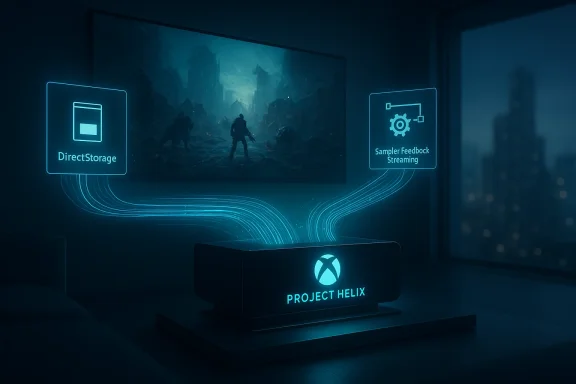
If Project Helix is an outcome, then Xbox Series X|S-era work supplied the tooling. Microsoft’s Xbox Velocity Architecture is not a single chip or a single piece of software; it is a coordinated set of hardware and API-level changes designed to remove I/O bottlenecks that have historically limited game streaming and world scale on consoles. The Velocity Architecture bundles a custom NVMe SSD, hardware decompression blocks, the DirectStorage API, and Sampler Feedback Streaming to let consoles read, decompress, and feed assets into the GPU at speeds that change how developers structure assets and streaming logic.DirectStorage—originally conceived as part of that Xbox Velocity vision—was subsequently brought to Windows. Its promise on PC is to enable GPU-assisted, highly parallel I/O paths so the CPU is not the bottleneck for feeding textures and level data into GPU memory. Over the last several years Microsoft refined DirectStorage on Windows 11, producing developer libraries and drivers that reduce load times and enable more ambitious streaming systems on PC. Those iterative improvements are directly relevant if Microsoft intends to ship a Windows‑rooted console: the software and developer interfaces already exist and have been hardened in a Windows environment.
What the Velocity + DirectStorage stack buys you
- Dramatically reduced load and streaming stalls through hardware-offloaded decompression and parallel I/O.
- The ability to treat SSDs as a primary data source for high-quality, large open worlds without the same RAM footprint.
- A consistent API surface across Windows and Xbox for game developers to target—reducing dual‑build maintenance.
Project Helix in context: from rumor to confirmation
Project Helix has been referenced in industry reporting for years; the earliest widely recognized mention dates back to Kotaku reporting in 2016, which described a broader Microsoft plan to converge Xbox and Windows under the internal codename. That piece and subsequent coverage documented Microsoft’s movement toward forward-compatible hardware and a PC-like iterative approach to console updates. The recent, concise confirmation from Microsoft—publicly amplified by new Xbox leadership—was less a surprise to anyone paying attention to those historical threads than a formal naming of a strategy finally moving into explicit product development.Asha Sharma, in her public post announcing the codename, stated: “Project Helix will lead in performance and play your Xbox and PC games,” and the Xbox account shared a brief teaser. That short message contains both a product claim (performance leadership) and a strategic framing (support for PC and Xbox games)—and it sent the industry scrambling to reconcile what “play your PC games” will mean in practice: native Windows access? Supported PC storefronts? Compatibility with existing PC peripherals and drivers? Early coverage and developer commentary are already working through those implications.
What “play your PC games” could actually mean (practical scenarios)
The phrase is deliberately broad, and Microsoft’s careful messaging leaves multiple technical and business possibilities open. Here are the likely interpretations—and their real-world implications:- A Windows 11 runtime under a TV-first UX (the “fully Windows” model)
- The device runs full Windows 11 beneath an Xbox shell, allowing users to exit to Windows and run PC storefronts, installers, and apps directly.
- Pro: maximum compatibility with existing PC games and modding scenes.
- Con: higher support surface, driver complexity, and potential cost; requires Microsoft to commit to shipping full Windows on a living‑room device.
- A console OS with native PC‑game compatibinsole boots to an Xbox-optimized OS but includes a compatibility layer or runtime to run Windows-built PC games natively or semi-natively.
- Pro: tighter integration, simpler consumer experience.
- Con: compatibility caveats, need for developer buy‑in and testing.
- A curated “PC game” program where Microsoft certifies select PC titles for native Helix play
- Microsoft curates and validates certain PC titles to run on Helix through a program similar to “Play Anywhere,” potentially enabling Steam/Epic/Game Pass variants to run.
- Pro: easier QA for hardware targets.
- Con: limits to breadth of ‘PC games’ available at launch.
- Cloud or subscription-driven PC access
- Instead of necessarily running every PC title locally, Helix could pair closely with cloud instances for non‑native games while running native and Game Pass content locally.
- Pro: offloads heavy compatibility work to cloud servers.
- Con: requires network ties and undermines the claim of “playing your PC games” if many titles depend on streaming.
Hardware and partners: clues we can credibly read today
Two publicly visible engineering signals matter here: Microsoft’s long-standing relationship with AMD for semi‑custom silicon and the technical demands implied by “lead in performance.”- AMD semi‑custom SoC work: AMD’s public comments that semi-custom SoC work for Microsoft is “progressing well to support a launch in 2027” are the most concrete timing signal we’ve seen. If accurate, that suggests Microsoft—and its silicon partner—are working toward a mid‑to‑late‑decade hardware refresh window that could host Helix.
- Storage and memory expectations: matching the performance claims demands modern SSD throughput, hardware decompression, and substantial GPU memory bandwidth. The Velocity Architecture’s lessons (hardware decompression, dedicated I/O pipelines) will be central to delivering the kind of experience Microsoft is promising.
Business implications: content, exclusivity, and Microsoft’s new scale
Helix doesn’t exist in a vacuum; Microsoft now owns a significantly larger content portfolio than it did five years ago. Following the Activision Blizzard King acquisition closing in October 2023, Microsoft disclosed in its annual materials that it now controls “20 franchises that have generated over $1 billion in lifetime revenue,” naming franchises ranging from Candy Crush and Diablo to Call of Duty and Warcraft as examples. That level of IP breadth materially changes Microsoft’s bargaining power for platform strategies, subscription offerings, and third‑party deals.This has three immediate strategic consequences for Helix:
- Content leverage: owning major franchises gives Microsoft options—make big tent-pole titles Helix-first, cross-sell via Game Pass, or license out titles selectively to maintain revenue across platforms.
- Competitive pressure: platform incumbents (Sony, Nintendo) and PC storefronts (Steam, Epic) will watch how Microsoft balances platform control with multiplatform play—decisions here will shape regulatory attention, partner relations, and consumer sentiment.
- Business model flexibility: Helix can be a hardware anchor for Game Pass subscriptions, cloud streaming, and cross-device entitlements, which are arguably Microsoft’s strategic differentiators versus box‑sale revenue.
Developer and ecosystem implications: promise and friction
For developers, a unified target would reduce fragmentation: one XDK/XDK‑style pipeline that targets both Windows and Helix could save engineering costs and lower the bar for cross‑platform rollouts. Microsoft’s past investments—OneCore, Play Anywhere, GameStack—show a pattern of building tools that reduce developer overhead. The continuing maturation of DirectStorage and related APIs only strengthens that case.But there are practical friction points:
- Certification and QA: if Helix runs full Windows, QA costs expand because peripherals, drivers, and third‑party middleware need support in a living‑room context.
- Store fragmentation and platform policy: will Steam, Epic, and other storefronts be allowed? Will Microsoft require special packaging or entitlements for Helix-compatible builds? The answers here determine whether Helix is genuinely open to the PC ecosystem or a Microsoft‑centered, curated environment.
- Pricing and market segmentation: a premium Helix at console‑or‑PC pricing could fragment Microsoft’s install base and complicate first‑party release windows and monetization expectations.
Risks and downsides Microsoft must manage
No single product claim scales without tradeoffs. The main risks for Project Helix fall into technical, commercial, and ecosystem categories.- Technical complexity and support surface: shipping a device that runs Windows or Windows‑equivalent runtimes in a living room multiplies the number of permutations Microsoft must support—drivers, OS updates, third‑party installers, and security updates. Consoles traditionally simplify this by serving fixed hardware and a curated store; diverging from that model reintroduces Windows‑style complexity to console customers.
- Price vs. market positioning: if Helix must deliver PC‑class performance, cost becomes a concern. Microsoft will either need to accept a build tiered options—both have strategic implications. Premium pricing could mean a narrower install base, which reduces the platform’s attractiveness for exclusive launches and third‑party marketing.
- Developer fragmentation and certification: inconsistent certification rules across PC storefronts and Helix could force studios into additional QA workflows, undermining the promise of a single development target.
- Platform politics and antitrust optics: owning a large number of high‑value franchises and simultaneously developing a platform that runs PC games opens regulatory and competitive scrutiny questions. Microsoft’s prior acquisition activity and promises to extend titles to other platforms will be part of how regulators and partners judge Helix stram]
What to watch next: practical signals that will answer the open questions
Microsoft’s Helix announcement was intentionally short. The community should monitor these specific signals at GDC and in subsequent Microsoft communications to understand the product’s shape:- OS and boot model: does Helix ship with full Windows 11, a locked-down Windows image, or a new hybrid console runtime? The answer decides the device’s support model and compatibility promise.
- Storefront policy: will third‑party PC storefronts (Steam, Epic) run natively? Will Microsoft require a certification program or special packaging? The policy will determine how "open" Helix actually is.
- Hardware spec hints: AMD statements and component previews (SSD throughput, RAM, GPU architecture) will indicate whether the device is truly aimed at PC-class performance or sits closer to console targets with PC compatibility.
- Price and SKU strategy: Microsoft must clarify whether Helix is a premium, mass, or multi‑tier product. Pricing will shape adoption, developer support, and the device’s role inside Microsoft’s overall gaming strategy.
- Developer SDKs and migration guidance: concrete tooling and certification guides will be the clearest signal of Microsoft’s commitment to a single‑build future for Xbox and Windows developers.
Bottom line: Helix is the visible endpoint of a long arc—but execution will decide its impact
Project Helix is not a spontaneous gambit. It is the public face of years of engineering—OneCore, Velocity Architecture, DirectStorage, and iterative dev tools—that make the idea of a console that plays PC games technically credible. Microsoft’s public messaging and its expanded content portfolio (including dozens of billion‑dollar franchises after the Activision Blizzard deal) mean Helix will be judged on both its technical delivery and its business behavior.For gamers and developers, the promise is seductive: one hardware target, console polish, and access to expansive PC libraries and tooling. For platform owners and regulators, the concern is familiar: how Microsoft balances openness, exclusivity, and business value. Whether Helix becomes the moment Microsoft heals the console/PC divide—or simply creates a new, higher‑end rung in its device family—will come down to three things: the OS model shipped, the storefront and certification policies Microsoft enforces, and the price Microsoft chooses to ask gamers to pay.
Those are not product details you can gloss over in a teaser. Expect the coming weeks—starting at the Game Developers Conference—to be decisive. The Helix codename is now public; the rest of the story arrives in the technical docs, SDKs, and the hardware specifications Microsoft provides next.
Conclusion
Project Helix is the crystallization of a nearly decade‑long engineering strategy: unify Windows and Xbox at an OS and tooling level, push storage and I/O innovations from console into PC and back again, and leverage an expanding content library to deliver new consumer propositions. That makes Helix intellectually and technically plausible today—but it does not make it simple. If Microsoft can ship a compelling hardware and OS package with reasonable pricing, clear storefront rules, and developer-friendly tools, Project Helix could reshape how consoles and PCs coexist. If Microsoft stumbles on any of those elements, Helix risks becoming an expensive experiment that complicates the very convergence it promises to solve. The next phase—detailed specs, SDK documentation, and partner policy—will show whether this decade of groundwork pays off.
Source: TweakTown Microsoft's new Project Helix next-gen Xbox console was 10 years in the making
