

Microsoft is reportedly using an internal Windows initiative known as Project K2 to improve Windows 11 performance, reliability, interface polish, and gaming efficiency, with SteamOS serving as a benchmark for handheld and PC gaming over the next one to two years. That is the factual core of the latest reporting, but the bigger story is less about Valve embarrassing Microsoft and more about Windows finally being judged by the experience users actually have. For years, Windows 11 has been treated inside Microsoft as a delivery vehicle for cloud services, AI hooks, ads, subscriptions, and ecosystem nudges. K2 matters because it suggests Microsoft may have rediscovered the operating system underneath all of that.
The awkward thing about SteamOS is not that it runs every game better than Windows. It does not. Anti-cheat support, publisher priorities, driver differences, and the sheer mass of Windows-first development still give Microsoft a formidable advantage in PC gaming.
The awkward thing is that SteamOS feels designed around the job the device is supposed to do. Pick up a Steam Deck or a SteamOS handheld and the operating system mostly disappears behind the game library, controller navigation, suspend-and-resume behavior, power profiles, and a coherent store-first-but-not-store-only interface. It is not perfect, but it has a point of view.
Windows 11 on handhelds has often felt like a desktop OS wearing a console mask. The Xbox app can be polished, the Game Bar can be useful, and OEM overlays can paper over some gaps, but eventually the user still collides with desktop Windows: tiny touch targets, background services, update prompts, driver panels, account nags, notification clutter, and the odd sensation that the machine is always trying to be a laptop even when it is shaped like a game controller.
That is why the reported SteamOS comparison is so damaging. Microsoft is not merely being challenged on frames per second. It is being challenged on focus.
That distinction matters. A numbered Windows release gives Microsoft a marketing event. A quality program gives it a long, boring, measurable obligation. The latter is what Windows needs.
The problem with Windows 11 has never been that it lacks features. It has widgets, Copilot integration, redesigned settings, a refreshed Microsoft Store, gaming features, security improvements, AI surfaces, accessibility upgrades, window management refinements, and a long list of platform work that rarely makes mainstream headlines. The problem is that the everyday experience can still feel slower, more interrupted, and less respectful than users expect from the world’s default PC operating system.
Windows has always carried historical baggage. Backward compatibility is not free. Enterprise manageability is not free. Supporting everything from boutique gaming rigs to ten-year-old office desktops is not free. But users do not experience architectural complexity as an excuse; they experience it as a delay when File Explorer opens, a stutter when the Start menu animates, or a driver updater demanding attention when they wanted to play a game.
K2, if the reporting is accurate, is Microsoft admitting that the vibes have become a product problem.
On a desktop with a keyboard, mouse, large monitor, wall power, and a patient user, Windows’ rough edges are survivable. On a seven-inch handheld, every unnecessary prompt becomes hostile. Every background process is battery life. Every inconsistent interface is a reminder that the operating system was not born for this form factor.
That is why SteamOS has become such a useful foil. Valve’s system is narrower in scope, and that narrowness is its strength. SteamOS does not have to be the universal platform for corporate endpoint management, CAD workstations, school laptops, legacy Win32 utilities, and gaming handhelds. Windows does, and Microsoft has historically treated that breadth as an unbeatable advantage.
In handheld gaming, breadth can become drag. The user is not asking for every possible Windows capability in that moment. The user is asking for a device that wakes quickly, launches a game cleanly, maintains controller focus, manages power intelligently, and does not behave like Outlook might need to be configured before Hades II can start.
Microsoft’s Xbox full screen experience is an important acknowledgement of that problem. It suppresses some standard Windows surfaces, foregrounds a controller-friendly gaming interface, and gives OEMs a way to boot into a more console-like environment. But a shell mode is not the same thing as an operating system philosophy. SteamOS feels like a gaming environment with a desktop available behind it. Windows often feels like a desktop environment with a gaming layer placed on top.
K2’s challenge is to make that difference less obvious.
But gaming performance is not just raw speed. On handhelds especially, the better operating system is often the one that delivers acceptable performance with less waste. If Windows matches SteamOS at 25 watts but loses badly at 12 watts, that is not parity. If Windows produces a slightly higher average frame rate but burns through the battery faster, wakes less reliably, or interrupts the session with background activity, that is not a win.
Microsoft knows how to optimize. Xbox exists. DirectX exists. Windows’ graphics stack has decades of investment behind it. The company has world-class kernel engineers, driver relationships, developer tooling, and telemetry at a scale Valve cannot match. The question is not whether Microsoft can make Windows gaming faster in isolated cases.
The question is whether it can make Windows feel intentional in the moments when overhead used to be tolerated as the price of compatibility.
That likely means work below the visible interface: service behavior, memory pressure, startup tasks, power management, graphics scheduling, driver coordination, shader caching, suspend and resume, input routing, and how aggressively non-gaming components are quieted during a gaming session. It also means Microsoft must be willing to treat some of its own experiences as optional rather than inevitable.
That feeling is poisonous for enthusiasts, and it is exhausting for IT professionals. Home users complain about ads and nagging. Power users complain about removed options and inconsistent settings. Admins complain about change management and feature churn. Gamers complain about overhead and interface friction. These groups disagree about many things, but they increasingly share a suspicion that Microsoft’s agenda is not always aligned with theirs.
SteamOS benefits from a simpler bargain. Valve wants you to buy and play games through Steam. That is obviously commercial, but it is legible. The interface, the store, the library, the controller layout system, the compatibility database, and the update model all point in the same direction.
Windows’ bargain is murkier. It wants to run your apps, secure your device, connect you to Microsoft services, promote Edge, surface Copilot, sync OneDrive, support Xbox, serve enterprises, satisfy OEMs, preserve legacy compatibility, and prepare for whatever Microsoft thinks ambient AI computing becomes next. No wonder users sometimes feel like the OS cannot sit still.
If K2 is serious, it cannot be only a performance project. It has to be a restraint project.
That makes Windows central to Xbox in a way that was once easier to ignore. If the next generation of Xbox hardware moves closer to the PC, or if Microsoft leans further into Windows-based gaming devices, the old separation between “Windows gaming” and “Xbox gaming” becomes harder to maintain. A clumsy Windows handheld is not just a Windows problem. It is an Xbox problem.
This is where Valve’s pressure is especially potent. SteamOS threatens Microsoft not by replacing Windows on every gaming PC, but by defining what a modern PC gaming appliance should feel like. If Valve and its hardware partners can make Linux-based gaming feel console-simple while retaining enough PC flexibility, Microsoft loses control of the premium narrative around PC gaming devices.
That would be a remarkable reversal. For decades, Windows was the unquestioned home of PC gaming. Linux gaming was the enthusiast experiment, the compatibility project, the thing people admired more than used. Proton changed that. The Steam Deck productized it. Handheld PCs made it visible.
Microsoft does not need SteamOS to overtake Windows market share to feel the threat. It only needs SteamOS to become the comparison that makes Windows look bloated.
For many users, the daily pain points are mundane. File Explorer should be fast and predictable. Search should return local files without feeling like a web advertising surface. The Start menu should open instantly. Settings should not feel like a half-migrated Control Panel replacement years after launch. Updates should be boring. Notifications should be respectful. Defaults should not reset suspiciously. The OS should not use every major update to relitigate the user’s browser, cloud storage, or AI preferences.
These are not glamorous requests. They are the foundation of trust.
The irony is that Windows 11 is also, in many respects, a strong operating system. Its security baseline is better than Windows 10’s. Its window management is improved. Its support for modern hardware, HDR, DirectStorage-era gaming concepts, passkeys, virtualization-based security, and hybrid CPU scheduling reflects real engineering. But those wins are easy to overlook when the visible layer feels slower or more manipulative than it should.
A quality push therefore has to meet two audiences at once. Gamers need Microsoft to reduce overhead and make Windows viable in SteamOS-like scenarios. Everyday users need Microsoft to stop turning the shell into a billboard. IT departments need Microsoft to make change predictable, documented, and manageable. These are different complaints, but they share a common root: Windows should behave like infrastructure before it behaves like a growth channel.
Taste is knowing when not to add a button. Taste is refusing to ship three overlapping settings experiences. Taste is understanding that a millisecond delay in a core shell surface matters more than a new promotional panel. Taste is treating silence as a feature. Taste is accepting that not every Microsoft service deserves a permanent invitation into the user’s workflow.
Valve’s advantage with SteamOS is not merely technical. It is editorial. The device has a clear hierarchy: games first, controller navigation first, suspend-and-resume first, store and library first, desktop second. That hierarchy allows Valve to say no.
Windows has historically struggled to say no because Windows is where every Microsoft priority wants to live. Teams wants hooks. Edge wants hooks. OneDrive wants hooks. Copilot wants hooks. Microsoft 365 wants hooks. Xbox wants hooks. OEMs want hooks. Security wants hooks. Enterprise wants hooks. Developers want backward compatibility. Users want all of it to somehow feel clean.
K2 will succeed only if someone inside Microsoft has enough authority to make trade-offs stick. Performance work can be assigned. Bugs can be triaged. But taste requires governance. It requires telling powerful internal teams that Windows is not an unlimited surface for their ambitions.
That may be the real test of whether this is a reset or a rebrand.
That does not mean K2 is meaningless. Internal initiatives can matter. A coordinated quality push can improve perceived performance, reduce papercuts, and force teams to align around measurable outcomes. Windows is large enough that even modest improvements in shell responsiveness, update reliability, and gaming efficiency would affect hundreds of millions of people.
But credibility will not come from the codename. It will come from boring evidence. Does File Explorer get faster and stay faster? Does the Start menu stop feeling like a remote surface? Does gaming on handhelds improve in battery-normalized testing? Does Microsoft reduce promotional clutter rather than simply move it? Do enterprise admins see fewer surprise behaviors? Do users feel less need to install third-party tools to restore basic dignity to the desktop?
The public will not grade K2 on intent. It will grade K2 on whether Windows becomes less annoying.
For years, Windows’ roughness on small gaming devices could be explained away as the unavoidable cost of compatibility. Then Valve showed that a PC gaming device could boot into a purpose-built interface, suspend and resume like a console, expose power controls that make sense to players, and still offer access to a desktop when needed. Suddenly the old excuses sounded less like laws of physics and more like product choices.
Microsoft should use that humiliation. Not defensively, and not by copying SteamOS superficially, but by accepting the underlying critique. Windows does not need to become Linux. It does not need to become a console OS. It does not need to abandon its unmatched software ecosystem. It needs to become more disciplined about context.
A gaming handheld context should not behave like a productivity laptop. A managed enterprise desktop should not behave like a consumer upsell surface. A local search box should not behave like a web portal unless the user asks it to. A system update should not feel like a product relaunch. These are not radical ideas. They are what mature platforms do when they respect the moment the user is in.
If K2 makes Windows more context-aware and less self-promotional, the SteamOS comparison will have done Microsoft a favor.
Source: KitGuru Microsoft reportedly wants to make Windows 11 as good as SteamOS - KitGuru
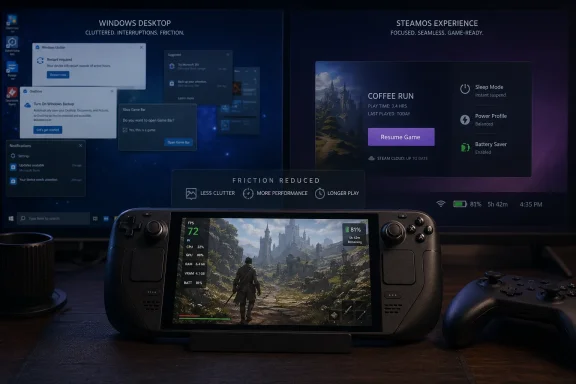 SteamOS Became the Scoreboard Microsoft Could Not Ignore
The awkward thing about SteamOS is not that it runs every game better than Windows. It does not. Anti-cheat support, publisher priorities, driver differences, and the sheer mass of Windows-first development still give Microsoft a formidable advantage in PC gaming.The awkward thing is that SteamOS feels designed around the job the device is supposed to do. Pick up a Steam Deck or a SteamOS handheld and the operating system mostly disappears behind the game library, controller navigation, suspend-and-resume behavior, power profiles, and a coherent store-first-but-not-store-only interface. It is not perfect, but it has a point of view.
Windows 11 on handhelds has often felt like a desktop OS wearing a console mask. The Xbox app can be polished, the Game Bar can be useful, and OEM overlays can paper over some gaps, but eventually the user still collides with desktop Windows: tiny touch targets, background services, update prompts, driver panels, account nags, notification clutter, and the odd sensation that the machine is always trying to be a laptop even when it is shaped like a game controller.
That is why the reported SteamOS comparison is so damaging. Microsoft is not merely being challenged on frames per second. It is being challenged on focus.
Project K2 Sounds Like a Quality Program Because Windows Needs One
According to reporting around Windows K2, this is not a single Windows release, not a “Windows 12 by another name,” and not a magic feature pack that suddenly arrives one Tuesday morning. It is described instead as an internal quality and user-trust effort aimed at the complaints that have accumulated around Windows 11: sluggishness, inconsistency, unwanted distractions, reliability worries, File Explorer frustrations, Start menu delays, update anxiety, and the sense that Microsoft’s priorities have drifted away from the people sitting in front of the machine.That distinction matters. A numbered Windows release gives Microsoft a marketing event. A quality program gives it a long, boring, measurable obligation. The latter is what Windows needs.
The problem with Windows 11 has never been that it lacks features. It has widgets, Copilot integration, redesigned settings, a refreshed Microsoft Store, gaming features, security improvements, AI surfaces, accessibility upgrades, window management refinements, and a long list of platform work that rarely makes mainstream headlines. The problem is that the everyday experience can still feel slower, more interrupted, and less respectful than users expect from the world’s default PC operating system.
Windows has always carried historical baggage. Backward compatibility is not free. Enterprise manageability is not free. Supporting everything from boutique gaming rigs to ten-year-old office desktops is not free. But users do not experience architectural complexity as an excuse; they experience it as a delay when File Explorer opens, a stutter when the Start menu animates, or a driver updater demanding attention when they wanted to play a game.
K2, if the reporting is accurate, is Microsoft admitting that the vibes have become a product problem.
The Handheld PC Exposed Windows at Its Weakest
The gaming handheld did not create Windows 11’s problems. It concentrated them.On a desktop with a keyboard, mouse, large monitor, wall power, and a patient user, Windows’ rough edges are survivable. On a seven-inch handheld, every unnecessary prompt becomes hostile. Every background process is battery life. Every inconsistent interface is a reminder that the operating system was not born for this form factor.
That is why SteamOS has become such a useful foil. Valve’s system is narrower in scope, and that narrowness is its strength. SteamOS does not have to be the universal platform for corporate endpoint management, CAD workstations, school laptops, legacy Win32 utilities, and gaming handhelds. Windows does, and Microsoft has historically treated that breadth as an unbeatable advantage.
In handheld gaming, breadth can become drag. The user is not asking for every possible Windows capability in that moment. The user is asking for a device that wakes quickly, launches a game cleanly, maintains controller focus, manages power intelligently, and does not behave like Outlook might need to be configured before Hades II can start.
Microsoft’s Xbox full screen experience is an important acknowledgement of that problem. It suppresses some standard Windows surfaces, foregrounds a controller-friendly gaming interface, and gives OEMs a way to boot into a more console-like environment. But a shell mode is not the same thing as an operating system philosophy. SteamOS feels like a gaming environment with a desktop available behind it. Windows often feels like a desktop environment with a gaming layer placed on top.
K2’s challenge is to make that difference less obvious.
Performance Is the Easy Part to Promise and the Hard Part to Prove
The phrase “as good as SteamOS” will inevitably be reduced to benchmark charts. That is understandable, because performance is measurable and argument-friendly. If two handhelds with the same APU run the same game at the same settings, people can compare average frame rates, one-percent lows, power draw, thermals, fan noise, memory use, shader compilation behavior, and resume reliability.But gaming performance is not just raw speed. On handhelds especially, the better operating system is often the one that delivers acceptable performance with less waste. If Windows matches SteamOS at 25 watts but loses badly at 12 watts, that is not parity. If Windows produces a slightly higher average frame rate but burns through the battery faster, wakes less reliably, or interrupts the session with background activity, that is not a win.
Microsoft knows how to optimize. Xbox exists. DirectX exists. Windows’ graphics stack has decades of investment behind it. The company has world-class kernel engineers, driver relationships, developer tooling, and telemetry at a scale Valve cannot match. The question is not whether Microsoft can make Windows gaming faster in isolated cases.
The question is whether it can make Windows feel intentional in the moments when overhead used to be tolerated as the price of compatibility.
That likely means work below the visible interface: service behavior, memory pressure, startup tasks, power management, graphics scheduling, driver coordination, shader caching, suspend and resume, input routing, and how aggressively non-gaming components are quieted during a gaming session. It also means Microsoft must be willing to treat some of its own experiences as optional rather than inevitable.
Microsoft’s Real Opponent Is Its Own Product Strategy
The harshest reading of Windows 11 is that it has too often mistaken engagement for value. More surfaces, more prompts, more recommendations, more cloud hooks, more AI entry points, more account flows, more “discoverability.” Each individual decision can be defended in a conference room. Together, they create the feeling that the operating system is never fully yours.That feeling is poisonous for enthusiasts, and it is exhausting for IT professionals. Home users complain about ads and nagging. Power users complain about removed options and inconsistent settings. Admins complain about change management and feature churn. Gamers complain about overhead and interface friction. These groups disagree about many things, but they increasingly share a suspicion that Microsoft’s agenda is not always aligned with theirs.
SteamOS benefits from a simpler bargain. Valve wants you to buy and play games through Steam. That is obviously commercial, but it is legible. The interface, the store, the library, the controller layout system, the compatibility database, and the update model all point in the same direction.
Windows’ bargain is murkier. It wants to run your apps, secure your device, connect you to Microsoft services, promote Edge, surface Copilot, sync OneDrive, support Xbox, serve enterprises, satisfy OEMs, preserve legacy compatibility, and prepare for whatever Microsoft thinks ambient AI computing becomes next. No wonder users sometimes feel like the OS cannot sit still.
If K2 is serious, it cannot be only a performance project. It has to be a restraint project.
The Next Xbox Makes This More Than a PC Enthusiast Story
The reported Windows gaming push also lands amid a broader strategic shift around Xbox. Microsoft’s console business is no longer just about a box under the television. Xbox is now a service layer, a storefront, a cloud gaming network, a PC app, a handheld initiative, a cross-buy promise, and a brand Microsoft increasingly wants to stretch across devices.That makes Windows central to Xbox in a way that was once easier to ignore. If the next generation of Xbox hardware moves closer to the PC, or if Microsoft leans further into Windows-based gaming devices, the old separation between “Windows gaming” and “Xbox gaming” becomes harder to maintain. A clumsy Windows handheld is not just a Windows problem. It is an Xbox problem.
This is where Valve’s pressure is especially potent. SteamOS threatens Microsoft not by replacing Windows on every gaming PC, but by defining what a modern PC gaming appliance should feel like. If Valve and its hardware partners can make Linux-based gaming feel console-simple while retaining enough PC flexibility, Microsoft loses control of the premium narrative around PC gaming devices.
That would be a remarkable reversal. For decades, Windows was the unquestioned home of PC gaming. Linux gaming was the enthusiast experiment, the compatibility project, the thing people admired more than used. Proton changed that. The Steam Deck productized it. Handheld PCs made it visible.
Microsoft does not need SteamOS to overtake Windows market share to feel the threat. It only needs SteamOS to become the comparison that makes Windows look bloated.
The Desktop Still Has to Matter
There is a danger in framing K2 too narrowly around gaming. Windows 11’s reputation problem did not begin with handhelds, and it will not be solved by an Xbox-style shell.For many users, the daily pain points are mundane. File Explorer should be fast and predictable. Search should return local files without feeling like a web advertising surface. The Start menu should open instantly. Settings should not feel like a half-migrated Control Panel replacement years after launch. Updates should be boring. Notifications should be respectful. Defaults should not reset suspiciously. The OS should not use every major update to relitigate the user’s browser, cloud storage, or AI preferences.
These are not glamorous requests. They are the foundation of trust.
The irony is that Windows 11 is also, in many respects, a strong operating system. Its security baseline is better than Windows 10’s. Its window management is improved. Its support for modern hardware, HDR, DirectStorage-era gaming concepts, passkeys, virtualization-based security, and hybrid CPU scheduling reflects real engineering. But those wins are easy to overlook when the visible layer feels slower or more manipulative than it should.
A quality push therefore has to meet two audiences at once. Gamers need Microsoft to reduce overhead and make Windows viable in SteamOS-like scenarios. Everyday users need Microsoft to stop turning the shell into a billboard. IT departments need Microsoft to make change predictable, documented, and manageable. These are different complaints, but they share a common root: Windows should behave like infrastructure before it behaves like a growth channel.
The Hardest Feature to Ship Is Taste
Microsoft has never lacked engineering talent. What it has often lacked in Windows is taste at the system level.Taste is knowing when not to add a button. Taste is refusing to ship three overlapping settings experiences. Taste is understanding that a millisecond delay in a core shell surface matters more than a new promotional panel. Taste is treating silence as a feature. Taste is accepting that not every Microsoft service deserves a permanent invitation into the user’s workflow.
Valve’s advantage with SteamOS is not merely technical. It is editorial. The device has a clear hierarchy: games first, controller navigation first, suspend-and-resume first, store and library first, desktop second. That hierarchy allows Valve to say no.
Windows has historically struggled to say no because Windows is where every Microsoft priority wants to live. Teams wants hooks. Edge wants hooks. OneDrive wants hooks. Copilot wants hooks. Microsoft 365 wants hooks. Xbox wants hooks. OEMs want hooks. Security wants hooks. Enterprise wants hooks. Developers want backward compatibility. Users want all of it to somehow feel clean.
K2 will succeed only if someone inside Microsoft has enough authority to make trade-offs stick. Performance work can be assigned. Bugs can be triaged. But taste requires governance. It requires telling powerful internal teams that Windows is not an unlimited surface for their ambitions.
That may be the real test of whether this is a reset or a rebrand.
Skepticism Is the Rational Default
Windows users have heard versions of this promise before. Microsoft often speaks fluently about listening, simplifying, improving fundamentals, and putting users first. Then a future update arrives with another prompt, another cloud default, another feature few asked for, and another workaround circulating on forums within hours.That does not mean K2 is meaningless. Internal initiatives can matter. A coordinated quality push can improve perceived performance, reduce papercuts, and force teams to align around measurable outcomes. Windows is large enough that even modest improvements in shell responsiveness, update reliability, and gaming efficiency would affect hundreds of millions of people.
But credibility will not come from the codename. It will come from boring evidence. Does File Explorer get faster and stay faster? Does the Start menu stop feeling like a remote surface? Does gaming on handhelds improve in battery-normalized testing? Does Microsoft reduce promotional clutter rather than simply move it? Do enterprise admins see fewer surprise behaviors? Do users feel less need to install third-party tools to restore basic dignity to the desktop?
The public will not grade K2 on intent. It will grade K2 on whether Windows becomes less annoying.
The SteamOS Comparison Gives Microsoft a Useful Humiliation
There is a productive kind of embarrassment in technology. It happens when a smaller or more focused rival proves that a painful norm was not inevitable. SteamOS has done that to Windows in handheld gaming.For years, Windows’ roughness on small gaming devices could be explained away as the unavoidable cost of compatibility. Then Valve showed that a PC gaming device could boot into a purpose-built interface, suspend and resume like a console, expose power controls that make sense to players, and still offer access to a desktop when needed. Suddenly the old excuses sounded less like laws of physics and more like product choices.
Microsoft should use that humiliation. Not defensively, and not by copying SteamOS superficially, but by accepting the underlying critique. Windows does not need to become Linux. It does not need to become a console OS. It does not need to abandon its unmatched software ecosystem. It needs to become more disciplined about context.
A gaming handheld context should not behave like a productivity laptop. A managed enterprise desktop should not behave like a consumer upsell surface. A local search box should not behave like a web portal unless the user asks it to. A system update should not feel like a product relaunch. These are not radical ideas. They are what mature platforms do when they respect the moment the user is in.
If K2 makes Windows more context-aware and less self-promotional, the SteamOS comparison will have done Microsoft a favor.
The K2 Test Will Be Measured in Friction, Not Slogans
The most concrete way to understand K2 is to ignore the codename and watch the friction points. Microsoft does not need users to admire its internal process. It needs them to notice fewer interruptions, faster surfaces, better gaming behavior, and a system that feels less at war with itself.- Windows 11 reportedly has an internal K2 initiative aimed at improving performance, reliability, and user trust rather than delivering one discrete branded release.
- Microsoft is reportedly treating SteamOS as a gaming benchmark, especially for comparable performance on similar handheld or PC gaming hardware.
- The Xbox full screen experience is a meaningful step for handhelds, but it does not by itself solve Windows’ deeper overhead, consistency, and focus problems.
- The next phase of Xbox makes Windows gaming quality strategically important beyond traditional PC enthusiasts.
- K2 will be judged less by new features than by whether Microsoft removes delays, distractions, promotional clutter, and needless background activity.
- The hardest part for Microsoft may be organizational restraint, because Windows has become the place where too many internal priorities compete for the user’s attention.
Source: KitGuru Microsoft reportedly wants to make Windows 11 as good as SteamOS - KitGuru
