

Microsoft is reportedly using Project K2, an internal Windows 11 improvement push centered on performance, reliability, and polish, to answer complaints from gamers and PC users as SteamOS and Linux-based handhelds make Windows look heavier, noisier, and less console-ready. That is the real story behind the latest round of Windows gaming headlines: not that Microsoft has suddenly discovered Valve, but that Valve has made Windows’ old compromises impossible to ignore. For two decades, Windows won PC gaming by being the default; now Microsoft has to make the default feel intentional.
Windows still has the library, the drivers, the anti-cheat coverage, the storefronts, the modding ecosystem, and the enterprise gravity. No serious analysis of PC gaming can pretend otherwise. The problem is that the advantages that made Windows unavoidable on desktops do not automatically translate to handhelds, living-room PCs, or console-like devices.
SteamOS changed the comparison. Valve did not beat Windows by matching every Windows feature. It beat Windows, in the Steam Deck context, by refusing to carry every Windows assumption into a seven-inch, controller-first device.
That distinction matters. SteamOS is not a better general-purpose desktop OS for everyone; it is a better appliance experience for a specific gaming job. It wakes into the thing you bought it for, keeps the storefront and library at the center, treats suspend and resume as part of the gaming loop, and hides the desktop until you ask for it.
Windows, by contrast, has historically treated gaming as one of many workloads orbiting the desktop shell. That is a perfectly rational design for a workstation, a laptop, or a tower under a desk. It feels much less rational when the user is holding a handheld PC and trying to dismiss a launcher dialog with thumbsticks.
Project K2, if the reports are accurate, is Microsoft acknowledging that this gap is not cosmetic. A prettier Xbox layer is useful, but it does not solve Windows’ deeper reputation problem. The platform has become too often associated with background churn, brittle updates, inconsistent UI decisions, and performance variance that users cannot easily explain.
That is why K2 should be read as an umbrella initiative rather than a single release. Microsoft has spent much of the Windows 11 era adding visible ideas: widgets, Copilot entry points, redesigned apps, Start menu experiments, settings migrations, new security defaults, and increasingly aggressive cloud tie-ins. Some were useful, some were premature, and some landed as if the Windows team was optimizing for keynote slides rather than daily tolerance.
A project focused on “biggest complaints” is a different posture. It suggests Microsoft knows the platform’s problem is no longer simply whether Windows 11 has enough capabilities. It has too many moments where the user feels managed, interrupted, or made to wait.
For gamers, that irritation is amplified because performance is emotionally legible. A spreadsheet user may not notice a few extra background tasks. A handheld gamer watching battery life drop, frame pacing wobble, or a resume sequence misbehave will notice immediately.
For sysadmins, the same issue appears in a different costume. Reliability is not a vibe in managed environments; it is ticket volume, rollback planning, help-desk load, and the number of times a cumulative update turns into a Monday morning incident. If K2 is real, it is not just a gaming project. It is an admission that Windows needs fewer surprises.
SteamOS has done exactly that. It has given users a clean mental model of what a gaming-first PC can feel like. It has also created a development target around handheld compatibility, power behavior, and controller-first navigation that Windows now has to answer.
The Steam Deck did something especially dangerous to Microsoft: it made Linux feel less like a hobbyist escape hatch and more like a consumer product. Proton and Steam’s compatibility work did not erase every gap, especially around certain anti-cheat systems and storefront dependencies, but they narrowed enough of them to make the experience credible. Once credible, the comparison became brutal.
Windows handheld makers have spent the last several years selling capable hardware strapped to an operating system that often behaves as if it has never seen a D-pad. OEM software layers tried to cover the problem, but every layer had to wrestle with the same underlying truth: Windows is a desktop OS first, and a handheld gaming environment second.
That is the opportunity K2 has to address. Not by copying SteamOS feature for feature, but by reducing the distance between turning on a Windows gaming device and actually playing a game. The fewer seams the user sees, the less Valve owns the emotional high ground.
That is necessary work. It is also not enough.
A shell can make Windows feel more like a console for the first five minutes. The operating system underneath determines whether that illusion survives the next five hours. Updates, sleep behavior, driver prompts, launchers, background services, window focus, overlays, power modes, and account sign-ins all have a way of punching through the facade.
This is where SteamOS has an advantage that is as philosophical as it is technical. Valve controls a narrower experience. The Steam Deck is not trying to be every PC for every person in every enterprise and every home office. Windows is, and that breadth is both Microsoft’s moat and its burden.
K2’s success will depend on whether Microsoft can make Windows modular in practice, not just in marketing language. A gaming handheld should not feel like a laptop pretending to be a console. A living-room gaming PC should not require mouse-and-keyboard rescue as a routine maintenance ritual. A desktop gaming rig should not need a separate identity crisis every time Microsoft wants to promote a new service.
For Project K2 to matter, Microsoft has to be specific internally even if it remains vague externally. The user does not need a slogan; the user needs fewer cases where Windows feels like it is doing something more important than the thing the user asked it to do.
Gaming makes this brutally measurable. A handheld has finite battery, constrained thermals, and no patience for waste. If Windows consumes extra memory, wakes services unnecessarily, or drags the user through desktop affordances, those costs show up as heat, noise, lower frame rates, or shorter sessions.
On a tower PC, Windows can often hide inefficiency behind brute force. On a handheld, inefficiency becomes product design. That is why SteamOS has become such an uncomfortable benchmark: it makes the OS overhead visible to ordinary users.
Microsoft does not need Windows 11 to beat SteamOS in every benchmark. It does need Windows gaming devices to stop feeling like they are winning compatibility while losing elegance. Performance without predictability will not be enough.
But tolerance is not loyalty. It is a debt instrument. At some point, the platform has to pay it down.
Reliability in Windows 11 now means more than avoiding blue screens. It means updates that do not reset expectations, sleep states that behave consistently, search that finds the thing the user is looking for, File Explorer that does not feel like a legacy monument wearing modern clothes, and system components that do not shift location or behavior just as users adapt to them.
The File Explorer angle is especially telling. Explorer is one of the most-used pieces of Windows and one of the clearest examples of how hard it is to modernize the OS without breaking its muscle memory. Users want it faster, cleaner, and more capable, but they do not want another half-migrated interface that looks new until it opens an old dialog from another era.
If K2 borrows from Microsoft’s experimental File Pilot work, the company should be careful. AI-assisted file management may be useful, but Windows’ first obligation is not to make file handling conversational. It is to make the ordinary act of browsing, copying, searching, previewing, and organizing files feel instant and trustworthy.
Windows 11 has never lacked design ambition. In its best moments, it is calmer and more coherent than late Windows 10. The centered taskbar, rounded surfaces, improved settings pages, and refreshed system apps all tried to move Windows away from its utility-room aesthetic.
But craft is not a screenshot. Craft is whether the new interface and the old interface agree with each other. Craft is whether right-click menus hide essential actions behind an extra click. Craft is whether Settings finally replaces Control Panel in a way that feels complete rather than eternal. Craft is whether a gaming mode can be operated from the couch without suddenly demanding a cursor.
Microsoft’s challenge is that Windows contains sedimentary layers of decisions made for different eras. Enterprise compatibility preserves them. Power-user expectation defends them. OEM customization complicates them. Microsoft’s own services strategy keeps adding new ones.
That is why craft in Windows is not just visual refinement. It is restraint. It is knowing when not to surface a promotion, not to add another tray icon, not to move a setting, not to push a cloud workflow into a local task, and not to treat every blank surface as a monetization opportunity.
Microsoft has already been moving away from the old model of giant, monolithic Windows releases. Enablement packages, controlled feature rollouts, store-delivered app updates, and servicing stack improvements all point in that direction. But the user-facing experience remains uneven because the Windows update story still blends security urgency, feature experimentation, driver delivery, and Microsoft account nudging into one psychological bucket.
For gamers, bad timing is part of the resentment. An update that is rational on a managed office laptop can feel absurd on a handheld grabbed for a 20-minute session. A forced reboot, a post-update setup screen, or a driver hiccup is enough to turn the OS into the villain of the evening.
For IT pros, smaller updates are attractive only if they are more predictable, not merely more frequent. Enterprises have spent years building rings, deferrals, validation groups, and rollback processes around Microsoft’s servicing cadence. If K2 means quality improves before broad rollout, that is welcome. If it means more change slipping through more channels, it will be treated as another management tax.
The ideal version of K2 would make Windows updates feel less like events. The PC should become safer and better without repeatedly asking the user to admire the plumbing.
But openness becomes awkward on a handheld. Every launcher is a potential input mismatch. Every updater is a possible interruption. Every account prompt is a chance to break the illusion that this is a game machine rather than a tiny laptop.
SteamOS benefits from centering Steam while still allowing escape routes. Microsoft cannot center the Microsoft Store or Xbox app in quite the same way without fighting user behavior. PC gamers have already voted with their libraries, and the vote is fragmented.
That makes Microsoft’s job harder but also clearer. The company should not try to pretend Windows gaming is an Xbox console. It should make Windows better at being the Switzerland of game libraries. A successful Windows gaming shell would treat third-party stores as first-class citizens rather than tolerated guests.
This is where Microsoft has an opening Valve does not. SteamOS is strongest when the user lives in Steam. Windows is strongest when the user refuses to live in one ecosystem. K2 should sharpen that advantage by making the multi-store reality less clumsy, not by burying it beneath Xbox branding.
That perception may be unfair in places, but it is powerful. Users who already believe Windows is too noisy will interpret every new assistant, badge, or setup prompt through that lens. Gamers who want fewer background processes are not primed to welcome more platform intelligence unless it clearly helps games run better.
This is why Project K2 matters strategically. It gives Microsoft a chance to rebalance the Windows story away from spectacle and toward competence. AI may eventually improve search, troubleshooting, accessibility, and file management. But if the baseline OS feels slow, inconsistent, or intrusive, AI becomes garnish on a meal people did not order.
The reported removal or reduction of some Copilot surfaces is not a retreat from AI so much as a recognition that integration has to earn its place. Windows users are not opposed to intelligence. They are opposed to being drafted into product strategy experiments while trying to use their computers.
If K2 is serious about craft, it should make AI quiet by default and useful by evidence. The fastest way to improve Windows’ image may be to stop making every improvement feel like a campaign.
Project K2’s reliability promise therefore has two audiences. The gamer wants smoothness. The admin wants silence. Both are asking for the same thing in different languages: fewer avoidable disruptions.
There is a useful overlap here. Better validation on real-world hardware helps everyone. Cleaner update staging helps everyone. Faster shell performance helps everyone. Reduced background overhead helps battery life on handhelds and responsiveness on corporate laptops.
The danger is fragmentation. If Microsoft creates a gaming-optimized Windows path that behaves differently enough from standard Windows, it risks adding another support matrix. If it does not create enough difference, it risks failing to solve the handheld problem.
The answer is likely not a separate “Windows Gaming Edition,” tempting as that may sound to enthusiasts. The better answer is a Windows that can adopt roles more cleanly: desktop workstation, managed enterprise endpoint, handheld gaming device, living-room console-like PC. The same core, fewer unnecessary assumptions.
Windows has always distributed that control across Microsoft, OEMs, driver vendors, storefronts, peripheral makers, anti-cheat providers, and users themselves. That is why it became the dominant PC platform. It is also why it is so hard to make it feel appliance-like.
Microsoft can claw back some control through certification, developer guidance, gaming compatibility labels, OEM requirements, and shell modes. The company is already moving in that direction with handheld guidance and compatibility expectations. Games need sane defaults, controller navigability, readable text, and power-aware behavior if they are going to feel at home on portable PCs.
But Microsoft cannot solve everything from the OS layer. Publishers have to stop shipping launchers that behave badly on controllers. OEMs have to stop duplicating utilities with conflicting overlays and power profiles. Storefronts have to accept that handheld PC users are not always sitting at a desk with a mouse.
This is the uncomfortable truth: Windows gaming’s rough edges are ecosystem rough edges. K2 can reduce them, but Microsoft will need to use its platform leverage to make partners care.
That contract has been shaped by years of prompts, restarts, half-finished migrations, inconsistent design, and features that arrived before they felt necessary. Even when Microsoft improves Windows, users often take a while to believe it. Reputation lags engineering.
Still, the timing is right. Windows 10’s long goodbye has forced many users and organizations to make decisions about Windows 11. Handheld gaming PCs have exposed Windows’ weaknesses in a fast-growing category. Valve’s living-room ambitions and broader SteamOS availability threaten to widen the comparison beyond one device.
Microsoft does not need panic; it needs urgency. Windows remains too important to PC gaming for fatalism. But importance is not immunity. The browser wars, mobile, and developer tooling all taught the same lesson: defaults can decay when the experience stops respecting the user.
K2’s best chance is to make Windows feel boringly excellent again. Not revolutionary. Not “AI-first.” Not newly monetized. Just fast, coherent, stable, and less needy.
That does not mean telemetry is useless. It means telemetry has to be paired with taste. Microsoft needs to watch not only crashes and hangs, but also friction: extra clicks, modal interruptions, UI dead ends, controller traps, slow context menus, update anxiety, and places where the OS exposes its org chart.
Windows has suffered from a sense that too many teams get to ship into the user experience without a single editor saying no. Craft requires that editor. It requires somebody with enough authority to decide that a feature may be strategically valuable but experientially wrong in a given context.
This is especially true in gaming. A handheld mode that launches beautifully but collapses into desktop weirdness under pressure will be judged as a gimmick. A full-screen Xbox interface that respects Steam, Epic, GOG, and local games will be judged as a platform. The distinction is not subtle to the people using it.
If Project K2 becomes a forcing function for that kind of editorial discipline, it could matter well beyond gaming. Windows does not need fewer ideas. It needs a stronger filter.
The comparison with SteamOS is useful because it strips away excuses. SteamOS cannot run everything Windows can run, but it makes the things it does run feel considered. Windows can run almost everything, but too often makes the user feel like the integrator of last resort.
That is a solvable problem, but not a small one. It requires Microsoft to treat performance as a user experience feature, reliability as a competitive weapon, and craft as infrastructure rather than decoration. It also requires the company to resist the temptation to turn every reclaimed inch of goodwill into another surface for promotion.
The best version of Windows 11 after K2 would not be a SteamOS clone. It would be a Windows that understands context: controller-first when held like a console, quiet and manageable in the office, powerful and flexible at the desk, and restrained everywhere.
Source: TweakTown Microsoft plans to bring Windows 11 closer to SteamOS with Project K2
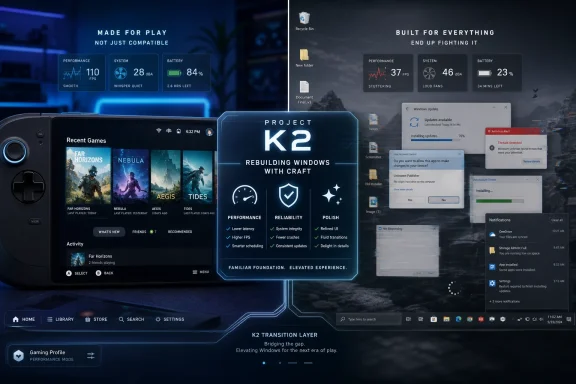 SteamOS Has Turned Windows’ Greatest Strength Into Its Weakness
Windows still has the library, the drivers, the anti-cheat coverage, the storefronts, the modding ecosystem, and the enterprise gravity. No serious analysis of PC gaming can pretend otherwise. The problem is that the advantages that made Windows unavoidable on desktops do not automatically translate to handhelds, living-room PCs, or console-like devices.SteamOS changed the comparison. Valve did not beat Windows by matching every Windows feature. It beat Windows, in the Steam Deck context, by refusing to carry every Windows assumption into a seven-inch, controller-first device.
That distinction matters. SteamOS is not a better general-purpose desktop OS for everyone; it is a better appliance experience for a specific gaming job. It wakes into the thing you bought it for, keeps the storefront and library at the center, treats suspend and resume as part of the gaming loop, and hides the desktop until you ask for it.
Windows, by contrast, has historically treated gaming as one of many workloads orbiting the desktop shell. That is a perfectly rational design for a workstation, a laptop, or a tower under a desk. It feels much less rational when the user is holding a handheld PC and trying to dismiss a launcher dialog with thumbsticks.
Project K2, if the reports are accurate, is Microsoft acknowledging that this gap is not cosmetic. A prettier Xbox layer is useful, but it does not solve Windows’ deeper reputation problem. The platform has become too often associated with background churn, brittle updates, inconsistent UI decisions, and performance variance that users cannot easily explain.
Project K2 Is Less a Feature Than a Reputation Repair Program
The reported pillars of Project K2 — performance, reliability, and craft — are revealing because they are not flashy. They are the kinds of words companies use when they are trying to rebuild trust after years of small paper cuts. Nobody buys a new PC because an operating system has more craft; they notice the absence of craft every time a menu stutters, a settings page contradicts another settings page, or File Explorer takes a beat too long to remember it is File Explorer.That is why K2 should be read as an umbrella initiative rather than a single release. Microsoft has spent much of the Windows 11 era adding visible ideas: widgets, Copilot entry points, redesigned apps, Start menu experiments, settings migrations, new security defaults, and increasingly aggressive cloud tie-ins. Some were useful, some were premature, and some landed as if the Windows team was optimizing for keynote slides rather than daily tolerance.
A project focused on “biggest complaints” is a different posture. It suggests Microsoft knows the platform’s problem is no longer simply whether Windows 11 has enough capabilities. It has too many moments where the user feels managed, interrupted, or made to wait.
For gamers, that irritation is amplified because performance is emotionally legible. A spreadsheet user may not notice a few extra background tasks. A handheld gamer watching battery life drop, frame pacing wobble, or a resume sequence misbehave will notice immediately.
For sysadmins, the same issue appears in a different costume. Reliability is not a vibe in managed environments; it is ticket volume, rollback planning, help-desk load, and the number of times a cumulative update turns into a Monday morning incident. If K2 is real, it is not just a gaming project. It is an admission that Windows needs fewer surprises.
Valve Did Not Need to Win the Desktop to Force Microsoft’s Hand
It is easy to overstate Linux’s rise in gaming. Windows remains dominant by any sane metric. But platform shifts do not always begin with majority share; they begin when a competitor defines the terms of comparison.SteamOS has done exactly that. It has given users a clean mental model of what a gaming-first PC can feel like. It has also created a development target around handheld compatibility, power behavior, and controller-first navigation that Windows now has to answer.
The Steam Deck did something especially dangerous to Microsoft: it made Linux feel less like a hobbyist escape hatch and more like a consumer product. Proton and Steam’s compatibility work did not erase every gap, especially around certain anti-cheat systems and storefront dependencies, but they narrowed enough of them to make the experience credible. Once credible, the comparison became brutal.
Windows handheld makers have spent the last several years selling capable hardware strapped to an operating system that often behaves as if it has never seen a D-pad. OEM software layers tried to cover the problem, but every layer had to wrestle with the same underlying truth: Windows is a desktop OS first, and a handheld gaming environment second.
That is the opportunity K2 has to address. Not by copying SteamOS feature for feature, but by reducing the distance between turning on a Windows gaming device and actually playing a game. The fewer seams the user sees, the less Valve owns the emotional high ground.
Xbox Mode Is the Demo; K2 Has to Be the Architecture
Microsoft’s Xbox full-screen experience is the visible edge of this strategy. It gives Windows handhelds and, increasingly, Windows PCs a more console-like interface. It can suppress parts of the standard desktop experience, make controller navigation more practical, and provide a cleaner way into a game library.That is necessary work. It is also not enough.
A shell can make Windows feel more like a console for the first five minutes. The operating system underneath determines whether that illusion survives the next five hours. Updates, sleep behavior, driver prompts, launchers, background services, window focus, overlays, power modes, and account sign-ins all have a way of punching through the facade.
This is where SteamOS has an advantage that is as philosophical as it is technical. Valve controls a narrower experience. The Steam Deck is not trying to be every PC for every person in every enterprise and every home office. Windows is, and that breadth is both Microsoft’s moat and its burden.
K2’s success will depend on whether Microsoft can make Windows modular in practice, not just in marketing language. A gaming handheld should not feel like a laptop pretending to be a console. A living-room gaming PC should not require mouse-and-keyboard rescue as a routine maintenance ritual. A desktop gaming rig should not need a separate identity crisis every time Microsoft wants to promote a new service.
Performance Is the Easy Word and the Hardest Promise
Every operating system improvement project promises performance. It is the safest possible claim because everyone wants it and almost nobody agrees on how to measure it. Boot time, app launch latency, gaming frame rates, frame pacing, battery drain, memory footprint, idle CPU activity, update duration, and Explorer responsiveness all live under the same vague umbrella.For Project K2 to matter, Microsoft has to be specific internally even if it remains vague externally. The user does not need a slogan; the user needs fewer cases where Windows feels like it is doing something more important than the thing the user asked it to do.
Gaming makes this brutally measurable. A handheld has finite battery, constrained thermals, and no patience for waste. If Windows consumes extra memory, wakes services unnecessarily, or drags the user through desktop affordances, those costs show up as heat, noise, lower frame rates, or shorter sessions.
On a tower PC, Windows can often hide inefficiency behind brute force. On a handheld, inefficiency becomes product design. That is why SteamOS has become such an uncomfortable benchmark: it makes the OS overhead visible to ordinary users.
Microsoft does not need Windows 11 to beat SteamOS in every benchmark. It does need Windows gaming devices to stop feeling like they are winning compatibility while losing elegance. Performance without predictability will not be enough.
Reliability Is Where Windows Can No Longer Spend Its Inheritance
Windows has always been allowed a certain amount of mess because the ecosystem was worth it. Users tolerated driver weirdness because the hardware choice was unmatched. Gamers tolerated launchers because the games were there. Businesses tolerated complexity because the manageability stack was mature.But tolerance is not loyalty. It is a debt instrument. At some point, the platform has to pay it down.
Reliability in Windows 11 now means more than avoiding blue screens. It means updates that do not reset expectations, sleep states that behave consistently, search that finds the thing the user is looking for, File Explorer that does not feel like a legacy monument wearing modern clothes, and system components that do not shift location or behavior just as users adapt to them.
The File Explorer angle is especially telling. Explorer is one of the most-used pieces of Windows and one of the clearest examples of how hard it is to modernize the OS without breaking its muscle memory. Users want it faster, cleaner, and more capable, but they do not want another half-migrated interface that looks new until it opens an old dialog from another era.
If K2 borrows from Microsoft’s experimental File Pilot work, the company should be careful. AI-assisted file management may be useful, but Windows’ first obligation is not to make file handling conversational. It is to make the ordinary act of browsing, copying, searching, previewing, and organizing files feel instant and trustworthy.
Craft Is the Word Microsoft Usually Forgets First
The most intriguing K2 pillar is craft. Performance and reliability are engineering disciplines with dashboards, regression tests, and telemetry. Craft is harder to quantify, which is one reason large platform companies often underinvest in it until users revolt.Windows 11 has never lacked design ambition. In its best moments, it is calmer and more coherent than late Windows 10. The centered taskbar, rounded surfaces, improved settings pages, and refreshed system apps all tried to move Windows away from its utility-room aesthetic.
But craft is not a screenshot. Craft is whether the new interface and the old interface agree with each other. Craft is whether right-click menus hide essential actions behind an extra click. Craft is whether Settings finally replaces Control Panel in a way that feels complete rather than eternal. Craft is whether a gaming mode can be operated from the couch without suddenly demanding a cursor.
Microsoft’s challenge is that Windows contains sedimentary layers of decisions made for different eras. Enterprise compatibility preserves them. Power-user expectation defends them. OEM customization complicates them. Microsoft’s own services strategy keeps adding new ones.
That is why craft in Windows is not just visual refinement. It is restraint. It is knowing when not to surface a promotion, not to add another tray icon, not to move a setting, not to push a cloud workflow into a local task, and not to treat every blank surface as a monetization opportunity.
Smaller Updates Would Be a Bigger Cultural Shift Than They Sound
The reported emphasis on agility — fewer, smaller updates and fewer bugs — sounds almost banal. In practice, it would mark a meaningful change in how Windows is experienced. Windows users do not dislike updates because they dislike security. They dislike updates because updates have too often felt like moments when the PC stops being theirs.Microsoft has already been moving away from the old model of giant, monolithic Windows releases. Enablement packages, controlled feature rollouts, store-delivered app updates, and servicing stack improvements all point in that direction. But the user-facing experience remains uneven because the Windows update story still blends security urgency, feature experimentation, driver delivery, and Microsoft account nudging into one psychological bucket.
For gamers, bad timing is part of the resentment. An update that is rational on a managed office laptop can feel absurd on a handheld grabbed for a 20-minute session. A forced reboot, a post-update setup screen, or a driver hiccup is enough to turn the OS into the villain of the evening.
For IT pros, smaller updates are attractive only if they are more predictable, not merely more frequent. Enterprises have spent years building rings, deferrals, validation groups, and rollback processes around Microsoft’s servicing cadence. If K2 means quality improves before broad rollout, that is welcome. If it means more change slipping through more channels, it will be treated as another management tax.
The ideal version of K2 would make Windows updates feel less like events. The PC should become safer and better without repeatedly asking the user to admire the plumbing.
Microsoft’s Gaming Problem Is Also a Storefront Problem
Windows gaming has never had one front door. That openness is part of its appeal. Steam, Epic, GOG, Battle.net, Ubisoft Connect, EA, itch.io, Xbox, emulators, mods, and standalone installers all coexist because Windows does not impose a console-like distribution regime.But openness becomes awkward on a handheld. Every launcher is a potential input mismatch. Every updater is a possible interruption. Every account prompt is a chance to break the illusion that this is a game machine rather than a tiny laptop.
SteamOS benefits from centering Steam while still allowing escape routes. Microsoft cannot center the Microsoft Store or Xbox app in quite the same way without fighting user behavior. PC gamers have already voted with their libraries, and the vote is fragmented.
That makes Microsoft’s job harder but also clearer. The company should not try to pretend Windows gaming is an Xbox console. It should make Windows better at being the Switzerland of game libraries. A successful Windows gaming shell would treat third-party stores as first-class citizens rather than tolerated guests.
This is where Microsoft has an opening Valve does not. SteamOS is strongest when the user lives in Steam. Windows is strongest when the user refuses to live in one ecosystem. K2 should sharpen that advantage by making the multi-store reality less clumsy, not by burying it beneath Xbox branding.
The AI Detour Has Made the Trust Problem Worse
No discussion of Windows 11’s reputation can ignore Microsoft’s AI push. Copilot integration, Recall controversy, AI-enhanced apps, cloud account pressure, and promotional surfaces have all contributed to a perception that Microsoft is more excited about what Windows can do for Microsoft than what it can do for the user.That perception may be unfair in places, but it is powerful. Users who already believe Windows is too noisy will interpret every new assistant, badge, or setup prompt through that lens. Gamers who want fewer background processes are not primed to welcome more platform intelligence unless it clearly helps games run better.
This is why Project K2 matters strategically. It gives Microsoft a chance to rebalance the Windows story away from spectacle and toward competence. AI may eventually improve search, troubleshooting, accessibility, and file management. But if the baseline OS feels slow, inconsistent, or intrusive, AI becomes garnish on a meal people did not order.
The reported removal or reduction of some Copilot surfaces is not a retreat from AI so much as a recognition that integration has to earn its place. Windows users are not opposed to intelligence. They are opposed to being drafted into product strategy experiments while trying to use their computers.
If K2 is serious about craft, it should make AI quiet by default and useful by evidence. The fastest way to improve Windows’ image may be to stop making every improvement feel like a campaign.
Enterprise IT Will Judge K2 by the Bugs It Never Sees
WindowsForum readers know the consumer gaming story is only half the equation. Microsoft cannot tune Windows exclusively for handhelds without protecting the boring, lucrative, mission-critical world of managed PCs. That world does not care whether Windows feels more like SteamOS. It cares whether the next update breaks VPN clients, printer workflows, BitLocker recovery behavior, or line-of-business applications.Project K2’s reliability promise therefore has two audiences. The gamer wants smoothness. The admin wants silence. Both are asking for the same thing in different languages: fewer avoidable disruptions.
There is a useful overlap here. Better validation on real-world hardware helps everyone. Cleaner update staging helps everyone. Faster shell performance helps everyone. Reduced background overhead helps battery life on handhelds and responsiveness on corporate laptops.
The danger is fragmentation. If Microsoft creates a gaming-optimized Windows path that behaves differently enough from standard Windows, it risks adding another support matrix. If it does not create enough difference, it risks failing to solve the handheld problem.
The answer is likely not a separate “Windows Gaming Edition,” tempting as that may sound to enthusiasts. The better answer is a Windows that can adopt roles more cleanly: desktop workstation, managed enterprise endpoint, handheld gaming device, living-room console-like PC. The same core, fewer unnecessary assumptions.
The SteamOS Benchmark Is Really About Control
When reports say Microsoft is treating SteamOS as a benchmark, the instinct is to think in terms of frame rates and UI. Those matter, but the deeper benchmark is control. SteamOS feels good on Steam Deck because Valve controls the route from power button to play session.Windows has always distributed that control across Microsoft, OEMs, driver vendors, storefronts, peripheral makers, anti-cheat providers, and users themselves. That is why it became the dominant PC platform. It is also why it is so hard to make it feel appliance-like.
Microsoft can claw back some control through certification, developer guidance, gaming compatibility labels, OEM requirements, and shell modes. The company is already moving in that direction with handheld guidance and compatibility expectations. Games need sane defaults, controller navigability, readable text, and power-aware behavior if they are going to feel at home on portable PCs.
But Microsoft cannot solve everything from the OS layer. Publishers have to stop shipping launchers that behave badly on controllers. OEMs have to stop duplicating utilities with conflicting overlays and power profiles. Storefronts have to accept that handheld PC users are not always sitting at a desk with a mouse.
This is the uncomfortable truth: Windows gaming’s rough edges are ecosystem rough edges. K2 can reduce them, but Microsoft will need to use its platform leverage to make partners care.
The One-Year-or-Two Timeline Is Ambitious Because Habits Are the Product
Reports that Microsoft hopes to make meaningful progress within a year or two should be treated with cautious optimism. A year is enough time to improve specific pain points. It is not enough time to fully rewrite the emotional contract users have with Windows 11.That contract has been shaped by years of prompts, restarts, half-finished migrations, inconsistent design, and features that arrived before they felt necessary. Even when Microsoft improves Windows, users often take a while to believe it. Reputation lags engineering.
Still, the timing is right. Windows 10’s long goodbye has forced many users and organizations to make decisions about Windows 11. Handheld gaming PCs have exposed Windows’ weaknesses in a fast-growing category. Valve’s living-room ambitions and broader SteamOS availability threaten to widen the comparison beyond one device.
Microsoft does not need panic; it needs urgency. Windows remains too important to PC gaming for fatalism. But importance is not immunity. The browser wars, mobile, and developer tooling all taught the same lesson: defaults can decay when the experience stops respecting the user.
K2’s best chance is to make Windows feel boringly excellent again. Not revolutionary. Not “AI-first.” Not newly monetized. Just fast, coherent, stable, and less needy.
The Real K2 Scorecard Will Be Written in Everyday Annoyances
The danger with a project like K2 is that Microsoft declares victory through internal metrics while users continue judging the OS by moments of irritation. A telemetry chart can say reliability improved. A user remembers the one time their handheld woke to a setup prompt instead of a game.That does not mean telemetry is useless. It means telemetry has to be paired with taste. Microsoft needs to watch not only crashes and hangs, but also friction: extra clicks, modal interruptions, UI dead ends, controller traps, slow context menus, update anxiety, and places where the OS exposes its org chart.
Windows has suffered from a sense that too many teams get to ship into the user experience without a single editor saying no. Craft requires that editor. It requires somebody with enough authority to decide that a feature may be strategically valuable but experientially wrong in a given context.
This is especially true in gaming. A handheld mode that launches beautifully but collapses into desktop weirdness under pressure will be judged as a gimmick. A full-screen Xbox interface that respects Steam, Epic, GOG, and local games will be judged as a platform. The distinction is not subtle to the people using it.
If Project K2 becomes a forcing function for that kind of editorial discipline, it could matter well beyond gaming. Windows does not need fewer ideas. It needs a stronger filter.
The Windows Team’s SteamOS Moment Has Arrived
Project K2 should be understood less as Microsoft chasing Valve and more as Microsoft being forced to relearn why people liked Windows in the first place. The platform won because it made the PC useful for almost everything. It risks losing affection when “everything” becomes a synonym for clutter.The comparison with SteamOS is useful because it strips away excuses. SteamOS cannot run everything Windows can run, but it makes the things it does run feel considered. Windows can run almost everything, but too often makes the user feel like the integrator of last resort.
That is a solvable problem, but not a small one. It requires Microsoft to treat performance as a user experience feature, reliability as a competitive weapon, and craft as infrastructure rather than decoration. It also requires the company to resist the temptation to turn every reclaimed inch of goodwill into another surface for promotion.
The best version of Windows 11 after K2 would not be a SteamOS clone. It would be a Windows that understands context: controller-first when held like a console, quiet and manageable in the office, powerful and flexible at the desk, and restrained everywhere.
The K2 Checklist Microsoft Cannot Fake
If K2 is going to be more than a codename passed around in briefings, users should be able to feel it without being told what changed. The proof will arrive in mundane places, because mundane places are where operating systems earn trust.- Windows gaming handhelds should reach a playable state faster, with fewer desktop interruptions and less need for mouse-and-keyboard recovery.
- File Explorer should feel consistently faster and more coherent, not merely decorated with another experimental layer.
- Updates should become less disruptive in practice, with fewer post-install surprises and a clearer separation between security maintenance and feature promotion.
- Xbox full-screen experiences should embrace the reality of multi-store PC gaming rather than pretending the Xbox app is the whole universe.
- AI features should remain quiet until they solve a real local problem better than the existing workflow.
- Enterprise admins should see K2 in reduced incident rates and cleaner deployment behavior, not just in consumer-facing polish.
Source: TweakTown Microsoft plans to bring Windows 11 closer to SteamOS with Project K2
