

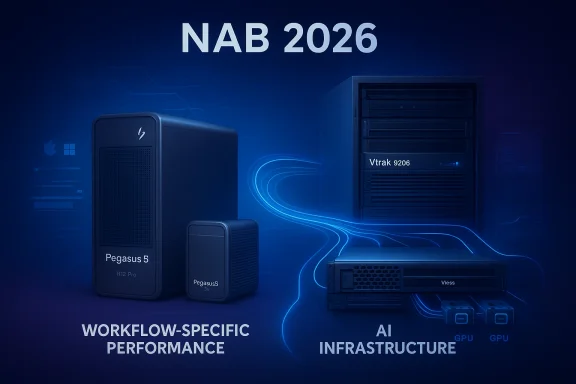
PROMISE Technology is using NAB 2026 to make a clear statement: the creator-storage market is no longer just about raw throughput, but about workflow-specific performance tuned for both Mac and Windows, plus the expanding demands of AI. The company’s Pegasus5 family is being positioned as a bridge between Thunderbolt 5 desktop and portable storage on one side, and NVMe-based AI and enterprise platforms on the other. That framing matters because it reflects where media production is actually heading in 2026: higher-resolution footage, more collaborative pipelines, and growing pressure to make local and shared storage behave like an extension of the compute stack.
PROMISE has spent years building a reputation in media and entertainment storage, and its Pegasus brand has become one of the company’s most recognizable product families. The latest push is not a clean-sheet reinvention so much as an extension of a long strategy: stay close to content creators, then translate that trust into broader infrastructure sales. The company’s 2025 NAB messaging already centered on Thunderbolt 5, Pegasus5 M8, and the R12/R12 Pro, showing that this 2026 showcase is an escalation rather than an abrupt pivot.
The timing is important. NAB Show 2026 runs April 18-22 in Las Vegas, which puts PROMISE’s announcements right in the middle of the industry’s annual product race. That show remains one of the most important launch windows for broadcast, post-production, and creator-tech vendors, and companies increasingly use it to explain not just what they built, but why their architecture is aligned with the next 12 to 24 months of production demand.
PROMISE’s product mix also tells a broader story about storage segmentation. The Pegasus5 R12 Pro is aimed at high-end Mac workflows, the Pegasus5 R12 is presented as a Windows-friendly editing platform, the Pegasus5 M8 and Pegasus5 N4 aim at mobile Thunderbolt 5 users, and the VTrak 8206 and Vess A8340 push the company into AI and data-center-oriented territory. That is a classic vendor move: once the brand is trusted in the edit bay, use that trust to sell up the stack into the machine room and the data center. (promise.com)
At the technical level, Thunderbolt 5 is still a major differentiator. Intel says the standard delivers 80 Gbps bidirectional bandwidth, with up to 120 Gbps available for certain display-heavy scenarios, and the company has positioned the interface as a leap forward for creators who need sustained performance rather than marketing-slogan speed. For storage vendors, that means the conversation is shifting from “Is this fast enough for 4K?” to “Can this system keep pace with 8K, multi-cam, AI-assisted effects, and shared collaboration without making the user think about the cable?”
The R12 Pro in particular looks like the company’s premium desktop answer for post-production teams that still want a local storage chassis rather than a NAS. PROMISE has described the Pro model as a hybrid design combining SATA HDD and NVMe SSD capacity, with throughput up to 6,000 MB/s and a design purpose-built for 8K editing, VFX, and high-end production environments. In practical terms, that is the kind of performance that reduces friction in NLE timelines, cache-heavy sessions, and massive project files that can otherwise bog down even powerful workstations.
For Windows users, the R12 story changes slightly. PROMISE is positioning the platform around Adobe Premiere Pro and GPU-accelerated editing, plus a company plug-in, which suggests it wants the R12 to be seen as integrated media infrastructure rather than generic external storage. That is a shrewd move because Windows editors are often more tolerant of modular toolchains, but they are also more likely to value automation and vendor-specific helpers if those tools reduce manual project setup.
That makes NAB the ideal stage. Demonstrations can show real-world throughput, but more importantly they can normalize the product in front of editors, DITs, and technical directors. The company has spent years building brand equity in this exact community, and that trust is likely to matter more than another few hundred megabytes per second on a slide. In this market, familiarity is a performance feature.
The Pegasus5 M8 is the clearest example of this shift. PROMISE has presented it as a compact Thunderbolt 5 RAID platform that can deliver multi-gigabyte-per-second performance and support demanding Mac workflows, including AI plugins in tools like DaVinci Resolve, Premiere, and Flame. That is a telling product message because it recognizes the way editors increasingly depend on local AI assistance for tasks that used to require additional passes or separate services.
That said, there is a difference between good demo speed and daily production usefulness. The best storage device in the world can still frustrate users if it behaves unpredictably under mixed workloads or if utilities feel bolted on. PROMISE’s challenge is to make the Pegasus line feel like a mature creative platform rather than a fast enclosure with clever branding.
That is where vendor ecosystems become decisive. If PROMISE can make its plug-in tools, RAID management, and workflow recommendations feel effortless, it gains a defensible position against commodity Thunderbolt enclosures. If not, the market may still admire the hardware while drifting toward simpler, cheaper alternatives.
PROMISE’s pitch for the N4 also fits the broader trend toward edge AI in production environments. The company is tying the compact chassis to AI tools in editing applications, which suggests it sees mobile creators as early adopters of background transcription, object detection, semantic tagging, and other lightweight AI workflows that benefit from very fast local storage. That is a smart bet because mobile production increasingly overlaps with data-light, compute-heavy tasks that still depend on fast access to media assets.
The larger opportunity is in hybrid teams. A field editor can bring footage back on an N4, hand it off to an R12 desktop later, and keep the workflow within one brand ecosystem. That is precisely how storage vendors build stickiness: by reducing the number of decisions a production team has to make.
This matters because AI workloads have changed the economics of storage buying. The bottleneck is no longer only the model or the GPU cluster; it is often the pathway between massive datasets and the compute nodes that need them. PROMISE is using this reality to argue that storage has become a first-order AI performance layer, not a passive repository. (promise.com)
That is where the competitive frame sharpens. Many storage vendors can claim “AI-ready” if they bolt a few marketing terms onto an existing array. PROMISE is trying to ground the claim in architecture: NVMe core, high-bandwidth networking, dual-controller reliability, and NVMe-oF integration. Whether buyers accept that claim will depend on deployment experience, but the technical story is coherent.
That is also why the product is strategically useful beyond pure performance metrics. It broadens PROMISE from “the Thunderbolt RAID company” into “the company that understands media data from capture to inference.” That is a far more durable market position.
That hybrid approach makes sense for organizations that need both capacity and intelligence. A pure flash array can be too expensive for certain long-retention workloads, while a pure HDD platform can feel slow and outdated for AI-assisted media services. By mixing tiers and layering in AI functions, PROMISE is aiming at a pragmatic middle where cost, performance, and functionality meet. (nbcrightnow.com)
In streaming and VOD, the economics of searchability matter almost as much as playback quality. If content can be classified faster and surfaced more intelligently, the storage layer stops being invisible and starts contributing to monetization.
PROMISE seems to understand that the modern media stack is layered. Some tasks belong on Thunderbolt-connected desktop units, some on NVMe clusters, and some in hybrid server platforms that can absorb both archival and analytics duty.
The upside of that breadth is obvious: a customer can stay within one vendor family from field capture to post-production to archive and AI analytics. The downside is equally clear: if the messaging is not disciplined, the brand risks becoming a collection of adjacent products rather than a focused platform. The best storage vendors sell coherence, not just hardware.
That is a reasonable bet, but it is not guaranteed. Creators often prize simplicity, and if a competitor offers “fast enough” storage with less complexity, they may win on convenience alone.
Still, the company’s media heritage may become an advantage if it can demonstrate that AI and content pipelines are converging. In a world where the same footage feeds creation, search, moderation, and monetization, a vendor that understands both creative and infrastructure pain points may be unusually well positioned.
This is especially relevant for teams working across platforms. Mac and Windows environments often coexist in the same studio, but the handoff between them can be messy. A vendor that reduces friction with plug-ins, utilities, and predictable RAID behavior can win mindshare even if competitors offer similar raw specs.
This is where PROMISE’s long tenure in media storage may help. The company is not inventing the idea of workflow-aware storage, but it is benefiting from years of iteration in a niche where small efficiency gains really do compound.
That is also why low latency matters so much. When AI tools are tied to media assets, the storage layer can either feel immediate or make the user wait. In a deadline-driven workflow, that difference is everything.
The most important thing to watch is whether the Pegasus5 family becomes a true platform, not just a series of devices. If the R12, R12 Pro, M8, and N4 can share a common reputation for reliability and workflow efficiency, PROMISE may have one of the more compelling creator-storage stories in the market. If the company can also make the VTrak and Vess lines resonate with AI and hybrid infrastructure buyers, it could expand well beyond its traditional niche.
Source: TechPowerUp Promise Technology Showcases Pegasus5 R12 Thunderbolt 5 Storage Solutions at NAB 2026 | TechPowerUp}
 Background
PROMISE has spent years building a reputation in media and entertainment storage, and its Pegasus brand has become one of the company’s most recognizable product families. The latest push is not a clean-sheet reinvention so much as an extension of a long strategy: stay close to content creators, then translate that trust into broader infrastructure sales. The company’s 2025 NAB messaging already centered on Thunderbolt 5, Pegasus5 M8, and the R12/R12 Pro, showing that this 2026 showcase is an escalation rather than an abrupt pivot.The timing is important. NAB Show 2026 runs April 18-22 in Las Vegas, which puts PROMISE’s announcements right in the middle of the industry’s annual product race. That show remains one of the most important launch windows for broadcast, post-production, and creator-tech vendors, and companies increasingly use it to explain not just what they built, but why their architecture is aligned with the next 12 to 24 months of production demand.
PROMISE’s product mix also tells a broader story about storage segmentation. The Pegasus5 R12 Pro is aimed at high-end Mac workflows, the Pegasus5 R12 is presented as a Windows-friendly editing platform, the Pegasus5 M8 and Pegasus5 N4 aim at mobile Thunderbolt 5 users, and the VTrak 8206 and Vess A8340 push the company into AI and data-center-oriented territory. That is a classic vendor move: once the brand is trusted in the edit bay, use that trust to sell up the stack into the machine room and the data center. (promise.com)
At the technical level, Thunderbolt 5 is still a major differentiator. Intel says the standard delivers 80 Gbps bidirectional bandwidth, with up to 120 Gbps available for certain display-heavy scenarios, and the company has positioned the interface as a leap forward for creators who need sustained performance rather than marketing-slogan speed. For storage vendors, that means the conversation is shifting from “Is this fast enough for 4K?” to “Can this system keep pace with 8K, multi-cam, AI-assisted effects, and shared collaboration without making the user think about the cable?”
The Pegasus5 Strategy
The centerpiece of PROMISE’s NAB 2026 story is the Pegasus5 R12 family, which splits into a mainstream R12 and a more capable R12 Pro. On PROMISE’s own product pages, Thunderbolt 5 support is described as being in place, while official certification is still in process, which is a useful reminder that vendor claims often move faster than ecosystem validation. That nuance matters because creators buying into a new interface want confidence not just in peak speed, but in driver stability, OS support, and device interoperability. (promise.com)The R12 Pro in particular looks like the company’s premium desktop answer for post-production teams that still want a local storage chassis rather than a NAS. PROMISE has described the Pro model as a hybrid design combining SATA HDD and NVMe SSD capacity, with throughput up to 6,000 MB/s and a design purpose-built for 8K editing, VFX, and high-end production environments. In practical terms, that is the kind of performance that reduces friction in NLE timelines, cache-heavy sessions, and massive project files that can otherwise bog down even powerful workstations.
Why the R12 Matters
The R12’s appeal is not just speed; it is workflow predictability. In editing, the difference between a fast drive and a useful drive is often whether playback remains stable when plugins, proxies, and background renders pile up. PROMISE’s framing around internal NVMe scratch for Final Cut Pro on Mac highlights that the company is selling a complete workflow assumption, not just a box full of disks. (promise.com)For Windows users, the R12 story changes slightly. PROMISE is positioning the platform around Adobe Premiere Pro and GPU-accelerated editing, plus a company plug-in, which suggests it wants the R12 to be seen as integrated media infrastructure rather than generic external storage. That is a shrewd move because Windows editors are often more tolerant of modular toolchains, but they are also more likely to value automation and vendor-specific helpers if those tools reduce manual project setup.
- Mac buyers are being sold an end-to-end creative appliance.
- Windows buyers are being sold a more extensible editing platform.
- Both groups are being told that Thunderbolt 5 is the enabler, not the headline.
- The real product is workflow reduction, not just capacity.
The Certification Question
There is a subtle tension here. PROMISE’s product page says Thunderbolt 5 functionality is supported while official certification remains in process, and that is not unusual in fast-moving hardware categories. But buyers in media production tend to be conservative, because downtime costs more than almost any spec-sheet advantage. If PROMISE wants this line to feel mature, it needs to prove that the certification gap is a paperwork issue, not an ecosystem risk. (promise.com)That makes NAB the ideal stage. Demonstrations can show real-world throughput, but more importantly they can normalize the product in front of editors, DITs, and technical directors. The company has spent years building brand equity in this exact community, and that trust is likely to matter more than another few hundred megabytes per second on a slide. In this market, familiarity is a performance feature.
Thunderbolt 5 and Creator Workflows
Thunderbolt 5 is doing more than giving PROMISE a marketing hook. It lets the company reframe external storage as a first-class editing component rather than a peripheral that merely gets out of the way. Intel’s own material emphasizes the 80 Gbps bidirectional design and the broader bandwidth headroom, which is especially meaningful for creators juggling multi-stream timelines, high-resolution codecs, and project assets that no longer fit neatly into old assumptions about local disk speed.The Pegasus5 M8 is the clearest example of this shift. PROMISE has presented it as a compact Thunderbolt 5 RAID platform that can deliver multi-gigabyte-per-second performance and support demanding Mac workflows, including AI plugins in tools like DaVinci Resolve, Premiere, and Flame. That is a telling product message because it recognizes the way editors increasingly depend on local AI assistance for tasks that used to require additional passes or separate services.
Mac-Centric Performance
PROMISE’s Mac story is especially strong because Apple hardware has become a favorite target for compact high-end creative storage. The combination of fast internal SSDs, efficient CPUs, and Thunderbolt connectivity makes the Mac a natural platform for portable RAID and scratch storage. PROMISE is clearly trying to ride that trend by optimizing around Final Cut Pro, internal NVMe scratch, and a “move fast, stay local” philosophy that appeals to single-user and small-team creative setups.That said, there is a difference between good demo speed and daily production usefulness. The best storage device in the world can still frustrate users if it behaves unpredictably under mixed workloads or if utilities feel bolted on. PROMISE’s challenge is to make the Pegasus line feel like a mature creative platform rather than a fast enclosure with clever branding.
- Thunderbolt 5 helps external storage feel internal.
- Mac creators get the most polished narrative.
- AI plugins make high-throughput scratch even more relevant.
- The real value is lower friction in multi-app workflows.
Why Bandwidth Alone Is Not Enough
Bandwidth numbers are important, but the industry has learned that latency, sustained writes, thermal behavior, and software integration often matter more in real production. A drive that starts fast and then falls off a cliff can be worse than a slower but stable system because editors care about consistency under pressure. PROMISE’s messaging around creative workflows suggests it understands that the user is buying trust as much as speed.That is where vendor ecosystems become decisive. If PROMISE can make its plug-in tools, RAID management, and workflow recommendations feel effortless, it gains a defensible position against commodity Thunderbolt enclosures. If not, the market may still admire the hardware while drifting toward simpler, cheaper alternatives.
Mobile Editing and Edge Production
The Pegasus5 N4 broadens the portfolio in a useful direction. An ultra-compact Thunderbolt 5 system with four NVMe drives makes sense for field production, on-location editing, and creators who need serious performance without the footprint of a desktop RAID tower. In an age where more footage is captured, reviewed, and rough-cut outside the studio, mobility is no longer a niche requirement; it is part of the default production chain.PROMISE’s pitch for the N4 also fits the broader trend toward edge AI in production environments. The company is tying the compact chassis to AI tools in editing applications, which suggests it sees mobile creators as early adopters of background transcription, object detection, semantic tagging, and other lightweight AI workflows that benefit from very fast local storage. That is a smart bet because mobile production increasingly overlaps with data-light, compute-heavy tasks that still depend on fast access to media assets.
What Mobile Creators Actually Need
Mobile editors usually do not want a compromise device. They want a system that is physically manageable but electrically and thermally serious, because the moment a live ingest or a fast turnaround job appears, the storage device is no longer “portable” in the casual sense. PROMISE seems to be aiming for that middle ground: compact enough to travel, capable enough to survive pressure.The larger opportunity is in hybrid teams. A field editor can bring footage back on an N4, hand it off to an R12 desktop later, and keep the workflow within one brand ecosystem. That is precisely how storage vendors build stickiness: by reducing the number of decisions a production team has to make.
Strategic Benefits of Compact NVMe
- Lower latency for active project files.
- Better fit for on-set review and proxy workflows.
- Easier transport across shoots and edit suites.
- More practical support for AI-assisted media tagging.
- Stronger alignment with laptop-based creator rigs.
AI-Optimized Infrastructure
If the Pegasus line is PROMISE’s creator front end, the VTrak 8206 is its AI back end. PROMISE describes the platform as an all-NVMe enterprise storage system built on PCIe 5.0 NVMe architecture, with support for high-speed networking, NVMe-over-Fabrics, and a dual-controller design for high availability. The company is clearly trying to position the 8206 as infrastructure for AI training, high-performance computing, and real-time analytics rather than mere archival storage. (promise.com)This matters because AI workloads have changed the economics of storage buying. The bottleneck is no longer only the model or the GPU cluster; it is often the pathway between massive datasets and the compute nodes that need them. PROMISE is using this reality to argue that storage has become a first-order AI performance layer, not a passive repository. (promise.com)
Why NVMe Matters for AI
The VTrak 8206’s design is focused on minimizing the delays that can stall model training or analytics jobs. By emphasizing ultra-low latency and up to 24 NVMe bays, PROMISE is signaling that it wants to serve environments where datasets are too large for local storage and too dynamic for traditional spinning-disk arrays. The high-speed fabric options, including 25GbE, 100GbE, and 400GbE-class connectivity, underline that this is an enterprise platform meant to sit near GPU servers and distributed compute nodes. (promise.com)That is where the competitive frame sharpens. Many storage vendors can claim “AI-ready” if they bolt a few marketing terms onto an existing array. PROMISE is trying to ground the claim in architecture: NVMe core, high-bandwidth networking, dual-controller reliability, and NVMe-oF integration. Whether buyers accept that claim will depend on deployment experience, but the technical story is coherent.
Bridge Between Creators and Data Centers
The most interesting thing about the VTrak 8206 is how it connects to the creator narrative. Video teams increasingly behave like AI teams because the same assets feed editing, tagging, transcription, search, and archival systems. If PROMISE can convince media companies that one storage vendor can support both the edit bay and the training rack, it gains a cross-sell advantage that smaller competitors may struggle to match.That is also why the product is strategically useful beyond pure performance metrics. It broadens PROMISE from “the Thunderbolt RAID company” into “the company that understands media data from capture to inference.” That is a far more durable market position.
Hybrid Enterprise Systems
The Vess A8340 extends the same logic into hybrid server territory. PROMISE describes it as an Intel Xeon 6-based system with multi-GPU support, NVMe and HDD storage, and onboard AI features aimed at video indexing, tagging, and subtitles for streaming and VOD workflows. This is a very different proposition from the Pegasus line, but the underlying idea is the same: make storage useful inside the application pipeline rather than merely adjacent to it. (nbcrightnow.com)That hybrid approach makes sense for organizations that need both capacity and intelligence. A pure flash array can be too expensive for certain long-retention workloads, while a pure HDD platform can feel slow and outdated for AI-assisted media services. By mixing tiers and layering in AI functions, PROMISE is aiming at a pragmatic middle where cost, performance, and functionality meet. (nbcrightnow.com)
Onboard AI as a Workflow Tool
Onboard AI is only valuable if it removes manual labor. That means better indexing, metadata extraction, speech-to-text, and content classification that can help teams publish faster and search deeper. PROMISE’s emphasis on subtitles and tagging suggests it is thinking about the operational side of media distribution, where even modest automation can save time across large libraries.In streaming and VOD, the economics of searchability matter almost as much as playback quality. If content can be classified faster and surfaced more intelligently, the storage layer stops being invisible and starts contributing to monetization.
Hybrid Is Not a Compromise Anymore
Hybrid storage used to sound like a compromise between performance and cost. Today, it sounds more like a sensible architecture for mixed workloads. AI indexing does not require the same latency profile as live editing, but both may share the same media estate, and that means the storage vendor must support different speeds of work at once.PROMISE seems to understand that the modern media stack is layered. Some tasks belong on Thunderbolt-connected desktop units, some on NVMe clusters, and some in hybrid server platforms that can absorb both archival and analytics duty.
- Xeon 6 gives the A8340 an enterprise-class compute foundation.
- Multi-GPU support helps with AI-heavy processing.
- Mixed storage lowers cost while preserving flexibility.
- Onboard AI features are aimed at operational efficiency.
Competitive Positioning
PROMISE’s announcements should also be read against a crowded backdrop. In creator storage, it competes not just with other RAID vendors but with SSD enclosure makers, NAS vendors, and workstation OEMs that are getting better at bundling fast local storage into broader ecosystem plays. In AI infrastructure, the competition shifts again toward enterprise arrays, distributed storage software vendors, and hyperscale-adjacent players. That makes the company’s portfolio broad, but also potentially harder to explain. (promise.com)The upside of that breadth is obvious: a customer can stay within one vendor family from field capture to post-production to archive and AI analytics. The downside is equally clear: if the messaging is not disciplined, the brand risks becoming a collection of adjacent products rather than a focused platform. The best storage vendors sell coherence, not just hardware.
Against Other Creator Vendors
In the creator market, PROMISE has a long historical advantage in brand recognition, especially among Mac-based post-production users. But the market is now more competitive than it was in the early Thunderbolt years, and buyers have more alternatives than ever. The company’s bet is that its combination of software, RAID expertise, and workflow-specific tuning will matter more than generic enclosure performance.That is a reasonable bet, but it is not guaranteed. Creators often prize simplicity, and if a competitor offers “fast enough” storage with less complexity, they may win on convenience alone.
Against Enterprise AI Storage Players
In AI storage, PROMISE faces a different problem. The VTrak 8206 and Vess A8340 need to be credible to IT architects, not just media technologists. That means the company has to prove enterprise reliability, management depth, and integration with real data-center environments. PROMISE does have the right vocabulary here—NVMe-oF, dual controllers, high-speed fabrics—but vocabulary is not the same thing as validation.Still, the company’s media heritage may become an advantage if it can demonstrate that AI and content pipelines are converging. In a world where the same footage feeds creation, search, moderation, and monetization, a vendor that understands both creative and infrastructure pain points may be unusually well positioned.
Software, Plug-ins, and Workflow Glue
Storage hardware increasingly ships with an expectation of software companionship, and PROMISE appears to be leaning into that trend. The company’s reference to a Windows workflow with Adobe Premiere and a PROMISE plug-in suggests it recognizes that file movement, project discovery, and cache behavior all benefit from software hooks. In modern production, the fastest drive still loses if the workflow around it is clumsy.This is especially relevant for teams working across platforms. Mac and Windows environments often coexist in the same studio, but the handoff between them can be messy. A vendor that reduces friction with plug-ins, utilities, and predictable RAID behavior can win mindshare even if competitors offer similar raw specs.
Software Is the Product Multiplier
The biggest advantage of software is not glamour; it is adoption. If a storage product integrates directly with Premiere, Final Cut Pro, or Resolve workflows, then the user sees it less as a peripheral and more as part of the editing environment. That increases daily exposure, which in turn increases the chance that the brand becomes the default recommendation in a studio.This is where PROMISE’s long tenure in media storage may help. The company is not inventing the idea of workflow-aware storage, but it is benefiting from years of iteration in a niche where small efficiency gains really do compound.
The AI Angle in Creative Apps
AI in creative software is no longer experimental. It is embedded in transcription, scene detection, masking, image enhancement, and search. PROMISE’s marketing around AI plugins in DaVinci Resolve, Premiere, and Flame is therefore timely, because creators increasingly expect their storage to keep pace with compute-heavy tasks that happen alongside editing.That is also why low latency matters so much. When AI tools are tied to media assets, the storage layer can either feel immediate or make the user wait. In a deadline-driven workflow, that difference is everything.
Strengths and Opportunities
PROMISE’s NAB 2026 lineup has several clear strengths. It is broad enough to serve creators, mobile editors, and enterprise AI buyers, yet focused enough to tie together under one story about high-performance storage and workflow acceleration. The opportunity is not only to sell more units, but to build a more durable platform identity across multiple tiers of media and data infrastructure.- Strong brand recognition in the creator community.
- Clear Thunderbolt 5 positioning for Mac and Windows workflows.
- Workflow-specific messaging that goes beyond raw spec sheets.
- AI alignment across both creative and enterprise products.
- Portfolio breadth from portable RAID to enterprise NVMe.
- Cross-sell potential between desktop, mobile, and data-center buyers.
- Good timing around NAB 2026, when industry attention is concentrated.
Risks and Concerns
The same breadth that makes the portfolio attractive also creates execution risk. PROMISE has to prove that its products are not just individually strong, but coherent as a family, and it must do so in a market where buyers are increasingly skeptical of vague AI claims and overextended branding. The company also has to manage the gap between headline speed and the operational realities of support, certification, and long-term reliability.- Thunderbolt 5 certification is still described as in process on at least one product page.
- Complex messaging may confuse buyers about which system fits which workflow.
- AI branding inflation could invite skepticism if features are not practical.
- Competition is intense in both creator storage and enterprise AI infrastructure.
- Workflow lock-in concerns may deter teams that prefer open, simple toolchains.
- Support expectations are higher when products are used in mission-critical production.
- Price pressure could make some buyers choose simpler commodity alternatives.
Looking Ahead
What happens next will depend on whether PROMISE can turn exhibition-floor excitement into procurement decisions. NAB demos can generate attention quickly, but enterprise and creative buyers alike usually want proof that the hardware fits their own operational realities, not just the company’s polished use cases. The company will need continued validation from editors, integrators, and IT teams if it wants this lineup to become more than a seasonal launch cycle.The most important thing to watch is whether the Pegasus5 family becomes a true platform, not just a series of devices. If the R12, R12 Pro, M8, and N4 can share a common reputation for reliability and workflow efficiency, PROMISE may have one of the more compelling creator-storage stories in the market. If the company can also make the VTrak and Vess lines resonate with AI and hybrid infrastructure buyers, it could expand well beyond its traditional niche.
- Whether PROMISE finalizes Thunderbolt 5 certification messaging.
- Whether third-party reviewers validate the claimed throughput in real workflows.
- Whether the Windows plug-in story gains traction with Premiere teams.
- Whether AI-assisted features prove genuinely useful in daily production.
- Whether enterprise buyers accept the VTrak 8206 as a credible AI storage platform.
- Whether the Vess A8340 earns attention as a hybrid media-and-AI server.
- Whether PROMISE can keep the Pegasus brand coherent across all tiers.
Source: TechPowerUp Promise Technology Showcases Pegasus5 R12 Thunderbolt 5 Storage Solutions at NAB 2026 | TechPowerUp}
