

For the week ending May 23, 2026, real-time analytics vendors clustered their announcements around agentic AI, governed data pipelines, private infrastructure, and edge deployment, with Dell Technologies World in Las Vegas providing the loudest signal that enterprise AI is moving from pilots into systems engineering. The market’s message was not subtle: the next phase of AI will be won less by model demos than by infrastructure discipline. Everyone now wants to be the layer that makes agents safe, data trustworthy, and inference close enough to the business to matter.
Dell Technologies World was the gravitational center of the week because Dell is trying to sell a complete operating model for enterprise AI, not just another server refresh. The company’s expanded Dell AI Factory with NVIDIA now stretches from deskside workstations to rack-scale systems, with NVIDIA OpenShell support presented as a way to build and govern autonomous agents under enterprise privacy controls.
That framing matters. For the past two years, enterprise AI has often been discussed as a software procurement problem: pick a model, choose a chatbot interface, connect some data, and hope productivity appears. Dell’s announcements push the conversation back into the language of power, cooling, networking, storage, lifecycle management, and data gravity.
PowerRack is the clearest expression of that shift. Dell described it as a fully integrated system combining compute, networking, and storage, with thermal design and software optimization treated as first-order architectural concerns. That is not the language of a speculative AI lab; it is the language of data center modernization.
There is also an implicit critique here. If AI systems are going to run long-lived agents, serve regulated workflows, and ingest operational data continuously, they cannot live only in a neat cloud abstraction. They need predictable performance, governed access, and infrastructure teams that can explain where data is, who touched it, and what happens when something fails.
This is where real-time analytics and AI are beginning to converge. Streaming data, metadata, semantic layers, vector indexes, SQL acceleration, and lineage tools are no longer separate buying conversations. They are becoming the substrate for systems that must reason over fresh operational context without leaking sensitive information or hallucinating business logic.
The reference to NVIDIA Blackwell and future Vera CPU platforms also shows how tightly data architecture is becoming bound to silicon roadmaps. Analytics vendors used to optimize for databases and clusters; now they also have to optimize for GPU memory, accelerated query engines, and inference pipelines. The analytics platform is becoming part of the AI machine room.
That machine room is increasingly hybrid. Dell, Teradata, OpenNebula, SUSE, Denodo, and others all leaned into variations of the same idea: enterprises want AI that can span cloud, on-premises, sovereign environments, and edge sites without turning governance into a scavenger hunt.
Kore.ai’s Artemis edition, Camunda’s ProcessOS, LaunchDarkly’s AgentControl, Miro’s Sidekicks and Flows, and Alteryx’s agentic automation upgrades all speak to the same enterprise anxiety. Companies want AI systems that can perform work, but they also want to constrain that work before it causes operational, legal, or reputational damage.
LaunchDarkly’s AgentControl is especially revealing because it borrows from the discipline of feature management. The ability to change an agent’s behavior at runtime without redeploying an application reflects a practical truth: agents will need knobs, kill switches, progressive rollout, and rollback strategies just like software services.
Versa’s Zero Trust architecture for the Model Context Protocol takes the argument further. If agents are going to call tools, access systems, and execute actions, then identity, role-based access, policy validation, and human approval cannot be decorative. They are the difference between automation and an incident report.
Versa approached MCP through Zero Trust. Solvd joined the Agentic AI Foundation with plans to contribute to MCP-related work and open-source agent tooling. Proofpoint’s Claude Compliance API integration, while not only an MCP story, sits in the same policy universe: AI-assisted work must be brought under the same compliance umbrella as email, endpoint, and cloud activity.
This is the predictable maturation curve of a new integration layer. First comes excitement over what can be connected. Then comes concern over who authorized the connection, what data moved, what action was taken, and whether anyone can reconstruct the chain afterward.
For WindowsForum readers, the analogy is familiar. PowerShell remoting, Active Directory delegation, endpoint management, and cloud IAM all taught administrators that powerful automation is a gift only when it is observable and revocable. Agent tooling is now learning the same lesson at higher speed.
Azure Container Linux reaching general availability gives Microsoft an immutable, container-optimized OS for managed environments. Azure Linux 4.0 heading toward public preview on Azure virtual machines expands the company’s Linux posture beyond a narrow infrastructure component and into a more visible platform choice for developers and organizations building modern workloads.
For a Windows audience, the reflexive headline is that Microsoft is once again doing more Linux. But the more important point is that Microsoft is aligning Linux, containers, Azure, GitHub, and AI infrastructure into a common operational story. The company is not treating Linux as a tolerated guest inside Azure; it is treating it as part of the control plane for AI-era computing.
That has practical consequences. Administrators who manage mixed Windows and Linux estates should expect more Microsoft-native Linux tooling, more Azure-first assumptions, and more pressure to understand container hosts, immutable operating systems, and policy-driven deployment. The Windows shop is not disappearing, but it is becoming more heterogeneous by default.
Edgecore is aiming at managed service providers, ISPs, and AI-powered SaaS and video analytics companies that need to push intelligence closer to customer sites. This is a pragmatic edge story. Cloud AI may be convenient, but latency, bandwidth, privacy, and cost all become more painful when every inference requires a round trip to a centralized region.
OWC’s Stack AI is more workstation-adjacent, pairing Thunderbolt 5 with local acceleration and storage for selected Windows and Linux PCs, with Mac support planned later. The product category is still early, but the direction is clear. Local AI is being repositioned from hobbyist experimentation into a serious option for developers, researchers, media teams, and power users who need larger models or private workflows near the desk.
HERE Location Reasoning belongs in this same edge-adjacent conversation. Location-aware AI is only useful in production if it produces deterministic, low-latency outcomes at manageable cost. The pitch is not simply that AI can understand maps; it is that operational systems can make grounded decisions without burning tokens on avoidable uncertainty.
Acceldata’s Autonomous Data & AI Platform emphasizes governed compute wherever enterprise data lives, including cloud, on-premises, hybrid, and sovereign environments. That is a direct response to the fragmentation problem: enterprises cannot simply centralize everything before trying AI. The data estate is messy, political, regulated, and geographically distributed.
Alteryx is pushing from analytics automation toward agentic outcomes. Domino is extending its enterprise AI platform across the full application lifecycle, including externally hosted models and agents. Teradata Factory brings on-premises infrastructure into the picture for hybrid AI and analytics environments.
Denodo’s AWS integrations are another expression of the same architecture. Agentic AI needs access to operational and analytical data across on-premises, SaaS, and multi-cloud systems, but raw access is not enough. The enterprise wants a logical data foundation that preserves context and governance while giving agents something useful to work with.
PostgreSQL sits under a large and growing share of modern application stacks, analytics systems, and AI-adjacent workloads. A widely used backup and recovery tool depending too heavily on a single maintainer is exactly the kind of open-source sustainability problem enterprises ignore until they cannot.
The planned work around bug fixes, feature development, maintainer onboarding, and broader sponsorship points to a healthier model. If open infrastructure is becoming the foundation for AI systems, then maintaining that infrastructure cannot be treated as charity or background noise.
The same logic applies across the week’s open-source activity. Microsoft is emphasizing open agentic ecosystems. Solvd is joining a Linux Foundation project. OpenNebula and SUSE are pitching a vendor-neutral sovereign cloud alternative. The rhetoric is about openness, but the operational issue is resilience.
The combined OpenNebula, SUSE Linux Enterprise, and SUSE Rancher story aims at that anxiety. It offers virtualization management, cloud orchestration, enterprise Linux, and Kubernetes management as a single platform. The target customer is not chasing novelty; it is trying to keep control over data, workloads, and vendor exposure.
This matters for AI because sovereignty and AI governance are becoming entangled. If an AI workload trains on or reasons over sensitive national, medical, industrial, or financial data, the location and control of infrastructure become more than compliance checkboxes. They become part of the risk model.
Private AI, sovereign AI, and hybrid AI are sometimes abused as marketing terms. But beneath the buzzwords is a real procurement shift. Enterprises are asking whether they can adopt AI without surrendering too much control over data, infrastructure, or policy enforcement.
Real-time systems are unforgiving. Batch analytics can often tolerate delay, manual repair, or retrospective cleanup. Real-time AI applications make decisions in motion, often with downstream consequences that are hard to unwind.
That is why the security and privacy controls are not secondary. If streaming data becomes the live nervous system for AI agents, then bad permissions, leaky topics, or poorly governed transformations become direct business risk. The faster the system acts, the less time humans have to notice that something is wrong.
The same pressure explains why observability is becoming a required part of every credible agentic pitch. Enterprises do not merely need to know whether a model returned an answer. They need to know what context it used, what action it proposed, what policy allowed it, and how that behavior changed over time.
Sidekicks, Flows, and new connectors are positioned as ways to move from individual AI productivity to organization-wide transformation. That phrase could easily become marketing fog, but the underlying challenge is real. Many companies have employees using AI in isolated pockets without connecting those gains to shared processes, durable knowledge, or accountable decisions.
The collaboration layer has an advantage because it already captures messy human context: diagrams, notes, workshops, retrospectives, planning boards, and design artifacts. The risk is that AI features become yet another layer of novelty unless they connect to systems of record and workflows that teams trust.
That is why Miro’s story belongs alongside Camunda, Kore.ai, Alteryx, and LaunchDarkly rather than off in a separate productivity category. The agentic enterprise is not one product. It is a negotiation between where people think, where data lives, where software runs, and where policy is enforced.
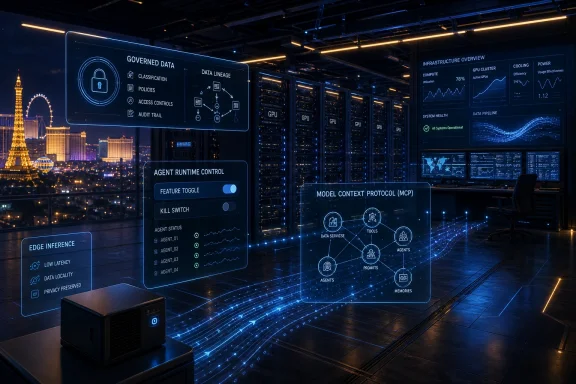 Dell Turns AI From a Product Category Into a Facilities Problem
Dell Technologies World was the gravitational center of the week because Dell is trying to sell a complete operating model for enterprise AI, not just another server refresh. The company’s expanded Dell AI Factory with NVIDIA now stretches from deskside workstations to rack-scale systems, with NVIDIA OpenShell support presented as a way to build and govern autonomous agents under enterprise privacy controls.That framing matters. For the past two years, enterprise AI has often been discussed as a software procurement problem: pick a model, choose a chatbot interface, connect some data, and hope productivity appears. Dell’s announcements push the conversation back into the language of power, cooling, networking, storage, lifecycle management, and data gravity.
PowerRack is the clearest expression of that shift. Dell described it as a fully integrated system combining compute, networking, and storage, with thermal design and software optimization treated as first-order architectural concerns. That is not the language of a speculative AI lab; it is the language of data center modernization.
There is also an implicit critique here. If AI systems are going to run long-lived agents, serve regulated workflows, and ingest operational data continuously, they cannot live only in a neat cloud abstraction. They need predictable performance, governed access, and infrastructure teams that can explain where data is, who touched it, and what happens when something fails.
The New AI Stack Starts With Data That Can Be Governed
The Dell AI Data Platform updates were less flashy than agentic branding, but they point to the harder problem. Enterprises do not generally lack data; they lack usable, contextual, governed data that can survive contact with security reviews and production workloads. The promise of unifying and orchestrating AI data pipelines at scale is therefore more than a feature bullet.This is where real-time analytics and AI are beginning to converge. Streaming data, metadata, semantic layers, vector indexes, SQL acceleration, and lineage tools are no longer separate buying conversations. They are becoming the substrate for systems that must reason over fresh operational context without leaking sensitive information or hallucinating business logic.
The reference to NVIDIA Blackwell and future Vera CPU platforms also shows how tightly data architecture is becoming bound to silicon roadmaps. Analytics vendors used to optimize for databases and clusters; now they also have to optimize for GPU memory, accelerated query engines, and inference pipelines. The analytics platform is becoming part of the AI machine room.
That machine room is increasingly hybrid. Dell, Teradata, OpenNebula, SUSE, Denodo, and others all leaned into variations of the same idea: enterprises want AI that can span cloud, on-premises, sovereign environments, and edge sites without turning governance into a scavenger hunt.
Agentic AI Has Entered Its Compliance Era
The week’s most repeated word was agentic, but the interesting development was not that vendors are building agents. It was that nearly every announcement paired agentic capability with governance, observability, security, or runtime control. The market has clearly moved past the “look what the bot can do” phase.Kore.ai’s Artemis edition, Camunda’s ProcessOS, LaunchDarkly’s AgentControl, Miro’s Sidekicks and Flows, and Alteryx’s agentic automation upgrades all speak to the same enterprise anxiety. Companies want AI systems that can perform work, but they also want to constrain that work before it causes operational, legal, or reputational damage.
LaunchDarkly’s AgentControl is especially revealing because it borrows from the discipline of feature management. The ability to change an agent’s behavior at runtime without redeploying an application reflects a practical truth: agents will need knobs, kill switches, progressive rollout, and rollback strategies just like software services.
Versa’s Zero Trust architecture for the Model Context Protocol takes the argument further. If agents are going to call tools, access systems, and execute actions, then identity, role-based access, policy validation, and human approval cannot be decorative. They are the difference between automation and an incident report.
MCP Is Becoming the API Debate of the Agent Age
The Model Context Protocol showed up in more than one place this week, and that is significant. MCP is quickly becoming shorthand for the question every enterprise will ask about agents: how do these systems connect to tools and data without creating an uncontrolled web of permissions?Versa approached MCP through Zero Trust. Solvd joined the Agentic AI Foundation with plans to contribute to MCP-related work and open-source agent tooling. Proofpoint’s Claude Compliance API integration, while not only an MCP story, sits in the same policy universe: AI-assisted work must be brought under the same compliance umbrella as email, endpoint, and cloud activity.
This is the predictable maturation curve of a new integration layer. First comes excitement over what can be connected. Then comes concern over who authorized the connection, what data moved, what action was taken, and whether anyone can reconstruct the chain afterward.
For WindowsForum readers, the analogy is familiar. PowerShell remoting, Active Directory delegation, endpoint management, and cloud IAM all taught administrators that powerful automation is a gift only when it is observable and revocable. Agent tooling is now learning the same lesson at higher speed.
Microsoft’s Linux Move Is Really an AI Infrastructure Move
Microsoft’s announcement around Azure Linux 4.0 and Azure Container Linux fits neatly into the week’s broader pattern. On paper, it is an operating system story. In practice, it is about hardening the substrate for cloud-native and AI-native workloads.Azure Container Linux reaching general availability gives Microsoft an immutable, container-optimized OS for managed environments. Azure Linux 4.0 heading toward public preview on Azure virtual machines expands the company’s Linux posture beyond a narrow infrastructure component and into a more visible platform choice for developers and organizations building modern workloads.
For a Windows audience, the reflexive headline is that Microsoft is once again doing more Linux. But the more important point is that Microsoft is aligning Linux, containers, Azure, GitHub, and AI infrastructure into a common operational story. The company is not treating Linux as a tolerated guest inside Azure; it is treating it as part of the control plane for AI-era computing.
That has practical consequences. Administrators who manage mixed Windows and Linux estates should expect more Microsoft-native Linux tooling, more Azure-first assumptions, and more pressure to understand container hosts, immutable operating systems, and policy-driven deployment. The Windows shop is not disappearing, but it is becoming more heterogeneous by default.
The Edge Is No Longer a Branch Office Afterthought
Edgecore’s Praxis and OWC’s Stack AI showed another side of the week’s infrastructure theme: the edge is becoming a target for AI execution, not just data collection. That changes the economics and the operational model.Edgecore is aiming at managed service providers, ISPs, and AI-powered SaaS and video analytics companies that need to push intelligence closer to customer sites. This is a pragmatic edge story. Cloud AI may be convenient, but latency, bandwidth, privacy, and cost all become more painful when every inference requires a round trip to a centralized region.
OWC’s Stack AI is more workstation-adjacent, pairing Thunderbolt 5 with local acceleration and storage for selected Windows and Linux PCs, with Mac support planned later. The product category is still early, but the direction is clear. Local AI is being repositioned from hobbyist experimentation into a serious option for developers, researchers, media teams, and power users who need larger models or private workflows near the desk.
HERE Location Reasoning belongs in this same edge-adjacent conversation. Location-aware AI is only useful in production if it produces deterministic, low-latency outcomes at manageable cost. The pitch is not simply that AI can understand maps; it is that operational systems can make grounded decisions without burning tokens on avoidable uncertainty.
The Analytics Vendors Are Rebranding Around Autonomy
Acceldata, Alteryx, Domino Data Lab, Teradata, and Denodo all used different language, but they are converging on a common enterprise proposition. Data platforms must now do more than store, transform, and visualize information. They must help autonomous systems act on it safely.Acceldata’s Autonomous Data & AI Platform emphasizes governed compute wherever enterprise data lives, including cloud, on-premises, hybrid, and sovereign environments. That is a direct response to the fragmentation problem: enterprises cannot simply centralize everything before trying AI. The data estate is messy, political, regulated, and geographically distributed.
Alteryx is pushing from analytics automation toward agentic outcomes. Domino is extending its enterprise AI platform across the full application lifecycle, including externally hosted models and agents. Teradata Factory brings on-premises infrastructure into the picture for hybrid AI and analytics environments.
Denodo’s AWS integrations are another expression of the same architecture. Agentic AI needs access to operational and analytical data across on-premises, SaaS, and multi-cloud systems, but raw access is not enough. The enterprise wants a logical data foundation that preserves context and governance while giving agents something useful to work with.
The Database Plumbing Still Matters More Than the Demo
Percona’s sponsorship role around pgBackRest may look small next to the week’s AI announcements, but it is a useful reminder that the boring layers remain critical. Backup and recovery tools do not make keynote sizzle reels. They do determine whether production systems survive failure.PostgreSQL sits under a large and growing share of modern application stacks, analytics systems, and AI-adjacent workloads. A widely used backup and recovery tool depending too heavily on a single maintainer is exactly the kind of open-source sustainability problem enterprises ignore until they cannot.
The planned work around bug fixes, feature development, maintainer onboarding, and broader sponsorship points to a healthier model. If open infrastructure is becoming the foundation for AI systems, then maintaining that infrastructure cannot be treated as charity or background noise.
The same logic applies across the week’s open-source activity. Microsoft is emphasizing open agentic ecosystems. Solvd is joining a Linux Foundation project. OpenNebula and SUSE are pitching a vendor-neutral sovereign cloud alternative. The rhetoric is about openness, but the operational issue is resilience.
Sovereignty Is Becoming a Buying Criterion, Not a Political Slogan
The OpenNebula and SUSE collaboration highlights another pattern: sovereign cloud is moving from policy discussion into product packaging. Organizations with strict data residency, regulatory, and procurement requirements want alternatives to proprietary virtualization and cloud stacks, especially as VMware disruption continues to push infrastructure teams to reassess their dependencies.The combined OpenNebula, SUSE Linux Enterprise, and SUSE Rancher story aims at that anxiety. It offers virtualization management, cloud orchestration, enterprise Linux, and Kubernetes management as a single platform. The target customer is not chasing novelty; it is trying to keep control over data, workloads, and vendor exposure.
This matters for AI because sovereignty and AI governance are becoming entangled. If an AI workload trains on or reasons over sensitive national, medical, industrial, or financial data, the location and control of infrastructure become more than compliance checkboxes. They become part of the risk model.
Private AI, sovereign AI, and hybrid AI are sometimes abused as marketing terms. But beneath the buzzwords is a real procurement shift. Enterprises are asking whether they can adopt AI without surrendering too much control over data, infrastructure, or policy enforcement.
Real-Time AI Is Becoming an Operations Discipline
Confluent’s announcements around Confluent Intelligence and Confluent Cloud fit the operational side of the story. Real-time AI applications need fresh data streams, secure connectivity, privacy controls, and workflows that engineers can actually manage. Natural language operations and automated data privacy sound like product features, but they also reflect where complexity is accumulating.Real-time systems are unforgiving. Batch analytics can often tolerate delay, manual repair, or retrospective cleanup. Real-time AI applications make decisions in motion, often with downstream consequences that are hard to unwind.
That is why the security and privacy controls are not secondary. If streaming data becomes the live nervous system for AI agents, then bad permissions, leaky topics, or poorly governed transformations become direct business risk. The faster the system acts, the less time humans have to notice that something is wrong.
The same pressure explains why observability is becoming a required part of every credible agentic pitch. Enterprises do not merely need to know whether a model returned an answer. They need to know what context it used, what action it proposed, what policy allowed it, and how that behavior changed over time.
Collaboration Tools Are Trying to Become the Agent Workbench
Miro’s announcements show how collaboration vendors are trying to avoid being reduced to passive canvases in the AI era. If agents are going to help teams plan, design, analyze, and decide, then collaborative workspaces want to be where human context and machine action meet.Sidekicks, Flows, and new connectors are positioned as ways to move from individual AI productivity to organization-wide transformation. That phrase could easily become marketing fog, but the underlying challenge is real. Many companies have employees using AI in isolated pockets without connecting those gains to shared processes, durable knowledge, or accountable decisions.
The collaboration layer has an advantage because it already captures messy human context: diagrams, notes, workshops, retrospectives, planning boards, and design artifacts. The risk is that AI features become yet another layer of novelty unless they connect to systems of record and workflows that teams trust.
That is why Miro’s story belongs alongside Camunda, Kore.ai, Alteryx, and LaunchDarkly rather than off in a separate productivity category. The agentic enterprise is not one product. It is a negotiation between where people think, where data lives, where software runs, and where policy is enforced.
The Week’s Announcements Reveal a Market Trying to Grow Up
The most concrete pattern this week is that vendors are trying to make AI less magical and more manageable. That is healthy. It also means buyers should be skeptical of any pitch that treats agents as a shortcut around architecture.- Enterprises are moving from AI pilots toward production systems that require infrastructure planning, governance, observability, and lifecycle control.
- Dell’s announcements show that AI infrastructure is now a rack-scale, data-platform, cooling, and power-management conversation as much as a GPU conversation.
- Agentic AI vendors are increasingly competing on runtime control, compliance, identity, and workflow integration rather than model novelty alone.
- Microsoft’s Azure Linux moves reinforce that AI-era infrastructure will be hybrid, Linux-heavy, containerized, and deeply tied to cloud operating models.
- Edge AI is becoming more practical as vendors try to reduce latency, bandwidth costs, and privacy exposure by moving inference closer to users and devices.
- Open-source sustainability, sovereign cloud, and backup tooling remain critical because the reliability of AI systems depends on the reliability of the unglamorous layers beneath them.
References
- Primary source: RT Insights
Published: 2026-05-24T20:30:08.219150
Real-time Analytics News for the Week Ending May 23 - RTInsights
In this week's real-time analytics news: Dell Technologies made a number of AI-related announcements at this week’s Dell Technologies World.www.rtinsights.com
- Related coverage: itpro.com
“Now we have, for the very first time, useful AI” – Jensen Huang and Michael Dell talk up the power of agentic AI at Dell Technologies World 2026 | IT Pro
Agents are the future of AI in enterprise, according to Dell Technologies and Nvidia CEOswww.itpro.com
