

Proofpoint joined OpenAI’s Daybreak Cyber Partner Program on June 22, 2026, giving the Sunnyvale cybersecurity vendor vetted access to GPT-5.5 for defensive work inside its products, managed services, Satori agentic AI portfolio, and customer-facing security operations rather than through direct customer model access. The move matters less because another security vendor has signed another AI partnership, and more because it shows where the enterprise AI market is settling after two years of exuberant experimentation. The winning pitch is no longer “give every analyst a chatbot.” It is “hide the frontier model inside governed workflows, then sell the result as speed with guardrails.”
The first wave of generative AI in security was noisy, demo-friendly, and often suspiciously vague. Vendors promised natural-language SOC copilots, instant incident summaries, phishing analysis at scale, and malware explanations that looked impressive in a conference booth. What buyers discovered quickly was that a clever interface does not automatically solve the deeper problem of security operations: trust.
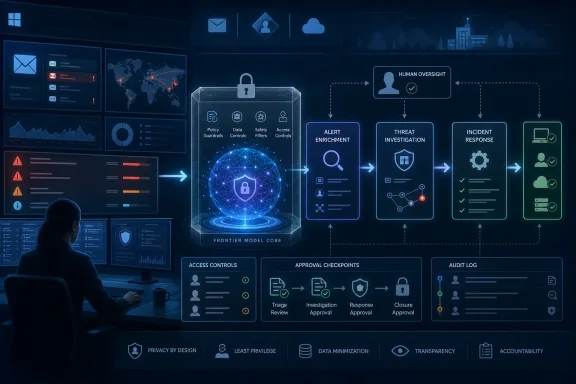
Proofpoint’s Daybreak announcement lands in a more disciplined phase. The company is not saying customers will log into GPT-5.5 directly and ask it to do whatever they want. It is saying the model will be embedded inside Proofpoint-controlled products, services, and managed workflows, where outputs can be constrained, monitored, and tied to repeatable defensive tasks.
That distinction is the story. Enterprise security teams have lived through enough automation surprises to know that a tool which moves too quickly in the wrong direction can create as much work as it saves. The pitch here is that OpenAI’s model can accelerate investigation, enrichment, intelligence analysis, and incident response without being treated as an unsupervised operator.
For Windows administrators and security teams, this is the shape AI adoption is likely to take. Not a magical analyst replacement, but a new layer inside the same email security, identity, cloud, endpoint, and collaboration defenses they already buy. The model becomes part of the machinery.
That is why access matters. Daybreak and the associated Trusted Access for Cyber framing are not just marketing wrappers; they are OpenAI’s answer to a hard product question. If a model is powerful enough to help with vulnerability triage, malware analysis, detection engineering, and incident response, then it is powerful enough to demand restrictions, identity checks, monitoring, and narrower use cases.
Proofpoint’s entry into the program puts it among a small set of companies allowed to use the model for customer-facing defensive work. That does not mean Proofpoint customers get a general-purpose cyber model at their fingertips. It means Proofpoint can use GPT-5.5 inside the services and products it operates on their behalf.
This is a notable departure from the consumer AI pattern. In ChatGPT, the user usually drives the session. In a managed security workflow, the vendor defines the task, the data boundary, the permitted action, and the escalation path. The model is powerful, but the environment is supposed to be boring.
That boredom is exactly what enterprise buyers want. In security, “exciting” often means “unbounded,” and unbounded systems are hard to explain to regulators, CISOs, insurers, auditors, and incident review boards.
That matters because AI-generated attacks are most visible at the social boundary. Better phishing copy, more plausible business email compromise, faster impersonation, multilingual fraud, and more adaptive lures all put pressure on systems that decide what is trustworthy before a user clicks. Proofpoint’s customer base gives it a broad view of those patterns across large enterprises and smaller organizations alike.
The company says it will apply GPT-5.5 to threat investigation, alert enrichment, intelligence analysis, and incident response. Those are not glamorous use cases. They are the repetitive connective tissue of security operations, where analysts assemble context from headers, URLs, attachments, user history, threat feeds, and previous incidents before deciding whether something is real.
That is where large language models can be useful without pretending to be omniscient. A model can summarize messy evidence, surface relationships, translate obscure telemetry into plain language, and propose next investigative steps. It can also be wrong, which is why the surrounding workflow matters more than the model’s benchmark score.
Proofpoint’s advantage is that it can wrap the model in existing security context. A generic chatbot knows what the user pastes into it. A security platform already sees message flow, identity signals, campaign history, data-loss patterns, and the organization’s policies. The model becomes more useful because it is not operating in a vacuum.
The promise is obvious. Security operations centers are drowning in tasks that are neither fully creative nor fully mechanical. Analysts pivot between dashboards, check reputation scores, compare indicators, read logs, write summaries, draft tickets, and decide whether to escalate. An agentic system can potentially stitch those steps together.
The danger is just as obvious. A system that can take action needs clear limits. In security, an overeager automated response can disable accounts, quarantine legitimate files, block business-critical domains, or bury a real attack under a misleading explanation. The industry has spent years learning that automation without careful scoping becomes a second incident.
Proofpoint’s framing is therefore cautious. GPT-5.5 may broaden Satori’s capabilities, but the company is emphasizing managed processes, governance, monitoring, safety controls, and abuse prevention. That is the right language for large customers, but it also creates an accountability test: if the AI is embedded deeply enough to matter, Proofpoint must be able to explain how it behaves when the evidence is ambiguous.
The best version of Satori is not an AI analyst that “handles” incidents alone. It is an assistant that reduces the number of low-value analyst motions while making the final human decision better informed. That may sound less futuristic, but it is a more credible path to deployment.
Alert fatigue is not simply a morale issue. It changes outcomes. When analysts are overloaded, they rely on shortcuts, defer low-confidence investigations, and miss weak signals that only become obvious later. The promise of AI is not that it eliminates the need for judgment, but that it can get more incidents to the point where judgment is possible.
Proofpoint’s listed use cases fit that model. Faster threat investigation, improved alert prioritization, quicker triage, better intelligence contextualization, and greater scale for managed security operations are all ways of saying the same thing: the company wants GPT-5.5 to make the queue less stupid.
That is more important than it sounds. Many security tools are excellent at producing alerts and poor at explaining why this alert matters now, to this business, in this environment. AI has a plausible role in converting raw detection into operational context. It can compare a suspicious message against known campaigns, explain why a URL is risky, summarize prior activity involving the same sender, and suggest containment steps.
The hard part is ensuring that this context does not become decorative prose. A confident AI-generated paragraph can make a weak detection look stronger than it is. If Proofpoint and OpenAI get the workflow right, the model’s output should be anchored to evidence and uncertainty rather than polished into false certainty.
In ordinary business functions, a bad AI answer may create embarrassment or rework. In cybersecurity, it can change the posture of the organization. A flawed recommendation can delay containment, misclassify an attack, or expose internal telemetry. A model trained or prompted poorly can also reveal patterns about the customer’s environment that an attacker would love to know.
The Daybreak structure attempts to answer those concerns by narrowing who can use the model and where it can operate. Proofpoint’s model of embedding GPT-5.5 inside managed products and workflows adds another layer of control. Customers may benefit from the model without directly handling it.
That arrangement has trade-offs. It reduces the risk of users improvising unsafe prompts or pushing the model into questionable territory. It also makes the vendor a more important trust broker. Customers will need to understand not only what the AI can do, but how Proofpoint logs model interactions, validates outputs, handles sensitive data, and prevents abuse.
This is where the marketing phrase “responsible AI” must become operational. Responsible AI in security is not a banner on a website. It is retention policy, access control, auditability, red-team testing, human review, prompt hardening, telemetry handling, and a clear answer to what happens when the model gets something wrong.
That does not mean AI has suddenly made every attacker elite. Much of the current criminal use of generative AI appears to be mundane: better writing, faster translation, boilerplate code, impersonation support, and campaign variation. But mundane improvements matter at scale. A phishing campaign does not need genius; it needs plausibility, volume, and iteration.
Proofpoint’s core market is directly exposed to that shift. If email and collaboration attacks become more personalized and less linguistically clumsy, old detection shortcuts become less reliable. Security products need more context about sender behavior, organizational relationships, URL infrastructure, attachment chains, and user risk.
AI can help defenders process that context, but it does not erase the asymmetry. Defenders must be right repeatedly across a sprawling environment. Attackers need one path that works. This is why the industry’s AI race feels less like a leap to safety and more like an acceleration of both sides.
The important question is whether defensive vendors can turn AI into durable advantage rather than temporary efficiency. If the model merely helps write cleaner incident summaries, the impact is limited. If it lets defenders correlate weak signals sooner and reduce dwell time, the stakes change.
For Windows-heavy organizations, this will feel familiar. Administrators did not always choose AI feature by feature; they inherited it through Microsoft 365, endpoint management, identity platforms, SIEM tooling, and security suites. Proofpoint’s model is similar. The AI arrives as an enhancement to an existing security control, not as a standalone procurement.
That makes vendor due diligence more important. If AI is buried inside managed workflows, customers may not see every prompt, intermediate reasoning step, or model interaction. They may instead see the result: a risk score, an enriched alert, a recommended response, or a generated investigation summary.
This is not necessarily bad. Most organizations do not want to become AI infrastructure experts just to inspect phishing alerts. But the abstraction must be honest. Buyers should ask which tasks are model-assisted, which remain deterministic, which actions require human approval, and what logs are available during incident review.
The more AI disappears into the stack, the more important transparency becomes at the control plane. The customer does not need every internal implementation detail. The customer does need enough visibility to assess risk, explain decisions, and meet regulatory obligations.
The likely near-term effect is not that SOC analysts disappear. It is that the baseline expectation for what an analyst can handle changes. If AI can summarize evidence, enrich indicators, draft reports, and suggest next steps, managers will expect more tickets, faster triage, and shorter mean time to decision.
That can be good if it removes drudgery. It can be harmful if it simply raises throughput pressure while leaving accountability with the human. Analysts may find themselves supervising machine-generated conclusions under time constraints, responsible for catching errors in outputs they did not create.
This is why interface design and workflow design matter. A good AI security assistant should make uncertainty visible. It should show supporting evidence, identify gaps, and make escalation easier. A bad one will produce fluent confidence and invite rubber-stamping.
Proofpoint’s managed approach could help if it keeps the model close to specific workflows rather than turning it into a general-purpose oracle. The narrower the task, the easier it is to measure whether the AI is improving outcomes. The broader the promise, the more likely it becomes another dashboard with better prose.
That means administrators will increasingly troubleshoot incidents where AI influenced the alert path. A phishing message may be classified by one model, enriched by another, summarized by a third, and escalated through a managed service before it reaches the internal team. The security stack is becoming more interpretive.
This could improve defense for organizations that lack large security teams. Smaller IT departments may benefit most from AI-assisted triage because they cannot staff specialist roles around the clock. If a managed service can convert a raw suspicious email cluster into a coherent response recommendation, that is real value.
But Windows administrators should be wary of black-box escalation chains. When a user’s account is disabled, a domain is blocked, or an attachment is quarantined, someone will need to explain why. “The AI said so” will not satisfy a business unit, a regulator, or a post-incident review.
The practical response is not to reject AI security tooling. It is to demand administrative visibility. Logs, policy controls, override paths, and clear labeling of AI-assisted decisions will matter as much as model capability.
Threat investigation is a good fit because it is evidence-heavy. Alert enrichment is a good fit because it requires synthesis across sources. Intelligence analysis is a good fit because it involves pattern recognition and narrative explanation. Incident response is more delicate, but AI can help draft steps, document rationale, and coordinate handoffs if humans retain control over consequential action.
The danger is scope creep. Once a model performs well in one part of the workflow, organizations will be tempted to let it do more. That is how assistance becomes automation and automation becomes authority. The governance structure must be strong enough to resist the vendor’s own roadmap pressure.
Proofpoint’s customer scale also cuts both ways. The company can learn from a huge volume of defensive activity, improving workflows and spotting patterns. But any systemic flaw in the AI layer could also propagate widely. Scale magnifies both the benefit and the blast radius.
This is why the partnership should be judged over time by operational evidence, not announcement language. The important metrics are reduced investigation time, fewer false positives, better escalation quality, lower analyst burden, and no meaningful increase in unsafe automation. Anything else is brochure copy.
That is logical. Cybersecurity is fragmented, regulated, and deeply workflow-specific. A foundation model company can build powerful capabilities, but it does not automatically have customer telemetry, SOC relationships, policy integrations, or incident response muscle. Security vendors do.
For Proofpoint, the partnership offers frontier-model credibility without requiring it to train everything itself. For OpenAI, Proofpoint supplies real-world defensive workflows and enterprise reach. For customers, the combined pitch is that advanced AI can arrive through an existing trusted vendor rather than a new, risky toolchain.
The strategic risk is dependency. If core security workflows begin to rely on proprietary frontier models, customers may face a new kind of vendor lock-in: not only to a security platform, but to the model behavior embedded inside it. Switching providers could mean changing not just dashboards and policies, but the way investigations are interpreted and summarized.
That does not make the partnership a bad idea. It makes it an early example of how AI capability will be packaged, governed, and monetized in security. The model arms race is not just about who has the best benchmark. It is about who controls the workflow where the benchmark becomes useful.
 The AI Security Boom Is Moving Behind the Console
The first wave of generative AI in security was noisy, demo-friendly, and often suspiciously vague. Vendors promised natural-language SOC copilots, instant incident summaries, phishing analysis at scale, and malware explanations that looked impressive in a conference booth. What buyers discovered quickly was that a clever interface does not automatically solve the deeper problem of security operations: trust.Proofpoint’s Daybreak announcement lands in a more disciplined phase. The company is not saying customers will log into GPT-5.5 directly and ask it to do whatever they want. It is saying the model will be embedded inside Proofpoint-controlled products, services, and managed workflows, where outputs can be constrained, monitored, and tied to repeatable defensive tasks.
That distinction is the story. Enterprise security teams have lived through enough automation surprises to know that a tool which moves too quickly in the wrong direction can create as much work as it saves. The pitch here is that OpenAI’s model can accelerate investigation, enrichment, intelligence analysis, and incident response without being treated as an unsupervised operator.
For Windows administrators and security teams, this is the shape AI adoption is likely to take. Not a magical analyst replacement, but a new layer inside the same email security, identity, cloud, endpoint, and collaboration defenses they already buy. The model becomes part of the machinery.
Daybreak Is OpenAI’s Attempt to Civilize Cyber Capability
OpenAI’s Daybreak program exists because cybersecurity is one of the clearest dual-use domains for frontier AI. The same reasoning ability that helps a defender understand a suspicious attachment can help an attacker refine a lure. The same code-analysis capability that helps validate a patch can help identify a route around one.That is why access matters. Daybreak and the associated Trusted Access for Cyber framing are not just marketing wrappers; they are OpenAI’s answer to a hard product question. If a model is powerful enough to help with vulnerability triage, malware analysis, detection engineering, and incident response, then it is powerful enough to demand restrictions, identity checks, monitoring, and narrower use cases.
Proofpoint’s entry into the program puts it among a small set of companies allowed to use the model for customer-facing defensive work. That does not mean Proofpoint customers get a general-purpose cyber model at their fingertips. It means Proofpoint can use GPT-5.5 inside the services and products it operates on their behalf.
This is a notable departure from the consumer AI pattern. In ChatGPT, the user usually drives the session. In a managed security workflow, the vendor defines the task, the data boundary, the permitted action, and the escalation path. The model is powerful, but the environment is supposed to be boring.
That boredom is exactly what enterprise buyers want. In security, “exciting” often means “unbounded,” and unbounded systems are hard to explain to regulators, CISOs, insurers, auditors, and incident review boards.
Proofpoint Knows the Inbox Is Still the Battlefield
Proofpoint is not a random entrant in this program. Its business sits close to one of the most durable attack surfaces in enterprise technology: the human layer. Email, collaboration tools, cloud accounts, and identity-driven workflows remain where many intrusions begin, especially in organizations that have already hardened endpoints and networks.That matters because AI-generated attacks are most visible at the social boundary. Better phishing copy, more plausible business email compromise, faster impersonation, multilingual fraud, and more adaptive lures all put pressure on systems that decide what is trustworthy before a user clicks. Proofpoint’s customer base gives it a broad view of those patterns across large enterprises and smaller organizations alike.
The company says it will apply GPT-5.5 to threat investigation, alert enrichment, intelligence analysis, and incident response. Those are not glamorous use cases. They are the repetitive connective tissue of security operations, where analysts assemble context from headers, URLs, attachments, user history, threat feeds, and previous incidents before deciding whether something is real.
That is where large language models can be useful without pretending to be omniscient. A model can summarize messy evidence, surface relationships, translate obscure telemetry into plain language, and propose next investigative steps. It can also be wrong, which is why the surrounding workflow matters more than the model’s benchmark score.
Proofpoint’s advantage is that it can wrap the model in existing security context. A generic chatbot knows what the user pastes into it. A security platform already sees message flow, identity signals, campaign history, data-loss patterns, and the organization’s policies. The model becomes more useful because it is not operating in a vacuum.
Satori Shows the Industry’s New Favorite Word: Agentic
Proofpoint is also tying the Daybreak work to Satori, its agentic AI portfolio for security operations. The word agentic has become one of the industry’s most elastic terms, stretched to cover everything from workflow automation to semi-autonomous systems that plan, act, and revise. In the security market, it carries both promise and danger.The promise is obvious. Security operations centers are drowning in tasks that are neither fully creative nor fully mechanical. Analysts pivot between dashboards, check reputation scores, compare indicators, read logs, write summaries, draft tickets, and decide whether to escalate. An agentic system can potentially stitch those steps together.
The danger is just as obvious. A system that can take action needs clear limits. In security, an overeager automated response can disable accounts, quarantine legitimate files, block business-critical domains, or bury a real attack under a misleading explanation. The industry has spent years learning that automation without careful scoping becomes a second incident.
Proofpoint’s framing is therefore cautious. GPT-5.5 may broaden Satori’s capabilities, but the company is emphasizing managed processes, governance, monitoring, safety controls, and abuse prevention. That is the right language for large customers, but it also creates an accountability test: if the AI is embedded deeply enough to matter, Proofpoint must be able to explain how it behaves when the evidence is ambiguous.
The best version of Satori is not an AI analyst that “handles” incidents alone. It is an assistant that reduces the number of low-value analyst motions while making the final human decision better informed. That may sound less futuristic, but it is a more credible path to deployment.
The Real Product Is Triage at Industrial Scale
Security vendors often describe AI as a way to “increase productivity,” which is accurate but bloodless. The practical problem is that modern organizations generate too many signals for humans to investigate with equal care. Every SOC is a rationing system, whether it admits it or not.Alert fatigue is not simply a morale issue. It changes outcomes. When analysts are overloaded, they rely on shortcuts, defer low-confidence investigations, and miss weak signals that only become obvious later. The promise of AI is not that it eliminates the need for judgment, but that it can get more incidents to the point where judgment is possible.
Proofpoint’s listed use cases fit that model. Faster threat investigation, improved alert prioritization, quicker triage, better intelligence contextualization, and greater scale for managed security operations are all ways of saying the same thing: the company wants GPT-5.5 to make the queue less stupid.
That is more important than it sounds. Many security tools are excellent at producing alerts and poor at explaining why this alert matters now, to this business, in this environment. AI has a plausible role in converting raw detection into operational context. It can compare a suspicious message against known campaigns, explain why a URL is risky, summarize prior activity involving the same sender, and suggest containment steps.
The hard part is ensuring that this context does not become decorative prose. A confident AI-generated paragraph can make a weak detection look stronger than it is. If Proofpoint and OpenAI get the workflow right, the model’s output should be anchored to evidence and uncertainty rather than polished into false certainty.
Governance Is Not a Compliance Add-On This Time
Proofpoint and OpenAI are stressing governance because enterprise buyers are no longer treating AI safety as an optional appendix. Security teams are under pressure from two directions at once. Executives want AI-driven efficiency, while risk leaders want proof that sensitive data, customer information, and operational decisions are not being sprayed into systems nobody can audit.In ordinary business functions, a bad AI answer may create embarrassment or rework. In cybersecurity, it can change the posture of the organization. A flawed recommendation can delay containment, misclassify an attack, or expose internal telemetry. A model trained or prompted poorly can also reveal patterns about the customer’s environment that an attacker would love to know.
The Daybreak structure attempts to answer those concerns by narrowing who can use the model and where it can operate. Proofpoint’s model of embedding GPT-5.5 inside managed products and workflows adds another layer of control. Customers may benefit from the model without directly handling it.
That arrangement has trade-offs. It reduces the risk of users improvising unsafe prompts or pushing the model into questionable territory. It also makes the vendor a more important trust broker. Customers will need to understand not only what the AI can do, but how Proofpoint logs model interactions, validates outputs, handles sensitive data, and prevents abuse.
This is where the marketing phrase “responsible AI” must become operational. Responsible AI in security is not a banner on a website. It is retention policy, access control, auditability, red-team testing, human review, prompt hardening, telemetry handling, and a clear answer to what happens when the model gets something wrong.
Attackers Are Getting the Same Productivity Memo
The defensive AI story cannot be separated from the offensive one. Attackers do not need frontier models to benefit from automation, but frontier models raise the ceiling for what small teams and opportunistic criminals can attempt. The same productivity gains that help defenders sort alerts can help adversaries scale reconnaissance, customize lures, and adapt scripts.That does not mean AI has suddenly made every attacker elite. Much of the current criminal use of generative AI appears to be mundane: better writing, faster translation, boilerplate code, impersonation support, and campaign variation. But mundane improvements matter at scale. A phishing campaign does not need genius; it needs plausibility, volume, and iteration.
Proofpoint’s core market is directly exposed to that shift. If email and collaboration attacks become more personalized and less linguistically clumsy, old detection shortcuts become less reliable. Security products need more context about sender behavior, organizational relationships, URL infrastructure, attachment chains, and user risk.
AI can help defenders process that context, but it does not erase the asymmetry. Defenders must be right repeatedly across a sprawling environment. Attackers need one path that works. This is why the industry’s AI race feels less like a leap to safety and more like an acceleration of both sides.
The important question is whether defensive vendors can turn AI into durable advantage rather than temporary efficiency. If the model merely helps write cleaner incident summaries, the impact is limited. If it lets defenders correlate weak signals sooner and reduce dwell time, the stakes change.
The Vendor Stack Is Becoming the AI Boundary
One underappreciated consequence of partnerships like this is that the security vendor becomes the boundary through which AI enters the enterprise. Many companies have restricted employee use of public AI tools, but they are simultaneously buying AI features embedded inside software they already trust. That creates a quieter, more consequential adoption path.For Windows-heavy organizations, this will feel familiar. Administrators did not always choose AI feature by feature; they inherited it through Microsoft 365, endpoint management, identity platforms, SIEM tooling, and security suites. Proofpoint’s model is similar. The AI arrives as an enhancement to an existing security control, not as a standalone procurement.
That makes vendor due diligence more important. If AI is buried inside managed workflows, customers may not see every prompt, intermediate reasoning step, or model interaction. They may instead see the result: a risk score, an enriched alert, a recommended response, or a generated investigation summary.
This is not necessarily bad. Most organizations do not want to become AI infrastructure experts just to inspect phishing alerts. But the abstraction must be honest. Buyers should ask which tasks are model-assisted, which remain deterministic, which actions require human approval, and what logs are available during incident review.
The more AI disappears into the stack, the more important transparency becomes at the control plane. The customer does not need every internal implementation detail. The customer does need enough visibility to assess risk, explain decisions, and meet regulatory obligations.
The Human Analyst Is Being Repriced, Not Replaced
Every AI security announcement carries an implicit labor-market argument. Vendors usually avoid saying “replacement,” preferring “augmentation,” “productivity,” and “operational efficiency.” Those words are softer, but they still imply a redistribution of work.The likely near-term effect is not that SOC analysts disappear. It is that the baseline expectation for what an analyst can handle changes. If AI can summarize evidence, enrich indicators, draft reports, and suggest next steps, managers will expect more tickets, faster triage, and shorter mean time to decision.
That can be good if it removes drudgery. It can be harmful if it simply raises throughput pressure while leaving accountability with the human. Analysts may find themselves supervising machine-generated conclusions under time constraints, responsible for catching errors in outputs they did not create.
This is why interface design and workflow design matter. A good AI security assistant should make uncertainty visible. It should show supporting evidence, identify gaps, and make escalation easier. A bad one will produce fluent confidence and invite rubber-stamping.
Proofpoint’s managed approach could help if it keeps the model close to specific workflows rather than turning it into a general-purpose oracle. The narrower the task, the easier it is to measure whether the AI is improving outcomes. The broader the promise, the more likely it becomes another dashboard with better prose.
Windows Shops Should Read This as a Platform Signal
Although Proofpoint’s announcement is not specifically a Windows story, WindowsForum readers should treat it as part of the same platform shift reshaping Microsoft-centric environments. Security operations in Windows shops already depend on layers: Microsoft Defender, Entra ID, Exchange Online, endpoint telemetry, email gateways, SIEM platforms, data-loss prevention, browser controls, and third-party security services. AI is being inserted into all of them.That means administrators will increasingly troubleshoot incidents where AI influenced the alert path. A phishing message may be classified by one model, enriched by another, summarized by a third, and escalated through a managed service before it reaches the internal team. The security stack is becoming more interpretive.
This could improve defense for organizations that lack large security teams. Smaller IT departments may benefit most from AI-assisted triage because they cannot staff specialist roles around the clock. If a managed service can convert a raw suspicious email cluster into a coherent response recommendation, that is real value.
But Windows administrators should be wary of black-box escalation chains. When a user’s account is disabled, a domain is blocked, or an attachment is quarantined, someone will need to explain why. “The AI said so” will not satisfy a business unit, a regulator, or a post-incident review.
The practical response is not to reject AI security tooling. It is to demand administrative visibility. Logs, policy controls, override paths, and clear labeling of AI-assisted decisions will matter as much as model capability.
Proofpoint’s Bet Is Sensible Because It Is Narrow
The strongest part of Proofpoint’s Daybreak move is its restraint. The company is not claiming that GPT-5.5 will autonomously defend the enterprise. It is mapping the model to bounded tasks where language, reasoning, summarization, and context assembly are genuinely useful.Threat investigation is a good fit because it is evidence-heavy. Alert enrichment is a good fit because it requires synthesis across sources. Intelligence analysis is a good fit because it involves pattern recognition and narrative explanation. Incident response is more delicate, but AI can help draft steps, document rationale, and coordinate handoffs if humans retain control over consequential action.
The danger is scope creep. Once a model performs well in one part of the workflow, organizations will be tempted to let it do more. That is how assistance becomes automation and automation becomes authority. The governance structure must be strong enough to resist the vendor’s own roadmap pressure.
Proofpoint’s customer scale also cuts both ways. The company can learn from a huge volume of defensive activity, improving workflows and spotting patterns. But any systemic flaw in the AI layer could also propagate widely. Scale magnifies both the benefit and the blast radius.
This is why the partnership should be judged over time by operational evidence, not announcement language. The important metrics are reduced investigation time, fewer false positives, better escalation quality, lower analyst burden, and no meaningful increase in unsafe automation. Anything else is brochure copy.
The Cyber Model Arms Race Is Becoming a Channel Strategy
OpenAI is not alone in seeing cybersecurity as a strategic AI vertical. The market now has competing visions for restricted cyber models, agentic vulnerability discovery, secure code review, and AI-assisted defense. What is changing is that model companies are using security vendors as their distribution channel.That is logical. Cybersecurity is fragmented, regulated, and deeply workflow-specific. A foundation model company can build powerful capabilities, but it does not automatically have customer telemetry, SOC relationships, policy integrations, or incident response muscle. Security vendors do.
For Proofpoint, the partnership offers frontier-model credibility without requiring it to train everything itself. For OpenAI, Proofpoint supplies real-world defensive workflows and enterprise reach. For customers, the combined pitch is that advanced AI can arrive through an existing trusted vendor rather than a new, risky toolchain.
The strategic risk is dependency. If core security workflows begin to rely on proprietary frontier models, customers may face a new kind of vendor lock-in: not only to a security platform, but to the model behavior embedded inside it. Switching providers could mean changing not just dashboards and policies, but the way investigations are interpreted and summarized.
That does not make the partnership a bad idea. It makes it an early example of how AI capability will be packaged, governed, and monetized in security. The model arms race is not just about who has the best benchmark. It is about who controls the workflow where the benchmark becomes useful.
The Daybreak Deal Draws a Line Around the AI SOC
The immediate lesson from Proofpoint’s move is that AI in security is becoming more controlled, more embedded, and more operationally specific. The companies that win enterprise trust will be the ones that can show not only that models are powerful, but that their use is bounded, auditable, and useful under pressure.- Proofpoint is using GPT-5.5 inside its own products, services, managed workflows, and Satori portfolio rather than offering customers direct model access.
- The partnership is aimed at defensive tasks such as threat investigation, alert enrichment, intelligence analysis, incident response, and analyst productivity.
- The Daybreak structure reflects OpenAI’s attempt to make advanced cyber-capable models available to vetted defenders without turning them into broadly accessible dual-use tools.
- The most important enterprise question is not whether AI can summarize security data, but whether the surrounding workflow preserves evidence, uncertainty, review, and accountability.
- Windows and Microsoft 365 administrators should expect more AI-assisted decisions inside the security stack and should demand logs, controls, and clear escalation paths.
References
- Primary source: SecurityBrief Australia
Published: 2026-06-24T08:15:46.137400
Proofpoint joins OpenAI Daybreak for cyber defence
The move could speed up threat triage and analysis for security teams, while limiting direct access to OpenAI models in customer workflows. securitybrief.com.au
- Related coverage: axios.com
OpenAI gives GPT-5.5-Cyber more powerful cybersecurity capabilities
Even as Anthropic's Fable remains in limbo, the race to get advanced AI models in the hands of defenders continues to heat up.www.axios.com
- Related coverage: proofpoint.com
Proofpoint Joins the OpenAI Daybreak Cyber Partner Program to Advance Responsible AI-Powered Cyber Defense | Proofpoint US
Proofpoint has been selected to participate in OpenAI Daybreak, which helps trusted cybersecurity companies integrate AI into defensive security operations. Through the OpenAI Daybreak Cyberwww.proofpoint.com
- Related coverage: macrumors.com
OpenAI's New Daybreak Platform Uses GPT-5.5 to Find Software Vulnerabilities
OpenAI today launched Daybreak, an answer to Anthropic's Project Glasswing initiative and Mythos AI model. Like Glasswing, Daybreak is a cyber defense effort that will help tech companies find security vulnerabilities in their platforms. OpenAI says Daybreak is aimed at building cyber...www.macrumors.com - Official source: help.openai.com
OpenAI Daybreak - Trusted Access for Cyber Overview | OpenAI Help Center
Learn what Trusted Access for Cyber is, what it supports, and how to request access. help.openai.com
- Related coverage: marketscreener.com
- Related coverage: itwire.com
Proofpoint Joins the OpenAI Daybreak Cyber Partner Program to Advance Responsible AI-Powered Cyber Defence | iTWire
Proofpoint has been selected to participate in OpenAI Daybreak, which helps trusted cybersecurity companies integrate AI into defensive security operations. - Through the... itwire.com
- Related coverage: checkpoint.com
- Related coverage: techradar.com
OpenAI rolls out new model for cybersecurity teams a month after Anthropic's Mythos debut | TechRadar
GPT-5.5-Cyber is now available to TAC memberswww.techradar.com - Official source: deploymentsafety.openai.com
- Related coverage: labs.cloudsecurityalliance.org
Governing Cyber-Permissive AI: GPT-5.4-Cyber and the Identity Question
PDF documentlabs.cloudsecurityalliance.org

