

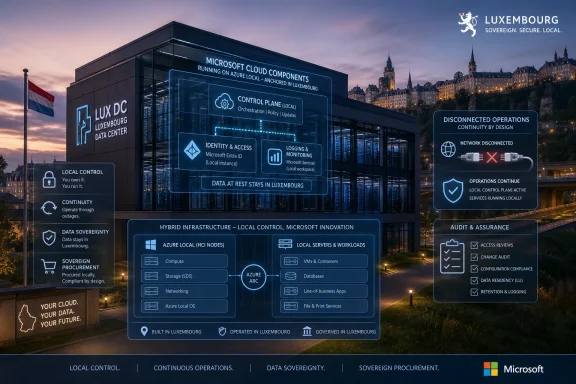
Proximus NXT Luxembourg announced on 20 May 2026 in Luxembourg that it has added Microsoft Azure Local Disconnected Operations, known as Aldo, to its sovereign cloud portfolio for organisations that need local control, regulatory assurance, and continuity without relying on public-cloud connectivity. The move is small in geography but large in implication: Microsoft’s cloud is no longer being sold only as a destination, but as a stack that can be placed inside national, regulated, and even disconnected operating boundaries. For Luxembourg’s banks, public institutions, critical-infrastructure operators, and European bodies, that is not a marketing nuance. It is the latest sign that sovereignty has moved from political slogan to procurement requirement.
For most of the modern cloud era, hyperscalers won by persuading customers to leave their own infrastructure behind. The value proposition was scale, global reach, elastic capacity, and a pace of feature delivery that enterprise datacenters could not match. Sovereignty complicates that story because the most sensitive customers do not merely ask where their data sits; they ask who can administer the stack, which jurisdiction can touch operations, and what happens when connectivity or geopolitics becomes part of the risk model.
Aldo is Microsoft’s answer to that pressure. Azure Local Disconnected Operations allows an Azure Local environment to be deployed and managed without a live connection to the Azure public cloud, while preserving enough of the Azure management model to keep the experience familiar to organisations already invested in Microsoft’s ecosystem. That matters because regulated buyers rarely want a clean break from hyperscale tooling. They want the governance and operational model they know, but with the blast radius pulled closer to home.
Proximus NXT’s role is to make that promise locally credible. Luxembourg is not a generic market for cloud services; it is a compact, regulation-heavy jurisdiction with an outsized concentration of financial institutions, EU-facing workloads, and cross-border data concerns. A sovereign cloud pitch in Luxembourg therefore has to survive scrutiny from IT teams, compliance officers, boards, and auditors who have heard enough vague assurances about “data residency” to know that residency alone is not sovereignty.
That is why the Aldo integration is more than another SKU in a partner catalogue. It is a statement that the next phase of sovereign cloud will be fought at the operational layer: who runs the control plane, who can update it, where logs and identities are processed, and how a service behaves when the public internet is not assumed to be available.
For public-sector and critical-service organisations, “always connected” is no longer an unqualified virtue. Connectivity can be a strength, but it can also be an exposure path, a dependency chain, or a compliance complication. The cloud model that once promised resilience through abstraction now has to prove resilience through locality as well.
Aldo addresses that by letting organisations operate Azure Local in environments where the public cloud is unavailable, undesirable, or intentionally excluded. That does not mean every workload suddenly belongs in a bunker. It means Microsoft is acknowledging that some workloads need Azure-like control without Azure-as-a-remote-service at the center of every operational loop.
This is a notable reversal of the usual cloud rhetoric. For years, disconnected systems were treated as legacy exceptions, tolerated only where bandwidth, regulation, or secrecy left no alternative. Now, Microsoft is packaging disconnected operation as part of a sovereign cloud continuum. The offline site is no longer a backward cousin of the cloud; it is being repositioned as a first-class deployment pattern for regulated and strategic customers.
Proximus NXT already had pieces of that story in place. Its Luxembourg portfolio includes Clarence, the sovereign cloud venture associated with Proximus and LuxConnect, and U-flex, its local cloud and hybrid infrastructure offer. Adding Aldo does not replace those propositions; it gives Proximus NXT another way to place Microsoft-compatible infrastructure inside a sovereign operating model.
That distinction matters. Sovereign cloud is not one product. It is a spectrum of choices: local hosting, local operations, encryption and key control, disconnected execution, contractual commitments, national or European ownership structures, and workload-specific isolation. Different customers will care about different combinations, and the serious providers are the ones assembling options rather than pretending one architecture satisfies every risk committee.
Luxembourg is particularly suited to that modular approach. A fintech may want low-latency Azure-adjacent infrastructure with strong compliance controls. A government agency may want local operations and legal assurance. A critical infrastructure operator may care most about maintaining service during disconnection. A European institution may insist on a chain of operational trust that is as political as it is technical.
That is where local expertise becomes commercially important. Sovereign cloud buyers are not simply choosing between Azure, AWS, Google Cloud, or private cloud. They are choosing who can stand in front of regulators, explain the operating model, document the controls, and keep services running when the assumptions behind conventional cloud architecture fail.
Proximus NXT’s participation in Microsoft’s Aldo Private Preview programme is therefore more than a badge. It suggests the company has been close enough to the product’s development and validation cycle to build operational knowledge before the service becomes another line item in procurement decks. In disconnected environments, implementation detail is not a footnote. It is the product.
Running a disconnected environment changes the administrative burden. Capacity planning becomes less forgiving. Updates require stronger process discipline. Monitoring and support cannot assume public-cloud telemetry is always flowing. Identity, governance, backup, logging, and recovery all need to be designed with separation in mind. A provider that cannot operationalise those details will reduce sovereignty to a slogan.
Microsoft 365 Local is designed to run core productivity workloads such as Exchange Server, SharePoint Server, and Skype for Business Server on Azure Local infrastructure under customer-owned and managed conditions. In plain English, Microsoft is offering a way to keep some of the Microsoft 365-style operating model while placing the workload inside a private cloud boundary. That is not the same thing as the global Microsoft 365 service, and it will not replicate every cloud-native feature users associate with modern Microsoft collaboration. But for some regulated environments, the point is not feature maximalism. The point is control.
This is where Microsoft’s sovereign cloud strategy becomes more subtle. The company does not want European or highly regulated customers to conclude that sovereignty means leaving the Microsoft ecosystem. Instead, it is trying to create a ladder of options: public cloud with residency controls, sovereign public cloud commitments, Azure Local for private-cloud deployments, Microsoft 365 Local for productivity workloads, and disconnected operation for the strictest environments.
That ladder protects Microsoft’s strategic position. If customers are forced to choose between cloud convenience and sovereignty, Microsoft risks losing sensitive workloads to national clouds, open-source stacks, or bespoke private platforms. If it can offer sovereignty as a Microsoft-compatible deployment choice, the customer may leave the public cloud without leaving Microsoft.
The control plane is now the contested ground. If a workload’s data is local but its management, identity, logging, policy enforcement, or update process depends on a foreign-operated public cloud, many customers will ask whether sovereignty has really been achieved. Aldo’s significance is that it pushes more of that operational machinery into the local environment.
This does not make every legal or political concern disappear. Microsoft remains a US-headquartered company. Its software supply chain, licensing terms, support relationships, and product roadmap still matter. A local Azure environment is not magically transformed into a purely domestic technology stack because it can run disconnected. But it does address a practical problem that data-residency-only models often leave exposed: the need to keep operating when the public cloud is unreachable or intentionally outside the boundary.
For IT administrators, the control-plane question is also refreshingly concrete. Can administrators provision and manage virtual machines locally? Can policy enforcement continue? Can role-based access control and auditing operate inside the boundary? Can teams patch and recover without waiting for the public-cloud mothership? These are the questions that separate a sovereign architecture from a sovereign brochure.
The reasons are cumulative. GDPR established a baseline expectation that data handling is a board-level issue. Schrems-era legal uncertainty kept transatlantic data transfers in the spotlight. The US CLOUD Act became a recurring talking point in European risk debates. Cyberattacks made operational resilience a matter of survival rather than hygiene. And the renewed focus on AI has raised new questions about where data is processed, how models are governed, and who can inspect or influence the stack.
Microsoft has responded with a broader sovereign cloud portfolio, including public-cloud commitments, Azure Local, Microsoft 365 Local, and local AI infrastructure options. Competitors are making their own sovereignty pitches. European providers are trying to turn local ownership and jurisdictional clarity into durable advantages. The result is a market where “cloud-first” increasingly has an asterisk: cloud-first, if control requirements are satisfied.
Proximus NXT’s Luxembourg announcement is one local expression of that broader market turn. It says, in effect, that the sovereign cloud conversation has reached the stage where customers are no longer asking whether such models exist. They are asking which provider can deliver them, operate them, and integrate them into the Microsoft-heavy reality of enterprise IT.
Azure Local Disconnected Operations still requires careful hardware planning, physical infrastructure, local capacity for the control plane, and operational procedures that account for updates, node maintenance, downtime windows, and support escalation. Microsoft’s own documentation makes clear that disconnected deployments come with additional requirements compared with conventional connected environments. This is not a lightweight branch-office appliance pretending to be Azure.
That complexity is not a flaw, but it is a cost. Sovereignty is not free. Customers gain control by accepting more responsibility, more design work, and often more operational overhead. A disconnected environment has to be sized not only for workloads but for the local management layer that makes the Azure-like experience possible. It has to be maintained by people who understand both Microsoft’s stack and the constraints of isolated or semi-isolated operations.
This is where partners become central. A regulated organisation may want sovereignty, but it may not want to become a specialist operator of disconnected Azure infrastructure. Proximus NXT’s commercial opportunity lies in absorbing some of that complexity while still giving customers the assurances they cannot get from a conventional public-cloud consumption model.
But local does not automatically mean safer. A poorly run private cloud can be less secure than a well-run public cloud. Disconnected systems can lag on updates if patching processes are weak. Air-gapped or isolated environments can create a false sense of immunity while administrators struggle with visibility, vulnerability management, and incident response. Sovereignty changes the risk model; it does not abolish risk.
Microsoft’s challenge is to preserve the disciplined governance of Azure while allowing customers to run more of the stack locally. Proximus NXT’s challenge is to turn that into a service model that does not leave customers with the worst of both worlds: hyperscaler complexity without hyperscaler scale, private-cloud control without private-cloud discipline.
The best sovereign deployments will be those that treat security as an operating practice rather than a sales adjective. That means tested recovery procedures, auditable access controls, local logging strategies, documented update processes, and clarity about what happens when support requires vendor involvement. The disconnected label is only meaningful if the organisation can prove it still knows how to operate under stress.
If sovereignty pressure forced those customers into a binary choice, Microsoft would be vulnerable. The company could lose sensitive workloads to European providers, national cloud initiatives, or open-source alternatives positioned as jurisdictionally cleaner. By extending Azure and Microsoft 365 concepts into local and disconnected environments, Microsoft is trying to prevent sovereignty from becoming an exit ramp.
That is not inherently cynical. Many customers genuinely want Microsoft compatibility under stronger control conditions. Rebuilding enterprise IT around an entirely different stack is expensive, risky, and often politically unrealistic. If Microsoft can provide a credible sovereign option, it may solve a real customer problem.
But the tension remains. European digital sovereignty is partly about reducing dependence on non-European hyperscalers. Microsoft’s sovereign cloud strategy reduces some forms of dependence while preserving others. It gives customers more operational control, but it also keeps them aligned with Microsoft’s architecture, licensing, and roadmap. For many buyers, that may be an acceptable compromise. For others, it will be precisely the compromise they are trying to avoid.
That role requires more than reseller credentials. It requires a local operating presence, knowledge of sector-specific compliance, relationships with regulators and institutions, and the engineering ability to run hybrid and private cloud environments at a standard customers will trust. It also requires a sober understanding of which workloads belong in which model.
Not every workload needs Aldo. Many applications will remain better suited to conventional public Azure, especially where elasticity, global service availability, managed platform features, or rapid innovation matter more than disconnected operation. Other workloads may fit a local Azure extension, a hybrid cloud model, or Proximus NXT’s existing sovereign services. The value is in matching the control posture to the workload rather than declaring every system sovereign by default.
That is where Luxembourg customers should press hardest. The question is not whether a provider can use the word sovereignty. The question is whether it can map legal, operational, and technical requirements to a defensible architecture. If Aldo becomes one option in that disciplined assessment, it could be valuable. If it becomes a branding layer applied indiscriminately, it will disappoint.
Azure Local descends from a long Microsoft lineage that includes Windows Server, Hyper-V, Azure Stack HCI, Azure Arc, and hybrid management tooling. The direction of travel is clear: Microsoft wants local infrastructure to be managed as part of an Azure-consistent environment, even when that infrastructure sits in a customer datacenter or partner sovereign facility. Aldo extends that concept into environments where cloud connectivity cannot be assumed.
That has consequences for skills. Administrators who once treated cloud and on-premises infrastructure as separate disciplines will increasingly find themselves operating in the seam between them. The same team may need to understand Azure policy models, local cluster operations, hardware lifecycle management, network isolation, certificate handling, identity design, and compliance documentation.
It also changes procurement conversations. A CIO asking for “sovereign cloud” is no longer asking only for a datacenter in-country. They may be asking for a hybrid operating model that looks like Azure, behaves locally, integrates with Microsoft tooling, and can survive disconnection. That is a much more complex ask, and it will require IT teams to be specific about what problem they are solving.
Aldo’s promise is that organisations can continue operating critical cloud-like environments even when public-cloud connectivity is unavailable. That promise should be tested rather than admired. Customers should ask how long they can run disconnected, which functions degrade, how updates are staged, what telemetry remains local, how administrative access is audited, and how the environment is reconnected safely when connectivity returns.
The same scrutiny applies to Microsoft 365 Local. Running Exchange, SharePoint, and related workloads locally may satisfy sovereignty requirements for some organisations, but it reintroduces operational responsibilities that many moved to Microsoft 365 precisely to escape. The sovereign productivity stack may be the right answer for sensitive environments, but it is not a no-effort version of cloud collaboration.
That is the deeper reality behind Proximus NXT’s announcement. Sovereignty is not a product customers buy once. It is an operating posture that has to survive audits, outages, upgrades, and attacks. The technology can make that posture possible, but it cannot substitute for governance.
What is emerging instead is a more fragmented but still interconnected landscape. Some workloads live in global public cloud regions. Some sit in local zones or extended locations. Some run in partner-operated sovereign clouds. Some remain on customer-owned infrastructure. Some are designed for hybrid operation, and a smaller but important subset must keep functioning while disconnected.
Microsoft’s strategy is to make those deployment models feel like variations of Azure rather than departures from it. Proximus NXT’s strategy is to make that variation credible in Luxembourg by combining Microsoft technology with local sovereign infrastructure and operations. Customers’ strategy should be to avoid ideology and classify workloads by risk, dependency, and operational need.
That is a more mature cloud conversation than the one the industry had a decade ago. Back then, debates often collapsed into public cloud versus private cloud. Today, the serious question is which control boundary a workload requires and which operational model can sustain it. Aldo is relevant because it addresses the far end of that spectrum, where autonomy and continuity outweigh the convenience of permanent connection.
 Microsoft’s Cloud Pitch Moves From “Come to Us” to “We’ll Come to You”
For most of the modern cloud era, hyperscalers won by persuading customers to leave their own infrastructure behind. The value proposition was scale, global reach, elastic capacity, and a pace of feature delivery that enterprise datacenters could not match. Sovereignty complicates that story because the most sensitive customers do not merely ask where their data sits; they ask who can administer the stack, which jurisdiction can touch operations, and what happens when connectivity or geopolitics becomes part of the risk model.Aldo is Microsoft’s answer to that pressure. Azure Local Disconnected Operations allows an Azure Local environment to be deployed and managed without a live connection to the Azure public cloud, while preserving enough of the Azure management model to keep the experience familiar to organisations already invested in Microsoft’s ecosystem. That matters because regulated buyers rarely want a clean break from hyperscale tooling. They want the governance and operational model they know, but with the blast radius pulled closer to home.
Proximus NXT’s role is to make that promise locally credible. Luxembourg is not a generic market for cloud services; it is a compact, regulation-heavy jurisdiction with an outsized concentration of financial institutions, EU-facing workloads, and cross-border data concerns. A sovereign cloud pitch in Luxembourg therefore has to survive scrutiny from IT teams, compliance officers, boards, and auditors who have heard enough vague assurances about “data residency” to know that residency alone is not sovereignty.
That is why the Aldo integration is more than another SKU in a partner catalogue. It is a statement that the next phase of sovereign cloud will be fought at the operational layer: who runs the control plane, who can update it, where logs and identities are processed, and how a service behaves when the public internet is not assumed to be available.
The Disconnected Cloud Is a Reaction to a Connected World That Got Too Risky
The phrase disconnected operations sounds like a niche requirement until you map it against the last decade of IT disruption. Ransomware incidents have forced networks offline. Cloud outages have reminded customers that dependency is still dependency, even when wrapped in a service-level agreement. War, sanctions, export controls, and legal conflicts over data access have turned architecture diagrams into geopolitical documents.For public-sector and critical-service organisations, “always connected” is no longer an unqualified virtue. Connectivity can be a strength, but it can also be an exposure path, a dependency chain, or a compliance complication. The cloud model that once promised resilience through abstraction now has to prove resilience through locality as well.
Aldo addresses that by letting organisations operate Azure Local in environments where the public cloud is unavailable, undesirable, or intentionally excluded. That does not mean every workload suddenly belongs in a bunker. It means Microsoft is acknowledging that some workloads need Azure-like control without Azure-as-a-remote-service at the center of every operational loop.
This is a notable reversal of the usual cloud rhetoric. For years, disconnected systems were treated as legacy exceptions, tolerated only where bandwidth, regulation, or secrecy left no alternative. Now, Microsoft is packaging disconnected operation as part of a sovereign cloud continuum. The offline site is no longer a backward cousin of the cloud; it is being repositioned as a first-class deployment pattern for regulated and strategic customers.
Luxembourg Is Small Enough to Be Local and Important Enough to Matter
Luxembourg’s cloud market is easy to underestimate because the country is small. That would be a mistake. The country’s financial sector, government services, data-center footprint, and proximity to EU institutions make it a natural proving ground for sovereignty models that have to satisfy both local control and international-grade expectations.Proximus NXT already had pieces of that story in place. Its Luxembourg portfolio includes Clarence, the sovereign cloud venture associated with Proximus and LuxConnect, and U-flex, its local cloud and hybrid infrastructure offer. Adding Aldo does not replace those propositions; it gives Proximus NXT another way to place Microsoft-compatible infrastructure inside a sovereign operating model.
That distinction matters. Sovereign cloud is not one product. It is a spectrum of choices: local hosting, local operations, encryption and key control, disconnected execution, contractual commitments, national or European ownership structures, and workload-specific isolation. Different customers will care about different combinations, and the serious providers are the ones assembling options rather than pretending one architecture satisfies every risk committee.
Luxembourg is particularly suited to that modular approach. A fintech may want low-latency Azure-adjacent infrastructure with strong compliance controls. A government agency may want local operations and legal assurance. A critical infrastructure operator may care most about maintaining service during disconnection. A European institution may insist on a chain of operational trust that is as political as it is technical.
Proximus NXT Is Selling Trust as Much as Technology
The core of Proximus NXT’s announcement is not that it can run Microsoft software. Many partners can deploy Microsoft infrastructure. The harder claim is that Proximus NXT can operate within Luxembourg’s trust environment while giving customers access to familiar Microsoft capabilities.That is where local expertise becomes commercially important. Sovereign cloud buyers are not simply choosing between Azure, AWS, Google Cloud, or private cloud. They are choosing who can stand in front of regulators, explain the operating model, document the controls, and keep services running when the assumptions behind conventional cloud architecture fail.
Proximus NXT’s participation in Microsoft’s Aldo Private Preview programme is therefore more than a badge. It suggests the company has been close enough to the product’s development and validation cycle to build operational knowledge before the service becomes another line item in procurement decks. In disconnected environments, implementation detail is not a footnote. It is the product.
Running a disconnected environment changes the administrative burden. Capacity planning becomes less forgiving. Updates require stronger process discipline. Monitoring and support cannot assume public-cloud telemetry is always flowing. Identity, governance, backup, logging, and recovery all need to be designed with separation in mind. A provider that cannot operationalise those details will reduce sovereignty to a slogan.
Microsoft 365 Local Shows the Real Ambition
The Proximus announcement also mentions participation in the Private Preview programme for Microsoft 365 Local, and that detail deserves more attention than it will probably get. Infrastructure sovereignty is important, but productivity sovereignty is where the argument becomes politically and operationally sharper.Microsoft 365 Local is designed to run core productivity workloads such as Exchange Server, SharePoint Server, and Skype for Business Server on Azure Local infrastructure under customer-owned and managed conditions. In plain English, Microsoft is offering a way to keep some of the Microsoft 365-style operating model while placing the workload inside a private cloud boundary. That is not the same thing as the global Microsoft 365 service, and it will not replicate every cloud-native feature users associate with modern Microsoft collaboration. But for some regulated environments, the point is not feature maximalism. The point is control.
This is where Microsoft’s sovereign cloud strategy becomes more subtle. The company does not want European or highly regulated customers to conclude that sovereignty means leaving the Microsoft ecosystem. Instead, it is trying to create a ladder of options: public cloud with residency controls, sovereign public cloud commitments, Azure Local for private-cloud deployments, Microsoft 365 Local for productivity workloads, and disconnected operation for the strictest environments.
That ladder protects Microsoft’s strategic position. If customers are forced to choose between cloud convenience and sovereignty, Microsoft risks losing sensitive workloads to national clouds, open-source stacks, or bespoke private platforms. If it can offer sovereignty as a Microsoft-compatible deployment choice, the customer may leave the public cloud without leaving Microsoft.
The Control Plane Is the New Sovereignty Battlefield
Cloud sovereignty debates often start with data location because data residency is easy to explain. Luxembourg data stays in Luxembourg; European data stays in Europe; sensitive data stays inside a customer or partner environment. But the more advanced conversation has moved beyond where bits are stored.The control plane is now the contested ground. If a workload’s data is local but its management, identity, logging, policy enforcement, or update process depends on a foreign-operated public cloud, many customers will ask whether sovereignty has really been achieved. Aldo’s significance is that it pushes more of that operational machinery into the local environment.
This does not make every legal or political concern disappear. Microsoft remains a US-headquartered company. Its software supply chain, licensing terms, support relationships, and product roadmap still matter. A local Azure environment is not magically transformed into a purely domestic technology stack because it can run disconnected. But it does address a practical problem that data-residency-only models often leave exposed: the need to keep operating when the public cloud is unreachable or intentionally outside the boundary.
For IT administrators, the control-plane question is also refreshingly concrete. Can administrators provision and manage virtual machines locally? Can policy enforcement continue? Can role-based access control and auditing operate inside the boundary? Can teams patch and recover without waiting for the public-cloud mothership? These are the questions that separate a sovereign architecture from a sovereign brochure.
The European Market Has Stopped Treating Sovereignty as an Edge Case
The timing of Proximus NXT’s move fits a wider European shift. Sovereignty used to be discussed mainly in defense, intelligence, and government procurement circles. It is now a mainstream concern for banks, healthcare providers, energy companies, public administrations, and enterprises with sensitive intellectual property.The reasons are cumulative. GDPR established a baseline expectation that data handling is a board-level issue. Schrems-era legal uncertainty kept transatlantic data transfers in the spotlight. The US CLOUD Act became a recurring talking point in European risk debates. Cyberattacks made operational resilience a matter of survival rather than hygiene. And the renewed focus on AI has raised new questions about where data is processed, how models are governed, and who can inspect or influence the stack.
Microsoft has responded with a broader sovereign cloud portfolio, including public-cloud commitments, Azure Local, Microsoft 365 Local, and local AI infrastructure options. Competitors are making their own sovereignty pitches. European providers are trying to turn local ownership and jurisdictional clarity into durable advantages. The result is a market where “cloud-first” increasingly has an asterisk: cloud-first, if control requirements are satisfied.
Proximus NXT’s Luxembourg announcement is one local expression of that broader market turn. It says, in effect, that the sovereign cloud conversation has reached the stage where customers are no longer asking whether such models exist. They are asking which provider can deliver them, operate them, and integrate them into the Microsoft-heavy reality of enterprise IT.
Disconnection Does Not Mean Simplicity
There is a temptation to hear “disconnected” and imagine a reassuringly simple architecture: servers in a local datacenter, data under local control, no dependency on a faraway hyperscaler. Real disconnected cloud is more complicated than that.Azure Local Disconnected Operations still requires careful hardware planning, physical infrastructure, local capacity for the control plane, and operational procedures that account for updates, node maintenance, downtime windows, and support escalation. Microsoft’s own documentation makes clear that disconnected deployments come with additional requirements compared with conventional connected environments. This is not a lightweight branch-office appliance pretending to be Azure.
That complexity is not a flaw, but it is a cost. Sovereignty is not free. Customers gain control by accepting more responsibility, more design work, and often more operational overhead. A disconnected environment has to be sized not only for workloads but for the local management layer that makes the Azure-like experience possible. It has to be maintained by people who understand both Microsoft’s stack and the constraints of isolated or semi-isolated operations.
This is where partners become central. A regulated organisation may want sovereignty, but it may not want to become a specialist operator of disconnected Azure infrastructure. Proximus NXT’s commercial opportunity lies in absorbing some of that complexity while still giving customers the assurances they cannot get from a conventional public-cloud consumption model.
The Security Argument Cuts Both Ways
Sovereign cloud is often sold with security language, and there is truth in that. Local control can reduce exposure to certain cross-border operational risks. Disconnected operation can help maintain critical services during outages or network isolation. Tighter administrative boundaries can make it easier to enforce specific compliance and access requirements.But local does not automatically mean safer. A poorly run private cloud can be less secure than a well-run public cloud. Disconnected systems can lag on updates if patching processes are weak. Air-gapped or isolated environments can create a false sense of immunity while administrators struggle with visibility, vulnerability management, and incident response. Sovereignty changes the risk model; it does not abolish risk.
Microsoft’s challenge is to preserve the disciplined governance of Azure while allowing customers to run more of the stack locally. Proximus NXT’s challenge is to turn that into a service model that does not leave customers with the worst of both worlds: hyperscaler complexity without hyperscaler scale, private-cloud control without private-cloud discipline.
The best sovereign deployments will be those that treat security as an operating practice rather than a sales adjective. That means tested recovery procedures, auditable access controls, local logging strategies, documented update processes, and clarity about what happens when support requires vendor involvement. The disconnected label is only meaningful if the organisation can prove it still knows how to operate under stress.
Microsoft Is Trying to Keep Europe Inside Its Orbit
There is a strategic calculation behind Microsoft’s sovereign cloud push. European customers want more control, but many are deeply embedded in Microsoft technologies. Windows Server, Active Directory, Entra ID, Exchange, SharePoint, SQL Server, Azure, Microsoft 365, Defender, and Power Platform are not abstract preferences; they are operational realities.If sovereignty pressure forced those customers into a binary choice, Microsoft would be vulnerable. The company could lose sensitive workloads to European providers, national cloud initiatives, or open-source alternatives positioned as jurisdictionally cleaner. By extending Azure and Microsoft 365 concepts into local and disconnected environments, Microsoft is trying to prevent sovereignty from becoming an exit ramp.
That is not inherently cynical. Many customers genuinely want Microsoft compatibility under stronger control conditions. Rebuilding enterprise IT around an entirely different stack is expensive, risky, and often politically unrealistic. If Microsoft can provide a credible sovereign option, it may solve a real customer problem.
But the tension remains. European digital sovereignty is partly about reducing dependence on non-European hyperscalers. Microsoft’s sovereign cloud strategy reduces some forms of dependence while preserving others. It gives customers more operational control, but it also keeps them aligned with Microsoft’s architecture, licensing, and roadmap. For many buyers, that may be an acceptable compromise. For others, it will be precisely the compromise they are trying to avoid.
Proximus NXT’s Advantage Is That It Can Translate Hyperscale Into Local Commitments
The most interesting players in sovereign cloud are not necessarily the largest hyperscalers or the purest local providers. They are the intermediaries that can translate global technology into local accountability. Proximus NXT is trying to occupy that position in Luxembourg.That role requires more than reseller credentials. It requires a local operating presence, knowledge of sector-specific compliance, relationships with regulators and institutions, and the engineering ability to run hybrid and private cloud environments at a standard customers will trust. It also requires a sober understanding of which workloads belong in which model.
Not every workload needs Aldo. Many applications will remain better suited to conventional public Azure, especially where elasticity, global service availability, managed platform features, or rapid innovation matter more than disconnected operation. Other workloads may fit a local Azure extension, a hybrid cloud model, or Proximus NXT’s existing sovereign services. The value is in matching the control posture to the workload rather than declaring every system sovereign by default.
That is where Luxembourg customers should press hardest. The question is not whether a provider can use the word sovereignty. The question is whether it can map legal, operational, and technical requirements to a defensible architecture. If Aldo becomes one option in that disciplined assessment, it could be valuable. If it becomes a branding layer applied indiscriminately, it will disappoint.
The Windows and Admin Angle Is Bigger Than the Press Release Suggests
For WindowsForum readers, the practical significance is not limited to Luxembourg. Azure Local and Microsoft 365 Local represent Microsoft’s attempt to bring the familiar Windows enterprise universe into a new phase of hybrid control. This affects how administrators think about virtualization, identity, patching, monitoring, productivity services, and disaster recovery.Azure Local descends from a long Microsoft lineage that includes Windows Server, Hyper-V, Azure Stack HCI, Azure Arc, and hybrid management tooling. The direction of travel is clear: Microsoft wants local infrastructure to be managed as part of an Azure-consistent environment, even when that infrastructure sits in a customer datacenter or partner sovereign facility. Aldo extends that concept into environments where cloud connectivity cannot be assumed.
That has consequences for skills. Administrators who once treated cloud and on-premises infrastructure as separate disciplines will increasingly find themselves operating in the seam between them. The same team may need to understand Azure policy models, local cluster operations, hardware lifecycle management, network isolation, certificate handling, identity design, and compliance documentation.
It also changes procurement conversations. A CIO asking for “sovereign cloud” is no longer asking only for a datacenter in-country. They may be asking for a hybrid operating model that looks like Azure, behaves locally, integrates with Microsoft tooling, and can survive disconnection. That is a much more complex ask, and it will require IT teams to be specific about what problem they are solving.
Sovereignty Will Be Measured During the Bad Week
Every sovereign cloud pitch sounds best on a normal day. The real test comes during the bad week: the connectivity failure, the urgent patch, the regulator’s audit request, the ransomware containment exercise, the vendor support escalation, the political shock, the certificate expiry, the storage failure, the identity outage.Aldo’s promise is that organisations can continue operating critical cloud-like environments even when public-cloud connectivity is unavailable. That promise should be tested rather than admired. Customers should ask how long they can run disconnected, which functions degrade, how updates are staged, what telemetry remains local, how administrative access is audited, and how the environment is reconnected safely when connectivity returns.
The same scrutiny applies to Microsoft 365 Local. Running Exchange, SharePoint, and related workloads locally may satisfy sovereignty requirements for some organisations, but it reintroduces operational responsibilities that many moved to Microsoft 365 precisely to escape. The sovereign productivity stack may be the right answer for sensitive environments, but it is not a no-effort version of cloud collaboration.
That is the deeper reality behind Proximus NXT’s announcement. Sovereignty is not a product customers buy once. It is an operating posture that has to survive audits, outages, upgrades, and attacks. The technology can make that posture possible, but it cannot substitute for governance.
The Luxembourg Deal Shows How the Cloud Is Fragmenting Without Fully Breaking Apart
The cloud market is not reversing back to 2005. Enterprises are not abandoning hyperscale platforms en masse to rebuild everything in server rooms. But the idea of one dominant public-cloud model for all workloads is weakening.What is emerging instead is a more fragmented but still interconnected landscape. Some workloads live in global public cloud regions. Some sit in local zones or extended locations. Some run in partner-operated sovereign clouds. Some remain on customer-owned infrastructure. Some are designed for hybrid operation, and a smaller but important subset must keep functioning while disconnected.
Microsoft’s strategy is to make those deployment models feel like variations of Azure rather than departures from it. Proximus NXT’s strategy is to make that variation credible in Luxembourg by combining Microsoft technology with local sovereign infrastructure and operations. Customers’ strategy should be to avoid ideology and classify workloads by risk, dependency, and operational need.
That is a more mature cloud conversation than the one the industry had a decade ago. Back then, debates often collapsed into public cloud versus private cloud. Today, the serious question is which control boundary a workload requires and which operational model can sustain it. Aldo is relevant because it addresses the far end of that spectrum, where autonomy and continuity outweigh the convenience of permanent connection.
The Practical Reading for Luxembourg’s Next Cloud Decision
Proximus NXT’s Aldo move should not be read as a blanket instruction to move sensitive systems into disconnected Azure Local environments. It should be read as evidence that the market now has more gradations of control than it did a few years ago, and that regulated customers can demand more precise answers from cloud providers.- Proximus NXT Luxembourg is adding Microsoft Azure Local Disconnected Operations to a sovereign portfolio that already includes local and multi-cloud options such as Clarence and U-flex.
- Aldo is aimed at organisations that need Azure-like infrastructure management while maintaining the ability to operate without a connection to the Azure public cloud.
- Microsoft 365 Local extends the same sovereignty argument into productivity workloads, but with trade-offs that administrators and compliance teams must evaluate carefully.
- Luxembourg’s financial, public-sector, and European-institution context makes it a credible proving ground for sovereign cloud models that go beyond simple data residency.
- The strongest customer posture is to classify workloads by control, continuity, legal, and operational requirements before choosing public cloud, hybrid cloud, sovereign cloud, or disconnected cloud.
- The hardest part of sovereignty will not be the announcement or the architecture diagram; it will be proving the model works during outages, audits, updates, and security incidents.
References
- Primary source: delano.lu
Published: Wed, 20 May 2026 06:55:59 GMT
Proximus expands Luxembourg sovereign cloud offer with Microsoft | Delano News
Proximus NXT Luxembourg has strengthened its Microsoft partnership by adding Azure Local Disconnected Operations to its sovereign cloud services, targeting clients that need local control, resilience and regulatory compliance. delano.lu
- Official source: learn.microsoft.com
Disconnected operations for Azure Local overview - Azure Local | Microsoft Learn
Learn how to use disconnected operations to deploy and manage Azure Local. Build secure, compliant private clouds for remote or sovereign environments.learn.microsoft.com - Official source: blogs.microsoft.com
Microsoft Sovereign Cloud adds governance, productivity and support for large AI models securely running even when completely disconnected - The Official Microsoft Blog
As digital sovereignty becomes a strategic requirement, organizations are rethinking how they deploy critical infrastructure and AI capabilities under tighter regulatory expectations and higher risk conditions. Microsoft’s approach to sovereignty is grounded in enabling enterprises...blogs.microsoft.com - Official source: microsoft.com
Discover Microsoft Sovereign Cloud | Microsoft
Empower digital resilience and digital and operational sovereignty with trusted, comprehensive cloud solutions from Microsoft. Discover Microsoft Sovereign Cloud.www.microsoft.com
- Related coverage: proximus.com
Proximus NXT selected as a sovereign cloud provider for European institutions
Proximus is proud to have been selected, alongside other suppliers, as part of a six-year framework agreement to deliver sovereign cloud services to European institutions and agencies.www.proximus.com
- Official source: azure.microsoft.com
Azure Local | Microsoft Azure
Discover Azure Local—a hybrid cloud platform and solution to run modern and traditional applications locally with flexibility, security, and unified management.azure.microsoft.com
- Related coverage: proximusnxt.lu
- Related coverage: itpro.com
Satya Nadella talks up Microsoft's sovereign cloud credentials as firm announces general availability for Azure Local Disconnected, new capabilities for Foundry Local | IT Pro
Microsoft has expanded its Sovereign Cloud for AI and regulated environments, as CEO Satya Nadella hypes up the full extent of AI support the firm now offers.www.itpro.com - Related coverage: techradar.com
European users can now run a fully disconnected Azure Local service with no cloud connectivity | TechRadar
Azure Local has now gone fully cloudlesswww.techradar.com - Official source: download.microsoft.com
- Related coverage: inetum.com
1148195855
In Data Center: Male IT Technician Running Maintenance Programme on a Laptop, Controls Operational Server Rack Optimal Functioning. Modern High-Tech Operational Super Computer in Neon Colours, Lightswww.inetum.com
- Official source: marketingassets.microsoft.com
