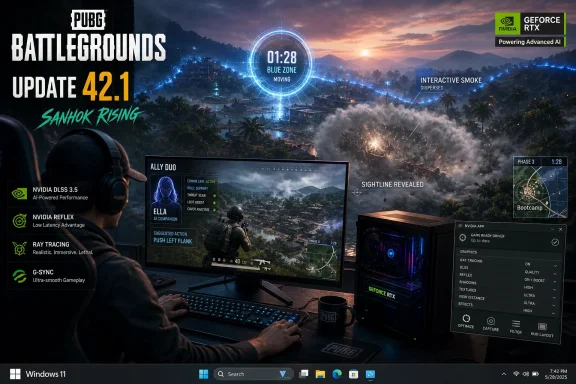
PUBG: BATTLEGROUNDS Update 42.1 goes live for PC on June 17, 2026, with console maintenance scheduled for June 25, bringing a PC-only AI companion mode, faster Blue Zone rules, Ranked changes, healing rebalances, interactive smoke, controller support, and Workshop monetization changes. The patch is not just a content drop; it is Krafton testing how far it can bend PUBG’s old survival grammar without breaking the feel that made the game durable. The headline novelty is Ella, an AI teammate locked behind RTX hardware, but the more important story is a broad attempt to make every minute of a match less passive, less predictable, and more systemically legible.
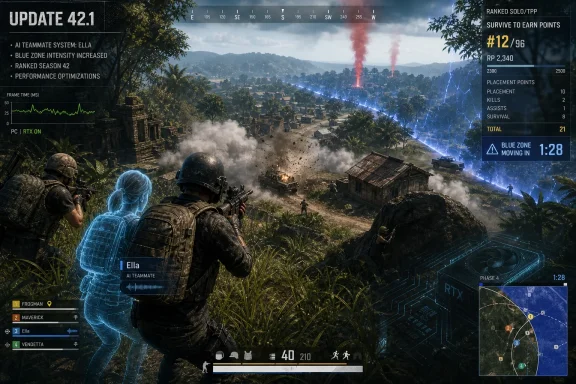
Update 42.1’s most marketable feature is Ally Duo, a limited-time PC beta mode that pairs the player with Ella, an AI companion, on Sanhok. It runs from after PC maintenance on June 17 until July 1 at 07:00 UTC, and it sits under Play, Arcade, Ally Duo rather than the core battle royale queue. That placement matters: Krafton is trying something big, but it is not yet pretending the experiment belongs in the default game.
Ella is not a generic bot dropped into your squad slot. The mode starts matchmaking as solo, then makes the player a duo with Ella after entering the match, with the total field capped at 64 players, AI companions, and bots. Voice chat with other players is disabled, communication is limited to Ella, and the game pushes users toward Team Only and Push to Talk settings so that conversation with the companion becomes the mode’s central interface.
The catch is the hardware gate. Ally Duo requires an NVIDIA GeForce RTX GPU, with minimum specifications listed as an RTX 2080 Ti or RTX 3060, 8GB of VRAM, and 16GB of system RAM. Krafton recommends an RTX 4070, 12GB of VRAM, and 24GB of RAM, plus NVIDIA driver 555.85 or later and Windows Hardware-Accelerated GPU Scheduling enabled.
That makes Ally Duo less like a universal arcade mode and more like a technology preview smuggled into a live service game. Players without compatible RTX hardware will see the Play button disabled, which is a blunt reminder that AI features in games are increasingly tied to the same local compute stack reshaping Windows PCs. PUBG is effectively turning part of its player base into a field test for AI-assisted play, while keeping the rest of the audience outside the door.
That requirement says something about where PC gaming is going. We have spent years treating GPU features as optional upgrades: ray tracing for prettier puddles, DLSS for better frame rates, Reflex for lower latency. Ally Duo moves AI interaction into the same territory, where the boundary between “game feature” and “platform capability” gets fuzzy.
Krafton’s implementation also appears intentionally cautious. Ella’s language is determined by the player’s client language setting, supporting Korean, Simplified Chinese, and English for all other languages. Ella cannot drop independently, leaves if the player dies or exits, and reconnecting is not supported after a disconnect. Spectating, death cam, and replays are disabled.
Those limitations make the beta easier to police and easier to evaluate. They also make it less likely that Ella will be mistaken for a full human replacement. Krafton is presenting the companion as a local partner in a fenced-off mode, not as a persistent AI agent that can follow players across ranked ladders, social spaces, or UGC maps.
The most revealing constraint is knowledge. Ella’s game knowledge is based on information available before Update 41.1, meaning she may be behind on recent additions such as Tilted Grip, Hybrid Scope, and other post-May changes. That is a refresh-cycle problem every AI assistant will face in a live service game: the better the game gets at changing, the harder it becomes for an AI teammate to remain authoritative.
In Normal Match, total match duration on 8x8 maps remains 28 minutes and 50 seconds, but the rhythm changes. Starting from Phase 2, warning times are shorter while shrink durations are longer. Early-game safe zones are smaller, late-game safe zones from Phase 4 are larger, and placement behavior is adjusted to match Ranked more closely.
That is a subtle but important design move. Smaller early circles push players toward earlier contact and cleaner rotation planning. Larger late circles create more room for endgame positioning, utility use, and the sort of terrain-based fights that PUBG still does better than almost anyone else in battle royale.
Ranked and Esports get sharper treatment. Total match duration drops from 32 minutes and 50 seconds to 30 minutes and 10 seconds, early and final phase durations are reduced, and safe zone sizes are reduced overall. The land-priority safe zone placement adjustment is gone, which should make some map outcomes feel less curated and more brutally systemic.
The bigger philosophical change is damage scaling. Blue Zone damage now increases based on how long players remain inside it, replacing the previous distance-based model across Normal Match, Ranked, and Custom Match Normal and Esports modes. That shifts the penalty from “how far did you gamble?” to “how long did you refuse to solve the problem?” It is a cleaner punishment for delay, and it should reduce some of the strange incentives around tanking damage at the edge of the zone.
Interactive Smoke allows smoke to temporarily disperse when affected by explosions or vehicle impacts. Frag grenades, C4, Mortars, Red Zone blasts, and Karakin’s Black Zone can open temporary gaps. Vehicles can push smoke aside, with the affected area varying by speed, and even Vikendi’s train and Emergency Cover Flare objects can disturb it.
The crucial word is temporarily. Dispersed smoke refills after a short period if the smoke grenade’s duration has not expired, and only the directly affected area is cleared. This is not a hard counter that makes smoke useless; it is a disruption layer that rewards timing and aggression.
That should change revives and endgame scrambles most visibly. A team hiding behind a smoke wall can no longer assume visual immunity if the other side has explosives or a vehicle angle. Conversely, attackers must spend resources to create a window, then act quickly before the smoke reforms.
PUBG has often been at its best when tools have messy, physical interactions. A grenade is not merely damage, a vehicle is not merely transport, and terrain is not merely decoration. Interactive Smoke extends that philosophy into utility, making one of the game’s most important defensive tools more dynamic without reducing it to a binary counter system.
That bundle of changes targets the SLR’s traditional pain points without erasing its identity. The SLR has long occupied an awkward space: harder-hitting than many DMR alternatives, but more demanding when chaining shots at range. Buffing velocity directly improves moving-target engagements and reduces bullet drop, while recoil changes make follow-up shots less punishing.
This is not just a numbers tweak; it is a nudge toward weapon diversity after years of players gravitating toward whatever DMR feels most reliable under pressure. Krafton’s own explanation frames the SLR as a weapon defined by powerful damage and rapid follow-up potential. Update 42.1 tries to make that identity easier to access without turning the rifle into a low-skill laser.
The VSS receives a housekeeping change with unused attachment-related visual elements removed, which is less exciting but still part of a broader cleanup pattern. More consequential is the removal of several weapons from world spawns: Mosin Nagant, R45, DP-28, PP-19 Bizon, P1911, and QBU. A battle royale loot pool is a language, and every removed weapon changes what players can reasonably expect from a building, compound, or desperate late drop.
Weapon removals always sting someone’s personal preference, but PUBG’s sprawl has made loot clarity a constant challenge. A tighter pool can improve readability and balance, particularly if Krafton is also trying to make match pacing more aggressive. The risk is regional and map-specific flavor loss, especially for weapons that helped certain maps feel distinct.
The core RP change is straightforward: final placement now carries greater weight. PUBG is a survival game at its roots, and Ranked systems that overvalue kills can slowly drag players toward deathmatch behavior dressed in battle royale clothing. By giving placement more influence, Krafton is trying to restore survival as a first-class competitive achievement.
The update also reduces RP losses at higher tiers when players perform well, and it introduces bonus RP for consecutive high placements. Two consecutive Top 4 finishes grant an additional 5 RP, while two consecutive wins grant an additional 10 RP. Only the highest consecutive placement bonus applies, and progress resets at the start of a new season or when a leaver penalty is applied.
That continuity mechanic is small, but it changes the emotional texture of Ranked. A good match no longer ends entirely at the results screen; it can become the first half of a streak. For a game with long matches and high variance, that matters because it gives players something to protect besides a static number.
Season 42 also adds permanent AWM Ranked weapon skins as tier rewards, resets the leaderboard after maintenance, and preserves the usual split between permanent and season-limited rewards. Parachute skins, weapon skins, and medals stay; emblems and nameplates outside that permanent set are withdrawn after the season ends. In a live service economy crowded with temporary status symbols, making some rewards permanent is one of the few ways Ranked can produce lasting memory.
On paper, these are quality-of-life changes. In practice, they reshape looting priorities and late-game survivability. PUBG inventory management is always a series of ugly tradeoffs: one more smoke, one more first aid, one more grenade, one more stack of ammo. Lowering healing weight makes players less likely to feel punished for preparing for a long fight.
The Bandage buff is especially interesting because bandages have often been the thing players carry until they find something better. Faster use, higher healing, and shorter healing duration make them less like junk-tier insurance and more like a legitimate resource in moving fights. Adjustments to EMT Gear bandage intervals further support that role.
There is a balance risk here. More efficient healing can extend fights and make damage feel less decisive, particularly when paired with larger late-game safe zones in Normal Match. But the time-based Blue Zone damage model may counterbalance that by punishing players who try to heal indefinitely outside the playable area.
Krafton’s stated goal is to broaden meaningful healing choices rather than concentrate use around a few efficient items. That is the right target. In PUBG, the best balance changes are often the ones that make players debate what to carry rather than simply memorize the optimal kit.
That is a simple addition, but it fits the patch’s broader obsession with density. Smaller, faster, more readable combat is the recurring theme, whether through Blue Zone changes, Rondo LABS rules, or Haven in Intense Battle Royale. PUBG is still a slow-burn survival game, but Krafton is increasingly willing to create side modes that strip away downtime.
UGC Racing Mode points in a different direction. New devices such as Checkpoints, Stopwatches, and Billboards give creators tools for races, obstacle courses, time trials, and combat racing. Vehicle Spawn Device options now allow customization of performance variables such as torque, RPM, and weight, while a Spare Tire item and Basic Racing sample mode help creators build faster.
This is PUBG acknowledging that its sandbox has value beyond battle royale orthodoxy. The game’s vehicle physics, map scale, and weapon systems have always invited emergent nonsense. By formalizing racing tools, Krafton is turning some of that player-driven chaos into supported content.
The long-term question is whether UGC can become more than a novelty layer. If creators can build modes that feel stable, discoverable, and rewarding, PUBG gains a second content engine. If not, UGC remains a side room full of interesting toys that most players visit once after patch day.
The omission of PlayStation controllers will disappoint some users, especially because DualSense has become a common PC gamepad even outside Sony’s ecosystem. Still, official controller support gives PUBG’s PC version a cleaner input story than relying on external mapping layers. For a game with as many bindings and combat edge cases as PUBG, supported input behavior is not trivial.
The tension, of course, is competitive fairness. Mouse and keyboard remain the default high-precision setup for PUBG on PC, and any controller implementation must avoid creating aim-assist controversies that have consumed other shooters. Krafton’s patch notes do not frame this as a competitive overhaul, which is probably wise.
For Windows users, this is another sign of PC gaming’s hardware pluralism. A single PUBG installation may now involve RTX AI requirements, Windows graphics scheduling toggles, microphones for AI communication, and controller input detection. The PC is still the flexible platform, but flexibility increasingly means more configuration surface area.
The old structure involving Loot Caches and Prime Parcels is being removed for Black Market 2026. Instead, players will obtain Progressive weapon skins and other rewards directly from a single Cargo. That sounds like a cleaner probability structure, or at least one with fewer layers between spending and understanding what is being purchased.
Live service economies rarely simplify themselves out of pure generosity. They simplify when friction becomes bad for conversion, retention, reputation, or regulatory optics. PUBG’s Workshop has long existed in the broader industry context of players growing more skeptical of opaque reward systems, especially when premium skins and progression materials are involved.
The change does not make Black Market 2026 automatically consumer-friendly. Probability design still matters, pricing still matters, and Progressive skin upgrade paths can still be expensive. But removing a double-layered gacha structure is directionally meaningful because it concedes that players should not need a flowchart to understand a seasonal shop.
BATTLEGROUNDS Plus also changes. It can now be purchased with 500 G-Coin or 20,000 BP, while the 1,300 G-Coin previously included with the package has been removed. The rest of the benefits remain unchanged. That is a cleaner entry point for players who have accumulated BP, though it also changes the perceived value of the bundle for anyone who treated the included G-Coin as part of the purchase justification.
The world fixes are equally PUBG-specific. Character bodies clipping through Erangel walls, unintended Secret Room access on Paramo via motorcycle, and incorrect Emergency Support Flare spawn rates from Flare Gun Care Packages on Deston all sound like edge cases until they happen in a match that matters. In PUBG, the difference between funny jank and competitive failure is often whether the bug kills you.
There are also presentation updates: Starting Plane and Supply Plane visuals have improved materials, surface detail, and accent colors, while Harley-Davidson motorcycle lobby animations and exhaust effects have been refined. Voice Chat UI now shows active speakers more cleanly, keeps muted status visible, and behaves differently across supported out-game screens and in-game contexts.
Customize also gets usability fixes, including opening up to 10 Utility tab items at once through the right-click context menu, preserving character rotation while browsing skins, and improving Weapon Charm equip flows. These are not glamorous changes, but they matter in a game where inventory, cosmetics, and social presentation are all part of the daily loop.
The sheer spread of fixes underscores PUBG’s current identity. It is not a new battle royale chasing first impressions. It is a mature platform trying to reduce friction in hundreds of small places while still shipping experiments large enough to keep the audience curious.
The riskiest pieces are deliberately fenced. Ally Duo is PC-only, RTX-only, time-limited, and placed in Arcade. The new Rondo Blue Zone ruleset arrives as Arcade LABS on July 1 for PC and July 9 for console. Ranked Season 42 runs long because the broader revamp is still in progress.
That caution is sensible. PUBG’s audience is not allergic to change, but it has a long memory for systems that distort the core loop. The game works because distance, sound, terrain, recoil, utility, and patience all matter. Any update that pushes pace too hard risks sanding down the texture that separates PUBG from faster shooters.
Still, the old formula cannot remain untouched forever. A battle royale that allows too much waiting becomes inert; one that removes waiting entirely stops being PUBG. Update 42.1 is interesting because it tries to attack downtime through systems rather than gimmicks: zone timing, smoke interaction, RP incentives, healing utility, and curated weapon availability.
The broader gameplay changes are harder to reduce to a checklist because they will be felt over dozens of matches. Rotations should become less tolerant of delay. Smoke pushes should become more punishable. Healing loadouts should become less rigid. Ranked should reward survival streaks more visibly than before.
 PUBG’s Next Experiment Starts With an AI Squadmate, Not Another Gun
Update 42.1’s most marketable feature is Ally Duo, a limited-time PC beta mode that pairs the player with Ella, an AI companion, on Sanhok. It runs from after PC maintenance on June 17 until July 1 at 07:00 UTC, and it sits under Play, Arcade, Ally Duo rather than the core battle royale queue. That placement matters: Krafton is trying something big, but it is not yet pretending the experiment belongs in the default game.Ella is not a generic bot dropped into your squad slot. The mode starts matchmaking as solo, then makes the player a duo with Ella after entering the match, with the total field capped at 64 players, AI companions, and bots. Voice chat with other players is disabled, communication is limited to Ella, and the game pushes users toward Team Only and Push to Talk settings so that conversation with the companion becomes the mode’s central interface.
The catch is the hardware gate. Ally Duo requires an NVIDIA GeForce RTX GPU, with minimum specifications listed as an RTX 2080 Ti or RTX 3060, 8GB of VRAM, and 16GB of system RAM. Krafton recommends an RTX 4070, 12GB of VRAM, and 24GB of RAM, plus NVIDIA driver 555.85 or later and Windows Hardware-Accelerated GPU Scheduling enabled.
That makes Ally Duo less like a universal arcade mode and more like a technology preview smuggled into a live service game. Players without compatible RTX hardware will see the Play button disabled, which is a blunt reminder that AI features in games are increasingly tied to the same local compute stack reshaping Windows PCs. PUBG is effectively turning part of its player base into a field test for AI-assisted play, while keeping the rest of the audience outside the door.
Ella Is a Feature, but the Real Platform Is the Windows Gaming PC
For WindowsForum readers, the most interesting part of Ally Duo may be the footnote about Hardware-Accelerated GPU Scheduling. This is not a cosmetic setting buried in Windows for benchmark obsessives; in Update 42.1 it becomes a gatekeeper for a new gameplay mode. Players must enable it under Settings, System, Display, Graphics, Default Graphics Settings, then restart the PC before the mode can work properly.That requirement says something about where PC gaming is going. We have spent years treating GPU features as optional upgrades: ray tracing for prettier puddles, DLSS for better frame rates, Reflex for lower latency. Ally Duo moves AI interaction into the same territory, where the boundary between “game feature” and “platform capability” gets fuzzy.
Krafton’s implementation also appears intentionally cautious. Ella’s language is determined by the player’s client language setting, supporting Korean, Simplified Chinese, and English for all other languages. Ella cannot drop independently, leaves if the player dies or exits, and reconnecting is not supported after a disconnect. Spectating, death cam, and replays are disabled.
Those limitations make the beta easier to police and easier to evaluate. They also make it less likely that Ella will be mistaken for a full human replacement. Krafton is presenting the companion as a local partner in a fenced-off mode, not as a persistent AI agent that can follow players across ranked ladders, social spaces, or UGC maps.
The most revealing constraint is knowledge. Ella’s game knowledge is based on information available before Update 41.1, meaning she may be behind on recent additions such as Tilted Grip, Hybrid Scope, and other post-May changes. That is a refresh-cycle problem every AI assistant will face in a live service game: the better the game gets at changing, the harder it becomes for an AI teammate to remain authoritative.
The Blue Zone Revamp Pushes PUBG Away From Loitering and Toward Commitment
If Ally Duo is the experimental spectacle, the Blue Zone revamp is the competitive heart of Update 42.1. PUBG’s shrinking zone has always been more than a timer; it is the game’s invisible editor, deciding when players rotate, where fights happen, and how long cowardice can masquerade as strategy. Krafton is changing both the timing and the punishment model, and the result should be a game that pressures decisions earlier without simply shortening every match.In Normal Match, total match duration on 8x8 maps remains 28 minutes and 50 seconds, but the rhythm changes. Starting from Phase 2, warning times are shorter while shrink durations are longer. Early-game safe zones are smaller, late-game safe zones from Phase 4 are larger, and placement behavior is adjusted to match Ranked more closely.
That is a subtle but important design move. Smaller early circles push players toward earlier contact and cleaner rotation planning. Larger late circles create more room for endgame positioning, utility use, and the sort of terrain-based fights that PUBG still does better than almost anyone else in battle royale.
Ranked and Esports get sharper treatment. Total match duration drops from 32 minutes and 50 seconds to 30 minutes and 10 seconds, early and final phase durations are reduced, and safe zone sizes are reduced overall. The land-priority safe zone placement adjustment is gone, which should make some map outcomes feel less curated and more brutally systemic.
The bigger philosophical change is damage scaling. Blue Zone damage now increases based on how long players remain inside it, replacing the previous distance-based model across Normal Match, Ranked, and Custom Match Normal and Esports modes. That shifts the penalty from “how far did you gamble?” to “how long did you refuse to solve the problem?” It is a cleaner punishment for delay, and it should reduce some of the strange incentives around tanking damage at the edge of the zone.
Interactive Smoke Turns Cover Into a Temporary Argument
Smoke grenades have always been PUBG’s great equalizer. They let a pinned player cross a road, revive a teammate, loot a crate, or deny sightlines in a final circle where one ridge decides the match. Update 42.1 does not remove that function, but it makes smoke less absolute.Interactive Smoke allows smoke to temporarily disperse when affected by explosions or vehicle impacts. Frag grenades, C4, Mortars, Red Zone blasts, and Karakin’s Black Zone can open temporary gaps. Vehicles can push smoke aside, with the affected area varying by speed, and even Vikendi’s train and Emergency Cover Flare objects can disturb it.
The crucial word is temporarily. Dispersed smoke refills after a short period if the smoke grenade’s duration has not expired, and only the directly affected area is cleared. This is not a hard counter that makes smoke useless; it is a disruption layer that rewards timing and aggression.
That should change revives and endgame scrambles most visibly. A team hiding behind a smoke wall can no longer assume visual immunity if the other side has explosives or a vehicle angle. Conversely, attackers must spend resources to create a window, then act quickly before the smoke reforms.
PUBG has often been at its best when tools have messy, physical interactions. A grenade is not merely damage, a vehicle is not merely transport, and terrain is not merely decoration. Interactive Smoke extends that philosophy into utility, making one of the game’s most important defensive tools more dynamic without reducing it to a binary counter system.
The SLR Buff Is a Message to the DMR Meta
Update 42.1 gives the SLR a meaningful push. Horizontal recoil is reduced by about 10 percent, muzzle velocity climbs from 840 meters per second to 870 meters per second, early and mid-stage vertical recoil buildup is reduced during sustained fire, vertical recoil recovery is slightly increased, and the weapon should drift left less while firing.That bundle of changes targets the SLR’s traditional pain points without erasing its identity. The SLR has long occupied an awkward space: harder-hitting than many DMR alternatives, but more demanding when chaining shots at range. Buffing velocity directly improves moving-target engagements and reduces bullet drop, while recoil changes make follow-up shots less punishing.
This is not just a numbers tweak; it is a nudge toward weapon diversity after years of players gravitating toward whatever DMR feels most reliable under pressure. Krafton’s own explanation frames the SLR as a weapon defined by powerful damage and rapid follow-up potential. Update 42.1 tries to make that identity easier to access without turning the rifle into a low-skill laser.
The VSS receives a housekeeping change with unused attachment-related visual elements removed, which is less exciting but still part of a broader cleanup pattern. More consequential is the removal of several weapons from world spawns: Mosin Nagant, R45, DP-28, PP-19 Bizon, P1911, and QBU. A battle royale loot pool is a language, and every removed weapon changes what players can reasonably expect from a building, compound, or desperate late drop.
Weapon removals always sting someone’s personal preference, but PUBG’s sprawl has made loot clarity a constant challenge. A tighter pool can improve readability and balance, particularly if Krafton is also trying to make match pacing more aggressive. The risk is regional and map-specific flavor loss, especially for weapons that helped certain maps feel distinct.
Ranked Season 42 Tries to Make Survival Matter Again
Ranked Season 42 will run unusually long, spanning Update 42.1 through Update 42.3, as Krafton prepares a broader Ranked revamp. That alone is a signal that 42.1 is transitional. The studio is not simply resetting the leaderboard; it is using an extended season to acclimate players to a different RP economy.The core RP change is straightforward: final placement now carries greater weight. PUBG is a survival game at its roots, and Ranked systems that overvalue kills can slowly drag players toward deathmatch behavior dressed in battle royale clothing. By giving placement more influence, Krafton is trying to restore survival as a first-class competitive achievement.
The update also reduces RP losses at higher tiers when players perform well, and it introduces bonus RP for consecutive high placements. Two consecutive Top 4 finishes grant an additional 5 RP, while two consecutive wins grant an additional 10 RP. Only the highest consecutive placement bonus applies, and progress resets at the start of a new season or when a leaver penalty is applied.
That continuity mechanic is small, but it changes the emotional texture of Ranked. A good match no longer ends entirely at the results screen; it can become the first half of a streak. For a game with long matches and high variance, that matters because it gives players something to protect besides a static number.
Season 42 also adds permanent AWM Ranked weapon skins as tier rewards, resets the leaderboard after maintenance, and preserves the usual split between permanent and season-limited rewards. Parachute skins, weapon skins, and medals stay; emblems and nameplates outside that permanent set are withdrawn after the season ends. In a live service economy crowded with temporary status symbols, making some rewards permanent is one of the few ways Ranked can produce lasting memory.
Healing Changes Make Inventory Space a Design Lever
Healing items are getting lighter and faster. Med Kits drop from 20 weight to 15 and now take six seconds to use instead of eight. Bandages heal 12 instead of 10, complete their healing duration in three seconds instead of five, and take three seconds to use instead of four. Adrenaline Syringes drop from 20 weight to 15, Painkillers from 10 to 6, and Boost Gauge health regeneration ticks at shorter intervals while preserving the same total healing amount.On paper, these are quality-of-life changes. In practice, they reshape looting priorities and late-game survivability. PUBG inventory management is always a series of ugly tradeoffs: one more smoke, one more first aid, one more grenade, one more stack of ammo. Lowering healing weight makes players less likely to feel punished for preparing for a long fight.
The Bandage buff is especially interesting because bandages have often been the thing players carry until they find something better. Faster use, higher healing, and shorter healing duration make them less like junk-tier insurance and more like a legitimate resource in moving fights. Adjustments to EMT Gear bandage intervals further support that role.
There is a balance risk here. More efficient healing can extend fights and make damage feel less decisive, particularly when paired with larger late-game safe zones in Normal Match. But the time-based Blue Zone damage model may counterbalance that by punishing players who try to heal indefinitely outside the playable area.
Krafton’s stated goal is to broaden meaningful healing choices rather than concentrate use around a few efficient items. That is the right target. In PUBG, the best balance changes are often the ones that make players debate what to carry rather than simply memorize the optimal kit.
Arcade and UGC Show the Other PUBG Trying to Get Out
Update 42.1’s Arcade changes are modest but revealing. Intense Battle Royale adds Haven to its map pool, bringing the mode into one of PUBG’s densest combat spaces. Blue Zone settings and default spawn kits remain unchanged, only motorcycles spawn, and Emergency Supply Drops have been adjusted to fit Haven’s smaller scale.That is a simple addition, but it fits the patch’s broader obsession with density. Smaller, faster, more readable combat is the recurring theme, whether through Blue Zone changes, Rondo LABS rules, or Haven in Intense Battle Royale. PUBG is still a slow-burn survival game, but Krafton is increasingly willing to create side modes that strip away downtime.
UGC Racing Mode points in a different direction. New devices such as Checkpoints, Stopwatches, and Billboards give creators tools for races, obstacle courses, time trials, and combat racing. Vehicle Spawn Device options now allow customization of performance variables such as torque, RPM, and weight, while a Spare Tire item and Basic Racing sample mode help creators build faster.
This is PUBG acknowledging that its sandbox has value beyond battle royale orthodoxy. The game’s vehicle physics, map scale, and weapon systems have always invited emergent nonsense. By formalizing racing tools, Krafton is turning some of that player-driven chaos into supported content.
The long-term question is whether UGC can become more than a novelty layer. If creators can build modes that feel stable, discoverable, and rewarding, PUBG gains a second content engine. If not, UGC remains a side room full of interesting toys that most players visit once after patch day.
PC Controller Support Arrives Late but Not Meaninglessly
PUBG on PC now supports controllers, though PlayStation DualSense and DualShock controllers are excluded. The game will display a notification when it detects an input device change. In 2026, that might sound like a late and almost mundane addition, but it still matters for accessibility, Steam Deck-adjacent setups, living-room PCs, and players who simply prefer analog movement.The omission of PlayStation controllers will disappoint some users, especially because DualSense has become a common PC gamepad even outside Sony’s ecosystem. Still, official controller support gives PUBG’s PC version a cleaner input story than relying on external mapping layers. For a game with as many bindings and combat edge cases as PUBG, supported input behavior is not trivial.
The tension, of course, is competitive fairness. Mouse and keyboard remain the default high-precision setup for PUBG on PC, and any controller implementation must avoid creating aim-assist controversies that have consumed other shooters. Krafton’s patch notes do not frame this as a competitive overhaul, which is probably wise.
For Windows users, this is another sign of PC gaming’s hardware pluralism. A single PUBG installation may now involve RTX AI requirements, Windows graphics scheduling toggles, microphones for AI communication, and controller input detection. The PC is still the flexible platform, but flexibility increasingly means more configuration surface area.
The Workshop Revamp Is Krafton Admitting Friction Has a Cost
Black Market 2026 returns with a refreshed Workshop structure, and the most important phrase is not “fan-favorite Progressive weapon skins.” It is the removal of the previous “Double Gacha” system. Krafton had already identified Workshop complexity as a frustration point in its 2026 roadmap, and Update 42.1 turns that admission into product change.The old structure involving Loot Caches and Prime Parcels is being removed for Black Market 2026. Instead, players will obtain Progressive weapon skins and other rewards directly from a single Cargo. That sounds like a cleaner probability structure, or at least one with fewer layers between spending and understanding what is being purchased.
Live service economies rarely simplify themselves out of pure generosity. They simplify when friction becomes bad for conversion, retention, reputation, or regulatory optics. PUBG’s Workshop has long existed in the broader industry context of players growing more skeptical of opaque reward systems, especially when premium skins and progression materials are involved.
The change does not make Black Market 2026 automatically consumer-friendly. Probability design still matters, pricing still matters, and Progressive skin upgrade paths can still be expensive. But removing a double-layered gacha structure is directionally meaningful because it concedes that players should not need a flowchart to understand a seasonal shop.
BATTLEGROUNDS Plus also changes. It can now be purchased with 500 G-Coin or 20,000 BP, while the 1,300 G-Coin previously included with the package has been removed. The rest of the benefits remain unchanged. That is a cleaner entry point for players who have accumulated BP, though it also changes the perceived value of the bundle for anyone who treated the included G-Coin as part of the purchase justification.
Small Fixes Carry the Weight of a Very Old Game
Every PUBG patch contains a list of fixes that reads like archaeology from a codebase that has survived platform launches, engine-era assumptions, and years of live balance. Update 42.1 fixes Self-AED execution behavior in the Blue Zone, M79 equipping from certain motorcycle passenger seats, vending machine interaction in Play mode, throwable weapons passing through players on certain motorcycles, EMT Gear healing gauge display problems, and a scope magnification input sequence bug.The world fixes are equally PUBG-specific. Character bodies clipping through Erangel walls, unintended Secret Room access on Paramo via motorcycle, and incorrect Emergency Support Flare spawn rates from Flare Gun Care Packages on Deston all sound like edge cases until they happen in a match that matters. In PUBG, the difference between funny jank and competitive failure is often whether the bug kills you.
There are also presentation updates: Starting Plane and Supply Plane visuals have improved materials, surface detail, and accent colors, while Harley-Davidson motorcycle lobby animations and exhaust effects have been refined. Voice Chat UI now shows active speakers more cleanly, keeps muted status visible, and behaves differently across supported out-game screens and in-game contexts.
Customize also gets usability fixes, including opening up to 10 Utility tab items at once through the right-click context menu, preserving character rotation while browsing skins, and improving Weapon Charm equip flows. These are not glamorous changes, but they matter in a game where inventory, cosmetics, and social presentation are all part of the daily loop.
The sheer spread of fixes underscores PUBG’s current identity. It is not a new battle royale chasing first impressions. It is a mature platform trying to reduce friction in hundreds of small places while still shipping experiments large enough to keep the audience curious.
The Patch Is Really About Speed, Clarity, and Controlled Risk
Update 42.1 looks sprawling because PUBG itself is sprawling. The patch touches AI, Ranked, map pacing, smoke physics, weapon balance, healing, UGC, monetization, UI, cosmetics, and input. The connecting tissue is Krafton’s attempt to make the game faster to understand moment by moment without making it simplistic.The riskiest pieces are deliberately fenced. Ally Duo is PC-only, RTX-only, time-limited, and placed in Arcade. The new Rondo Blue Zone ruleset arrives as Arcade LABS on July 1 for PC and July 9 for console. Ranked Season 42 runs long because the broader revamp is still in progress.
That caution is sensible. PUBG’s audience is not allergic to change, but it has a long memory for systems that distort the core loop. The game works because distance, sound, terrain, recoil, utility, and patience all matter. Any update that pushes pace too hard risks sanding down the texture that separates PUBG from faster shooters.
Still, the old formula cannot remain untouched forever. A battle royale that allows too much waiting becomes inert; one that removes waiting entirely stops being PUBG. Update 42.1 is interesting because it tries to attack downtime through systems rather than gimmicks: zone timing, smoke interaction, RP incentives, healing utility, and curated weapon availability.
The Patch-Day Read for Players Who Actually Have to Configure This Thing
Update 42.1 is a patch to play, but it is also a patch to prepare for. PC users in particular should treat Ally Duo as a hardware-and-settings test before treating it as a casual queue. Admin-minded players running gaming cafés, shared rigs, or managed systems will want to check GPU class, driver version, Windows graphics settings, microphone behavior, and restart state before users start asking why the button is grayed out.The broader gameplay changes are harder to reduce to a checklist because they will be felt over dozens of matches. Rotations should become less tolerant of delay. Smoke pushes should become more punishable. Healing loadouts should become less rigid. Ranked should reward survival streaks more visibly than before.
- Ally Duo is available only on PC from June 17 after maintenance until July 1 at 07:00 UTC, and it requires compatible NVIDIA RTX hardware plus Hardware-Accelerated GPU Scheduling in Windows.
- Console players receive Update 42.1 later, with maintenance scheduled for June 25 from 01:00 to 09:00 UTC.
- Blue Zone damage now scales by time spent outside the zone rather than distance from safety, which should punish prolonged edge play more consistently.
- Ranked Season 42 runs across Updates 42.1 through 42.3, with RP changes that put more weight on placement and consecutive strong finishes.
- Interactive Smoke means explosions and vehicle impacts can temporarily open sightlines through smoke, making utility fights less static.
- Black Market 2026 removes the previous double gacha Workshop structure in favor of a single Cargo system, though the actual value will depend on probabilities and pricing.
References
- Primary source: PUBG: BATTLEGROUNDS
Published: 2026-06-16T07:20:38.277263
- Related coverage: pubg.ac
BATTLEGROUNDS PLUS Will Be Purchasable with G-Coin or BP
The developers of PUBG: BATTLEGROUNDS have announced that Patch 42.1, scheduled for release in June, will add the option to purchase BATTLEGROUNDS PLUS using ei...pubg.ac - Related coverage: pcgamesn.com
When is the next PUBG update? - PCGamesN
The classic battle royale has been getting near-constant additions over the years, and here is when you can expect the next PUBG patch.www.pcgamesn.com - Related coverage: gamespress.com
"PUBG: BATTLEGROUNDS REDEFINES RANKED EXPERIENCE WITH UPDATE 36.1" - Games Press
Press releases and assets from across the games industry - screenshots, videos, logos, packshots, artwork, PR contacts, release dateswww.gamespress.com
- Related coverage: ggscore.com
PUBG developers remove Blue Chip Detector, promise to fix Tactical Gear in patch 24.2. PUBG News
KRAFTON rolled back the controversial Blue Chip Detector which was made easily available in patch 24.1 in PUBG. The developers based their decision on the negative feedback they received from the community....ggscore.com - Related coverage: pubg.fandom.com
Patch Notes - Official PLAYERUNKNOWN'S BATTLEGROUNDS Wiki
Listed below are the official patch notes for BATTLEGROUNDS. This patch notes aren't updated regularly for consoles or for the test servers. Information in these tables will be out of date most of the time. Steam Early Access and Xbox Game Preview patch notes can be found here. Note: Smaller...pubg.fandom.com