
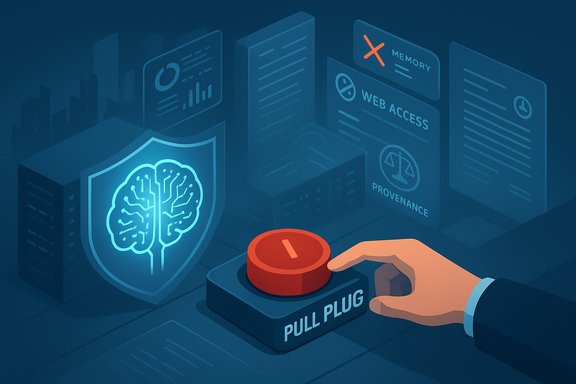
The debate over whether, when and how to "pull the plug" on artificial intelligence has moved from philosophy seminars into courtrooms, regulator briefings and boardrooms — and the practical answer being argued by lawyers, technologists and regulators is emphatically not a single moment of shutdown but a layered, enforceable strategy of limits, defaults and human oversight designed to stop specific harms before they scale into systemic damage.
Background: why the question matters now
The recent wave of high‑profile incidents — from tribunal decisions that exposed hallucinated case law to judicial rebukes and fresh professional guidance — has turned AI from an abstract policy debate into a problem with legal, ethical and operational consequences for everyday users and institutions. Courts have confronted filings containing non‑existent authorities; regulators and professional bodies have issued guidance stressing verification and transparency; and major platform vendors are embedding assistants into desktop and cloud productivity stacks at scale. These developments make the practical question unavoidable: how do organisations and regulators know when to restrict or disable AI features, and what does "pulling the plug" actually mean in practice? The Law Society Gazette review that prompted this feature frames the issue around three core tensions: (1) AI’s tangible productivity gains, (2) the unique reputational and legal risks when outputs are wrong, and (3) the sociotechnical dynamics — product incentives, default settings and distribution channels — that amplify rare failures into mass harms. That framing shifts the question away from metaphysical alarms about “machines becoming persons” toward operational decisions about which features to disable, when, and under what governance regimes.Overview: the practical problem of “when to pull the plug”
At its simplest, the decision to disable an AI feature is not binary. There are four distinct operational meanings:- Disable at the endpoint: remove or block an assistant on devices (user or managed) so it cannot be called.
- Disable specific capabilities: leave the assistant but turn off risky features (long‑term memory, web access, code execution, document ingestion).
- Disable by use case: allow the assistant for low‑risk drafting but forbid it for legal, clinical or safety‑critical tasks.
- Disable by user cohort: permit access for trained, credentialed staff and prohibit it for trainees, minors or vulnerable groups.
Why defaults matter
Design defaults and distribution channels determine how many people will encounter a feature and under what assumptions. When an assistant is on by default inside an operating system or office suite, millions of users adopt it without explicit consent or training. That scale turns a low error rate into frequent real‑world incidents and irrecoverable harms for vulnerable people or regulated contexts. Regulators and professional bodies now treat defaults as a policy lever: safer defaults + opt‑in for personalization reduce downstream risk.What the legal and professional response looks like
Legal institutions and professional regulators have converged on a consistent set of expectations:- Human responsibility remains primary: lawyers, clinicians and other professionals retain ultimate duty for verification and advice. Tools do not shift legal responsibility.
- Auditability and provenance: organisations should require auditable logs, model‑version stamping and provenance metadata for any AI output used in high‑stakes work.
- Contractual guardrails: no‑retrain, deletion guarantees and egress/exportable logs are now baseline procurement asks for matter‑level data.
- Disclosures and practice rules: courts and regulatory bodies are moving toward requiring explicit disclosures where AI materially contributes to filings or decisions; professional guidance prompts firms to codify internal policies.
Practical thresholds for turning features off (a decision framework)
Organisations should adopt explicit threshold tests that translate abstract harms into operational triggers. The following framework is practical and implementable for IT, legal and compliance teams:- Immediate disable (pull the plug) when:
- The feature demonstrably causes demonstrable, repeatable harms to safety, dignity or legal rights (e.g., producing fabricated legal authorities used in court).
- Independent audits show classifiers or refusal heuristics fail to block crisis‑level outputs (suicidality, self‑harm, explicit exploitation).
- There is confirmed sensitive data exfiltration into vendor training corpora contrary to contractual terms.
- Conditional restrict (soft plug) when:
- Accuracy metrics for a use case fall below an agreed tolerance (for example, >X% hallucination rate on citation tasks during pilot).
- There is credible legal/regulatory uncertainty over liability that cannot be mitigated contractually.
- Product defaults enable risky personalization (persistent memory) for minors or other vulnerable cohorts without parental or guardian consent.
- Gradual rollout with controls when:
- Pilot metrics show productivity gains and tolerable error profiles with robust human verification and auditable logs.
- Vendors provide independent audits, provenance metadata and contractual non‑retrain clauses.
- Never disable when:
- The feature is purely cosmetic or superficial and presents negligible risk (for example, UI theming or icon shape choices).
- Disabling would create an immediate, measurable deterioration in critical services with no feasible fallback.
Technical and procurement controls that make “pull the plug” meaningful
Disabling a button in the UI is not enough. Effective mitigation requires engineering, procurement and operational changes:- Tenant grounding and endpoint DLP: ensure any assistant that touches organisational data does so under tenant‑controlled retrieval and with DLP protections that block exfiltration.
- Prompt and response logging: capture prompts, model version, timestamp and retrieval provenance for forensic traceability.
- Mode separation: separate editing / clarity modes (low‑risk) from research / citation modes (high‑risk) and require different approval workflows.
- Memory management: default to no persistent memory; make long‑term personalization opt‑in with clear export and deletion controls.
- Human‑in‑the‑loop gates: for every category of high‑risk output (legal filings, clinical triage, automated actuations), require a named human approver and record sign‑offs.
Where the evidence supports shutdowns — and where it does not
Strengths in the argument for targeted shutdowns- Scale multiplies rare harms: even a very small hallucination rate becomes significant when the assistant reaches millions of users. Stopping high‑risk features at scale prevents widespread harm.
- Professionally consequential failures: in domains where outputs are relied on as authoritative (court filings, medical advice, safety‑critical automation) the error cost is high and justifies stronger limits.
- Design incentives push toward personification: features that increase engagement (memory, persona) also increase dependence and manipulation risks — a strong argument to restrict such features by default.
- Overbroad bans can harm access: outright prohibitions can prevent useful, low‑risk assistance that improves productivity and access to services — for example, drafting support, accessibility features, or low‑intensity mental‑health triage with human escalation. The balance matters.
- Hard attribution problems: proving causation in emotional‑harm suits or in complex product ecosystems remains difficult and may not yield a simple injunction. Courts and standards bodies are still building factual and evidentiary criteria. Flag: where claims about causation lack transparent empirical backing, treat them as plausible but not proven.
- Fragmented enforcement: even if large vendors agree on conservative defaults, hobbyist developers and open‑source combinations can recreate risky personification features outside corporate governance — requiring regulatory and standards responses.
Cross‑checking headline claims (verification and independent confirmation)
Several of the article’s core claims have verifiable backing in independent reporting and primary documents:- Courts are penalising or rebuking practitioners for AI‑generated fake citations — confirmed by multiple high‑quality news outlets and court orders; one recent federal matter in Oregon resulted in remedial measures accepted by the judge rather than sanctions.
- The Bar Council (England & Wales) has updated guidance for barristers, reinforcing verification duties and warning against blind reliance on LLMs. The Bar Council’s public guidance and Law Gazette reporting corroborate this professional posture.
- Major platform vendors are commercialising desktop assistants (Copilot and variants) with clear pricing and administrative controls. Microsoft’s own product pages show a paid Microsoft 365 Copilot SKU and administrative features (tenant grounding, DLP integration) that make enterprise governance possible. This confirms that the product levers needed to implement the staged approach actually exist in current tooling.
A practical playbook: how Windows users, IT teams and law firms should act now
- Inventory and map exposure: identify every integration, connector and Copilot seat. Map which workstreams involve regulated data.
- Implement immediate technical gates: tenant grounding, Conditional Access, Endpoint DLP and centrally managed toggles for Copilot features before enabling matter data ingestion.
- Create verification workflows: mandatory human sign‑off for external filings, exportable prompt/response logs and role‑based competency attestations for approvers.
- Harden procurement: demand deletion guarantees, no‑retrain clauses and auditable logs from vendors. If vendors refuse, restrict those platforms to non‑sensitive workflows.
- Train and redesign: pair AI‑assisted tasks with deliberate supervised learning so juniors still gain formative experience; redesign assessments and performance metrics to reward verified quality, not raw throughput.
- Monitor and adapt: set measurable KPIs (error rate, verification time, incident frequency) and use them to decide whether a feature is temporarily disabled, restricted to pilots, or rolled out more broadly.
Conclusion — a sober, practicable verdict
The right approach is not an absolutist shutdown of all artificial intelligence nor a laissez‑faire embrace of every feature. The evidentiary record, professional guidance and platform capabilities point toward a middle path: enforceable defaults, clear thresholds for disabling risky features, procurement and technical controls that make "pulling the plug" meaningful, and a regulatory regime that supports shared standards for provenance and auditability. The Law Society Gazette review and the broader corpus of judicial and regulator activity make the policy case clear: organisations must treat AI features like any other high‑risk capability — measure their failure modes, codify threshold triggers, and be prepared to turn off or limit features when they fail the test of safety, transparency or legal defensibility. Ultimately, "pull the plug" is a pragmatic governance decision — a set of tools and thresholds that let institutions protect people and preserve trust while still extracting measurable value from AI systems where they are safe and accountable.Source: The Law Society Gazette When to pull the plug on artificial intelligence
