

Pure Storage and Microsoft have announced a tighter set of integrations and co-engineered services designed to make migrations to Azure less risky and more cost‑predictable—extending Pure Storage storage into Azure VMware Solution (AVS) and Azure Local, integrating FlashArray with Azure local services, and aligning Portworx container storage with Azure Kubernetes offerings and virtualization on Kubernetes. These changes promise easier "lift‑and‑shift" migrations, new options for on‑premises Azure experiences, and vendor‑backed performance and cost claims intended to accelerate AI adoption on existing database platforms.
Hybrid cloud modernization remains the dominant challenge for enterprises: legacy applications, regulatory constraints, and cost unpredictability make simple “move everything to the cloud” strategies impractical for many IT organizations. Pure Storage’s recent announcements with Microsoft are explicitly positioned to address that gap by offering storage-as-a-service for VMware workloads in Azure, deeper integration for on‑prem Azure Local experiences, and data‑platform optimizations targeted at AI workloads—plus unified data management for Kubernetes through Portworx. The vendor narrative centers on four problems: cost, control/security, AI readiness, and Kubernetes/VM convergence; the solutions are Pure Storage Cloud Azure Native (for AVS and private preview for Azure VMs), FlashArray + Azure Local, FlashArray performance optimizations for embedding/vector workloads, and Portworx for KubeVirt and AKS/ARO. This article breaks down what is announced, analyzes the technical and commercial realities beneath the marketing claims, and offers a pragmatic checklist for IT leaders evaluating these options.
However, the vendor‑reported performance and cost improvements underpinning the most attractive marketing claims should be treated as directional rather than definitive. The right course of action is careful, workload‑specific validation: use pilots, insist on real application benchmarks, and model costs conservatively. For IT leaders, this partnership expands the toolkit for hybrid cloud transformation—but the details of contracts, previews versus GA, and measured benchmarking will determine whether the move delivers the promised relief or merely reshuffles complexity.
In short: these integrations substantially lower the technical and operational barriers to hybrid modernization—but prudent engineering validation and financial modeling remain essential before adopting the vendor’s headline savings and performance figures.
Source: CXOToday.com Microsoft and Pure Storage Simplify Migration to Azure
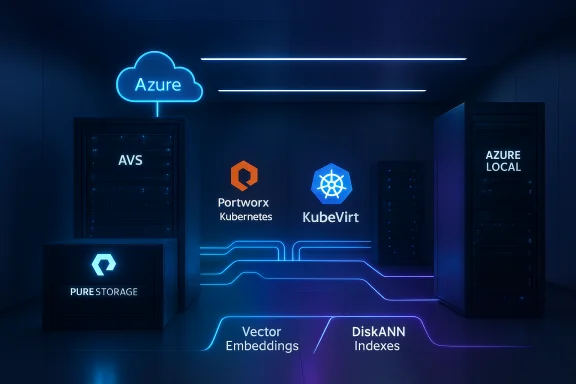 Background / Overview
Hybrid cloud modernization remains the dominant challenge for enterprises: legacy applications, regulatory constraints, and cost unpredictability make simple “move everything to the cloud” strategies impractical for many IT organizations. Pure Storage’s recent announcements with Microsoft are explicitly positioned to address that gap by offering storage-as-a-service for VMware workloads in Azure, deeper integration for on‑prem Azure Local experiences, and data‑platform optimizations targeted at AI workloads—plus unified data management for Kubernetes through Portworx. The vendor narrative centers on four problems: cost, control/security, AI readiness, and Kubernetes/VM convergence; the solutions are Pure Storage Cloud Azure Native (for AVS and private preview for Azure VMs), FlashArray + Azure Local, FlashArray performance optimizations for embedding/vector workloads, and Portworx for KubeVirt and AKS/ARO. This article breaks down what is announced, analyzes the technical and commercial realities beneath the marketing claims, and offers a pragmatic checklist for IT leaders evaluating these options.What Microsoft and Pure Storage Announced
Core pieces of the announcement
- Pure Storage Cloud Azure Native — a fully managed, Azure‑integrated storage offering that connects Pure Storage’s block storage capabilities into Azure VMware Solution (AVS) (generally available) and is in private preview for Azure VMs, with the goal of minimizing refactoring for VMware migrations and enabling provisioning/monitoring from the Azure console. The vendor positions this as delivering materially lower costs for many AVS customers compared with alternative approaches.
- FlashArray + Azure Local integration — an external‑storage integration that lets FlashArray present storage to Azure Local racks (the Azure Local experience that brings Azure services into customer data centers), targeting customers that require local data residency, low latency, or specific sovereignty/compliance controls. The integration aims to preserve on‑premises operational familiarity while providing Azure service consistency.
- AI‑readiness via SQL Server 2025 + FlashArray — Microsoft’s SQL Server 2025 introduces native vector capabilities (DiskANN‑backed vector search and T‑SQL integration). Pure Storage claims that running SQL Server on FlashArray yields higher performance density and smaller storage footprints for vector/embedding workloads (vendor figures cited include “up to 3X more performance density per rack unit” and major reductions in embedding storage footprint). These claims are presented as an optimized path to AI for organizations that want to build on existing database investments rather than replatforming to a separate vector database.
- Portworx advances — Portworx (now part of Pure Storage) has expanded its enterprise storage, protection, and mobility for Kubernetes, including a KubeVirt‑focused offering that enables running VMs and containers side‑by‑side on Kubernetes and integrations that target AKS and Azure Red Hat OpenShift (ARO). Portworx for KubeVirt is explicitly positioned as a migration path for VMs into Kubernetes environments with cost and operational consistency benefits.
Why this matters: Four practical benefits for enterprise IT
- Lower friction for VMware migrations — Decoupling storage from compute inside AVS and presenting enterprise block storage via a managed service removes a common blocker to moving VMware workloads: the storage mismatch between on‑prem arrays and native cloud disks. The solution aims to preserve operational processes (vSphere tooling, datastore semantics) while giving teams the elasticity of Azure. Expect smoother migrations for heavy block‑storage workloads.
- Stronger options for sovereignty and edge use cases — Azure Local plus FlashArray external storage gives organizations with regulatory or latency needs a route to keep data on site while still using Azure’s management plane and services. This directly addresses sectors (government, regulated healthcare/finance) that can’t move certain datasets off local premises.
- An incremental, low‑risk path to AI — Rather than introducing a separate vector store and rewriting apps, SQL Server 2025’s integrated vector support allows organizations to start RAG (retrieval‑augmented generation) and embedding‑based features inside their existing T‑SQL stacks. Paired with high‑density FlashArray hardware, Pure Storage frames this as a way to get AI readiness without a full platform migration. Microsoft’s own messaging confirms SQL Server 2025’s AI‑centric architecture.
- Unified management across VMs and containers — Portworx’s KubeVirt work and support for AKS/ARO unify lifecycle, backup, and mobility for both VMs and containers, giving teams a single data plane for stateful apps across clouds and on‑prem infrastructure—a significant simplification if it matches operational expectations.
Technical details and limits you should check
On the migration front (AVS / Azure Native)
- The Pure Storage Cloud integration into AVS is built to be native to Azure management flows; customers can provision and monitor storage from the Azure console without switching UIs. Confirm the exact AVS regions and SKUs supported for your tenancy and whether your existing Azure Consumption Commitments (MACC) or credits apply to the service. Pure’s materials show AVS availability, while Azure VM integration was announced as private preview—confirm preview eligibility.
- Verify VMware feature parity (VAAI, vVols, or other storage APIs you rely upon). Some platform features (vVols, certain storage integrations) have historically seen gaps in cloud variants of VMware; validate the specifics for your workloads and test HCX/VMware migration tooling on a pilot project.
For Azure Local + FlashArray
- Azure Local deployments are opinionated and include Microsoft‑managed components (e.g., the Azure Arc Resource Bridge or the Azure Local rack). The FlashArray integration will present external storage but licensing and monthly Azure Local fees may be separate—confirm financial model and whether storage is charged inside the Azure billing model or via Pure’s commercial model. Also validate integration features like MPIO, SafeMode snapshots, and DR workflows.
AI and SQL Server 2025
- SQL Server 2025 ships native vector capabilities (DiskANN‑based vector index and vector search exposed via T‑SQL and REST interfaces). The performance and storage footprint numbers quoted by Pure Storage are vendor claims based on internal benchmarking of FlashArray//XL R5; those numbers should be validated in your environment, as actual gains depend on embedding sizes, data reduction ratios, compression/deduplication factors, and query patterns. Treat the “up to 3X” and “up to 50–60%” reductions as vendor benchmarks, and plan proof‑of‑concept tests before committing to capacity and TCO models.
Portworx, KubeVirt, and AKS/ARO
- Portworx’s KubeVirt work introduces RWX raw block volumes, VM‑centric licensing options, and backup/DR primitives for VMs on Kubernetes. Confirm which Portworx license you need (Portworx for Modern Virtualization, Portworx Enterprise VM, etc., how licensing is applied to cloud‑managed Kubernetes (AKS/ARO), and the supported KubeVirt distributions (Red Hat OpenShift Virtualization, SUSE/KubeVirt builds).
Vendor claims and independent verification — what’s solid, what’s vendor marketing
- The most verifiable claim is Microsoft’s SQL Server 2025 plan: Microsoft published SQL Server 2025 with native vector database capabilities and previewing the release—this is an explicit Microsoft product direction. That foundation materially changes how enterprises can approach AI on transactional data.
- Pure Storage claims (AVS availability, Portworx KubeVirt integration, Azure Local FlashArray support) are documented on Pure Storage’s site and in Pure press releases—those elements are real and available as preview/GA in specific offerings. For example, Pure documents AVS support and the FlashArray + Azure Local integration as current initiatives. These are vendor announcements you can validate via Pure’s product pages and Azure integration details.
- Performance and cost numbers (e.g., “up to 3X more performance density per rack unit,” “up to 50–60% smaller embedding footprints,” “50% lower costs in many cases”) originate from Pure Storage benchmarking and marketing materials. Comparable claims appear in Pure’s product pages and webinars, but they are vendor‑sourced. Independent third‑party benchmark reports and analyst validations are limited in public venues; therefore treat these as useful directional metrics but require your own validation. Pure’s own materials note that results vary by workload and configuration. Plan controlled benchmarks for your representative workloads before acting on percentage claims.
- Portworx outcomes (30–50% cost savings when using Portworx with OpenShift Virtualization) are quoted in Portworx/Pure release materials and PR; those figures reflect customer anecdotes and vendor benchmarks—again, validate on your workloads and licensing terms.
Risks and operational caveats
- Preview vs GA — Several elements (Azure VMs integration, some Azure Local refinements) are in private preview or early GA; features, region availability, pricing, and quotas can change between preview and full GA. Don’t assume parity with the pure cloud‑native experience until you test the exact preview builds you will use.
- Billing and cost modeling complexity — Combining vendor‑managed storage, Azure compute, and Microsoft‑managed Azure Local racks introduces layered billing. Confirm where storage is invoiced (Azure billing vs. Pure billing), how Azure credits apply, and whether there are per‑core or per‑rack fees for Azure Local. Misunderstanding this can produce unexpected cost surprises.
- Vendor lock‑in and operational assumptions — Porting VMs onto Kubernetes (KubeVirt) simplifies operations for some teams but adds Kubernetes platform complexity for others. If your staff lacks Kubernetes operations experience, the migration could trade one operational burden for another. Similarly, relying on vendor‑specific storage features (e.g., SafeMode snapshot semantics) will require careful exit planning.
- Security and compliance nuance — Azure Local + FlashArray addresses data residency, but regulatory controls around data governance, key management, and auditability must be explicitly validated. For highly regulated data, get legal and compliance sign‑off before relying on Azure Local to satisfy sovereignty requirements.
- Performance variance — Benchmarks are sensitive to embedding size, dedupe/compression effectiveness, concurrency, and disk/controller configuration. A claimed “3X” density improvement in vendor materials should be validated against your SQL workload, embedding sizes, and SLAs with a formal POC.
Practical migration and validation checklist (operational steps)
- Inventory and classify workloads by latency, IOPS, and sovereignty needs. Run a discovery phase to identify candidates for AVS / Azure Local / AKS migration.
- Map VMware feature dependencies (vVols, VAAI, SRM/HCX) and confirm feature parity in AVS + Pure integration.
- Confirm licensing and billing flows: which Azure credits and MACC apply, how Pure Storage billing interfaces with Azure billing, and which Portworx licenses are required.
- Build a small pilot: migrate a non‑critical, representative VM set to AVS with Pure Cloud Azure Native and measure latency, RPO/RTO, and costs versus on‑prem.
- For AI: run a SQL Server 2025 + FlashArray pilot using your embedding sizes and models. Measure query latency, storage reduction (dedupe/compression), and vector search throughput.
- For Kubernetes: validate Portworx for KubeVirt with a mixed VMs+containers workload on OpenShift or AKS, measuring backup/restore times, replication, and live migration if used.
- Validate DR and snapshot workflows end‑to‑end, including SafeMode/immutable snapshot semantics and cross‑site replication.
- Engage security/compliance teams to validate key management, audit trails, and privacy/regulatory controls for Azure Local and hybrid flows.
- Document rollback and exit plans for each pilot path (how to move back on‑prem, how to migrate off Pure Cloud Block Store if required).
- Run a TCO sensitivity analysis with conservative and aggressive assumptions for data reduction, egress, and licensing to bound potential financial outcomes.
Vendor strengths and strategic fit
- Pure Storage strengths: deep storage engineering pedigree, Evergreen upgrade model, and recent product designs that emphasize high performance density (FlashArray//XL) and cloud integration. Pure’s acquisition/advancement of Portworx gives it a strong position in stateful Kubernetes storage. These capabilities are attractive for enterprises that want storage parity between on‑prem and cloud and who prioritize predictable performance for databases and AI workloads.
- Microsoft strengths: SQL Server 2025’s in‑engine vector support materially lowers the barrier to adding RAG/semantic search features into existing relational applications. Microsoft’s Azure Local and AVS investments make the Azure ecosystem more palatable for regulated or latency‑sensitive customers. Combining Microsoft’s database roadmap with Pure Storage’s storage roadmap creates a pragmatic in‑place modernization path for many enterprises.
Bottom line: Who should care and next steps
- Enterprises with large VMware estates that need a low‑risk migration path to Azure and want to avoid wholesale replatforming should strongly evaluate Pure Storage Cloud Azure Native for AVS. Start with a measured pilot and validate storage feature parity and billing assumptions.
- Organizations that must keep data local for sovereignty or latency reasons should evaluate FlashArray + Azure Local, but must engage compliance and procurement early to confirm contract terms and cost structure before committing to a deployment.
- Teams experimenting with embeddings, RAG, and search should pilot SQL Server 2025 on FlashArray to measure real‑world embedding footprint reductions and query performance. Treat published “3X” or “50–60%” figures as vendor benchmarks and validate them in your environment.
- Organizations pursuing unified operations for VMs and containers should evaluate Portworx for KubeVirt and test the approach against existing operational skillsets—migrating to KubeVirt can be powerful, but it assumes operational maturity in Kubernetes.
Final assessment
The Microsoft–Pure Storage collaboration is a meaningful and pragmatic push toward modernization without mandatory replatforming. By aligning storage, database, and container platforms with Azure’s hybrid services, they offer many enterprises a realistic set of migration and modernization choices that preserve existing operational models while preparing for AI‑driven workloads.However, the vendor‑reported performance and cost improvements underpinning the most attractive marketing claims should be treated as directional rather than definitive. The right course of action is careful, workload‑specific validation: use pilots, insist on real application benchmarks, and model costs conservatively. For IT leaders, this partnership expands the toolkit for hybrid cloud transformation—but the details of contracts, previews versus GA, and measured benchmarking will determine whether the move delivers the promised relief or merely reshuffles complexity.
In short: these integrations substantially lower the technical and operational barriers to hybrid modernization—but prudent engineering validation and financial modeling remain essential before adopting the vendor’s headline savings and performance figures.
Source: CXOToday.com Microsoft and Pure Storage Simplify Migration to Azure
