

Microsoft is rolling out Microsoft Purview Roadmap ID 558681, an API change intended to enrich Graph API alert data with DLP rule-match event details that customers currently obtain through the Management API. The roadmap lists Preview availability for May 2026 and General Availability for June 2026. It remains marked Rolling out, and Microsoft has not published tenant-level availability details in the provided roadmap facts. The practical benefit is straightforward: security and compliance integrations may be able to retrieve an alert and more of the evidence explaining it through a simpler integration path.
An alert and its underlying DLP event serve different purposes. The alert tells an operations team that activity may require attention. The event details help explain why a policy or rule matched and can provide the context needed to investigate the activity.
Microsoft’s planned enhancement will enrich Graph API alert data with DLP event data. The stated goal is to make correlation and integration easier.
The roadmap does not establish that every field currently available through the Management API will be copied into Graph. It also does not identify the exact Graph resource, endpoint, property names, permission model, or release mechanism involved. Until Microsoft publishes technical documentation, “enriched” should be read as a product direction rather than a complete implementation specification.
The roadmap should therefore be treated as an integration opportunity, not as authorization to redesign production collectors immediately.
That distinction matters. An organization may use Management API data for purposes beyond enriching alerts, and Roadmap ID 558681 does not claim to replace those uses. It promises an easier way to correlate DLP event information with alert data for the scenarios Microsoft names.
The roadmap also does not establish whether customers will need different authentication arrangements, new subscriptions, revised pagination logic, or specific update-handling mechanisms. Those questions remain open until Microsoft publishes the technical contract.
Administrators should avoid designing around assumptions about how the enrichment will arrive. It could appear in an existing object, a related object, or another documented representation. It could be present when an alert is first retrieved or added later. These are plausible implementation possibilities, but the roadmap does not confirm any of them.
The correct planning position is therefore neutral: prepare integrations to evaluate the new data, but wait for published documentation before changing authentication, collection, or processing logic.
For automated workflows, additional DLP event data may offer more useful inputs for routing or triage. The roadmap, however, does not identify which fields will be available or guarantee that the enrichment will support any particular response action.
For customizable reports, the additional event data may enable more detailed analysis than alert-level information alone. Again, the roadmap does not specify the schema, workload coverage, or reporting examples.
Automation requires even greater caution. No production workflow should assume that a particular DLP property will be present until Microsoft documents the schema and the organization observes the field consistently in its own tenant. Missing, delayed, or workload-specific data could otherwise cause incorrect routing or incomplete investigations.
Reporting teams should make the same distinction between availability and completeness. An enriched Graph record may improve dashboards without reproducing every element of the existing Management API record. Reports built from Graph should disclose their data scope until field coverage is understood.
The roadmap’s most important unanswered question is therefore not whether Graph receives “DLP event data.” It is how much event data appears, how consistently it appears, and whether Microsoft defines a stable contract that vendors and customers can safely map.
A DLP rule match is not automatically proof of malicious activity. It can result from an approved business process, a user mistake, an overly broad policy, or potentially harmful behavior. Analysts need context before deciding which interpretation applies.
The roadmap does not say that the feature changes a specific Defender alert resource or guarantees particular evidence, asset, incident, or investigation fields. Until Microsoft publishes supporting documentation, the affected data should be described simply as Graph API alert data.
The roadmap also does not enumerate supported DLP workloads for the enrichment. Existing assumptions about email, collaboration storage, endpoints, or other workloads should not be presented as confirmed coverage for this feature.
That does not turn every DLP match into a security incident, nor does it eliminate the need for human judgment. It simply offers the possibility of making DLP signals easier to use alongside other operational security information.
The feature’s importance is therefore practical rather than transformational. Better access to event context can make existing investigations and integrations less fragmented. It does not, by itself, define a new cross-domain analytics system or guarantee automatic correlation with identity, endpoint, or cloud application signals.
The roadmap also does not define retention behavior for the enriched information. Customers should not assume that alert data and Management API event data have identical availability or satisfy the same archival requirements.
No permission details have been supplied in the roadmap facts. Claims about privileged roles, application permissions, content visibility, or field-level access would therefore be speculative until Microsoft publishes documentation.
The sensitivity of DLP information also warrants a least-privilege review once the permission model is published. Enrichment could make more contextual information available to an application that already reads alert data, or Microsoft could establish separate controls. The roadmap does not say which approach will be used.
Administrators should not expand permissions preemptively. When documentation arrives, they should identify the minimum access needed by each integration and distinguish investigative systems from general dashboards, reporting tools, and broad-purpose automation.
This is a recommendation, not a statement about the final Graph design. The access model must be validated against Microsoft’s published documentation before production deployment.
The roadmap does not confirm:
Correlation identifiers will be especially important. If Graph presents the DLP event data as part of the relevant alert record, integration work may become substantially easier. If customers still need to infer relationships using loosely matched properties, the improvement will be more limited.
Timing must also be tested rather than assumed. Administrators should observe whether the first returned alert contains the expected DLP fields and whether those fields change later. Microsoft’s roadmap does not say how enriched alert updates might be delivered, so teams should not build polling, subscription, or notification logic around conjecture.
Documentation should be treated as the release gate for development, and tenant testing should be treated as the release gate for production.
June 2026 — The roadmap lists General Availability.
July 9, 2026 — According to the supplied roadmap facts, Microsoft updated the entry and it remained marked Rolling out.
The timeline describes roadmap scheduling and status; it does not prove universal tenant availability or confirm that every connector and integration can already consume the enriched data.
The roadmap remains marked Rolling out, and Microsoft has not published tenant-level availability details in the provided roadmap facts. Administrators should verify behavior in each target tenant rather than treating the listed General Availability month as proof that the enrichment is present everywhere.
It also does not say whether existing SIEM connectors, reports, scripts, or automation products will automatically expose the new information. Availability in an API does not by itself establish that every downstream product will store or display the added data.
Existing integrations that already combine Graph alerts with Management API records require particular care. Removing the current correlation pipeline before comparing field coverage could discard information that the enriched Graph representation does not include.
Parallel ingestion is the safest validation method. It allows the organization to compare records without making assumptions about completeness, timing, or update behavior. It also exposes duplicate-counting risks while both sources are active.
Deduplication should be based on documented and observed identifiers rather than guessed relationships. If Microsoft publishes a formal correlation field, teams should test its stability. Until then, existing matching logic should remain in place unless controlled testing demonstrates a better supported method.
Least privilege should be reassessed after Microsoft publishes the permission requirements. The objective is not merely to reduce the number of API calls; it is to simplify the pipeline without broadening access unnecessarily or weakening the organization’s audit record.
For administrators, the right response is neither to ignore the change nor to redesign around it prematurely. Track the rollout, wait for the technical contract, validate the new fields against real Management API records, and keep the existing collector until the enriched Graph data proves that it can support the organization’s required workflows.
What changed / what admins should do now
Confirmed by roadmap: Graph API alert data will be enriched with DLP event data for worldwide standard multi-tenant customers, with SIEM integrations, automated workflows, and customizable reports named as uses.
Not yet published: The roadmap does not provide the enriched schema, required permissions, affected endpoint, alert-update behavior, or a migration procedure.
Do now: Track Roadmap ID 558681, watch for Graph API documentation and release notes, and plan a controlled comparison between an enriched Graph alert and the corresponding Management API DLP record. Do not retire the existing collector until field coverage has been verified.
 Microsoft Is Repairing the Gap Between Detection and Evidence
Confirmed by roadmap
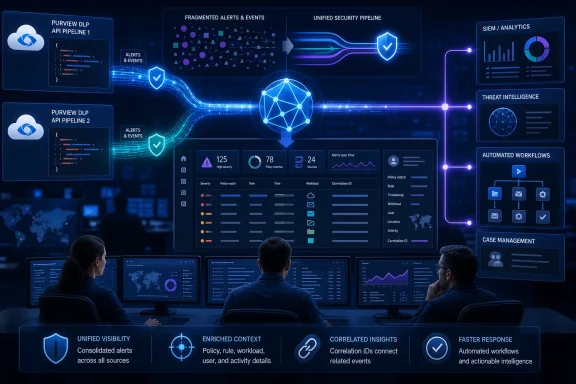
The problem behind Roadmap ID 558681 is easy to describe. Microsoft says alert data is available through the Graph API, while DLP rule-match event details are available through the Management API. Customers that need both therefore have to obtain related parts of the same security story from different interfaces.An alert and its underlying DLP event serve different purposes. The alert tells an operations team that activity may require attention. The event details help explain why a policy or rule matched and can provide the context needed to investigate the activity.
Microsoft’s planned enhancement will enrich Graph API alert data with DLP event data. The stated goal is to make correlation and integration easier.
The roadmap does not establish that every field currently available through the Management API will be copied into Graph. It also does not identify the exact Graph resource, endpoint, property names, permission model, or release mechanism involved. Until Microsoft publishes technical documentation, “enriched” should be read as a product direction rather than a complete implementation specification.
WindowsForum take
The value of the change will depend less on the existence of additional fields than on whether those fields are sufficiently complete, stable, and documented. If an enriched Graph response contains the policy, rule-match, workload, and correlation context required for triage, customers may be able to simplify alert-centered integrations. If it contains only a small summary, the Management API may remain necessary even for routine investigations.The roadmap should therefore be treated as an integration opportunity, not as authorization to redesign production collectors immediately.
Two APIs Have Been Telling Different Halves of the Same Story
The current split is more consequential than making two requests instead of one. Customers must reconcile records represented through different interfaces and decide how the resulting data should be normalized, stored, and presented to analysts.| Integration concern | Graph API before the change | Management API role described by the roadmap | Direction under Roadmap ID 558681 |
|---|---|---|---|
| Primary information in scope | Alert data | DLP rule-match event details | Graph alert data enriched with DLP event data |
| Customer correlation | Related information must be brought together by the customer | Supplies the DLP event side of the record | Intended to make correlation easier |
| Stated uses | Alert-centered integrations | Existing source of the DLP details | SIEM integrations, automated workflows, and customizable reports |
| Migration status | Existing integrations remain in place | Existing collectors may still serve other requirements | No migration procedure has been published |
| Technical detail available | Existing Graph behavior depends on the resource in use | Existing Management API behavior depends on the customer implementation | New schema, endpoint, permissions, and delivery behavior are not yet specified |
Confirmed by roadmap
Microsoft is not announcing the retirement of the Management API. The roadmap describes enrichment of Graph API alert data, not wholesale consolidation of Microsoft 365 security, compliance, or audit interfaces.That distinction matters. An organization may use Management API data for purposes beyond enriching alerts, and Roadmap ID 558681 does not claim to replace those uses. It promises an easier way to correlate DLP event information with alert data for the scenarios Microsoft names.
The roadmap also does not establish whether customers will need different authentication arrangements, new subscriptions, revised pagination logic, or specific update-handling mechanisms. Those questions remain open until Microsoft publishes the technical contract.
WindowsForum take
The likely near-term architecture is selective simplification rather than total replacement. Graph may become the preferred operational source for DLP-related alert workflows, while an existing Management API pipeline continues serving broader audit, compliance, historical, or reporting requirements.Administrators should avoid designing around assumptions about how the enrichment will arrive. It could appear in an existing object, a related object, or another documented representation. It could be present when an alert is first retrieved or added later. These are plausible implementation possibilities, but the roadmap does not confirm any of them.
The correct planning position is therefore neutral: prepare integrations to evaluate the new data, but wait for published documentation before changing authentication, collection, or processing logic.
The Real Product Is a Cleaner Security Pipeline
Microsoft lists three uses for the enhancement: SIEM integrations, automated workflows, and customizable reports. Each depends on receiving enough context to make alert data operationally useful.Confirmed by roadmap
For SIEM integrations, the intended benefit is easier correlation. Instead of relying exclusively on customer-built logic to connect alert data from Graph with DLP event details from the Management API, an enriched alert representation may provide more of the required context through Graph.For automated workflows, additional DLP event data may offer more useful inputs for routing or triage. The roadmap, however, does not identify which fields will be available or guarantee that the enrichment will support any particular response action.
For customizable reports, the additional event data may enable more detailed analysis than alert-level information alone. Again, the roadmap does not specify the schema, workload coverage, or reporting examples.
WindowsForum take
A SIEM record becomes more useful when it contains enough context to classify and investigate the underlying activity. If the new Graph data includes stable policy, rule, workload, and event identifiers, connectors may be able to perform that work with less customer-owned correlation logic.Automation requires even greater caution. No production workflow should assume that a particular DLP property will be present until Microsoft documents the schema and the organization observes the field consistently in its own tenant. Missing, delayed, or workload-specific data could otherwise cause incorrect routing or incomplete investigations.
Reporting teams should make the same distinction between availability and completeness. An enriched Graph record may improve dashboards without reproducing every element of the existing Management API record. Reports built from Graph should disclose their data scope until field coverage is understood.
The roadmap’s most important unanswered question is therefore not whether Graph receives “DLP event data.” It is how much event data appears, how consistently it appears, and whether Microsoft defines a stable contract that vendors and customers can safely map.
Purview DLP Is Moving Closer to the SOC
Data loss prevention sits across compliance, information governance, endpoint operations, and security response. Policy ownership may reside with a compliance or data-governance team, while an alert may still require investigation by a security operations center.A DLP rule match is not automatically proof of malicious activity. It can result from an approved business process, a user mistake, an overly broad policy, or potentially harmful behavior. Analysts need context before deciding which interpretation applies.
Confirmed by roadmap
Roadmap ID 558681 is intended to make DLP event information more accessible in workflows that begin with Graph API alert data. Microsoft specifically identifies SIEM export, automation, and reporting as uses.The roadmap does not say that the feature changes a specific Defender alert resource or guarantees particular evidence, asset, incident, or investigation fields. Until Microsoft publishes supporting documentation, the affected data should be described simply as Graph API alert data.
The roadmap also does not enumerate supported DLP workloads for the enrichment. Existing assumptions about email, collaboration storage, endpoints, or other workloads should not be presented as confirmed coverage for this feature.
WindowsForum take
Bringing more DLP context into an alert-centered API can reduce the handoff between compliance and security teams. Analysts may be able to begin triage with a more complete record, while compliance specialists continue to manage the policies and interpret complex data-handling requirements.That does not turn every DLP match into a security incident, nor does it eliminate the need for human judgment. It simply offers the possibility of making DLP signals easier to use alongside other operational security information.
The feature’s importance is therefore practical rather than transformational. Better access to event context can make existing investigations and integrations less fragmented. It does not, by itself, define a new cross-domain analytics system or guarantee automatic correlation with identity, endpoint, or cloud application signals.
Simplification Does Not Mean Full Consolidation
It would be premature to conclude that customers can retire their Management API collectors when the feature appears in a tenant. Microsoft has not made that claim, and the roadmap does not provide a migration or deprecation plan.Confirmed by roadmap
The announced change enriches Graph API alert data with DLP event data. It does not state that Graph becomes a replacement for the Management API, that historical records will be equivalent, or that every existing DLP data field will be available through Graph.The roadmap also does not define retention behavior for the enriched information. Customers should not assume that alert data and Management API event data have identical availability or satisfy the same archival requirements.
No permission details have been supplied in the roadmap facts. Claims about privileged roles, application permissions, content visibility, or field-level access would therefore be speculative until Microsoft publishes documentation.
WindowsForum take
Organizations should separate operational alert requirements from audit and compliance requirements. A Graph-based workflow may eventually provide everything a SOC needs for initial DLP triage while still falling short of what a compliance archive, legal investigation, or long-term reporting system requires.The sensitivity of DLP information also warrants a least-privilege review once the permission model is published. Enrichment could make more contextual information available to an application that already reads alert data, or Microsoft could establish separate controls. The roadmap does not say which approach will be used.
Administrators should not expand permissions preemptively. When documentation arrives, they should identify the minimum access needed by each integration and distinguish investigative systems from general dashboards, reporting tools, and broad-purpose automation.
This is a recommendation, not a statement about the final Graph design. The access model must be validated against Microsoft’s published documentation before production deployment.
The Missing Schema Will Decide How Valuable This Becomes
The roadmap confirms the direction but leaves the technical contract open. Microsoft has not published the fields that will be added, their structure, the permissions required to retrieve them, the endpoint or resource involved, or the procedure for adopting the change.Confirmed by roadmap
Graph API alert data will be enriched with DLP event data to make correlation easier. That is the extent of the supplied implementation detail.The roadmap does not confirm:
- Whether all Management API DLP fields will be represented.
- Whether the enrichment will use an existing Graph resource or another documented surface.
- Whether fields will have one common structure across DLP workloads.
- Whether enriched information will be present immediately or added later.
- Whether applications must change permissions or consent.
- Whether older alerts will receive the new information.
- Whether Microsoft will publish a formal migration process.
- Whether any existing collector can be safely retired.
WindowsForum take
A durable implementation needs stable property names, clear field definitions, documented workload differences, and predictable behavior when information is unavailable. Vendors and customers need to know whether a missing value means that no rule detail exists, that the workload does not supply it, that the caller lacks permission, or that enrichment has not completed.Correlation identifiers will be especially important. If Graph presents the DLP event data as part of the relevant alert record, integration work may become substantially easier. If customers still need to infer relationships using loosely matched properties, the improvement will be more limited.
Timing must also be tested rather than assumed. Administrators should observe whether the first returned alert contains the expected DLP fields and whether those fields change later. Microsoft’s roadmap does not say how enriched alert updates might be delivered, so teams should not build polling, subscription, or notification logic around conjecture.
Documentation should be treated as the release gate for development, and tenant testing should be treated as the release gate for production.
Timeline
May 2026 — The roadmap lists Preview availability for worldwide standard multi-tenant customers.June 2026 — The roadmap lists General Availability.
July 9, 2026 — According to the supplied roadmap facts, Microsoft updated the entry and it remained marked Rolling out.
The timeline describes roadmap scheduling and status; it does not prove universal tenant availability or confirm that every connector and integration can already consume the enriched data.
The roadmap remains marked Rolling out, and Microsoft has not published tenant-level availability details in the provided roadmap facts. Administrators should verify behavior in each target tenant rather than treating the listed General Availability month as proof that the enrichment is present everywhere.
Existing Connectors Must Not Assume the Payload Is Static
Even an additive API change can affect clients that make rigid assumptions about returned data. At the same time, some connectors may continue operating while silently ignoring fields they have not been programmed to map.Confirmed by roadmap
Microsoft intends to enrich Graph API alert data. The roadmap does not describe compatibility effects, connector updates, schema versioning, or vendor readiness.It also does not say whether existing SIEM connectors, reports, scripts, or automation products will automatically expose the new information. Availability in an API does not by itself establish that every downstream product will store or display the added data.
WindowsForum take
Administrators should test parsers, transformations, storage mappings, and reports before treating the enrichment as production-ready. A client that tolerates additional properties may continue functioning, but that does not mean it is preserving the new DLP information.Existing integrations that already combine Graph alerts with Management API records require particular care. Removing the current correlation pipeline before comparing field coverage could discard information that the enriched Graph representation does not include.
Parallel ingestion is the safest validation method. It allows the organization to compare records without making assumptions about completeness, timing, or update behavior. It also exposes duplicate-counting risks while both sources are active.
Deduplication should be based on documented and observed identifiers rather than guessed relationships. If Microsoft publishes a formal correlation field, teams should test its stability. Until then, existing matching logic should remain in place unless controlled testing demonstrates a better supported method.
Least privilege should be reassessed after Microsoft publishes the permission requirements. The objective is not merely to reduce the number of API calls; it is to simplify the pipeline without broadening access unnecessarily or weakening the organization’s audit record.
Practical validation procedure
- Check Roadmap ID 558681. Confirm that the entry remains applicable to the organization’s cloud environment and review its current rollout status.
- Watch for Microsoft’s technical publication. Inspect Graph API documentation and release notes when Microsoft publishes the affected resource, schema, permissions, and availability details.
- Collect a test DLP alert. Use a controlled policy and test activity appropriate to the organization’s environment and authorization procedures.
- Retrieve the Graph representation. Capture the returned alert data using the organization’s existing supported integration after the enrichment is available.
- Locate the corresponding Management API record. Preserve the original record currently used by the organization’s collector.
- Compare the fields. Check policy and rule context, identifiers, workload-specific information, timestamps, status values, and any other fields on which investigations or reports depend.
- Observe the record over time. Determine whether the Graph data is complete on first retrieval or changes later, without assuming a particular update mechanism.
- Test downstream handling. Verify that SIEM mappings, reports, automation, and storage retain the new fields and do not count the same underlying activity twice.
- Keep the existing collector. Retain the Management API ingestion path until field coverage and operational behavior have been verified for the organization’s required scenarios.
Action checklist for admins
- Confirm the current status of Roadmap ID 558681 and verify availability in each target tenant.
- Inventory every application, connector, script, report, and workflow that consumes Graph API alert data or Purview DLP event data.
- Do not assume a particular Graph endpoint, schema, permission, subscription, or update mechanism before Microsoft publishes documentation.
- Capture representative test alerts for the DLP policies and workloads used by the organization.
- Compare enriched Graph records with corresponding Management API records for field coverage and operational usefulness.
- Test parsers, transformations, SIEM mappings, storage limits, dashboards, and automation for both errors and silent field loss.
- Evaluate deduplication while Graph and Management API ingestion operate in parallel.
- Review access under the published permission model and apply least privilege based on each integration’s actual purpose.
- Preserve the existing Management API collector for audit, historical, or operational uses not demonstrably covered by the enriched Graph data.
- Retire or reduce the old correlation path only after repeated tenant testing demonstrates that Graph provides the required fields, that downstream tools retain them, and that investigations, reports, and automated workflows continue to produce complete and reliable results.
For administrators, the right response is neither to ignore the change nor to redesign around it prematurely. Track the rollout, wait for the technical contract, validate the new fields against real Management API records, and keep the existing collector until the enriched Graph data proves that it can support the organization’s required workflows.