• Thread Author
Microsoft has quietly tightened one of the most consequential guardrails for enterprise AI: Microsoft Purview’s Data Loss Prevention (DLP) policies that block Microsoft 365 Copilot processing of sensitivity‑labeled files will now apply to Word, Excel, and PowerPoint files regardless of where those files are stored — including local device storage and non‑Microsoft cloud locations — with a staged rollout Microsoft plans to complete between late March and late April 2026.

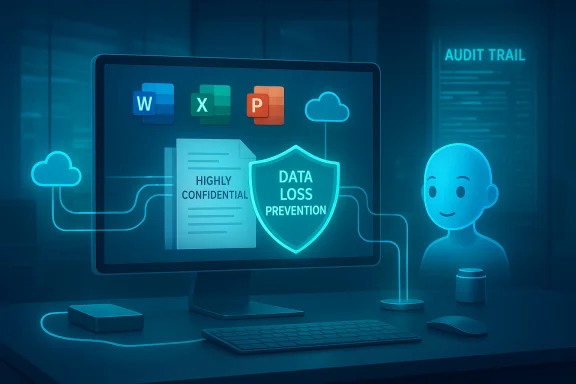
Computer monitor shows a data loss prevention shield protecting a confidential document, with cloud and Office icons.Background​

For organizations that have invested in sensitivity labels and DLP rules inside Microsoft Purview, the promise of consistent enforcement has always been clear: label a document “Highly Confidential,” and downstream systems should treat it accordingly. Historically, however, there was an important technical caveat: DLP enforcement for Copilot’s processing was consistently applied to content stored in Microsoft 365 services (SharePoint, OneDrive, Exchange), but files that lived purely on a user’s local drive or on other storage locations could slip outside the policy enforcement path that Copilot used. That protection gap has now been closed by a change implemented in Office clients and the components that read sensitivity labels.
The timing of the announcement follows a high‑visibility incident in which Microsoft acknowledged a logic error (tracked internally as service advisory CW1226324) that allowed Microsoft 365 Copilot Chat’s “Work” experience to access and summarize emails in users’ Sent Items and Drafts that were labeled confhat violated expected DLP protections. Microsoft deployed a fix after detecting the issue in late January 2026 and has been communicating remediation progress to tenants. Multiple independent outlets covered the incident, underlining why consistent label enforcement across storage locations is no longer optional for enterprise adoption.

What Microsoft changed — the technical story​

How DLP enforcement reached local files​

The core technical move is simple in concept but significant in effect: Office applications (Word, Excel, PowerPoint) and the underlying label‑reading components will now make the sensitivity label for an open document available locally to the pieces of the Office ecosystem that decide whether Copilot can process the document’s content. Where Copilot previously relied on cloud checks and service‑side rules to decide whether a file was safe to ingest, the updated Office architecture surfaces label metadata from within the client itself, enabling enforcement even when the file hasn’t ever touched SharePoint or OneDrive.
This change is implemented at the Office client and augmentation‑loop layers — the internal flows that supply contextual signals to connected experiences such as Copilot — rather than by changing the Copilot service directly. From an operational perspective this means the behavior is on by default for tenants that already have DLP rules configured to block Copilot processing for labeled content; admins should not need to rewrite policies or create special exceptions to benefit.

What file types and scenarios are covered​

According to the product roadmap and Microsoft’s guidance, the change explicitly covers Office file types used in productivity workflows: .docx, .xlsx and .pptx when opened in the corresponding desktop or mobile apps. The blocked processing applies to the Copilot skills and experiences that would otherwise access file content, i.e., summarization, content extraction, and generation tasks that consume file text. Microsoft’s documentation already treated sensitivity labels as portable protections that travel with files; the new update simply ensures those protections are respected by Copilot across storage boundaries.

Timeline and rollout​

Microsoft’s rollout schedule places the change in general availability across worldwide tenants beginning in late March 2026 with completion expected by late April 2026. This schedule is tied to Microsoft 365 update channels and depends on Office client updates and augmentation‑loop distribution, so organizations should expect a phased deployment rather than an instantaneous switch. Administrators should watch their tenant Message Center and update channels for the specific Message Center IDs and deployment timelines applicable to their environment.
Two practical implications for timing:
  • The setting is on by default for tenants with relevant DLP rules — meaning organizations that already block Copilot from processing labeled content gain coverage for local files without policy changes.
  • Because enforcement is implemented in Office clients, organizations that lag in Office patching or that run unmanaged/older clients may see uneven behavior until the client update reaches all endpoints.

Why this matters: the Copilot bug and the compliance wake‑up call​

The urgency behind this policy extension is tangible: the CW1226324 advisory exposed a scenario where Copilot Chat summarized confidential emails despite labels and DLP rules — a clear breach of the intended security model even if access remained limited to users who already could view the messages. Microsoft framed the incident as a code error and rolled out a server‑side fix, but the episode illustrated two persistent truths for enterprise AI:
  • Embedded AI creates new retrieval pathways and accidental surfaces where policy assumptions cease to hold.
  • Enterprises expect labeling and governance to be consistent no matter where data is stored; inconsistency undermines trust and compliance.
The bug’s discovery timeline (late January detection, fixes in early February) and subsequent reporting by security and tech press highlighted the importance of making label enforcement in‑app and not solely dependent on cloud checks. The new Office client behavior directly addresses that lesson by ensuring Copilot consults the local label signal before processing.

What this actually protects — and what it doesn’t​

Immediate protections (wins)​

  • Consistent DLP enforcement: Documents labeled and governed by Purview will be excluded from Copilot processing even if stored on the device, network shares, or third‑party cloud mounts accessible through Office. This removes a long‑standing protection gap. ([office//office365itpros.com/2026/02/24/dlp-policy-for-copilot-storage/)
  • No policy migration required: Existing DLP rules that already block Copilot from processing labeled content apply automatically once clients are updated. Admin overhead to adopt the change is minimal.
  • Quicker local decisioning: By surfacing labels locally, Office apps avoid round trips to cloud services to check whether Copilot can process the file, reducing the race conditions that can lead to mis‑applied permissions.

Limits and caveats (risks- Scope limited to Office file types and Office apps: The rollout covers Word, Excel, and PowerPoint files when opened in Office apps. Other content types (PDFs, non‑Office documents), and some connected experiences that don’t reference file content may not be blocked in the same way. Admins must verify coverage for other file formats and user flows in their environment.​

  • Network shares and legacy file systems: While the label metadata travels with files, certain legacy file systems and custom network attachments may not preserve label metadata reliably. IT should verify that labels remain intact when files are moved between systems.
  • Encrypted or containerized files: Files encrypted at rest or stored inside containers that prevent Office from reading internal metadata may not be evaluated properly until decrypted or opened by Office. This creates operational constraints for endpoints that rely on encryption without an Office‑aware labeling integration.
  • BYOC / consumer Copilot tie‑ins: There remain governance wrinkles when personal Copilot instances or personal Microsoft accounts are used with work documents, or when users sign into Office with multiple accounts. These mixed‑account scenarios have been a source of concern and require explicit admin controls.
  • Auditability and telemetry: Blocking Copilot from processing is only part of compliance; organizations also need reliable auditing to show when and how content was excluded from AI processing. Microsoft’s logging for Copilot‑related DLP events should be evaluated to ensure it meets regulatory evidence needs.
Finally, Microsoft has not published granular metrics about how many tenants were impacted by the Copilot Chat bug or whether any customer‑facing data was retained in log caches; reporting indicates remediation steps and targeted outreach, but details on scale remain limited in public disclosures. Administrators should treat those aspects as unverifiable via public statements and demand clarity from Microsoft for high‑impact environments.

Practical recommendations for IT and security teams​

If your organization uses Microsoft 365 Copilot or plans to roll it out, these steps will help you get ahead of the change and reduce operational friction.
  • Inventory sensitivity‑labeled content and DLP policies. Confirm which labels already have rules to block Copilot processing and ensure labels are applied consistently across repositories.
  • Patch and validate Office clients. Because enforcement is implemented in Office clients and augmentation components, prioritize patching endpoints on your supported update ring to ensure consistent behavior when the rollout reaches your tenant.
  • Test representative workflows in a pilot ring. Simulate local, network share, and third‑party cloud file scenarios to validate that Copilot is blocked from processing labeled content and that user experience impact is acceptable.
  • Validate label portability for shared and archived files. Test file movement scenarios (downloads, USBs, network shares) to ensure labels persist and remain readable by Office.
  • Audit and alerting: ensure your monitoring collects DLP events tied to Copilot interactions — confirm where logs are recorded (Microsoft Purview audit logs, Offict retention meets compliance needs.
  • Revisit bring‑your‑own Copilot (BYOC) policies. Clarify whether personal Copilot subscriptions and personal accounts are allowed to interact with corporate documents; enforce sign‑in and access controls accordingly.
Short checklist for action within 30 days:
  • Run a label coverage report and map to critical business document stores.
  • Ensure pilot endpointent update applied as soon as it’s available.
  • Create a testing plan that includes encrypted files, PDFs, and mixed‑account sessions.
  • Update internal IT guidance and user training materials about Copilot interactions with labeled files.

Governance and legal angle — what compliance teams should watch​

From a regulatory perspective, the change reduces a concrete compliance exposure: if AI processing had been allowed for locally stored labeled files, organizations subject to strict data‑handling regimes (healthcare, finance, government) faced a mismatch between policy and enforcement. Extending DLP to local files is therefore a net positive for regulated industries.
However, compliance teams should scrutinize four items:
  • Evidence of enforcement: Confirm that audit trails explicitly show Copilot access attempts and whether the access was blocked because of DLP. Evidence is essential for regulatory reporting and breach reviews.
  • Cross‑jurisdictional data movement: Labels that apply regionally (e.g., EU data residency designations) must be validated for portability across storage movements, especially if files are saved to endpoints that sync with consumer cloud accounts.
  • Contractual protections: Contracts with Microsoft and any third‑party Copilot connectors should be reviewed for clauses about AI processing, retention, and incident notification to ensure remedies and timelines align with your organization’s risk posture.
  • Incident response integration: If Copilot or other connected experiences ever behave in unexpected ways (as in the CW1226324 case), ensure your incident response playbooks include steps to isolate AI services, preserve logs, aakeholders.

Remaining blind spots and attack surface​

Extending DLP to local storage reduces a specific class of accidental exposure, but it does not eliminate risk. Operational and security teams must be mindful of:
  • Privilege and identity misconfigurations: Copilot operates “as the user” — if an account has overly broad access, Copilot’s decisions will still be bounded by that account. Excessive privileges still magnify risk.
  • Client‑side vulnerabilities and logic errors: The CW1226324 advisory was rooted in a code error; client or service logic bugs remain a plausible vector for future lapses. Defensive engineering, testing, and vendor transparency around root‑cause analysis are needed.
  • Third‑party connectors and BYOC scenarios: Any connector that imports or surfaces content to Copilot from external systems must preserve labels and respect DLP, or organizations will face inconsistent enfn factors**: Users can overwrite labels or move files to unmanaged locations. Labeling automation and user education remain essential complements to technical controls.

How this changes the risk calculus for adopting Copilot​

For many enterprises, the announcement lowers one of the major hurdles to widespread Copilot adoption: the fear that local files and legacy storage would bypass DLP and therefore open compliance gaps. With enforcement unified across storage locations, CIOs and CISOs can more confidently pilot Copilot features inside productivity workflows — provided they pair the feature with disciplined endpoint management and governance.
That said, the change should be seen as necessary but not sufficient. True risk reduction requires integrated identity hygiene, contract‑level assurances from vendors, robust audit trails, and regular validation testing. The Copilot bug that preceded this move is a reminder that the AI layer adds complexity, and that operational resilience must keep pace.

Short‑term checklist for business leaders​

  • Confirm your organization’s relevant DLP policies and sensitivity labels are configured to block Copilot processing where necessary. No migration is required for the policy to take effect, but validation is essential.
  • Prioritize Office client patching for users in regulated business units.
  • Establish a Copilot‑specific audit and incident‑response playbook that includes preservation of Copilot logs and label enforcement evidence.
  • Communicate to users the boundaries of Copilot: what it can and cannot process when working with labeled content.
  • If you use consumer or personal Copilot instances anywhere near corporate content, create explicit policy and technical controls to manage account separation.

Conclusion​

Microsoft’s extension of Purview DLP enforcement to local and arbitrary storage locations for Office files is a pragmatic, technically measured response to a real and recently exposed risk in the enterprise Copilot story. By surfacing sensitivity labels inside Office clients and augmentation components, the company narrows a key attack vector and aligns enforcement with organizational expectations of consistency.
That victory is important: it restores an expected security boundary. Yet it is not a panacea. Organizations must still treat Copilot as an additional system in their security architecture — one that requires tight identity controls, disciplined endpoint management, continuous auditing, and careful contractual safeguards. The recent Copilot Chat advisory served as a sharp reminder that AI adds plumbing and pathways that change how data flows; fixing one such path is progress, but the broader task of verifying and proving consistent behavior across all flows remains with enterprises and their vendors alike.
Only with that combined vigilance — patching and policy, testing and auditability, education and contractual clarity — will enterprises be able to safely take advantage of Copilot’s productivity gains without delegating control over their most sensitive information.

Source: Techzine Global Copilot gets less access to sensitive Office documents
 

Microsoft is rolling out explicit branding and provenance controls to Microsoft 365 Copilot that let organizations stamp AI‑generated assets with their corporate identity and add visible or embedded AI watermarks to multimedia — a practical, governance‑first set of features designed to make Copilot outputs easier to manage, attribute, and audit inside enterprise workflows.

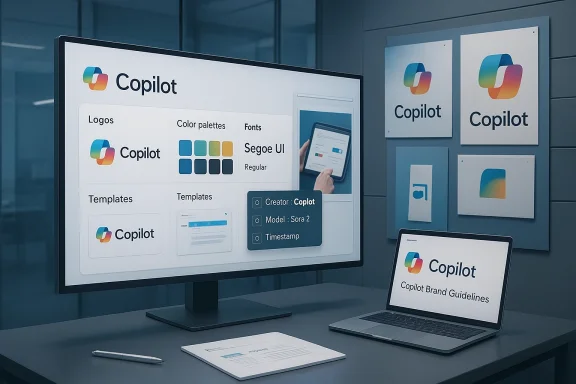
Workspace showcasing Copilot branding and guidelines on a monitor and wall posters.Background​

Microsoft 365 Copilot has evolved from a research demo into a broad productivity fabric across Word, PowerPoint, Designer, Clipchamp, and the Copilot app itself. That evolution has brought two tensions into focus: businesses want fast, creative content generation, but they also need strong controls for branding, licensing, and content provenance. Microsoft’s new controls — brand kits that push logos/colors into generated images and centralized policies for visible or audio watermarks on AI‑altered content — are a direct response to that double mandate.
Those controls are rolling out in stages: brand‑kit driven “branded images, banners and posters” are available inside the Copilot Create experience, while organizational watermarking and metadata provenance features for audio and video are gated behind Cloud Policy and account privacy settings slated for availability in the second half of February 2026. Microsoft’s documentation makes clear that image watermarking is handled differently (users can enable image watermarks via their My Account privacy settings) and that metadata flags will be populated even when visible watermarks are disabled.

What Microsoft announced — the short version​

  • Branded content in Copilot: Organizations can provision brand kits (logos, color palettes, fonts, templates) to Microsoft 365 Copilot so AI‑generated posters, banners, infographics and images follow corporate identity automatically. This is surfaced inside the Copilot Create workflows.
  • Watermarks and provenance: A tenant‑level policy can add visible watermarks to videos and audio that are generated or altered by Copilot. For images, users can toggle watermarking through personal privacy settings, and regardless of visible marks Microsoft will insert provenance metadata (model used, app, timestamp) into generated content.
  • Enterprise controls via Cloud Policy: Admins will enable or disable watermark policies and control access to Designer image generation — including an option to prevent users from generating images at all. For video/audio watermarks, the Cloud Policy path is required; images are handled through account privacy settings at present.
These are product changes with clear compliance and branding intent — not merely UX tweaks. Microsoft frames them as enterprise governance levers to reduce the friction of AI adoption in regulated environments.

How the features work (technical overview)​

Brand kits: what they contain and how they apply​

Brand kits are tenant‑managed collections of corporate assets that Copilot will use at generation time. Typical kit contents include:
  • Logos and logo variants (color, mono, icon only)
  • Color palettes / color tokens
  • Brand fonts (or font families) and typographic guidance
  • Approved templates for posters, banners, and infographics
  • Optional brand guidelines (PDFs) that Copilot can ingest to extract rules
Once a brand kit is installed in the Copilot Create experience, the AI will apply those assets and style tokens when producing visual content. This reduces manual rework and keeps collateral consistent across teams. Microsoft’s support documentation explains how brand kits appear in the Create module and how users select them when generating images.

Watermarks and metadata: two layers of provenance​

Microsoft implements provenance along two complementary paths:
  • Visible watermarks (video/audio) — Administrators can enable a tenant policy that overlays a visual watermark on videos created or altered with Copilot’s AI or adds an audio watermark to audio overviews generated by Copilot. The feature is controlled via the Cloud Policy service and cannot be freely customized in placement or wording.
  • Metadata content credentials (images, video, audio) — Even when visible watermarks are off, Microsoft adds structured metadata about creation (which app, which model, timestamp) into files’ metadata fields. For images this metadata is being populated now; Microsoft is working to extend the metadata workflow to video and audio. The company references content provenance standards (for example, C2PA) as the conceptual model behind these metadata flags.

Administrative guardrails​

Cloud Policy lets tenant admins:
  • Enable or disable the visible watermark policy for audio and video.
  • Control whether users can access Designer image generation at the tenant level (effectively turning off image generation in M365 apps).
  • Combine watermarking with DLP/labeling and retention rules so that generated content is governed like any other corporate asset.

Why this matters to IT, legal, and brand teams​

1) Governance and regulatory compliance​

AI‑generated content in enterprise contexts raises immediate compliance questions about provenance, IP and misuse. Visible watermarks and embedded provenance metadata help auditing teams answer the basic question: was this file created or altered by AI? That creates a defensible trail for regulators and internal review. For organizations subject to sectoral rules (finance, healthcare, government), being able to mark and trace generative content is an essential risk control.

2) Brand consistency at scale​

Large enterprises produce thousands of slide decks, banners, and social graphics every month. Brand kits let marketing and creative ops push approved visual identity into the AI output so generated content doesn’t erode visual standards — a standardization win for centralized brand governance.

3) Operational efficiency and user adoption​

When employees can generate on‑brand assets quickly inside Word, PowerPoint, or Copilot, teams iterate faster and reduce the time spent on manual edits. For organizations that already store templates and masters in their Organization Asset Library, Copilot’s brand‑aware generation collapses workflow steps and increases adoption.

Critical analysis — strengths and meaningful limits​

Notable strengths​

  • Enterprise‑first design. Microsoft didn’t simply bolt on a watermark toggle — it integrated brand kits, Cloud Policy, and metadata generation into existing admin surfaces, which makes these features meaningful for governed deployments. This is a pragmatic approach for enterprise IT teams that need policy leverage and auditability.
  • Separation of visible marks and metadata. The dual approach — visible watermarking plus metadata — balances detectability with usability. Organizations that can't tolerate visible marks on outward‑facing marketing materials still get provenance metadata for audit and compliance.
  • Integration with video generation models. Microsoft’s Copilot Create integration with internal models (Sora 2 and other multimodal engines) already indicates visible watermark overlays for generated video. That demonstrates the company is building provenance into newer generative modalities, not just static images.

Important caveats and risks​

  • Watermarks are not a silver bullet. Visible watermarks can be cropped, blurred, or removed. They help deter and detect misuse, but they do not prevent bad actors from editing or re‑encoding content. For high‑risk use cases (sensitive IP, regulated disclosures) watermarks need to be combined with robust access controls and retention policies. Treat visible watermarks as part of a multi‑layered defense, not the only control.
  • Metadata integrity depends on custodial controls. The usefulness of embedded provenance rests on preserving metadata across systems and exports. When assets leave corporate storage (e.g., are downloaded and re‑uploaded to social platforms), metadata is frequently stripped. Admins should plan retention and content‑transfer policies to preserve provenance for audit.
  • Policy complexity and user friction. Tenant‑level Cloud Policy decisions will create tradeoffs: enabling audio/video watermarks by default increases compliance but may frustrate creative teams who want watermark‑free assets for client deliverables. Microsoft’s current model splits controls between Cloud Policy (audio/video) and user privacy settings (images), which may confuse governance owners. IT teams should prepare clear guidance and change management to avoid shadow AI work.
  • Provenance standards are evolving. Microsoft references C2PA‑style content credentials, but industry standards and implementation details are still maturing. Until provenance schemas are universally adopted and hardened, interoperability and cross‑platform detection will be uneven. Flag any claims of “tamper‑proof” provenance as aspirational rather than absolute.

Context: why Microsoft is making this move now​

The push toward brand and provenance controls follows a broader industry pattern: vendors are responding to enterprise demand for safe, auditable AI. Microsoft’s recent product cadence (new image/video models, Copilot integration across M365, and stronger admin surfaces) naturally leads to governance features to make AI usable at scale in business contexts. Enterprise customers have also been outspoken about the need for controls after high‑profile incidents where AI systems processed sensitive material incorrectly — a reminder that provenance and DLP need to be deployed in tandem.
Community reaction inside IT and security forums has echoed this, with administrators praising the ability to apply brand controls while warning that perimeter and metadata hygiene remain significant challenges for adoption.

Practical guidance for IT and security teams​

If you manage Microsoft 365 in a corporate environment, treat this rollout as an operational change that intersects identity, DLP, and brand operations. Here’s a short checklist to get your team ready.
  • Inventory and prepare brand assets.
  • Consolidate logos, color tokens, and approved templates; prepare a single brand kit per legal entity. Why: Copilot uses tenant brand kits for generation and will apply stored assets directly.
  • Decide watermarks policy and pilot with risk‑bearing teams.
  • Enable the Cloud Policy watermark setting in a controlled pilot (legal, communications, marketing) and gather feedback before tenant‑wide enablement. Why: The policy affects video/audio and is non‑customizable in placement/wording.
  • Align DLP and retention rules to preserve provenance.
    rePoint retention rules preserve file metadata and set DLP to detect generation metadata where possible. Why: Provenance metadata loses value if it’s stripped when files transit systems.
  • Update acceptable use and creative guidelines.
  • Clearly document when employees may create AI assets, the required approvals for external use, and watermarking policy exceptions. Why: Clear governance reduces shadow AI and compliance drift.
  • Train marketing and agency partners.
  • Teach external partners how to handle Copilot‑generated assets, including metadata preservation during handoffs and the meaning of visible watermarks. Why: Marketing often moves files off‑platform; preserve provenance where it matters.
  • Monitor and iterate.
  • Track how often users generate images and video, audit watermark application, and refine policies to balance usability and risk. Why: Adoption data will reveal where policy adjustments are needed.

Policy, legal and trust implications​

Visible watermarks and metadata give compliance teams tangible evidence for investigations, but organizations must not conflate provenance with legal safety. Watermarked or metadata‑tagged content still raises questions about copyright, third‑party IP in AI outputs, and model training data provenance. Enterprises should:
  • Negotiate contractual warranties and IP clarifications with vendors.
  • Maintain human review processes for customer‑facing assets.
  • Include provenance metadata as part of audit packages when regulatory inquiries arise.
Microsoft’s documentation explicitly points to the Enterprise AI Services Code of Conduct and to cross‑industry provenance work (C2PA) as the normative anchors — but that does not eliminate the need for legal teams to validate how generated outputs behave in specific jurisdictions. Flag claims about automatic legal protection as conditional and counsel‑dependent.

What’s still unclear (and what to watch)​

  • Exact watermark visuals and wording. Microsoft’s docs say placement and wording are not customizable today; however, customers will want clarity about what users and external viewers actually see and whether marks meet regulatory disclosure requirements. This can affect marketing and legal acceptability.
  • Robustness of metadata across ecosystems. Will social networks strip content credentials? How reliably will third‑party systems preserve or expose metadata? These are practical interoperability questions that affect provenance usefulness.
  • Behavior in hybrid consumer/enterprise contexts. Microsoft has already signaled scenarios where personal Copilot subscriptions can interact with work documents when users sign in with multiple accounts. The governance interaction between personal watermark toggles and tenant policies requires careful examination.
  • Security incident context. Recent reports of a Copilot bug that allowed summarization of confidential emails underscore the importance of pairing watermark/provenance controls with rapid security patching and monitoring — provenance is helpful after an incident, but preventing unintended exposure remains critical.

Conclusion — measured optimism with operational rigor​

Microsoft’s move to add brand kits and visible/metadata provenance to Microsoft 365 Copilot is a pragmatic step toward making generative AI enterprise‑ready. The feature set addresses real business needs: brand consistency, basic provenance, and centralized policy control. At the same time, these capabilities are not a substitute for strong DLP, human review, and contractual protections.
For IT leaders, the action plan is straightforward: prepare assets, pilot watermark policies with high‑risk teams, align DLP/retention to preserve metadata, and educate creative partners and end users. For legal and risk teams, assume provenance is an investigative aid — not an automatic legal shield — and demand clarity on IP, model training, and cross‑platform metadata integrity.
Generative AI is useful because it speeds workflows and unlocks creativity; enterprises will only reap those benefits sustainably if they bake governance into the rollout. Microsoft’s brand kits and watermarking take the practical next step toward that goal, but the heavy lifting will happen inside organizations as they map policy to practice, train users, and harden the end‑to‑end lifecycle for AI‑created content.

Source: Windows Report https://windowsreport.com/microsoft-365-copilot-will-get-corporate-logos-and-ai-watermarks/
 

The last ten days of February 2026 did more than reshape a regional crisis; they made a blunt, public argument that modern war has already migrated from steel and fuel into petabytes and GPUs, and that a handful of Silicon Valley and cloud companies sit at the fulcrum of that shift.

Silhouetted scientists monitor a glowing blue holographic brain and orb in a futuristic command center.Background: a new archetype of conflict​

For decades the phrase AI in warfare lived in think‑tank memos and defense PowerPoint decks. Operation Epic Fury—an intensive U.S.‑Israeli campaign launched at the end of February 2026—moved that phrase into operational reality. What separates Epic Fury from earlier high‑intensity campaigns is not only the scale of kinetic activity, but the density and speed of decision loops that relied on commercial large language models, cloud infrastructure, automated target‑production pipelines, and real‑time intelligence fusion.
That infrastructure has three clearly visible layers:
  • Model providers (frontier labs producing GPT‑class or Claude‑class models) acting as the cognitive layer that ingests, fuses, and reasons over disparate intelligence streams.
  • Cloud platforms providing the computational and storage backbone—confidential clouds, GPU racks, and managed ML services.
  • Operational integrators and local systems—national and contractor tools that translate model outputs into tasking, target lists, and timing decisions.
Taken together, this stack shortens the classic sensor‑to‑shooter timeline from hours to minutes and in some cases to seconds, compressing human review and elevating the economic and political value of being the provider at the top of the stack.

How Epic Fury exposed the AI‑Cloud‑Defense complex​

The operation’s defining feature: software first​

Epic Fury was notable less for its bombshell headlines and more for how it ran. The campaign combined conventional air strikes, drone swarms, cyber operations, and special operations with a software‑first operational rhythm. Classified war‑fighting systems and public cloud platforms reportedly fed imagery, signal intercepts, logistics telemetry, and social media at scale into a fusion layer that prioritized, de‑duplicated, and ranked targets.
This is not speculative: public statements and industry disclosures over the past weeks confirm that frontier models were formally authorized for classified networks and that general‑purpose cloud contracts with regional governments have been key enablers of compute and storage. At the same time, investigative reporting about automated targeting tools used in previous conflicts has shown the practical feasibility—and the dangers—of bringing algorithmic decision‑making close to lethal outcomes.

What “software‑driven war” actually looks like​

  • Rapid automated triage of imagery and communications to surface likely targets.
  • Automated or semi‑automated generation of target lists that feed kinetic planners.
  • Use of behavioral scoring systems to prioritize individuals for surveillance and possible strike scheduling.
  • Cloud‑hosted simulation and wargaming models that allow decisionmakers to iteratively test courses of action in hours rather than days.
The result is a battlefield where time‑sensitive decisions increasingly depend on the quality of the model and the latency of the cloud connection, not only on the number of aircraft or missiles.

OpenAI’s pivot: from ethical posture to classified deployments​

The public pivot​

In late February 2026 OpenAI publicly announced an agreement to deploy its GPT‑series models into a classified defense environment for "defense‑related scenarios." The company framed this as a constrained, cloud‑only deployment with contractual guardrails: no mass domestic surveillance, no deployment on edge devices that would enable fully autonomous lethal systems, and retention of human oversight for high‑stakes decisions.
This move marks a stark shift from earlier public positions many companies took about refusing certain military uses. For OpenAI, the calculus appears to have been pragmatic: trading a strict public stance for an explicit, high‑value role in national security infrastructure.

Commercial and political stakes​

For Wall Street and the markets, this is straightforward: defense and classified work can generate counter‑cyclical revenue, reduce churn in downturns, and create long‑term, high‑margin contracts that are difficult for competitors to displace. For policymakers and civil society, it raises urgent governance questions: which contractual and technical safeguards genuinely prevent misuse, and can private companies credibly enforce red lines when the counterparty is a sovereign state and the agreement is secret by necessity?

Technical realities and the “battlefield brain”​

The technical description of what OpenAI and similar models can do in defense contexts is modest but consequential: fuse multi‑modal intelligence, surface likely correlations, generate summaries, assist translation and exploitation, and run large‑scale simulations. Those are narrow tasks when stated abstractly—but when models are fed with petabytes of satellite imagery, persistent signals intelligence, and civil‑media feeds, the outputs can be operationally decisive.
Two practical implications follow:
  • A cloud‑hosted model that confidently identifies likely targets and predicts movement creates a de facto “battlefield brain” that human workflows will come to rely on.
  • The company controlling that model gains asymmetric pricing power and influence because substituting an entire model‑cloud‑integration stack under operational pressure is costly and slow.

Anthropic and the consequences of principled refusal​

A standoff over “red lines”​

Anthropic—known for insisting on explicit safety commitments—refused to accept contractual language the Department of Defense sought that would allow “any lawful use” of its models. Anthropic’s publicly stated red lines included refusing to authorize its models for fully autonomous lethal weapon systems and for participation in mass domestic surveillance.
The dispute escalated quickly into a supply‑chain standoff. The Department’s labeling of Anthropic as a “supply chain risk” and orders to wind down Anthropic use on government contracts within six months created a stark market signal: in high‑stakes national security procurement, willingness to accept broad lawful‑use clauses may now be a major determinant of access.

Why this matters​

  • Investors will treat regulatory and political alignment as a core risk factor; startups that adhere to restrictive red lines risk sudden exclusion from a huge buyer.
  • Firms that negotiate will capture lucrative, opaque cash flows and deepen entanglement with the state.
  • The precedent reframes safety as a commercial liability: principled refusal moves from laudable to financially punitive in certain markets.
There is a governance cost: if only a few suppliers are willing to operate under looser constraints, the diversity of safety philosophies shrinks precisely when the consequences of mistakes are life and death.

Microsoft and Google: the cloud as the real kill‑chain operating system​

Cloud is the enabler, not just the enabler​

If frontier models offer cognitive capability, cloud platforms provide the bandwidth, latency, storage, and specialized hardware that let that cognition scale. Major cloud providers have long contracted with governments; project agreements and local‑site deployments have given states near‑unlimited capacity to index and analyze their populations and adversaries.
The commercial realities are stark:
  • Large‑scale confidential clouds host terabytes to petabytes of intelligence data.
  • On‑demand GPU clusters allow rapid retraining, fine‑tuning, and inference at battlefield tempos.
  • Contractual clauses and procurement structures can legally constrain what vendors may refuse to serve, creating built‑in operational guarantees for states—but also geopolitical and reputational risk for the providers.

Political and reputational costs​

Cloud vendors have repeatedly faced internal dissent, public protests, and employee resignations over government contracts that touch on surveillance or offensive capabilities. Project Nimbus—the multi‑year cloud deal involving Google and Amazon to provision Israeli government cloud infrastructure—is an instructive case: it illustrates how contract terms, local legal arrangements, and national security expectations can bind vendors into serving a wide range of entities, including defense establishments.
For enterprise software companies, the tradeoff is now explicit: stable, high‑value government revenue versus higher public‑facing reputational and regulatory risk. That risk is not theoretical; it has already manifested in employee unrest, NGO pressure, and investor scrutiny.

Israel’s reported “kill‑factory” tools: portability and precedent​

What investigative reporting revealed​

Investigations into Israeli operational tools used in Gaza—commonly referred to in reporting as systems named Lavender, Gospel, and Where’s Daddy—describe a three‑part architecture:
  • Lavender: a behavioral and relationship‑mapping system that assigns a probability score to individuals, used for human‑target prioritization.
  • Gospel: an automated infrastructure‑and‑building classifier that generates lists of buildings assessed as militarily relevant.
  • Where’s Daddy: a timing/trigger system that schedules strikes when a prioritized individual is present in a specific location.
Investigations claimed tens of thousands of people were scored and that human review in many cases was compressed to seconds. Human rights groups and U.N. experts warned that algorithmic bias, incomplete data, and compressed review cycles dramatically increase the risk of civilian harm.

Portability: the real strategic concern​

The horrifying implication is technical portability: once the algorithms, data fusion patterns, and workflow templates exist, they can be adapted to new geographies and target sets if similar data streams—communications metadata, location trajectories, social graph features—are available. That means the same functional logic used in lower‑intensity theaters can be scaled or repurposed against different state targets, including political elites.
This portability is not a theoretical abstraction; it is the reason many analysts view Epic Fury not only as a kinetic campaign but as a real‑world stress test of automated targeting doctrines.

Market architecture: pricing power, lock‑in, and the future of defense procurement​

The new asset class: AI‑Cloud‑Defense​

The confluence of frontier models and large cloud providers has birthed a de‑facto complex that blends tech and defense: a handful of companies now supply the cognitive and computational layers required for modern high‑tempo operations. That gives these companies:
  • Pricing power in procurement cycles, because swapping out a full model‑cloud‑integration can take months and re‑engineer substantial classified workflows.
  • Counter‑cyclical revenue during conflicts; defense budgets and urgent demand for capabilities can bolster margins even during wider tech downturns.
  • Political leverage as their alignment becomes a factor in national security decisions.

Consequences for military procurement and capability development​

  • Shorter procurement timetables—agencies will favor providers who can rapidly deliver at scale.
  • Fewer suppliers—ethical stances and technical integration barriers may consolidate supplier bases.
  • Opaque evaluation metrics—because much of this activity occurs on classified networks, external oversight will be limited unless new governance mechanisms are developed.
This combination risks creating a black‑boxed profit center for a few vendors and a strategic vulnerability for states reliant on that narrow supply base.

The normative and legal question: responsibility when recommendations become coordinates​

At the heart of this technological turn lies a fundamental accountability problem: models produce recommendations; humans currently make the final call. But the thinness of that human check matters.
  • Is a de‑conflicted “human in the loop” meaningful if human review amounts to a minute‑long confirmation of an algorithmic list?
  • When a model’s output originates from fused, proprietary data and complex weighting, can outside oversight audit the causal chain from raw data to strike decision?
  • Who is legally and ethically responsible when an algorithmic recommendation leads to civilian deaths: the system integrator, the model provider, the cloud operator, or the military commander who authorizes the strike?
Existing law and policy were not designed for this multi‑actor technical ecosystem. Without new international norms or binding domestic rules, responsibility will remain diffuse—an outcome that is politically dangerous and morally unacceptable.

What we can verify — and what remains opaque​

There are verifiable developments in the public domain: companies have publicly acknowledged classified agreements or platform contracts; investigative reporting has documented the architecture and alleged operational behavior of certain automated targeting suites; governments have used front‑line cloud and AI capabilities for intelligence and targeting.
At the same time, a large and decisive part of the system remains deliberately opaque: the exact data pipelines, the weightings models apply to different intelligence streams, the contractual fine print that governs "lawful uses," and the on‑the‑ground human review protocols in specific operations are all shielded by classification, security waivers, or commercial confidentiality.
Where public reporting relies on anonymous sources or leaked documents, those claims should be treated with caution and cross‑checked when possible. Some high‑impact assertions—like whether a particular leader was directly targeted using a named algorithmic pipeline—are extremely difficult to independently verify from open sources in real time.

Strengths and risks of the current trajectory​

Notable strengths​

  • Operational speed and scale: Frontier models and cloud infrastructures enable much faster processing of multi‑modal intelligence, improving situational awareness in ways that can reduce friendly casualties and increase mission tempo.
  • Decision support: Good model outputs can reduce analytical overload, surface non‑obvious correlations, and provide planners with richer hypothesis spaces to test.
  • Resilience against adversary AI: The same capabilities that assist defensive operations can also blunt adversary automation by enabling faster detection and integrated responses.

Significant risks​

  • Reduced human judgment: Compressed review cycles and algorithmic authority risk turning human oversight into a rubber stamp.
  • Algorithmic bias and civilian harm: When models trained on partial, noisy, or biased datasets contribute to targeting decisions, false positives translate into lives lost.
  • Concentration risk: A small number of vendors controlling cognitive and computational layers creates strategic single points of failure or leverage.
  • Legal and ethical black boxes: Classified deployments and proprietary stacks make public accountability difficult, eroding democratic control over lethal force.
  • Market coercion of ethics: Companies face a clear financial incentive to accommodate broad lawful‑use clauses, potentially eroding their publicly stated safety commitments.

Practical recommendations for policymakers, industry, and civil society​

Policymakers​

  • Establish clear, public standards for acceptable AI uses in kinetic contexts, including legally mandated human‑in‑the‑loop definitions that require meaningful review times and explainability thresholds.
  • Create an independent, cleared auditing mechanism with authority to evaluate model outputs and workflows used for targeting on classified systems.
  • Negotiate procurement clauses that preserve vendor diversity and avoid single‑supplier lock‑in for mission‑critical cognitive and cloud stacks.

Industry​

  • Publicly document and legally bind the operational limits of any models used in classified or defense contexts, making those commitments auditable under appropriate security channels.
  • Build “explainability rails” and forensic logging into any deployment that feeds operational decision‑support for lethal outcomes.
  • Adopt procurement strategies that prioritize interoperability and a defined migration path to avoid strategic lock‑in.

Civil society and the press​

  • Maintain investigative scrutiny of procurement arrangements, cloud contracts, and reported uses of automated targeting systems.
  • Advocate for transparency mechanisms—classification is necessary, but secrecy should not preclude independent oversight where civilian life is at stake.

The geopolitics of outsourcing violence to cloud and model providers​

Epic Fury suggests a new geopolitics: wars will increasingly hinge on who supplies the best low‑latency inference, who hosts the most resilient confidential cloud, and who can integrate models into operational decision chains with the fewest legal frictions. That dynamic reshapes alliances, investment flows, and domestic politics.
When national security procurement privileges vendors that accept broader lawful‑use clauses, the market sends a powerful message: corporate ethics that limit the state’s options may become devalued. Conversely, companies willing to accept those clauses gain access to enormous, opaque revenue streams and de facto influence over how state violence is executed.
This is a structural change in the political economy of conflict. It should prompt societies to ask whether democratic institutions are prepared to govern not just weapons systems, but the software, models, and commercial contracts that now orchestrate them.

Conclusion: critical choices ahead​

We are at a crossroads where a small set of commercial technologies—large models, confidential clouds, and automated targeting pipelines—have become foundational to modern high‑tempo warfare. Epic Fury revealed how tightly stitched that fabric already is: models feeding classified networks, clouds supplying the compute and storage, and automated systems compressing spaces for human judgment.
The choices in the coming months and years are consequential. Democracies must decide whether to accept a defense procurement ecosystem that privileges speed and availability over stringent, auditable safeguards—or to demand explicit, enforceable rules that ensure meaningful human responsibility, transparency under appropriate oversight, and vendor diversity.
If the answer is the former, a few corporations will become the de facto operational centers of twenty‑first‑century conflict. If the latter, society must move quickly to design legal and technical architectures that preserve both security and accountability before algorithmic recommendations become coordinates with irreversible human costs.

Source: PANews OpenAI, Microsoft, Google, and other AI companies are orchestrating a war together with "killer factories."
 

Back
Top