
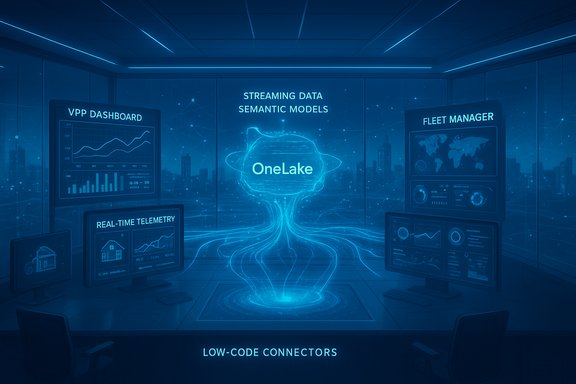
Qcells’ decision to standardize its global operations on Microsoft Fabric and Azure marks a consequential moment where a major solar manufacturer treats data architecture as a strategic lever for growth, customer experience, and product innovation—moving from fragmented, site-by-site troubleshooting toward centralized, AI-enabled operational intelligence that underpins new services such as virtual power plants and fleet management.
Background / Overview
Qcells, part of Hanwha Solutions’ solar portfolio and a dominant supplier in the U.S. module market, faced an operational ceiling created by thousands of decentralized engineering sites and brittle open‑source stacks that hampered scalability and delayed product launches. To break that ceiling, Qcells adopted Microsoft Fabric and Azure to consolidate telemetry, analytics, and reporting across its residential PV and storage fleet—delivering real‑time dashboards, semantic models, and integrated tooling that accelerate time to market and reduce operational overhead. Qcells’ market footprint underpins the urgency: the company publicly reports a commanding U.S. presence—claims that roughly one in three newly solar‑equipped U.S. households used Qcells panels during recent market windows—and Wood Mackenzie’s U.S. PV Leaderboard has repeatedly ranked Qcells at or near the top of U.S. residential module shipments. That market position explains why solving scale and data fragmentation is existential for the business: physical growth without digital scale can create operational risk and missed revenue.What Qcells built and why it matters
The core problem: scale, fragmentation, and speed
For manufacturers and energy-service providers, rapid product rollouts and high‑quality operations require two things in parallel: a reliable field telematics backbone and a governed analytics platform that turns sensor events and business data into action. Qcells’ previous stack—described in the company’s account as a tapestry of localized open‑source tools and fragile pipelines—created three downstream pains:- Slow issue detection and remediation at scale (troubleshooting that could take hours).
- Long ramp times for new services and slow time to market for customer‑facing products.
- Operational complexity that inflated overhead and licensing costs as the company scaled.
The platform choices: Microsoft Fabric + Azure SQL + Power BI
Qcells selected a converged Microsoft stack with Microsoft Fabric as the unified analytics plane, Azure SQL as the secure scalable backbone, and Power BI for consumption and decision support. The case study highlights three platform capabilities that drove the choice:- OneLake & unified data estate: a “single logical lake” for governed, zero‑copy sharing across workloads.
- Real‑Time Intelligence: streaming ingestion, event routing, KQL‑style queries, and low‑latency dashboards for operational visibility.
- Native connectors and low‑code flows: faster integrations with Snowflake, SAP, Salesforce, and other systems reduced development friction.
The new capabilities Qcells launched
With the Fabric + Azure foundation, Qcells launched two high‑visibility, customer‑facing systems:- Virtual Power Plant (VPP) portal: aggregates residential solar, batteries, and EV chargers into a single orchestration layer that can participate in grid services and incentive programs—allowing homeowners and businesses to monetise surplus energy and contribute to grid resilience.
- Fleet Manager platform: provides operations teams with near‑real‑time views into thousands of distributed assets, enabling predictive maintenance, automated alerts, and coordinated response to grid events.
Technical anatomy — what the implementation actually did
Data ingestion and the real‑time layer
The backbone is Fabric’s Real‑Time Intelligence workload, which ingests streaming telemetry from residential inverters, battery management systems, and edge controllers. By funneling device events into a governed Real‑Time hub, Qcells can apply anomaly detection, route events into alerting workflows, and populate live Power BI dashboards for field crews and control‑room operators. The result: site‑level troubleshooting that previously took hours can now be detected and often resolved in seconds. Microsoft’s Fabric documentation details this Real‑Time Intelligence pattern and its integration with Copilot and Kusto-like query tooling.Data model and semantics: one truth for operations and business
Qcells built semantic models that normalize terminologies across field telemetry, CRM records, and ERP data—so field technicians, product managers, and executive dashboards all “speak the same data.” OneLake’s zero‑copy sharing allows the Fleet Manager and the VPP portal to read the same curated data objects without duplicating terabytes. This is critical when operational SLAs require that analytics, billing, and regulatory reporting derive from the same ground truth.Integrations and low‑code acceleration
A recurring theme in the case narrative is that Fabric’s native connectors shortened integration cycles to Snowflake, SAP, Salesforce, and other enterprise systems. That lowered integration TCO and let Qcells’ small internal team move quickly—an important factor for hardware manufacturers that must coordinate service, warranty, and finance workflows across partners. Microsoft’s product pages emphasize the same low‑code/no‑code connectors and OneLake shortcuts that reduce ETL effort.Business outcomes reported (vendor claims)
The Microsoft customer story lists several quantifiable outcomes attributed to the platform migration:- 16,000+ customers onboarded in nine months.
- Time to market for new products cut by roughly 50%.
- Operational overhead reduced by 30–40%.
- Site licensing fees lowered by approximately 25%.
Independent corroboration and market context
- Qcells’ market dominance in the U.S. residential module market is well‑documented in industry trackers: Wood Mackenzie’s U.S. PV Leaderboard placed Qcells at the top of U.S. residential shipments in the period cited, and Hanwha/Qcells’ corporate pages and press releases repeat that one‑in‑three (≈33–35%) figure for recent quarters. That market share explains why Qcells needs an enterprise‑grade data backbone to manage growth and build services such as VPPs.
- Microsoft Fabric’s technical capabilities—OneLake, Real‑Time Intelligence, native Power BI integration, and Copilot for Fabric—are documented in Microsoft Learn and Fabric product pages. Independent analyst writeups and technology blogs likewise describe Fabric as a converged analytics SaaS, with strengths in governance, integrated workloads, and low‑code connectors; these attributes align with the reasons Qcells cites for selection.
- Industry coverage of Qcells’ operational initiatives (e.g., recycling partnerships and U.S. manufacturing investments) shows the company is investing across the product lifecycle, making a unified, auditable data plane more valuable—especially for supply‑chain traceability, warranty verification, and circular‑economy initiatives. These broader investments form the strategic backdrop for why Qcells needed to move beyond siloed tooling.
Critical analysis — strengths, real value, and what to watch
What Qcells did well
- Platform consolidation reduces operational drag. Replacing a patchwork of specialized tools with a single analytics pipeline reduces copy sprawl, simplifies governance, and lowers the friction of building cross‑functional features like billing + grid participation. This is the clearest pathway to the headline outcomes Qcells claims.
- Real‑time telemetry tied to business processes is high leverage. For distributed energy resources (DERs), minutes or seconds of visibility can make the difference between paying for a grid event and being paid to provide services. Fabric’s real‑time capabilities and Power BI coupling help close that gap.
- Faster integrability accelerates productization. The ability to connect Snowflake, SAP, Salesforce, and other enterprise systems with fewer custom connectors materially lowers engineering lead time—critical when launching customer‑facing services at scale.
Risks, caveats, and open questions
- Vendor lock‑in and architectural dependence. Moving enterprise operational telemetry, semantic models, and customer data into a single vendor ecosystem reduces integration friction but increases dependency on that vendor’s roadmap, SLAs, and pricing. Qcells reports licensing savings, but long‑term total cost of ownership depends on usage profiles, data egress, and feature pricing in future years.
- Operational security & OT risk exposure. Integrating operational telemetry with cloud analytics increases the attack surface for OT systems. Fabric’s governance and Microsoft Defender/Entra controls can mitigate this, but Qcells and any operator must maintain rigorous segmentation, key‑management, and incident playbooks to avoid compromising field devices. Microsoft docs emphasize security controls, but implementation responsibility falls to Qcells and its integrators.
- Regulatory and data sovereignty complexity. Energy data can be sensitive and regulated at municipal, state, and federal levels. Centralizing data across regions requires careful design to meet local compliance, retention, and audit requirements—especially if Qcells scales VPP and marketplace services in jurisdictions with varying grid rules.
- Claims need independent validation. The most impactful operational metrics (16,000 customers onboarded; 50% time‑to‑market improvement; 30–40% OPEX reduction) are compelling but self‑reported. Independent benchmarks, auditor attestations, or reproducible case comparisons would strengthen the story for enterprise buyers and investors. The case study does not publish raw telemetry or benchmarking methodology, so readers should treat the figures as vendor‑provided.
- Grid integration and market readiness. VPPs promise new revenue streams, but realising those requires market rules, aggregator relationships, and often direct integration into distribution system operator programs. The platform is an enabler, not a guarantee of market success—the commercial and regulatory work remains significant.
Environmental and operational footprint considerations
Scaling VPPs and fleet operations increases electricity flows, data center usage, and lifecycle management obligations (e.g., recycling panels). Qcells’ concurrent investments in U.S. manufacturing and recycling partnerships show an awareness of lifecycle impacts, but scaling both physical and digital services must be matched by robust circularity programs and transparent reporting on embodied carbon and resource recovery.Practical lessons for other energy companies and utilities
- Start with a narrow, high‑value pilot that proves the “data pipeline to action” loop—e.g., pick a subset of assets for predictive maintenance and measure mean time to detection and resolution before scaling.
- Prioritize semantic modeling early. A governed domain model reduces downstream friction when multiple teams (operations, finance, product) consume the same events.
- Protect OT with defense‑in‑depth. Treat telemetry endpoints as critical assets: firmware management, segmented networking, certificate lifecycle, and continuous monitoring must be operationalized from day one.
- Validate vendor efficiency claims with a reproducible scorecard: time to incident detection, failed device rate, cost-per‑event, and latency percentiles. Vendor case stories are invaluable, but buyers should demand runbook artifacts and audit evidence.
- Consider hybrid architectures to avoid full lock‑in. Use standard open formats (Delta/Parquet, Kusto tables export, or CDC streams) and keep an export path for historical telemetry if migration is needed.
What remains to be verified (cautionary flags)
- The precise interpretation of the “one in three rooftops” phrase used in marketing deserves clarification. Industry reporting and Wood Mackenzie references make clear the statistic refers to market share of modules in U.S. residential shipments during specific quarters (≈33–35% in cited periods), not literally one in three of all U.S. single‑family rooftops. Careful phrasing matters when translating market share into absolute household penetration.
- The internal efficiency numbers (time to market, overhead reduction, licensing savings) are sourced from the Microsoft‑Qcells case narrative; independent audit reports or reproducible metrics were not published alongside the case study. These should be treated as company‑reported and considered directional rather than definitive until third‑party benchmarking is available.
Strategic implications — why this matters for the solar and energy market
- Data-first operations become a competitive moat. As solar+storage deployments scale, companies that can reliably operate, monetize, and orchestrate DER fleets with low marginal cost will capture outsized value in capacity markets, demand response programs, and consumer service revenues.
- Hyperscaler platforms are moving into core operational domains. Microsoft’s push to package Real‑Time Intelligence, governance, and integrated BI means more energy companies will evaluate converged cloud‑native analytics as alternatives to bespoke OT stacks.
- Ecosystem plays are emerging. Qcells’ platform can act as a hub: once semantics and APIs are standardized, Qcells can offer its Fleet Manager and VPP functionality to OEMs, installers, and utilities—turning a module manufacturer into a recurring‑revenue services provider.
Final assessment
Qcells’ Fabric migration is a textbook example of treating data and analytics as strategic infrastructure rather than an afterthought. The technical choices—OneLake for governed storage, Real‑Time Intelligence for event processing, Azure SQL for secure backends, and Power BI for consumption—map neatly to the operational problems Qcells described. Microsoft’s case study lays out a persuasive set of business outcomes and a clear architecture that other energy firms will study closely. At the same time, caution is warranted: many of the most attractive performance claims are vendor‑reported and require independent validation; the move concentrates operational and commercial dependencies on a single vendor stack; and scaling VPPs into regulated electricity markets remains as much a commercial and policy challenge as it is a technical one. When evaluated on both opportunity and risk, Qcells’ approach is forward‑looking and strategically sensible—but it underscores the importance of measurable, auditable KPIs and robust OT security and governance plans before enterprises commit their entire fleet to a single cloud platform.Takeaway for IT and energy leaders
- Treat analytics platforms as product infrastructure: choose solutions that offer governed sharing, streaming analytics, and low‑code connectors to accelerate integrations.
- Validate vendor claims with reproducible pilots and independent benchmarks.
- Build strong OT security and data‑sovereignty controls before connecting field devices at scale.
- Use semantic models to maintain one authoritative dataset across product, operations, and finance.
- Expect the hyperscalers to be credible providers of operational analytics—but weigh the tradeoffs of speed vs. vendor dependence.
Source: Microsoft Qcells unifies clean solar energy operations globally with Fabric | Microsoft Customer Stories
