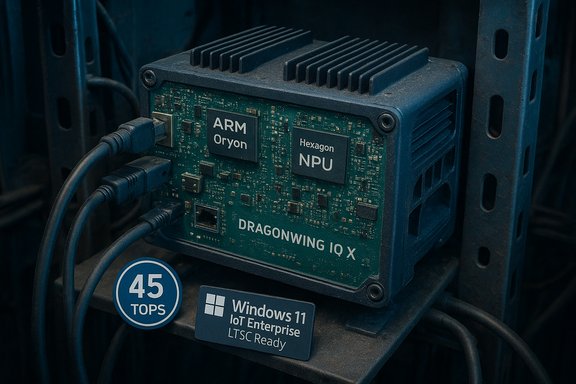
Qualcomm’s latest Dragonwing IQ‑X family of system‑on‑chips (SoCs) pushes the company deeper into industrial edge computing by packaging a ruggedized ARM‑based CPU, local AI acceleration and Windows 11 IoT support into modules designed for harsh factory and field environments — and while the headline NPU figure (up to 45 TOPS) is modest compared with Qualcomm’s highest‑end Dragonwing parts, it’s an explicit signal that on‑device AI is now a standard requirement for industrial PCs and controllers.
Qualcomm has been expanding its Dragonwing branded lineup across a broad spectrum: from fixed‑wireless access platforms to a growing family of Dragonwing IQ (industrial/IoT) processors that target vision AI, robotics and industrial automation. The IQ series (IQ6, IQ8, IQ9 and related variants) is already in use across SMARC/COM modules and reference systems from embedded suppliers, and manufacturers such as Tria, SECO and Advantech have publicly announced Dragonwing‑based modules and designs. These partners routinely cite wide operating‑temperature support and integrated Hexagon NPUs as the reasons Dragonwing fits industrial use cases. The Dragonwing IQ‑X announcement — reported in the trade press and summarized by Notebookcheck from a Qualcomm email — is a clear productization of the same strategy for the more rugged end of the market: combine the company’s Oryon/Kryo‑derived CPUs with an on‑chip Hexagon Neural Processing Unit (NPU), certify for Windows IoT Enterprise, and deliver COM/SMARC‑friendly footprints so OEMs can drop the chips into existing industrial carrier boards. Notebookcheck’s summary lists a number of high‑level claims: up to 45 TOPS NPU performance, operation between –40 °C and +105 °C, between 8 and 12 Oryon performance cores, and Windows 11 IoT Enterprise LTSC support. Those claims sit inside a broader Qualcomm roadmap that includes higher‑end Dragonwing variants with much larger NPU ceilings (for example the IQ‑9075 and IQ9 family items that vendors cite as offering up to 100 TOPS in certain configurations). The practical takeaway is simple: Qualcomm is scaling the Dragonwing line to let industrial OEMs choose the right balance of compute, NPU throughput and price for the application.
For context on how Qualcomm is positioning other high‑end PC‑class silicon (and the scale of NPU figures across product lines), Qualcomm’s laptop‑class Snapdragon X2 family doubled NPU capacity to 80 TOPS in its flagship parts — a useful comparison that shows Qualcomm’s strategy: scale NPU where the market needs it (laptops and high‑end edge), and offer midrange NPU capacity for industrial modules.
Qualcomm’s Dragonwing IQ‑X fills a well‑defined industrial niche: not the raw NPU leader, but the practical, certified and partnered SoC option that industrial OEMs can adopt with minimal redesign. For manufacturers balancing cost, ruggedness and the need to run inference locally on the factory floor, the IQ‑X family will be worth a close look — provided the promised specs are confirmed in published datasheets and real‑world tests.
Source: Notebookcheck Qualcomm Dragonwing IQ-X: New SoCs come with Windows 11 support and NPU performance on par with AMD and Intel
 Background / Overview
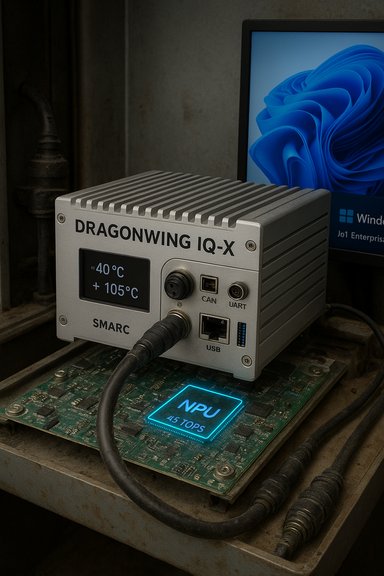
Qualcomm has been expanding its Dragonwing branded lineup across a broad spectrum: from fixed‑wireless access platforms to a growing family of Dragonwing IQ (industrial/IoT) processors that target vision AI, robotics and industrial automation. The IQ series (IQ6, IQ8, IQ9 and related variants) is already in use across SMARC/COM modules and reference systems from embedded suppliers, and manufacturers such as Tria, SECO and Advantech have publicly announced Dragonwing‑based modules and designs. These partners routinely cite wide operating‑temperature support and integrated Hexagon NPUs as the reasons Dragonwing fits industrial use cases. The Dragonwing IQ‑X announcement — reported in the trade press and summarized by Notebookcheck from a Qualcomm email — is a clear productization of the same strategy for the more rugged end of the market: combine the company’s Oryon/Kryo‑derived CPUs with an on‑chip Hexagon Neural Processing Unit (NPU), certify for Windows IoT Enterprise, and deliver COM/SMARC‑friendly footprints so OEMs can drop the chips into existing industrial carrier boards. Notebookcheck’s summary lists a number of high‑level claims: up to 45 TOPS NPU performance, operation between –40 °C and +105 °C, between 8 and 12 Oryon performance cores, and Windows 11 IoT Enterprise LTSC support. Those claims sit inside a broader Qualcomm roadmap that includes higher‑end Dragonwing variants with much larger NPU ceilings (for example the IQ‑9075 and IQ9 family items that vendors cite as offering up to 100 TOPS in certain configurations). The practical takeaway is simple: Qualcomm is scaling the Dragonwing line to let industrial OEMs choose the right balance of compute, NPU throughput and price for the application. What Qualcomm says the IQ‑X family brings
Key headline claims
- NPU / AI acceleration: up to 45 TOPS of NPU performance for on‑device inference and sensor fusion workloads.
- CPU configuration: between 8 and 12 Oryon performance cores (ARM‑based core cluster).
- Industrial thermal rating: guaranteed operation from −40 °C to +105 °C, intended for hot factory floors and outdoor enclosures.
- OS and ecosystem: support for Windows 11 IoT Enterprise LTSC, plus standard embedded Linux and middleware stacks used in industrial automation.
- Module compatibility & evaluation kit: designed to be compatible with existing carrier boards and compute modules (SMARC/COM), with evaluation kits aimed at rapid prototyping.
NPU: what 45 TOPS means in practice
“TOPS” (trillions of operations per second) is a useful shorthand for peak integer throughput, but it is not a direct measure of real LLM speed or CV model accuracy; practical throughput depends on model precision (INT8/INT4/FP16), memory bandwidth, kernel support and the inference runtime. Still, a 45 TOPS NPU is a meaningful figure for industrial tasks: it is in the ballpark for common vision and sensor classification models used for defect detection, predictive maintenance (time‑series anomaly scoring), and basic quantized language/text embedding tasks at the edge. Qualcomm’s broader Dragonwing family includes parts with much larger NPU capacity (some partner announcements reference up to 100 TOPS on higher‑end IQ parts), which leaves the IQ‑X squarely in the middle of the product stack where performance, cost and thermal headroom are balanced.Technical breakdown
CPU architecture and core counts
The IQ‑X’s reported 8–12 Oryon “performance” cores suggests Qualcomm has tuned its Oryon microarchitecture (or Kryo variants depending on SKU) for industrial throughput rather than pure mobile burst clocks. In the industrial space that tradeoff is sensible: many PLC/HMI/box PC workloads are multithreaded and I/O bound, so sustained multi‑core throughput and deterministic scheduling matter more than single‑thread peak burst. Qualcomm’s IQ family has been presented with dedicated real‑time islands and safety features in other variants; whether IQ‑X includes a hardened safety island or ECC‑backed memory options depends on the SKU and will be crucial for safety‑certified automation applications. Vendor partner material on Dragonwing IQ parts lists various Kryo/Kryo‑derived core mixes, and module vendors are already shipping IQ‑based SOMs with 8 cores for edge devices.Memory, I/O and form factor
Dragonwing IQ series modules are being offered in industrial COM/SMARC form factors to reduce OEM integration friction. Expect typical industrial interfaces: multiple GigE/2.5GbE ports with TSN options, PCIe lanes for NVMe storage and accelerator cards, multiple MIPI CSI lanes or camera interfaces for vision, and extended I/O families (CAN, UART, SPI, I2C) for factory equipment. Memory capacity and bandwidth will determine how large a quantized model an IQ‑X system can host locally; Qualcomm’s other IQ families support LPDDR variants and inline ECC in some models for reliability. Module suppliers (Tria, SECO, Advantech) are already calibrating boards around these interfaces.Ruggedization and thermal grade
The reported −40 °C to +105 °C operating window is aggressive but not unprecedented for industrial SoCs; several Dragonwing‑class modules already advertise similar ranges for outdoor and industrial use. Achieving reliable performance at +105 °C requires attention to package selection, PMIC thermal throttling, and component derating — and it typically narrows available TDP for sustained workloads (the silicon must run cooler to avoid junction overheating). For buyers, the practical test is not just maximum temperature but how long the board can operate at elevated temperature under expected workload.Ecosystem and partner support
Qualcomm’s strategy for Dragonwing IQ has been to lean on an ecosystem of module and board partners — Tria (Avnet), SECO, Advantech, Lantronix and others — so OEMs can pick off‑the‑shelf compute modules and fast‑track development. Tria and SECO have publicly announced SMARC/SMARC‑like modules and SOMs that support Windows 11 IoT Enterprise as well as Yocto/Ubuntu, signaling that Microsoft’s IoT and Windows on ARM stacks are now treated as first‑class options for embedded modules. Advantech’s own announcements show Dragonwing parts powering vision AI kits and edge appliances, and Lantronix is packaging Open‑Q modules around IQ‑series chips for industrial gateway use. These partner designs provide practical routes to deployment without deep silicon integration work. Practical benefits for OEMs:- Faster time‑to‑market via SMARC/COM module drop‑in compatibility.
- Multi‑OS support (Windows 11 IoT Enterprise LTSC, Yocto Linux, Ubuntu).
- Pre‑validated AI runtimes and tooling via Qualcomm’s AI software stack and common runtimes (ONNX, PyTorch bridge layers, etc..
Critical analysis — strengths
- Purpose‑built industrial package: The combination of wide temperature support, COM‑module compatibility and Windows IoT certification is exactly what industrial OEMs have been asking for — a rugged SoC option that doesn’t force a complete rework of existing carrier boards or software stacks.
- On‑device AI that fits common edge workloads: 45 TOPS is enough for many machine vision models (quantized CV networks), smaller embedding models for local recall, and pre/post‑processing tasks. For cases where cloud connectivity is intermittent or unacceptable for privacy reasons, a local NPU in this performance range is a practical enabler.
- Ecosystem momentum: Tria, SECO, Advantech and other players already publishing module designs and kits lowers integration risk for early adopters and signals that the platform will have commercial hardware available soon.
- Windows IoT Enterprise support: For industrial customers entrenched in Windows‑based SCADA, HMI and supervisory stacks, Windows 11 IoT Enterprise LTSC compatibility removes a major obstacle to adopting ARM‑based hardware.
Critical analysis — risks and limitations
- TOPS is not the whole story: A raw 45 TOPS INT8 number does not guarantee specific model latency, throughput, or energy efficiency. Real‑world AI performance depends on memory bandwidth, NPU microarchitecture (e.g., on‑chip memory size and access patterns), model kernels and compiler/runtime support for common frameworks. Buyers should demand application‑level benchmarks (e.g., frames per second for your inspection model at the resolution you use) rather than trusting TOPS alone. Treat TOPS as an indicative ceiling, not a guaranteed application metric.
- Driver and runtime maturity: Windows on ARM in industrial contexts requires robust vendor drivers, long life‑cycle BIOS/UEFI support and certified runtimes for inference (ONNX, TensorRT‑like accelerators for Hexagon if available). If Qualcomm’s NPU toolchain or Microsoft’s Copilot/AI runtime support is immature for industrial models, OEMs may face development delays. Historically, Windows‑on‑ARM ecosystems needed time to catch up; this remains a potential friction point.
- Thermal tradeoffs at high ambient temperatures: Operating at +105 °C ambient will constrain sustained SoC power. Many designs will need active cooling or conservative power profiles to avoid throttling; OEMs must validate workloads in target enclosures. Warranty and MTBF assumptions should be revisited for high‑temperature deployments.
- Fragmentation across Dragonwing SKUs: Qualcomm already ships Dragonwing variants with very different NPU ceilings and CPU mixes (IQ‑9075 at high TOPS, IQ‑615 and IQ6/8/9 series with different targets). Choosing the right SKU for a multi‑year deployment requires careful analysis of performance headroom and projected model evolution — undersizing can force expensive redesigns, oversizing increases BOM.
- Longevity and supply‑chain assurances: Industrial customers prioritize long life cycles and guaranteed supply. Qualcomm and its module partners have announced 10‑year longevity for some modules in other IQ‑branded products, but buyers should insist on explicit lifecycle commitments for IQ‑X variants prior to committing to large deployments.
How IQ‑X fits into the competitive landscape
- Qualcomm Dragonwing (IQ family): positions as an industrial, edge‑focused ARM alternative with integrated Hexagon NPUs, modular COM support and multi‑OS compatibility. Offers a range of NPU sizes (40–100 TOPS on various SKUs) so OEMs can pick price vs. performance.
- Intel/AMD x86 embedded SoCs: continue to dominate some industrial markets where x86‑native software and legacy drivers are crucial. x86 vendors are also accelerating NPU integration into SoCs but have historically lagged Qualcomm’s modem/ecosystem integration for always‑connected deployments.
- NVIDIA/Arm‑based accelerators and dedicated AI edge boxes: provide much higher AI throughput, but at a BOM and power cost that is inappropriate for many embedded controllers or fanless box PC use cases.
For context on how Qualcomm is positioning other high‑end PC‑class silicon (and the scale of NPU figures across product lines), Qualcomm’s laptop‑class Snapdragon X2 family doubled NPU capacity to 80 TOPS in its flagship parts — a useful comparison that shows Qualcomm’s strategy: scale NPU where the market needs it (laptops and high‑end edge), and offer midrange NPU capacity for industrial modules.
Buying and deployment checklist for industrial customers
When evaluating IQ‑X‑based modules for pilots or production, engineering teams should validate the following:- Application‑level AI benchmarks: measure your model’s latency and throughput on the target module under the expected ambient temperature and enclosure constraints.
- Driver and runtime support: confirm Windows 11 IoT Enterprise LTSC images, Hexagon NPU SDK availability, and supported inference runtimes (ONNX, PyTorch quantized flows).
- Thermal testing: perform soak testing at the maximum specified ambient (e.g., +85–105 °C) to understand sustained throttling behavior and failure modes.
- Long‑term supply: secure lifecycle and availability agreements from the module vendor/QC to cover planned product lifetimes (typical industrial programs expect 5–10 years).
- Security and manageability: validate secure boot, remote management options and whether the platform supports out‑of‑band servicing (some Qualcomm platforms include features targeted at remote management).
What remains unclear / claims that need independent verification
- The Notebookcheck summary attributes the IQ‑X specs to a Qualcomm email; while Notebookcheck’s reporting aligns with partner announcements that Dragonwing IQ parts are targeting industrial use, some granular claims — particularly the precise Oryon core configurations (8–12 performance cores) and the maximum 45 TOPS NPU figure for the IQ‑X SKUs — will need independent validation from Qualcomm’s official product pages or module datasheets once published. Notebookcheck explicitly notes “Qualcomm (E‑Mail)” as the source, which signals vendor‑provided info rather than an independent datasheet publication. For mission‑critical purchases, insist on a formal datasheet and a published module spec before production acceptance.
- The timeline is vague: Notebookcheck reports “first products expected in the coming months,” and module partners have shown Dragonwing designs in trade shows, but exact sampling and volume dates for IQ‑X SKUs have not been universally published. OEM roadmaps and module availability should be confirmed with the vendor or the module partner directly.
- Application‑level NPU behavior under high‑temperature stress is not yet independently documented. Organizations should require vendor thermal profiles and real‑world inference benchmarks measured at elevated thermals to confirm the platform meets their uptime SLAs.
Immediate implications for Windows IoT and industrial device makers
- Windows 11 IoT Enterprise LTSC support on these modules lowers the friction for companies that have historically depended on Windows‑based automation stacks and SCADA tools. That reduces migration costs from x86 to ARM for many appliances, provided driver parity is maintained for I/O and peripheral hardware. Tria, SECO and other module vendors already publish Windows support for Dragonwing modules, which will help accelerate migration projects.
- Edge‑first AI workflows (local anomaly detection, video pre‑filtering, low‑latency inference for safety loops) become more achievable without cloud dependency. For privacy‑sensitive or latency‑sensitive applications, placing inference on IQ‑X class modules can reduce operational cost and network bandwidth needs.
- Vendors building long‑lifecycle industrial products should engage with Qualcomm/module partners early to secure firmware support, BIOS/UEFI maintenance agreements and long‑term availability commitments.
Conclusion
The Dragonwing IQ‑X series is a pragmatic and timely addition to Qualcomm’s industrial portfolio: it combines the company’s ARM‑based compute pedigree, a usable midrange Hexagon NPU and an industrialized package tuned for embedded form factors and Windows IoT compatibility. For many industrial customers the combination of ruggedization, Windows 11 IoT Enterprise support and local AI acceleration (the reported 45 TOPS figure) will be the deciding factor in migrating from legacy x86 controllers to modern ARM‑based IPCs — but buyers should demand application‑level benchmarking, robust driver/toolchain guarantees and formal datasheets before committing to production runs. Notebookcheck’s summary and module/vendor announcements indicate strong ecosystem momentum, while partner press releases and module listings show the path from evaluation kit to shipping product; still, key deployment variables — thermal behavior under load, runtime maturity, and guaranteed lifecycles — must be validated in the field.Qualcomm’s Dragonwing IQ‑X fills a well‑defined industrial niche: not the raw NPU leader, but the practical, certified and partnered SoC option that industrial OEMs can adopt with minimal redesign. For manufacturers balancing cost, ruggedness and the need to run inference locally on the factory floor, the IQ‑X family will be worth a close look — provided the promised specs are confirmed in published datasheets and real‑world tests.
Source: Notebookcheck Qualcomm Dragonwing IQ-X: New SoCs come with Windows 11 support and NPU performance on par with AMD and Intel