• Thread Author
Qualcomm’s new Snapdragon X2 Plus arrives at CES 2026 with a clear aim: bring meaningful on-device AI and long battery life to a much wider range of Windows 11 Copilot+ laptops, shifting the conversation from elite flagship machines to affordable mainstream notebooks.

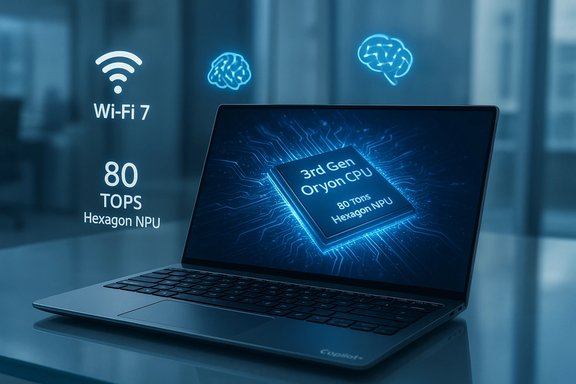
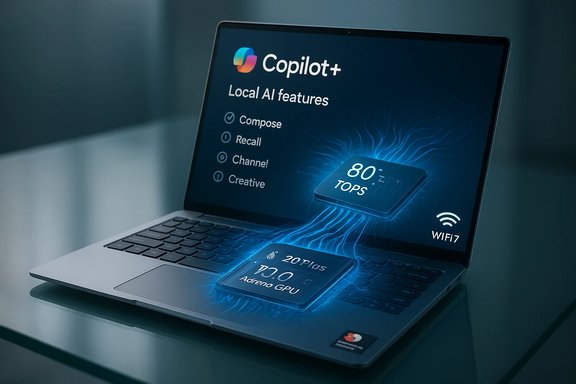
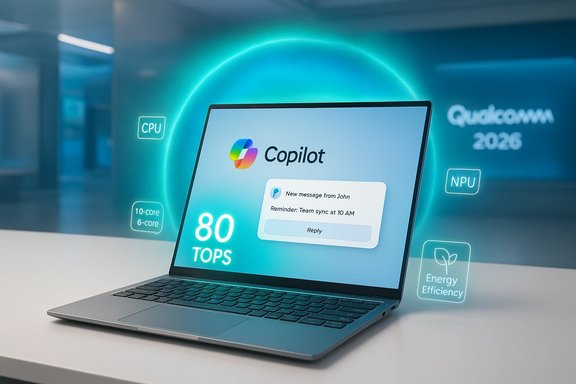
Laptop shows Copilot UI with holographic AI performance icons (CPU, NPU, 80 TOPS).Background​

Qualcomm’s Snapdragon X family has been a central pillar of the company’s push into Windows laptops since the original Snapdragon X Elite. The X2 generation—announced at CES 2026—extends that strategy with multiple SKUs, most notably the Snapdragon X2 Plus, which targets mainstream Copilot+ PCs. The chipmaker positions the X2 Plus between the top-tier X2 Elite/Extreme variants and the entry-level X Platform, delivering a blend of improved CPU and GPU performance while dramatically boosting on-device AI capability through a beefed-up NPU.
This update matters because Microsoft’s Copilot+ PC certification requires a baseline local AI capability on the device. By making a high-NPU part available for more affordable systems, Qualcomm is effectively enabling OEMs to ship more Copilot+ Windows 11 laptops across price tiers. The ripple effects include expanded app support for native Arm builds, a broader market for AI features that run locally, and renewed competition with Intel and AMD in the thin-and-light laptop segment.

What Qualcomm announced at CES 2026​

  • The Snapdragon X2 Plus is offered in 10‑core and 6‑core variants, leveraging Qualcomm’s third‑generation Oryon CPU architecture and an upgraded Hexagon NPU.
  • The company claims the X2 Plus delivers up to 35% higher single‑core CPU performance, up to 29–39% improved GPU performance, and a substantial uplift in NPU capability—with marketing figures pointing to around 80 TOPS (trillion operations per second) for on‑device AI inference.
  • Qualcomm projects up to 43% better power efficiency versus its previous X Plus generation, enabling multi‑day or significantly extended battery life under light-to-moderate workloads.
  • OEMs are expected to ship X2 Plus‑powered Windows 11 Copilot+ laptops in the first quarter of 2026, with an eye toward expanding the Copilot+ footprint into sub-$1,000 mainstream devices.
These are Qualcomm’s headline claims; several independent technology outlets and early hands‑on benchmark briefings reported consistent findings in preliminary testing and vendor briefings, though exact SKU configurations and final retail device performance will depend on OEM designs, cooling, and power limits.

Technical deep dive: CPU, GPU, and NPU​

CPU: third‑generation Oryon cores tuned for sustained workloads​

Qualcomm says the X2 Plus uses its third‑generation Oryon CPU cores, redesigned to emphasize sustained, efficient performance rather than ultra‑short burst speeds. Early disclosures indicate:
  • Two SKUs: a 10‑core configuration (mix of “prime” and “performance” cores) and a 6‑core variant focused on power efficiency.
  • Peak single‑core gains targeted at roughly +35% over the prior X Plus generation in Qualcomm’s internal comparisons.
This design philosophy reflects the laptop market’s demand for steady performance during prolonged workflows—content creation, web development, and multitasking—rather than short microbursts typically associated with mobile devices.

GPU: incremental but meaningful increases​

The X2 Plus’s GPU is presented as an evolution rather than a leap. Qualcomm claims up to ~29–39% GPU performance gains depending on the test and SKU. The company emphasizes improvements in sustained GPU throughput at lower wattage levels, which matter for thin-and-light laptops where thermal headroom is limited.

NPU: the headline number — up to 80 TOPS​

The most important architectural change for Microsoft’s Copilot+ ecosystem is the NPU. Qualcomm positions the X2 Plus as delivering roughly 80 TOPS of NPU performance—an increase that, if realized in consumer devices, significantly widens the range of AI models and features that can execute locally without cloud roundtrips.
What that means in practice:
  • Faster local inference for Copilot features, on‑device summarization, real‑time transcription, and more capable multimodal assistants.
  • Better offline and privacy‑friendly AI experiences, since heavier workloads can run without sending data to remote servers.
  • The potential to support larger or more complex foundation models in constrained scenarios, or to run optimized distillations and quantized variants more effectively.
Caveat: TOPS is a useful marketing metric to convey raw NPU capability, but it’s not a direct predictor of real‑world application performance. Practical throughput depends on memory bandwidth, model format, quantization support, software stack optimizations, and thermal/power limits applied by OEMs.

Verified performance claims and early benchmarks​

Qualcomm’s own ISO‑power comparisons and early independent tests reported during CES show the X2 Plus beating contemporaneous low‑power Intel Core Ultra and select AMD Ryzen AI parts in select CPU tests, often at significantly lower power draw. Early hands‑on benchmark runs (Geekbench-like workloads and 3DMark/Steel Nomad synthetic graphics tests) generally corroborate the vendor’s performance direction:
  • Single‑thread and multi‑thread CPU gains align with Qualcomm’s advertised uplift versus X Plus.
  • GPU benchmarks show meaningful generational improvement but still indicate the X2 Plus targets efficiency and application responsiveness more than high‑end gaming.
  • NPU throughput improvements are notable on paper; early demonstrations showed faster inference times for quantized transformer workloads and responsive local Copilot demonstrations.
Important verification notes:
  • Numbers cited by Qualcomm were corroborated by independent technology outlets that ran early previews and benchmark comparisons. However, public, peer-reviewed benchmark datasets for final retail laptops are still pending as OEMs finalize product SKUs and power/thermal tuning.
  • Real‑world performance will vary by OEM configuration: TDP limits, cooling solutions, RAM type and capacity, and storage speed all change outcomes appreciably. Until broad retail testing occurs, treat manufacturer and early‑review numbers as directional rather than definitive.

How Snapdragon X2 Plus changes the Copilot+ PC landscape​

Lowering the bar for Copilot+ hardware​

Microsoft’s Copilot+ PC standard has a minimum on‑device AI capability requirement. Historically, meeting that threshold with robust user experience required premium hardware. The Snapdragon X2 Plus aims to shift that by offering Amped AI capabilities in chips designed to be priced into mainstream systems.
This change means:
  • More OEM models can be labeled Copilot+, expanding marketing and feature parity with ARM flagship laptops.
  • Consumers can access Copilot features locally without paying flagship prices.
  • Developers and ISVs gain a larger install base of machines that can run local AI inference, making it more attractive to optimize for on‑device models.

OEM adoption and device timing​

Qualcomm’s roadmap indicates multiple OEMs planning X2 Plus designs slated for early 2026. Expect to see:
  • Thin‑and‑light laptops and 2‑in‑1 convertibles aimed at productivity users and students.
  • Higher RAM ceilings and LPDDR5x configurations on premium builds; lower‑cost SKUs will balance RAM/SSD to hit mainstream price points.
  • A focus on battery life, LTE/5G optionality, and integrated wireless stacks that capitalize on Qualcomm’s connectivity portfolio.

Software, drivers, and app compatibility​

Native ARM apps vs emulation​

A major strength of the Copilot+ push is Microsoft’s ongoing work to broaden native Arm application coverage. Native apps perform better and use NPU acceleration if they have been compiled/optimized for Arm64.
  • Native Arm builds of major productivity apps are increasingly available, improving battery life and responsiveness.
  • For non‑native apps, Microsoft’s Prism emulator and other compatibility layers continue to receive updates to reduce friction.

Drivers and GPU support​

Qualcomm committed to regular GPU driver updates and broader game/application compatibility. The X2 Plus supports modern APIs such as DirectX 12.2 Ultimate, Vulkan 1.4, and OpenCL 3.0, which expands native software support.

AI frameworks and developer tooling​

Qualcomm and partners are enhancing toolchains to help developers leverage the Hexagon NPU and other accelerators:
  • Model conversion and quantization tools for popular ML frameworks.
  • SDKs that expose accelerated primitives for inference and multimedia processing.
  • OEMs and Microsoft are expected to ship optimized libraries that let Copilot+ features make efficient use of the NPU.

Battery life and efficiency claims: what to expect​

Qualcomm’s messaging centers on sustained performance with low energy use. The X2 Plus is claimed to deliver up to 43% improved power efficiency over the previous generation, theoretically translating to longer battery life or the ability to use higher performance modes within the same battery budget.
Practical expectations:
  • Everyday productivity (web, office apps, video playback) is likely to benefit most, with some configurations achieving all‑day or multi‑day standby scenarios under light load.
  • Intensive AI workloads performed locally will increase power draw; efficiency improvements mean these tasks may be feasible on battery for short bursts but will still consume noticeable energy for sustained large-model inference.
  • OEM thermal design and battery capacity remain the primary determinants of real battery life; chip efficiency is necessary but not sufficient.

Comparative positioning: Snapdragon X2 Plus vs Intel, AMD, and Apple​

The X2 Plus aims to compete where efficiency and on‑device AI matter most. Key comparison points:
  • Intel Core Ultra chips—particularly the low‑power Ultra 7 class—remain strong in legacy application compatibility and single‑thread performance in certain scenarios. Qualcomm’s edge is energy‑efficient sustained workloads and native AI acceleration.
  • AMD Ryzen AI series competes in hybrid CPU+NPU strategies; Qualcomm’s advantage is an integrated NPU designed from the start for local inference combined with tight SoC integration for connectivity and power.
  • Apple Silicon (M‑series) leads in single-threaded performance and mature software ecosystem for macOS, but the Windows ecosystem’s app diversity and Microsoft’s Copilot+ initiative create a distinct domain where Qualcomm’s approach on Windows aims to excel.
In short: Qualcomm isn’t promising a universal win over x86 in every benchmark; rather, it’s offering a differentiated value proposition emphasizing efficient sustained performance and robust local AI.

Security, privacy, and platform readiness​

Qualcomm highlights platform security as a design focus. Copilot+ PCs generally include protections like Microsoft Pluton and secure boot mechanisms. On-device AI also has privacy advantages: more data can be processed locally without being uploaded to cloud services.
Risk considerations:
  • Secure enclaves and firmware-level protections must be audited and tested across OEMs.
  • Local AI models raise questions about model provenance, patching, and how updates are delivered and validated securely on consumer devices.

Risks, limitations, and open questions​

No platform is risk‑free. The Snapdragon X2 Plus brings significant promise but also several caveats:
  • Real‑world NPU utility depends on software: TOPS numbers do not translate directly to better end-user experiences unless applications are optimized to use the NPU efficiently. Developers must adopt new toolchains and best practices.
  • Compatibility and the Windows ecosystem: Despite progress, some legacy Windows applications—particularly plugins, low-level drivers, and niche creative tools—still run best on x86. Emulation continues to improve, but edge cases remain.
  • Gaming expectations: The X2 Plus improves GPU throughput but is not targeted at high‑end gaming. Users expecting console‑level or desktop GPU performance should temper expectations.
  • Thermals and OEM tuning: The same silicon can perform very differently depending on laptop thermal design and TDP settings. Benchmarks on preview units with generous cooling won’t necessarily reflect thin retail models.
  • Supply, pricing, and market segmentation: Qualcomm’s aim to broaden Copilot+ availability into mainstream price tiers depends on OEMs controlling BOM costs and supply chain pressures. Pricing targets may shift as devices are configured for different markets.
  • Marketing vs reality: Some early figures are vendor-provided or derived from controlled demo environments. Until independent retail testing across multiple devices is published, some claims should be treated as optimistic projections.
Where claims were not fully corroborated by public documentation—for example, exact cache sizes, sustained clocks across SKU lines, or final retail GPU frequencies—those details are identified in vendor briefings and early leaks; they must be confirmed when devices are sampled for comprehensive review.

What consumers should look for when shopping for X2 Plus Copilot+ laptops​

  • Check the actual SKU and power limits used in the retail model—many manufacturers will ship both performance‑tuned and power‑sipping versions under the same chip family.
  • Look for LPDDR5x RAM and NVMe SSD configurations; memory bandwidth and storage significantly influence AI and multitasking performance.
  • Confirm native app support for the productivity applications you use most—native Arm builds will offer the best battery and performance balance.
  • Evaluate thermals and chassis design—thin laptops may throttle more aggressively than slightly thicker models with active cooling.
  • Review battery capacity and advertised runtimes with realistic workloads (e.g., web browsing, video playback) rather than relying solely on vendor claims.

Developer and enterprise implications​

For developers, the X2 Plus line makes it more attractive to optimize for local inference on Windows devices. Enterprises gain options to deploy Copilot-like capabilities on endpoints that do not require continuous cloud connectivity, which can reduce latency and improve privacy compliance.
Actionable considerations for IT decision-makers:
  • Pilot local AI features with a subset of users to measure real productivity gains and security posture.
  • Validate line-of-business applications under the target OEM configuration, including emulator performance for legacy x86 apps.
  • Budget for potential app migration or testing to ensure critical workflows remain performant on Arm-based Copilot+ devices.

The big picture: is Qualcomm finally bringing AI laptops to the mainstream?​

The Snapdragon X2 Plus is Qualcomm’s clearest attempt yet to mainstream on‑device AI in Windows laptops. By coupling stronger NPU capability with improved CPU efficiency and reasonable GPU gains, Qualcomm is creating an attractive path for OEMs to ship Copilot+ laptops at price points beyond elite flagships.
The platform’s long‑term success will depend less on single‑digit percentage gains and more on ecosystem momentum: whether developers embrace optimized on‑device AI, whether OEMs strike the right balance between performance and cost in final products, and whether real‑world battery and thermals meet user expectations.
The early signs are promising. Qualcomm’s X2 Plus brings essential architectural improvements and an explicit strategy to expand Copilot+ access. But the true measure will appear in retail devices: real benchmarks, daily battery experience, and the breadth of software that leverages the on‑device NPU effectively.

Conclusion​

Qualcomm’s Snapdragon X2 Plus announcement at CES 2026 signals a strategic pivot from niche flagship AI machines toward democratizing Copilot+ capabilities across mainstream Windows 11 laptops. The combination of improved Oryon CPU cores, a markedly stronger NPU, and better energy efficiency creates a viable platform for on‑device AI in affordable devices.
There are reasonable grounds for optimism: early benchmark previews and OEM commitments suggest the X2 Plus will deliver the promised generational improvements. Yet several open questions remain about final retail tuning, software optimization, and practical NPU utilization. Consumers and IT buyers should approach the first wave of X2 Plus laptops with enthusiasm—but also with typical due diligence: validate configurations, test compatibility with mission‑critical software, and wait for independent reviews that reflect real‑world usage.
If Qualcomm’s claims hold up in shipping devices, the Snapdragon X2 Plus could be a defining piece in Microsoft’s Copilot+ strategy—expanding local AI to more users, accelerating developer interest in on‑device models, and reshaping expectations for what mainstream Windows laptops can do without a cloud connection.

Source: Neowin https://www.neowin.net/news/ces-202...x2-plus-to-mainstream-windows-11-copilot-pcs/
 

Qualcomm’s Snapdragon X2 Plus lands as a deliberate, mid‑premium bridge between flagship X2 Elite silicon and entry X‑series chips — a chip explicitly tuned to put meaningful on‑device AI into mainstream Windows 11 Copilot+ laptops while preserving the battery life and thermals that buyers expect from thin, productivity‑focused designs.

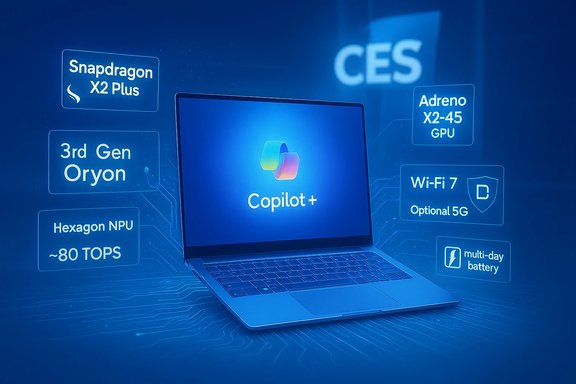
A sleek tablet displays Copilot AI summaries and a Snapdragon X2+ badge.Background​

Qualcomm unveiled the Snapdragon X2 family at CES 2026 and introduced the Snapdragon X2 Plus as a two‑SKU offering — a 10‑core and a 6‑core variant — sharing the same high‑throughput Hexagon NPU claimed to deliver roughly 80 TOPS for INT8 workloads. Qualcomm positions the X2 Plus to qualify devices for Microsoft’s Copilot+ PC program, which requires baseline local AI capability for on‑device Copilot features. On paper, Qualcomm’s messaging emphasizes three objectives:
  • deliver stronger single‑thread and sustained multi‑thread CPU responsiveness with third‑generation Oryon cores,
  • boost GPU efficiency and sustained throughput for common productivity and media tasks with the Adreno X2‑45 family, and
  • dramatically expand on‑device inference headroom with the upgraded Hexagon NPU so that Copilot features, local summarization, and offline AI workflows run without cloud roundtrips.
These architectural choices come with a broader platform play: Microsoft has prepared a device‑targeted Windows 11 platform branch (commonly discussed as “26H1” / Bromine) to validate drivers, NPU runtimes and firmware for next‑gen Arm silicon before enabling the user‑facing features more broadly. That coordinated silicon‑OS‑OEM strategy reduces day‑one risk for complex hardware‑dependent AI features.

What exactly is Snapdragon X2 Plus?​

Variants and silicon lineage​

  • Two SKUs: a 10‑core X2P‑64‑100 and a 6‑core X2P‑42‑100, both built on a 3nm class process and sharing the same core microarchitecture lineage as the higher‑end X2 Elite chips.

Key claimed specifications (vendor disclosures)​

  • NPU: ~80 TOPS (INT8) Hexagon NPU across X2 family SKUs — the headline metric for on‑device AI.
  • CPU: third‑generation Oryon cores with peak boost on performance cores up to 4.0 GHz on X2 Plus SKUs (higher boost clocks exist on Elite/Extreme bins).
  • GPU: Adreno X2‑45 family; 10‑core SKU lists GPU clocks up to 1.7 GHz, 6‑core SKU trimmed to around 0.9 GHz in some configurations.
  • Cache & Memory: reported cache up to 34 MB on the 10‑core SKU, support for LPDDR5x memory up to vendor choices (Qualcomm references up to 128 GB and ~152 GB/s bandwidth in product materials).
  • Connectivity & security: integrated FastConnect subsystem with Wi‑Fi 7 and optional 5G; Qualcomm’s Snapdragon Guardian security features are called out in product briefs.
These numbers are repeated across engineering slides and early press previews and have been echoed by multiple outlets reporting from CES 2026.

Why the X2 Plus matters for Windows 11 Copilot+ PCs​

Lowering the bar for mainstream Copilot+ devices​

Microsoft’s Copilot+ certification requires devices to provide a minimum level of local inference capability. By offering a mid‑tier part with the same NPU class as Elite chips, Qualcomm enables OEMs to ship Copilot+‑branded laptops at lower price thresholds, increasing market reach for local AI features that were previously reserved for flagship machines. That’s a strategic product shift: move Copilot experiences out of the expensive, niche tier and into the mainstream where most buyers and enterprise fleets live.

Real user benefits (potential)​

  • Faster local responses in Copilot tasks (summaries, local search, transcriptions).
  • Reduced cloud dependency — better offline capability and privacy improvements for sensitive data processing.
  • Broader software incentive for developers to ship native Arm builds and NPU‑accelerated features, since the potential install base grows.

Technical deep dive: CPU, GPU, NPU — what to expect in practice​

CPU: Oryon tuned for sustained work​

Qualcomm emphasizes sustained, efficient performance over ultra‑short turbo bursts. The Oryon evolution in X2 Plus is targeted at real‑world productivity workloads: content creation, multitasking with many browser tabs, and developer scenarios. Benchmarks previewed by vendors show notable single‑thread gains (Qualcomm quoted up to 35% single‑core uplift versus the prior X Plus family in vendor slides). Treat vendor charts as directional; final retail performance depends on OEM TDP, cooling and firmware.

GPU: modest generational gains, efficiency first​

GPU claims range from ~29–39% generational improvement in Qualcomm’s materials, but the architectural message is one of sustained throughput at modest wattage rather than raw gaming supremacy. The X2 Plus targets responsive UI, accelerated media workloads, and casual gaming compatibility — not high‑end AAA performance. Gaming toolchain improvements (driver delivery and broader anti‑cheat support) make the platform more viable for a wider set of titles, but the X2 Plus remains an efficiency‑oriented part.

NPU: the practical meaning of “80 TOPS”​

The 80 TOPS figure is the X2 family’s poster spec and the key enabler for Copilot+ experiences, but TOPS is a raw hardware throughput metric — useful for headline comparisons but not an automatic guarantee of better user‑facing AI. Real inference performance depends heavily on:
  • memory bandwidth and architecture,
  • model size/format and quantization,
  • runtime software optimizations and secure model manifests,
  • thermal and power constraints set by OEMs.
In short: 80 TOPS increases the ceiling for on‑device workloads (allowing larger distilled models or faster batched inference), but application developers and system integrators must still optimize runtimes and pipelines to realize that potential.

Performance claims: vendor slides vs. independent verification​

  • Qualcomm’s CES briefings and reference demos showed large relative gains versus both prior Qualcomm X parts and selected Intel Core Ultra mobile SKUs using power‑normalized comparisons. Vendor slides claim up to 3.1× multi‑core or 3.5× single‑core improvements in some normalized scenarios.
  • Independent early previews from outlets running Geekbench‑style tests on engineering hardware broadly corroborate the direction of the gains — improved single‑thread responsiveness and competitive multi‑thread results at lower power consumption — but they also reinforce one caveat: retail models will vary substantially by OEM thermal design and power limits.
Caveat and practical guidance: treat early vendor and preview numbers as directional rather than definitive. Many of the most eye‑catching charts are power‑normalized, and how “same power” is defined materially changes head‑to‑head results. Expect the true picture to emerge only when a range of retail X2 Plus laptops are independently tested (battery life, sustained workloads, and real application benchmarks).

Windows 11, 26H1 (“Bromine”) and platform readiness​

Microsoft’s Canary channel activity and statements indicate a device‑targeted platform branch—commonly discussed as Windows 11 version 26H1 / Bromine—intended to validate next‑gen silicon such as Qualcomm’s X2 and other emerging platforms. That branch is explicitly framed as a platform release (drivers, runtimes, signed firmware), not a broad consumer feature update; mainstream feature rollouts remain on the usual H2 cadence. Why Microsoft and OEMs favor a device‑first release:
  • ensures verified DCH drivers and NPU runtimes ship with factory images,
  • preserves privacy/security attestations for local model handling,
  • provides a homogeneous telemetry set to detect device‑specific regressions quickly.
Important verification note: Microsoft has not tied consumer‑facing features exclusively to 26H1 forever — historically, device‑gated features have been staged and later rolled out more widely once runtime and driver stacks stabilize. Treat the “26H1 exclusivity” as a sensible engineering move, not an indefinite lockout.

OEM plans, product segments and timing​

Multiple OEMs signaled X2 Plus designs for early 2026, with initial units expected in the first quarter of 2026. Vendors are targeting:
  • thin‑and‑light ultrabooks and 2‑in‑1 convertibles in the $799–$1,299 mainstream band,
  • larger IdeaPad/Yoga‑style designs for portability and battery longevity,
  • selective premium Yoga or X series models that stick to Elite silicon for top‑bin performance.
OEM choices will determine user experience: the same X2 Plus silicon can be tuned toward performance (higher sustained TDP, larger fans) or battery life (aggressive clocks and fanless designs). Buyers should always check the exact SKU, thermal limits and memory configuration of a retail device rather than relying solely on the SoC name.

Developer and enterprise implications​

  • Developers: the X2 Plus line broadens the addressable market for native Arm64 plus NPU‑accelerated apps. Investing in optimized model conversion, quantization and runtime hooks can pay off faster if a meaningful share of enterprise endpoints support local inference.
  • Enterprises: Copilot+ hardware can reduce latency and cloud egress for sensitive inference tasks, but procurement teams must validate compatibility for line‑of‑business apps and test emulation behavior where legacy x86 binaries are still required. Pilot deployments and coexistence testing remain essential.
Actionable checklist for IT decision‑makers:
  • Validate critical LOB apps on candidate OEM images (native vs. emulated behavior).
  • Pilot Copilot+ features with a controlled user cohort to measure latency, privacy and productivity effects.
  • Ensure update/patch management for NPU runtimes and secure model manifests is part of the endpoint lifecycle plan.

Security, privacy and supply‑chain considerations​

Security and model provenance​

On‑device AI reduces cloud exposure but increases the attack surface on endpoints: secure enclaves, signed model manifests, and robust firmware/driver signing practices are essential to ensure local models are authentic and updated safely. Qualcomm and Microsoft highlight platform security features (e.g., Pluton style protections and Snapdragon Guardian), but vendors and enterprises must verify implementation details across OEM images.

Patch and model distribution​

Local AI models require a secure, auditable delivery path. Questions to resolve operationally include:
  • How are model updates signed and validated on devices?
  • What telemetry and rollback mechanisms exist if a model is found malicious or buggy?
  • How will enterprises manage model versions across fleets to maintain reproducibility and compliance?

Supply and pricing risks​

Qualcomm’s stated price targets (Plus to broaden Copilot+ availability under flagship price points) depend on OEM BOM choices and component supply (memory, displays, remotes). Market pricing can shift quickly if RAM or OLED panel deficits worsen. Early adopters should expect a range of SKUs and price‑performance tradeoffs.

Practical buyer guidance: what to look for in an X2 Plus Copilot+ laptop​

  • Confirm the actual X2 Plus SKU used in the retail model (10‑core vs 6‑core) and any OEM TDP/power limit.
  • Check RAM type (LPDDR5x preferred) and memory bandwidth — AI inference and multitasking benefit from higher bandwidth.
  • Inspect SSD type and capacity — large datasets and local model caches need fast NVMe storage for best throughput.
  • Evaluate thermal design and real‑world battery tests from independent reviews rather than vendor claims.
  • Verify native Arm support for mission‑critical apps; where not available, test emulation and AVX2/AVX fallback behavior.

Strengths, limitations and the realistic upside​

Strengths​

  • Makes Copilot+ viable for mainstream price tiers, expanding reach and developer incentives.
  • Large NPU headroom (80 TOPS) unlocks new classes of local workloads if software stacks mature.
  • Improved performance-per-watt that promises longer battery life for mobility use cases in many OEM designs.

Limitations and risks​

  • Marketing metrics vs. real‑world UX: TOPS and vendor slides are helpful but do not guarantee uniformly superior end‑user experiences; software and OEM tuning are decisive.
  • Compatibility friction: some legacy x86 software and niche drivers still prefer x86, which could complicate migrations for specific workflows.
  • Thermals and SKU fragmentation: one SoC name does not equal one experience — thin fanless SKUs will perform differently than active‑cooled models.

Where verification remains important (claims to watch)​

  • Battery life: Qualcomm’s “multi‑day” claims are attractive, but real battery life will depend on display, SoC TDP, and workload; independent long‑term battery tests are required.
  • Performance vs. x86: head‑to‑head gains shown in vendor slides are often power‑normalized and may not translate identically in retail laptops. Wait for independent multi‑device reviews.
  • Exact sustained clocks and cache figures: some public numbers (cache sizes, sustained clock targets per SKU) appear in leaks or vendor briefings but should be confirmed from retail spec sheets and hands‑on tests.

Final analysis — is Snapdragon X2 Plus a turning point?​

The Snapdragon X2 Plus is Qualcomm’s clearest attempt to democratize on‑device AI in Windows laptops: it pairs a higher‑throughput Hexagon NPU with better CPU efficiency and usable GPU throughput, and it forces the Windows ecosystem to treat Arm devices as mainstream first‑class citizens through coordinated platform work (26H1/Bromine). If OEMs ship thoughtfully tuned products and developers invest in native Arm and NPU‑accelerated paths, the result could be a substantial shift in how everyday Windows productivity tasks are assisted by local AI. That said, big “ifs” remain: software optimization, retail thermal tuning, secure model distribution, and unbiased independent testing will determine whether the X2 Plus moves from an ambitious silicon story to a broadly valuable user experience. For consumers and enterprise buyers, the prudent path is to evaluate retail devices on their merits — configuration, thermals, app compatibility, and battery — rather than assuming SoC branding alone guarantees the promised magic.

Conclusion​

Qualcomm’s Snapdragon X2 Plus shifts the narrative from “AI‑enabled flagships” toward “AI‑capable mainstream laptops” by packaging Elite‑class NPU throughput into more volume‑oriented SKUs. The technical prerequisites Microsoft is building into Windows (device‑targeted platform releases and validated driver/runtimes) make this ecosystem approach credible and pragmatic. Early reports and vendor previews point to meaningful gains in sustained performance and local inference capability, but the real test will arrive when a broad set of retail X2 Plus laptops land in reviewers’ hands and enterprise fleets begin measured pilots.
For now, the X2 Plus is a powerful signal: the next wave of Windows laptops will be judged less on raw x86 frequency wars and more on how well manufacturers and software partners can deliver safe, efficient, and genuinely useful on‑device AI experiences. Proceed with cautious optimism — verify SKU details, test workloads that matter to you, and prioritize independent reviews before committing at scale.
Source: Windows Report https://windowsreport.com/qualcomm-...-plus-for-windows-11-copilot-pcs-at-ces-2026/
 

Qualcomm’s new Snapdragon X2 Plus chips shift the company’s Windows-on-Arm strategy from flagship proof-of-concept into a mainstream play, promising stronger single‑thread performance, a much larger on‑device neural engine, and noticeably better efficiency for Windows 11 Copilot+ laptops arriving in early 2026.

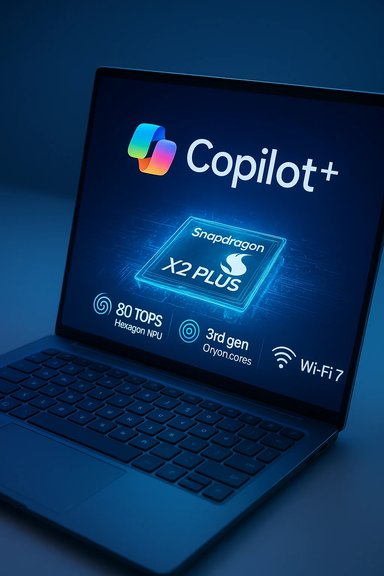
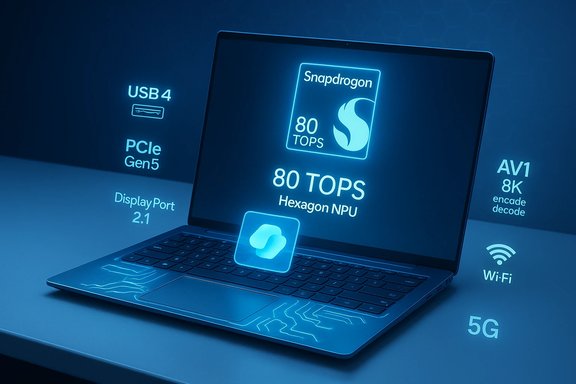
Blue holographic display on a laptop highlighting Snapdragon X2 Plus, 80 TOPS, and Copilot+.Background​

Qualcomm introduced the Snapdragon X2 family at CES 2026, and the X2 Plus is the mid‑tier SKU created to deliver advanced Copilot+ features to more affordable laptops. The company positions the X2 Plus between the premium X2 Elite/Extreme parts and its entry X Platform, offering the same class of neural processing hardware as the Elite line but with fewer CPU cores and tuned clocks to hit mainstream price and power targets. Microsoft’s Copilot+ PC program expects a baseline of local inference capability on qualifying devices; that requirement is a primary reason chip vendors and OEMs are emphasizing NPUs and integrated acceleration in 2026 hardware. Qualcomm’s strategy with X2 Plus is to put that NPU headroom into machines where most consumers and enterprise buyers shop, expanding the pool of devices that can run responsive on‑device Copilot features.

What’s inside Snapdragon X2 Plus​

Third‑generation Oryon CPU — responsive and sustained​

The X2 Plus uses Qualcomm’s third‑generation Oryon CPU microarchitecture, tuned for sustained responsiveness rather than only bursty peak clocks. Qualcomm claims up to 35% better single‑core performance compared with the prior X Plus family, an improvement aimed at real‑world productivity workloads—browsing, editing, and short single‑threaded tasks where responsiveness matters most. Independent hands‑on previews mirrored Qualcomm’s direction, though retail tuning will ultimately decide real‑world results. Key takeaways:
  • Two X2 Plus SKUs: a 10‑core variant (mixed prime/performance cores) and a 6‑core variant (prime‑focused).
  • Peak boost clocks for performance cores are quoted around 4.0 GHz for X2 Plus SKUs in vendor materials. Treat these as vendor specifications; sustained clocks will depend on OEM power limits.

Hexagon NPU — headline 80 TOPS for on‑device AI​

The most consequential spec is the Hexagon neural processing unit: Qualcomm advertises up to 80 TOPS (trillion operations per second) of INT8 throughput for X2 family NPUs, and the X2 Plus inherits that same NPU class as Elite chips. This near‑doubling of raw TOPS compared to earlier X‑series NPUs (previous figures around the mid‑40s TOPS) is the primary enabler for more advanced on‑device Copilot+ features—local summarization, faster transcription, privacy‑friendly inference, and offline multimodal assistance. Important context: TOPS is a hardware throughput metric, not a user‑experience guarantee. Real inference speed depends on memory bandwidth, model type/quantization, runtime optimizations, and OEM thermal/power constraints. Early demos and synthetic AI benchmarks showed large deltas; independent retail testing will be required to measure actual application‑level gains.

Adreno GPU — modest but meaningful gains​

Qualcomm reports up to ~29% GPU performance uplift for the integrated Adreno X2‑45 family versus the prior X Plus generation, with improved sustained throughput that’s aimed at UI fluidity, media acceleration, and casual gaming rather than high‑end AAA titles. The X2 Plus supports multiple external 4K displays, making it practical for creators and multitaskers who rely on external monitors.

3nm process and power efficiency​

A key engineering leap is the move to a 3nm class manufacturing process, which Qualcomm says contributes to a roughly 43% reduction in power usage compared with the earlier X Plus generation. That efficiency gain underpins the company’s “multi‑day” battery claims for light usage and the ability to sustain higher performance under the same battery budget. Early press previews and Qualcomm‑provided power‑normalized charts corroborated the efficiency narrative; however, actual battery life will vary widely by OEM chassis, display, and power management choices.

Connectivity and platform features​

The Snapdragon X2 Plus platform bundles modern connectivity and security primitives:
  • Optional integrated 5G modem and FastConnect subsystem supporting Wi‑Fi 7 and Bluetooth variants for faster, more reliable wireless performance.
  • Hardware security: Qualcomm Security Processing Unit with Microsoft Pluton integration, plus optional Snapdragon Guardian Technology for remote management and enterprise protections. These features are targeted at business users who require hardware‑anchored protections and fleet management.

Why the X2 Plus matters for Windows 11 Copilot+ PCs​

Qualcomm’s move is both tactical and strategic: by offering an NPU class capable of the same order of magnitude throughput as its Elite parts in a lower‑cost SKU, OEMs can certify more devices as Windows 11 Copilot+ without pushing pricing into the flagship bracket. That has three immediate consequences:
  • Broader market penetration for on‑device AI features that used to be limited to premium laptops.
  • Stronger incentive for ISVs and developers to ship native Arm64 builds and NPU‑accelerated paths, because the potential install base for capable hardware grows.
  • Competitive pressure on x86 vendors to either increase their integrated AI capabilities or emphasize other strengths such as legacy app compatibility or raw single‑thread peak performance.
Microsoft has been executing a coordinated device enablement approach—validating drivers, NPU runtimes, and firmware with specific device images—so that first‑wave X2 devices can ship with a tested platform baseline. That reduces day‑one friction for complex hardware‑dependent AI features, though it also means enterprises will want to treat any device‑targeted Windows images as a separate validation path for imaging and lifecycle management.

Performance expectations and caveats​

What vendor numbers mean — and what they don’t​

Vendor slides and Qualcomm’s press materials present compelling per‑watt and TOPS comparisons: single‑core CPU gains (quoted up to 35%), GPU improvements approaching ~29%, and NPU throughput near 80 TOPS. Independent outlets that attended press previews largely reported consistent directions in early engineering‑sample benchmarks. However, the following caveats apply:
  • Benchmarks were often run on Qualcomm reference designs with defined power envelopes; retail laptops will vary depending on OEM TDP, cooling, and firmware tuning.
  • TOPS alone is not a direct measure of application performance; model size, memory subsystems, and software runtimes shape real‑world inference. Treat TOPS as an upper bound for parallel arithmetic throughput, not an automatic UX improvement.
  • GPU gains are meaningful for productivity and media acceleration, but don’t make the X2 Plus a gaming powerhouse relative to higher‑TDP discrete‑GPU notebooks. Expect good integrated GPU performance for mainstream creative workloads, not high‑end gaming headroom.

Memory, storage and bandwidth matter for AI​

Local inference benefits from higher memory bandwidth and fast NVMe storage. OEM choices on LPDDR5x capacity and bandwidth will materially affect NPU‑bound inference latency and throughput. Buyers should prefer configurations with LPDDR5x and healthy memory bandwidth if on‑device AI is a core requirement.

OEM timing, pricing and product segmentation​

Qualcomm and industry reporting point to first X2 Plus laptops arriving in the first half of 2026, with multiple major OEMs planning designs for thin‑and‑light and 2‑in‑1 segments. Pricing expectations (based on vendor commentary and early reporting) position X2 Plus devices to target mainstream price bands—often cited in the $799–$1,299 window for well‑equipped SKUs—while Elite machines remain the $1,000+ class. These are vendor targets and will depend heavily on RAM and panel choices. Qualcomm’s public remarks and press coverage indicate OEMs may ship both performance‑tuned and power‑sipping SKUs from the same SoC family, creating a range of user experiences under the “X2 Plus” banner. That makes SKU verification critical for shoppers.

Enterprise and IT implications​

Image management and platform gating​

Because Microsoft may ship validated device images for X2‑class silicon (a device‑targeted Windows baseline often discussed in the industry), enterprises purchasing early X2 Plus devices should plan for:
  • A validation pass on imaging and baseline drivers.
  • Testing of line‑of‑business applications (including any emulated x86 binaries) under the target OEM configuration.
  • Policies for updating NPU runtimes and signed model manifests to maintain compliance and reproducibility across fleets.

Security and manageability​

Snapdragon Guardian Technology, Qualcomm’s Security Processing Unit, and Microsoft Pluton integration are all attractive to enterprise buyers because they provide hardware‑rooted protections and remote management options. Enterprises should evaluate vendor management tooling, firmware update processes, and supply chain support when selecting X2 Plus devices for fleets.

Practical buying checklist — what to verify before you buy​

  • Confirm which X2 Plus SKU is used in the model (10‑core vs 6‑core) and whether OEMs list sustained power limits/TDP.
  • Choose LPDDR5x RAM and higher memory bandwidth where possible for better AI and multitasking performance.
  • Check the NPU claim (80 TOPS on paper) but prioritize real‑world tests—look for independent AI inference benchmarks and application trials.
  • Evaluate native Arm app support for your critical software; if not native, test performance under Microsoft’s emulator.
  • Look for real battery tests (web browsing, video playback, and local AI workloads) in retail reviews, not just vendor “multi‑day” claims.

Strengths, trade‑offs and risks​

Strengths​

  • Democratizes Copilot+: Enabling high‑throughput NPUs in mainstream SKUs broadens access to local AI features.
  • Efficiency gains: The 3nm class process and architectural tuning aim for meaningful battery life benefits in thin designs.
  • Platform readiness: Coordinated OS/driver work with Microsoft reduces day‑one software risk for complex features.

Trade‑offs and risks​

  • TOPS vs UX: TOPS is a headline stat; real user experiences depend on software, memory, storage, and thermal design. Treat vendor numbers as directional.
  • SKU fragmentation: The same SoC name can produce different outcomes—fanless versus actively cooled designs will behave differently. Confirm the retail configuration.
  • Software maturity: Native Arm builds and optimized NPU runtimes are improving, but some legacy professional apps may still require compatibility testing.
  • Supply and pricing: Memory and panel supply shortages can push OEMs to alter configurations, affecting price and performance. Early price targets are vendor guidance, not guarantees.
Flagged claim: Qualcomm’s exact “multi‑day battery life” assertions and some vendor‑provided benchmark deltas should be treated with caution until independent retail reviews confirm them. Early engineering samples and power‑normalized tests are promising, but real‑world battery and sustained performance are determined by the final OEM design, not just the SoC.

Developer and software ecosystem implications​

Developers see a clearer case for investing in native Arm builds and NPU‑accelerated pipelines when a larger installed base of capable hardware exists. Qualcomm and partners are improving model conversion tooling, runtime SDKs, and quantization support to make it easier to run optimized models on Hexagon hardware. That said, successful ecosystems require:
  • Robust developer tools and documentation.
  • Reliable model distribution and signing workflows for enterprise scenarios.
  • Clear guidelines on power‑aware inference to prevent battery surprises in portable devices.
Enterprises should plan pilot programs to measure actual productivity lifts, latency improvements, and operational concerns (model lifecycle, update cadence, and compliance). Hardware alone won’t deliver benefits without integrated software and governance.

The verdict — where Snapdragon X2 Plus fits in the market​

The Snapdragon X2 Plus is a pragmatic play: it takes the high‑throughput NPU class introduced in Qualcomm’s Elite parts and packages it into silicon engineered for mainstream laptops. If OEMs ship thoughtfully configured devices with adequate memory, cooling, and software, X2 Plus machines could meaningfully expand the reach of on‑device AI in Windows 11 Copilot+ PCs. Early press previews and vendor data consistently show the same directional improvements—better single‑thread responsiveness, stronger NPU headroom, and real power efficiency gains—but the industry must still validate those claims in retail devices across typical workloads and enterprise fleets. This generation is less about a single winning benchmark and more about an ecosystem shift: Intel, AMD, and Arm‑class vendors are now racing to make local AI practical, efficient, and broadly available. The X2 Plus could be the catalyst that moves Copilot+ from a premium differentiator to a mainstream expectation—if software, OEM tuning, and real‑world testing align.

Conclusion​

Qualcomm’s Snapdragon X2 Plus is a deliberate step to expand Windows 11 Copilot+ capabilities beyond flagship laptops by combining a third‑generation Oryon CPU, an 80 TOPS Hexagon NPU, an improved Adreno GPU, and a 3nm‑class efficiency win into SKUs designed for mainstream laptops. The technical ingredients are compelling on paper and in early previews, but buyer outcomes will hinge on OEM configuration, memory and storage choices, and the pace at which developers ship Arm‑native, NPU‑aware software. For consumers and enterprises prioritizing on‑device AI, the X2 Plus era is promising—but prudent buyers should wait for independent retail reviews and validate device configurations against real workloads before committing fleet purchases.
Source: TechloMedia Qualcomm Unveils Snapdragon X2 Plus for Windows 11 Copilot+ PCs
 

Qualcomm’s Snapdragon X2 Plus arrived at CES as the company’s strategic mid-tier salvo in a rapidly intensifying arms race for Windows 11 Copilot+ PCs — a chip designed to deliver sizable on-device AI performance, multi-day battery life, and mainstream price accessibility without surrendering the premium features that defined Qualcomm’s earlier X2 Elite launches.

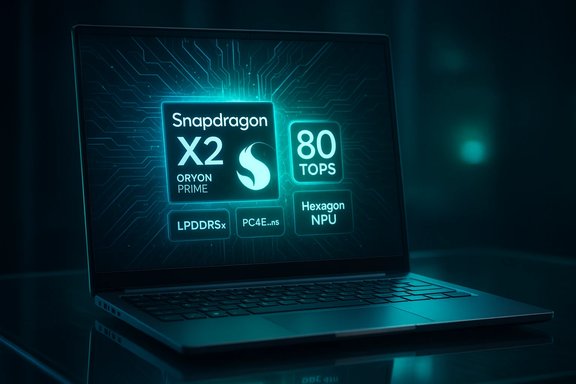
Laptop promo highlighting Snapdragon X2 Plus with 80 TOPS Hexagon NPU, Adreno GPU, and Wi‑Fi 7.Background​

The Snapdragon X2 Plus is the newest member of Qualcomm’s Snapdragon X Series, introduced at CES 2026 as a complement to the X2 Elite family. Qualcomm positions X2 Plus explicitly for mainstream Windows 11 Copilot+ laptops and 2‑in‑1 systems: devices that must run local AI workloads efficiently to unlock Microsoft’s newest on-device features. The platform promises to bridge the gap between premium AI-capable ultrabooks and more affordable thin-and-light machines. This announcement follows Qualcomm’s earlier expansion of the Snapdragon X family (including X2 Elite and Elite Extreme), and comes amid competing launches from Intel and AMD that also emphasize integrated NPUs and better AI efficiency. The competition has shifted the laptop market from a pure CPU-and-GPU contest into a three-way fight that increasingly centers on the capability and accessibility of NPUs and the software ecosystems that use them.

What Snapdragon X2 Plus actually is​

Platform summary​

  • CPU: 3rd Gen Qualcomm Oryon custom CPU cores (architecture tuned for sustained, efficient performance).
  • NPU: Qualcomm Hexagon NPU rated at 80 TOPS (trillion operations per second).
  • GPU: Adreno X2‑45 family (frequency and configuration differ between 6‑core and 10‑core SKUs).
  • Variants: Two principal configurations — a 10‑core model aimed at higher-tier ultraportables and a 6‑core model targeted at value and fanless designs.
  • Memory & I/O: Support for LPDDR5x, high memory bandwidth targets, and connectivity with Wi‑Fi 7 and optional 5G.
  • Security / Manageability: New Snapdragon Guardian feature set for device protection and remote management.
  • Availability: Qualcomm projects select OEM devices in the market in the first half of 2026.

Two SKUs, one design philosophy​

Qualcomm’s strategy with X2 Plus mirrors common silicon segmentation: both SKUs share the same NPU architecture (80 TOPS) and the same underlying process, but differ in core count, cache, and GPU clocks to create clear price-performance tiers. The 10‑core X2 Plus emphasizes higher sustained throughput with more cache and faster GPU clocks, while the 6‑core part trades some peak GPU headroom and cache for lower cost and improved thermals in fanless designs. Early reporting from press briefings and OEM reveals lines up with this dual‑SKU approach.

Technical deep dive​

3rd Gen Oryon CPU: speed vs. efficiency​

Qualcomm claims the third‑generation Oryon CPU in X2 Plus delivers up to 35% faster single‑core performance compared with the previous generation while consuming about 43% less power. Those figures come directly from Qualcomm’s launch materials and were reiterated in multiple press briefings. The combination of a higher single‑thread ceiling and lower energy draw is central to Qualcomm’s message: better responsiveness for everyday apps with longer battery life under sustained load. These improvements are consistent with Qualcomm’s emphasis on efficiency-first microarchitecture tuning for thin-and-light Windows devices. Caveat: microarchitectural claims from vendors are useful directional indicators but must be validated in independent, real-world testing. Single‑core percentage gains often depend heavily on the comparison baseline, workload mix, and thermal constraints of a given laptop design.

Hexagon NPU — 80 TOPS and what it means​

The X2 Plus’s headline figure is 80 TOPS for its integrated Hexagon NPU — a number Qualcomm uses to qualify Copilot+ eligibility and to advertise a broad set of local AI capabilities such as real‑time transcription, image and video enhancements, and “agentic” assistant workloads that run without cloud dependency. For consumers, that translates into faster local inference for generative features, privacy‑friendly processing, and lower latency for interactive tools. Analysts and press outlets repeatedly confirmed the 80 TOPS specification at launch. Important nuance: TOPS is a synthetic throughput metric. Practical performance for ML models depends on model size, supported numeric formats (INT8, FP16, FP8, etc., on‑chip memory, bandwidth, and software stack optimizations. The effective advantage of 80 TOPS will vary widely by workload and software maturity.

Graphics and memory​

X2 Plus uses the Adreno X2‑45 GPU family. Qualcomm’s slides show different GPU clocks between the SKUs, with the higher‑end 10‑core variant running the GPU at higher frequencies. Memory support targets LPDDR5x with high bandwidth; some OEM device specs included support for up to 128 GB of LPDDR5x in premium configurations. These choices reflect a platform optimized for AI‑assisted creative tasks that often blend NPU work with GPU acceleration (e.g., image enhancement, upscaling) and benefit from higher memory throughput.

Connectivity and security​

Wi‑Fi 7 support and optional 5G modems position X2 Plus as a connectivity-forward platform — fast local networks and cloud fallback remain part of the modern hybrid workflow. On the security front, Qualcomm debuted Snapdragon Guardian, a hardware-and-cloud managed suite that promises features like remote locate/lock/wipe, out‑of‑band management, and integration with enterprise IT workflows. Guardian leverages built‑in cellular fallback to manage devices even when they’re turned off or offline — a clear push toward enterprise trust and fleet management.

Windows 11 Copilot+ integration: why it matters​

Microsoft’s Copilot+ program ties certain on-device AI capabilities to hardware thresholds so vendors can guarantee a baseline user experience for features that run locally. Qualcomm’s messaging highlights that any device carrying the X2 Plus’s 80 TOPS Hexagon NPU will meet those thresholds, unlocking exclusive Windows features such as advanced Recall functionality and Windows Studio effects (local background substitution, auto framing, and more). That hardware‑based qualification is a strategic lever: it incentivizes OEMs to adopt X2 Plus to ship Copilot+‑eligible machines at lower price points than X2 Elite. From a user perspective, on‑device Copilot features promise lower latency, less cloud reliance for routine tasks, and potentially better privacy for sensitive inference. From a Microsoft/OEM perspective, Copilot+ creates a clearer product segmentation and a competitive advantage for platforms that meet the technical bar.

OEM adoption and the first wave of devices​

Several OEMs used CES to show products or configuration options that include Snapdragon X2 Plus silicon. HP’s OmniBook Ultra 14, for instance, will be offered with Qualcomm X2 silicon variants alongside Intel Panther Lake options — confirming Qualcomm’s device strategy across mainstream and premium OEM portfolios. Windows Central and other outlets reported that HP, Lenovo, ASUS, and others will adopt the X2 family across a range of thin‑and‑light, 2‑in‑1, and even fanless designs slated for the first half of 2026. Qualcomm’s own press materials list “select devices from leading OEMs” coming in H1 2026. Key takeaways for buyers:
  • Expect a mix of ultraportables, business ultrabooks, and 2‑in‑1s with X2 Plus.
  • OEMs will likely offer multiple processor choices for the same chassis (Qualcomm, Intel, and sometimes AMD).
  • Release windows depend heavily on OEM validation and memory/power component availability, so “H1 2026” is an OEM- and region-dependent expectation rather than a hard shipping date for all models.

Performance positioning and competitive landscape​

Qualcomm’s message positions X2 Plus as an ideal mid‑market AI chip: faster and more efficient than prior Snapdragon X Plus iterations, and bringing the 80 TOPS NPU to a broader set of devices. Review previews and early benchmark leaks show the X2 Plus delivering strong AI and single‑thread CPU performance relative to prior Arm PC silicon, and competitive generative‑AI throughput compared with Intel’s NPU-equipped Panther Lake family. However, Panther Lake’s NPU (reported at around 50 TOPS) and Intel’s stronger CPU core lineage remain meaningful competition; Apple’s silicon and AMD’s growing AI play also factor into the landscape. Practical implications:
  • If your workflow depends heavily on local AI inference (transcription, image manipulation, on‑device models), X2 Plus looks materially compelling.
  • If you rely on heavy single‑thread x64 desktop apps or on maximum GPU gaming, Intel and AMD still present strong alternatives; benchmarks vary by workload and thermal headroom.
  • Software maturity — namely how many mainstream Windows apps are optimized for Arm64 and NPUs — will largely define the perceived advantage in early shipments. Microsoft’s recent Prism emulator updates and developer interest are closing the gap, but translation still costs cycles.

Strengths: where X2 Plus shines​

  • On‑device AI throughput: 80 TOPS is a significant figure at mainstream price points, enabling richer local Copilot+ experiences and offline AI capabilities.
  • Efficiency gains: Qualcomm’s claim of improved single‑core speed with lower power suggests better sustained workloads without aggressive throttling in thin designs. This matters for creators and professionals who need consistent responsiveness.
  • Broad OEM reach: Early partner announcements (HP and others) indicate the architecture won’t be limited to niche devices, increasing consumer choice.
  • Enterprise features: Snapdragon Guardian and built‑in connectivity give IT teams stronger remote control and anti‑theft options, which is attractive for fleet management.
  • Connectivity: Wi‑Fi 7 and optional cellular modems future‑proof devices for high bandwidth and mobility scenarios.

Risks and caveats​

1. Real‑world AI performance depends on software​

TOPS numbers are useful for marketing but don’t guarantee user experience. ML performance depends on model support, runtime optimizations, memory architecture, and developer adoption. Users should wait for independent benchmarks on real apps (e.g., local model inference, audio transcription, video processing) before treating TOPS as a single source of truth.

2. App compatibility and emulation overhead​

Although Microsoft is actively improving Windows on Arm’s Prism emulator (adding AVX/AVX2 and other extensions), running legacy x64 apps under translation still carries overhead and occasional incompatibilities. Enterprise users or professionals dependent on niche x64 applications should validate mission‑critical software on Arm devices before migrating. Expect the best results on apps that are natively compiled for Arm64 or recompiled with NPU/GPU acceleration.

3. Pricing and memory supply pressures​

Qualcomm repeatedly emphasized price accessibility, but high LPDDR5x memory costs and supply constraints can push OEM configurations upward or lead to lower memory SKUs in the value‑oriented segment. In some regions, higher memory prices might blunt X2 Plus’s mainstream appeal if OEMs have to compromise on RAM or storage to hit price targets.

4. Competitive pressure from Intel and others​

Intel’s Panther Lake and AMD’s AI-centric roadmap focus heavily on NPU integration and CPU/GPU balance. While Qualcomm’s NPU advantage is clear on paper, Intel’s CPU/GPU pedigree, aggressive punch on single‑thread workloads, and software ecosystem depth are important counterweights. Market dynamics will play out in heterogeneous device lineups and sustained software optimizations.

5. Security and privacy trade‑offs​

Snapdragon Guardian’s remote features are powerful for enterprise management, but centralized remote-control capabilities always raise governance questions. IT administrators will need robust policies, clear role controls, and audit trails to prevent misuse. From a consumer privacy perspective, on‑device AI reduces cloud exposure, but any cloud‑connected management or telemetry must be transparent and auditable.

What buyers should look for in X2 Plus machines​

When evaluating the initial wave of X2 Plus laptops, prioritize the following:
  • Native Arm64 app availability for your core workflows. Native apps will always yield the best performance and battery life.
  • RAM and storage configuration. For AI workloads, more LPDDR5x bandwidth and capacity matter. Prefer 16 GB minimum for heavy multitasking or creative tasks.
  • Thermal design and sustained performance testing. Thin laptops vary widely in how they manage sustained loads; independent reviews should include long-duration tests.
  • Battery capacity and real‑world battery testing. Qualcomm’s “multi‑day” claims are enticing, but real battery life depends on screen, brightness, and workload mix.
  • Enterprise manageability needs. If fleet management is a requirement, evaluate Snapdragon Guardian features and their integration with your existing MDM tools.

Developer and ecosystem considerations​

Qualcomm’s strategy depends as much on software as silicon. Increasingly, NPUs require toolchains, SDKs, and model conversion pipelines so developers can compile or offload inference efficiently. Qualcomm is leaning on partnerships with app vendors and Microsoft’s Copilot+ developer guidance to accelerate optimization.
From a platform perspective, Microsoft’s improvements to Prism and ongoing developer interest in Arm64 builds reduce migration friction. Still, software vendors must prioritize native builds to fully exploit the NPU and avoid emulation overhead that erodes battery and performance benefits. Early success will hinge on readily available libraries, streamlined workflows for model deployment, and transparent documentation for developers targeting Hexagon and Adreno accelerators.

Final analysis — who wins and why it matters​

Snapdragon X2 Plus is a strategic product: it democratizes high‑end NPU throughput by putting 80 TOPS into a more affordable performance tier. That matters because it sets a baseline for what consumers and businesses can expect from mainstream AI‑capable Windows laptops: real-time transcription, on-device photo and video enhancement, advanced meeting features, and responsive Copilot interactions — all with less reliance on cloud inference.
Qualcomm’s strengths are clear: efficient custom CPU cores tailored to sustained mobile workloads, a powerful Hexagon NPU, and a design that emphasizes connectivity and security via Guardian. Combined with an aggressive OEM roadmap, X2 Plus could quickly make Copilot+ capabilities commonplace in sub‑premium price brackets. Risks are equally real. Practical AI advantage depends on model and app optimizations, memory pricing can shape final product value, and emulation still presents friction for legacy x64 software. Intel’s Panther Lake and other competitors will blunt the narrative that one vendor “owns” on‑device AI; instead, consumers will see a richer, more fragmented market where the right choice depends on workloads, app compatibility, and price points.

Conclusion​

The Snapdragon X2 Plus is Qualcomm’s pragmatic play for the mainstream Copilot+ era: it brings an 80 TOPS Hexagon NPU and a more efficient Oryon CPU design to a price-sensitive tier of Windows laptops, backed by OEM interest and enterprise-grade features like Snapdragon Guardian. For users who prioritize on‑device AI, battery life, and always‑on connectivity, X2 Plus machines look promising. For buyers anchored to legacy x64 applications or the highest GPU gaming performance, Intel and AMD variants — and the evolving state of emulation and native Arm64 ports — will remain compelling alternatives.
The coming months of independent reviews, OEM device tests, and real‑world app benchmarking will determine whether Qualcomm’s promises translate into everyday gains. Early signs at CES and OEM reveals indicate a meaningful shift: AI‑capable PCs are no longer confined to the high end, and that change will shape the PC market throughout 2026.
Source: InfotechLead https://infotechlead.com/devices/qu...-power-next-gen-windows-11-copilot-pcs-92910/
 

Attachments

  • windowsforum-snapdragon-x2-plus-brings-80-tops-npu-to-mainstream-windows-copilot-laptops.webp
    windowsforum-snapdragon-x2-plus-brings-80-tops-npu-to-mainstream-windows-copilot-laptops.webp
    150.7 KB · Views: 0
Qualcomm’s latest salvo in the PC silicon wars brings the company’s Snapdragon X2 family downmarket with a purpose-built part for mainstream Windows 11 Copilot+ laptops: the Snapdragon X2 Plus. Announced around CES 2026, the X2 Plus packages the same Hexagon neural processing unit (NPU) class used in Qualcomm’s premium X2 Elite chips, while trimming CPU cores and GPU clocks to hit lower price and thermal envelopes — a move designed to put meaningful on‑device AI into laptops that cost substantially less than flagship Ultrabooks.

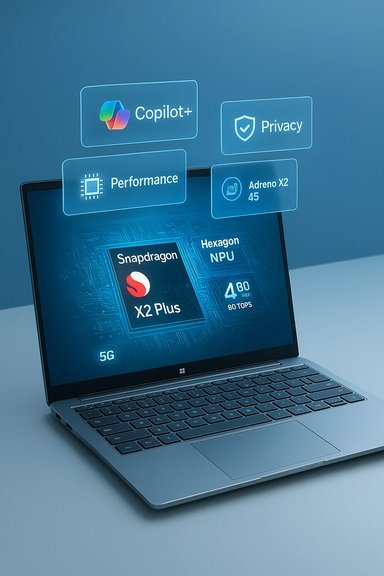
Laptop with floating panels highlighting Copilot+, Privacy, Performance, Adreno, and Snapdragon chips.Background​

Why this matters now​

The laptop market has shifted from a two-way fight between CPU and GPU into a three-cornered contest where the on‑device NPU is increasingly decisive. Microsoft’s Copilot+ certification and the broader push for local inference — faster responses, offline capabilities and privacy-sensitive processing — give hardware vendors a clear threshold to hit. Qualcomm’s X2 Plus is explicitly positioned to help OEMs meet that bar in mainstream price tiers, expanding the pool of machines able to run Copilot features locally without cloud round trips.

Market context: ARM’s place in the PC landscape​

ARM‑based processors (including Apple’s M-series, Qualcomm’s Snapdragon family and Arm‑based Chromebooks) have steadily grown their presence in the PC market, but remain a minority compared with x86. Recent market figures place ARM’s share of microprocessor unit shipments in the low‑to‑mid teens — roughly just under 14% of the PC microprocessor market in the most recent quarter reported — an addressable base that is growing but still far from parity with Intel and AMD. That positioning matters: bringing stronger NPUs to midmarket Windows devices is one lever to accelerate native Arm workloads and broaden real‑world adoption.

What Qualcomm announced: the Snapdragon X2 Plus, explained​

Product positioning and SKUs​

The Snapdragon X2 Plus sits between Qualcomm’s flagship X2 Elite/Extreme chips and entry-level X Platform SKUs. Qualcomm released two principal X2 Plus configurations:
  • A 10‑core model (identified in some materials as X2P‑64‑100) — targeting higher‑tier ultraportables with a mixed core layout.
  • A 6‑core model (X2P‑42‑100) — aimed at more power‑sensitive or fanless mainstream designs.
Both SKUs share the same Hexagon NPU class and the Adreno family GPU (Adreno X2‑45), but differ in CPU core counts, cache and peak GPU clocks to create distinct price/performance tiers. Qualcomm projects OEMs will use the X2 Plus to ship Windows 11 Copilot+ systems in early 2026.

Key headline specifications (vendor claims)​

  • NPU: Hexagon NPU class rated at roughly 80 TOPS (INT8 throughput) — the same NPU class used in X2 Elite/Extreme variants and the central spec claimed to enable Copilot+ functionality.
  • CPU: Third‑generation Oryon cores, tuned for sustained and efficient performance rather than only short turbo bursts; Qualcomm claims up to ~35% single‑core performance improvement vs. the previous X Plus generation.
  • GPU: Adreno X2‑45 with vendor‑quoted GPU uplift in the high‑20s to high‑30s percent vs. the prior generation, depending on SKU and test.
  • Memory & I/O: LPDDR5x support, Wi‑Fi 7 FastConnect, and optional integrated 5G modem configurations. Peak memory bandwidth figures and maximum supported capacities vary by OEM configuration.
  • Process node: Built on a 3nm‑class process (vendor messaging emphasizes die‑density and efficiency benefits).
These are Qualcomm’s public claims and form the basis for how OEMs will qualify devices as Copilot+ capable; the actual user experience will depend on final device tuning.

Technical deep dive​

The CPU story: Oryon, sustained performance, and what that buys you​

Qualcomm’s Oryon lineage continues to emphasize energy‑efficient sustained throughput rather than chasing the highest short‑term turbo clocks. For laptop workloads — web browsing, editing, compiling, and multitasking — sustained responsiveness often matters more than transient peak numbers. Qualcomm’s claim of up to 35% single‑core improvement over the prior generation is a vendor‑supplied comparative, reflected in internal benchmarks and early engineering samples, but it should be treated as a directional indicator until independent retail testing is available. OEM power limits and chassis thermals will determine sustained clocks and therefore real‑world gains.

The GPU: incremental gains, sustained throughput​

The Adreno X2‑45 GPU is presented as an evolutionary step: Qualcomm quotes up to roughly 29% improvement for some tests, while other vendor notes place the figure higher depending on the SKU and workload. The architectural focus is on efficiency and steady frame delivery at low power, which benefits UI fluidity, media acceleration, and casual gaming — not high‑end AAA gaming at ultra settings. Again, OEM clocking choices change outcomes.

The NPU: why 80 TOPS is the narrative weapon​

The X2 Plus’s most consequential spec is the Hexagon NPU class rated at ~80 TOPS. That figure is the headline because Microsoft’s Copilot+ eligibility is tied to baseline on‑device inference capability; delivering 80 TOPS at mainstream price points helps OEMs certify more devices. Practically, the NPU allows more complex or faster local model inference — better transcription, faster summarization, more responsive assistant tasks and privacy‑friendly processing without cloud dependency.
Important nuance: TOPS is a synthetic throughput metric, not a user‑experience guarantee. Effective model inference speed depends on memory bandwidth, on‑chip memory, supported numeric formats (INT8, FP16, FP8), runtime optimizations and software maturity. In short, 80 TOPS raises the ceiling for what can run locally, but software and system integration determine how much of that ceiling gets used.

Performance claims vs. independent verification​

What Qualcomm showed and what independent previews reported​

Qualcomm demonstrated power‑normalized slides and engineering‑sample benchmarks at its briefings and at CES. Early hands‑on previews from multiple outlets reported the same SKU split and NPU headline, and some early benchmark runs (Geekbench‑style, AI inference tests) on preproduction hardware broadly tracked vendor claims — higher single‑thread responsiveness and strong AI scores on ML benchmarks. Those early reports are consistent, but they come with caveats: test conditions, power normalization and firmware build differences affect results materially.

What to expect in retail devices​

Retail machines will vary by:
  • OEM power limits (PL1/PL2 or a chassis‑level sustained envelope).
  • Cooling subsystem (fanless vs active cooling with vapor chamber).
  • Memory capacity and bandwidth (LPDDR5x speed and configuration).
  • Driver maturity and software stack (Hexagon runtime, DirectML/DirectX integrations, optimized model pipelines).
Independent retail reviews will be the final arbiter; vendor engineering samples are directional but not definitive. Buyers should wait for full device reviews and real‑world battery tests before making migration or procurement decisions.

Copilot+ integration and OEM adoption​

Microsoft’s role and OEM participation​

Microsoft’s Copilot+ program ties certain Windows features to on‑device AI capability. Qualcomm’s messaging is explicit: devices with the X2 Plus’s NPU class can unlock Copilot experiences such as advanced Recall, Studio Effects and local assistant features without offloading sensitive data to the cloud. Several OEMs showcased or confirmed Snapdragon X2 family designs at CES — HP, Lenovo, ASUS and others — and the first wave of X2 Plus‑powered laptops is expected in early 2026 (H1 in Qualcomm’s materials).

What OEMs will trade off in practice​

To hit mainstream price brackets, OEMs will juggle memory capacity, storage, display resolution and chassis materials. That means some lower‑cost SKUs may ship with smaller LPDDR5x capacities or narrower memory bandwidth, which will blunt peak AI and multitasking performance compared with premium configurations. Prospective buyers should check the exact SKU and verify that the retail model’s power and memory choices align with their workloads.

Power efficiency and real battery outcomes​

Qualcomm promotes significant efficiency gains — vendor materials suggest up to ~43% improved power efficiency versus the prior X Plus generation and marketing language such as “multi‑day” battery for light usage. Those are plausible outcomes on lightweight tasks, thanks to a 3nm‑class process and microarchitectural tuning, but actual run times will depend heavily on screen brightness, platform power management, and workload mix. Battery claims should be validated with independent, consistent measurement methods (e.g., web browsing or video playback at standardized brightness levels).

Security, connectivity and manageability​

  • Snapdragon Guardian: A Qualcomm suite combining hardware and cloud services for remote management, locate/lock/wipe and out‑of‑band device control aimed at enterprise fleets. This leverages integrated cellular fallback for device management scenarios.
  • Connectivity: FastConnect Wi‑Fi 7 readiness and optional integrated 5G modems position X2 Plus machines for modern hybrid work patterns.
  • Platform security: Qualcomm highlights integration with hardware security modules and the inclusion of secure enclaves in the platform, aligning with enterprise expectations for manageability and firmware servicing.
These features are attractive to IT departments, though enterprise buyers must evaluate management policies, firmware‑update cadences and governance around remote control features. Centralized remote management always requires careful policy controls.

Competitive landscape: how X2 Plus stacks up​

Against Intel Panther Lake​

Intel’s Panther Lake (Core Ultra Series 3) reasserts Intel’s focus on integrated NPUs — multiple outlets report an NPU in the ~50 TOPS range for Panther Lake family parts — and substantial improvements in CPU and GPU performance. Panther Lake’s combined platform TOPS (CPU+GPU+NPU) is promoted as another route to richer on‑device AI. The practical contest is nuanced: Qualcomm’s X2 family promotes a higher standalone NPU TOPS figure at 80 TOPS, while Intel’s platform-level integration and x86 software compatibility remain major strengths for legacy Windows users.

Against AMD and Apple​

AMD’s Ryzen AI roadmap and Apple’s M-series continue to press in different ways: Apple’s silicon leads in single‑thread and software maturity on macOS, while AMD emphasizes hybrid CPU+NPU balance. Qualcomm’s differentiation is a tightly integrated NPU plus modem/connectivity, with a particular focus on Windows Copilot+ ecosystems. Buyers choosing platforms should match workload profiles (native app needs, GPU requirements, emulation tolerance and enterprise management) to platform strengths rather than chasing a single metric.

Strengths, risks and buyer guidance​

Strengths​

  • NPU parity with Elite: Bringing the same class of Hexagon NPU to a midmarket SKU is a strategic advantage for accelerating Copilot+ adoption.
  • Efficiency-focused design: Oryon tuning and a 3nm process promise meaningful battery life and sustained performance in thin designs.
  • OEM reach: Early OEM commitments and CES showings indicate Qualcomm is not limited to niche devices — mainstream notebooks and convertibles are on the roadmap.

Risks and caveats​

  • TOPS vs. experience: 80 TOPS is a ceiling; application‑level benefit depends entirely on software integration, memory bandwidth and model optimization. Treat TOPS as one indicator, not proof of superior UX.
  • Emulation and app compatibility: Legacy x64 applications that aren’t recompiled for Arm still run under emulation, which can incur overhead. Enterprises should validate mission‑critical applications on Arm devices.
  • OEM tuning variability: Performance and battery life depend more on OEM power limits and thermal design than raw chip specs; one X2 Plus laptop may feel significantly different from another.
  • Pricing and memory supply: To hit lower price points, OEMs may ship lower LPDDR5x capacities or slower configurations, reducing the marginal benefit of a high‑TOPS NPU in practice.

Practical buyer checklist​

  • Confirm the exact X2 Plus SKU (6‑core vs 10‑core) and the OEM’s power‑profile for that model.
  • Verify LPDDR5x capacity and bandwidth; higher bandwidth matters for AI and mixed workloads.
  • Check whether the OEM ships a validated Copilot+ Windows image with required driver and runtime updates.
  • Wait for independent reviews that show battery life, sustained performance and real‑world AI tasks, rather than relying solely on vendor slides.

The ecosystem question: will developers and enterprises follow?​

Qualcomm’s strategy is only half the equation. Software vendors, ISVs and Microsoft must optimize runtimes, provide Arm‑native binaries for key applications and adapt models to make practical use of the Hexagon NPU. Microsoft’s work on Prism and emulator improvements reduces friction for legacy apps, but the best experience will always come from native builds with optimized inference paths. Enterprises should run pilot programs and validate their own workloads before broad rollouts.

Conclusion​

The Snapdragon X2 Plus is a deliberate, pragmatic move by Qualcomm to bring serious on‑device AI to the mainstream Windows laptop market. By transplanting the high‑throughput Hexagon NPU class into lower‑cost SKUs while trimming CPU/GPU resources, Qualcomm is betting that Copilot+ experiences and local inference will matter enough to buyers and enterprises to shift buying decisions.
That bet is credible: early engineering previews and vendor briefings report real generational gains and a clear strategy to expand Copilot+ eligibility. But the headline numbers — 80 TOPS, 35% single‑core gains, and multi‑day battery claims — should be considered directional until independent retail devices are tested under consistent conditions. The true impact of X2 Plus will hinge on OEM configuration choices, software optimizations and whether Microsoft’s Copilot+ ecosystem and ISVs seize the opportunity to ship native, NPU‑aware experiences at scale.
For consumers and IT decision‑makers, the sensible approach is measured optimism: the X2 Plus is a meaningful step toward democratized on‑device AI, but the practical value will be realized only when final OEM SKUs, drivers and native software converge to put those raw numbers into regular use. Validate configurations, wait for full reviews, and pilot deployments where possible — if Qualcomm’s claims hold up in shipping devices, the X2 Plus could significantly broaden the set of Windows laptops that deliver fast, private and responsive AI features without needing a cloud trip.

Source: Silicon UK Qualcomm Debuts Lower-Cost Desktop Chip | Silicon UK Tech
 

Blue-tinted laptop highlighting the 3rd Gen Oryon CPU with 80 TOPS Hexagon NPU and Wi-Fi 7.
Qualcomm’s announcement of the Snapdragon X2 Plus at CES 2026 reshapes the mid‑tier of the Windows 11 Copilot+ PC market: it pairs a third‑generation Oryon CPU with an 80 TOPS Hexagon NPU, Wi‑Fi 7 connectivity and optional 5G, promising faster single‑core performance, materially lower power consumption, and more capable on‑device AI than the previous Snapdragon X generation.

Background​

Qualcomm’s Snapdragon X Series has been the company’s strategic vehicle for pushing Arm‑based silicon into mainstream Windows laptops, targeting thin, light and always‑connected designs. The Snapdragon X2 family launched in 2025 as Qualcomm’s attempt to close the gap with high‑end x86 and Apple silicon, and the Snapdragon X2 Plus is the newly revealed mid‑range member that aims to bring many of the Elite series’ AI and efficiency advantages to a broader set of devices.
Microsoft’s Copilot+ PC initiative requires devices to meet minimum on‑device AI performance and system specifications so certain AI experiences run locally and responsively. The Copilot+ certification notably calls for NPUs capable of at least 40 TOPS and baseline system specs such as 16 GB RAM and 256 GB of storage to enable features like Recall, Click to Do, Live Captions with translation and other generative or perceptual AI tasks. Snapdragon X2 Plus, with its integrated 80 TOPS NPU and platform level features, is positioned squarely to power those experiences.

What Qualcomm announced: the headline specifications​

  • CPU: 3rd Gen Oryon architecture (Qualcomm‑branded). Qualcomm claims up to 35% faster single‑core CPU performance than the previous generation and up to 43% lower power for comparable tasks.
  • NPU: Integrated Qualcomm Hexagon neural processing unit rated at 80 TOPS for INT8 workloads.
  • GPU: Adreno X2‑45 class integrated graphics with differentiated clock tiers across SKUs.
  • SKUs: Two primary X2 Plus SKUs have been shown to OEMs — a 10‑core and a 6‑core model — with the 10‑core variant targeting higher‑end ultrabooks and the 6‑core variant aimed at more cost‑sensitive designs.
  • Memory: Support for up to 128 GB LPDDR5x, with a 128‑bit bus delivering approximately 152 GB/s of memory bandwidth.
  • Connectivity: Wi‑Fi 7 via Qualcomm’s FastConnect system and optional 5G modem support for always‑connected designs.
  • Security: Qualcomm bundles platform security under the Snapdragon Guardian umbrella.
  • Availability: Systems from several major OEMs are slated to arrive in the first half of 2026, marketed as Windows 11 Copilot+ PCs.
Multiple independent outlets and Qualcomm’s press materials repeat the central claims above. However, the company’s public announcement emphasized comparative performance and efficiency gains rather than exhaustive technical disclosure, and some micro‑specs and sustained power targets remain subject to OEM briefs and follow‑up documentation.

Deep dive: CPU, NPU, and memory architecture​

3rd Gen Oryon CPU — what to expect​

The 3rd Gen Oryon CPU is the heart of the Snapdragon X2 Plus. Qualcomm frames this generation around single‑thread responsiveness and improved energy efficiency — the two metrics most consumers notice in everyday tasks like web browsing, document editing and switching between apps.
  • The company’s performance figures claim up to 35% faster single‑core performance compared to the prior Snapdragon X family, which would be a meaningful uplift in scenarios that still favor high IPC and high single‑thread throughput.
  • Energy claims of 43% lower power usage for similar workloads suggest Qualcomm optimized both microarchitecture and process node characteristics to reduce leakage and dynamic power.
Caveat: the manufacturer’s delta figures describe relative, lab‑controlled comparisons. Independent third‑party benchmarks under real‑world sustained loads (office suites, compilation, long‑run content creation, thermal throttling scenarios) will be required to validate how those gains translate to delivered performance across devices.

Hexagon NPU at 80 TOPS — doubling the on‑device AI headroom​

Qualcomm integrated a Hexagon NPU rated at 80 TOPS into the X2 Plus platform. Since Microsoft’s Copilot+ features generally require an NPU capable of at least 40 TOPS, the X2 Plus effectively doubles that baseline, enabling:
  • Larger or more simultaneous local AI models.
  • Reduced latency for inference‑heavy features such as image generation, real‑time transcription/translation and sophisticated assistant tasks.
  • The ability to run multiple agentic experiences concurrently without immediately offloading to cloud compute.
This 80 TOPS mark is significant from a product positioning perspective: it is designed to support the richer generative and perceptual AI experiences Microsoft has been shipping to Copilot+ certified devices, and to give OEMs and app developers more headroom to experiment with local AI features.

Adreno X2‑45 GPU and memory bandwidth​

The integrated Adreno X2‑45 GPU family on the X2 Plus sits below the X2‑90 used in the Elite tier but still claims appreciable gains over previous generations. Reported GPU clocking differences between the 10‑core and 6‑core variants indicate Qualcomm is tuning GPU frequency to hit discrete market price points.
Memory support tops out at LPDDR5x on a 128‑bit bus, with roughly 152 GB/s of effective bandwidth listed for the platform. That memory profile is compelling for AI workloads that are sensitive to memory throughput and for multitasking with large assets (e.g., high‑resolution images, complex browser workloads, virtualized environments).

Copilot+ compatibility and the local‑AI equation​

Microsoft’s Copilot+ program is designed to offload many AI tasks to the device. That makes the NPU a pivotal specification for evaluation.
  • Minimum thresholds: Many Copilot+ experiences require NPUs capable of 40+ TOPS; the Snapdragon X2 Plus’s 80 TOPS specification comfortably exceeds that threshold.
  • Local AI features: Capabilities like Recall (local search and snapshotting of activity), Click to Do (contextual interaction), Live Captions with real‑time translation, and Cocreator image generation are heavily optimized for on‑device inference to reduce latency and privacy exposure.
  • Operational overhead: Running generative models locally still demands substantial memory, storage and thermal headroom. Microsoft’s guidelines (16 GB RAM minimum, 256 GB SSD, Windows 11 24H2 or newer) remain relevant checkboxes for OEMs and enterprise IT.
Practical implication: the X2 Plus is built to enable richer, locally executed Copilot+ features without requiring constant cloud connectivity, which matters for privacy‑conscious users and for reducing latency on interactive workflows.

Connectivity and security: Wi‑Fi 7, 5G and Snapdragon Guardian​

Connectivity is a visible selling point for Snapdragon X platforms, and X2 Plus continues that trend.
  • Wi‑Fi 7 integration promises higher throughput, lower latency and better handling of congested networks — features that benefit large file transfers, cloud synchronization and collaborative video workflows.
  • Optional 5G keeps the always‑connected PC concept alive for mobile users who want cellular backup or full‑time connectivity.
  • Snapdragon Guardian groups Qualcomm’s hardware and platform security features under one brand. While the announcement highlighted improved security, the company did not enumerate all hardware or software controls — an expected approach when listing platform benefits at launch.
Security and connectivity are crucial for the target audience — professionals, creators and mobile knowledge workers who shift between office, home and travel environments.

Power and battery life claims: multi‑day promises, but verify in the lab​

Qualcomm’s claim of multi‑day battery life stems primarily from the power efficiency gains of the 3rd Gen Oryon CPU and the platform’s system optimizations. Multi‑day battery life is an appealing marketing phrase, but it is highly sensitive to:
  • Device design (battery capacity, chassis thermals, display technology).
  • Workload mix (video conferencing, streaming, AI inference, web browsing).
  • OEM firmware, power management tuning and display brightness targets.
At this stage, the absence of standardized battery runtime figures, test conditions and sustained power targets makes the “multi‑day” claim unverifiable in isolation. Independent reviews using standardized benchmarks and real‑world traces will be necessary to substantiate how many hours—and under which workloads—X2 Plus systems achieve the advertised endurance.

Market positioning and competition​

Qualcomm positions Snapdragon X2 Plus to broaden access to Copilot+ experiences, situating it between the entry‑level Snapdragon X and the higher‑end X2 Elite / X2 Elite Extreme.
  • Target segments: modern professionals, aspiring creators, and general consumers who demand long battery life and responsive systems.
  • Pricing expectations: industry coverage suggests OEM pricing tiers where Plus sits below Elite, enabling broader OEM adoption and easier OEM configurability for business fleets.
  • Competitive landscape: X2 Plus faces established x86 players (Intel and AMD) who have accelerated their own AI‑centric product roadmaps, and Apple’s M‑series systems which continue to define high performance‑per‑watt benchmarks in the laptop space.
  • Software ecosystem: Windows on Arm has advanced rapidly, but compatibility gaps remain for certain legacy x86 applications and specialized software stacks. Qualcomm and Microsoft have been addressing these gaps with improved emulation and AVX2 support; nevertheless, enterprise buyers will likely evaluate compatibility on a per‑app basis.
For OEMs and enterprise IT buyers, X2 Plus is attractive if the balance of real‑world application compatibility, battery life and manageability meets operational needs.

Strengths: where Snapdragon X2 Plus stands out​

  • AI headroom: An 80 TOPS Hexagon NPU gives the platform clear on‑device AI capacity, enabling richer Copilot+ experiences and offline capabilities.
  • Efficiency gains: Qualcomm’s stated reductions in power draw combined with higher single‑thread performance are attractive for thin and light designs where thermal headroom is limited.
  • Connectivity: Wi‑Fi 7 plus optional 5G is a strong selling point for mobile professionals.
  • Memory support: Up to 128 GB LPDDR5x and healthy bandwidth reduce bottlenecks for multitasking and inference workloads.
  • Ecosystem momentum: Improved software (AVX2 emulation, dedicated GPU driver updates, Snapdragon Control Panel) reduces friction for gaming and legacy app compatibility.
These strengths make the X2 Plus a compelling choice for buyers who want Copilot+ features and on‑device AI without paying elite flagship prices.

Risks and caveats: what to watch for​

  1. Emulation and legacy app compatibility
    • Even with AVX2 emulation and improved anti‑cheat support, certain x86 workloads and niche software may still run with reduced performance or encounter edge‑case compatibility issues.
  2. Thermals and sustained performance
    • Peak CPU/GPU bursts reported in launch briefs do not reveal sustained power envelopes. Throttling under long creative or compute tasks can negate peak gains.
  3. Battery claims need independent verification
    • “Multi‑day battery life” is marketing‑friendly but unspecified. Buyers should wait for third‑party battery traces across typical workloads.
  4. Software stack maturity
    • Local AI features depend on a complex software stack: optimized model pipelines, drivers, Windows updates and OEM firmware. Early devices frequently ship with incremental updates that refine performance and battery behavior.
  5. Privacy concerns around Copilot+ features
    • Features like Recall capture snapshots of user activity (opt‑in on many systems). Although Microsoft emphasizes local storage and encryption, privacy considerations will remain a deployment and policy discussion for enterprises.
  6. Supply chain and pricing pressure
    • Component shortages (DRAM) and geopolitical supply constraints can affect pricing and availability; OEM pricing may vary by region and configuration.
These risk vectors suggest a cautious adoption strategy for enterprise buyers and a preference for waiting for device reviews for consumers who need definitive answers on runtime and compatibility.

OEMs, timelines and who stands to benefit​

Qualcomm indicated that selected OEM systems using Snapdragon X2 Plus would ship in the first half of 2026. The announcement did not enumerate all manufacturing partners, but industry reporting suggests multiple major PC makers are preparing X2 Plus‑based laptops for different market segments.
  • Small business and enterprise IT can benefit if vendor‑validated images and management tools arrive that prove compatibility with corporate applications.
  • Content creators and hybrid workers who value long battery life and low latency on AI features will find local inference advantageous — especially when privacy or offline operation matters.
  • Students and mobile professionals could gain access to Copilot+ features in more affordable Windows laptop configurations.
Timing and regional availability will influence early adoption curves; organizations with strict deployment windows should plan pilot evaluations once early review units surface.

Practical advice: how to evaluate X2 Plus laptops before purchase​

  1. Confirm the device meets Microsoft’s Copilot+ baseline (NPU ≥ 40 TOPS, 16 GB RAM, 256 GB SSD) if Copilot+ features are required.
  2. Review third‑party benchmarks for:
    • Real‑world battery runtimes using mixed workloads.
    • Sustained CPU and GPU performance over long workloads (content creation, compilations, rendering).
    • Emulated x86 application performance for critical business apps.
  3. Check the OEM’s update and driver strategy — platform stability often improves after several driver and firmware updates in the first months after launch.
  4. Evaluate privacy settings for Copilot+ features like Recall and ensure compliance and governance controls for enterprise deployments.
  5. If gaming or niche software is important, verify anti‑cheat support and AVX2 emulation performance for relevant titles or apps.
These steps will provide a realistic view of whether a specific X2 Plus device fits personal or organizational needs.

The broader picture: what Snapdragon X2 Plus means for Windows laptops​

The Snapdragon X2 Plus announcement is a marker of continued momentum for Arm‑based Windows PCs and the shift toward local AI experiences. By delivering an 80 TOPS NPU inside a power‑efficient platform, Qualcomm is making on‑device generative and perceptual AI more accessible beyond the highest‑end flagships.
That said, hardware alone does not guarantee success. Software compatibility, driver maturity and consistent OEM implementations will determine whether the X2 Plus delivers its promised blend of performance, battery life and AI capability in real products. For Microsoft, OEM partners and Qualcomm, X2 Plus is an important building block in the Copilot+ ecosystem; for consumers and IT buyers, it represents a promising but not yet fully proven path to AI‑enhanced productivity.

Conclusion​

The Snapdragon X2 Plus is a strategic, pragmatic move by Qualcomm: it brings much of the AI capability of the Elite tier into a more accessible platform, pairs a beefy 80 TOPS Hexagon NPU with an energy‑efficient 3rd Gen Oryon CPU, and targets the expanding market for Copilot+ Windows 11 PCs. Its strengths are clear — strong on‑device AI headroom, modern connectivity, and ambitious efficiency gains — but the usual caveats apply. Independent benchmarks, OEM chassis design choices and software maturity will ultimately decide how the platform performs in the real world.
For buyers and IT decision‑makers, the advice is pragmatic: treat the X2 Plus as an exciting option in the Copilot+ era, but verify claims through device‑level testing and real‑world compatibility checks before deploying at scale. The on‑device AI era for Windows is accelerating — Snapdragon X2 Plus is another important step forward, but the proof will be in the shipped devices and the measurements that follow.

Source: futurefive.co.nz https://futurefive.co.nz/story/qualcomm-unveils-snapdragon-x2-plus-for-copilot-pcs/
 

Qualcomm’s move to broaden its Snapdragon X2 family with the new Snapdragon X2 Plus marks a deliberate push to put meaningful on‑device AI into mainstream Windows laptops, promising high neural processing performance and improved per‑watt CPU gains while aiming to hit price points below premium Ultrabooks. The launch—announced at CES—positions the X2 Plus as a scaled, cost‑conscious sibling to the company’s X2 Elite silicon: it keeps the same class of Hexagon neural engine and Adreno graphics lineage while reducing CPU/GPU clocks and core counts to better suit thinner, lower‑cost designs.

A laptop screen shows Copilot+ UI over a glowing hexagonal network design.Background / Overview​

The PC industry is entering a third pillar of competition: not just CPU and GPU, but on‑device NPUs that accelerate inference for generative and perceptual AI features. Microsoft’s Copilot+ program—designed to offer richer, low‑latency AI experiences that can run locally—has created a clear hardware bar for OEMs and silicon vendors. Qualcomm’s Snapdragon X2 family was built with that dynamic in mind; the X2 Plus is explicitly positioned to bring the NPU throughput required by Copilot+ to more affordable systems. Early OEM partner signups and CES demos show Qualcomm and device makers coordinating to ship Windows 11 Copilot+ machines that meet Microsoft’s device requirements. This matters because mainstream laptop buyers and IT fleets live in price bands where many devices are sold and refreshed. If a vendor can deliver robust local AI on a $799–$1,199 machine, the potential reach of on‑device AI features grows substantially—creating incentives for developers, enterprises and consumers to adopt Arm‑native or NPU‑accelerated workflows.

What Qualcomm announced: Snapdragon X2 Plus, explained​

SKUs and platform position​

Qualcomm introduced the Snapdragon X2 Plus as a mid‑market member of the X2 family, sold alongside the higher‑end X2 Elite and X2 Elite Extreme SKUs. The Plus is available in two primary configurations: a 10‑core variant and a 6‑core variant. Both use Qualcomm’s third‑generation Oryon CPU microarchitecture and share the same Hexagon NPU class as the Elite parts, which is the central architectural decision that defines the product’s appeal. Key platform highlights:
  • Third‑generation Oryon CPU family focused on sustained, efficient single‑thread responsiveness.
  • Hexagon NPU at the same class used in Elite parts—Qualcomm’s public briefings point toward a high‑throughput topology aimed at local inference tasks.
  • Adreno X2‑45 family GPU, with different clock tiers across SKUs to balance performance and cost.
  • Support for LPDDR5x memory, Wi‑Fi 7 FastConnect, and optional integrated 5G modems for always‑connected designs.

Headline claims and manufacturer numbers​

Qualcomm’s launch materials and vendor briefings emphasized several measurable deltas compared with the prior X Plus generation:
  • Up to ~35% faster single‑core CPU performance on select workloads (vendor‑quoted).
  • Multi‑core uplift figures that vary by SKU (reported examples: ~10% for the six‑core and up to ~17% for the 10‑core, depending on the comparison baseline).
  • GPU improvement quoted in the high‑20s percent (examples referenced 29% uplift versus the prior gen in marketing materials).
  • The NPU throughput is a focal point—Qualcomm and most hands‑on outlets reported an NPU class rating intended to be roughly 80 TOPS (trillion operations per second) in marketing summaries; this is presented as the key enabler for Copilot+ features in mainstream models.
Caveat: these figures were presented by Qualcomm and corroborated in early engineering previews and press demonstrations; real‑world results will depend heavily on OEM power limits, thermal design and memory configurations. Independent retail device testing remains necessary to validate how those percentage improvements translate to everyday user experiences.

Why the NPU matters: Copilot+ and on‑device AI​

The most strategic claim behind X2 Plus is the parity of NPU capability with higher‑end X2 chips. Microsoft’s Copilot+ features—local summarization, faster assistant responses, studio effects, audio transcription and other inference tasks—are gated by device capabilities in some cases. By delivering an NPU class that can meet or exceed Copilot+ thresholds, Qualcomm allows OEMs to certify more devices for Copilot+ without pushing them into flagship price bands. That unlocks several practical outcomes:
  • Reduced latency and offline capability for common AI tasks.
  • Greater privacy for sensitive workloads that can run locally instead of being uploaded.
  • A larger potential install base for native Arm and NPU‑accelerated apps, encouraging developer investment.
Important nuance: TOPS is a raw throughput metric, not a UX guarantee. The effective user benefit of a high TOPS NPU depends on memory bandwidth, model format (INT8/FP16/FP8), runtime software stacks, and thermal/power headroom. Real application performance is a function of the entire platform—chip, memory, OEM firmware and software optimization.

Technical deep dive: CPU, GPU, memory and power​

CPU: third‑generation Oryon​

Qualcomm’s Oryon lineage is tuned for single‑thread responsiveness and energy‑efficient sustained performance—attributes that matter for typical productivity workflows. The X2 Plus’s 10‑core and 6‑core variants reflect OEM choices: higher core counts and cache for better sustained throughput in higher‑end ultrabooks, and a leaner 6‑core design for fanless or budget machines. Qualcomm’s quoted single‑core uplift figures are plausible given process and microarchitecture tuning, but they are vendor numbers until verified on retail hardware.

GPU: Adreno family​

The integrated Adreno X2‑45 GPU family shows incremental but meaningful generational gains in driver and sustained throughput. Qualcomm positions the GPU improvements toward UI fluidity, media acceleration and light creative workloads rather than AMD/Intel discrete‑grade gaming. Expect modest improvements in synthetic scores and real‑world GPU tasks, with clocking differences between SKUs affecting outcomes.

Memory, I/O and process node​

X2 Plus supports LPDDR5x and, in some vendor configurations, memory capacities up to 128 GB and bandwidth approaching the 150 GB/s class—specs that matter for AI and large model inference. Qualcomm also emphasized a 3nm‑class process node for density and efficiency gains, which underpins the company’s power claims. OEMs will, however, choose final memory configurations that balance BOM cost and marketed price, which means retail devices may ship with lower memory in budget SKUs.

Power efficiency and battery claims​

Vendor materials highlighted up to ~43% lower power for comparable tasks versus the prior X Plus generation, with Qualcomm suggesting multi‑day standby scenarios and strong battery life in light workloads. Those are attractive claims, but practical battery life will vary with chassis, display, component choices and firmware. Early independent previews align directionally with the efficiency narrative, yet retail device reviews are required to substantiate everyday runtimes.

Where X2 Plus fits against Intel, AMD and Apple​

ARM‑based silicon is no longer an oddity in laptops. Apple’s M‑series leads in single‑thread raw performance and a mature software ecosystem on macOS, while Intel and AMD remain dominant in x86 application compatibility and high‑end discrete GPU performance. Qualcomm’s differentiation is a combination of integrated NPU throughput, modem/connectivity, and an emphasis on efficiency for thin designs.
  • Intel’s recent Ultra/Panther Lake family competes on single‑thread performance and systems ecosystem support; Intel’s NPU claims differ in design philosophy and integration.
  • AMD’s Ryzen AI roadmap targets hybrid CPU+NPU balance with different market tradeoffs.
  • Apple’s M‑series remains a formidable performance leader in macOS but targets a different OS ecosystem.
X2 Plus’s proposition is not to win every benchmark, but to make on‑device AI broadly available in the mid‑market where most buying decisions happen.

OEM adoption, availability and device considerations​

Qualcomm indicated selected OEMs will ship X2 Plus devices in early 2026; CES demos included partners showing Snapdragon X2 options across laptops and convertibles. Some device models (examples seen at CES) will offer X2 Plus alongside Intel or AMD SKUs in the same chassis, giving consumers choice and OEMs flexibility in market segmentation. Buyers and IT teams should verify several retail details before purchase:
  • Confirm the exact X2 Plus SKU (6‑core vs 10‑core) and the OEM’s declared power/tuning profile.
  • Check RAM type and capacity—LPDDR5x bandwidth materially affects AI throughput.
  • Ensure the device ships with a validated Copilot+ Windows image or that OEMs provide drivers and firmware to meet Microsoft’s baseline.
  • Review battery and sustained performance tests from independent labs rather than relying only on vendor slides.

Strengths: what X2 Plus brings to the table​

  • On‑device AI throughput at mainstream price points: Sharing the same NPU class as Elite makes Copilot+ eligibility easier to achieve for mid‑market laptops.
  • Efficiency first: Oryon tuning and modern process nodes promise better sustained performance in thin designs.
  • OEM reach: Early partner commitments indicate the platform won’t be limited to niche models.
  • Enterprise features: Integrated connectivity and management features (e.g., Snapdragon Guardian) appeal to fleet management and remote device scenarios.

Risks, caveats and unanswered questions​

  • TOPS vs. experience: 80 TOPS is a marquee number, but practical gains depend on software stacks, memory, model formats and OEM tuning; TOPS should be treated as an upper bound on arithmetic throughput rather than a direct UX metric.
  • Emulation and app compatibility: Legacy x64 apps running under emulation still carry overhead; enterprises should validate mission‑critical apps and confirm AVX/AVX2 behavior in specific workflows. Microsoft’s emulator improvements help, but native Arm binaries remain preferable.
  • OEM variability: Two laptops with the same SoC can behave very differently based on thermal limits, power profiles and memory selection; scrutinize the retail SKU, not just the chip model.
  • Pricing and memory supply: To hit lower price points, OEMs may ship reduced RAM or slower storage; that undercuts some AI advantages if memory bandwidth is insufficient.
  • Ecosystem and developer momentum: Success hinges on ISV adoption of Arm64 builds and NPU-optimized runtimes; hardware alone won’t create a thriving ecosystem without software that leverages it.

How consumers and IT should evaluate X2 Plus laptops​

  • Check Copilot+ baseline compliance: confirm NPU, RAM and storage meet Microsoft’s stated minimums if those features are required.
  • Insist on independent battery and sustained‑load benchmarks—vendor slides rarely reflect everyday usage scenarios.
  • Validate application compatibility: test mission‑critical tools, especially if they’re legacy x86 binaries.
  • Consider the upgrade path: soldered LPDDR5x reduces future-proofing; choose a memory configuration that fits expected workloads.
  • For enterprise rollouts, run small pilots to measure actual productivity gains and governance implications of on‑device AI features.

Verification, cross‑checks and a note on market share claims​

The X2 Plus technical claims have been reported consistently across multiple independent outlets and press briefings. Early reporting from major technology publications corroborates Qualcomm’s core assertions: the presence of 6‑ and 10‑core SKUs, third‑generation Oryon CPU cores, an upgraded Adreno GPU family, and a high‑throughput Hexagon NPU aimed at Copilot+ experiences. That said, some public numeric claims require careful handling:
  • The reported 80 TOPS figure has been stated in vendor materials and repeated by press previews—this is a platform‑level marketing figure that should be validated in retail devices and measured against specific model and runtime conditions.
  • Market share references to Arm‑based PC penetration (e.g., “just under 14%”) vary by quarter, by what is included (Chromebooks, Apple M‑series Macs, and Arm‑based Windows devices), and by whether the statistic refers to unit shipments or installed base. Mercury Research and other analysts publish quarter‑by‑quarter figures that differ over time; therefore, treat any single percentage point estimate as dependent on the quarter and definitions used. Independent analyst reports show Arm client shares in the low‑to‑mid teens at times, but the exact number depends on the specific quarter and methodology.
In short: major claims are directionally supported by multiple independent reports, but the ultimate test is retail device review data and enterprise pilot results.

The strategic significance: what X2 Plus could mean for the PC market​

If Qualcomm’s X2 Plus achieves its technical promises in shipping devices, it will accelerate a pragmatic shift: Copilot+‑capable devices moving out of the premium bracket and into mainstream shopping lists. That expands the install base that can run local inference, encouraging developers to publish native Arm builds and accelerate adoption of on‑device features that prioritize privacy and low latency.
However, the larger market impact will depend on a set of connected events:
  • OEM choices around pricing, memory and cooling.
  • Microsoft and OEMs shipping validated device images and driver stacks to reduce day‑one friction.
  • Developer uptake of Arm64 and Hexagon‑accelerated runtimes.
  • Competitive responses from Intel and AMD in their AI integration roadmaps.
Qualcomm’s strategy is clear: transplant the NPU class of its flagship silicon into more accessible SKUs so that on‑device AI becomes a practical selling point in multiple price tiers. That is a credible play—one that could reshape consumer expectations of what a mainstream Windows laptop can do without cloud dependencies.

Conclusion​

The Snapdragon X2 Plus is a calculated, ecosystem‑aware product: it keeps the high‑throughput Hexagon NPU that powers Copilot+‑scale features while trimming CPU/GPU headroom to hit mainstream price and thermal targets. The engineering direction—improved single‑thread responsiveness, meaningful GPU gains, and a generous NPU class—aligns with the practical needs of on‑device AI and thin laptop designs.
Early reports and vendor briefings provide consistent directional support for Qualcomm’s claims, but the decisive verdict will come from retail device reviews and enterprise pilots. TOPS and percent‑improvement figures are useful for understanding relative capability, but buyers should focus on real‑world outcomes: sustained performance, memory bandwidth, battery life, and compatibility with the apps they run every day.
For consumers and IT professionals, Snapdragon X2 Plus is worth serious attention: it could democratize local AI in Windows laptops. But prudence is essential—validate the retail SKU, insist on independent testing, and pilot deployments before full rollouts. The X2 Plus looks like a strategic lever that could meaningfully expand Copilot+ adoption—provided the hardware and software ecosystems deliver the practical experiences that these impressive headline numbers promise.
Source: Silicon UK Qualcomm Debuts Lower-Cost Desktop Chip | Silicon UK Tech
 

Qualcomm’s Snapdragon X2 Plus is a deliberate, mid-market strike aimed at mainstreaming on‑device AI in Windows 11 Copilot+ laptops by combining a beefed‑up Hexagon NPU with an efficiency‑tuned 3rd‑generation Oryon CPU and modern connectivity—promises that, if realized in shipping hardware, will broaden Copilot+ availability while reshaping buyer priorities around local AI throughput, sustained performance, and battery life.

Laptop screen showcasing Copilot+ with Snapdragon X2 Plus AI chip, 80 TOPS NPU, 3rd-gen Oryon cores.Background​

Qualcomm announced the Snapdragon X2 Plus at CES 2026 as the mid‑tier member of its Snapdragon X2 family, positioned between the premium X2 Elite/Extreme parts and the entry X Platform chips. The company framed the X2 Plus as a platform for “modern professionals, aspiring creators and everyday users” who need responsive multitasking, long battery life, and capable local AI. Qualcomm’s launch materials emphasize relative gains—up to 35% faster single‑core CPU performance and 43% lower power versus the prior generation—while spotlighting an 80 TOPS Hexagon NPU as the key enabler for Microsoft Copilot+ experiences. Independent reporting from major technology outlets and early hands‑on previews corroborate Qualcomm’s central narrative: the X2 Plus is intended to expand Copilot+‑eligible hardware beyond flagship price bands by providing ample local inference headroom and improved per‑watt CPU responsiveness. Early device shipments from major OEMs are expected in the first half of 2026, according to Qualcomm and multiple press reports.

What Snapdragon X2 Plus is—and what Qualcomm actually disclosed​

A platform, not a single SKU​

Qualcomm markets the X2 Plus as a platform rather than a single fixed chip model. Public materials emphasize architectural targets—3rd‑gen Oryon CPU cores, an Adreno X2‑series GPU, LPDDR5x memory support, Wi‑Fi 7 FastConnect, optional 5G modem support, and the Hexagon NPU rated at approximately 80 TOPS. The firm focused on comparative performance and power improvements rather than releasing an exhaustive spec sheet. That strategy is consistent with previous Snapdragon X launches. Several press briefings and leaked OEM materials expand on the picture, reporting two primary X2 Plus variants—a 10‑core SKU and a 6‑core SKU—targeted respectively at higher‑tier ultraportables and cost‑sensitive fanless designs. These secondary disclosures come from vendor slides and press previews rather than the core Qualcomm press release, so they should be treated as early engineering details pending official OEM spec pages.

Headline claims verified​

  • 80 TOPS NPU: Qualcomm’s PR and CES briefings list an NPU class rated at roughly 80 trillion operations per second (TOPS), a near‑doubling of the on‑device AI headroom compared with earlier Snapdragon X parts. Independent outlets repeating Qualcomm’s figures and early hands‑on demos align on this number.
  • 35% single‑core / 43% power reduction: Those relative gains come directly from Qualcomm’s marketing slides; independent previews reported similar directional performance improvements under power‑normalized conditions, though final retail performance will hinge on OEM tuning.
  • Wi‑Fi 7 and optional 5G: The platform includes FastConnect Wi‑Fi 7 capabilities and optional 5G modem support—part of Qualcomm’s long‑standing “always connected PC” narrative.
Caveat: Qualcomm’s public announcement downplayed low‑level microarchitectural details (exact core counts, clock speeds, cache sizes, and process node specifics) in favor of comparative claims. Some outlets and engineering slides filled these gaps, but until OEM product pages and official silicon spec sheets are published, certain micro‑specs remain unverified.

Technical deep dive​

CPU: 3rd‑gen Oryon tuned for sustained responsiveness​

Qualcomm positions the 3rd‑generation Oryon CPU cores as focused on sustained, energy‑efficient single‑thread responsiveness rather than only brief turbo bursts. The vendor’s claim of up to 35% faster single‑core performance versus the prior X Plus family is a vendor‑supplied comparative metric; early hands‑on benchmark previews echo the direction of those gains under normalized power conditions. For users, improved single‑thread performance typically translates to snappier app launches, faster tab switching in browsers, and smoother UI responsiveness during routine productivity tasks. Important verification notes:
  • The exact core topology (how many “big” vs “efficiency” cores), peak clock speeds, and cache allocations were not fully enumerated in Qualcomm’s main PR. Some press materials reference 10‑core and 6‑core variants, but those figures originate from briefing slides and should be confirmed on final vendor spec pages. Treat core counts from secondary sources as provisional.

GPU: Adreno X2‑series improvements​

The X2 Plus uses an Adreno X2‑45 family GPU tuned for efficiency and sustained throughput rather than raw gaming supremacy. Qualcomm’s marketing points to up to ~29–39% GPU gains over the previous generation in some tests, with the platform favoring UI fluidity, media acceleration, and light gaming at lower wattages. That positioning aligns with the X2 Plus target market—ultraportables and hybrid 2‑in‑1s—rather than high‑end gaming laptops.

NPU: Hexagon at ~80 TOPS—what that actually means​

The most consequential technical claim is the integrated Hexagon NPU rated at approximately 80 TOPS (INT8). That figure matters because Microsoft’s Copilot+ certification generally requires a local NPU capable of 40+ TOPS; the X2 Plus’s 80 TOPS figure provides headroom for larger or multiple concurrent models, faster inference, and more ambitious local AI use cases. In practice, the extra TOPS can accelerate:
  • Local summarization and recall tasks
  • Real‑time speech transcription and translation
  • On‑device image generation and studio effects
  • Multimodal Copilot agents running concurrently
However, TOPS is a raw throughput metric and not a direct measure of application‑level performance. Practical inference speed depends on memory bandwidth, model format and quantization, runtime optimizations, and OEM thermal/power limits. In other words: 80 TOPS raises the ceiling, but software and system integration determine how much of that ceiling will be usable in daily scenarios.

Memory, I/O and connectivity​

Qualcomm’s materials and engineering slides list support for LPDDR5x memory (with some slides mentioning up to 128 GB in premium configurations) on a 128‑bit bus delivering roughly ~152 GB/s effective bandwidth—numbers that matter for large model inference and multitasking with high‑resolution media. The platform also includes FastConnect Wi‑Fi 7 and optional integrated 5G modems, furthering Qualcomm’s always‑connected PC vision.

Security and manageability: Snapdragon Guardian​

Qualcomm brands its enterprise and endpoint protections as Snapdragon Guardian, a collection of hardware and firmware features intended for secure boot, device management, and remote protections. Qualcomm’s announcements referenced Guardian without exhaustive disclosure of the exact hardware subsystems; Microsoft Pluton and platform‑level secure elements are often mentioned in complementary OEM materials. Enterprises deploying Copilot+ fleets should validate Guardian capabilities and update/patch roadmaps with their vendor.

Copilot+ compatibility and ecosystem implications​

Microsoft’s Copilot+ program created a clear hardware threshold—NPUs capable of at least 40 TOPS, 16 GB of DDR5/LPDDR5 RAM, and 256 GB of storage—to guarantee responsive local AI experiences. The Snapdragon X2 Plus’s 80 TOPS claim positions it comfortably above that baseline and thus enables OEMs to certify a broader range of mainstream devices for Copilot+. This has three strategic implications:
  • Developers gain a larger potential install base for on‑device inference, increasing the incentive to ship optimized Arm64 builds and NPU‑accelerated features.
  • OEMs can market Copilot+ features on sub‑flagship devices, making local AI an accessible differentiator for mass market laptops.
  • Enterprises can potentially deploy AI‑capable endpoints that reduce cloud dependency for sensitive workloads, though they must validate compatibility and compliance for specific line‑of‑business applications.
However, software maturity remains the gating factor. Native Arm builds, optimized runtimes, and robust drivers are required to translate raw TOPS into smooth user experiences. Microsoft’s emulator and developer toolchain improvements have narrowed the gap, but legacy x86 dependencies and the need for emulation still impose performance tradeoffs for some workloads.

Performance claims: verification, caveats, and what to expect in real devices​

Qualcomm and early previews provide a consistent directional message: X2 Plus should deliver noticeably better single‑thread responsiveness, improved GPU throughput for everyday workloads, and materially larger NPU headroom at lower power. Independent preview coverage by outlets that tested engineering hardware generally corroborated Qualcomm’s power‑normalized comparisons. But the practical user experience will depend on multiple variables:
  • OEM power/thermal limits: Thin, fanless designs often throttle sooner; thicker chassis with active cooling will sustain higher clocks.
  • Memory configuration: LPDDR5x speed and capacity substantially influence AI and multitasking performance.
  • Driver and runtime maturity: GPU and NPU drivers, plus optimized ML runtimes, determine how much of the silicon’s theoretical capability is usable.
  • Model selection and quantization: Running larger or non‑quantized models will tax the NPU and memory system differently than small quantized models used in demos.
Concrete battery runtimes were not published by Qualcomm alongside the X2 Plus announcement. The company claimed multi‑day battery life under light usage, citing CPU power‑efficiency gains, but did not provide lab conditions, test workloads, or battery capacities. Until independent reviews of retail units publish standardized battery tests, treat multi‑day claims as aspirational.

Market positioning, OEM adoption, and timelines​

Qualcomm projects select OEM devices using Snapdragon X2 Plus to ship in H1 2026. Early partner mentions and CES demos pointed to major PC makers preparing X2 Plus SKUs across thin‑and‑light clamshells, 2‑in‑1 convertibles, and fanless ultraportables. This aligns with the company’s strategy to broaden Copilot+ availability to price bands where most units are sold and refreshed. Pricing guidance in early coverage placed X2 Plus systems between the entry X models and the X2 Elite tier—effectively targeting mid‑range and mainstream buyers. Qualcomm indicated that the X2 Plus will make Copilot+ experiences more affordable, but OEM configuration choices (RAM, SSD, display) will determine final retail price points.

Strengths: where X2 Plus could move the needle​

  • On‑device AI headroom: 80 TOPS significantly exceeds the Copilot+ baseline and enables richer local inference scenarios without relying on cloud compute.
  • Efficiency‑focused CPU gains: Up to 35% single‑core improvement and 43% lower power (vendor figures) point toward better sustained responsiveness in thin designs.
  • Modern connectivity: Wi‑Fi 7 and optional 5G improve mobility and align with always‑connected device expectations.
  • Platform breadth: By positioning X2 Plus between Elite and entry parts, Qualcomm can help OEMs ship Copilot+ devices across multiple price points, accelerating ecosystem adoption.

Risks, unknowns, and practical caveats​

  • TOPS is not the whole story: Raw TOPS numbers are a necessary but insufficient predictor of user‑visible AI performance. Memory bandwidth, runtime optimizations, model formats, and thermal limits matter even more in many real workloads. Treat 80 TOPS as potential, not guaranteed experience.
  • Software and driver maturity: Arm‑native app availability and robust drivers (GPU and NPU) determine how well Copilot+ features integrate into daily work. Early silicon often needs months of driver updates for best results.
  • Emulation tradeoffs: Legacy x86 apps that must run under emulation can suffer performance and compatibility differences; enterprises should validate critical apps on target configurations before mass deployment.
  • Battery claims require independent testing: Qualcomm’s “multi‑day” statements lack reproducible conditions; buyers should wait for standardized battery tests on retail units.
  • Partial disclosure of micro‑specs: Qualcomm’s public release emphasized comparative numbers but omitted complete microarchitectural detail. Some press sources report 6‑ and 10‑core SKUs, but those figures await final OEM confirmation. Buyers seeking specific performance envelopes should check final product spec pages.

Practical buying guidance: what to check before you commit to an X2 Plus laptop​

  • Confirm the device is Copilot+‑certified (NPU ≥ 40 TOPS, 16 GB RAM, 256 GB storage) if you require local Copilot features.
  • Check the exact X2 Plus SKU (6‑core vs 10‑core) and OEM‑published sustained power/TDP figures; retail tuning affects real performance.
  • Verify RAM type and capacity — LPDDR5x and 16 GB+ are ideal for heavy multitasking and AI tasks.
  • Look for driver update policies and OEM commitments to GPU/NPU driver support; frequent driver updates materially improve platform stability and performance.
  • Evaluate battery life tests from independent reviewers using mixed real‑world workloads rather than vendor headline claims.
  • For enterprise purchases, validate line‑of‑business apps (and any emulation paths) on the target SKU before large rollouts.

The strategic picture: will X2 Plus accelerate Arm‑based Windows adoption?​

Snapdragon X2 Plus is an important strategic plank for Qualcomm in the 2026 PC market because it directly addresses the hardware gating point that Microsoft created with Copilot+: local inference capability. By offering a platform that pairs a high‑throughput NPU with improved CPU efficiency at mid‑range price points, Qualcomm reduces the friction for OEMs to ship Copilot+ devices at scale. If OEMs execute well—balancing thermal design, memory configuration, and driver delivery—the X2 Plus could materially expand the install base of Copilot+‑capable machines and encourage developers to ship Arm64‑native, NPU‑accelerated apps. That said, the long‑term outcome depends on ecosystem factors: application compatibility, enterprise validation, and the practical reality of how many mainstream apps are optimized for local NPUs. Intel and AMD are also shipping NPU‑equipped families, and Apple remains a formidable competitor on single‑thread performance and ecosystem momentum. The race for mainstream on‑device AI is now a multi‑front competition where silicon capability, software maturity, and OEM execution all matter.

Conclusion​

The Snapdragon X2 Plus is a pragmatic, architecture‑level attempt to democratize on‑device AI for Windows 11 Copilot+ PCs. By bringing an 80 TOPS Hexagon NPU, an efficiency‑focused 3rd‑gen Oryon CPU, Wi‑Fi 7, and optional 5G into a mid‑tier platform, Qualcomm is making a coherent case for wider Copilot+ adoption across mainstream laptop categories. Verified vendor figures and independent previews substantiate the direction of performance and efficiency gains, but several important caveats remain—most notably the distinction between theoretical TOPS and delivered application performance, the lack of exhaustive public micro‑specs, and the need for mature drivers and optimized runtimes.
For buyers and IT decision‑makers, the pragmatic path is clear: assess Copilot+ needs, wait for retail‑unit benchmarks and battery tests, confirm OEM driver and update policies, and validate critical workloads on target SKUs before committing at scale. If Qualcomm’s claims hold up in shipping devices, Snapdragon X2 Plus could be the silicon that shifts local AI from an elite badge to a mainstream expectation in Windows laptops—transforming how Copilot+ experiences are delivered and broadening the practical reach of on‑device generative and perceptual AI.
Source: futurefive.com.au https://futurefive.com.au/story/qualcomm-unveils-snapdragon-x2-plus-for-copilot-pcs/
 

Qualcomm’s Snapdragon X2 Plus is the company’s clearest attempt to push on-device AI, improved efficiency and Copilot+ compatibility into mainstream Windows laptops, promising a notable step up in neural processing, single‑thread responsiveness and wireless connectivity for thin‑and‑light PCs.

Laptop screen shows Copilot+ Local AI features with an 80 TOPS GPU and WiFi 7.Background / Overview​

Qualcomm introduced the Snapdragon X2 Plus as part of its Snapdragon X family at CES 2026, positioning it between the premium X2 Elite/Extreme parts and entry-level X Platform silicon. The vendor frames X2 Plus for “modern professionals, aspiring creators and everyday users” who want long battery life, responsive single‑thread performance and meaningful on‑device AI for Microsoft’s Copilot+ features. At its core the X2 Plus emphasizes three pillars:
  • A third‑generation Oryon CPU tuned for sustained, efficient single‑thread responsiveness.
  • A beefed‑up Hexagon NPU rated at approximately 80 TOPS, aimed at local AI inference for Copilot+ experiences.
  • Modern connectivity (Wi‑Fi 7, optional 5G) and platform security under the Snapdragon Guardian brand.
Qualcomm says systems built on X2 Plus from major OEMs will arrive in the first half of 2026 as Windows 11 Copilot+ PCs. The company’s marketing highlights relative improvements (for example, up to 35% faster single‑core CPU performance and ~43% lower power versus the prior X Plus generation), but it has stressed platform advantages over exhaustive micro‑spec lists in its initial announcement.

What Qualcomm actually disclosed​

Headline platform claims​

Qualcomm’s launch materials and accompanying press briefings emphasize relative performance and capability improvements rather than a full, line‑by‑line datasheet. The key public claims are:
  • 3rd‑Gen Oryon CPU with marketing figures asserting up to 35% single‑core performance improvement versus the previous X Plus generation.
  • Hexagon NPU ≈ 80 TOPS for INT8 workloads — the central spec for Copilot+ on‑device AI.
  • GPU improvements via an Adreno X2‑45 family, with Qualcomm citing roughly 29–39% uplifts depending on the test and SKU.
  • Connectivity: integrated Wi‑Fi 7 (FastConnect) and optional cellular 5G modem support for always‑connected designs.
  • Security: platform protections branded Snapdragon Guardian, described as advanced but without full public technical detail at launch.
These platform assertions are supported by Qualcomm’s own press assets and corroborated in independent coverage from mainstream tech outlets that observed the CES briefings and early engineering samples.

SKU and micro‑spec status​

Qualcomm’s initial communications describe X2 Plus as a platform with multiple SKUs rather than a single fixed chip. Vendor briefings and leak slides seen by press indicate two primary X2 Plus configurations — commonly referenced as a 10‑core and a 6‑core variant (X2P‑64‑100 and X2P‑42‑100 in vendor materials). However, Qualcomm’s official press release avoids exhaustive micro‑spec disclosure (exact cache sizes, sustained clocks under OEM thermal limits, and some process details were not enumerated in the headline PR). Treat these SKU numbers as credible but provisional until OEM spec pages and retail SKUs are published.

Technical deep dive: CPU, GPU and NPU​

3rd‑Gen Oryon CPU — what changed and why it matters​

Qualcomm emphasizes sustained responsiveness with the third‑generation Oryon cores: the company claims up to 35% faster single‑core performance while using 43% less power for comparable workloads relative to the prior X Plus family. For everyday productivity tasks — web browsing, document editing, single‑threaded utilities — single‑thread gains often translate directly to perceived snappiness. Two practical caveats:
  • Vendor percentage gains are comparative lab claims and depend heavily on the chosen baseline, the benchmark used, and the power/TDP points selected for the comparison. Independent, retail‑unit benchmarks are required to validate sustained performance across OEM designs.
  • Real‑world sustained clocks will vary significantly with OEM thermal design. Thin, fanless chassis may throttle earlier than thicker laptops with active cooling, altering the delivered advantage.

Adreno X2‑45 GPU — iterative uplift​

The integrated Adreno X2‑45 GPU family in X2 Plus appears to be tuned for improved sustained throughput rather than raw gaming dominance. Qualcomm cites GPU performance gains in the high‑20s to high‑30s percent range over the previous generation in certain tests, with the aim of accelerating UI responsiveness, media encodes/decodes and light creative workloads. For heavy AAA gaming, x86 discrete or Apple silicon still hold advantages; X2 Plus targets efficiency and media acceleration in thin designs.

Hexagon NPU — the 80 TOPS headline and what it actually enables​

The most consequential change for Copilot+ is the integrated Hexagon NPU rated at about 80 TOPS (INT8). That number is significant because Microsoft’s Copilot+ program generally expects NPUs in the 40+ TOPS range to enable many local AI features — so X2 Plus’s 80 TOPS effectively doubles the commonly cited baseline and gives vendors and developers more headroom. However, a crucial technical reminder: TOPS is a raw throughput metric, not a direct predictor of application‑level user experience. Delivered inference performance depends on many factors:
  • Memory bandwidth and architecture.
  • Model size, quantization, and runtime optimizations.
  • Thermal and power constraints imposed by the OEM.
  • Maturity of drivers, ML runtimes, and OS integration.
When properly matched to optimized models (quantized, distilled, and runtime tuned), an 80 TOPS NPU substantially widens the set of Copilot+ features that can run locally — from real‑time transcription and translation to local image generation, Recall features, and richer agentic assistants — with lower latency and improved privacy compared with cloud‑only implementations.

Connectivity, memory and security​

Wi‑Fi 7 and optional 5G​

X2 Plus integrates Qualcomm’s FastConnect Wi‑Fi 7 subsystem and supports optional 5G modems for always‑connected scenarios. This combination is aimed at mobile professionals who prioritize consistent connectivity for cloud sync, video calls and large file uploads without relying solely on Wi‑Fi. Wi‑Fi 7 also helps in high‑density, high‑bandwidth situations where local network capacity matters.

Memory and I/O​

Vendor briefings and leaked slides indicate support for LPDDR5x memory configurations with a 128‑bit bus and memory bandwidth figures that are competitive for mainstream AI workloads (figures around 152 GB/s are cited in engineering materials). Some outlets also reported support for up to 128 GB LPDDR5x depending on OEM configurations. Memory bandwidth remains critical for larger on‑device models and multitasking with big assets.

Snapdragon Guardian — security under the brand​

Qualcomm groups platform security features under the Snapdragon Guardian label. While the vendor highlights advanced security for Copilot+ scenarios and enterprise use, specific hardware/software implementations (for example, the role of hardware roots-of-trust or interaction with Microsoft Pluton) were not exhaustively enumerated at launch. Enterprises are advised to validate Guardian features and vendor update policies during procurement.

Copilot+ compatibility and ecosystem implications​

Microsoft’s Copilot+ PC program sets minimum local‑AI thresholds (generally 40+ TOPS, with baseline system specifications such as 16 GB RAM and 256 GB storage) so that certain AI experiences run locally and responsively. By offering an 80 TOPS NPU in a mid‑market platform, Qualcomm makes it easier for OEMs to ship Copilot+‑eligible laptops at lower price points — potentially expanding the market for local AI features beyond expensive flagships. The practical effect:
  • OEMs can add Copilot+ marketing to more SKUs, accelerating mainstream adoption.
  • Developers gain a larger potential install base for on‑device models, improving incentives to ship Arm64 native builds and NPU‑accelerated features.
  • Enterprises can deploy endpoints capable of local AI without constant cloud reliance, which may help latency‑sensitive and privacy‑sensitive workloads.
That said, software maturity remains the gating factor — native Arm builds, robust drivers, and model conversion tools are necessary to turn theoretical NPU headroom into everyday user value. Microsoft’s emulator and developer toolchain improvements help, but legacy x86 dependencies continue to impose performance penalties for some workloads.

Verification of key claims (independent cross‑checks)​

  • NPU rating (~80 TOPS): Qualcomm’s press materials state ~80 TOPS and PR distribution confirms this figure. Independent outlets that reported from CES corroborate the 80 TOPS marketing number.
  • 35% single‑core gain & 43% lower power: These are vendor comparative claims quoted in Qualcomm’s PR and repeated by several outlets. Independent early hands‑on previews observed similar directional improvements under power‑normalized test conditions, but retail‑unit verification is still required. Treat the lab percentage deltas as directional until independent reviews of shipping devices are available.
  • SKU counts (10‑core and 6‑core variants) and clocks: Industry coverage and leaked vendor materials cite two X2 Plus SKUs, but Qualcomm’s core press release emphasized platform claims rather than full micro‑specs. Early reporting lists specific SKU IDs in vendor slides; these should be verified against final OEM spec pages when devices are announced.
  • Wi‑Fi 7 and optional 5G: Confirmed in Qualcomm materials and mainstream reporting from CES.
  • First‑half 2026 device availability: Qualcomm projects H1 2026 shipments for select OEM devices; press coverage from major outlets and OEM CES demonstrations align with that timeline but emphasize that exact ship dates will vary by vendor and region.

Strengths and opportunities​

  • Mainstreaming on‑device AI: By doubling the commonly cited Copilot+ threshold, X2 Plus enables richer local AI in more affordable laptops, potentially accelerating developer investment in Arm‑native apps.
  • Per‑watt improvements: Qualcomm’s emphasis on single‑thread gains with reduced power consumption addresses one of the core complaints about earlier Arm PC silicon — sustaining usable performance within conservative thermal envelopes.
  • Connectivity leadership: Wi‑Fi 7 and optional 5G feed the always‑connected PC narrative and provide practical benefits for hybrid work and creators moving large assets.
  • OEM reach: Early OEM interest (HP, Lenovo, ASUS and others noted in coverage) suggests the X2 Plus will appear across mainstream form factors — from fanless convertibles to actively cooled ultrabooks.

Risks, limitations and unanswered questions​

  • TOPS vs. delivered performance: TOPS is a headline metric; real‑world AI performance depends on memory bandwidth, runtime optimizations and thermal/power budgets. Users should be cautious about equating TOPS with immediate real‑world gains.
  • Battery and “multi‑day” claims: Qualcomm cites multi‑day battery life in promotional material but did not publish standardized test conditions or workloads with its announcement. Independent battery tests on retail configurations will be required before taking multi‑day claims at face value.
  • Software and driver maturity: The user experience depends heavily on OS, driver and ML runtime maturity — especially for NPUs. Early shipping devices often reveal gaps between silicon potential and end‑user experience until drivers and SDKs stabilize.
  • Security details: Snapdragon Guardian is a broad brand; enterprises must validate concrete security features (attestation, secure boot, firmware update models, remote management) for fleet deployment.
  • Comparisons with x86 and Apple silicon: While X2 Plus narrows certain gaps (AI throughput, efficiency), x86 CPUs and Apple silicon still lead in some workloads — especially those heavily reliant on legacy x64 code or demanding GPU compute. Buyers should match platform strengths to workload requirements.

Practical buying and evaluation checklist​

When X2 Plus laptops ship, buyers and IT teams should follow a short validation checklist:
  • Confirm the exact X2 Plus SKU and retail power limit (TDP) used in the laptop model; avoid assuming all X2 Plus laptops behave identically.
  • Validate memory and storage: prefer LPDDR5x and NVMe SSD configurations that meet or exceed Microsoft’s recommended Copilot+ minima (16 GB RAM, 256 GB SSD) for a better local AI experience.
  • Run representative workloads: native Arm apps first, followed by emulated x64 workloads where necessary, and measure sustained performance and battery life.
  • Test Copilot+ features that matter to your workflow (Recall, Click to Do, local generation/transcription), and note whether tasks run locally or fall back to cloud.
  • Confirm vendor update and driver policies: enterprise IT should assess patch cadence and security feature integration for Snapdragon Guardian and related platform services.

What this means for developers and enterprises​

  • Developers gain a larger potential install base for on‑device models, raising the business case for optimized Arm64 builds and NPU acceleration. Tooling and model conversion (quantization, distillation) remain important priorities to take full advantage of the 80 TOPS NPU.
  • Enterprises considering Copilot+ endpoints can now target more price bands while still meeting local‑AI minimums, but should run pilot deployments to measure the operational impact — from latency improvements to data residency changes.

Final assessment​

Qualcomm’s Snapdragon X2 Plus is a market‑smart move: it brings Elite‑class NPU capability into a mid‑market platform while promising notable single‑thread performance and efficiency gains. If Qualcomm’s claims hold up in retail devices — particularly the NPU throughput, sustained CPU performance and real battery endurance — then X2 Plus could materially broaden the reach of Microsoft’s Copilot+ vision and accelerate the industry’s shift toward mainstream on‑device AI. That optimism is tempered by the perennial caveat of platform launches: marketing numbers must be validated in shipping hardware. Buyers should watch for independent reviews that measure sustained clocks, standardized battery runtimes, driver maturity and real‑world Copilot+ feature behaviour. Until those retail tests are widely available, treat vendor percentage improvements and TOPS headlines as directional indicators rather than definitive proofs of end‑user experience.
Qualcomm’s timing — aligning an NPU‑rich mid‑tier platform with Microsoft’s Copilot+ requirements — could be a defining moment for Windows on Arm if the software and OEM ecosystem executes as planned. For now, the Snapdragon X2 Plus is a compelling promise: powerful on paper, potentially transformative in practice, and worthy of close attention as the first wave of devices reaches the market in the first half of 2026.
Source: ChannelLife Australia https://channellife.com.au/story/qualcomm-unveils-snapdragon-x2-plus-for-copilot-pcs/
 

Qualcomm’s Snapdragon X2 Plus arrived at CES 2026 as a deliberate bid to bring high-throughput on‑device AI and extended battery life to mainstream Windows 11 Copilot+ laptops, packing an upgraded 3rd‑generation Oryon CPU, an 80 TOPS Hexagon NPU, Wi‑Fi 7, optional 5G and a raft of platform-level security and manageability features aimed at professionals, creators and mobile workers.

Copilot+ powered laptop with Snapdragon X2 Plus, 3rd Gen Oryon, Adreno GPU, Wi-Fi 7, 5G, and multi-day battery.Background​

Qualcomm launched the Snapdragon X family to push Arm-based silicon into Windows laptops capable of running local AI workloads. The X2 Plus is positioned between the premium X2 Elite/Extreme tier and the entry-level X Platform, intentionally offering the same class of neural engine used in Elite parts while trimming CPU and GPU resources to fit thinner, lower-cost designs. This tiering is aimed at expanding the pool of devices that can meet Microsoft’s Copilot+ hardware thresholds and deliver local AI experiences — a critical shift for low-latency, privacy-conscious AI features. Qualcomm’s own press materials and early press coverage frame the X2 Plus as a platform rather than a single monolithic SKU: OEMs will receive multiple variants tuned for distinct chassis and price points, with the vendor promising shipments of select Copilot+‑qualified designs in the first half of 2026.

What Qualcomm Announced (Executive Summary)​

  • CPU: Third‑generation Qualcomm Oryon cores tuned for sustained single‑thread responsiveness and energy efficiency, with vendor claims of up to 35% faster single‑core performance versus the previous X Plus generation.
  • NPU: Integrated Qualcomm Hexagon NPU rated at ~80 TOPS (INT8 throughput), doubling the NPU headroom of prior mainstream X parts and comfortably exceeding Microsoft’s commonly cited Copilot+ baseline.
  • GPU: Adreno X2‑45 family with meaningful sustained throughput gains (Qualcomm cites mid‑to‑high‑20s percentage improvements in select tests), configured at different clock tiers across SKUs.
  • Memory & I/O: LPDDR5x support (128‑bit bus), memory bandwidth targets competitive for mainstream AI workloads, and capability for up to large capacities depending on OEM choices.
  • Connectivity & Security: FastConnect Wi‑Fi 7, optional integrated 5G modem options, and platform protections under Snapdragon Guardian for fleet management and remote recovery.
  • Availability: Select OEM devices expected in H1 2026. Qualcomm and OEMs showcased early device plans at CES.
These headline claims were reiterated across Qualcomm’s press kit and independent coverage at CES; the vendor emphasized comparative performance curves and platform benefits more than exhaustive micro‑specs in the initial materials.

Technical deep dive​

CPU: 3rd‑Generation Oryon — what changed and why it matters​

Qualcomm designed the third‑generation Oryon cores with sustained responsiveness and energy efficiency as the primary goals. The vendor’s lab comparisons claim up to 35% single‑core gains over the prior X Plus family while using approximately 43% less power for similar workloads — a combination Qualcomm points to when promising “multi‑day” battery scenarios for light usage. These improvements are meaningful for everyday tasks where single‑thread responsiveness directly affects perceived snappiness (web browsing, document editing, UI interactions). Practical caveat: vendor percentage improvements are directionally useful but depend heavily on the selected baseline, benchmark suite and the power/TDP targets used for comparison. Real-world sustained clocks and user experience will vary by OEM thermal design, battery capacity and firmware power curves. Independent retail testing across representative devices will be necessary to validate these claims in practical scenarios.

NPU: 80 TOPS — more than a headline​

The Hexagon NPU rated at around 80 TOPS is the most consequential technical claim for Windows 11 Copilot+ devices. Microsoft’s guidance for Copilot+ hardware commonly cites NPUs capable of 40+ TOPS as the threshold for many on‑device experiences. By delivering ~80 TOPS, Qualcomm positions X2 Plus to not only meet the baseline but to provide headroom for running larger or multiple models concurrently — enabling faster local inference for transcription, real‑time translation, image generation, Recall features and more agentic assistant behavior. Important nuance: TOPS is a throughput metric, not a user‑experience guarantee. Delivered inference performance depends on memory bandwidth, model size and quantization, runtime optimizations (e.g., ONNX Runtime, ML runtimes), driver maturity and OEM power limits. TOPS should be treated as an upper bound for raw arithmetic capability rather than a deterministic predictor of application‑level responsiveness.

GPU and memory system​

The Adreno X2‑45 GPU family on X2 Plus aims for improved sustained throughput rather than gaming dominance. Qualcomm cites GPU uplifts in the high‑20s to high‑30s percent versus the prior X Plus generation in specific tests, emphasizing UI fluidity, media acceleration and content‑creation responsiveness over AAA gaming top‑end performance. Memory support for LPDDR5x with roughly 152 GB/s effective bandwidth (128‑bit bus) aligns the platform for larger local models and high‑resolution asset handling, though final capacities and memory speeds will be OEM‑dependent.

Connectivity and platform security​

FastConnect Wi‑Fi 7 integration and optional 5G modem support keep the always‑connected PC concept alive: higher wireless throughput and lower latency are important for cloud sync, hybrid workflows and collaborative features. Snapdragon Guardian bundles hardware, firmware and cloud services aimed at remote management, out‑of‑band controls and enterprise protections — attractive for IT fleets. Precise capabilities and manageability interfaces will be clarified as OEMs publish enterprise spec sheets.

Why 80 TOPS matters for Copilot+ (and where it doesn’t)​

Microsoft’s Copilot+ experience is explicitly built around a device‑capable NPU that can run many AI tasks locally to reduce latency and improve privacy. The practical effects of an 80 TOPS NPU on mainstream devices include:
  • Faster local inference for summarization, transcription and assistant prompts.
  • The ability to run multiple smaller models or more complex quantized models concurrently without offloading to the cloud.
  • Improved privacy posture because sensitive data can be kept on‑device for many tasks.
However:
  • TOPS doesn’t capture memory subsystem limitations, model I/O, runtime overhead, or thermal‑driven throttling. Deliverable performance requires an end‑to‑end tuned stack: model quantization, optimized runtimes, drivers and OS integration.
  • Many mainstream Windows apps still lack native Arm64 builds or NPU acceleration paths — software maturity will materially affect perceived gains.
  • Enterprise validation — imaging, driver sign‑off, and manageability — remains a gating factor in larger corporate deployments.

OEM and ecosystem implications​

Qualcomm’s strategic intent is clear: by offering the same class of NPU as Elite parts in a lower‑cost SKU, OEMs can certify more mainstream notebooks as Copilot+ without pushing retail prices into premium territory. Early OEM confirmations and CES product surfaces (HP, Lenovo, ASUS and others) suggest an initial wave of ultraportables, business ultrabooks and 2‑in‑1s targeting H1 2026 availability. This will likely:
  • Broaden the install base for Copilot+ features and incentivize ISVs to build native Arm64 + NPU‑accelerated versions.
  • Increase competition against Intel and AMD, forcing x86 vendors to further emphasize their NPU story or highlight other strengths (legacy x64 support, raw single‑thread performance).
  • Drive OEMs to offer multiple processor choices for the same chassis (Qualcomm, Intel, AMD), complicating purchasing decisions for customers who want consistent Copilot+ behavior.
Practical reality: OEMs control thermal design and power limits; the same X2 Plus part in two different laptops will not deliver identical performance or battery life. Buyers and IT teams should evaluate final device reviews and manufacturer power/TDP disclosures rather than chipset headlines alone.

Competitive landscape — where X2 Plus stands​

  • Apple silicon remains a different axis of competition: tightly integrated hardware/software and a mature Arm app ecosystem give Apple an advantage in content creation workflows on macOS, but Apple’s closed stack and macOS‑specific software limit its direct impact on Windows Copilot+ adoption.
  • Intel’s Core Ultra (Panther Lake) and AMD’s Ryzen AI products target similar hybrid‑AI goals; their NPUs differ in architecture and TOPS metrics, and Windows x86 legacy compatibility remains a differentiator for many enterprise apps. Reviews at CES indicated Qualcomm’s NPU throughput is competitive in this emerging dimension, but raw CPU or GPU dominance remains workload dependent.
Key takeaway: X2 Plus makes on‑device AI the primary battleground for mainstream laptops. The winner in 2026 will be the vendor that balances silicon capability, software maturity (runtimes, drivers, developer tooling) and OEM design execution.

Verification and independent checks​

Qualcomm’s PR and multiple independent outlets reported the core claims:
  • The vendor press release and PR wire summarize the overall platform and the Kedar Kondap quote used in launch messaging.
  • Reputable tech outlets (The Verge, Tom’s Hardware, Tom’s Guide, Forbes) independently reported the 80 TOPS NPU figure, CPU uplift percentages and the two primary SKUs (10‑core and 6‑core variants), corroborating Qualcomm’s public claims.
  • Microsoft’s Copilot+ documentation and developer guidance show 40+ TOPS as a practical NPU threshold for many features, which places Qualcomm’s 80 TOPS figure as a meaningful margin above the baseline.
Cautionary note: vendor lab figures and early engineering previews were the main inputs for the percentage and TOPS claims at launch; retail‑unit benchmarks, cross‑platform driver behavior and long‑term software support will be the true validators of how those numbers translate into day‑to‑day user experience. Treat headline numbers as promises to be validated rather than final guarantees.

Risks, unknowns, and practical caveats​

  • TOPS vs. UX gap: TOPS is a useful marketing shorthand but not a one‑to‑one proxy for user experience. Model architecture, runtime efficiency, memory bandwidth and thermal/power throttling all shape actual inference latency.
  • Software maturity: Broad, meaningful gains require ISVs to ship Arm64 builds and NPU‑accelerated paths; while Microsoft is enabling toolchains and emulation, many mission‑critical Windows apps remain x64‑centric. This limits immediate perceived benefit for some users.
  • Thermals and TDP tuning: Thin, fanless ultrabooks may throttle earlier than thicker designs with active cooling, changing the sustained performance profile substantially. OEM tuning will therefore determine real‑world outcomes.
  • Ecosystem variance: Copilot+ capabilities are only as valuable as the software and services that exploit them; early devices may vary in which Copilot+ features are available at launch depending on driver maturity and Microsoft certification timelines.
  • Enterprise controls and manageability: While Snapdragon Guardian promises hardware-based manageability, enterprises should validate remote provisioning, imaging and lifecycle management flows on test devices before broad rollouts.

For buyers and IT decision‑makers — practical guidance​

  • Evaluate complete device listings, not just the chip: check OEM power/TDP settings, battery capacity, display type, and thermal design. Small changes in these variables materially alter battery life and sustained performance.
  • Prioritize devices with robust driver support and vendor promises of quarterly updates for GPU and NPU runtimes. Qualcomm signaled improved driver cadence; verify OEM commitments in writing.
  • For enterprise fleets, pilot at least one Copilot+ SKU and validate imaging, remote management and security integrations (e.g., Pluton, Secured-core, Snapdragon Guardian features) before scaling.
  • If on‑device AI is critical, favor configurations with higher memory bandwidth and larger RAM capacities; NPU headroom is necessary but not sufficient without adequate memory and storage.

The broader market impact​

Qualcomm’s X2 Plus is not just a hardware announcement; it’s a market strategy to push meaningful on‑device AI into price tiers where most PCs sell. By lowering the effective cost of Copilot+ certification through an accessible 80 TOPS NPU in midmarket SKUs, Qualcomm increases the potential reach of local AI features — a move that could accelerate developer investment in Arm64 and NPU‑accelerated workflows. If OEMs ship broadly and software catches up, 2026 may mark the year on‑device AI became a mainstream Windows differentiator rather than a premium outlier. However, that future hinges on coordinated success across silicon vendors, OEMs and Microsoft: performance claims must survive retail validation, driver ecosystems must mature, and—critically—app developers must optimize for on‑device inference. Without those pieces, even compelling hardware could see slow real‑world adoption.

Conclusion​

Snapdragon X2 Plus is a strategic, technically credible attempt to democratize on‑device AI for Windows 11 Copilot+ laptops. Qualcomm’s combination of a 3rd‑generation Oryon CPU, an 80 TOPS Hexagon NPU, modern connectivity and platform‑level security represents a serious bet that mainstream buyers value local AI, long battery life and always‑connected designs. Early independent reporting and Qualcomm’s press materials corroborate the core claims, and Microsoft’s Copilot+ requirements suggest there is practical room for X2 Plus to expand the Copilot+ device base. Buyers should remain pragmatic: verify OEM device reviews, check thermal/power profiles and confirm software/driver commitments before assuming headline figures will translate directly into their workflows. If Qualcomm’s claims hold up in retail devices, 2026 will be the year on‑device NPUs matured from niche curiosities into mainstream laptop features — but execution across the supply chain will determine whether that promise becomes pervasive value or incremental differentiation.

Source: Pulse 2.0 Qualcomm Unveils Snapdragon X2 Plus For Windows 11 Copilot Plus PCs
 

Qualcomm’s CES 2026 reveal of the Snapdragon X2 Plus brings flagship-grade AI and connectivity to mainstream Windows 11 Copilot+ laptops by pairing the same 80 TOPS Hexagon NPU and high‑end I/O of the X2 Elite series with lower‑power CPU and GPU configurations designed for thin‑and‑light, battery‑friendly systems.

Futuristic laptop screen shows Snapdragon 80 TOPS Hexagon NPU for AI acceleration.Background​

The Snapdragon X family has been Qualcomm’s strategic play to push Arm‑based silicon into Windows PCs, targeting the “always‑connected, AI‑native” laptop segment. The original Snapdragon X and the more recent X2 Elite chips were pitched at premium, high‑performance devices; the new X2 Plus broadens the portfolio to mainstream Copilot+ machines by trading compute cores and GPU frequency for efficiency while preserving on‑device AI and advanced connectivity. Microsoft’s Copilot+ designation requires minimum on‑device neural processing thresholds and incentivizes OEMs to ship hardware capable of running local AI inference. Qualcomm’s move to put the same 80 TOPS NPU into a lower‑cost part is a clear attempt to make Copilot+ features — real‑time transcription, local image and voice models, and agentic background AI — available across price tiers.

What Qualcomm announced: the X2 Plus family at a glance​

Qualcomm introduced two X2 Plus SKUs for mainstream Windows devices:
  • X2P‑64‑100 — 10 cores (6 Prime + 4 Performance), up to 4.04 GHz boost / 4.0 GHz sustained; 34 MB cache; Adreno X2‑45 GPU @ 1.7 GHz.
  • X2P‑42‑100 — 6 cores (6 Prime), up to 4.04 GHz boost / 4.0 GHz sustained; 22 MB cache; Adreno X2‑45 GPU @ 0.9 GHz.
Both chips are built on a 3 nm process node, use Qualcomm’s third‑generation Oryon CPU cores, and — critically for AI and media — include the same Hexagon NPU rated at 80 TOPS (INT8). That NPU parity is the headline: you get flagship-class AI acceleration in lower‑cost machines. Key platform features shared with the Elite family include:
  • FastConnect 7800 Wi‑Fi 7 and Bluetooth 5.4 for tri‑band wireless and low‑latency connectivity.
  • Optional Snapdragon X75 5G Modem‑RF system for mmWave and sub‑6 cellular, with peak theoretical downlink speeds in the multi‑Gbps range.
  • Memory: LPDDR5x‑9523 MT/s on a 128‑bit bus (up to 128 GB supported), delivering ~152 GB/s bandwidth.
  • I/O and media: NVMe via dual PCIe Gen5 lanes, UFS 4.0, three USB4 Type‑C ports (40 Gbps), DisplayPort 2.1 outputs for multiple 4K@144 Hz displays, and AV1 encode/decode support for 8K/60p class workflows.
That combination tells OEMs they can build feature‑complete Copilot+ laptops — full external display support, modern Wi‑Fi, USB4, and carrier‑grade cellular — without reserving these building blocks solely for premium price points.

Performance and efficiency claims: what Qualcomm is promising​

Qualcomm states the X2 Plus delivers up to 35% faster single‑core performance while using 43% less power compared with the first‑generation Snapdragon X Plus. These numbers emphasize a single‑thread uplift and a large efficiency gain, positioning X2 Plus for longer sustained workloads on battery. Why this matters: Windows productivity — whether editing documents, compiling code, or running complex web apps — frequently benefits from strong single‑thread responsiveness. The X2 Plus’s higher single‑core clocks (4.04 GHz boost) and microarchitecture tweaks aim to deliver snappier user experiences while keeping thermals and fan noise low. Independent coverage supports Qualcomm’s framing of those gains, though real‑world results will depend on OEM thermal design and software stacks. Qualcomm also compared X2 Plus against contemporaneous x86 mobile parts at iso‑power, citing multi‑fold improvements in some low‑power scenarios. Media outlets reproduced these vendor claims; they are useful as directional marketing numbers but should be validated with third‑party benchmarks once review units hit the market.

AI capabilities: local models and Copilot+ readiness​

The jump from 45 TOPS in prior X‑class chips to 80 TOPS is the central upgrade for on‑device AI. That increase gives X2 Plus enough headroom to run larger local models and more simultaneous AI experiences — from background agents that summarize meetings to real‑time image enhancement and offline language models for privacy‑sensitive tasks. Qualcomm frames the NPU as enabling “multiday” battery life plus continuous AI features without cloud dependence; in practice, the Hexagon NPU’s efficiency and software stack will dictate how many agentic workloads can run concurrently before thermal throttling or battery drain becomes noticeable. For Copilot+ functionality, the 80 TOPS rating meets Microsoft’s on‑device thresholds and should unlock advanced Copilot experiences even on mid‑range systems. Developers will need robust SDKs, optimized runtimes, and model quantization support to exploit the NPU effectively. Qualcomm’s prior investments in Hexagon tooling and driver updates improve prospects, but software maturity often lags silicon launches — an important caveat for early adopters wanting production‑grade local AI today.

Graphics: a deliberate compromise​

Both X2 Plus SKUs use the Adreno X2‑45 GPU, but Qualcomm deliberately scales clock frequency between the two models:
  • X2P‑64‑100 (10‑core): Adreno X2‑45 @ 1.7 GHz.
  • X2P‑42‑100 (6‑core): Adreno X2‑45 @ 0.9 GHz.
That split means the 10‑core part will be far more capable for graphics‑heavy tasks such as gaming, 3D modeling, and GPU‑accelerated creative workflows. The 6‑core model favors battery longevity and sustained CPU responsiveness over peak GPU throughput. For everyday productivity, video conferencing, and AI inference, the 6‑core configuration will be well‑balanced; for creators and gamers, the higher‑clocked 10‑core variant is the safer choice. Expectations for gaming should be tempered: even with modern driver improvements, integrated Adreno parts historically lag discrete GPUs. Qualcomm says it will improve graphics driver cadence and broaden game compatibility, but frame‑rate parity with discrete GPUs remains unlikely in the near term. If gaming is a priority, pick higher‑clocked SKUs or discrete‑GPU systems.

I/O, media, and connectivity: flagship features retained​

One of the most notable design choices is that Qualcomm did not cut corners on platform I/O and media:
  • USB4 (40 Gbps): up to three Type‑C ports for high‑speed docking and external GPU/storage.
  • PCIe Gen5 lanes and dual NVMe support for high‑capacity, high‑performance storage.
  • AV1 encode/decode up to 8K profiles — important for creators and streaming workflows that value modern codecs.
  • FastConnect 7800 (Wi‑Fi 7) and optional Snapdragon X75 modem for low‑latency, multi‑Gbps wireless experiences.
That parity with the Elite series means OEMs can offer the same set of ports, display outputs, and media pipelines across different price tiers, simplifying product lines and reducing trade‑offs for buyers who want modern I/O even in mid‑range builds.

Security and manageability: enterprise features​

X2 Plus includes hardware security primitives — Qualcomm SPU paired with Microsoft Pluton — and supports Snapdragon Guardian Technology for out‑of‑band (OOB) remote management over Wi‑Fi and 5G. These features let IT managers locate, lock, wipe, or update devices even if the OS is offline, providing enterprise‑grade control for distributed deployments. For businesses, OOB remote manageability is a compelling value proposition: it reduces device‑recovery costs and supports secure, remote maintenance of fleet devices. Enterprises will still evaluate endpoint management integrations, attestation chains, and privacy policies, but the inclusion of Pluton and Snapdragon Guardian aligns X2 Plus with corporate security expectations.

Software ecosystem and compatibility: Windows first, but not exclusive​

Qualcomm and its partners are positioning X2 Plus as a Windows 11 Copilot+‑first platform. Microsoft’s Copilot+ features and Windows compatibility are central to the product narrative, and Qualcomm has confirmed Windows 11 support at launch. Historically, Snapdragon laptop platforms have had some Linux support, but it’s typically limited compared with x86 ecosystems and depends on vendor driver availability. Two practical realities should be emphasized:
  • OEM driver maturity will determine how well legacy x86 apps, games, and creative tools run on Arm Windows with X2 Plus hardware.
  • Native Linux support may exist but will likely require specific distributions, kernels, and driver stacks; enterprise Linux adoption should be validated carefully for each OEM model.
Qualcomm and several OEMs (HP, Dell, Lenovo, Samsung) are expected to announce X2 Plus designs in H1 2026, so buyers wanting proven driver stacks should look for early reviews focusing on application compatibility and driver update cadences.

Availability, pricing expectations, and OEM lineup​

Qualcomm says laptops powered by Snapdragon X2 Plus will arrive from leading OEMs in the first half of 2026. Industry reporting names HP, Dell, Lenovo, and Samsung among likely partners, and we’ve already seen early design announcements such as HP’s OmniBook variants that include X2 silicon options. Pricing signals from media coverage indicate 6‑core models will target sub‑$1,000 segments, while 10‑core designs may land higher depending on display, RAM, and storage choices. OEMs will face supply and cost pressures — DRAM market dynamics and high‑speed LPDDR5x availability are factors that could affect final SKUs and pricing. Early adopters should expect variability in RAM configurations and base storage, and OEMs will likely offer tiered models to hit different price bands.

Practical buying guidance: who should consider X2 Plus laptops?​

  • People who prioritize on‑device AI (offline Copilot experiences, transcription, local image generation) but want mainstream pricing will find X2 Plus appealing. The 80 TOPS NPU enables richer AI features without cloud costs.
  • Mobile professionals who need multi‑day battery life and always‑connected networking (Wi‑Fi 7 and optional 5G) will benefit from the efficiency focus. Expect long sustained workloads with minimal throttling on well‑designed OEM chassis.
  • Creators who need modern media pipelines (AV1, 8K encode/decode, multiple external displays) should prefer the 10‑core X2P‑64‑100 SKU given its higher GPU clocks.
  • Gamers and heavy GPU users should hold judgment: the X2‑45 will be competitive for integrated workloads but not a replacement for discrete GPUs if you require high‑fps, high‑quality gaming. Driver maturity and per‑game optimization will determine real‑world success.

Risks, unknowns, and areas to watch​

Even with strong specs and bold claims, several risks and open questions remain:
  • Software and driver maturity: Arm‑on‑Windows success depends on optimized drivers and broad app compatibility. Early silicon often exposes gaps that require iterative firmware and driver updates. Qualcomm’s promise of improved driver cadence is encouraging, but real‑world testing matters.
  • Benchmark framing: Vendor claims of “35% faster” and “43% less power” are useful but must be validated by independent reviews under consistent test conditions. Look for standardized benchmarks and battery‑life tests from reputable reviewers.
  • Thermals in thin designs: 3 nm density enables higher clocks, but thin laptops struggle with heat dissipation. OEM thermal design will be a primary determinant of sustained performance and fan noise.
  • Ecosystem lock‑in and management trade‑offs: Snapdragon Guardian’s OOB management is powerful for enterprises, but it introduces remote control capabilities that must be balanced with privacy and governance policies. IT teams should evaluate vendor controls and auditability.
  • Linux support limitations: While Arm Linux kernels and driver work continue to improve, enterprise Linux environments may face compatibility hurdles compared with x86 offerings; verify per‑model support if Linux is a hard requirement.

How X2 Plus reshapes the market: analysis and implications​

The strategic logic behind X2 Plus is straightforward: democratize on‑device AI and modern connectivity across price tiers while letting OEMs segment products by CPU/GPU tuning rather than by cutting core platform capabilities. Keeping the same 80 TOPS NPU, FastConnect 7800, and X75 modem options across tiers removes previous tradeoffs where only flagship models got true AI and connectivity parity. For Microsoft, this strengthens Copilot+ adoption: OEMs can hit the Copilot+ spec in mid‑range SKUs without having to reserve the experience for flagship, likely accelerating user exposure to on‑device agents and raising expectations for local AI workflows. For developers, it expands the addressable market for optimized local models. Competitive pressure on Intel and AMD will center on the battery‑efficiency narrative and integration of hardware AI. Early comparisons published by media outlets suggest Qualcomm can outclass some x86 parts at similar power envelopes for certain AI and single‑threaded tasks, but total platform performance (particularly across legacy x86 apps and high‑end GPU workloads) remains a multi‑axis comparison. Customers will choose based on workload profile: productivity and AI-first tasks favor X2 Plus designs; raw compute and broad‑compatibility needs still justify x86.

Conclusion​

The Snapdragon X2 Plus is a pragmatic and strategically smart expansion of Qualcomm’s PC silicon roadmap: it delivers flagship‑class AI (80 TOPS), modern I/O (USB4, PCIe Gen5), and cutting‑edge wireless (Wi‑Fi 7, optional 5G) into the mainstream Copilot+ laptop market while intentionally lowering CPU/GPU peak throughput to preserve battery life and enable thinner designs. Qualcomm’s approach reduces the trade‑offs that traditionally forced buyers to choose between features, connectivity, or cost. That said, the X2 Plus’s real impact will be decided by OEM thermal engineering, driver and runtime maturity, and how quickly the software ecosystem embraces efficient, quantized on‑device models. Buyers should watch early reviews for sustained performance numbers, battery life tests, and compatibility checks before committing to a platform. If the launch wave in H1 2026 lives up to Qualcomm’s claims, the X2 Plus could be the first widely available SoC to make advanced local AI a standard feature in sub‑$1,000 Windows laptops.
Source: CNX Software Snapdragon X2 Plus 6-core and 10-core processors target low-power Windows Copilot+ PCs - CNX Software
 

Qualcomm’s Snapdragon X2 family has landed with a clear, unapologetic mission: to be the fastest, most AI-capable SoC for Windows laptops yet — and the company’s headline numbers (up to an 18‑core Extreme SKU with burst clocks that can reach 5.0 GHz, an Adreno X2 GPU uplift, and a Hexagon NPU rated as high as 80 TOPS on select SKUs) make that ambition hard to ignore.

Blue-tinted laptop screen displays Snapdragon X2 with 80 TOPS and Hexagon NPU.Background / Overview​

Qualcomm designed the Snapdragon X2 series — marketed across X2 Elite, X2 Elite Extreme, and X2 Plus tiers — as a generational leap for Windows on Arm. At its core are third‑generation Oryon CPU cores arranged in heterogeneous clusters, a redesigned Adreno X2 GPU family targeting substantial perf/watt gains, and dramatically larger Hexagon NPUs aimed at enabling meaningful on‑device AI features such as Copilot+ experiences. These changes are paired with modern I/O (PCIe Gen5 storage channels, USB4/DisplayPort 2.1 outputs) and higher‑bandwidth LPDDR5x memory options that include on‑package configurations on top SKUs.
Microsoft’s Windows engineering has responded in kind: an early Canary branch (visible as build 28000 and discussed as “26H1” or the Bromine platform branch) is being used to validate platform-level plumbing — drivers, NPU runtimes and firmware — for hardware like X2 ahead of broader feature rollouts. That gating approach is intended to give OEMs and Microsoft a controlled path to ship and certify complex Arm-based PCs without destabilizing the broader Windows ecosystem.

Why Snapdragon X2 matters: a short technical snapshot​

The X2 family’s most consequential technical claims break down into three pillars:
  • CPU uplift: third‑generation Oryon cores with higher single‑thread boost (top Extreme bins advertise up to 5.0 GHz on one or two Prime cores) and multi‑core configurations up to 18 cores on the Extreme SKU. This is an explicit attempt to close the single‑thread gap between Arm and the dominant x86 and Apple silicon offerings.
  • NPU scale: Hexagon NPU throughput reported up to 80 TOPS (INT8) on certain X2 SKUs, a large step from prior X‑class parts and a key enabler for sustained, local AI inference across Copilot+ scenarios. TOPS here is being used as an architectural shorthand for raw matrix throughput available to optimized, quantized models.
  • GPU and memory: the Adreno X2 GPUs (multiple variants) boost clocks and perf-per-watt; Extreme SKUs also introduce on‑package LPDDR5x options with very high bandwidth figures to feed both GPU and NPU workloads efficiently.
These are not incremental tweaks. Taken together, the architecture attempts to shift how OEMs balance thin designs, sustained performance, and on‑device AI capability.

Technical deep dive​

CPU: Oryon evolution and real-world implications​

Qualcomm’s third‑generation Oryon cores adopt a heterogeneous cluster approach tuned for both high single‑thread peak and better sustained throughput. Top Extreme parts are described as having an 18‑core arrangement (commonly represented as 12 “Prime” + 6 “Performance”) with very high burst clocks on Prime cores. Multiple vendor briefings and hands‑on previews confirm boost behaviour reaching 5.0 GHz in short‑duration scenarios on select bins. That single‑core headroom matters because many interactive apps — IDE responsiveness, browser JavaScript, and certain legacy workloads — still reward high single‑thread performance.
Important nuance: 5.0 GHz is a peak boost figure obtained under very specific thermal/power windows. Sustained multi‑core frequencies will be significantly lower and are heavily influenced by OEM thermal design and power limits. Real sustained throughput will therefore vary widely between thin ultrabooks and heavier chassis-oriented models.

GPU: Adreno X2 — gaming and creative workloads​

Qualcomm’s Adreno X2 lineup is pitched as its largest integrated GPU for PCs, with higher clocks and appreciable efficiency gains versus earlier Adreno generations. Early hands‑on reports and synthetic runs show meaningful uplifts in 3DMark and other GPU-centric workloads, and reviewers reported playable frame rates in demanding titles on engineering hardware. However, the key limitation remains thermal headroom: thin and fanless designs will likely tune the GPU to lower sustained wattages compared with bulkier designs that can maintain higher clocks.

NPU: Hexagon at 80 TOPS — what that number actually means​

The Hexagon NPU’s headline number — up to 80 TOPS (INT8) on selected X2 SKUs — is the central marketing point for on‑device generative and inference workloads. That throughput potentially enables larger local models, faster batch inference, and concurrent agent workloads for Copilot+ features that prioritize privacy and latency by running on the device rather than in the cloud.
Caveats to interpret TOPS correctly:
  • TOPS is precision‑specific: TOPS figures normally reflect INT8 throughput and do not directly translate to floating‑point model performance without accounting for quantization, accuracy tradeoffs, and runtime support.
  • Memory architecture and runtime matter: high TOPS is only useful if the model runtime, memory bandwidth and caches can keep the NPU fed; on‑package memory and wide buses on Extreme SKUs help, but software stacks and model optimizations are equally important.
  • Thermal and concurrency constraints: running many models at the same time or large models repeatedly will push thermal budgets and reduce sustained throughput over time.

Memory, packaging, and I/O​

Qualcomm’s Extreme SiP options include large on‑package LPDDR5x pools (reports note 48 GB on‑package RAM and memory bandwidth numbers reported in the 200+ GB/s range for top configurations). These package choices matter because they reduce latency between SoC domains and reduce the penalties when GPUs and NPUs contend for DRAM bandwidth. For OEMs this opens design levers: high sustained AI/GPU throughput without needing a bulky chassis for discrete memory solutions.
I/O highlights that matter for PC use cases include PCIe Gen5 storage lanes, USB4/DisplayPort 2.1 outputs for multiple external displays, and FastConnect/Wi‑Fi 7 stacks. Those capabilities position X2 machines as fully featured laptops rather than niche ultra‑mobile devices.

Benchmarks, hands‑on runs and the "engineering sample" problem​

Early hands‑on tests and vendor briefings produced some striking figures:
  • Reported gaming runs on engineering X2 Elite Extreme laptops showed AAA titles sustaining 60+ fps at 1080p/Medium (Black Myth: Wukong around 76–82 fps; Cyberpunk 2077 in the low 60s with ray tracing enabled; Overwatch 2 exceeding 100 fps in esports settings). These are impressive numbers for integrated silicon running on Windows, but they come from pre‑production hardware with vendor-tuned thermals and drivers.
  • Synthetic CPU scores cited in preview runs placed single‑core Geekbench scores in the low 4,000s and multi‑core totals above 23,000 on the Extreme SKU under plugged‑in, high‑performance conditions. AI benchmarks (Procyon, Geekbench AI) similarly showed large uplifts compared with prior Snapdragon laptop parts. Again, many of these numbers are from tuned engineering systems or Qualcomm-guided demos.
Why treat these numbers cautiously:
  • Engineering samples often run special firmware and thermals that retail units do not ship with; OEMs may throttle clocks or reconfigure power to balance battery life and heat.
  • Driver maturity matters: until GPU and NPU runtimes are finalized and Windows drivers are widely distributed, some workloads (especially emulated x86 apps) may still run suboptimally.
  • Emulation overhead: many legacy Windows apps and games still run under x86 emulation on Arm Windows. Improvements to Microsoft’s emulator and app ports are ongoing, and this affects real‑world compatibility and performance.

Microsoft’s platform strategy and what “26H1 / Bromine” means​

Microsoft’s Canary build changes indicate a deliberate strategy: when silicon introduces significant platform‑level changes (heterogeneous CPU clusters, large NPUs, new memory topologies), Microsoft prefers a narrow, validated Windows image for OEMs to ship with — rather than broad servicing changes that could destabilize millions of PCs. The Canary build labeled 26H1 (or internally Bromine) is being used to test and gate those low‑level changes. Qualcomm’s X2 is widely reported as the primary reason for that branch.
Practical implications for businesses and IT teams:
  • OEMs can ship factory images with verified drivers and NPU runtimes that ensure day‑one functionality for Copilot+ experiences.
  • Enterprises planning fleet purchases or pilot deployments must validate image compatibility, telemetry settings and update channels — first‑wave X2 machines may ship with platform‑specific servicing semantics different from mainstream updates.
  • For developers, the platform branch means early access to NPU runtimes and driver stacks, but also a shifting target as drivers mature and OEM power profiles are finalized.

Strengths: where X2 could change the Windows PC landscape​

  • On‑device AI at scale: the combination of an 80 TOPS Hexagon NPU, high memory bandwidth options and optimized runtimes could enable Copilot features to run locally with usable latency and privacy, reducing reliance on cloud backends.
  • Improved single‑thread performance: peak Oryon frequencies reduce the historical single‑thread penalty for Arm clients, making many everyday desktop tasks feel snappier.
  • Integrated graphics that matter: Adreno X2’s uplift places sustained integrated GPU performance into a range that makes lightweight gaming and GPU‑accelerated creative workflows more practical on thin laptops.
  • Modern platform I/O: PCIe Gen5, USB4 and DisplayPort 2.1 support make X2 laptops functionally competitive with x86 counterparts on connectivity and display capabilities.
  • OEM segmentation flexibility: X2 Plus enables more affordable Copilot+ qualifying devices without forcing premium pricing on all models.

Risks and caveats — what to watch for​

  • Engineering sample optimism: many early performance claims derive from tuned engineering hardware and vendor‑guided demos. Retail firmware, thermal limits and finalized drivers frequently reduce headline numbers. Treat preview fps and peak clocks as directionally accurate, not retail guarantees.
  • TOPS vs user experience: raw NPU TOPS is a useful metric but not a full proxy for end‑user model performance. Model size, quantization, memory movement and runtime optimization all materially affect latency and concurrency behavior.
  • Battery life tradeoffs: the Extreme SKUs delivering high sustained throughput do so at elevated power points. OEMs must choose whether to tune for performance or for battery/thinness, and that decision will create distinct product classes under the X2 umbrella.
  • Software compatibility and emulation: legacy x86 apps that are not yet ported will continue to incur emulation overhead on Arm Windows. Microsoft is improving compatibility, but enterprises should test critical software paths thoroughly before fleet rollouts.
  • Driver & runtime maturity: GPU drivers, NPU runtimes and Windows integration are complex and will iterate rapidly after launch. Early adopter systems will likely need multiple firmware and driver updates to reach mature behavior.

Practical guidance: buyers, enterprises and developers​

For early adopters and enthusiasts​

  • Wait for retail reviews that include long‑run thermal and battery tests; engineering samples can overstate day‑to‑day experience.
  • Inspect OEM power and thermal settings — look for published TDP ranges or factory firmware notes that indicate whether a model prioritizes battery life or peak performance.
  • Confirm driver update policies and warranty terms for performance‑related updates.

For enterprises and IT teams​

  • Pilot a small group of X2 devices with your standard imaging and management stack to validate driver behavior, telemetry, and security controls under your policies.
  • Validate any line‑of‑business apps under Arm or emulated x86 modes. Record performance baselines and check for corner cases in native and emulated paths.
  • Require OEM and Microsoft guidance on update servicing for Bromine/26H1 images — know whether devices will receive platform updates on a different cadence and what that means for patching workflows.

For developers and ISVs​

  • Prioritize native Arm builds for performance‑sensitive workloads and test NPU runtimes where AI features are used locally.
  • Learn the Hexagon NPU model runtime and quantization best practices — TOPS is only valuable when your models and runtimes are optimized to exploit it.
  • Use power‑normalized benchmarks when comparing across architectures to reflect realistic mobile laptop use cases rather than peak plugged‑in scenarios.

Market implications and competition​

Qualcomm’s X2 effort places pressure on both Intel/AMD and Apple to respond along two axes: power‑efficiency/sustained performance and on‑device AI capabilities. X2’s combination of NPU scale and competitive CPU bursts narrows previously comfortable lead spaces. For OEMs, armed with X2 silicon, new design choices open up: premium thin‑and‑light Copilot+ laptops, mainstream X2 Plus options that bring local AI to mainstream price bands, and heavier Extreme models aimed at content creators and gamers who require sustained throughput.
However, the competitive reality will be decided by shipping hardware, final drivers, and ecosystem support — not vendor slides. Apple’s unified memory architecture and Intel/AMD roadmap responses will shape where X2 wins or faces limitations.

Final assessment​

The Snapdragon X2 family is the most significant Qualcomm push into Windows laptop silicon to date: higher core counts, record Peak Oryon clocks, larger Hexagon NPUs, and a redesigned Adreno GPU create a compelling architectural story that targets both everyday productivity and a new class of on‑device AI experiences. Early engineering sample tests and vendor briefings show meaningful uplifts in synthetic CPU/AI scores and playable integrated GPU performance, and Microsoft’s own platform gating signals that the industry expects X2-level changes to be meaningful at the OS level.
Yet the moment of truth arrives with retail shipping units, mature drivers, and independent long‑run reviews. Buyers should expect divergent product outcomes across OEMs — from battery‑first thin clients to performance‑oriented Extreme machines — and treat early benchmark claims with calibrated skepticism until third‑party retail reviews validate sustained performance, battery behavior, and software compatibility.
Qualcomm has produced the fastest Snapdragon‑branded PC silicon on paper, and its bets on on‑device AI and modern packaging are strategically sound. The key questions now are execution and ecosystem maturity: can OEMs deliver chassis and firmware that translate peak silicon numbers into everyday usable performance, and can Microsoft/OEMs ship drivers and runtimes that let the Hexagon NPU and Adreno X2 realize their potential in real apps? If the answer is yes, X2 will be the chip that changes how Windows laptops think about AI, performance and battery — but the answer depends on the months after launch, not just the launch slides.

Concluding verdict: Snapdragon X2 is a watershed moment for Windows on Arm — a serious architectural play with the potential to shift OEM and enterprise adoption — but its ultimate impact will be determined by retail hardware, driver maturity, and real‑world endurance testing.

Source: Windows Report https://windowsreport.com/snapdragon-x2-elite-extreme-emerges-as-qualcomms-fastest-pc-chip-yet/
 

Back
Top