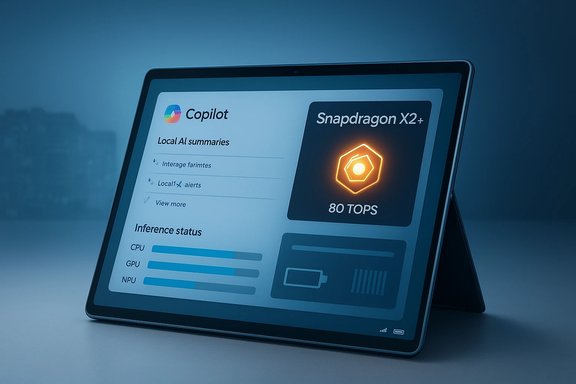
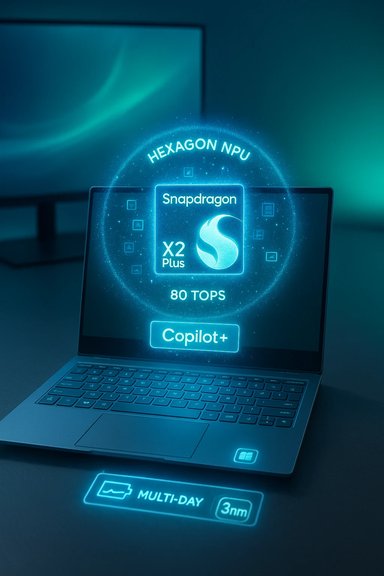
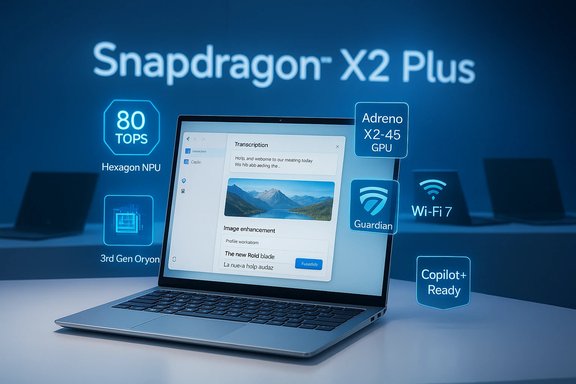
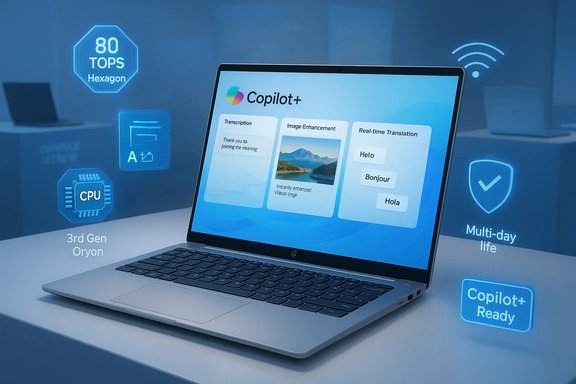
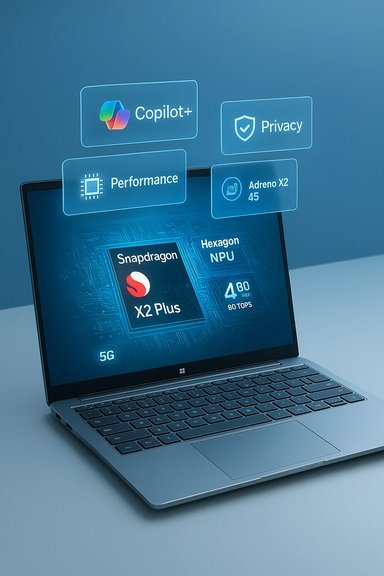
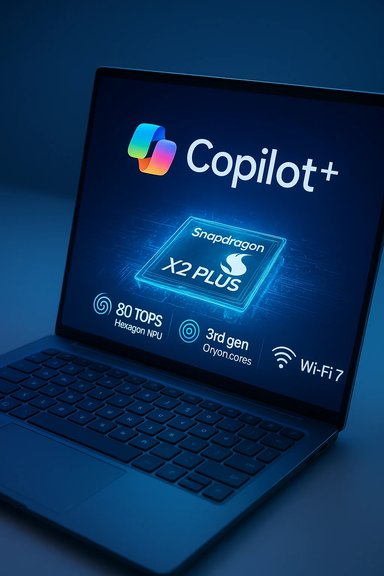
Qualcomm’s new Snapdragon X2 Plus arrives at CES 2026 with a clear aim: bring meaningful on-device AI and long battery life to a much wider range of Windows 11 Copilot+ laptops, shifting the conversation from elite flagship machines to affordable mainstream notebooks.
Qualcomm’s Snapdragon X family has been a central pillar of the company’s push into Windows laptops since the original Snapdragon X Elite. The X2 generation—announced at CES 2026—extends that strategy with multiple SKUs, most notably the Snapdragon X2 Plus, which targets mainstream Copilot+ PCs. The chipmaker positions the X2 Plus between the top-tier X2 Elite/Extreme variants and the entry-level X Platform, delivering a blend of improved CPU and GPU performance while dramatically boosting on-device AI capability through a beefed-up NPU.
This update matters because Microsoft’s Copilot+ PC certification requires a baseline local AI capability on the device. By making a high-NPU part available for more affordable systems, Qualcomm is effectively enabling OEMs to ship more Copilot+ Windows 11 laptops across price tiers. The ripple effects include expanded app support for native Arm builds, a broader market for AI features that run locally, and renewed competition with Intel and AMD in the thin-and-light laptop segment.
What that means in practice:
This change means:
Practical expectations:
Risk considerations:
Actionable considerations for IT decision-makers:
The platform’s long‑term success will depend less on single‑digit percentage gains and more on ecosystem momentum: whether developers embrace optimized on‑device AI, whether OEMs strike the right balance between performance and cost in final products, and whether real‑world battery and thermals meet user expectations.
The early signs are promising. Qualcomm’s X2 Plus brings essential architectural improvements and an explicit strategy to expand Copilot+ access. But the true measure will appear in retail devices: real benchmarks, daily battery experience, and the breadth of software that leverages the on‑device NPU effectively.
There are reasonable grounds for optimism: early benchmark previews and OEM commitments suggest the X2 Plus will deliver the promised generational improvements. Yet several open questions remain about final retail tuning, software optimization, and practical NPU utilization. Consumers and IT buyers should approach the first wave of X2 Plus laptops with enthusiasm—but also with typical due diligence: validate configurations, test compatibility with mission‑critical software, and wait for independent reviews that reflect real‑world usage.
If Qualcomm’s claims hold up in shipping devices, the Snapdragon X2 Plus could be a defining piece in Microsoft’s Copilot+ strategy—expanding local AI to more users, accelerating developer interest in on‑device models, and reshaping expectations for what mainstream Windows laptops can do without a cloud connection.
Source: Neowin https://www.neowin.net/news/ces-202...x2-plus-to-mainstream-windows-11-copilot-pcs/
 Background
Qualcomm’s Snapdragon X family has been a central pillar of the company’s push into Windows laptops since the original Snapdragon X Elite. The X2 generation—announced at CES 2026—extends that strategy with multiple SKUs, most notably the Snapdragon X2 Plus, which targets mainstream Copilot+ PCs. The chipmaker positions the X2 Plus between the top-tier X2 Elite/Extreme variants and the entry-level X Platform, delivering a blend of improved CPU and GPU performance while dramatically boosting on-device AI capability through a beefed-up NPU.This update matters because Microsoft’s Copilot+ PC certification requires a baseline local AI capability on the device. By making a high-NPU part available for more affordable systems, Qualcomm is effectively enabling OEMs to ship more Copilot+ Windows 11 laptops across price tiers. The ripple effects include expanded app support for native Arm builds, a broader market for AI features that run locally, and renewed competition with Intel and AMD in the thin-and-light laptop segment.
What Qualcomm announced at CES 2026
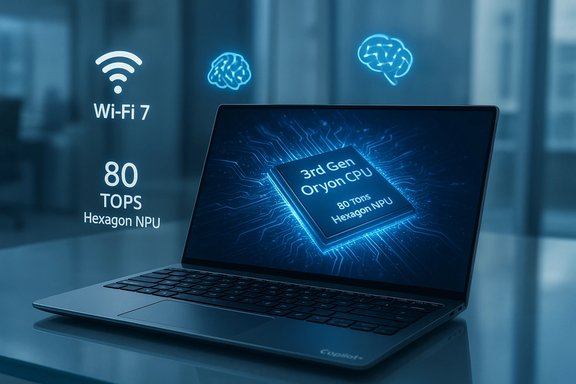
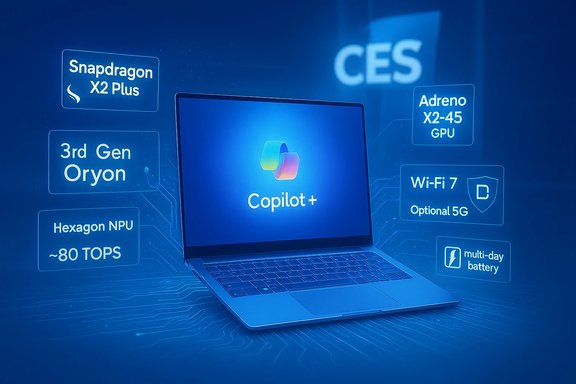
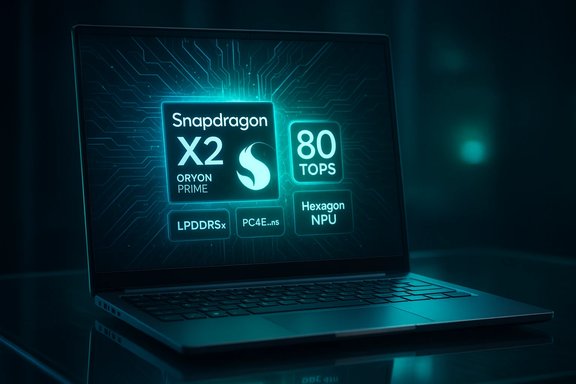
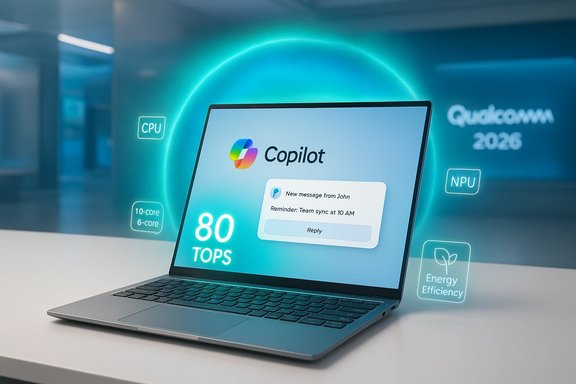
- The Snapdragon X2 Plus is offered in 10‑core and 6‑core variants, leveraging Qualcomm’s third‑generation Oryon CPU architecture and an upgraded Hexagon NPU.
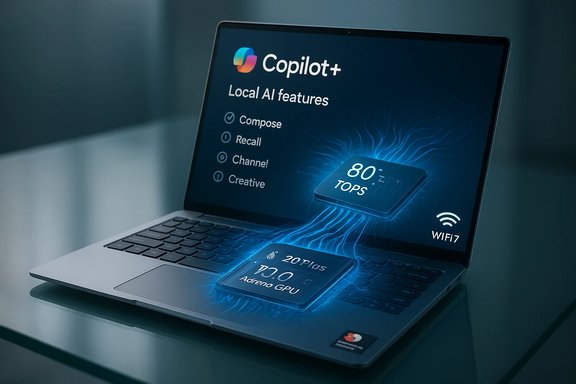
- The company claims the X2 Plus delivers up to 35% higher single‑core CPU performance, up to 29–39% improved GPU performance, and a substantial uplift in NPU capability—with marketing figures pointing to around 80 TOPS (trillion operations per second) for on‑device AI inference.
- Qualcomm projects up to 43% better power efficiency versus its previous X Plus generation, enabling multi‑day or significantly extended battery life under light-to-moderate workloads.
- OEMs are expected to ship X2 Plus‑powered Windows 11 Copilot+ laptops in the first quarter of 2026, with an eye toward expanding the Copilot+ footprint into sub-$1,000 mainstream devices.
Technical deep dive: CPU, GPU, and NPU
CPU: third‑generation Oryon cores tuned for sustained workloads
Qualcomm says the X2 Plus uses its third‑generation Oryon CPU cores, redesigned to emphasize sustained, efficient performance rather than ultra‑short burst speeds. Early disclosures indicate:- Two SKUs: a 10‑core configuration (mix of “prime” and “performance” cores) and a 6‑core variant focused on power efficiency.
- Peak single‑core gains targeted at roughly +35% over the prior X Plus generation in Qualcomm’s internal comparisons.
GPU: incremental but meaningful increases
The X2 Plus’s GPU is presented as an evolution rather than a leap. Qualcomm claims up to ~29–39% GPU performance gains depending on the test and SKU. The company emphasizes improvements in sustained GPU throughput at lower wattage levels, which matter for thin-and-light laptops where thermal headroom is limited.NPU: the headline number — up to 80 TOPS
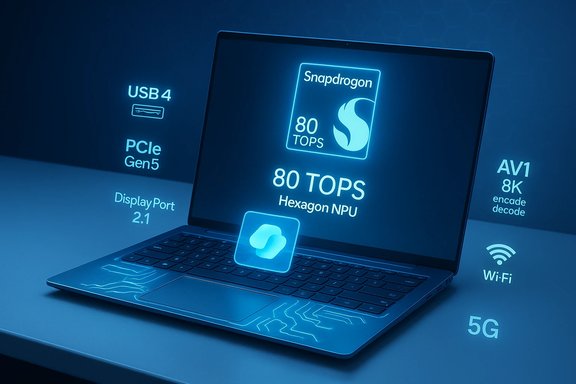
The most important architectural change for Microsoft’s Copilot+ ecosystem is the NPU. Qualcomm positions the X2 Plus as delivering roughly 80 TOPS of NPU performance—an increase that, if realized in consumer devices, significantly widens the range of AI models and features that can execute locally without cloud roundtrips.What that means in practice:
- Faster local inference for Copilot features, on‑device summarization, real‑time transcription, and more capable multimodal assistants.
- Better offline and privacy‑friendly AI experiences, since heavier workloads can run without sending data to remote servers.
- The potential to support larger or more complex foundation models in constrained scenarios, or to run optimized distillations and quantized variants more effectively.
Verified performance claims and early benchmarks
Qualcomm’s own ISO‑power comparisons and early independent tests reported during CES show the X2 Plus beating contemporaneous low‑power Intel Core Ultra and select AMD Ryzen AI parts in select CPU tests, often at significantly lower power draw. Early hands‑on benchmark runs (Geekbench-like workloads and 3DMark/Steel Nomad synthetic graphics tests) generally corroborate the vendor’s performance direction:- Single‑thread and multi‑thread CPU gains align with Qualcomm’s advertised uplift versus X Plus.
- GPU benchmarks show meaningful generational improvement but still indicate the X2 Plus targets efficiency and application responsiveness more than high‑end gaming.
- NPU throughput improvements are notable on paper; early demonstrations showed faster inference times for quantized transformer workloads and responsive local Copilot demonstrations.
- Numbers cited by Qualcomm were corroborated by independent technology outlets that ran early previews and benchmark comparisons. However, public, peer-reviewed benchmark datasets for final retail laptops are still pending as OEMs finalize product SKUs and power/thermal tuning.
- Real‑world performance will vary by OEM configuration: TDP limits, cooling solutions, RAM type and capacity, and storage speed all change outcomes appreciably. Until broad retail testing occurs, treat manufacturer and early‑review numbers as directional rather than definitive.
How Snapdragon X2 Plus changes the Copilot+ PC landscape
Lowering the bar for Copilot+ hardware
Microsoft’s Copilot+ PC standard has a minimum on‑device AI capability requirement. Historically, meeting that threshold with robust user experience required premium hardware. The Snapdragon X2 Plus aims to shift that by offering Amped AI capabilities in chips designed to be priced into mainstream systems.This change means:
- More OEM models can be labeled Copilot+, expanding marketing and feature parity with ARM flagship laptops.
- Consumers can access Copilot features locally without paying flagship prices.
- Developers and ISVs gain a larger install base of machines that can run local AI inference, making it more attractive to optimize for on‑device models.
OEM adoption and device timing
Qualcomm’s roadmap indicates multiple OEMs planning X2 Plus designs slated for early 2026. Expect to see:- Thin‑and‑light laptops and 2‑in‑1 convertibles aimed at productivity users and students.
- Higher RAM ceilings and LPDDR5x configurations on premium builds; lower‑cost SKUs will balance RAM/SSD to hit mainstream price points.
- A focus on battery life, LTE/5G optionality, and integrated wireless stacks that capitalize on Qualcomm’s connectivity portfolio.
Software, drivers, and app compatibility
Native ARM apps vs emulation
A major strength of the Copilot+ push is Microsoft’s ongoing work to broaden native Arm application coverage. Native apps perform better and use NPU acceleration if they have been compiled/optimized for Arm64.- Native Arm builds of major productivity apps are increasingly available, improving battery life and responsiveness.
- For non‑native apps, Microsoft’s Prism emulator and other compatibility layers continue to receive updates to reduce friction.
Drivers and GPU support
Qualcomm committed to regular GPU driver updates and broader game/application compatibility. The X2 Plus supports modern APIs such as DirectX 12.2 Ultimate, Vulkan 1.4, and OpenCL 3.0, which expands native software support.AI frameworks and developer tooling
Qualcomm and partners are enhancing toolchains to help developers leverage the Hexagon NPU and other accelerators:- Model conversion and quantization tools for popular ML frameworks.
- SDKs that expose accelerated primitives for inference and multimedia processing.
- OEMs and Microsoft are expected to ship optimized libraries that let Copilot+ features make efficient use of the NPU.
Battery life and efficiency claims: what to expect
Qualcomm’s messaging centers on sustained performance with low energy use. The X2 Plus is claimed to deliver up to 43% improved power efficiency over the previous generation, theoretically translating to longer battery life or the ability to use higher performance modes within the same battery budget.Practical expectations:
- Everyday productivity (web, office apps, video playback) is likely to benefit most, with some configurations achieving all‑day or multi‑day standby scenarios under light load.
- Intensive AI workloads performed locally will increase power draw; efficiency improvements mean these tasks may be feasible on battery for short bursts but will still consume noticeable energy for sustained large-model inference.
- OEM thermal design and battery capacity remain the primary determinants of real battery life; chip efficiency is necessary but not sufficient.
Comparative positioning: Snapdragon X2 Plus vs Intel, AMD, and Apple
The X2 Plus aims to compete where efficiency and on‑device AI matter most. Key comparison points:- Intel Core Ultra chips—particularly the low‑power Ultra 7 class—remain strong in legacy application compatibility and single‑thread performance in certain scenarios. Qualcomm’s edge is energy‑efficient sustained workloads and native AI acceleration.
- AMD Ryzen AI series competes in hybrid CPU+NPU strategies; Qualcomm’s advantage is an integrated NPU designed from the start for local inference combined with tight SoC integration for connectivity and power.
- Apple Silicon (M‑series) leads in single-threaded performance and mature software ecosystem for macOS, but the Windows ecosystem’s app diversity and Microsoft’s Copilot+ initiative create a distinct domain where Qualcomm’s approach on Windows aims to excel.
Security, privacy, and platform readiness
Qualcomm highlights platform security as a design focus. Copilot+ PCs generally include protections like Microsoft Pluton and secure boot mechanisms. On-device AI also has privacy advantages: more data can be processed locally without being uploaded to cloud services.Risk considerations:
- Secure enclaves and firmware-level protections must be audited and tested across OEMs.
- Local AI models raise questions about model provenance, patching, and how updates are delivered and validated securely on consumer devices.
Risks, limitations, and open questions
No platform is risk‑free. The Snapdragon X2 Plus brings significant promise but also several caveats:- Real‑world NPU utility depends on software: TOPS numbers do not translate directly to better end-user experiences unless applications are optimized to use the NPU efficiently. Developers must adopt new toolchains and best practices.
- Compatibility and the Windows ecosystem: Despite progress, some legacy Windows applications—particularly plugins, low-level drivers, and niche creative tools—still run best on x86. Emulation continues to improve, but edge cases remain.
- Gaming expectations: The X2 Plus improves GPU throughput but is not targeted at high‑end gaming. Users expecting console‑level or desktop GPU performance should temper expectations.
- Thermals and OEM tuning: The same silicon can perform very differently depending on laptop thermal design and TDP settings. Benchmarks on preview units with generous cooling won’t necessarily reflect thin retail models.
- Supply, pricing, and market segmentation: Qualcomm’s aim to broaden Copilot+ availability into mainstream price tiers depends on OEMs controlling BOM costs and supply chain pressures. Pricing targets may shift as devices are configured for different markets.
- Marketing vs reality: Some early figures are vendor-provided or derived from controlled demo environments. Until independent retail testing across multiple devices is published, some claims should be treated as optimistic projections.
What consumers should look for when shopping for X2 Plus Copilot+ laptops
- Check the actual SKU and power limits used in the retail model—many manufacturers will ship both performance‑tuned and power‑sipping versions under the same chip family.
- Look for LPDDR5x RAM and NVMe SSD configurations; memory bandwidth and storage significantly influence AI and multitasking performance.
- Confirm native app support for the productivity applications you use most—native Arm builds will offer the best battery and performance balance.
- Evaluate thermals and chassis design—thin laptops may throttle more aggressively than slightly thicker models with active cooling.
- Review battery capacity and advertised runtimes with realistic workloads (e.g., web browsing, video playback) rather than relying solely on vendor claims.
Developer and enterprise implications
For developers, the X2 Plus line makes it more attractive to optimize for local inference on Windows devices. Enterprises gain options to deploy Copilot-like capabilities on endpoints that do not require continuous cloud connectivity, which can reduce latency and improve privacy compliance.Actionable considerations for IT decision-makers:
- Pilot local AI features with a subset of users to measure real productivity gains and security posture.
- Validate line-of-business applications under the target OEM configuration, including emulator performance for legacy x86 apps.
- Budget for potential app migration or testing to ensure critical workflows remain performant on Arm-based Copilot+ devices.
The big picture: is Qualcomm finally bringing AI laptops to the mainstream?
The Snapdragon X2 Plus is Qualcomm’s clearest attempt yet to mainstream on‑device AI in Windows laptops. By coupling stronger NPU capability with improved CPU efficiency and reasonable GPU gains, Qualcomm is creating an attractive path for OEMs to ship Copilot+ laptops at price points beyond elite flagships.The platform’s long‑term success will depend less on single‑digit percentage gains and more on ecosystem momentum: whether developers embrace optimized on‑device AI, whether OEMs strike the right balance between performance and cost in final products, and whether real‑world battery and thermals meet user expectations.
The early signs are promising. Qualcomm’s X2 Plus brings essential architectural improvements and an explicit strategy to expand Copilot+ access. But the true measure will appear in retail devices: real benchmarks, daily battery experience, and the breadth of software that leverages the on‑device NPU effectively.
Conclusion
Qualcomm’s Snapdragon X2 Plus announcement at CES 2026 signals a strategic pivot from niche flagship AI machines toward democratizing Copilot+ capabilities across mainstream Windows 11 laptops. The combination of improved Oryon CPU cores, a markedly stronger NPU, and better energy efficiency creates a viable platform for on‑device AI in affordable devices.There are reasonable grounds for optimism: early benchmark previews and OEM commitments suggest the X2 Plus will deliver the promised generational improvements. Yet several open questions remain about final retail tuning, software optimization, and practical NPU utilization. Consumers and IT buyers should approach the first wave of X2 Plus laptops with enthusiasm—but also with typical due diligence: validate configurations, test compatibility with mission‑critical software, and wait for independent reviews that reflect real‑world usage.
If Qualcomm’s claims hold up in shipping devices, the Snapdragon X2 Plus could be a defining piece in Microsoft’s Copilot+ strategy—expanding local AI to more users, accelerating developer interest in on‑device models, and reshaping expectations for what mainstream Windows laptops can do without a cloud connection.
Source: Neowin https://www.neowin.net/news/ces-202...x2-plus-to-mainstream-windows-11-copilot-pcs/