

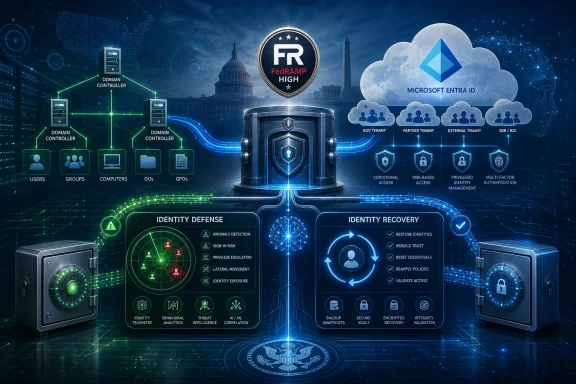
Quest Software announced on July 8, 2026, that Quest Identity Defense and Quest Identity Recovery for Entra ID are now available as a FedRAMP High authorized SaaS offering in Microsoft Azure Government for federal and regulated customers running hybrid Microsoft identity estates. The news, carried by TipRanks and Pluang and based on Quest’s own announcement, is not just another compliance badge in the crowded identity-security market. It is a bet that the next phase of Windows infrastructure security will be fought less over endpoints and more over the identity control plane. For agencies, contractors, and enterprises that still live in the messy middle between Active Directory and Microsoft Entra ID, that bet lands in exactly the right place.
FedRAMP High is not marketing glitter for vendors trying to sound government-ready. It is the level of assurance aimed at cloud systems where a breach could have a severe or catastrophic impact on government operations, assets, or individuals. When a security product reaches that bar inside Azure Government, it changes the procurement conversation from “interesting tool” to “eligible for the shortlist.”
That matters because identity defense is no longer an optional overlay for Microsoft environments. Active Directory remains deeply embedded in federal and enterprise networks, while Entra ID has become the front door for Microsoft 365, Azure, SaaS apps, conditional access, and privileged cloud administration. The result is a hybrid identity estate that is both indispensable and difficult to reason about.
Quest’s pitch is that those environments need purpose-built detection and recovery rather than a loose bundle of monitoring, backup, and manual runbooks. Its announcement says Quest Identity Defense and Quest Identity Recovery for Entra ID are delivered as SaaS in Microsoft Azure Government, giving agencies and regulated organizations a route to secure and restore Microsoft identity infrastructure without standing up an equivalent platform themselves.
The phrase “only purpose-built ITDR provider” deserves scrutiny, because vendor superlatives usually do. But the more important claim is narrower and more practical: Quest says it is offering FedRAMP High authorized SaaS for hybrid Active Directory and Entra ID identity defense and recovery. In a market where many tools focus on either cloud identity, endpoint telemetry, or on-prem directory hygiene, that hybrid emphasis is the real story.
Entra ID, meanwhile, is not just “Azure AD with a new name.” It is the identity layer for cloud access, application permissions, service principals, conditional access, device trust, and increasingly automated administration. The practical problem for IT teams is that the two worlds are coupled but not identical, synchronized but not symmetrical, and governed by different operational habits.
That is why identity threat detection and response, or ITDR, has become a serious category rather than another analyst acronym. Attackers do not need to burn zero-days when they can escalate privileges, abuse stale accounts, compromise service principals, or modify policy in ways that look like normal administration until it is too late. The control plane is the target because the control plane decides who gets to do everything else.
Quest is positioning its platform around that uncomfortable reality. Identity Defense is meant to surface posture problems, privilege exposure, risky configuration, and suspicious identity behavior across AD and Entra ID. Identity Recovery for Entra ID is meant to address the other half of the incident timeline: what happens after the directory, tenant objects, conditional access policies, groups, roles, or cloud identity configuration have been damaged.
This is where the announcement moves beyond compliance. FedRAMP High may open the door, but the underlying buyer pain is operational: a ransomware event, insider compromise, or identity-plane attack can turn a Microsoft environment into a locked building where the administrators no longer know which keys still work.
Microsoft has long promoted Azure Government as a home for public-sector systems requiring elevated compliance. Microsoft’s own documentation also frames FedRAMP High alignment for Entra ID and Azure Government as a major part of the cloud identity compliance story. Quest is now trying to sit adjacent to that story rather than outside it.
That positioning is clever because Microsoft is both the platform owner and, in some areas, a competitor. Microsoft Defender for Identity, Entra ID Protection, Entra governance features, Sentinel, Purview, and the broader Defender stack already cover large pieces of the identity-security puzzle. But Microsoft’s native tooling does not erase the need for independent recovery, cross-environment analysis, or specialized workflows for customers with complex AD histories.
The question for customers is not whether Microsoft has identity-security features. Of course it does. The question is whether those features, by themselves, give a heavily regulated organization enough independent visibility and recoverability when the identity plane becomes the incident.
That is where a third-party product with FedRAMP High authorization can become more than a nice-to-have. It gives security architects a defensible way to add an additional control layer without fighting the compliance battle from scratch.
The risk is that “AI-driven threats” becomes a catch-all phrase that explains everything and therefore explains nothing. Attackers using automation to enumerate privileges, identify weak service accounts, generate phishing lures, or move through cloud permissions are not science fiction. But defenders should be wary of any vendor implying that artificial intelligence has magically rewritten the fundamentals of identity security.
The fundamentals remain stubbornly familiar. Organizations still struggle with stale privileged accounts, overbroad groups, unmonitored service principals, brittle recovery plans, poorly understood synchronization dependencies, and emergency access accounts that are either too weak or too hard to use during a crisis. AI can accelerate abuse of those weaknesses, but it does not create them from nothing.
Where Quest’s Anetac acquisition could become meaningful is in visibility across identities that are no longer just employees with passwords. Modern environments are full of non-human identities: automation accounts, service principals, workload identities, application registrations, managed identities, scripts, bots, and now AI agents. These identities often carry permissions that are powerful, poorly documented, and rarely reviewed with the same care as human admin roles.
If Quest can fold Anetac’s capabilities into its Security Management Platform in a way that maps access chains and privilege behavior across both AD and Entra ID, the AI rhetoric will have a concrete product consequence. If not, “AI-ready identity infrastructure” risks becoming another badge on a dashboard.
Identity recovery is uniquely unforgiving because every other recovery process depends on identity. Restoring servers, rotating secrets, rebuilding endpoints, accessing cloud consoles, re-enrolling devices, and communicating securely all assume that administrators can authenticate and that the directory still reflects reality. If the identity layer is compromised, the recovery team may be standing on the floor it is trying to repair.
For Active Directory, disaster recovery has long been a specialized discipline. Forest recovery, domain controller rebuilds, privileged-access cleanup, and authoritative restores are not weekend chores. Entra ID adds a different kind of fragility: cloud objects, roles, policies, app registrations, conditional access rules, and tenant configuration can be altered in ways that are hard to reconstruct from memory or logs alone.
That is why Entra ID recovery is becoming a serious enterprise requirement. The cloud identity plane has accumulated too much business logic to be treated as self-healing. A deleted or maliciously modified object can interrupt application access, break automation, weaken policy, or create persistence for an attacker.
Quest is trying to claim that space by offering defense and recovery together. That is a stronger argument than selling backup alone, because recovery without posture awareness can restore yesterday’s weakness, while detection without recovery can leave teams knowing exactly how bad things are but unable to rebuild quickly.
A security team can now ask more specific questions. What exactly is inside Quest’s authorization boundary? Which components run in Azure Government? How are customer identity objects stored, encrypted, retained, and separated? What data leaves the customer environment? How does the product handle privileged access during a recovery operation? How often are recovery workflows tested against realistic hybrid identity scenarios?
Those are the questions that separate compliance theater from operational resilience. FedRAMP High creates a baseline, but the customer still has to understand the architecture. In government IT, the badge gets you to the table; the boundary diagrams and runbooks keep you there.
The commercial implications are also straightforward. Quest gains a stronger route into public sector accounts and contractors that could not easily adopt a non-authorized SaaS identity platform. It also strengthens recurring revenue prospects because SaaS identity defense and recovery are not one-time migrations. They become ongoing controls.
That is particularly important for Quest, a company long associated with Microsoft ecosystem management, migration, database tooling, and administrative products. The Security Management Platform strategy gives Quest a broader umbrella: not just helping customers move and manage Microsoft infrastructure, but helping them defend and recover it.
But Microsoft’s sprawl also creates opportunities for specialists. Many IT departments want tools that explain Microsoft environments in operational terms, not just expose more telemetry. They want cross-domain views, recovery workflows, posture scoring, and reports that map to the way administrators actually inherit environments.
Quest has history here. It built credibility over years of Active Directory migration, management, auditing, and recovery work. That history matters because AD is not a greenfield cloud service. It is a fossil record of mergers, reorganizations, application decisions, delegated permissions, forgotten scripts, and emergency fixes that became permanent.
The challenge for Quest is to prove that its platform can bridge the old and new worlds without becoming another pane of glass that shows problems but does not reduce them. Security teams already have dashboards. What they need is a shorter path from detection to containment to restoration.
That is why the FedRAMP High authorization should be read as infrastructure for a broader product argument. Quest wants to be the identity resilience layer for Microsoft-heavy organizations, especially those that cannot tolerate weak compliance assurances. Azure Government gives the company a credible venue. The market will decide whether the workflows are compelling enough.
Quest’s claim that it is the only purpose-built ITDR provider for hybrid Active Directory and Entra ID with this level of FedRAMP High SaaS authorization is a useful differentiator. But it is still a starting point. Agencies will need to see how the product behaves in environments with multiple forests, privileged access workstations, legacy trusts, GCC High dependencies, contractor tenants, and strict incident-response rules.
Defense contractors face a similar calculus. Many are under pressure to harden systems that connect to federal work, satisfy compliance regimes, and prove that they can protect controlled data. Identity security is central to that story because compromised credentials and privilege abuse remain among the most efficient ways to move through an environment.
Regulated enterprises outside government should also pay attention. FedRAMP High is not their procurement standard in the same way, but it can serve as a signal. Banks, utilities, healthcare organizations, and critical infrastructure operators often face the same identity-recovery problem even if the compliance labels differ.
The broader lesson is that identity resilience is becoming a board-level issue because outages and breaches increasingly converge. A cyberattack that destroys trust in the directory is also a business-continuity event. A recovery plan that assumes identity will be available is not a recovery plan; it is a hope.
The Anetac acquisition gives Quest a way to talk about emerging identity problems, especially non-human and agentic identities. The FedRAMP High authorization gives it a way to talk to government and regulated buyers with more authority. The missing piece, as always, is execution.
Integration matters. If Anetac-derived visibility becomes a separate module with separate workflows and separate assumptions, customers will treat it as another add-on. If it becomes part of a coherent model that shows how human admins, service accounts, app registrations, agents, groups, and policies create exploitable paths, Quest will have something more differentiated.
Recovery testing matters even more. A product that backs up identity configuration is useful; a product that helps teams rehearse and execute recovery under pressure is strategically valuable. The difference becomes visible only during tabletop exercises, red-team drills, and real incidents.
There is also a governance question. High-assurance customers will want to know who can initiate restores, how approvals work, how break-glass access is protected, how changes are audited, and how Quest’s own SaaS environment is defended from becoming a privileged target. A recovery platform for identity is, by definition, a high-value system.
 Quest Is Selling Assurance, Not Just Another Identity Console
FedRAMP High is not marketing glitter for vendors trying to sound government-ready. It is the level of assurance aimed at cloud systems where a breach could have a severe or catastrophic impact on government operations, assets, or individuals. When a security product reaches that bar inside Azure Government, it changes the procurement conversation from “interesting tool” to “eligible for the shortlist.”That matters because identity defense is no longer an optional overlay for Microsoft environments. Active Directory remains deeply embedded in federal and enterprise networks, while Entra ID has become the front door for Microsoft 365, Azure, SaaS apps, conditional access, and privileged cloud administration. The result is a hybrid identity estate that is both indispensable and difficult to reason about.
Quest’s pitch is that those environments need purpose-built detection and recovery rather than a loose bundle of monitoring, backup, and manual runbooks. Its announcement says Quest Identity Defense and Quest Identity Recovery for Entra ID are delivered as SaaS in Microsoft Azure Government, giving agencies and regulated organizations a route to secure and restore Microsoft identity infrastructure without standing up an equivalent platform themselves.
The phrase “only purpose-built ITDR provider” deserves scrutiny, because vendor superlatives usually do. But the more important claim is narrower and more practical: Quest says it is offering FedRAMP High authorized SaaS for hybrid Active Directory and Entra ID identity defense and recovery. In a market where many tools focus on either cloud identity, endpoint telemetry, or on-prem directory hygiene, that hybrid emphasis is the real story.
The Hybrid Identity Problem Refuses to Die
For years, the industry has talked as if cloud identity would simply replace Active Directory. That was always too neat. AD is not merely an authentication store; it is a dependency web woven through file servers, line-of-business apps, Kerberos workflows, group policy assumptions, privileged admin models, and decades of operational shortcuts.Entra ID, meanwhile, is not just “Azure AD with a new name.” It is the identity layer for cloud access, application permissions, service principals, conditional access, device trust, and increasingly automated administration. The practical problem for IT teams is that the two worlds are coupled but not identical, synchronized but not symmetrical, and governed by different operational habits.
That is why identity threat detection and response, or ITDR, has become a serious category rather than another analyst acronym. Attackers do not need to burn zero-days when they can escalate privileges, abuse stale accounts, compromise service principals, or modify policy in ways that look like normal administration until it is too late. The control plane is the target because the control plane decides who gets to do everything else.
Quest is positioning its platform around that uncomfortable reality. Identity Defense is meant to surface posture problems, privilege exposure, risky configuration, and suspicious identity behavior across AD and Entra ID. Identity Recovery for Entra ID is meant to address the other half of the incident timeline: what happens after the directory, tenant objects, conditional access policies, groups, roles, or cloud identity configuration have been damaged.
This is where the announcement moves beyond compliance. FedRAMP High may open the door, but the underlying buyer pain is operational: a ransomware event, insider compromise, or identity-plane attack can turn a Microsoft environment into a locked building where the administrators no longer know which keys still work.
Azure Government Gives the Offering Its Real Address
The Azure Government detail is not incidental. Federal customers cannot simply consume any commercial SaaS product and call it a day. They need authorization boundaries, data-handling assurances, control mappings, incident-response expectations, and procurement confidence that the service lives in a cloud environment designed for government workloads.Microsoft has long promoted Azure Government as a home for public-sector systems requiring elevated compliance. Microsoft’s own documentation also frames FedRAMP High alignment for Entra ID and Azure Government as a major part of the cloud identity compliance story. Quest is now trying to sit adjacent to that story rather than outside it.
That positioning is clever because Microsoft is both the platform owner and, in some areas, a competitor. Microsoft Defender for Identity, Entra ID Protection, Entra governance features, Sentinel, Purview, and the broader Defender stack already cover large pieces of the identity-security puzzle. But Microsoft’s native tooling does not erase the need for independent recovery, cross-environment analysis, or specialized workflows for customers with complex AD histories.
The question for customers is not whether Microsoft has identity-security features. Of course it does. The question is whether those features, by themselves, give a heavily regulated organization enough independent visibility and recoverability when the identity plane becomes the incident.
That is where a third-party product with FedRAMP High authorization can become more than a nice-to-have. It gives security architects a defensible way to add an additional control layer without fighting the compliance battle from scratch.
AI Is the Marketing Frame, but Automation Is the Operational Threat
Quest’s announcement leans into the “AI era,” and the company’s recent acquisition of Anetac makes that framing predictable. In June 2026, Quest announced it had acquired Anetac, a company focused on AI-powered identity security for human, non-human, and agentic identities. The acquisition gives Quest a timely narrative around agentic AI, privilege behavior, and identity access chains.The risk is that “AI-driven threats” becomes a catch-all phrase that explains everything and therefore explains nothing. Attackers using automation to enumerate privileges, identify weak service accounts, generate phishing lures, or move through cloud permissions are not science fiction. But defenders should be wary of any vendor implying that artificial intelligence has magically rewritten the fundamentals of identity security.
The fundamentals remain stubbornly familiar. Organizations still struggle with stale privileged accounts, overbroad groups, unmonitored service principals, brittle recovery plans, poorly understood synchronization dependencies, and emergency access accounts that are either too weak or too hard to use during a crisis. AI can accelerate abuse of those weaknesses, but it does not create them from nothing.
Where Quest’s Anetac acquisition could become meaningful is in visibility across identities that are no longer just employees with passwords. Modern environments are full of non-human identities: automation accounts, service principals, workload identities, application registrations, managed identities, scripts, bots, and now AI agents. These identities often carry permissions that are powerful, poorly documented, and rarely reviewed with the same care as human admin roles.
If Quest can fold Anetac’s capabilities into its Security Management Platform in a way that maps access chains and privilege behavior across both AD and Entra ID, the AI rhetoric will have a concrete product consequence. If not, “AI-ready identity infrastructure” risks becoming another badge on a dashboard.
Recovery Is the Part Security Teams Ignore Until It Is Too Late
The more interesting half of Quest’s announcement may be recovery rather than detection. Security vendors love detection because it feels active, measurable, and board-friendly. Recovery is less glamorous. It is where architecture, backups, permissions, dependencies, and human process collide at the worst possible time.Identity recovery is uniquely unforgiving because every other recovery process depends on identity. Restoring servers, rotating secrets, rebuilding endpoints, accessing cloud consoles, re-enrolling devices, and communicating securely all assume that administrators can authenticate and that the directory still reflects reality. If the identity layer is compromised, the recovery team may be standing on the floor it is trying to repair.
For Active Directory, disaster recovery has long been a specialized discipline. Forest recovery, domain controller rebuilds, privileged-access cleanup, and authoritative restores are not weekend chores. Entra ID adds a different kind of fragility: cloud objects, roles, policies, app registrations, conditional access rules, and tenant configuration can be altered in ways that are hard to reconstruct from memory or logs alone.
That is why Entra ID recovery is becoming a serious enterprise requirement. The cloud identity plane has accumulated too much business logic to be treated as self-healing. A deleted or maliciously modified object can interrupt application access, break automation, weaken policy, or create persistence for an attacker.
Quest is trying to claim that space by offering defense and recovery together. That is a stronger argument than selling backup alone, because recovery without posture awareness can restore yesterday’s weakness, while detection without recovery can leave teams knowing exactly how bad things are but unable to rebuild quickly.
FedRAMP High Changes the Sales Motion for Regulated Buyers
For federal agencies, defense contractors, and highly regulated enterprises, FedRAMP High authorization removes one of the largest barriers to adoption: the long argument over whether the cloud service itself can be trusted for sensitive operations. It does not guarantee that a deployment is well designed, nor does it absolve the customer of its own security responsibilities. But it does shift the conversation.A security team can now ask more specific questions. What exactly is inside Quest’s authorization boundary? Which components run in Azure Government? How are customer identity objects stored, encrypted, retained, and separated? What data leaves the customer environment? How does the product handle privileged access during a recovery operation? How often are recovery workflows tested against realistic hybrid identity scenarios?
Those are the questions that separate compliance theater from operational resilience. FedRAMP High creates a baseline, but the customer still has to understand the architecture. In government IT, the badge gets you to the table; the boundary diagrams and runbooks keep you there.
The commercial implications are also straightforward. Quest gains a stronger route into public sector accounts and contractors that could not easily adopt a non-authorized SaaS identity platform. It also strengthens recurring revenue prospects because SaaS identity defense and recovery are not one-time migrations. They become ongoing controls.
That is particularly important for Quest, a company long associated with Microsoft ecosystem management, migration, database tooling, and administrative products. The Security Management Platform strategy gives Quest a broader umbrella: not just helping customers move and manage Microsoft infrastructure, but helping them defend and recover it.
Microsoft’s Ecosystem Creates Room for Specialists
It is tempting to view every Microsoft-adjacent security vendor as living on borrowed time. Microsoft can bundle, integrate, and discount in ways few competitors can match. The company’s security portfolio is now broad enough that almost any identity-security conversation eventually touches a Microsoft-native product.But Microsoft’s sprawl also creates opportunities for specialists. Many IT departments want tools that explain Microsoft environments in operational terms, not just expose more telemetry. They want cross-domain views, recovery workflows, posture scoring, and reports that map to the way administrators actually inherit environments.
Quest has history here. It built credibility over years of Active Directory migration, management, auditing, and recovery work. That history matters because AD is not a greenfield cloud service. It is a fossil record of mergers, reorganizations, application decisions, delegated permissions, forgotten scripts, and emergency fixes that became permanent.
The challenge for Quest is to prove that its platform can bridge the old and new worlds without becoming another pane of glass that shows problems but does not reduce them. Security teams already have dashboards. What they need is a shorter path from detection to containment to restoration.
That is why the FedRAMP High authorization should be read as infrastructure for a broader product argument. Quest wants to be the identity resilience layer for Microsoft-heavy organizations, especially those that cannot tolerate weak compliance assurances. Azure Government gives the company a credible venue. The market will decide whether the workflows are compelling enough.
The Government Market Will Reward Proof Over Slogans
The public-sector identity market is crowded with vendors promising zero trust, AI defense, automated recovery, and resilience. Government customers have heard all of this before. What changes buying behavior is proof: authorization status, reference architectures, tested recovery procedures, integration with existing Microsoft controls, and evidence that the product can survive the ugly edge cases.Quest’s claim that it is the only purpose-built ITDR provider for hybrid Active Directory and Entra ID with this level of FedRAMP High SaaS authorization is a useful differentiator. But it is still a starting point. Agencies will need to see how the product behaves in environments with multiple forests, privileged access workstations, legacy trusts, GCC High dependencies, contractor tenants, and strict incident-response rules.
Defense contractors face a similar calculus. Many are under pressure to harden systems that connect to federal work, satisfy compliance regimes, and prove that they can protect controlled data. Identity security is central to that story because compromised credentials and privilege abuse remain among the most efficient ways to move through an environment.
Regulated enterprises outside government should also pay attention. FedRAMP High is not their procurement standard in the same way, but it can serve as a signal. Banks, utilities, healthcare organizations, and critical infrastructure operators often face the same identity-recovery problem even if the compliance labels differ.
The broader lesson is that identity resilience is becoming a board-level issue because outages and breaches increasingly converge. A cyberattack that destroys trust in the directory is also a business-continuity event. A recovery plan that assumes identity will be available is not a recovery plan; it is a hope.
The Fine Print Will Decide Whether This Becomes a Platform Moment
Quest’s Security Management Platform strategy is ambitious. The company wants to unify identity threat detection, containment, recovery, and modernization across hybrid Microsoft identity infrastructure. That is the kind of platform story buyers like when it reduces tool sprawl, and dislike when it simply repackages existing products under a new banner.The Anetac acquisition gives Quest a way to talk about emerging identity problems, especially non-human and agentic identities. The FedRAMP High authorization gives it a way to talk to government and regulated buyers with more authority. The missing piece, as always, is execution.
Integration matters. If Anetac-derived visibility becomes a separate module with separate workflows and separate assumptions, customers will treat it as another add-on. If it becomes part of a coherent model that shows how human admins, service accounts, app registrations, agents, groups, and policies create exploitable paths, Quest will have something more differentiated.
Recovery testing matters even more. A product that backs up identity configuration is useful; a product that helps teams rehearse and execute recovery under pressure is strategically valuable. The difference becomes visible only during tabletop exercises, red-team drills, and real incidents.
There is also a governance question. High-assurance customers will want to know who can initiate restores, how approvals work, how break-glass access is protected, how changes are audited, and how Quest’s own SaaS environment is defended from becoming a privileged target. A recovery platform for identity is, by definition, a high-value system.
The Windows Admin’s Map Just Got Redrawn
For WindowsForum readers, the practical significance is not that another vendor won a compliance trophy. It is that the Microsoft identity stack is now being treated as critical infrastructure with its own dedicated defense and recovery layer. That is a useful mental shift for anyone still treating AD cleanup and Entra ID governance as separate backlog items.- Quest’s FedRAMP High authorization applies to Quest Identity Defense and Quest Identity Recovery for Entra ID delivered as SaaS in Microsoft Azure Government.
- The announcement targets federal agencies, defense contractors, and regulated organizations that operate hybrid Active Directory and Microsoft Entra ID environments.
- The authorization strengthens Quest’s public-sector sales case, but customers still need to examine the authorization boundary, data handling, recovery workflow, and shared-responsibility model.
- Quest’s acquisition of Anetac gives the company a stronger story around AI-era identity risks, especially non-human and agentic identities.
- The most important operational issue is not detecting identity compromise alone, but restoring a trustworthy identity control plane quickly enough for the rest of recovery to proceed.
References
- Primary source: TipRanks
Published: 2026-07-08T11:30:13.692133
Loading…
www.tipranks.com - Independent coverage: Pluang
Published: 2026-07-08T10:30:13.687626
Loading…
pluang.com - Related coverage: globenewswire.com
Loading…
www.globenewswire.com - Related coverage: blog.quest.com
Loading…
blog.quest.com - Related coverage: quest.com
Loading…
www.quest.com - Official source: learn.microsoft.com
Configure Microsoft Entra ID to meet FedRAMP High Impact level - Microsoft Entra | Microsoft Learn
Overview of how you can meet a FedRAMP High Impact level for your organization by using Microsoft Entra ID.learn.microsoft.com