

Rackspace Technology is positioning AI-ready infrastructure on Microsoft Azure as a practical answer to one of enterprise AI’s hardest problems: moving promising models out of isolated pilots and into dependable, governed production environments without allowing cloud and compute costs to spiral out of control. The company’s message is compelling because it targets the operational work that often determines whether an AI initiative succeeds—modernizing applications, preparing data, securing identities, managing GPU and cloud consumption, and maintaining a recoverable platform after deployment.
That message should also be viewed with appropriate discipline. AI-ready infrastructure can absolutely improve efficiency, accelerate delivery, and eliminate waste created by fragmented cloud operations. But it is not a shortcut to guaranteed savings. The financial outcome still depends on architecture, model selection, data quality, workload patterns, procurement decisions, governance, and the ability of a business to retire older processes rather than simply layering AI costs on top of them.
For Windows-centric organizations already invested in Microsoft technologies, Rackspace’s Azure-focused approach highlights a broader shift in enterprise IT. The conversation is moving beyond “Which AI model should we use?” toward a more pressing question: Can the organization operate AI safely, efficiently, and continuously at production scale?
The first wave of generative AI adoption was dominated by experimentation. Teams built chatbots, copilots, document summarization tools, retrieval-augmented generation systems, forecasting workflows, and automation prototypes with surprising speed. In many cases, the technical demonstration was not the difficult part.
The challenge emerged when organizations tried to make those projects permanent.
A production AI service needs more than a model endpoint. It needs secure connectivity to enterprise data, identity controls, logging, monitoring, data retention policies, cost allocation, network design, disaster recovery procedures, and a clear owner when something fails at 2 a.m. It may also need to integrate with existing Windows Server workloads, Active Directory or Microsoft Entra ID, SQL Server estates, on-premises applications, Power Platform automations, and line-of-business systems that were never designed with generative AI in mind.
That is the gap Rackspace Technology is attempting to address through its Microsoft Azure expertise. Rather than presenting AI as a standalone software purchase, the company is framing it as an end-to-end cloud operating model involving migration, modernization, managed services, AI and machine learning operations, security, and cost optimization.
This is an important distinction. A company can purchase access to an AI platform quickly. Building an environment where that platform can use sensitive enterprise data responsibly, produce auditable outputs, withstand a cyber incident, and remain affordable over time is considerably more difficult.
For Azure deployments, that generally means coordinating several layers of technology and operations.
Modernization can involve:
An AI-ready Azure environment therefore requires a disciplined approach to:
That can include:
This does not make AI security automatic. Misconfigured permissions, overly broad service identities, and weak secrets management remain serious risks. But it gives organizations a more coherent route to applying existing governance practices to new AI workloads.
For a business that already operates Microsoft 365, Windows endpoints, Active Directory, Intune, Defender, SQL Server, and Azure resources, a unified approach can be significantly easier to manage than assembling a completely separate AI stack from unfamiliar providers.
An effective AI-ready infrastructure strategy must acknowledge that reality. Data may remain on-premises while selected services run in Azure. A model may process sanitized or approved data in the cloud while systems of record stay within private infrastructure. Sensitive workloads may require dedicated, private, sovereign, or isolated environments.
Rackspace’s experience across public cloud, private cloud, hybrid infrastructure, and managed operations could be valuable in these scenarios. The company’s broader enterprise AI direction is increasingly tied to governed environments where organizations need more control than a simple public cloud deployment may provide.
Rackspace’s Azure migration and modernization services are positioned around a more complete goal: building scalable environments that are prepared for AI, rather than merely transferring servers from one location to another.
That distinction matters. A company hoping to deploy AI-driven search, support automation, intelligent document processing, predictive analytics, or agentic workflows will need its applications and data sources to be discoverable, securely connected, and manageable. AI becomes difficult to operationalize when the underlying estate remains opaque.
An optimized Azure architecture can help address this through:
The resulting savings are not limited to infrastructure bills. They can appear as:
Governance does not eliminate risk, but it can make problems more visible and controllable. Access controls, audit logs, model monitoring, data segmentation, and recovery planning create operational discipline that is easy to undervalue until it is needed.
For regulated organizations, this is often the real business case. The goal is not simply to make an AI process cheaper. It is to make it defensible, repeatable, and resilient.
These are logical use cases for AI-assisted infrastructure because they involve large volumes of documents, customer information, screening data, investigation notes, and regulatory reporting requirements. AI can help classify documents, extract information, prioritize work, identify potential relationships, summarize evidence, and draft materials for human review.
However, these are also areas where overconfidence can be dangerous.
A safer model emphasizes:
The metrics should be tracked over time, not just during a demonstration.
A KYC system that accelerates initial screening but increases downstream rework has not necessarily created value. Likewise, a tool that reduces case-processing time but produces unreliable explanations may increase compliance risk. The strongest deployments are those that improve speed and preserve transparency.
AI deployments add new assets to protect:
A credible recovery strategy should include:
Without granular chargeback or showback mechanisms, an organization may know that AI spending is growing but not which department, application, customer segment, or workflow is responsible.
The answer is not simply to impose hard spending caps. Teams need observability that connects technical consumption to business value. A customer-support assistant with a meaningful reduction in resolution time may justify its cost. An internal chatbot that sees little adoption may not.
That may be appropriate, especially when the priority is speed and operational consistency. Still, organizations should understand where portability is realistic and where it is not.
They should also document:
The better approach is to provide governed, accessible pathways for experimentation. A mature AI-ready environment should make the secure option easier to use than the insecure one.
This can include approved sandboxes, preconfigured Azure templates, enterprise identity integration, curated models, safe data-access patterns, logging, cost controls, and clear escalation channels for higher-risk use cases.
Common examples include:
A low-risk internal summarization tool should not require the same approval process as an AI-assisted financial decision workflow. Risk-based governance is more sustainable than one-size-fits-all governance.
This approach also helps distinguish genuine cost savings from cost shifting. If AI reduces manual effort but requires substantial new review work, the organization needs to see that clearly.
This is where a managed Azure partner can be useful. Rackspace Technology’s experience with Azure modernization, cloud operations, and enterprise AI infrastructure can help organizations that lack the internal capacity to maintain every layer independently. But the customer still needs accountable internal owners for risk, data, and business outcomes.
For Microsoft-centric enterprises, the combination of Azure expertise, migration and modernization services, managed cloud operations, security controls, and recoverability planning can provide a credible route from experimentation to production. The approach is particularly relevant where Windows workloads, Microsoft identity systems, hybrid infrastructure, regulated data, and enterprise-scale operational requirements intersect.
The strongest aspect of the strategy is its focus on the work that too often receives less attention than models and user interfaces: architecture, integration, governance, resilience, cost management, and day-to-day operations. Those disciplines are what turn AI from an impressive pilot into a dependable business capability.
Still, the promised cost savings should be evaluated through measurable outcomes rather than broad assumptions. AI-ready infrastructure can reduce waste, accelerate delivery, and improve operational efficiency—but only when organizations rightsize compute, govern data carefully, choose appropriate models, automate the right workflows, and maintain clear responsibility for the services they deploy.
In that sense, the real opportunity is not simply to run AI on Microsoft Azure. It is to create an environment where AI can be deployed with the same rigor expected of every other mission-critical Windows and cloud workload: secure, observable, recoverable, auditable, and economically sustainable.
That message should also be viewed with appropriate discipline. AI-ready infrastructure can absolutely improve efficiency, accelerate delivery, and eliminate waste created by fragmented cloud operations. But it is not a shortcut to guaranteed savings. The financial outcome still depends on architecture, model selection, data quality, workload patterns, procurement decisions, governance, and the ability of a business to retire older processes rather than simply layering AI costs on top of them.
For Windows-centric organizations already invested in Microsoft technologies, Rackspace’s Azure-focused approach highlights a broader shift in enterprise IT. The conversation is moving beyond “Which AI model should we use?” toward a more pressing question: Can the organization operate AI safely, efficiently, and continuously at production scale?
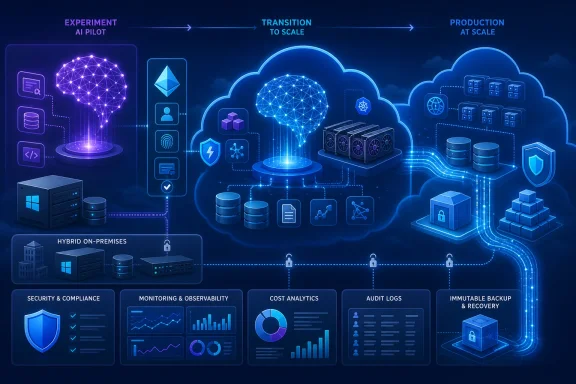 Overview: AI Adoption Is Becoming an Infrastructure Challenge
The first wave of generative AI adoption was dominated by experimentation. Teams built chatbots, copilots, document summarization tools, retrieval-augmented generation systems, forecasting workflows, and automation prototypes with surprising speed. In many cases, the technical demonstration was not the difficult part.The challenge emerged when organizations tried to make those projects permanent.
A production AI service needs more than a model endpoint. It needs secure connectivity to enterprise data, identity controls, logging, monitoring, data retention policies, cost allocation, network design, disaster recovery procedures, and a clear owner when something fails at 2 a.m. It may also need to integrate with existing Windows Server workloads, Active Directory or Microsoft Entra ID, SQL Server estates, on-premises applications, Power Platform automations, and line-of-business systems that were never designed with generative AI in mind.
That is the gap Rackspace Technology is attempting to address through its Microsoft Azure expertise. Rather than presenting AI as a standalone software purchase, the company is framing it as an end-to-end cloud operating model involving migration, modernization, managed services, AI and machine learning operations, security, and cost optimization.
This is an important distinction. A company can purchase access to an AI platform quickly. Building an environment where that platform can use sensitive enterprise data responsibly, produce auditable outputs, withstand a cyber incident, and remain affordable over time is considerably more difficult.
Why “AI-Ready” Means More Than Having Cloud Capacity
The phrase AI-ready infrastructure is used widely across the technology industry, sometimes with little precision. At its best, it describes an environment designed to support the entire lifecycle of AI workloads rather than merely providing virtual machines or cloud subscriptions.For Azure deployments, that generally means coordinating several layers of technology and operations.
The foundation: cloud architecture and modernization
Many enterprise applications were designed around fixed infrastructure, legacy integration methods, and data stores that are difficult to expose safely to modern AI services. Simply moving those workloads to Azure may improve flexibility, but a lift-and-shift migration alone does not necessarily create an AI-ready foundation.Modernization can involve:
- Refactoring applications for cloud-native operation
- Containerizing services where appropriate
- Standardizing data pipelines and APIs
- Reducing dependence on brittle point-to-point integrations
- Establishing consistent identity and access controls
- Improving observability across applications and infrastructure
- Mapping dependencies before migration or AI integration begins
Data readiness is central, not optional
AI infrastructure is only as useful as the data flowing through it. Organizations often discover that their data is duplicated across departments, stored in incompatible formats, missing critical metadata, or subject to policies that were never designed for machine-assisted analysis.An AI-ready Azure environment therefore requires a disciplined approach to:
- Data classification and sensitivity labeling
- Data residency and sovereignty requirements
- Quality controls for source systems
- Access policies for structured and unstructured data
- Audit trails for data retrieval and model outputs
- Retention and deletion rules
- Segmentation between development, testing, and production environments
AI operations must be treated as real operations
Production AI is not a “deploy once and forget” undertaking. Models change, user behavior changes, costs fluctuate, data evolves, prompts drift, and vendors release new capabilities. An organization needs the equivalent of DevOps discipline for AI services.That can include:
- Model versioning and approval workflows
- Prompt and agent configuration management
- Testing for accuracy, safety, and regression issues
- Monitoring for latency, availability, and token consumption
- Guardrails for sensitive data and risky actions
- Human approval checkpoints for consequential workflows
- Clear incident-response procedures
The Microsoft Azure Advantage for Windows Organizations
Rackspace’s Azure emphasis is strategically sensible for enterprises that already depend on Microsoft’s business and infrastructure ecosystem. Microsoft Azure provides an extensive set of cloud services for compute, storage, networking, identity, data analytics, security, and AI development. For many Windows-heavy organizations, Azure can also reduce the friction of connecting modern services to established Microsoft estates.Familiar identity and management patterns
One major advantage is the ability to build on identity patterns that many IT teams already understand. Microsoft Entra ID, hybrid identity integration, role-based access controls, privileged access workflows, and policy-based governance can form the access-control backbone for AI environments.This does not make AI security automatic. Misconfigured permissions, overly broad service identities, and weak secrets management remain serious risks. But it gives organizations a more coherent route to applying existing governance practices to new AI workloads.
For a business that already operates Microsoft 365, Windows endpoints, Active Directory, Intune, Defender, SQL Server, and Azure resources, a unified approach can be significantly easier to manage than assembling a completely separate AI stack from unfamiliar providers.
Hybrid cloud remains relevant
Despite the rush toward public cloud AI, many enterprises cannot—or should not—move every workload and data source into a single public-cloud environment. Some applications have latency needs, contractual restrictions, specialized hardware dependencies, or regulatory boundaries that make hybrid architectures necessary.An effective AI-ready infrastructure strategy must acknowledge that reality. Data may remain on-premises while selected services run in Azure. A model may process sanitized or approved data in the cloud while systems of record stay within private infrastructure. Sensitive workloads may require dedicated, private, sovereign, or isolated environments.
Rackspace’s experience across public cloud, private cloud, hybrid infrastructure, and managed operations could be valuable in these scenarios. The company’s broader enterprise AI direction is increasingly tied to governed environments where organizations need more control than a simple public cloud deployment may provide.
Azure migration as an AI enabler
Migration is often described as a cost-reduction exercise, but it is more accurately an opportunity to improve the operating model. Moving workloads without redesigning governance, observability, backup, network controls, and cost accountability can simply relocate old inefficiencies into a new billing structure.Rackspace’s Azure migration and modernization services are positioned around a more complete goal: building scalable environments that are prepared for AI, rather than merely transferring servers from one location to another.
That distinction matters. A company hoping to deploy AI-driven search, support automation, intelligent document processing, predictive analytics, or agentic workflows will need its applications and data sources to be discoverable, securely connected, and manageable. AI becomes difficult to operationalize when the underlying estate remains opaque.
Where the Cost-Savings Argument Is Most Credible
Rackspace Technology’s claim that AI-ready infrastructure can reduce costs should be interpreted as a potential operational outcome, not a universal promise. Savings are credible when a managed infrastructure approach addresses measurable waste or avoids predictable implementation failures.Reducing overprovisioning
AI workloads can be expensive because compute demand is uneven. A system may require significant capacity during training, batch processing, or business-hour inference peaks, while needing much less at other times. If capacity is provisioned permanently for the peak, the organization may pay for idle resources.An optimized Azure architecture can help address this through:
- Rightsizing virtual machines and compute instances
- Separating development, test, and production capacity
- Scheduling noncritical workloads
- Applying autoscaling where workload behavior allows it
- Using appropriate model sizes for each task
- Moving batch workloads away from premium always-on configurations
- Monitoring actual utilization rather than relying on estimates
Improving engineering productivity
Cloud and AI projects frequently lose time to infrastructure setup, access requests, troubleshooting, patching, migration rework, and integration problems. Managed services can reduce this burden by providing engineers who are familiar with Azure architecture, cloud operations, security controls, and modernization patterns.The resulting savings are not limited to infrastructure bills. They can appear as:
- Faster time to a usable production deployment
- Fewer stalled pilots
- Less internal time spent on undifferentiated operational work
- More consistent support for business teams
- Reduced duplication between cloud, security, and application teams
- Improved availability of scarce cloud and AI specialists
Avoiding expensive governance failures
The most meaningful savings may come from avoided risk rather than lower monthly cloud invoices. A poorly governed AI deployment can expose sensitive data, generate inaccurate automated decisions, create audit failures, violate contractual restrictions, or become unavailable during a critical business period.Governance does not eliminate risk, but it can make problems more visible and controllable. Access controls, audit logs, model monitoring, data segmentation, and recovery planning create operational discipline that is easy to undervalue until it is needed.
For regulated organizations, this is often the real business case. The goal is not simply to make an AI process cheaper. It is to make it defensible, repeatable, and resilient.
Financial Services: KYC and AML Show the Stakes Clearly
Rackspace has highlighted AI-powered approaches to Know Your Customer (KYC) and anti-money laundering workflows, areas where manual processes, fragmented data, and high alert volumes can create substantial operational pressure.These are logical use cases for AI-assisted infrastructure because they involve large volumes of documents, customer information, screening data, investigation notes, and regulatory reporting requirements. AI can help classify documents, extract information, prioritize work, identify potential relationships, summarize evidence, and draft materials for human review.
However, these are also areas where overconfidence can be dangerous.
Human oversight cannot be treated as a formality
KYC and AML decisions can have major consequences for customers, institutions, and regulators. An AI system may surface risk indicators or organize an investigator’s workflow, but it should not be treated as an unquestionable authority.A safer model emphasizes:
- Human review for consequential decisions
- Clear escalation paths
- Verifiable records of evidence and approvals
- Regular testing for false positives and false negatives
- Controls for bias and inconsistent outcomes
- Separation between AI suggestions and final compliance determinations
- Strong data-access governance
Operational efficiency needs measurable definitions
Claims around AI efficiency should be assessed using concrete operational metrics. Organizations should ask whether a deployment reduces average handling time, increases analyst throughput, improves consistency, lowers duplicate work, decreases false alerts, or accelerates appropriately reviewed filings.The metrics should be tracked over time, not just during a demonstration.
A KYC system that accelerates initial screening but increases downstream rework has not necessarily created value. Likewise, a tool that reduces case-processing time but produces unreliable explanations may increase compliance risk. The strongest deployments are those that improve speed and preserve transparency.
Recoverability and Cyber Resilience Are Becoming AI Requirements
One of the more important elements of Rackspace’s enterprise AI strategy is its work with Rubrik around recoverable, governed, and audit-ready environments. This is a welcome reminder that AI platforms are still business systems—and business systems must be recoverable after ransomware, data corruption, compromised credentials, software failure, or operator error.AI deployments add new assets to protect:
- Training and reference data
- Vector databases and indexes
- Model configurations
- Prompt libraries and agent instructions
- Identity integrations
- API credentials and secrets
- Evaluation datasets
- Workflow definitions
- Audit logs
- Fine-tuned model artifacts
Recovery needs to be tested, not assumed
Immutable backups, isolated recovery environments, and automated recovery workflows can materially improve cyber resilience. But the real test is whether an organization can restore its critical AI-enabled processes in a realistic time frame, with validated data and without reintroducing malware or compromised configurations.A credible recovery strategy should include:
- Asset inventory: Identify every data store, model artifact, identity dependency, integration, and configuration required for the AI service.
- Recovery priorities: Define which systems must return first and what functionality is acceptable during a partial restoration.
- Isolation procedures: Ensure recovery environments are separated from the potentially compromised production environment.
- Validation steps: Verify data integrity, access policies, model configurations, and integrations before restoring full service.
- Regular exercises: Test the recovery plan under realistic conditions rather than relying on documentation alone.
The Risks Behind the “AI-Ready” Label
The AI-ready infrastructure narrative is strong, but organizations should resist treating it as a substitute for strategy. A well-managed Azure environment can enable AI adoption; it cannot decide which use cases deserve investment or guarantee that users will trust the results.Cost visibility can still fail
Generative AI cost structures are more complex than traditional server costs. Expenses can be driven by inference calls, token volumes, model selection, vector search, storage, network movement, GPU utilization, logging, data preparation, and third-party software.Without granular chargeback or showback mechanisms, an organization may know that AI spending is growing but not which department, application, customer segment, or workflow is responsible.
The answer is not simply to impose hard spending caps. Teams need observability that connects technical consumption to business value. A customer-support assistant with a meaningful reduction in resolution time may justify its cost. An internal chatbot that sees little adoption may not.
Vendor concentration deserves attention
Building deeply on Azure can simplify operations for Microsoft-centric enterprises, but it also increases dependence on Microsoft services, commercial terms, regional availability, and platform roadmaps. Adding a managed services partner can further centralize responsibility.That may be appropriate, especially when the priority is speed and operational consistency. Still, organizations should understand where portability is realistic and where it is not.
They should also document:
- Data export options
- Backup formats and restoration paths
- Identity dependencies
- Model and API abstraction layers
- Contractual responsibilities
- Service-level expectations
- Exit and transition plans
Governance must not slow every useful idea to a halt
There is an opposite risk as well: organizations can make AI governance so cumbersome that teams bypass approved platforms and use unapproved consumer tools. That creates “shadow AI,” where sensitive data may be shared outside established controls.The better approach is to provide governed, accessible pathways for experimentation. A mature AI-ready environment should make the secure option easier to use than the insecure one.
This can include approved sandboxes, preconfigured Azure templates, enterprise identity integration, curated models, safe data-access patterns, logging, cost controls, and clear escalation channels for higher-risk use cases.
What a Practical Azure AI Roadmap Looks Like
Organizations considering an AI-ready Azure program should avoid starting with an abstract platform project. The more effective route is to connect infrastructure investment to specific, prioritized business problems.Start with a workload inventory
Identify workloads that are candidates for AI enhancement, modernization, or migration. Look for business processes that are repetitive, document-heavy, data-intensive, slow, error-prone, or difficult to scale.Common examples include:
- Internal knowledge search
- Customer service assistance
- Document extraction and classification
- Contract review support
- Software development assistance
- Security operations triage
- Forecasting and anomaly detection
- Compliance workflow support
- Employee self-service automation
Establish platform guardrails early
Before deploying production AI, define baseline controls for identity, data, networking, logging, secrets management, security review, and cost management. These controls should be standardized enough to be reusable but flexible enough to support different workload risk levels.A low-risk internal summarization tool should not require the same approval process as an AI-assisted financial decision workflow. Risk-based governance is more sustainable than one-size-fits-all governance.
Measure business outcomes, not just technical activity
A successful AI infrastructure program should report more than the number of models deployed or cloud resources created. It should demonstrate business metrics such as faster resolution times, fewer manual touchpoints, lower error rates, improved availability, reduced recovery times, or stronger audit performance.This approach also helps distinguish genuine cost savings from cost shifting. If AI reduces manual effort but requires substantial new review work, the organization needs to see that clearly.
Build for operations from day one
Production ownership should be clear before launch. Teams need to know who supports the infrastructure, who owns the data, who approves model changes, who receives security alerts, who controls spend, and who handles failures.This is where a managed Azure partner can be useful. Rackspace Technology’s experience with Azure modernization, cloud operations, and enterprise AI infrastructure can help organizations that lack the internal capacity to maintain every layer independently. But the customer still needs accountable internal owners for risk, data, and business outcomes.
The Bottom Line
Rackspace Technology’s Azure-focused AI infrastructure strategy reflects a necessary maturation of the enterprise AI market. The value proposition is not merely that organizations can gain access to more AI capabilities. It is that they can build a governed operational foundation capable of supporting those capabilities over time.For Microsoft-centric enterprises, the combination of Azure expertise, migration and modernization services, managed cloud operations, security controls, and recoverability planning can provide a credible route from experimentation to production. The approach is particularly relevant where Windows workloads, Microsoft identity systems, hybrid infrastructure, regulated data, and enterprise-scale operational requirements intersect.
The strongest aspect of the strategy is its focus on the work that too often receives less attention than models and user interfaces: architecture, integration, governance, resilience, cost management, and day-to-day operations. Those disciplines are what turn AI from an impressive pilot into a dependable business capability.
Still, the promised cost savings should be evaluated through measurable outcomes rather than broad assumptions. AI-ready infrastructure can reduce waste, accelerate delivery, and improve operational efficiency—but only when organizations rightsize compute, govern data carefully, choose appropriate models, automate the right workflows, and maintain clear responsibility for the services they deploy.
In that sense, the real opportunity is not simply to run AI on Microsoft Azure. It is to create an environment where AI can be deployed with the same rigor expected of every other mission-critical Windows and cloud workload: secure, observable, recoverable, auditable, and economically sustainable.