

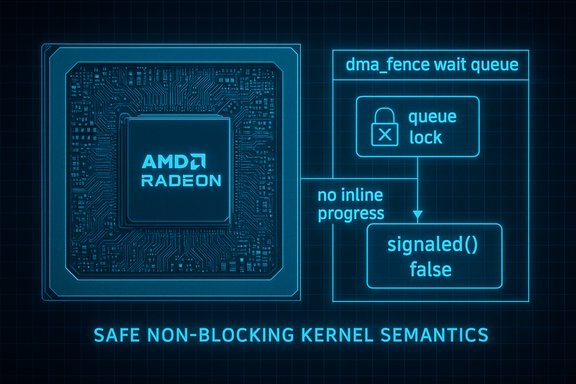
A subtle but important kernel fix landed in mid‑December: a guarded change to the Radeon DRM driver removes an attempt to progress the wait queue from the dma‑fence “is_signaled” path, eliminating a class of self‑deadlocks that could hang the graphics stack. The patch — tracked as CVE‑2025‑68223 — removes radeon_fence_process from is_signaled so that calling dma‑fence_ops::signaled can no longer cause the fence/wait‑queue lock to re‑enter queue‑progress code in an unsafe context; the result is a cleaner, lower‑risk semantics where returning false from signaled is acceptable and avoids lock inversions.
The Linux graphics stack uses fence objects (dma_fence) to serialize GPU and CPU operations: fences mark work that must complete before dependent work can proceed. Fence implementations expose an ops structure that includes methods such as signaled (a fast, non‑blocking query) and wait (a blocking wait for completion). Drivers often augment fence semantics with wait queues and helper functions that attempt to progress queued work when a fence is checked — an optimization to reduce latency by doing a little forward progress inline.
That optimization can be dangerous. In the Radeon DRM driver case, the fence’s lock doubles as the wait‑queue lock, and dma‑fence_ops::signaled may be invoked with the fence lock held in an unknown context (interrupt, softirq, or process). If signaled tries to call into queue‑progress routines that acquire the same lock or otherwise expect a process‑context environment, the code can deadlock against itself: code on CPU A holds the lock and waits; CPU B — executing a signaled callback perhaps from interrupt context — attempts to make forward progress and blocks waiting for a resource held by CPU A, producing a self‑deadlock. The fix removes the inline queue progression from is_signaled so the signaled call remains a safe, low‑risk check. External vulnerability trackers and vendor advisories summarize the change and its rationale.
In the Radeon case the fence lock also acts as the wait‑queue lock. That tight coupling means code paths that examine the fence state must take the same lock to inspect queue structures. If the signaled callback tries to make forward progress on the wait queue (for instance by trying to dequeue and complete queued work inline), it may:
Exploitability characteristics:
For operators, the path forward is straightforward: inventory devices that load the radeon driver, apply vendor or distribution kernel updates that include the upstream commit, reboot into patched kernels, and adopt short‑term access restrictions for untrusted workloads if immediate patching is infeasible. The patch’s narrow scope makes it simple to backport and low risk to deploy, but the usual long‑tail vendor lag and testing caveats apply.
This change is one more example of the kernel community’s pragmatic approach to graphics driver hardening: prefer conservative, surgical edits that close deterministic deadlocks while preserving functional correctness and minimizing regression risk.
Source: MSRC Security Update Guide - Microsoft Security Response Center
 Background
The Linux graphics stack uses fence objects (dma_fence) to serialize GPU and CPU operations: fences mark work that must complete before dependent work can proceed. Fence implementations expose an ops structure that includes methods such as signaled (a fast, non‑blocking query) and wait (a blocking wait for completion). Drivers often augment fence semantics with wait queues and helper functions that attempt to progress queued work when a fence is checked — an optimization to reduce latency by doing a little forward progress inline.That optimization can be dangerous. In the Radeon DRM driver case, the fence’s lock doubles as the wait‑queue lock, and dma‑fence_ops::signaled may be invoked with the fence lock held in an unknown context (interrupt, softirq, or process). If signaled tries to call into queue‑progress routines that acquire the same lock or otherwise expect a process‑context environment, the code can deadlock against itself: code on CPU A holds the lock and waits; CPU B — executing a signaled callback perhaps from interrupt context — attempts to make forward progress and blocks waiting for a resource held by CPU A, producing a self‑deadlock. The fix removes the inline queue progression from is_signaled so the signaled call remains a safe, low‑risk check. External vulnerability trackers and vendor advisories summarize the change and its rationale.
What changed in practical terms
At a code level the remediation is small and surgical: the driver no longer attempts to advance the wait queue when evaluating whether a fence is signaled. Concretely:- The call path that previously invoked radeon_fence_process from within the fence’s signaled method has been removed.
- This prevents signaled from entering code that performs queue re‑arming or progress operations while the fence/wait queue lock may be held in an IRQ‑sensitive context.
- The driver now tolerates the (safe) behavior where signaled returns false even if some queued progress might have allowed it to return true — the correctness contract for signaled permits false negatives; it must not perform heavy forward progress or cause blocking.
Why this matters: deadlock mechanics explained
Deadlocks in kernel drivers often arise from two simple ingredients: (1) a lock is acquired in multiple contexts with different constraints (for example, in hardirq vs process contexts), and (2) code executed while holding the lock attempts to perform actions that in turn depend on acquiring other locks or performing context‑sensitive work.In the Radeon case the fence lock also acts as the wait‑queue lock. That tight coupling means code paths that examine the fence state must take the same lock to inspect queue structures. If the signaled callback tries to make forward progress on the wait queue (for instance by trying to dequeue and complete queued work inline), it may:
- attempt to acquire additional locks that are held by a process on another CPU, or
- attempt to sleep or otherwise require a non‑IRQ context.
Scope and affected systems
This is a Linux kernel-level change in the DRM/radeon driver. The direct impact surface is:- Systems that load the radeon DRM driver (typically AMD GPUs that use the legacy radeon stack rather than amdgpu).
- Kernels that include the vulnerable code prior to the remedial commit(s) referenced by public CVE trackers.
- Multi‑user or multi‑tenant hosts where unprivileged local processes or containers have access to DRM device nodes (/dev/dri/*), as well as developer workstations and desktops where untrusted processes may interact with the graphics stack.
Operational impact: availability, exploitability and risk profile
This vulnerability is availability‑first. The observed risk is that a local actor — a user or process with the ability to exercise the DRM/fence code paths — can cause a self‑deadlock that hangs the graphics stack or the kernel, resulting in a frozen display, compositor crash, or system instability that may require a reboot.Exploitability characteristics:
- Attack vector: local only. The actor must be able to trigger the relevant DRM/fence code paths (often possible through compositors, GPU‑accelerated media, or containerized workloads that mount /dev/dri).
- Privilege: low in many desktop setups because unprivileged users can cause modesets and other graphics operations indirectly.
- Complexity: low to moderate — the deadlock is deterministic under the right interleavings and contexts; it is therefore an attractive Denial‑of‑Service primitive for a local adversary.
- Confidentiality/Integrity: the fix and public analysis indicate no direct confidentiality or integrity impact — the bug does not expose memory or enable code execution on its own.
Recommended remediation and verification steps
Rapid, operations‑ready guidance for administrators and desktop users:- Inventory and identify candidates:
- Run uname -r to collect kernel versions.
- Check if the radeon driver is loaded: lsmod | grep radeon.
- Inspect device node permissions: ls -l /dev/dri/* to see whether unprivileged processes or containers have access.
- Patch:
- Apply your distribution or vendor kernel updates that include the upstream commit addressing CVE‑2025‑68223.
- If you build custom kernels, cherry‑pick the upstream stable commit(s) referenced by public trackers and rebuild.
- Reboot:
- Kernel fixes take effect only after a reboot into the patched kernel.
- Validate:
- Confirm the running kernel version with uname -r and verify the patch appears in kernel changelogs or commit lists exposed by your vendor’s package metadata.
- Re‑exercise representative display workloads (hotplug, multi‑monitor transitions, GPU accelerated playback) while monitoring kernel logs for oops or deadlock traces.
- Short‑term mitigations if patching is impossible:
- Restrict access to /dev/dri/* using udev rules, group membership (remove untrusted users from video/render groups), or container runtime device policies.
- Avoid exposing GPU devices to multi‑tenant or untrusted workloads (drop —device=/dev/dri from container runs).
- Increase kernel logging and ensure OOPS traces are collected quickly for triage.
Technical analysis: strengths of the fix
- Surgical scope. The remediation removes a single risky optimization — inline queue progression within signaled — rather than redesigning fence semantics or driver architecture. That keeps the change small, reviewable, and low risk for regressions.
- Context safety. By limiting signaled to a non‑progressing query, the function no longer depends on process context or additional locks; it becomes safe to call from interrupt or non‑sleepable contexts.
- Backport friendliness. The narrow patch is easy for vendors to port into stable kernel branches and vendor kernels, shortening the long‑tail exposure window for many distributions.
- Preserves correctness. The contract for signaled allows false negatives; returning false rather than attempting inline progress is correct, albeit potentially slightly less eager to clear dependencies. This is a pragmatic trade‑off between safety and opportunistic progress.
Potential downsides and residual risks
No patch is free of trade‑offs. Key caveats to consider:- Eager progress lost. Removing inline progression from signaled may delay the moment dependent threads learn a fence has completed. In practice this is minor: drivers and userspace commonly handle completions via callbacks or deferred work and the occasional delayed wake is acceptable compared with a deadlock.
- Vendor lag. Embedded devices, custom OEM images, and vendor‑forked kernels can take weeks or months to receive backports. These long‑tail systems remain vulnerable until vendors publish patched images. Inventory and vendor follow‑up are essential.
- Testing gaps. Subtle timing changes can reveal other latent races; regression testing across typical display and workload scenarios is necessary before rolling to production fleets.
- Incomplete mapping. Not all vendor advisories enumerate the full list of affected products. Absence of an attestation does not guarantee safety — operators must confirm per artifact.
How this change fits into recent DRM/fence hardening trends
Over the past year maintainers have repeatedly favored two patterns when addressing DRM and GPU driver races and deadlocks:- Move context‑sensitive work out of inline callbacks into worker or workqueue contexts where locks and sleeps are allowed.
- Convert inline progress and IRQ‑unsafe operations into simple queries and defer the heavy lifting to process‑context handlers.
Detection and forensic indicators
If you suspect an unpatched host has hit this deadlock class, look for:- Kernel oops or deadlock messages referencing fence/wait queue symbols in the radeon driver stack traces.
- Repeated compositor crashes, pageflip timeouts, or frozen displays correlated with local processes performing modesets or heavy GPU workloads.
- Logs showing fence callbacks attempting to progress wait queues or lock warnings in DRM/fence call stacks.
Conclusion
CVE‑2025‑68223 is a textbook kernel robustness fix: a small, well‑reasoned removal of an optimistic but unsafe optimization that could self‑deadlock the Radeon DRM fence logic. The remedy — stop trying to make forward progress inside dma_fence_ops::signaled — aligns with kernel best practice for context safety and keeps the signaled path fast and non‑blocking.For operators, the path forward is straightforward: inventory devices that load the radeon driver, apply vendor or distribution kernel updates that include the upstream commit, reboot into patched kernels, and adopt short‑term access restrictions for untrusted workloads if immediate patching is infeasible. The patch’s narrow scope makes it simple to backport and low risk to deploy, but the usual long‑tail vendor lag and testing caveats apply.
This change is one more example of the kernel community’s pragmatic approach to graphics driver hardening: prefer conservative, surgical edits that close deterministic deadlocks while preserving functional correctness and minimizing regression risk.
Source: MSRC Security Update Guide - Microsoft Security Response Center
