

Microsoft is pitching Rayfin, shown in a Microsoft Source developer session for Microsoft Fabric, as a preview-era way to let developers and AI coding agents generate enterprise web apps with managed databases, authentication, backend services, and Fabric-connected analytics in minutes. The claim is not simply that app scaffolding gets faster. It is that the backend itself becomes a governed, code-defined Fabric artifact rather than a pile of glue code living somewhere outside the data estate. That is the interesting part, and also the part IT departments should inspect most closely.
The Rayfin demo lands in a very specific moment for Microsoft. Build 2026 was not just another AI developer conference; it was Microsoft’s declaration that agentic software development is becoming a first-class workload across GitHub, Azure, Fabric, and the broader Microsoft cloud. In that context, Rayfin is less a quirky SDK than a strategic answer to a problem Microsoft helped create: if AI agents can generate apps at high speed, where do those apps actually run, and who governs them?
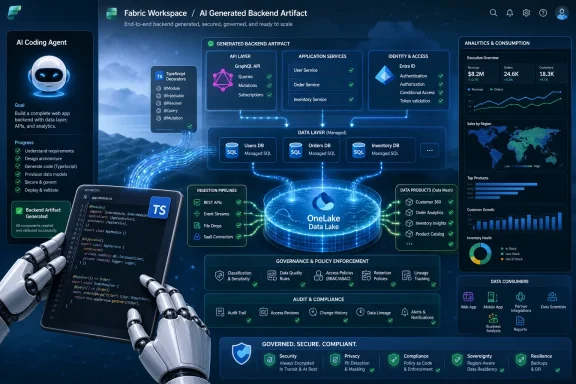
Microsoft’s answer is Fabric. The company describes Rayfin as an open-source SDK and CLI for defining and deploying a complete application backend in code, including data models, APIs, identity, access policies, and business logic. Microsoft Learn describes Fabric Apps, currently in preview, as a managed service that combines app hosting, a SQL database in Fabric, generated GraphQL APIs, and Microsoft Entra-backed authentication.
That framing matters because the demo language — “build an enterprise app in minutes” — could otherwise sound like ordinary vibe coding marketing. We have all seen AI-generated React front ends that look convincing until someone asks about identity, persistence, auditability, permissions, or production operations. Rayfin’s bet is that the coding agent should not just write a pretty app; it should declare the backend in a form Fabric can understand, deploy, secure, and connect to the rest of the analytics stack.
The result is a very Microsoft kind of bargain. Developers get a shorter path from prompt to working application, but the app lands inside Microsoft’s governed data platform. The agent gets freedom at the code layer, while the enterprise keeps the deployment surface closer to Fabric, OneLake, Entra ID, Power BI, and the operational controls administrators already know.
Rayfin is explicitly designed for both developers and coding agents. Microsoft’s Build-era messaging says developers work through familiar GitHub-based workflows to define data models, backend logic, and access policies in code. Microsoft’s Fabric documentation says projects can be created with
That sounds pedestrian until you imagine the user is not a senior backend engineer but an AI coding assistant inside a developer environment. The agent can create a TypeScript model, decorate it, wire a client, generate a front end, and deploy the backend without inventing a security model from scratch. Microsoft is trying to make the safe path the easiest path for AI-assisted development.
The trick is that Rayfin’s unit of abstraction is not a database-first design or a hand-written REST API. It is a TypeScript-defined model that becomes database schema, GraphQL API surface, permission policy, and type-safe client. In Microsoft’s documentation, decorators such as
That approach will feel familiar to developers who have used ORMs, schema-first APIs, or infrastructure-as-code frameworks. But Rayfin’s novelty is in collapsing several layers into one Fabric-native workflow. The promise is that a developer — or an agent acting on behalf of a developer — can describe the domain once and let Fabric produce the operational backend.
Fabric Apps, according to Microsoft Learn, run as managed services in Microsoft Fabric. A deployed app can include static frontend content, a managed SQL database, GraphQL endpoints, and Fabric SSO through Microsoft Entra ID. The app gets a backend URL with service paths for GraphQL, authentication, and storage, while the underlying child services appear under the Fabric app item in the Fabric portal.
The important consequence is that a Rayfin app is not merely hosted “on Azure” in a generic sense. It is part of the Fabric workspace model, with capacity requirements, tenant admin settings, workspace permissions, and preview-region availability. That makes Rayfin more constrained than a free-floating app platform, but also potentially more acceptable to enterprises that already treat Fabric as their governed data layer.
This is where Microsoft’s pitch starts to diverge from the consumer-friendly story of “AI builds your app.” For enterprise IT, the question is not whether an AI agent can produce a working prototype. It is whether that prototype can be moved into a governed environment without being rewritten by a different team six months later. Rayfin is aimed directly at that prototype-to-production gap.
The risk is that Microsoft is asking Fabric to become yet another development platform in addition to being a data platform. Fabric already spans lakehouses, warehouses, real-time intelligence, notebooks, Power BI, Data Factory-style pipelines, governance, and AI features. Adding managed app backends extends the platform’s reach, but it also raises the complexity ceiling for tenants that are still getting their Fabric fundamentals under control.
That is not an accident. TypeScript is legible to human developers, friendly to AI coding tools, and strict enough to catch certain classes of mistakes before deployment. If the agent invents a field that does not exist, a type-safe client can complain. If the model is declared in code, it can be reviewed, versioned, diffed, and pushed through a normal software development lifecycle.
This is a very different posture from low-code app builders, even if the target users overlap. Microsoft already has Power Apps for business-led app creation, and Power Platform remains the more obvious choice for many internal forms, approvals, and workflow interfaces. Rayfin, by contrast, is aimed at pro developers and agent-assisted coding environments where the artifact of record is code.
That distinction will matter politically inside organizations. Citizen developers may see Rayfin as too code-heavy. Traditional developers may see it as too managed. Platform teams may appreciate the Git-based deployment story but worry about preview maturity, capacity consumption, and the operational boundaries between app teams and data teams.
The more interesting audience is the developer who knows enough to be dangerous but not enough to safely build a backend alone. That includes analysts turned builders, data engineers asked to produce internal tools, and product teams experimenting with AI agents that need persistent state. Rayfin gives those users a backend lane, but it does not absolve them of design responsibility.
Microsoft’s own prerequisites tell the more sober story. A Fabric workspace must have capacity assigned. A tenant administrator must enable the Fabric Apps workload. Fabric Apps are not available in all regions. Deployed apps use Microsoft Entra single sign-on exclusively, while email-and-password authentication is limited to local development. Static frontend assets are served from a public URL, which means developers remain responsible for keeping secrets out of code and builds.
None of that undercuts the value of Rayfin. It simply makes clear that “minutes” describes the construction path after the enterprise runway exists. A developer with the right tenant, capacity, permissions, and region support may be able to go from model to deployed app quickly. A company trying to establish governance, cost controls, security review, and deployment standards will not compress that work into a coffee break.
This is where IT professionals should resist both cynicism and hype. The demo speed is real enough to matter. But the organizational speed will depend on whether Fabric is already a trusted platform inside the company.
For organizations deep into Fabric, Rayfin could become a natural extension of existing investments. For those still evaluating Fabric, it is another reason the platform feels increasingly like an all-or-nothing commitment: data, BI, AI, and now app backends under one Microsoft roof.
That gives developers a clean and understandable path: define entities, deploy, query through the client, and let Fabric handle infrastructure. For internal tools, prototypes, dashboards, and agent applications that need structured persistent state, this is exactly the sort of backend teams often wish existed already.
But the same managed model imposes limits. Microsoft’s Fabric Apps FAQ says Fabric Apps support SQL Server as the default for Fabric deployments and that you cannot point Fabric Apps at an existing database with a predefined schema. The app database is managed from the TypeScript model; schema changes are intended to flow through Rayfin, not ad hoc portal edits.
That is likely the right tradeoff for agent-generated backends. Letting AI agents mutate arbitrary production databases would be an invitation to chaos. A controlled model-driven database gives the platform something it can reason about, generate APIs from, and govern.
Still, enterprises should not confuse that with full application-platform flexibility. Apps with complex transaction requirements, stored procedure-heavy architectures, custom authentication providers, or deep integration with existing operational databases may not fit comfortably. Rayfin appears strongest where the app’s backend can be modeled cleanly and Fabric can own the generated service boundary.
That will annoy developers who want pluggable identity providers, consumer login flows, or bespoke authentication schemes. But for Microsoft’s target enterprise customer, it is a defensible constraint. Entra ID is already where many organizations manage users, groups, conditional access, and identity governance. If Rayfin apps are going to spread through a tenant, Microsoft wants their sign-in story to be boring.
Boring is good in identity. It means fewer homegrown password stores, fewer inconsistent login prompts, and fewer one-off auth libraries maintained by teams that would rather ship product features. It also makes it easier for administrators to reason about who can access the app and how that access relates to Fabric workspace permissions.
The catch is that sign-in is not the same as authorization. Microsoft’s documentation is clear that developers remain responsible for what the app exposes to authenticated users. Rayfin can provide row-level security decorators and integrate with Fabric permissions, but a badly designed app can still leak the wrong data to the wrong audience if its model, policies, or UI logic are sloppy.
That point becomes more urgent in an agentic development workflow. If an AI assistant writes the first draft of the model and access rules, a human still needs to review the security implications. Rayfin may reduce the boilerplate, but it does not eliminate judgment.
OneLake has become Microsoft’s unifying concept for Fabric: a single logical data lake where Fabric workloads can interoperate. Rayfin’s promise is that apps built with it can place operational data where Power BI, notebooks, data science tools, data agents, and other Fabric experiences can immediately make use of it. In Microsoft’s Build messaging, this is part of a larger push toward “AI-ready” operational experiences.
That is an attractive proposition for organizations tired of the gap between transactional apps and analytics. Internal apps often generate useful operational data that ends up locked in app databases, exported through brittle jobs, or manually copied into reporting systems. If a Rayfin app’s data is already close to Fabric’s analytical plane, the time from app usage to insight could shrink.
The same integration may also make governance more tractable. Data lineage, access policies, reporting, and AI workflows can be pulled closer to a single platform rather than scattered across bespoke app stacks. For administrators, that is the strongest version of the Rayfin story: faster app creation without creating a new shadow estate.
But gravity wells have a cost. The more an app depends on Fabric-native services, the more tightly it is bound to Microsoft’s platform roadmap, regional availability, licensing, and capacity model. A Rayfin app is not just an app; it is a vote for Fabric as the operational home for a class of internal software.
Microsoft’s documentation already flags practical constraints. Fabric Apps require tenant enablement, Fabric capacity, supported regions, and the right workspace configuration. Custom authentication providers are not supported after deployment. Certain application patterns, including complex multi-step transactions and stored-procedure-heavy designs, may not be good fits.
For early adopters, the right use cases are therefore not customer-facing systems of record or business-critical workflows with regulatory exposure. They are internal tools, governed prototypes, agent experiments, analytics-adjacent applications, and departmental apps where Fabric is already part of the environment. These are exactly the places where the cost of backend setup has historically made “small” apps more expensive than they should be.
The preview phase is also when developers should test the parts demos skip. How does schema evolution feel after the third change? How does rollback work in practice? How observable are the generated services? What happens under capacity pressure? How clear is the boundary between Rayfin-managed database schema and broader Fabric data operations?
Those questions are not objections. They are the difference between admiring a demo and operating a platform.
Without a platform like Rayfin, an AI-generated app might land in a random cloud account, a personal GitHub repository, a free database tier, or a developer’s laptop. It might have no clear owner, no proper authentication, no audit trail, and no path to integration with enterprise data. That is the shadow IT nightmare with a better code completion engine.
Rayfin offers Microsoft’s preferred alternative. Let agents help generate the app, but make the backend declarative, typed, reviewable, and deployable into Fabric. Make identity Entra-backed. Make the app a Fabric item. Put the data near OneLake. Keep the organization’s governance plane in the loop.
This is why Rayfin should be understood as a platform governance product as much as a developer productivity product. The productivity story gets the clicks because “full stack app in minutes” sounds exciting. The governance story is what will decide whether enterprises actually allow it.
The tension is that governance only works if the platform’s abstractions are comprehensible. If Rayfin becomes another black box that spits out services few administrators understand, it will merely move shadow IT into a different wrapper. Microsoft must make the generated pieces visible, auditable, observable, and manageable enough for real operations teams.
For Windows developers, that likely means the local machine becomes less of a traditional development island and more of an agent-assisted control plane. You prompt, edit, review, run locally, and deploy to Fabric. The heavy operational pieces live in Microsoft’s cloud, but the developer experience still flows through familiar Windows tools such as VS Code, terminals, Node.js, Git, and GitHub Copilot.
That model fits Microsoft’s current product instincts. Windows remains the workstation. GitHub supplies the development collaboration and AI coding layer. Azure and Fabric supply the cloud substrate. Entra supplies identity. Power BI and Fabric supply analytics. Rayfin is a connector between those layers, aimed at the increasingly common case where the thing being built is not just a website but an intelligent, data-aware enterprise tool.
This could also blur the line between software developers and data professionals. A Fabric engineer who understands the organization’s lakehouse, semantic models, and Power BI estate may now have a more direct route to building an operational app. A web developer may find that the backend constraints are increasingly shaped by Fabric governance rather than by a standalone app platform.
That convergence is powerful, but it will create new skills gaps. Teams will need people who understand TypeScript and Fabric, Entra and GraphQL, app design and data governance. The agent can help write code; it cannot yet replace the human who knows why the app should exist and what data boundaries it must respect.
The security responsibilities in Microsoft’s documentation are blunt enough to deserve attention. Developers must keep secrets and sensitive data out of code, frontend assets, and repositories. They must design what authenticated users can see and do. They must grant contributors only the permissions needed to deploy or manage apps. They remain accountable for the data their apps collect, process, and store.
That is especially important because AI-generated code can be deceptively polished. A generated app may compile, authenticate, render charts, and query data while still encoding poor assumptions about access control, validation, error handling, or data retention. Rayfin can make the scaffolding more consistent, but it cannot guarantee the business logic is correct.
The mature pattern will be human-in-the-loop platform engineering. Let agents generate the first draft. Let Rayfin create the managed backend. Then require code review, policy review, test data, deployment gates, and monitoring before the app becomes a production dependency.
If Microsoft wants Rayfin to survive beyond the preview hype cycle, it should lean into that discipline rather than pretend every user is one prompt away from a production system. The best customers will not be the ones who deploy fastest. They will be the ones who turn speed into repeatable, governed delivery.
 Microsoft Wants the Agent to Build Where the Data Already Lives
The Rayfin demo lands in a very specific moment for Microsoft. Build 2026 was not just another AI developer conference; it was Microsoft’s declaration that agentic software development is becoming a first-class workload across GitHub, Azure, Fabric, and the broader Microsoft cloud. In that context, Rayfin is less a quirky SDK than a strategic answer to a problem Microsoft helped create: if AI agents can generate apps at high speed, where do those apps actually run, and who governs them?Microsoft’s answer is Fabric. The company describes Rayfin as an open-source SDK and CLI for defining and deploying a complete application backend in code, including data models, APIs, identity, access policies, and business logic. Microsoft Learn describes Fabric Apps, currently in preview, as a managed service that combines app hosting, a SQL database in Fabric, generated GraphQL APIs, and Microsoft Entra-backed authentication.
That framing matters because the demo language — “build an enterprise app in minutes” — could otherwise sound like ordinary vibe coding marketing. We have all seen AI-generated React front ends that look convincing until someone asks about identity, persistence, auditability, permissions, or production operations. Rayfin’s bet is that the coding agent should not just write a pretty app; it should declare the backend in a form Fabric can understand, deploy, secure, and connect to the rest of the analytics stack.
The result is a very Microsoft kind of bargain. Developers get a shorter path from prompt to working application, but the app lands inside Microsoft’s governed data platform. The agent gets freedom at the code layer, while the enterprise keeps the deployment surface closer to Fabric, OneLake, Entra ID, Power BI, and the operational controls administrators already know.
The Backend-as-a-Service Pitch Has Been Rewritten for AI
Backend-as-a-service is not new. Firebase, Supabase, Appwrite, Amplify, and countless internal platform engineering efforts have long promised to spare developers from rebuilding authentication, CRUD APIs, hosting, and database plumbing. What is new is the intended author.Rayfin is explicitly designed for both developers and coding agents. Microsoft’s Build-era messaging says developers work through familiar GitHub-based workflows to define data models, backend logic, and access policies in code. Microsoft’s Fabric documentation says projects can be created with
npm create @microsoft/rayfin@latest, initialized with the Rayfin CLI, run locally with Docker, and deployed to Fabric with npx rayfin up.That sounds pedestrian until you imagine the user is not a senior backend engineer but an AI coding assistant inside a developer environment. The agent can create a TypeScript model, decorate it, wire a client, generate a front end, and deploy the backend without inventing a security model from scratch. Microsoft is trying to make the safe path the easiest path for AI-assisted development.
The trick is that Rayfin’s unit of abstraction is not a database-first design or a hand-written REST API. It is a TypeScript-defined model that becomes database schema, GraphQL API surface, permission policy, and type-safe client. In Microsoft’s documentation, decorators such as
@entity, @uuid, @text, and @role are not just syntactic sugar; they are the contract from which Fabric generates infrastructure.That approach will feel familiar to developers who have used ORMs, schema-first APIs, or infrastructure-as-code frameworks. But Rayfin’s novelty is in collapsing several layers into one Fabric-native workflow. The promise is that a developer — or an agent acting on behalf of a developer — can describe the domain once and let Fabric produce the operational backend.
Fabric Apps Turn the Demo Into a Platform Play
The Source session description emphasizes that Rayfin-generated apps can connect to existing data in a Microsoft Fabric data estate and use Fabric’s analytics, BI, and AI capabilities. That is the real platform play. Microsoft does not want Rayfin apps to be isolated applets; it wants them to become another way to operationalize Fabric data.Fabric Apps, according to Microsoft Learn, run as managed services in Microsoft Fabric. A deployed app can include static frontend content, a managed SQL database, GraphQL endpoints, and Fabric SSO through Microsoft Entra ID. The app gets a backend URL with service paths for GraphQL, authentication, and storage, while the underlying child services appear under the Fabric app item in the Fabric portal.
The important consequence is that a Rayfin app is not merely hosted “on Azure” in a generic sense. It is part of the Fabric workspace model, with capacity requirements, tenant admin settings, workspace permissions, and preview-region availability. That makes Rayfin more constrained than a free-floating app platform, but also potentially more acceptable to enterprises that already treat Fabric as their governed data layer.
This is where Microsoft’s pitch starts to diverge from the consumer-friendly story of “AI builds your app.” For enterprise IT, the question is not whether an AI agent can produce a working prototype. It is whether that prototype can be moved into a governed environment without being rewritten by a different team six months later. Rayfin is aimed directly at that prototype-to-production gap.
The risk is that Microsoft is asking Fabric to become yet another development platform in addition to being a data platform. Fabric already spans lakehouses, warehouses, real-time intelligence, notebooks, Power BI, Data Factory-style pipelines, governance, and AI features. Adding managed app backends extends the platform’s reach, but it also raises the complexity ceiling for tenants that are still getting their Fabric fundamentals under control.
TypeScript Becomes the Contract Between Humans, Agents, and Fabric
Rayfin’s most revealing design decision is its commitment to TypeScript. Microsoft Learn says Fabric Apps support TypeScript for data models, client code, and application logic, and that data models are defined with TypeScript decorators. The front end can use common JavaScript frameworks, but the backend model definition is TypeScript-first.That is not an accident. TypeScript is legible to human developers, friendly to AI coding tools, and strict enough to catch certain classes of mistakes before deployment. If the agent invents a field that does not exist, a type-safe client can complain. If the model is declared in code, it can be reviewed, versioned, diffed, and pushed through a normal software development lifecycle.
This is a very different posture from low-code app builders, even if the target users overlap. Microsoft already has Power Apps for business-led app creation, and Power Platform remains the more obvious choice for many internal forms, approvals, and workflow interfaces. Rayfin, by contrast, is aimed at pro developers and agent-assisted coding environments where the artifact of record is code.
That distinction will matter politically inside organizations. Citizen developers may see Rayfin as too code-heavy. Traditional developers may see it as too managed. Platform teams may appreciate the Git-based deployment story but worry about preview maturity, capacity consumption, and the operational boundaries between app teams and data teams.
The more interesting audience is the developer who knows enough to be dangerous but not enough to safely build a backend alone. That includes analysts turned builders, data engineers asked to produce internal tools, and product teams experimenting with AI agents that need persistent state. Rayfin gives those users a backend lane, but it does not absolve them of design responsibility.
The Demo Is Fast Because Microsoft Removed the Boring Parts
The phrase “in minutes” is always a little dangerous in enterprise software. It usually means the demo has been optimized, the tenant is ready, permissions are prearranged, and the hard organizational questions have been left outside the room. Rayfin is no exception.Microsoft’s own prerequisites tell the more sober story. A Fabric workspace must have capacity assigned. A tenant administrator must enable the Fabric Apps workload. Fabric Apps are not available in all regions. Deployed apps use Microsoft Entra single sign-on exclusively, while email-and-password authentication is limited to local development. Static frontend assets are served from a public URL, which means developers remain responsible for keeping secrets out of code and builds.
None of that undercuts the value of Rayfin. It simply makes clear that “minutes” describes the construction path after the enterprise runway exists. A developer with the right tenant, capacity, permissions, and region support may be able to go from model to deployed app quickly. A company trying to establish governance, cost controls, security review, and deployment standards will not compress that work into a coffee break.
This is where IT professionals should resist both cynicism and hype. The demo speed is real enough to matter. But the organizational speed will depend on whether Fabric is already a trusted platform inside the company.
For organizations deep into Fabric, Rayfin could become a natural extension of existing investments. For those still evaluating Fabric, it is another reason the platform feels increasingly like an all-or-nothing commitment: data, BI, AI, and now app backends under one Microsoft roof.
The Managed Database Is a Feature and a Constraint
Rayfin’s managed database story is central to its appeal. Fabric Apps can create a managed SQL database based on the TypeScript data model, and Fabric applies schema changes from code during deployment. The generated GraphQL API then becomes the application-facing interface for reads and writes.That gives developers a clean and understandable path: define entities, deploy, query through the client, and let Fabric handle infrastructure. For internal tools, prototypes, dashboards, and agent applications that need structured persistent state, this is exactly the sort of backend teams often wish existed already.
But the same managed model imposes limits. Microsoft’s Fabric Apps FAQ says Fabric Apps support SQL Server as the default for Fabric deployments and that you cannot point Fabric Apps at an existing database with a predefined schema. The app database is managed from the TypeScript model; schema changes are intended to flow through Rayfin, not ad hoc portal edits.
That is likely the right tradeoff for agent-generated backends. Letting AI agents mutate arbitrary production databases would be an invitation to chaos. A controlled model-driven database gives the platform something it can reason about, generate APIs from, and govern.
Still, enterprises should not confuse that with full application-platform flexibility. Apps with complex transaction requirements, stored procedure-heavy architectures, custom authentication providers, or deep integration with existing operational databases may not fit comfortably. Rayfin appears strongest where the app’s backend can be modeled cleanly and Fabric can own the generated service boundary.
Authentication Is Simpler Because Microsoft Made a Hard Choice
Authentication is one of the places where Rayfin reveals its enterprise priorities. In local development, Fabric Apps can support email and password. Once deployed to Fabric, Microsoft Learn says authentication uses Fabric SSO with Microsoft Entra ID exclusively.That will annoy developers who want pluggable identity providers, consumer login flows, or bespoke authentication schemes. But for Microsoft’s target enterprise customer, it is a defensible constraint. Entra ID is already where many organizations manage users, groups, conditional access, and identity governance. If Rayfin apps are going to spread through a tenant, Microsoft wants their sign-in story to be boring.
Boring is good in identity. It means fewer homegrown password stores, fewer inconsistent login prompts, and fewer one-off auth libraries maintained by teams that would rather ship product features. It also makes it easier for administrators to reason about who can access the app and how that access relates to Fabric workspace permissions.
The catch is that sign-in is not the same as authorization. Microsoft’s documentation is clear that developers remain responsible for what the app exposes to authenticated users. Rayfin can provide row-level security decorators and integrate with Fabric permissions, but a badly designed app can still leak the wrong data to the wrong audience if its model, policies, or UI logic are sloppy.
That point becomes more urgent in an agentic development workflow. If an AI assistant writes the first draft of the model and access rules, a human still needs to review the security implications. Rayfin may reduce the boilerplate, but it does not eliminate judgment.
OneLake Is the Strategic Gravity Well
The session description’s reference to existing data in the Microsoft Fabric data estate is not ornamental. It is the core reason Rayfin belongs in Fabric rather than as a standalone Azure developer service. Microsoft wants app data, analytical data, and AI context to orbit the same gravity well.OneLake has become Microsoft’s unifying concept for Fabric: a single logical data lake where Fabric workloads can interoperate. Rayfin’s promise is that apps built with it can place operational data where Power BI, notebooks, data science tools, data agents, and other Fabric experiences can immediately make use of it. In Microsoft’s Build messaging, this is part of a larger push toward “AI-ready” operational experiences.
That is an attractive proposition for organizations tired of the gap between transactional apps and analytics. Internal apps often generate useful operational data that ends up locked in app databases, exported through brittle jobs, or manually copied into reporting systems. If a Rayfin app’s data is already close to Fabric’s analytical plane, the time from app usage to insight could shrink.
The same integration may also make governance more tractable. Data lineage, access policies, reporting, and AI workflows can be pulled closer to a single platform rather than scattered across bespoke app stacks. For administrators, that is the strongest version of the Rayfin story: faster app creation without creating a new shadow estate.
But gravity wells have a cost. The more an app depends on Fabric-native services, the more tightly it is bound to Microsoft’s platform roadmap, regional availability, licensing, and capacity model. A Rayfin app is not just an app; it is a vote for Fabric as the operational home for a class of internal software.
The Preview Label Should Slow Down the Procurement Brain
Rayfin and Fabric Apps are in preview, and that single word should temper every architectural conclusion. Preview does not mean unusable. It does mean APIs, limits, region availability, pricing details, administrative controls, and operational behaviors may still shift.Microsoft’s documentation already flags practical constraints. Fabric Apps require tenant enablement, Fabric capacity, supported regions, and the right workspace configuration. Custom authentication providers are not supported after deployment. Certain application patterns, including complex multi-step transactions and stored-procedure-heavy designs, may not be good fits.
For early adopters, the right use cases are therefore not customer-facing systems of record or business-critical workflows with regulatory exposure. They are internal tools, governed prototypes, agent experiments, analytics-adjacent applications, and departmental apps where Fabric is already part of the environment. These are exactly the places where the cost of backend setup has historically made “small” apps more expensive than they should be.
The preview phase is also when developers should test the parts demos skip. How does schema evolution feel after the third change? How does rollback work in practice? How observable are the generated services? What happens under capacity pressure? How clear is the boundary between Rayfin-managed database schema and broader Fabric data operations?
Those questions are not objections. They are the difference between admiring a demo and operating a platform.
Rayfin Is Also a Governance Story in Disguise
The most consequential thing about Rayfin may be that it acknowledges an uncomfortable truth: AI agents are going to generate business software whether central IT likes it or not. The question is whether those apps are generated into chaos or into a managed substrate.Without a platform like Rayfin, an AI-generated app might land in a random cloud account, a personal GitHub repository, a free database tier, or a developer’s laptop. It might have no clear owner, no proper authentication, no audit trail, and no path to integration with enterprise data. That is the shadow IT nightmare with a better code completion engine.
Rayfin offers Microsoft’s preferred alternative. Let agents help generate the app, but make the backend declarative, typed, reviewable, and deployable into Fabric. Make identity Entra-backed. Make the app a Fabric item. Put the data near OneLake. Keep the organization’s governance plane in the loop.
This is why Rayfin should be understood as a platform governance product as much as a developer productivity product. The productivity story gets the clicks because “full stack app in minutes” sounds exciting. The governance story is what will decide whether enterprises actually allow it.
The tension is that governance only works if the platform’s abstractions are comprehensible. If Rayfin becomes another black box that spits out services few administrators understand, it will merely move shadow IT into a different wrapper. Microsoft must make the generated pieces visible, auditable, observable, and manageable enough for real operations teams.
Windows Developers Should Watch Even If Fabric Is the Headliner
At first glance, this may seem like a Fabric story rather than a Windows story. But WindowsForum readers should pay attention because Rayfin sits inside a broader shift in Microsoft’s developer stack. The company is rebuilding the path from local development to cloud deployment around AI agents, GitHub workflows, TypeScript, Entra ID, and managed platform services.For Windows developers, that likely means the local machine becomes less of a traditional development island and more of an agent-assisted control plane. You prompt, edit, review, run locally, and deploy to Fabric. The heavy operational pieces live in Microsoft’s cloud, but the developer experience still flows through familiar Windows tools such as VS Code, terminals, Node.js, Git, and GitHub Copilot.
That model fits Microsoft’s current product instincts. Windows remains the workstation. GitHub supplies the development collaboration and AI coding layer. Azure and Fabric supply the cloud substrate. Entra supplies identity. Power BI and Fabric supply analytics. Rayfin is a connector between those layers, aimed at the increasingly common case where the thing being built is not just a website but an intelligent, data-aware enterprise tool.
This could also blur the line between software developers and data professionals. A Fabric engineer who understands the organization’s lakehouse, semantic models, and Power BI estate may now have a more direct route to building an operational app. A web developer may find that the backend constraints are increasingly shaped by Fabric governance rather than by a standalone app platform.
That convergence is powerful, but it will create new skills gaps. Teams will need people who understand TypeScript and Fabric, Entra and GraphQL, app design and data governance. The agent can help write code; it cannot yet replace the human who knows why the app should exist and what data boundaries it must respect.
The Fastest Demo Is Not the Same as the Safest Deployment
The strongest argument for Rayfin is that it gives agentic development a safer default backend. The strongest argument against careless adoption is that safer defaults are not the same as safe outcomes. Enterprises should approach Rayfin as a way to accelerate governed development, not as permission to skip engineering review.The security responsibilities in Microsoft’s documentation are blunt enough to deserve attention. Developers must keep secrets and sensitive data out of code, frontend assets, and repositories. They must design what authenticated users can see and do. They must grant contributors only the permissions needed to deploy or manage apps. They remain accountable for the data their apps collect, process, and store.
That is especially important because AI-generated code can be deceptively polished. A generated app may compile, authenticate, render charts, and query data while still encoding poor assumptions about access control, validation, error handling, or data retention. Rayfin can make the scaffolding more consistent, but it cannot guarantee the business logic is correct.
The mature pattern will be human-in-the-loop platform engineering. Let agents generate the first draft. Let Rayfin create the managed backend. Then require code review, policy review, test data, deployment gates, and monitoring before the app becomes a production dependency.
If Microsoft wants Rayfin to survive beyond the preview hype cycle, it should lean into that discipline rather than pretend every user is one prompt away from a production system. The best customers will not be the ones who deploy fastest. They will be the ones who turn speed into repeatable, governed delivery.
The Rayfin Bet Comes Down to Five Concrete Realities
Rayfin’s appeal is easy to understand, but its enterprise value will be decided by mundane implementation details. The demo shows a direction of travel; administrators and developers now have to decide where that direction fits their estates.- Rayfin is best understood as a code-first backend layer for Fabric Apps, not as a general-purpose replacement for every backend platform.
- Deployed Fabric Apps use Microsoft Entra-backed Fabric SSO, which simplifies enterprise identity but rules out many custom authentication scenarios.
- The TypeScript model is the center of gravity, because it drives schema generation, GraphQL APIs, permission policies, and type-safe clients.
- Fabric capacity, tenant settings, supported regions, and preview limitations will determine whether “in minutes” applies to your environment.
- The strongest early use cases are internal tools, analytics-adjacent apps, governed prototypes, and agentic applications that need persistent state near Fabric data.
- Human review remains essential, because generated backend plumbing does not automatically produce correct authorization, data handling, or business logic.
References
- Primary source: Microsoft
Published: 2026-07-04T19:12:08.343424
Loading…
www.microsoft.com - Official source: learn.microsoft.com
Loading…
learn.microsoft.com - Official source: developer.microsoft.com
Loading…
developer.microsoft.com - Official source: community.fabric.microsoft.com
Loading…
community.fabric.microsoft.com - Related coverage: machinebrief.com
Loading…
www.machinebrief.com - Official source: azure.microsoft.com
Microsoft Build 2026: Building agentic apps with Microsoft Fabric and Microsoft Databases | Microsoft Azure Blog
Microsoft Build 2026 highlights advancements in app development with Microsoft Fabric and Microsoft Databases, emphasizing a unified data and AI platform.azure.microsoft.com
- Official source: download.microsoft.com
Loading…
download.microsoft.com - Related coverage: tomsguide.com
Biggest Microsoft Build 2026 announcements — agentic AI, RTX Spark Dev Box, GitHub Copilot app, new MAI models, and more | Tom's Guide
All the big news from Microsoft's AI-focused eventwww.tomsguide.com - Official source: techcommunity.microsoft.com
Loading…
techcommunity.microsoft.com - Related coverage: techradar.com
50 Microsoft tools you can use for free just in time for Build 2026 | TechRadar
Free tools from across the Microsoft ecosystemwww.techradar.com - Official source: news.microsoft.com
Loading…
news.microsoft.com - Official source: cdn.techcommunity.microsoft.com