

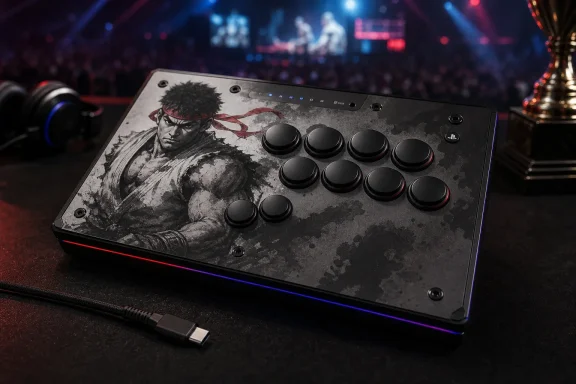
Razer’s Kitsune – Ryu Edition takes one of the most polished leverless fighting-game controllers on the market and gives it a striking Street Fighter makeover, pairing a dye-sublimated aluminium top plate with the same low-profile optical switches, slim chassis, PlayStation 5 support, and tournament-focused controls introduced with the original Kitsune in 2023. The result earns strong marks for responsiveness, portability, and presentation, but its AU$549.95 premium price, wired-only operation, and continued lack of native PlayStation 4 compatibility make this special edition easier to recommend to committed competitors and Ryu collectors than to newcomers simply curious about leverless play.
Leverless controllers replace the traditional arcade joystick with four directional buttons, usually placing left, down, and right beneath the player’s fingers while positioning the up button lower down for the thumb. The concept can look peculiar to anyone raised on arcade cabinets, gamepads, or conventional fight sticks, yet it offers a highly deliberate approach to movement.
Hit Box helped popularize the commercial leverless format beginning in 2010. The category remained comparatively niche for years, but interest accelerated as professional players demonstrated how all-button movement could improve consistency, reduce mechanical travel, and simplify certain techniques.
That difference does not automatically make every input faster or every player stronger. It does, however, create opportunities for cleaner charge management, rapid directional changes, reliable backdashes, and more consistent execution once the user has adapted.
Street Fighter 6, Tekken 8, Guilty Gear Strive, Mortal Kombat 1, and other modern fighters arrived during a period of intense experimentation with input devices. As leverless controllers appeared more frequently at major events, the layout stopped looking like an eccentric alternative and started becoming one of the Fighting Game Community’s established control methods.
The Ryu Edition announced in June 2026 is not a second-generation Kitsune. It is a limited-edition cosmetic variation built on the same underlying hardware, meaning its strengths and weaknesses largely mirror those of the three-year-old original.
That restraint suits Ryu. The design reflects discipline and simplicity rather than relying on a collage of logos, effects, and character portraits, giving the controller enough visual presence to work both as tournament equipment and as a collectible display piece.
Fortunately, the flat surface is straightforward to clean with an appropriate microfiber cloth. The artwork also integrates the PlayStation button markings cleanly, preserving usability without compromising the illustration.
The top plate is removable, but buyers should regard the Ryu finish as part of the product’s value. Anyone planning to cover it immediately with custom art could save money by purchasing a standard model, particularly when discounted stock is available.
A platform switch changes between PS5 and PC operation. The arrangement is functional rather than luxurious, and the compact auxiliary buttons are deliberately difficult to press by accident during a match.
Razer also surrounds the chassis with Chroma RGB lighting. The illumination has no meaningful competitive function, but it adds personality without shining directly into the player’s eyes, and onboard shortcuts provide access to common lighting effects.
The chassis resists normal flex, and the aluminium top contributes to its reassuring rigidity. It cannot replicate the weight or planted feel of a large metal fight stick, but that is not what Razer is trying to achieve.
Its detachable USB-C cable further simplifies packing. Players do not have to wrap a permanently attached lead around the case, reducing strain on both the cable and the controller’s internal connection.
This portability is particularly valuable for competitors who travel with a gaming laptop, headset, gamepad, charging equipment, and other event-day essentials. A thinner controller leaves meaningful space in an already crowded bag.
Players with broader shoulders or those accustomed to full-size arcade cabinets may find the hand spacing narrow at first. Others will appreciate the ability to keep their wrists closer together and maintain a relaxed posture.
The flat body supports several playing positions, but ergonomics remain personal. A controller that feels ideal during a 30-minute training session can reveal pressure points during a six-hour tournament, so serious buyers should test the Kitsune’s dimensions if an opportunity arises.
The switches feel more like premium low-profile keyboard keys than classic Sanwa arcade buttons. They actuate smoothly, return quickly, and avoid the mechanical wobble associated with cheaper compact leverless devices.
In practice, the Kitsune feels immediate. More importantly, it delivers consistent timing, which matters more than chasing marketing-friendly fractions of a millisecond that may disappear within the wider system.
Optical activation also avoids the metal contact mechanism used by many mechanical switches. That can reduce contact-related wear, although the long-term reliability of the complete controller still depends on its circuit board, USB port, cable, and other components.
Players who want a heavy tactile bump or loud click may find the controls too smooth. Those who prefer minimal resistance and fast repeated presses are more likely to enjoy them.
The low-profile implementation also helps reduce finger fatigue when used with a light touch. Pressing each button aggressively against the plate remains unnecessary and can undermine the ergonomic advantage of the design.
The biggest challenge is conceptual rather than mechanical. Players must stop imagining the directions as a joystick and begin treating them as separate commands.
Those benefits remain dependent on the game’s input parser and simultaneous-direction rules. A technique that works in one fighting game may behave differently in another, so players should learn the controller in the context of their primary title rather than assuming universal shortcuts.
That resolution is known as SOCD cleaning. It is essential to both predictable operation and compliance with tournament rules.
These settings are not interchangeable from a competitive rules perspective. A mode accepted by one game or organizer may be prohibited by another, particularly when it enables movement that would be impossible on a conventional controller.
The neutral default is the safest general-purpose option. When opposing directions are pressed together, neither is sent, reducing ambiguity and aligning with the direction taken by many contemporary tournament policies.
Owners should update the controller before attending an event and then verify its mode after the update. Firmware changes, factory resets, or accidental shortcut activation can affect how opposing directions resolve.
Tournament officials may inspect controllers, and ignorance of a prohibited configuration rarely protects a player from penalties. Competitors must understand both their hardware and the rules of the specific game being played.
The supplied USB-A-to-USB-C cable connects to a recessed port along the rear edge. Once inserted, the clasp closes around the connector to reduce the chance of an accidental disconnection during energetic play.
That limitation is intentional and appropriate for tournament hardware. Wired connections simplify device management, avoid battery concerns, and make it easier for organizers to ensure a previous player’s controller is no longer communicating with the console.
The confusion may stem from the detachable lead or from comparisons with conventional gamepads that support both connection types. Buyers should nevertheless understand that unplugging the Kitsune ends the connection.
Placement matters as much as functionality. Razer positions the smaller system controls away from the primary action area, while the lock adds a second layer of protection against an accidental Options or PlayStation-button press.
Competitors should still test the lock before sitting down for an official match. Hardware safeguards help, but a simple pre-match routine remains the best defence against configuration errors.
A platform selector allows the controller to switch between PS5 and PC modes. The process is straightforward, and the familiar PlayStation labels reduce confusion at an event setup.
This distinction is important because many locals and retro side tournaments continue using older hardware. PS4 systems are inexpensive, widely available, and support an enormous catalogue of fighting games, making them practical even as flagship competitions move to PS5 and PC.
An adapter may provide a workaround, but it introduces another device into the chain. Competitors must confirm the adapter’s legality, compatibility, firmware condition, and latency characteristics before relying on it at an event.
Steam Input and individual game settings may expand compatibility, but software remapping cannot create the physical range of a missing analogue stick. The device is best treated as fighting-game hardware that happens to support selected additional genres.
Its value lies less in any game-specific trick than in the consistency of its directional and attack inputs. Once the user develops muscle memory, the same fundamental layout transfers between titles.
Modern Controls do not make specialized hardware irrelevant. Even when special moves use simplified commands, movement, spacing, defence, drive management, and attack timing still benefit from an input device that suits the player.
Classic Controls reveal more of the Kitsune’s character, especially with charge characters and technically demanding combo routes. The controller cannot perform those sequences automatically, but it can provide a stable platform for repetition.
Tekken players often value leverless controllers for precise directional sequences and reduced thumb strain compared with prolonged pad use. The Kitsune’s low-profile buttons reinforce that appeal, particularly for players who practice movement drills for long periods.
Virtua Fighter’s strict timing also rewards clarity. As always, controller choice does not replace matchup knowledge, punishment, spacing, or decision-making, but cleaner physical input can help the player express those skills more reliably.
Compatibility becomes poor when a game expects analogue movement, analogue trigger values, or continuous camera control. The absence of a right stick is particularly restrictive in modern 3D games.
This is not a defect in the Kitsune. It is a consequence of building highly specialized hardware around one genre’s requirements.
Buyers seeking a single premium controller for an entire game library should look elsewhere. The Kitsune belongs alongside a normal gamepad, keyboard and mouse, or other general-purpose input device rather than replacing them.
The compact form also works well for a desk-based emulation or arcade setup. Users must still respect platform support and game-specific input requirements, but the controller’s secondary value extends beyond one-on-one fighters.
That premium is difficult to evaluate without considering the rapidly expanding leverless market. Compact all-button controllers are now available at dramatically lower prices, and many offer extra directional buttons, replaceable switches, extensive remapping, or multiple console modes.
There is no need to install a third-party authentication board, cut an enclosure, print artwork, or assemble components. For customers who value a polished retail experience, that convenience has genuine worth.
The Ryu artwork also carries collector appeal that cannot be reduced to the cost of switches and circuit boards. A dedicated Street Fighter enthusiast may reasonably value the object differently from a player who sees it solely as an input device.
Standard Kitsune models have also appeared at substantial discounts in some markets. That creates an uncomfortable comparison: buyers may be asked to pay full premium pricing for Ryu artwork while functionally equivalent versions sell for far less.
Budget leverless controllers are not necessarily equal in construction, firmware support, or native console compatibility. Even so, the price gap is large enough that prospective owners should evaluate alternatives rather than assuming that premium cost guarantees a proportionate competitive advantage.
The controller can also reduce reliance on cramped gamepad D-pads during long practice sessions. However, any ergonomic benefit depends on posture and technique, and players experiencing persistent pain should not treat new hardware as a substitute for medical advice or healthier play habits.
The cable clasp and lock switch likewise reduce preventable interruptions. At a large tournament, even small improvements in station turnover and match reliability can compound across hundreds of sets.
Organizers still need a clear controller policy covering SOCD modes, adapters, macros, and auxiliary buttons. As hardware becomes more configurable, visual inspection alone becomes less reliable for confirming legal operation.
The strategy also exposes the tension between enthusiast products and fast-moving competition. Smaller leverless manufacturers iterate rapidly, while a large brand must balance certification, distribution, warranty service, and manufacturing scale.
Razer’s challenge is to preserve the Kitsune’s premium reputation while rivals add features at lower prices. Artwork can sustain interest, but eventually the platform will need more than new character editions.
Razer’s next move will reveal whether the company sees Kitsune primarily as a platform for licensed designs or as hardware ready for a genuine second generation.
Additional buttons are another possibility. Contemporary fighting games increasingly make use of mechanics that benefit from dedicated shortcuts, while tournament rules permit more flexible layouts than the traditional eight-button face arrangement in many contexts.
Hot-swappable switches could appeal to enthusiasts who want to tune actuation feel or replace worn components. Razer would need to preserve the Kitsune’s low profile and structural rigidity, but modularity would help justify premium pricing.
Razer cannot rely indefinitely on optical-switch branding and native PS5 support to sustain a large premium. A second-generation model must either add capabilities unavailable elsewhere or compete more aggressively on price.
Limited character editions can remain part of the strategy, especially with Street Fighter’s extensive roster. Yet the strongest future release would combine meaningful hardware evolution with art that celebrates the game, rather than asking artwork alone to refresh an established platform.
For a dedicated Ryu fan who plays primarily on PS5 or PC and wants a polished leverless controller without building or configuring one from parts, the package is compelling. The character art gives an already refined device a distinctive identity, and its physical execution feels appropriately high-end.
For newcomers, value-conscious competitors, and players who regularly attend PS4-based events, the decision is less straightforward. Less expensive alternatives can provide a credible introduction to leverless play, while discounted standard Kitsune models may offer identical competitive performance without the Ryu premium.
The strongest verdict is therefore more nuanced than a simple score: the Ryu Edition is one of the most elegant and tournament-ready leverless controllers available, but it is also a luxury variation of three-year-old hardware facing younger, cheaper, and increasingly ambitious competition. Razer has delivered a fitting tribute to Street Fighter’s most enduring warrior; now it must decide how the Kitsune itself will continue training for the battles ahead.
 Background
Leverless controllers replace the traditional arcade joystick with four directional buttons, usually placing left, down, and right beneath the player’s fingers while positioning the up button lower down for the thumb. The concept can look peculiar to anyone raised on arcade cabinets, gamepads, or conventional fight sticks, yet it offers a highly deliberate approach to movement.Hit Box helped popularize the commercial leverless format beginning in 2010. The category remained comparatively niche for years, but interest accelerated as professional players demonstrated how all-button movement could improve consistency, reduce mechanical travel, and simplify certain techniques.
Why leverless controllers gained momentum
A joystick must physically move through a gate and return toward neutral. Buttons operate independently, allowing the player to transition between directions without moving a lever across that physical distance.That difference does not automatically make every input faster or every player stronger. It does, however, create opportunities for cleaner charge management, rapid directional changes, reliable backdashes, and more consistent execution once the user has adapted.
Street Fighter 6, Tekken 8, Guilty Gear Strive, Mortal Kombat 1, and other modern fighters arrived during a period of intense experimentation with input devices. As leverless controllers appeared more frequently at major events, the layout stopped looking like an eccentric alternative and started becoming one of the Fighting Game Community’s established control methods.
The original Kitsune’s place in the market
Razer entered the category in August 2023 with the original Kitsune, an officially licensed all-button optical arcade controller for PlayStation 5 and Windows PCs. It distinguished itself through an unusually thin chassis, low-profile optical switches, a removable aluminium top plate, and native PS5 support without requiring a separate authentication adapter.The Ryu Edition announced in June 2026 is not a second-generation Kitsune. It is a limited-edition cosmetic variation built on the same underlying hardware, meaning its strengths and weaknesses largely mirror those of the three-year-old original.
The Ryu Edition’s Design
The visual centerpiece is an ink-wash-inspired depiction of Ryu based on his Street Fighter 6 appearance. Monochrome artwork dominates the aluminium surface, while carefully placed red highlights evoke the character’s headband and add contrast without turning the controller into an overly busy piece of merchandise.That restraint suits Ryu. The design reflects discipline and simplicity rather than relying on a collage of logos, effects, and character portraits, giving the controller enough visual presence to work both as tournament equipment and as a collectible display piece.
A genuinely premium top plate
Razer uses a dye-sublimated aluminium top plate rather than applying an easily replaceable paper insert beneath acrylic. The result feels rigid, cool, and expensive, although fingerprints and skin oils can become visible under direct light.Fortunately, the flat surface is straightforward to clean with an appropriate microfiber cloth. The artwork also integrates the PlayStation button markings cleanly, preserving usability without compromising the illustration.
The top plate is removable, but buyers should regard the Ryu finish as part of the product’s value. Anyone planning to cover it immediately with custom art could save money by purchasing a standard model, particularly when discounted stock is available.
Familiar controls in sensible positions
The face layout follows the established leverless arrangement, with four movement buttons and eight primary attack buttons. Smaller controls provide access to the PlayStation button, Create, Options, touchpad-related functions, L3, and R3.A platform switch changes between PS5 and PC operation. The arrangement is functional rather than luxurious, and the compact auxiliary buttons are deliberately difficult to press by accident during a match.
Razer also surrounds the chassis with Chroma RGB lighting. The illumination has no meaningful competitive function, but it adds personality without shining directly into the player’s eyes, and onboard shortcuts provide access to common lighting effects.
Build Quality and Portability
At approximately 296 by 210 millimetres and only 19.2 millimetres thick, the Kitsune remains dramatically slimmer than most traditional arcade sticks. Its approximate 800-gram weight keeps it manageable in a backpack while giving it enough substance to avoid feeling like a hollow plastic accessory.The chassis resists normal flex, and the aluminium top contributes to its reassuring rigidity. It cannot replicate the weight or planted feel of a large metal fight stick, but that is not what Razer is trying to achieve.
Designed for travelling competitors
The absence of a protruding joystick makes a substantial practical difference. Traditional sticks can catch on bags, clothing, seats, and cables, while the Kitsune slides into luggage much like a compact laptop.Its detachable USB-C cable further simplifies packing. Players do not have to wrap a permanently attached lead around the case, reducing strain on both the cable and the controller’s internal connection.
This portability is particularly valuable for competitors who travel with a gaming laptop, headset, gamepad, charging equipment, and other event-day essentials. A thinner controller leaves meaningful space in an already crowded bag.
Stability on a desk or lap
A broad rubber layer covers most of the underside, helping the controller remain stable on desks and other smooth surfaces. It also provides grip during lap play, although the relatively compact body may not suit everyone’s preferred seating position.Players with broader shoulders or those accustomed to full-size arcade cabinets may find the hand spacing narrow at first. Others will appreciate the ability to keep their wrists closer together and maintain a relaxed posture.
The flat body supports several playing positions, but ergonomics remain personal. A controller that feels ideal during a 30-minute training session can reveal pressure points during a six-hour tournament, so serious buyers should test the Kitsune’s dimensions if an opportunity arises.
Optical Switch Performance
Razer’s low-profile linear optical switches are central to the Kitsune’s identity. Instead of relying on the taller arcade buttons found in many conventional controllers, the Kitsune uses a short actuation path that produces rapid, consistent inputs with relatively little finger movement.The switches feel more like premium low-profile keyboard keys than classic Sanwa arcade buttons. They actuate smoothly, return quickly, and avoid the mechanical wobble associated with cheaper compact leverless devices.
Speed without a miracle advantage
The controller is highly responsive, but claims of “near-zero latency” should be interpreted as shorthand for extremely low input delay rather than a literal absence of latency. Every controller, USB polling process, console, game engine, display pipeline, and screen introduces some delay.In practice, the Kitsune feels immediate. More importantly, it delivers consistent timing, which matters more than chasing marketing-friendly fractions of a millisecond that may disappear within the wider system.
Optical activation also avoids the metal contact mechanism used by many mechanical switches. That can reduce contact-related wear, although the long-term reliability of the complete controller still depends on its circuit board, USB port, cable, and other components.
Sound and tactile character
The linear switches are not silent, but their sound differs from that of large arcade buttons. They produce a sharper, shallower report, with the aluminium plate amplifying some higher-frequency noise during rapid sequences.Players who want a heavy tactile bump or loud click may find the controls too smooth. Those who prefer minimal resistance and fast repeated presses are more likely to enjoy them.
The low-profile implementation also helps reduce finger fatigue when used with a light touch. Pressing each button aggressively against the plate remains unnecessary and can undermine the ergonomic advantage of the design.
Learning the Leverless Layout
A leverless controller does not provide instant mastery. Experienced keyboard users may adapt quickly because the left hand already understands independent directional inputs, while longtime arcade-stick players can initially struggle with the thumb-operated up button.The biggest challenge is conceptual rather than mechanical. Players must stop imagining the directions as a joystick and begin treating them as separate commands.
A practical adaptation process
New owners should resist the temptation to test the controller exclusively in online ranked matches. A structured transition reduces frustration and prevents poor habits from becoming embedded.- Begin with basic movement. Practice walking, crouching, jumping, dashing, and blocking until the up button feels natural beneath the thumb.
- Add common motion inputs. Repeat quarter circles, dragon-punch motions, half circles, and double-quarter-circle supers on both sides.
- Train charge timing. Use characters such as Guile to learn how independent directional buttons change charge storage and release.
- Practice side switching. Many players become comfortable on the first-player side while remaining awkward on the second, so every drill should be mirrored.
- Introduce real combos gradually. Start with reliable bread-and-butter sequences before attempting highly optimized routes.
- Play longer casual sets. Extended matches expose ergonomic, timing, and adaptation problems that short training drills may conceal.
- Enter competition only after building consistency. The controller should reduce cognitive load during a tournament, not become another variable demanding attention.
Character-specific benefits
Charge characters are an obvious match because separate buttons allow the player to manage opposing directions precisely. Leverless controls can also help with Korean backdashing in Tekken, instant air inputs, rapid crouch transitions, and sequences requiring unusually clean directional changes.Those benefits remain dependent on the game’s input parser and simultaneous-direction rules. A technique that works in one fighting game may behave differently in another, so players should learn the controller in the context of their primary title rather than assuming universal shortcuts.
SOCD Cleaning and Tournament Legality
Simultaneous Opposing Cardinal Directions occur when a player presses left and right, or up and down, at the same time. A physical joystick cannot occupy both sides of its gate simultaneously, but an all-button controller can electronically register contradictory directions unless its firmware resolves them.That resolution is known as SOCD cleaning. It is essential to both predictable operation and compliance with tournament rules.
Four configurable cleaning modes
Updated Kitsune firmware provides multiple SOCD behaviours that can be selected through hardware shortcuts. Available options include neutral resolution, absolute up priority, last-input priority, and first-input priority, while PC operation can also permit an uncleaned mode.These settings are not interchangeable from a competitive rules perspective. A mode accepted by one game or organizer may be prohibited by another, particularly when it enables movement that would be impossible on a conventional controller.
The neutral default is the safest general-purpose option. When opposing directions are pressed together, neither is sent, reducing ambiguity and aligning with the direction taken by many contemporary tournament policies.
Why firmware matters
The inclusion of multiple SOCD modes shows how quickly leverless hardware has evolved since 2023. The original physical design has not changed, but firmware has become a significant part of its competitive functionality.Owners should update the controller before attending an event and then verify its mode after the update. Firmware changes, factory resets, or accidental shortcut activation can affect how opposing directions resolve.
Tournament officials may inspect controllers, and ignorance of a prohibited configuration rarely protects a player from penalties. Competitors must understand both their hardware and the rules of the specific game being played.
Tournament Features
Razer designed the Kitsune around formal competition rather than merely borrowing tournament language for marketing. Its cable security clasp, lock switch, native PS5 authentication, and streamlined controls address real problems that occur at crowded events.The supplied USB-A-to-USB-C cable connects to a recessed port along the rear edge. Once inserted, the clasp closes around the connector to reduce the chance of an accidental disconnection during energetic play.
The importance of wired operation
Despite one review suggesting a choice between wired and wireless connections, the Kitsune is a wired controller and does not include a battery or wireless gaming mode. Its detachable cable is the only connection method for PS5 and PC play.That limitation is intentional and appropriate for tournament hardware. Wired connections simplify device management, avoid battery concerns, and make it easier for organizers to ensure a previous player’s controller is no longer communicating with the console.
The confusion may stem from the detachable lead or from comparisons with conventional gamepads that support both connection types. Buyers should nevertheless understand that unplugging the Kitsune ends the connection.
Tournament Lock prevents costly mistakes
The Tournament Lock switch disables non-essential controls that could interrupt a match. This is more than a convenience because pausing during a tournament can lead to a lost round or game under common event rules.Placement matters as much as functionality. Razer positions the smaller system controls away from the primary action area, while the lock adds a second layer of protection against an accidental Options or PlayStation-button press.
Competitors should still test the lock before sitting down for an official match. Hardware safeguards help, but a simple pre-match routine remains the best defence against configuration errors.
PlayStation and Windows Compatibility
The Kitsune is officially designed for PlayStation 5 and Windows PC. Native PS5 support remains one of its strongest selling points because authentication requirements can complicate the use of independent arcade controllers on Sony’s console.A platform selector allows the controller to switch between PS5 and PC modes. The process is straightforward, and the familiar PlayStation labels reduce confusion at an event setup.
The persistent PlayStation 4 limitation
The Kitsune does not work natively when connected directly to a PlayStation 4. It can control compatible PS4 games running through backward compatibility on a PS5, but that does not help at events still using physical PS4 consoles.This distinction is important because many locals and retro side tournaments continue using older hardware. PS4 systems are inexpensive, widely available, and support an enormous catalogue of fighting games, making them practical even as flagship competitions move to PS5 and PC.
An adapter may provide a workaround, but it introduces another device into the chain. Competitors must confirm the adapter’s legality, compatibility, firmware condition, and latency characteristics before relying on it at an event.
PC use is capable but specialized
On Windows, the Kitsune behaves as a dedicated digital controller rather than a replacement for a full DualSense or Xbox gamepad. Its directional buttons correspond to digital directional input, and it lacks analogue sticks, triggers with variable travel, motion sensors, and conventional camera controls.Steam Input and individual game settings may expand compatibility, but software remapping cannot create the physical range of a missing analogue stick. The device is best treated as fighting-game hardware that happens to support selected additional genres.
Performance Across Fighting Games
The Ryu Edition inherits the original Kitsune’s broad suitability for 2D and 3D fighters. Street Fighter 6 is the obvious showcase, but the hardware also makes sense for Tekken 8, Mortal Kombat 1, Fatal Fury: City of the Wolves, Virtua Fighter, Guilty Gear, and compatible retro collections.Its value lies less in any game-specific trick than in the consistency of its directional and attack inputs. Once the user develops muscle memory, the same fundamental layout transfers between titles.
Street Fighter and traditional 2D inputs
Street Fighter emphasizes quarter circles, charge timing, dragon-punch motions, and rapid transitions between crouching defence and standing attacks. The Kitsune handles these demands cleanly and makes directional mistakes easier to diagnose because each command corresponds to a discrete finger press.Modern Controls do not make specialized hardware irrelevant. Even when special moves use simplified commands, movement, spacing, defence, drive management, and attack timing still benefit from an input device that suits the player.
Classic Controls reveal more of the Kitsune’s character, especially with charge characters and technically demanding combo routes. The controller cannot perform those sequences automatically, but it can provide a stable platform for repetition.
Tekken, Virtua Fighter, and 3D movement
Three-dimensional fighters place different demands on the left hand. Sidesteps, crouch dashes, wavedashes, and repeated backdash inputs can benefit from independent buttons, although adapting from a joystick or pad may initially feel even more disorienting than in a 2D game.Tekken players often value leverless controllers for precise directional sequences and reduced thumb strain compared with prolonged pad use. The Kitsune’s low-profile buttons reinforce that appeal, particularly for players who practice movement drills for long periods.
Virtua Fighter’s strict timing also rewards clarity. As always, controller choice does not replace matchup knowledge, punishment, spacing, or decision-making, but cleaner physical input can help the player express those skills more reliably.
Use Beyond Fighting Games
The Kitsune can operate in some platformers, puzzle games, rhythm titles, arcade compilations, and retro releases that rely primarily on digital directional input. Games designed around a D-pad and a limited set of face buttons are the best candidates.Compatibility becomes poor when a game expects analogue movement, analogue trigger values, or continuous camera control. The absence of a right stick is particularly restrictive in modern 3D games.
Why “the game launches” is not enough
A Windows or PlayStation title may recognize the controller and still remain effectively unplayable. Menus might work through digital inputs while the character cannot move correctly, rotate the camera, or perform actions assigned to missing controls.This is not a defect in the Kitsune. It is a consequence of building highly specialized hardware around one genre’s requirements.
Buyers seeking a single premium controller for an entire game library should look elsewhere. The Kitsune belongs alongside a normal gamepad, keyboard and mouse, or other general-purpose input device rather than replacing them.
Retro gaming is the better secondary use
Older arcade games often map naturally to the Kitsune because they were designed around digital joysticks and buttons. Beat ’em ups, shoot ’em ups, run-and-gun games, and classic platformers can feel excellent once their controls are mapped appropriately.The compact form also works well for a desk-based emulation or arcade setup. Users must still respect platform support and game-specific input requirements, but the controller’s secondary value extends beyond one-on-one fighters.
Value and Competitive Position
The official Australian price of AU$549.95 places the Ryu Edition firmly in luxury territory. In the United States, its US$299.99 list price is US$20 above the standard black Kitsune, reflecting the licensed artwork and limited-edition positioning.That premium is difficult to evaluate without considering the rapidly expanding leverless market. Compact all-button controllers are now available at dramatically lower prices, and many offer extra directional buttons, replaceable switches, extensive remapping, or multiple console modes.
What the premium buys
Razer’s strongest argument is integration. Buyers receive native PS5 support, a rigid and highly portable body, refined optical buttons, tournament controls, attractive lighting, and an officially licensed Street Fighter design in one finished product.There is no need to install a third-party authentication board, cut an enclosure, print artwork, or assemble components. For customers who value a polished retail experience, that convenience has genuine worth.
The Ryu artwork also carries collector appeal that cannot be reduced to the cost of switches and circuit boards. A dedicated Street Fighter enthusiast may reasonably value the object differently from a player who sees it solely as an input device.
Why the price remains difficult
The core technology is still based on the 2023 Kitsune. The Ryu Edition does not add PS4 support, wireless operation, new physical buttons, expanded hardware remapping, a carrying case, or a redesigned chassis.Standard Kitsune models have also appeared at substantial discounts in some markets. That creates an uncomfortable comparison: buyers may be asked to pay full premium pricing for Ryu artwork while functionally equivalent versions sell for far less.
Budget leverless controllers are not necessarily equal in construction, firmware support, or native console compatibility. Even so, the price gap is large enough that prospective owners should evaluate alternatives rather than assuming that premium cost guarantees a proportionate competitive advantage.
Consumer and Enterprise Impact
For individual players, the Ryu Edition is a specialist purchase with a clear audience. Competitive Street Fighter users, travelling PS5 players, and collectors stand to gain the most, while casual users may struggle to justify the expense.The controller can also reduce reliance on cramped gamepad D-pads during long practice sessions. However, any ergonomic benefit depends on posture and technique, and players experiencing persistent pain should not treat new hardware as a substitute for medical advice or healthier play habits.
Implications for tournament organizers
Native PS5 compatibility reduces setup friction at events. Organizers spend less time troubleshooting authentication adapters, unsupported controllers, and wireless pairing problems when competitors bring officially licensed wired hardware.The cable clasp and lock switch likewise reduce preventable interruptions. At a large tournament, even small improvements in station turnover and match reliability can compound across hundreds of sets.
Organizers still need a clear controller policy covering SOCD modes, adapters, macros, and auxiliary buttons. As hardware becomes more configurable, visual inspection alone becomes less reliable for confirming legal operation.
Implications for retailers and hardware makers
Limited editions allow manufacturers to extend the commercial life of mature hardware without funding a complete redesign. Ryu’s global recognition makes him a particularly safe choice for a premium collaboration.The strategy also exposes the tension between enthusiast products and fast-moving competition. Smaller leverless manufacturers iterate rapidly, while a large brand must balance certification, distribution, warranty service, and manufacturing scale.
Razer’s challenge is to preserve the Kitsune’s premium reputation while rivals add features at lower prices. Artwork can sustain interest, but eventually the platform will need more than new character editions.
Strengths and Opportunities
The Ryu Edition remains an accomplished controller because its foundation was strong from the beginning. Its greatest opportunities lie in serving players who prioritize a cohesive, competition-ready product over maximum customization.- The optical switches deliver fast, consistent actuation with a short travel distance suited to repeated fighting-game inputs.
- The slim chassis is among the Kitsune’s most practical advantages, making it easier to carry than a full-size arcade stick.
- Native PlayStation 5 support removes authentication uncertainty and strengthens its appeal for tournaments built around Sony hardware.
- The cable clasp and Tournament Lock address real competitive risks rather than functioning as superficial additions.
- The Ryu artwork feels integrated into the hardware, giving collectors a more convincing product than a basic logo swap.
- Configurable SOCD cleaning increases the controller’s flexibility, provided players understand and follow tournament regulations.
- The broad rubber underside supports desk and lap use, allowing players to choose a comfortable setup.
- Firmware support has expanded the original hardware’s capability, demonstrating that Razer can add meaningful functionality without replacing the device.
Risks and Concerns
The Ryu Edition’s disadvantages do not invalidate its performance, but they substantially narrow its audience. Buyers should consider them before paying a collector-level price.- The AU$549.95 price is exceptionally high for a controller that does not materially change the original Kitsune’s hardware.
- There is no native PlayStation 4 support, which can create problems at locals and retro events still using PS4 consoles.
- The controller is wired only, contrary to any suggestion that it offers both wired and wireless operation.
- Its specialized layout makes it unsuitable for many non-fighting games, particularly those requiring analogue movement or camera control.
- The low-profile switches are a matter of preference, and players who love traditional arcade buttons may dislike their sound and feel.
- The compact body may not fit every lap or shoulder width comfortably, especially during long sessions.
- Adapters add compatibility but also complexity, including possible firmware, legality, and latency concerns.
- Cheaper competitors increasingly offer more physical controls and customization, weakening the Kitsune’s value proposition.
- A limited-edition finish may discourage heavy modification, even though customization is one of the leverless community’s attractions.
- SOCD flexibility creates user responsibility, as selecting an illegal mode can lead to tournament penalties.
What to Watch Next
The Ryu Edition arrives during a transitional period for leverless controllers. The category is no longer defined by one or two specialist brands, and manufacturers now compete on switch technology, console authentication, firmware, extra buttons, size, artwork, and price.Razer’s next move will reveal whether the company sees Kitsune primarily as a platform for licensed designs or as hardware ready for a genuine second generation.
Potential priorities for a Kitsune successor
PS4 compatibility would solve a long-standing limitation, although supporting an ageing console may be less commercially attractive as PS5 adoption continues. Broader console support, including Xbox and future platforms, could provide a stronger reason to upgrade.Additional buttons are another possibility. Contemporary fighting games increasingly make use of mechanics that benefit from dedicated shortcuts, while tournament rules permit more flexible layouts than the traditional eight-button face arrangement in many contexts.
Hot-swappable switches could appeal to enthusiasts who want to tune actuation feel or replace worn components. Razer would need to preserve the Kitsune’s low profile and structural rigidity, but modularity would help justify premium pricing.
Pricing will matter as much as features
The leverless market’s lower end has improved dramatically. New players can now experiment with the format without committing the cost of a console, while experienced users can choose between boutique builds, open-source boards, licensed products, and mass-market controllers.Razer cannot rely indefinitely on optical-switch branding and native PS5 support to sustain a large premium. A second-generation model must either add capabilities unavailable elsewhere or compete more aggressively on price.
Limited character editions can remain part of the strategy, especially with Street Fighter’s extensive roster. Yet the strongest future release would combine meaningful hardware evolution with art that celebrates the game, rather than asking artwork alone to refresh an established platform.
Looking Ahead
The Razer Kitsune – Ryu Edition deserves its reputation as premium fighting-game hardware, but it should be understood accurately. It is a beautifully decorated, wired version of the original Kitsune, not a new generation and not a wireless controller, with excellent optical inputs, a highly portable body, versatile SOCD firmware, and thoughtful tournament safeguards.For a dedicated Ryu fan who plays primarily on PS5 or PC and wants a polished leverless controller without building or configuring one from parts, the package is compelling. The character art gives an already refined device a distinctive identity, and its physical execution feels appropriately high-end.
For newcomers, value-conscious competitors, and players who regularly attend PS4-based events, the decision is less straightforward. Less expensive alternatives can provide a credible introduction to leverless play, while discounted standard Kitsune models may offer identical competitive performance without the Ryu premium.
The strongest verdict is therefore more nuanced than a simple score: the Ryu Edition is one of the most elegant and tournament-ready leverless controllers available, but it is also a luxury variation of three-year-old hardware facing younger, cheaper, and increasingly ambitious competition. Razer has delivered a fitting tribute to Street Fighter’s most enduring warrior; now it must decide how the Kitsune itself will continue training for the battles ahead.